
Do You Need Anti-Reflective Coatings for Pickleball? [Ref & Player Guide]
Share
Do You Need Anti-Reflective Coatings for Pickleball? [Ref & Player Guide]
If reflections, bright court lights, or sunlight bouncing across your lenses distract you while tracking the ball, you may be wondering whether anti-reflective coating for pickleball glasses is worth it. The short answer: anti-reflective (AR) coatings can improve visual comfort by reducing reflections from lens surfaces, but whether you need AR depends on your lenses, lighting conditions, prescription, and where you play.
For pickleball players and referees, AR is only one part of choosing court eyewear. Lens clarity, prescription accuracy, tint, coverage, comfort, impact resistance, and whether you prefer polarized or non-polarized lenses can all affect which pair makes the most sense.
Do You Need Anti-Reflective Coating for Pickleball Glasses?
Not necessarily—but it can be useful. Anti-reflective coating reduces reflections from the surfaces of a lens. That can make it particularly helpful when you regularly play around bright overhead lighting, backlighting, or other conditions where lens reflections become distracting.
AR coating should not be confused with polarization. Anti-reflective coatings reduce reflections occurring at the lens surface, while polarized lenses filter certain reflected light entering through the lens. They solve different problems.
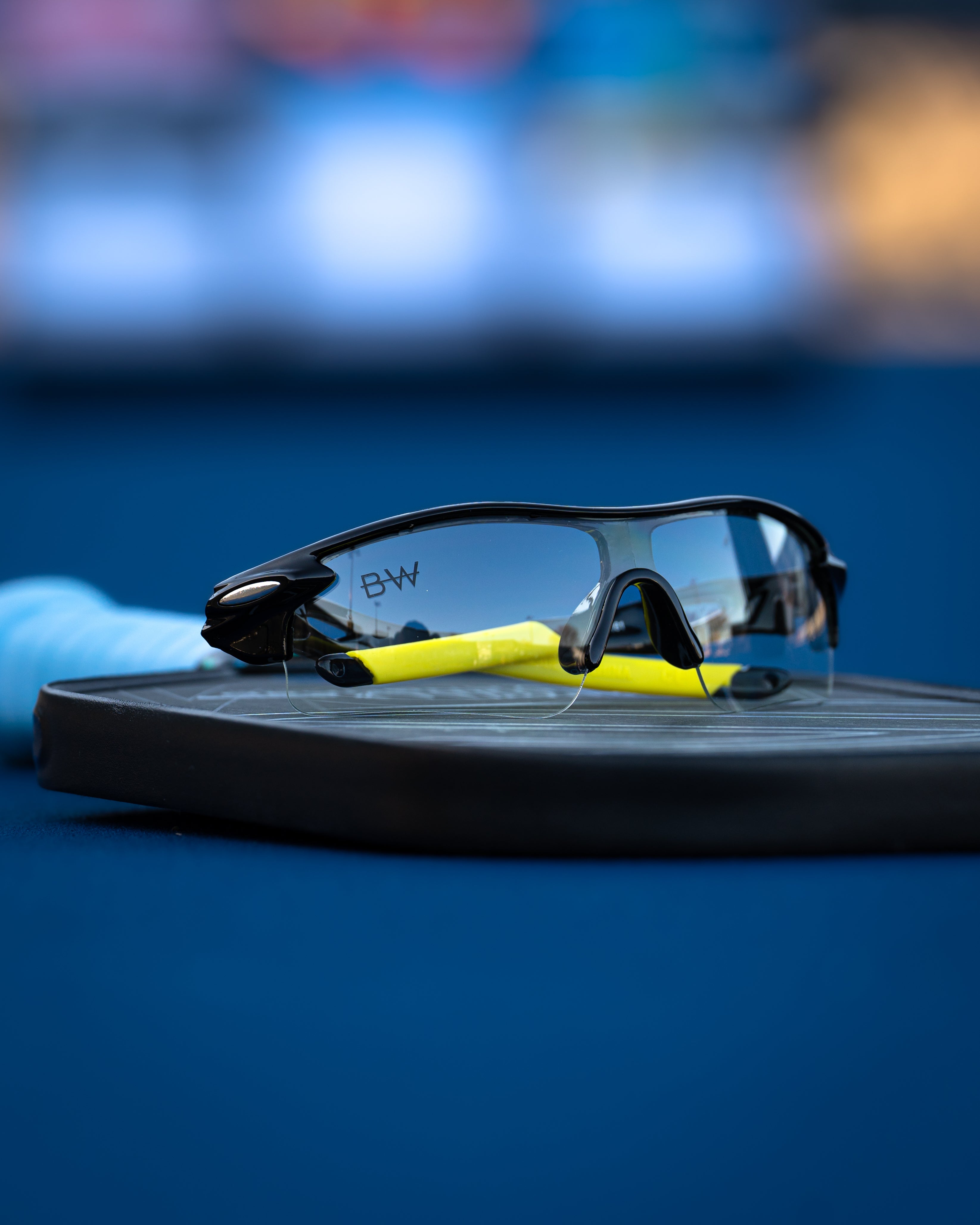
Blinded Wear takes a performance-first approach to pickleball eyewear, including non-polarized lens options for players who prefer an unobstructed view of the court and natural visual cues during fast ball tracking.
Compare Pickleball Glasses Before You Buy
If you already know whether you need prescription or non-prescription eyewear, start with the appropriate Blinded Wear collection. You can also use the complete pickleball glasses guide to compare options before choosing a frame.
What Is Anti-Reflective Coating on Sports Glasses?
Anti-reflective coating, often shortened to AR coating and sometimes called an anti-glare coating, is a lens treatment designed to reduce reflections from lens surfaces.
Without AR treatment, some light can reflect from the front or back surface of a lens instead of passing cleanly through it. Depending on the lens and environment, those reflections can become noticeable while playing.
When Can Lens Reflections Become Distracting?
Pickleball presents several challenging lighting situations because players constantly move their eyes and head while tracking a relatively small, fast-moving ball. Reflections may become more noticeable during:
- Bright outdoor play
- Backlit court conditions
- Indoor courts with strong overhead lighting
- Evening games under artificial court lights
- Rapid transitions between shade and sunlight
- Situations where light reaches the back surface of the lens
An AR treatment can reduce these lens-surface reflections. However, it does not replace the need for an appropriate prescription, suitable lens tint, comfortable fit, or other features that matter in sports eyewear.
Benefits of Anti-Reflective Coating for Pickleball
The main reason to consider AR coating is straightforward: reducing unwanted lens reflections can make your eyewear more visually comfortable in challenging lighting.
1. Fewer Lens-Surface Reflections
AR treatments are designed specifically to reduce reflections from the surfaces of your lenses. This can be valuable when bright light sources are positioned in front of or behind you.
2. Better Visual Comfort in Difficult Lighting
If you notice distracting reflections while playing indoors under bright fixtures or outdoors around strong sunlight, an AR treatment may make your glasses more comfortable to use.
3. Cleaner-Looking Lenses
Reducing surface reflections can also make lenses appear clearer when someone is looking at you, which can be useful for players who wear their sports eyewear beyond the court.
4. Potentially Useful for Players and Referees
Players constantly change position, while referees may spend longer periods viewing play from relatively consistent court positions. Either can encounter distracting reflections depending on the lighting and lens design, so AR is worth evaluating based on your actual environment rather than assuming every pickleball player needs it.
Anti-Reflective vs. Polarized Pickleball Glasses: What Is the Difference?
AR and polarization are frequently treated as interchangeable features, but they work differently. Understanding that difference is important when shopping for pickleball sunglasses.
| Feature | Anti-Reflective Coating | Polarized Lenses |
|---|---|---|
| Primary purpose | Reduce reflections from lens surfaces | Reduce certain reflected glare entering through the lens |
| Type of feature | Lens-surface treatment | Light-filtering lens technology |
| Can be useful for | Bright or challenging lighting where lens reflections are noticeable | Environments with strong reflected glare |
| Required for pickleball? | No | No |
| Same technology? | No | No |
Buying takeaway: Don't choose pickleball eyewear simply because the product page says “anti-glare.” Determine whether that term refers to an AR surface treatment, polarization, tint, or another lens feature, because those technologies are not identical.
Why Consider Non-Polarized Pickleball Glasses?
Some players prefer non-polarized pickleball glasses because they want a straightforward view of the court without a polarization filter. Blinded Wear uses a non-polarized approach for its performance-focused pickleball eyewear.
The important distinction is that choosing non-polarized lenses does not mean you have to ignore glare or reflections. Lens tint, coverage, AR treatments where available, frame geometry, and the position of the sun or court lights can all contribute to visual comfort.
This makes the better buying question less about whether one technology is universally “best” and more about which combination of lens features works for your prescription, court conditions, and playing preferences.
Do RX Pickleball Glasses Need Anti-Reflective Coating?
Prescription players should prioritize accurate vision correction first. AR coating can be an additional consideration, but it cannot compensate for an incorrect prescription or unsuitable sports frame.
When comparing prescription pickleball glasses, consider the complete lens package rather than judging the glasses solely on whether AR is included.
- Your current prescription
- Lens material and thickness
- Frame fit and coverage
- Indoor versus outdoor use
- Lens tint
- Impact resistance
- Weight and comfort during longer matches
- Whether AR treatment is included or available
Blinded Wear prescription eyewear includes high-index prescription lenses at no additional cost, eliminating a separate high-index upcharge. The RX collection is designed for players looking for lightweight, performance-focused prescription sports eyewear.
Who Benefits Most From Anti-Reflective Pickleball Glasses?
Anti-reflective coating is not automatically necessary for every player. Its value depends on where you play, the direction of the light, your lens setup, and how noticeable reflections are to you during a match.
AR coating may be worth prioritizing if you regularly notice distracting reflections from your lenses or frequently play under challenging lighting conditions.
Outdoor Pickleball Players
Outdoor courts can expose players to changing sun angles, backlighting, and light entering from behind or beside the frame. An AR treatment can reduce reflections occurring on the lens surfaces, which may make the eyewear more comfortable in these conditions.
Indoor Pickleball Players
Indoor courts can create their own visual challenges. Bright overhead fixtures and concentrated artificial lighting may produce noticeable reflections depending on your lenses and viewing angle. Players who regularly notice these reflections may benefit from AR-treated lenses.
Players Who Compete in Different Lighting Conditions
If you move between morning matches, afternoon sun, indoor courts, and evening play, your eyewear encounters very different lighting environments. In this situation, consider the complete lens setup—including tint, prescription, coverage, and AR treatment where available—rather than choosing glasses around a single feature.
Pickleball Referees
Referees need to maintain a clear view of the ball, court, lines, and players throughout a match. Because officials may spend more time viewing play from relatively consistent positions, distracting reflections can become particularly noticeable when the lighting angle is unfavorable.
For more referee-specific considerations, read the guide to choosing sunglasses for pickleball referees.
When Does AR Coating Matter Most on a Pickleball Court?
Instead of asking whether every pickleball player needs anti-reflective coating, consider whether you regularly encounter situations where lens-surface reflections bother you.
| Playing Condition | Potential Value of AR | What Else to Consider |
|---|---|---|
| Bright outdoor court | May reduce distracting lens-surface reflections | Lens tint, coverage, fit and sun position |
| Indoor court | May help when overhead lighting creates noticeable reflections | Lens clarity and appropriate indoor tint |
| Evening or stadium lighting | May reduce reflections from concentrated artificial light sources | Lens transmission and tint |
| Mixed sun and shade | Can help manage reflections as lighting angles change | Overall lens choice and visibility |
| Refereeing | May be useful when reflections repeatedly occur from a fixed viewing position | Wide field of view, comfort and lens clarity |
How to Tell if You Need Anti-Reflective Coating
You do not need to buy glasses based on a feature list alone. Think about what actually happens while you play.
- Notice reflections during your next match. Pay attention to whether you see distracting reflections on the inside or outside surfaces of your lenses.
- Identify when they happen. Do they appear primarily under indoor lights, with the sun behind you, during evening play, or throughout the entire match?
- Check your current eyewear. Reflections may be related to several factors, including the lenses, frame coverage, light direction, and whether your current glasses have an AR treatment.
- Consider how distracting they actually are. If you rarely notice reflections, AR may not need to be your highest purchasing priority.
- Compare the entire lens package. Prescription accuracy, tint, comfort, impact resistance, coverage, and lens design can matter just as much as AR treatment.
Bottom line: if reflections regularly distract you from seeing the court comfortably, AR is a feature worth considering. If reflections are rarely noticeable, prioritize the other features your playing environment demands.
What to Look for When Buying Pickleball Glasses With Anti-Reflective Lenses
AR coating should be treated as one part of a larger buying decision. Whether you are shopping for RX or non-RX pickleball eyewear, compare these factors before choosing a pair.
1. Prescription Requirements
If you need vision correction, start with your prescription. Sports eyewear should meet your vision needs before additional lens features are considered.
2. Lens Material
Lens material affects factors such as weight, thickness, durability, and optical characteristics. Blinded Wear RX eyewear includes high-index prescription lenses at no additional cost, so there is no separate high-index upcharge.
3. Impact Resistance
Pickleball involves fast movement and a ball traveling at close range. Impact-resistant lenses are therefore an important consideration when comparing sports eyewear.
4. Frame Weight and Comfort
A feature-rich lens will not help much if you constantly want to remove the glasses. Look for lightweight sports frames that remain comfortable through longer games and tournament sessions.
5. Coverage and Field of View
Consider how much of your field of view the frame and lenses cover. Sports-oriented eyewear should allow you to scan the court naturally without the frame becoming unnecessarily distracting.
6. Lens Tint
The appropriate tint depends on where you play. Outdoor sunlight, indoor courts, overcast conditions, and evening play can require different levels of visible-light transmission.
7. AR Treatment
If lens reflections are a recurring problem, determine whether the pair you are considering includes an anti-reflective treatment and where that treatment is applied.
8. Polarized vs. Non-Polarized
Do not confuse polarization with AR. They are separate lens technologies. Blinded Wear takes a non-polarized, performance-first approach to its pickleball eyewear for players who prefer that lens setup for court play.
RX vs. Non-RX Pickleball Glasses: What Should You Prioritize?
| Feature | RX Pickleball Glasses | Non-RX Pickleball Glasses |
|---|---|---|
| Primary purpose | Combine vision correction with sports eyewear | Sports eyewear without prescription correction |
| Prescription accuracy | Essential | Not applicable |
| AR coating | Helpful in some lighting situations but not the only consideration | Helpful when lens reflections are distracting |
| Impact resistance | Important | Important |
| Comfort and fit | Important for extended play | Important for extended play |
| Lens tint | Choose for your primary court conditions | Choose for your primary court conditions |
| Best starting point | Prescription needs first, then performance features | Playing conditions and performance preferences |
If you need corrective lenses, browse the Blinded Wear RX Pickleball Glasses Collection. Players who do not require prescription correction can compare the Non-RX Pickleball Sunglasses Collection.
What Makes Blinded Wear Pickleball Eyewear Different?
Instead of choosing sports glasses around one buzzword or coating, Blinded Wear focuses on a combination of features intended for pickleball players.
- Prescription options available for players who need corrective lenses
- High-index RX lenses included at no additional cost
- No separate high-index upcharge
- Non-polarized performance-first lens approach
- Lightweight sports frames designed for extended play
- Impact-resistant lenses
- Options for recreational and competitive players
- 50% lifetime replacement warranty if the glasses break
That makes AR only one part of the decision. The better goal is finding eyewear that matches your vision requirements, court environment, playing style, and budget.
Common Mistakes When Shopping for Anti-Glare Pickleball Glasses
Mistake 1: Assuming “Anti-Glare” Always Means Anti-Reflective
Product terminology can be confusing. Anti-reflective treatments and polarized lenses address different types of reflections and should not automatically be treated as interchangeable.
Mistake 2: Buying Based Only on AR Coating
AR does not automatically make one pair of sports glasses better than another. Prescription requirements, lens material, tint, fit, comfort, coverage, and impact resistance should also be part of the comparison.
Mistake 3: Ignoring Your Actual Court Conditions
A player who competes primarily outdoors at midday may have different lens priorities from someone who plays indoors under LED fixtures several nights per week.
Mistake 4: Treating RX and Non-RX Eyewear the Same
Prescription players have an additional priority: accurate vision correction. Start there, then compare performance features.
Mistake 5: Assuming the Most Expensive Lens Package Is Automatically Best
More features do not necessarily mean a better match. Choose features that address the conditions you actually encounter rather than paying for specifications simply because they sound advanced.
Anti-Reflective Pickleball Glasses for Players vs. Referees
| Priority | Players | Referees |
|---|---|---|
| Ball visibility | Important during rapid movement and tracking | Important for following rallies and making calls |
| Lens reflections | May change as the player's position changes | May persist when viewing from a relatively fixed position |
| Frame stability | Especially important during movement | Comfort may be especially important over long matches |
| Field of view | Important for tracking play across the court | Important for maintaining a broad view of play |
| AR consideration | Worth considering if reflections regularly become distracting | Worth considering if court lighting repeatedly creates lens reflections |
Officials looking for a more specialized breakdown can also read RX Glasses for Pickleball Referees or the Pickleball Referee Sunglasses Guide.
Choosing Pickleball Eyewear by Court Lighting
Bright Sunny Courts
Prioritize an appropriate sunglass tint, comfortable coverage, and a frame that works well during extended outdoor play. AR can be useful when lens-surface reflections remain noticeable.
Overcast Conditions
Darker is not automatically better. Consider how much visible light you need to comfortably track the ball and court.
Indoor Courts
Clearer or lighter lens options may make more sense than dark sunglass lenses. If overhead fixtures create distracting lens reflections, AR becomes a more relevant consideration.
Dusk and Evening Play
As available light decreases, preserving visibility becomes increasingly important. Players who regularly compete around sunset can learn more in the Pickleball at Dusk RX Glasses Guide.
Not Sure Which Pickleball Glasses to Choose?
If AR coating is only one of several features you are comparing, use the Pickleball Sunglasses Quiz to narrow down your options.
You can also use the 2026 Pickleball Glasses Buying Guide to compare prescription and non-prescription options before purchasing.
Frequently Asked Questions About Anti-Reflective Pickleball Glasses
Do you need anti-reflective coating for pickleball glasses?
No. Anti-reflective coating is not required for pickleball, but it can be useful if reflections from your lens surfaces regularly distract you. Whether it is worth prioritizing depends on your prescription, lenses, court lighting, and personal preferences.
What does anti-reflective coating do on pickleball glasses?
Anti-reflective, or AR, coating is designed to reduce reflections from the surfaces of a lens. For pickleball players, this may improve visual comfort when reflections become noticeable around bright sunlight, overhead court lighting, or other concentrated light sources.
Is anti-reflective coating the same as anti-glare?
The terms are sometimes used interchangeably in eyewear marketing, but they can describe different technologies. An anti-reflective coating specifically reduces reflections from lens surfaces. Polarization, tint, and other lens technologies may also be marketed around glare reduction, so check what a manufacturer actually means by “anti-glare.”
Is anti-reflective coating the same as polarized lenses?
No. Anti-reflective coatings and polarized lenses are different technologies. AR treatments reduce reflections occurring at lens surfaces, while polarized lenses filter certain reflected light passing through the lens. A lens can therefore be non-polarized and still use an anti-reflective treatment where available.
Are polarized or non-polarized glasses better for pickleball?
There is no single lens setup that is automatically best for every player. Blinded Wear uses a non-polarized, performance-first approach for pickleball eyewear. Players should consider court conditions, tint, prescription requirements, comfort, and their own visual preferences when choosing lenses.
Does anti-reflective coating help with indoor pickleball?
It can. Indoor courts often use concentrated overhead lighting, and some players may notice reflections from those lights on their lenses. If those reflections are distracting, AR treatment may be worth considering.
Does anti-reflective coating help with outdoor pickleball?
It can help reduce reflections from the lens surfaces, but AR should not be confused with a sunglass tint or other methods of managing bright outdoor light. Outdoor players should evaluate tint, frame coverage, fit, prescription needs, and other lens characteristics along with AR.
Should pickleball referees wear anti-reflective glasses?
AR coating may be useful for referees who regularly encounter distracting lens reflections from court lighting. It is not mandatory, however. Referees should also prioritize clear vision, comfort, field of view, appropriate tint, and the correct prescription when needed.
Do prescription pickleball glasses need AR coating?
Not necessarily. Prescription accuracy should come first. AR can then be considered as an additional lens feature based on your playing conditions and whether reflections bother you.
Does Blinded Wear charge extra for high-index prescription lenses?
No. Blinded Wear includes high-index prescription lenses at no additional cost, so there is no separate high-index upcharge.
What happens if my Blinded Wear glasses break?
Blinded Wear offers a 50% lifetime replacement warranty if the glasses break, providing additional long-term value for players purchasing sports eyewear.
Anti-Reflective Coating for Pickleball: Pros and Cons
| Potential Advantages | Potential Drawbacks |
|---|---|
| Reduces reflections from lens surfaces | May not make a noticeable difference for every player |
| Can improve visual comfort in challenging lighting | Should not be prioritized over an accurate prescription or proper fit |
| Can be useful around indoor overhead lighting | Does not replace an appropriate outdoor lens tint |
| Can reduce visible reflections on the lenses | Availability and specifications can vary by lens |
| Can complement other carefully selected lens features | It solves a different problem from polarization |
Verdict: AR coating can be a worthwhile feature for pickleball players who experience distracting lens reflections, but it should be evaluated as part of the complete eyewear setup rather than treated as a requirement for everyone.
What Should You Prioritize When Choosing Pickleball Eyewear?
If you are deciding where to spend your money, prioritize the features that directly address your vision requirements and playing conditions.
- Get the prescription right if you require vision correction.
- Choose sports eyewear with impact-resistant lenses.
- Find a lightweight frame that remains comfortable during extended play.
- Select a lens tint appropriate for your usual court conditions.
- Decide whether you prefer a polarized or non-polarized lens setup.
- Consider AR treatment if lens-surface reflections are a recurring distraction.
- Compare total prescription cost and warranty coverage before purchasing.
This approach prevents a single feature such as AR coating from overshadowing the factors that may matter more for your individual eyewear needs.
Shopping for Prescription Pickleball Glasses?
If you need prescription correction, compare the complete RX package rather than looking only at the advertised frame price.
Blinded Wear prescription pickleball eyewear includes high-index RX lenses at no additional cost. There is no separate high-index upcharge, and the collection combines prescription availability with lightweight sports frames, impact-resistant lenses, and a performance-first design.
Blinded Wear also provides a 50% lifetime replacement warranty if the glasses break, adding long-term value for players who regularly use their eyewear on the court.
Continue Researching Pickleball Eyewear
If you are comparing lens technologies, prescriptions, or different playing environments, these Blinded Wear guides can help you narrow down your choice:
So, Do You Really Need Anti-Reflective Coating for Pickleball?
You do not need anti-reflective coating simply because you play pickleball. AR becomes more valuable when reflections from the surfaces of your lenses are noticeable enough to interfere with visual comfort.
If you play under bright indoor fixtures, around changing outdoor light, or in another environment where lens reflections repeatedly bother you, AR is worth considering. If reflections are rarely noticeable, your money and attention may be better directed toward the correct prescription, appropriate tint, comfortable frame fit, impact-resistant lenses, and the overall lens configuration you prefer.
The most important takeaway is that anti-reflective coating and polarization are not the same thing. AR reduces lens-surface reflections, while polarization filters certain reflected light entering through a lens. Understanding that distinction makes it easier to compare pickleball eyewear based on what each feature actually does.
Find the Right Pickleball Glasses for Your Game
Rather than choosing eyewear around one coating or marketing term, compare the entire package: prescription needs, lens material, tint, impact resistance, frame comfort, coverage, playing environment, and long-term value.
Blinded Wear offers both prescription and non-prescription performance-focused pickleball eyewear, including lightweight sports frames and impact-resistant lenses. Prescription customers also receive high-index lenses at no additional cost.
Key Takeaways
- Anti-reflective coating is optional: not every pickleball player needs it.
- AR reduces lens-surface reflections: it may be useful when those reflections become distracting.
- AR and polarization are different: they should not be treated as interchangeable technologies.
- RX players should prioritize prescription accuracy: additional lens features come after vision correction.
- Court conditions matter: indoor lighting, outdoor sun, evening play, and changing light can require different lens priorities.
- Shop the entire eyewear package: consider prescription, tint, comfort, impact resistance, coverage, lens configuration, price, and warranty rather than choosing based on one feature.
Ready to Compare Pickleball Eyewear?
If you already know you need prescription correction, start with the Prescription Pickleball Eyewear Collection.
If you do not need RX lenses, browse the Non-RX Pickleball Sunglasses Collection.
Still comparing your options? Take the Pickleball Sunglasses Quiz or use the 2026 Pickleball Glasses Guide before choosing your pair.