
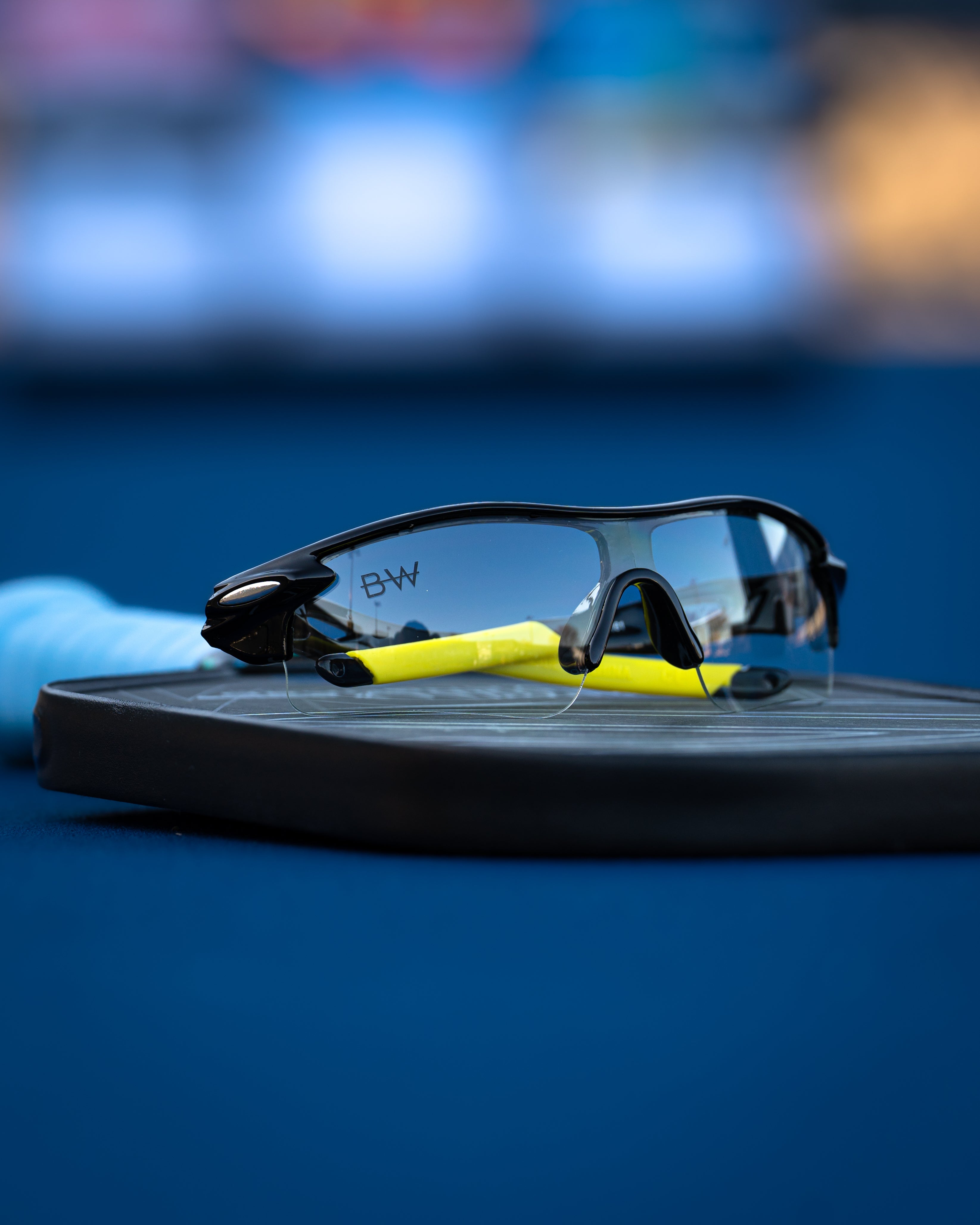
How Often Should You Replace Your Sports RX Glasses? 🕶️🏆
Share
How Often Should You Replace Your Sports RX Glasses?
How often should you replace prescription sports glasses? There is no single replacement schedule that fits every athlete. Your prescription, lens condition, frame integrity, frequency of play, and changes in your vision matter more than simply reaching a certain age for the glasses.
For pickleball players, RX eyewear gets exposed to sweat, repeated movement, transportation in gear bags, outdoor conditions, cleaning, and everyday handling. Instead of automatically replacing a pair every 12 or 24 months, regularly inspect your prescription pickleball glasses and replace them when your prescription, lenses, frame, or playing needs indicate it is time.
This guide explains the signs that your sports RX glasses may need replacing, when an eye exam should come first, how to make your current pair last longer, and what to compare when buying your next pair.
Quick Answer: When Should You Replace Sports Prescription Glasses?
You should consider replacing your sports RX glasses when your prescription is no longer appropriate, the lenses have damage that interferes with useful vision, the frame no longer fits or functions properly, or the eyewear no longer meets your needs on the court.
Do not replace an otherwise functional pair simply because it reaches an arbitrary age. Some athletes may need new eyewear sooner because their prescription changes or their glasses become damaged, while a well-maintained pair with a current prescription may remain useful longer.
| What You Notice | What to Do |
|---|---|
| Your prescription has changed | Discuss updated prescription lenses or new RX eyewear with your eye-care professional |
| Scratches interfere with your vision | Consider replacing the affected lenses or eyewear |
| Frame is cracked or structurally damaged | Stop relying on a compromised frame and determine whether replacement is appropriate |
| Frame continually slips or no longer fits correctly | Check whether adjustment is possible; replace it if the fit cannot be restored |
| Vision has changed unexpectedly | See a qualified eye-care professional rather than assuming the glasses are the problem |
| Glasses remain clear, comfortable and appropriate for your current RX | Continue inspecting and caring for them rather than replacing them solely because of age |
Replacing Your Pair? Compare Pickleball RX Glasses
If your current eyewear is ready for replacement, Blinded Wear offers prescription sports eyewear designed around the needs of pickleball players.
Why Replacing Sports RX Glasses at the Right Time Matters
Your prescription sports eyewear has two jobs: provide the vision correction prescribed for you and remain functional during the activity for which you use it. Problems with either side of that equation can be a reason to reevaluate your pair.
Your Prescription Can Change
A pair of glasses can remain physically intact even after the prescription inside the lenses no longer matches your current vision needs. If you notice new blur, visual discomfort, headaches, difficulty focusing, or other changes, schedule an appropriate eye examination instead of assuming that cleaning the lenses or buying a different tint will solve the issue.
Your eye-care professional can tell you whether your prescription has changed and recommend an appropriate examination schedule for your individual needs.
Lens Damage Can Affect Useful Vision
Sports eyewear gets handled frequently. Over time, lenses can develop scratches, surface damage, or other wear.
A tiny cosmetic mark near the edge of a lens does not necessarily mean the entire pair needs immediate replacement. Damage becomes more important when it interferes with your field of view, creates distracting reflections, affects clarity, or otherwise makes the eyewear difficult to use.
Frames Can Wear or Become Damaged
Repeated use can affect hinges, nose-contact areas, temple sections, and other parts of a frame. A loose screw may simply require maintenance, while a cracked or significantly compromised frame may justify replacement.
The key distinction is between normal maintenance and structural damage. Do not continue relying on a damaged sports frame simply because the prescription lenses themselves are still usable.
Your Playing Needs Can Change
You may also outgrow an eyewear setup without physically wearing it out. A player who moves from occasional indoor recreation to frequent outdoor competition may want different eyewear than when the original pair was purchased.
Changes in playing environment, prescription, fit preferences, and frequency of play are all reasonable reasons to reassess your sports RX setup.
8 Signs It May Be Time to Replace Your Sports RX Glasses
1. Your Vision Is No Longer Clear With Your Current Prescription
If objects that previously appeared clear are becoming consistently blurry through your glasses, your prescription may need to be reevaluated. Clean the lenses properly first, but persistent changes in vision deserve professional attention.
2. Scratches Are Interfering With Your View
Sports glasses do not need to look brand new forever. The more important question is whether lens damage is affecting how comfortably and clearly you can see through them.
Scratches located directly within your normal line of sight can be more distracting than minor cosmetic wear elsewhere on the lens.
3. The Frame Is Cracked or Structurally Damaged
Visible cracking, broken components, or other meaningful structural damage should not be ignored in eyewear used during active play.
4. Your Glasses No Longer Fit Properly
If a previously comfortable pair constantly slides, sits unevenly, or has become difficult to position correctly, determine whether the frame can be adjusted. If the problem cannot be corrected, replacing the eyewear may make more sense.
5. Hinges or Other Components Repeatedly Come Loose
Occasional maintenance is normal. Repeated problems that continue after appropriate adjustment can indicate that the frame is reaching the point where replacement is more practical.
6. The Lens Surface Has Noticeably Deteriorated
Visible peeling, crazing, persistent haziness, or other surface deterioration that cannot be removed through proper cleaning may justify replacing the affected lenses or eyewear.
7. Your Playing Environment Has Changed
A lens configuration selected for one environment may not be what you prefer after your playing schedule changes. For example, moving from daytime outdoor sessions to indoor or evening pickleball may change the type of lens you want to use.
8. Your Eye-Care Professional Recommends Updated Correction
If an eye examination produces a new prescription that meaningfully changes your correction needs, follow your eye-care professional's guidance about updating your eyewear.
Should You Replace Sports RX Glasses Every Year or Every Two Years?
Not automatically. A rigid 12-month, 18-month, or two-year replacement rule oversimplifies the decision.
The original version of this guide recommended fixed replacement intervals for lenses, frames, and complete RX glasses. :contentReference[oaicite:0]{index=0} A more useful approach is to evaluate your prescription and the actual condition of your eyewear rather than assuming every pair expires on the same schedule.
| Factor | Replace or Reevaluate When... |
|---|---|
| Prescription | Your eye-care professional determines that your correction needs have changed |
| Lenses | Damage or deterioration materially interferes with useful vision or function |
| Frame | Damage, wear, or fit problems can no longer be appropriately corrected |
| Complete RX pair | The prescription, lenses, frame, or intended use no longer meets your needs |
This approach can prevent two opposite mistakes: continuing to use eyewear that no longer works properly and unnecessarily replacing a perfectly functional pair just because a calendar says it is old.
Do You Need New Sports Glasses Every Time Your Prescription Changes?
Whether you need new lenses or an entirely new pair depends on the prescription change, the existing frame, lens compatibility, and the advice of your eye-care professional and eyewear provider.
A small prescription change does not automatically tell you whether the complete frame must be replaced. Conversely, a frame that is already damaged or no longer fits properly may make a full replacement more practical when updating your prescription.
If you notice a change in your vision before your normal examination schedule, do not wait simply because your current glasses are relatively new. Vision changes should be evaluated based on your individual circumstances rather than the purchase date printed on an order confirmation.
Sports RX Replacement Checklist
Before deciding whether to keep or replace your current pair, inspect it systematically.
- Clean the lenses correctly. Make sure apparent haze or blur is not simply dirt or residue.
- Check your vision. Notice whether your prescription still feels appropriate during normal use and on court.
- Inspect both lenses. Look for scratches, cracks, surface deterioration, or other damage.
- Inspect the frame. Look for cracks, deformation, loose components, or other structural problems.
- Check the fit. Make sure the eyewear remains comfortable and appropriately positioned during movement.
- Consider your playing environment. Ask whether the lens setup still makes sense for where and when you currently play.
- Check your eye-exam status. Follow the examination schedule recommended for you by your eye-care professional.
- Decide whether maintenance, lens replacement, or complete replacement makes the most sense.
Should You Repair, Replace the Lenses, or Buy New RX Glasses?
| Situation | Possible Next Step |
|---|---|
| Loose screw or minor adjustable fit issue | Maintenance or professional adjustment may be enough |
| Prescription changed but frame remains usable | Ask whether replacement lenses are compatible with the frame |
| Lens is damaged but frame remains structurally sound | Ask whether the affected lens or lenses can be replaced |
| Frame is significantly damaged | Consider replacing the frame or complete pair |
| Prescription and frame both need updating | A new complete RX pair may be the most practical option |
| Current pair works but you need different lenses for another environment | Consider a second pair configured for those playing conditions |
Do not assume every issue requires throwing away the entire pair. At the same time, avoid repeatedly repairing eyewear when structural damage or an outdated prescription makes replacement the more sensible option.
What to Look for When Replacing Prescription Pickleball Glasses
If you have decided it is time for a new pair, compare more than frame appearance. The best replacement is the one that fits your current prescription and the way you actually play.
Current Prescription
Start with accurate correction from a qualified eye-care professional. Do not attempt to compensate for an outdated prescription by changing tint or other secondary lens features.
Prescription Lens Material and Cost
Look at the finished RX price rather than only the advertised frame price. Blinded Wear includes high-index prescription lenses at no additional cost, so there is no separate high-index upcharge with its RX eyewear.
Sports-Focused Frame Design
Blinded Wear uses lightweight sports frames designed around pickleball and extended match wear.
Impact-Resistant Lenses
Durability matters in active eyewear. Blinded Wear uses impact-resistant lenses in its sports eyewear without making unsupported certification claims.
Non-Polarized Performance Approach
Blinded Wear takes a non-polarized approach to pickleball eyewear to preserve natural visual information used for depth perception and ball tracking rather than automatically adding a polarization filter.
Replacement Coverage
Consider what happens if your next pair eventually breaks. Blinded Wear provides a 50% lifetime replacement warranty if the glasses break, adding long-term value beyond the initial purchase.
What Matters Most When Comparing Replacement RX Sports Glasses?
| Buying Factor | Why It Matters | Blinded Wear |
|---|---|---|
| Prescription availability | Required for players who need vision correction during play | RX available |
| High-index pricing | Lens-material upgrades can increase the total price of some RX eyewear | High-index RX included at no additional cost |
| Lens approach | Lens characteristics should match the intended activity | Non-polarized, performance-first approach |
| Lens durability | Sports eyewear is used in an active environment | Impact-resistant lenses |
| Frame comfort | Comfort becomes increasingly important during long sessions | Lightweight sports frames |
| Sport focus | Dedicated sports eyewear is selected around active use | Designed for pickleball players |
| Long-term replacement value | Breakage can affect the lifetime cost of owning sports eyewear | 50% lifetime replacement warranty if glasses break |
How to Make Your Sports RX Glasses Last Longer
Replacement is eventually necessary for some pairs, but proper care can help preserve the condition of your prescription sports glasses. Pickleball eyewear regularly encounters sweat, fingerprints, dust, transportation, temperature changes, and repeated handling, so small habits can make a meaningful difference.
Store Them in a Protective Case
Avoid dropping your RX glasses loose into a pickleball bag alongside paddles, balls, keys, or other equipment. A protective case can reduce unnecessary contact with objects that could scratch the lenses or damage the frame.
Clean the Lenses Properly
Use cleaning methods appropriate for your specific lenses. Dirt or particles trapped between a cloth and the lens surface can contribute to scratching, so avoid aggressively rubbing visibly dirty lenses.
Follow the care instructions supplied with your eyewear or recommended by your eyewear provider rather than assuming every household cleaner is safe for prescription lenses.
Do Not Leave Sports Glasses in Extreme Heat
Avoid unnecessarily exposing prescription eyewear to extreme temperatures, such as leaving it inside a very hot vehicle for extended periods. Heat can be hard on eyewear materials and lens treatments.
Inspect Your Pair Regularly
Take a few seconds before playing to check the lenses, hinges, temples, and overall fit. Catching a loose component early may allow a simple adjustment before it becomes a larger problem.
Use Two Pairs if Your Playing Conditions Are Very Different
Players who regularly move between dramatically different environments may benefit from having more than one eyewear setup. This can also reduce how heavily a single pair is used while providing a backup if one pair is damaged or misplaced.
Should Pickleball Players Keep a Backup Pair of RX Glasses?
For players who depend on prescription correction, a backup pair can be particularly useful. Breaking, losing, or damaging your only prescription sports glasses shortly before a match can leave you without the correction you normally use on court.
A second pair can also serve a different playing environment. For example, you might prefer one configuration for bright daytime play and another for lower-light conditions.
The important point is not that every pickleball player needs multiple pairs. It is that athletes who cannot comfortably play without prescription correction may find a backup more valuable than players who use RX eyewear only occasionally.
Common Mistakes That Can Shorten the Useful Life of Sports RX Glasses
Putting Glasses in a Gear Bag Without Protection
Loose eyewear can come into contact with equipment and other hard objects. A dedicated protective case is a simple way to reduce unnecessary wear during transportation.
Wiping Dirty Lenses Without Removing Debris
Repeatedly rubbing particles across the lens surface can contribute to scratching. Clean your lenses using an appropriate method instead of using whatever fabric happens to be nearby.
Ignoring a Loose or Poorly Fitting Frame
If your sports glasses suddenly fit differently, do not simply continue wearing them indefinitely. Determine whether the frame needs adjustment or whether a component has become worn or damaged.
Assuming Blurry Vision Means the Lenses Are Worn Out
Blur can have multiple causes. If cleaning the lenses does not solve the issue or you notice a persistent change in your vision, an eye-care professional can determine whether your prescription or eye health should be evaluated.
Keeping an Old Prescription Just Because the Frames Still Look New
Physical condition and prescription accuracy are separate issues. A nearly flawless frame does not guarantee that the correction inside its lenses is still appropriate for you.
Replacing Perfectly Functional Glasses Because of an Arbitrary Deadline
The opposite mistake is replacing sports RX eyewear solely because it has reached a particular age. Condition, fit, prescription, and current needs provide more useful information than a universal replacement countdown.
Do You Need New Lenses or an Entirely New Pair?
Sometimes the lenses need attention while the frame remains usable. In other situations, the prescription is fine but the frame has become damaged. Understanding the difference can help you avoid spending money unnecessarily.
Consider New Lenses When:
- Your prescription has changed and the existing frame can appropriately accommodate new lenses.
- The lenses have damage that affects useful vision but the frame remains structurally sound.
- Your eyewear provider determines that replacing the lenses is appropriate for the existing frame.
Consider a New Frame or Complete Pair When:
- The frame is cracked or significantly damaged.
- The fit can no longer be appropriately adjusted.
- Important frame components repeatedly fail.
- Your new prescription or preferred lens configuration is not suitable for the existing frame.
- You want sports eyewear better suited to your current playing conditions.
Because prescription and frame compatibility can vary, confirm your options with the appropriate eyewear provider rather than assuming any new prescription lens can be installed in any existing sports frame.
The Real Cost of Replacing Prescription Sports Glasses
When comparing replacement RX glasses, the advertised frame price does not always represent the final cost. Prescription strength, lens material, optional treatments, and other choices can affect what you ultimately pay.
That makes the complete prescription price an important comparison point for athletes who expect to use their eyewear frequently.
High-Index RX Without an Additional Upcharge
Blinded Wear includes high-index prescription lenses at no additional cost. There is no separate high-index upcharge, which can simplify the buying decision for players whose RX order uses high-index lenses.
High-index refers to lens material. It should not be interpreted as a guarantee of better pickleball performance or as something every prescription necessarily requires.
Factor Replacement Coverage Into Long-Term Cost
The initial purchase price is only one part of the ownership equation. Because sports eyewear is used in an active environment, replacement coverage can matter when comparing long-term value.
Blinded Wear offers a 50% lifetime replacement warranty if the glasses break. Instead of evaluating a new pair only by its upfront price, consider the prescription lens cost, construction, intended use, and applicable replacement coverage together.
Why Replacement RX Glasses Should Match the Way You Play Pickleball
If you have decided that your old pair needs replacing, the next question should not simply be, “Which glasses look best?” Your replacement should make sense for the sport and conditions in which you actually intend to use it.
Prescription Correction
Players who require vision correction should begin with their current prescription and required measurements. Sports-specific styling does not replace accurate vision correction.
Lightweight Construction
Comfort can become increasingly noticeable over long recreational sessions, league nights, or tournament days. Blinded Wear uses lightweight sports frames designed for extended active use.
Impact-Resistant Lenses
Sports eyewear operates in a different environment from glasses worn primarily at a desk or around the house. Blinded Wear uses impact-resistant lenses as part of its performance-first sports eyewear approach.
Non-Polarized Lenses for Pickleball
Polarization can be useful for reducing certain forms of reflected glare, but it is not automatically required for every activity. Blinded Wear uses non-polarized lenses for its performance-first pickleball approach, preserving natural visual information used for depth perception and ball tracking rather than adding a polarization filter.
Playing Conditions
Consider when you actually play. Bright outdoor courts, indoor facilities, nighttime matches, and sessions that transition from daylight toward dusk can produce different eyewear preferences.
Instead of purchasing based on one feature in isolation, evaluate the entire setup: prescription, lens configuration, frame, comfort, playing environment, durability, and long-term value.
Should You Use Everyday Prescription Glasses for Pickleball?
If your normal prescription glasses provide the correction you need, it can be tempting to use the same pair for every activity. However, players who participate frequently may prefer dedicated prescription sports eyewear designed around active use.
Dedicated sports RX glasses can also keep your primary everyday eyewear from being the pair repeatedly exposed to sweat, equipment bags, outdoor conditions, and active movement.
That does not mean every recreational player must own dedicated sports glasses. The decision depends on how frequently you play, how dependent you are on prescription correction, your comfort preferences, and the condition and suitability of your existing eyewear.
Replacement Buying Guide: What to Check Before Ordering New Sports RX Glasses
-
Confirm your current prescription.
If your vision has changed or your eye-care professional recommends an updated examination, handle that before ordering replacement prescription eyewear.
-
Make sure you have the required RX measurements.
Provide the information required to accurately fill your prescription rather than guessing measurements.
-
Choose eyewear for your actual sport.
Consider sports-oriented frames rather than selecting solely by fashion or everyday use.
-
Consider your normal court lighting.
Think about whether you primarily play outdoors, indoors, at night, or across changing lighting conditions.
-
Compare the complete prescription price.
Look beyond the frame price and consider the cost of the RX lens configuration you actually need.
-
Review frame weight and comfort.
Eyewear that feels acceptable for several minutes may feel different during an extended playing session.
-
Consider lens durability.
Sports eyewear is exposed to active use, making lens construction an important part of the purchase decision.
-
Check replacement coverage.
Understand what happens if your sports glasses eventually break.
Prescription Pickleball Glasses: Features to Compare
| Feature | Question to Ask | Blinded Wear Approach |
|---|---|---|
| RX availability | Can I order the eyewear with prescription correction? | Prescription available |
| High-index lenses | Will high-index RX add another charge? | High-index RX lenses included at no additional cost |
| Polarization | Is the lens approach appropriate for how I play? | Non-polarized, performance-first approach |
| Lens construction | Is the lens designed with active use in mind? | Impact-resistant lenses |
| Frame | Will the frame be comfortable during longer sessions? | Lightweight sports frames |
| Sport | Was the eyewear selected around pickleball use? | Designed for pickleball players |
| Replacement value | What happens if my eyewear eventually breaks? | 50% lifetime replacement warranty if the glasses break |
When You Probably Do Not Need to Replace Your Sports RX Glasses Yet
Replacement is not automatically necessary simply because your sports glasses have been used for a year or two.
If your prescription remains appropriate, your eye-care professional has not advised an update, your lenses provide clear useful vision, the frame remains structurally sound, the fit is comfortable, and the eyewear continues to suit your playing conditions, there may be no immediate reason to replace the pair solely because of its age.
Regular inspection and appropriate eye care are more useful than treating sports glasses as if they have a universal expiration date.
When Should You Stop Using a Pair of Sports Glasses?
There is a difference between cosmetic wear and a problem that affects whether you should continue relying on the eyewear.
Stop and evaluate the pair if you notice significant structural damage, a broken frame, cracked lenses, substantial distortion, or another condition that makes the glasses unreliable or interferes with your useful vision.
Likewise, persistent or sudden changes in your vision should not simply be blamed on old glasses. Seek appropriate professional evaluation when necessary.
How Replacement Needs Can Differ by Pickleball Player
| Player Type | What to Monitor |
|---|---|
| Occasional recreational player | Prescription accuracy, basic frame condition, lens clarity, and fit |
| Frequent league player | Regular wear, fit during movement, lens condition, and current RX |
| Tournament player | Condition of primary eyewear plus whether a backup RX pair would be useful |
| Indoor and outdoor player | Whether one lens setup continues to meet both playing environments |
| Player with changing prescription | Professional eye-care recommendations and whether existing eyewear remains appropriate |
| Player whose glasses have been damaged | Whether repair, lens replacement, warranty replacement, or a completely new pair is appropriate |
Ready to Replace Your Current Pickleball RX Glasses?
If your current pair is scratched, damaged, no longer fits properly, or no longer matches your prescription needs, compare your replacement options before buying another pair.
Blinded Wear prescription pickleball eyewear combines high-index RX lenses at no additional cost, lightweight sports frames, impact-resistant lenses, a non-polarized performance-first approach, and a 50% lifetime replacement warranty if the glasses break.
Shop Prescription Pickleball Glasses →
Not sure which style or lens direction fits the way you play?
Frequently Asked Questions About Replacing Sports RX Glasses
How often should you replace prescription sports glasses?
There is no universal replacement interval for prescription sports glasses. Consider replacing them when your prescription changes, lens damage interferes with useful vision, the frame becomes structurally damaged, the fit can no longer be corrected, or the eyewear no longer suits your playing needs. A functional pair does not automatically need replacement simply because it reaches a certain age.
Should I replace my sports glasses every year?
Not necessarily. If your prescription remains appropriate, the lenses are clear, the frame is structurally sound, and the glasses continue to fit and function well, age alone is not a reason to replace them. Follow the eye-examination schedule recommended by your eye-care professional and inspect your eyewear regularly.
How do I know if my prescription sports glasses are worn out?
Signs can include scratches that interfere with vision, cracked or damaged lenses, a damaged frame, repeated component problems, persistent fit issues, or lens-surface deterioration. A change in your actual vision should be evaluated by an eye-care professional rather than automatically attributed to worn-out glasses.
Do scratched prescription lenses need to be replaced?
Minor cosmetic marks do not always require immediate replacement. Replacement becomes more important when scratches or other lens damage interfere with your normal field of view, clarity, or comfortable use.
Can I replace only the prescription lenses and keep my sports frame?
Sometimes. Whether an existing frame can accept replacement prescription lenses depends on its condition, design, the new prescription, and the eyewear provider's capabilities. Ask your provider to confirm compatibility rather than assuming every sports frame can be reused.
Should I replace my RX glasses when my prescription changes?
If your eye-care professional determines that your prescription has changed, ask whether your current sports eyewear should be updated. Whether that means replacing only the lenses or purchasing a complete new pair depends on the prescription, frame condition, compatibility, and your individual needs.
Can I keep using an old prescription for pickleball?
If you have been given an updated prescription, follow the guidance of your eye-care professional about your correction needs. A frame can still look new even when the prescription inside it no longer reflects your current vision.
Should I have a separate pair of prescription glasses for pickleball?
Not every player needs a separate pair, but frequent players who require vision correction may prefer dedicated RX pickleball glasses designed around active use. A separate sports pair can also keep your everyday eyewear from being the pair regularly exposed to sweat, equipment bags, outdoor conditions, and athletic movement.
Should I keep backup prescription sports glasses?
A backup can be useful if you rely on prescription correction to play comfortably, especially for league or tournament play. It can also give you a second lens configuration for different lighting conditions.
Are high-index lenses better for prescription sports glasses?
High-index refers to the refractive properties of the lens material and can allow certain prescriptions to be made with thinner lenses than lower-index alternatives. It does not automatically improve athletic performance. Blinded Wear includes high-index prescription lenses at no additional cost with its RX eyewear.
Are polarized lenses necessary for pickleball?
No. Polarization can be useful in some environments, but it is not automatically necessary for pickleball. Blinded Wear uses a non-polarized, performance-first lens approach intended to preserve natural visual information used for depth perception and ball tracking rather than making polarization the default.
What happens if my Blinded Wear glasses break?
Blinded Wear provides a 50% lifetime replacement warranty if the glasses break. This gives buyers a long-term replacement option to consider when comparing the total value of prescription pickleball eyewear.
Replace or Keep? Quick Decision Guide
| Current Condition | Likely Next Step |
|---|---|
| Current RX, clear lenses, good fit, no structural damage | Continue using and inspecting the glasses |
| Minor cosmetic wear that does not affect vision or function | Continue monitoring the eyewear |
| Loose component that can be appropriately adjusted | Consider maintenance or professional adjustment |
| Scratches interfering with your normal view | Consider replacement lenses or new eyewear |
| Updated prescription | Determine whether new lenses or a complete RX pair is appropriate |
| Cracked or significantly damaged frame | Consider replacing the frame or complete pair |
| Cracked or significantly damaged lens | Stop relying on the damaged lens and seek an appropriate replacement |
| Persistent unexplained change in vision | Consult a qualified eye-care professional |
| Current pair no longer matches where or when you play | Consider eyewear better suited to your current playing conditions |
Sports RX Replacement Myths
Myth: Prescription Sports Glasses Automatically Expire After Two Years
Reality: there is no single expiration date that applies to every pair. Prescription accuracy, lens condition, frame integrity, fit, and your current playing needs are more useful replacement indicators.
Myth: Any Scratch Means You Need New Glasses
Reality: minor cosmetic wear and damage that interferes with useful vision are not the same thing. Evaluate the location and severity of the damage rather than treating every small mark as a reason to discard the pair.
Myth: If the Frame Looks Fine, the Glasses Are Still Fine
Reality: the physical condition of the frame does not tell you whether your prescription is still appropriate. Prescription needs and eyewear condition should be considered separately.
Myth: A New Pair of Sports Glasses Will Automatically Improve Your Game
Reality: appropriate prescription eyewear can support clear vision, but athletic performance also depends on technique, anticipation, positioning, decision-making, practice, and other factors.
Myth: The Most Expensive Lens Upgrade Is Automatically Best for Pickleball
Reality: lens choices should fit your prescription, playing environment, and individual needs. More expensive does not automatically mean more appropriate for your particular use.
Should You Replace RX Glasses Before a Pickleball Tournament?
A tournament is a good reason to inspect your equipment, but not necessarily a reason to replace functional prescription glasses.
Before an important event, check:
- Whether your prescription remains appropriate
- Whether both lenses are clear and free of significant damage
- Whether the frame is structurally sound
- Whether the glasses remain comfortable during movement
- Whether your lens configuration makes sense for the expected lighting
- Whether you have an appropriate backup if you depend on RX correction
If you do purchase a new pair, give yourself enough time to confirm that the prescription, fit, and overall eyewear setup are appropriate before relying on them during an important match.
Can You Keep Your Old RX Glasses as a Backup?
Potentially, but an older pair is only useful as a backup if it remains functional and its prescription is still appropriate for you.
If your prescription has changed, ask your eye-care professional whether the older correction remains suitable for any intended use. Do not assume an outdated pair is an ideal sports backup simply because you can still see through it.
If you replace a pair because you wanted a different lens setup rather than because the old pair was damaged or outdated, the previous glasses may be more practical as a backup.
Do You Actually Need RX Pickleball Glasses?
If you require prescription correction while playing, start with the Blinded Wear RX Pickleball Glasses Collection.
If you do not require prescription correction, there is no reason to purchase RX lenses solely because you play pickleball. Browse non-prescription pickleball eyewear instead.
If you are unsure which eyewear category or style fits your needs, take the Pickleball Glasses Quiz.
Related Prescription Pickleball Eyewear Guides
Replacing a pair is also a good opportunity to make sure your next RX setup better matches the way you play. Continue with these Blinded Wear guides:
How Often Should You Replace Sports RX Glasses? Key Takeaways
- There is no universal replacement schedule. Do not replace prescription sports glasses solely because they have reached an arbitrary age.
- Your prescription matters first. If your vision changes or your eye-care professional updates your prescription, determine whether your sports eyewear should also be updated.
- Lens condition matters. Scratches, cracks, haze, or deterioration that interferes with useful vision can justify replacement.
- Frame condition matters. Structural damage, repeated component problems, or fit issues that cannot be corrected may mean it is time for a new frame.
- Your playing environment matters. A pair that once suited your schedule may no longer be ideal if you move between outdoor, indoor, nighttime, or dusk pickleball.
- Maintenance can extend useful life. Proper cleaning, protected storage, regular inspection, and avoiding unnecessary extreme heat can help preserve your eyewear.
- Replacement does not always mean replacing everything. Depending on compatibility and condition, maintenance or new lenses may sometimes be appropriate.
- Blinded Wear includes high-index RX lenses at no additional cost. There is no separate high-index upcharge.
- Blinded Wear uses lightweight sports frames and impact-resistant lenses designed around active pickleball use.
- Blinded Wear takes a non-polarized, performance-first approach for pickleball eyewear, with the goal of preserving natural visual information used for depth perception and ball tracking.
- Blinded Wear provides a 50% lifetime replacement warranty if the glasses break, which can be considered when comparing long-term value.
Final Verdict: Replace Based on Condition and Vision, Not Just the Calendar
So, how often should you replace your sports RX glasses? The most useful answer is: when there is a reason to.
Your prescription may change before your frame wears out. Your lenses may become damaged while your prescription remains stable. Your frame may eventually stop fitting properly. Or your entire pair may continue working well beyond an arbitrary one- or two-year milestone.
Use four questions to guide the decision:
- Is my prescription still appropriate?
- Are my lenses still providing clear, usable vision?
- Is my frame structurally sound and comfortable?
- Does this eyewear still fit the way and conditions in which I play?
If the answer to all four is yes, your current pair may still have useful life left. If one or more answers are no, determine whether adjustment, new lenses, professional vision evaluation, or complete replacement is the appropriate next step.
Need a New Pair? Find Your Next Prescription Pickleball Glasses
If your current sports RX glasses are ready for replacement, Blinded Wear offers prescription pickleball eyewear designed for recreational and competitive players.
Blinded Wear RX eyewear includes high-index prescription lenses at no additional cost with no separate high-index upcharge, along with lightweight sports frames, impact-resistant lenses, a non-polarized performance-first approach, and a 50% lifetime replacement warranty if the glasses break.
Don't need prescription correction? Shop Non-RX Pickleball Glasses →
Still deciding? Take the Pickleball Glasses Quiz → or use the 2026 Pickleball Glasses Buying Guide →.