
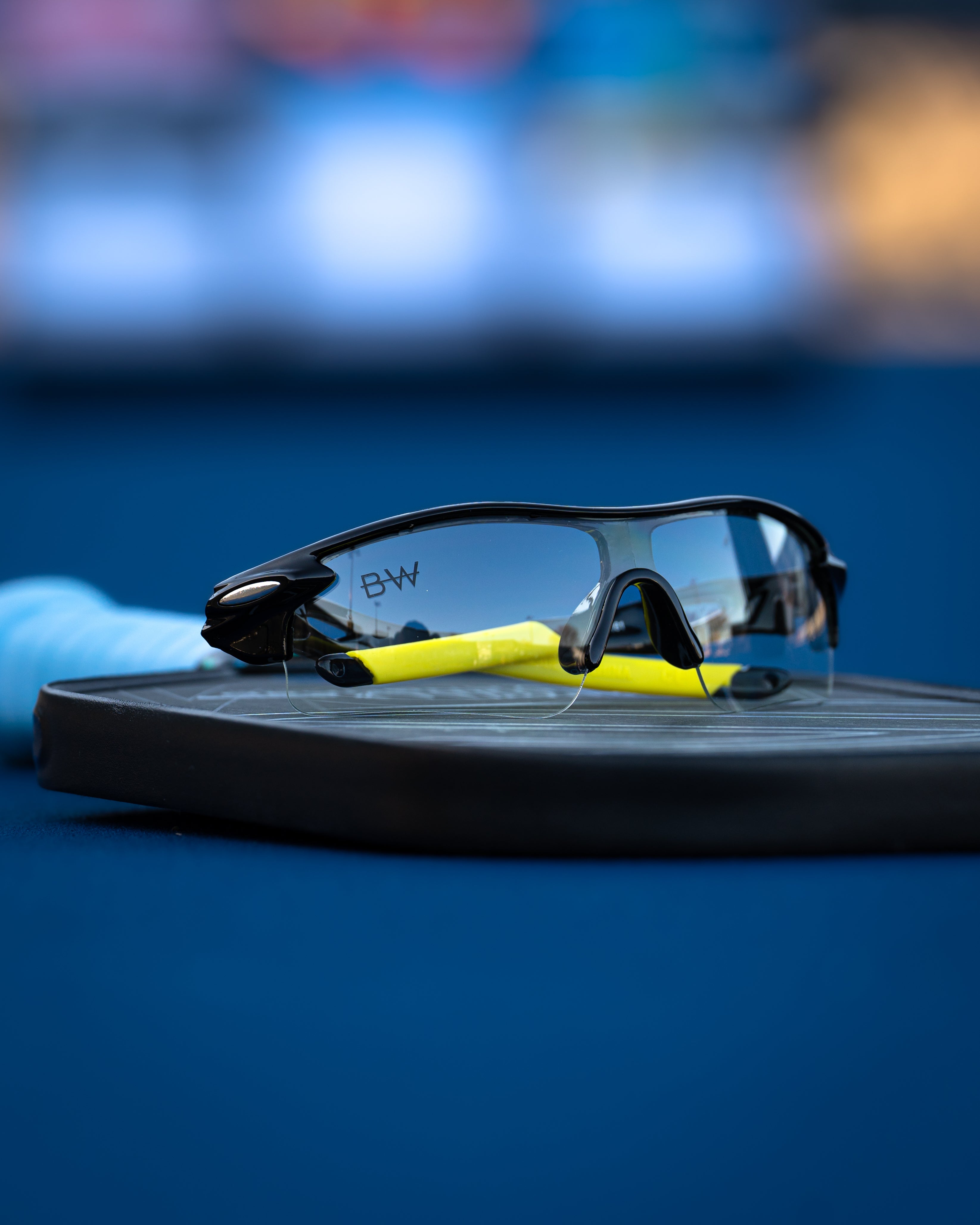
Maintenance Tips: Keeping Your Prescription Sports Eyewear in Top Shape
Share
Prescription Sports Eyewear Maintenance: How to Clean, Store & Protect RX Glasses
Proper prescription sports eyewear maintenance starts with gentle cleaning, appropriate storage, regular inspection, and following the care instructions for your exact frame and lenses. Sports glasses can be exposed to perspiration, fingerprints, dust, court debris, travel, and repeated handling, making routine care especially important.
You do not need an aggressive cleaning routine or a cabinet full of chemicals. In fact, using the wrong cleaner, wiping dirty lenses with whatever is nearby, or tossing prescription glasses loose into a sports bag can create unnecessary risk of damage.
This guide covers practical ways to clean prescription sports glasses, protect them during travel, inspect them for wear, and know when damage deserves professional attention or replacement.
Prescription Sports Eyewear Resources
Why Prescription Sports Glasses Need Regular Care
Prescription sports eyewear performs two important jobs: it provides the vision correction prescribed for you while also functioning as eyewear you use during active movement.
That combination can expose your glasses to conditions ordinary eyewear may encounter less frequently, including:
- Perspiration
- Fingerprints and skin oils
- Dust and outdoor debris
- Repeated removal and handling
- Sports bags and backpacks
- Travel
- Changes between indoor and outdoor environments
- Accidental drops or impacts
Routine maintenance helps you notice dirt, loose components, changes in fit, and physical damage before simply continuing to use the eyewear.
Maintenance does not make eyewear indestructible, restore damaged lens material, or replace appropriate professional repair when a frame or prescription lens has a significant problem.
How Often Should You Clean Prescription Sports Glasses?
There is no universal requirement that every athlete clean eyewear on an exact daily or weekly schedule. How often cleaning is useful depends on how frequently you wear the glasses and how dirty they become.
| Situation | Practical Response |
|---|---|
| Fingerprints or Smudges | Clean when they interfere with comfortable viewing or the lenses are visibly dirty. |
| After Sweaty Activity | Inspect and clean the eyewear appropriately rather than storing it heavily soiled. |
| Dust or Loose Debris | Remove loose debris appropriately before rubbing the lens surface. |
| After Travel | Inspect the frame and lenses for dirt or damage before your next activity. |
| Before Competition | Check that the eyewear is clean, comfortable, and free from obvious damage. |
The goal is not to clean your lenses as frequently as possible. Clean them when needed using a method appropriate for the exact eyewear.
How to Clean Prescription Sports Glasses
Always follow the care instructions for your exact lenses and frame when they are available. Different lens treatments and frame materials can have different requirements.
A conservative cleaning process is:
- Inspect the lenses first. Look for visible dust, sand, or other loose debris before rubbing them.
- Remove loose debris appropriately. Rubbing abrasive particles across a lens can create unnecessary surface contact.
- Use a lens-safe cleaning method. Choose products and methods confirmed appropriate for your eyewear.
- Clean gently. Excessive force should not be necessary.
- Use appropriate lens-cleaning material. Avoid grabbing whatever clothing or rough material happens to be nearby.
- Clean the frame as needed. Perspiration and oils can collect around the bridge, temples, and other contact areas.
- Allow the eyewear to dry appropriately. Do not immediately seal heavily wet eyewear into storage.
- Inspect the glasses afterward. Cleaning is a useful opportunity to notice damage or changes in fit.
Should You Rinse Prescription Glasses Before Wiping Them?
If loose particles are sitting on a lens, immediately rubbing them across the surface is not ideal.
When compatible with the care instructions for your exact eyewear, appropriately removing loose debris before wiping can reduce unnecessary rubbing of particles against the lens.
This is particularly relevant after activities where eyewear may encounter:
- Dust
- Dirt
- Sand
- Outdoor debris
- Dried perspiration or residue
Avoid assuming that every frame, coating, or lens treatment should be cleaned using exactly the same liquid or technique. When in doubt, follow the manufacturer's instructions for the specific eyewear.
Should You Use a Microfiber Cloth on Prescription Sports Glasses?
A clean lens-appropriate microfiber cloth can be useful for eyewear cleaning, but the word clean matters.
A cloth that has collected dirt, oils, or debris can transfer that material back onto your lenses.
Good habits include:
- Keep the cloth reasonably clean
- Store it away from dirty sports equipment
- Do not place it loose on dirty surfaces
- Do not use it to grind visible debris across the lens
- Follow applicable care instructions for cleaning the cloth itself
Also remember that a microfiber cloth is a cleaning tool—not proof that a lens is scratch-proof.
Can You Clean Sports Glasses With Your Shirt or a Paper Towel?
It is better to use material intended for cleaning eyewear rather than making a habit of wiping prescription lenses with whatever is available.
Clothing can carry dirt, perspiration, skin oils, or other debris, while disposable paper products vary in texture and composition.
If your sports glasses are important to your prescription vision, keeping an appropriate cleaning cloth or lens-safe cleaning supplies in your bag is a simple way to avoid improvising after every practice.
What Cleaning Products Are Safe for Prescription Sports Glasses?
The safest answer depends on the exact lens and any treatments applied to it.
Use products confirmed as appropriate for your eyewear rather than assuming that a general household cleaner is lens-safe.
Be especially cautious with:
- Household glass cleaners
- Bleach or other aggressive household chemicals
- Strong solvents
- Unverified cleaning sprays
- Products not intended for eyewear
Lens materials and treatments vary, so a cleaning product being safe for one surface does not automatically make it appropriate for prescription eyewear.
Can You Use Alcohol Wipes or Hand Sanitizer on Prescription Glasses?
Do not assume that alcohol wipes, hand sanitizer, or another alcohol-containing product is appropriate for every prescription lens or frame.
Compatibility can depend on the exact lens material, frame material, and any lens treatments present.
If you do not know whether a cleaning product is compatible with your eyewear, use a cleaning method specifically confirmed as safe rather than experimenting on your prescription lenses.
How to Clean Sweat Off Prescription Sports Glasses
Sports eyewear frequently comes into contact with perspiration around the bridge, temples, and frame surfaces.
After a sweaty session:
- Remove the eyewear carefully.
- Inspect the lenses and frame for dirt or debris.
- Clean the eyewear using an appropriate lens-safe method.
- Pay attention to areas that contact your face.
- Allow wet components to dry appropriately before prolonged storage.
- Inspect the frame for any visible damage or change in fit.
Do not assume that a frame is “sweat-proof” simply because it is designed for sports.
What if Your Sports Glasses Get Very Dirty?
If eyewear becomes heavily soiled, avoid immediately scrubbing the lenses aggressively.
Start by determining what is on the eyewear and follow the appropriate care instructions. Loose or abrasive debris deserves particular caution because rubbing it across a lens can create additional surface contact.
If the eyewear has been exposed to an unusual substance and you are unsure how the lens or frame material will react to a cleaner, verify the appropriate cleaning method before applying chemicals.
How to Handle Fogging Without Damaging RX Lenses
Fogging is condensation. It can be influenced by temperature, humidity, perspiration, airflow, frame-to-face spacing, and other environmental factors.
If your lenses fog during play:
- Avoid repeatedly wiping them with dirty clothing
- Keep an appropriate cleaning cloth accessible
- Keep the eyewear itself clean
- Consider environmental factors contributing to condensation
- Verify whether any anti-fog product is compatible with your exact lenses before using it
Do not assume Blinded Wear RX eyewear automatically includes an anti-fog treatment unless that characteristic is verified for the exact lens configuration.
Can You Use Anti-Fog Spray on Prescription Sports Glasses?
Only use an anti-fog product when it is compatible with your exact lens material and treatments.
An aftermarket product being marketed for eyewear does not automatically establish compatibility with every prescription lens.
Before applying one, check:
- Lens material compatibility
- Compatibility with any existing lens treatments
- Application instructions
- Whether repeated use has specific requirements
If compatibility is uncertain, do not experiment simply because fogging is inconvenient.
What Should You Do if Prescription Sports Glasses Get Scratched?
A scratch is physical lens damage. Cleaning can remove dirt and residue, but it cannot restore lens material that has been physically scratched away or damaged.
If you notice a scratch:
- Clean the lens appropriately to make sure the mark is actually damage rather than residue.
- Inspect where the scratch sits within the lens.
- Pay attention to whether it interferes with comfortable viewing.
- Avoid unverified DIY polishing methods that could alter the lens surface.
- Review repair or replacement options if the damage is significant.
Impact-resistant should not be confused with scratch-proof. Blinded Wear sports eyewear uses impact-resistant lenses, but that does not mean the lenses cannot be scratched.
Can You Remove Scratches From Prescription Glasses at Home?
Be cautious with online “scratch removal” methods involving abrasive compounds, household chemicals, toothpaste, or polishing.
A prescription lens is an optical surface. Attempting to grind or polish away a scratch can alter that surface rather than truly restore the lens to its original condition.
If a scratch materially affects your use of the eyewear, replacement or appropriate professional guidance is a safer direction than attempting an aggressive DIY repair.
How to Inspect Prescription Sports Glasses for Damage
Cleaning is a convenient time to perform a quick inspection.
Check:
- Lenses for visible scratches, cracks, chips, or other damage
- Frame for cracks or deformation
- Hinges and connection points where applicable
- Temples for changes in alignment
- Bridge area for damage
- Any frame components that appear loose
- Whether the glasses still sit as expected
If the eyewear has experienced a significant impact, inspect it even if the damage is not immediately obvious while you are playing.
What Should You Do About Loose Screws or Hardware?
Some eyewear uses screws or other small hardware. If something becomes loose, avoid continuing to force or repeatedly bend the frame.
A minor hardware issue may sometimes be serviceable, but the correct response depends on the exact frame construction.
Do not assume every sports frame:
- Uses traditional screws
- Should be tightened by the wearer
- Uses the same screw size
- Can be safely adjusted with a generic tool
If you are unsure how a component should be adjusted, seek appropriate assistance rather than risking additional damage.
Should You Bend Prescription Sports Glasses Back Into Shape?
Avoid aggressively bending a damaged or misshapen frame yourself.
Frame materials respond differently to force, and an attempted adjustment can potentially create additional damage.
If your RX sports glasses become noticeably bent, twisted, cracked, or misaligned after an impact, evaluate the damage before continuing to rely on them during sports.
Can Heat Damage Prescription Sports Glasses?
Extreme conditions can be a concern for eyewear materials, but exact heat sensitivity depends on the frame, lenses, and any lens treatments.
A conservative approach is to avoid unnecessarily exposing prescription eyewear to extreme heat or storing it for extended periods in environments where temperatures can become unusually high.
Follow the care instructions for the exact eyewear rather than assuming every frame and lens reacts identically to heat.
Should You Leave Prescription Sports Glasses in a Hot Car?
A vehicle can experience substantial temperature changes, particularly when parked in direct sun. Because frame and lens materials vary, a hot vehicle is not an ideal default long-term storage location for important prescription eyewear.
When possible, keep RX sports glasses in an appropriate storage location rather than leaving them exposed to unnecessary environmental extremes.
How to Store Prescription Sports Glasses
When the glasses are not being worn, keep them separated from objects that could press against, scrape, or otherwise damage them.
Avoid tossing prescription sports glasses loose among:
- Keys
- Sports equipment
- Shoes
- Water bottles
- Tools
- Other hard objects
The appropriate storage method depends on your eyewear and situation, but the basic principle is simple: do not leave prescription lenses unprotected in environments where they can repeatedly contact harder objects.
How to Store Sports Glasses in a Gym or Pickleball Bag
A sports bag can be one of the roughest environments for prescription eyewear because objects move around as you walk, drive, or travel.
Try to keep the eyewear:
- Separated from heavy equipment
- Away from keys and abrasive objects
- Protected from direct pressure
- Reasonably dry before prolonged storage
- Easy to locate without digging through equipment
This becomes particularly important if your RX sports glasses are the only pair you have available for competition.
How to Protect Prescription Sports Glasses While Traveling
Travel introduces additional handling, packing, and storage considerations.
For a tournament or sports trip, consider packing:
- Your primary RX sports glasses
- Appropriate protective storage
- Lens-safe cleaning supplies
- A clean lens cloth
- A backup prescription pair when appropriate
- Your prescription information if you depend on RX correction
Keep essential eyewear somewhere you can access and protect it rather than burying it underneath heavy equipment.
Should Prescription Sports Glasses Go in Your Carry-On?
If you depend on prescription eyewear, keeping an essential pair accessible during travel can be practical.
The key issue is not that normal aircraft pressure automatically damages glasses. Rather, keeping important eyewear with you can reduce dependence on luggage that may be handled separately or become temporarily unavailable.
Use appropriate storage wherever you pack the eyewear.
Should Athletes Carry a Backup Pair of Prescription Glasses?
A backup pair can be useful when losing or damaging your primary glasses would leave you without appropriate prescription correction.
Consider carrying backup RX eyewear when:
- You are traveling for a tournament
- You have multiple matches in one day
- You are far from home
- You depend heavily on prescription correction
- Replacing damaged eyewear quickly would be difficult
A backup is not mandatory for every athlete, but it can be useful risk management when your vision correction is essential to your routine.
Prescription Eyewear Checklist Before a Tournament
Instead of discovering a problem during warmups, perform a quick eyewear check before an important event.
- Clean the lenses appropriately.
- Inspect for obvious scratches, cracks, chips, or other damage.
- Check the frame for visible damage.
- Make sure the eyewear still fits as expected.
- Pack appropriate cleaning supplies.
- Bring backup RX eyewear when appropriate.
- Use appropriate storage between matches.
- Make sure you have the lens configuration needed for the expected environment.
What to Do With RX Sports Glasses After a Match
A simple post-match routine can keep dirty eyewear from disappearing into the bottom of your bag.
- Inspect the glasses for visible damage.
- Clean perspiration, fingerprints, and debris using an appropriate method.
- Allow wet eyewear to dry appropriately.
- Place the glasses in appropriate storage.
- Keep them separated from hard or abrasive sports equipment.
If the eyewear took a significant hit during play, inspect it more carefully before the next session.
What Should You Do if Sports Glasses Take an Impact?
If your prescription sports glasses are struck by a ball, paddle, equipment, or another object, do not assume they are unaffected simply because they remain in one piece.
After a meaningful impact, inspect:
- The lenses
- The frame
- Connection points
- Frame alignment
- Fit
- Any visible cracks, chips, or deformation
Blinded Wear sports eyewear uses impact-resistant lenses, but impact-resistant does not mean indestructible or shatterproof.
When Should Prescription Sports Eyewear Be Replaced?
There is no universal replacement schedule that applies to every pair of sports glasses.
Instead, consider replacement or appropriate professional evaluation when:
- The lens is significantly damaged
- The frame is cracked or damaged
- The frame no longer fits appropriately
- Important components are damaged
- Your prescription changes
- Your visual needs change
- Your sport requires specifications your current eyewear does not provide
Prescription sports eyewear should not be kept indefinitely simply because the frame is still technically wearable.
What if Your Prescription Changes?
Maintenance can preserve the physical condition of eyewear, but it cannot keep an old prescription appropriate forever.
If your prescription changes, determine whether your existing eyewear still meets your current vision needs.
Do not assume that:
- Every existing frame can be re-lensed
- A prescription update is automatically included under replacement support
- Every new prescription will remain compatible with the same sports frame
Compatibility should be evaluated for the specific frame and updated prescription.
Blinded Wear Replacement Support: What to Know
Blinded Wear provides 50% lifetime replacement support if glasses break, subject to the current policy terms.
Replacement support should not be expanded into a promise that every scratch, loss, prescription change, or type of damage automatically qualifies.
It also does not mean:
- Every replacement is free
- Lost eyewear is automatically covered
- Every cosmetic scratch is automatically covered
- The glasses are indestructible
- The lenses are shatterproof
- Your prescription can be updated for free whenever it changes
Always review the current policy for complete eligibility and replacement terms.
12 Prescription Sports Eyewear Maintenance Mistakes to Avoid
- Rubbing visible debris directly across the lens. Remove loose particles appropriately before aggressive wiping.
- Cleaning lenses with dirty clothing. Keep appropriate cleaning material available.
- Using random household chemicals. Verify that cleaning products are compatible with your eyewear.
- Assuming alcohol is safe for every lens. Lens materials and treatments vary.
- Trying abrasive DIY scratch-removal tricks. A prescription lens is an optical surface.
- Throwing glasses loose into a sports bag. Separate eyewear from hard and abrasive objects.
- Storing heavily wet eyewear for long periods. Allow it to dry appropriately.
- Ignoring frame damage after an impact. Inspect the eyewear before continuing to rely on it.
- Forcefully bending a damaged frame back into shape. Different materials respond differently to adjustment.
- Assuming impact-resistant means scratch-proof or shatterproof. These are different characteristics.
- Ignoring a changed prescription. Physical maintenance cannot correct outdated vision correction.
- Assuming replacement support covers everything. Review the actual current policy terms.
FAQ: Cleaning & Maintaining Prescription Sports Glasses
How often should I clean prescription sports glasses?
Clean them as needed based on use, perspiration, fingerprints, dust, and debris rather than following an arbitrary schedule for every wearer.
Can I use a microfiber cloth on prescription glasses?
A clean, lens-appropriate microfiber cloth can be useful. Avoid using a dirty cloth or rubbing loose debris across the lens.
Can I wash prescription sports glasses with water?
Follow the care instructions for your exact eyewear. When rinsing is compatible with the frame and lenses, removing loose debris before wiping can be useful.
Can I clean my glasses with my shirt?
It is better to use appropriate lens-cleaning material. Clothing can contain dirt, oils, perspiration, or debris.
Can I use hand sanitizer to clean prescription lenses?
Do not assume hand sanitizer is compatible with every lens or frame. Use a cleaning method confirmed appropriate for your eyewear.
Can scratches be polished out of prescription lenses?
Be cautious with DIY polishing methods. Attempting to remove a scratch abrasively can alter the optical surface rather than restore the lens.
Should I tighten my glasses every month?
There is no universal monthly tightening requirement. Inspect the eyewear periodically and address loose components according to the construction of the exact frame.
Should prescription sports glasses be stored in a case?
They should be stored in a way that protects them from pressure, abrasion, and contact with hard objects. Use storage appropriate for the exact eyewear.
Can heat damage prescription glasses?
Materials vary in their response to heat. Avoid unnecessary exposure to extreme temperatures and follow the care guidance for the exact frame and lenses.
What should I do if my sports glasses get hit by a ball?
Inspect the lenses, frame, alignment, connection points, and fit for signs of damage before continuing to rely on the eyewear.
Are impact-resistant lenses scratch-proof?
No. Impact resistance and scratch resistance are separate characteristics.
Does Blinded Wear replace broken prescription glasses?
Blinded Wear provides 50% lifetime replacement support if glasses break, subject to the current policy terms.
Before vs. After Play: A Simple RX Eyewear Maintenance Routine
Prescription sports eyewear does not need an elaborate maintenance process. A short routine before and after activity can help you catch dirt or damage before your next session.
| When | What to Check |
|---|---|
| Before Play | Lens cleanliness, visible damage, frame condition, fit, and prescription eyewear availability |
| During Play | Avoid unnecessary handling; if cleaning is needed, use an appropriate method |
| After Play | Inspect for sweat, dirt, debris, or damage |
| Before Storage | Clean when needed and allow wet eyewear to dry appropriately |
| Before Travel | Pack protected eyewear, cleaning supplies, and backup RX glasses when appropriate |
How to Maintain Prescription Pickleball Glasses
Pickleball eyewear can experience repeated exposure to perspiration, fingerprints, outdoor dust, handling between games, and occasional contact with equipment.
A practical pickleball eyewear routine is:
- Start each session with appropriately cleaned lenses.
- Inspect the frame and lenses for visible damage.
- Keep suitable lens-cleaning material in your pickleball bag.
- Avoid wiping dusty lenses with a sweaty shirt or towel.
- After playing, inspect and clean the glasses as needed.
- Allow wet eyewear to dry appropriately before prolonged storage.
- Store prescription glasses away from paddles, keys, shoes, and other hard objects.
Pickleball-specific marketing does not make eyewear maintenance-free. RX sports glasses still need reasonable cleaning, storage, and inspection.
Maintaining Prescription Sports Glasses After Outdoor Play
Outdoor sports can expose eyewear to environmental debris in addition to normal perspiration and fingerprints.
After outdoor activity, look for:
- Dust
- Dirt
- Loose particles
- Perspiration residue
- Fingerprints
- Visible frame or lens damage
If particles are present, avoid immediately grinding them across the lens with a dry cloth. Remove loose debris appropriately before wiping.
Outdoor use also does not change the basic rule for lens specifications: do not assume that a prescription lens has a particular UV rating, scratch treatment, hydrophobic treatment, or other feature unless it is verified for that exact configuration.
Do Indoor Prescription Sports Glasses Need the Same Maintenance?
Yes. Indoor eyewear may encounter less outdoor dust, but it can still collect perspiration, fingerprints, skin oils, and other residue.
Clear prescription sports lenses should be cleaned and stored with the same basic care as tinted RX eyewear.
A clear lens is not automatically:
- Scratch-proof
- Anti-fog
- Hydrophobic
- Anti-reflective
- More durable than a tinted lens
Those characteristics must be verified separately.
How to Care for Photochromic Prescription Sports Lenses
If your sports eyewear uses photochromic lenses, follow the care instructions for the exact lens configuration.
The basic principles remain similar:
- Avoid rubbing abrasive debris across the lens
- Use compatible cleaning products
- Use appropriate lens-cleaning material
- Store the eyewear away from objects that could damage it
- Avoid unverified DIY polishing or coating treatments
Do not assume that a cleaning product compatible with one type of prescription lens is automatically appropriate for every photochromic configuration.
How to Care for High-Index Prescription Sports Lenses
Blinded Wear includes high-index prescription lenses at no additional cost with RX eyewear.
High-index describes a lens-material characteristic. It does not make prescription lenses maintenance-free.
Continue to:
- Use appropriate cleaning methods
- Avoid abrasive wiping
- Store eyewear appropriately
- Inspect for physical damage
- Verify compatibility before using aftermarket cleaning or treatment products
High-index also does not automatically mean the lens is scratch-resistant, anti-fog, hydrophobic, anti-reflective, or shatterproof.
How Should You Care for Prescription Lens Coatings?
If your prescription lenses have a specific coating or surface treatment, care requirements may depend on that exact treatment.
Potential lens features can include:
- Anti-reflective treatments
- Anti-fog treatments
- Scratch-resistant treatments
- Hydrophobic treatments
- Mirror finishes
- Photochromic technology
Do not assume every Blinded Wear RX lens includes these features. If a treatment is present, follow the cleaning guidance applicable to that exact lens.
This is especially important before applying:
- Alcohol-based products
- Anti-fog sprays
- Polishing compounds
- Household cleaners
- Unverified lens treatments
What Should You Avoid Using on Prescription Sports Glasses?
When compatibility has not been established, avoid experimenting with aggressive or abrasive cleaning methods.
| Item or Method | Why to Be Cautious |
|---|---|
| Dirty Clothing | May carry dirt, oils, sweat, or debris |
| Abrasive Materials | Can create unnecessary contact with the lens surface |
| Household Glass Cleaner | Not automatically formulated for prescription eyewear |
| Bleach / Aggressive Chemicals | Compatibility with eyewear materials should not be assumed |
| Hand Sanitizer | Not automatically appropriate for every lens or frame |
| Toothpaste / Abrasive DIY Polish | Can alter the lens surface rather than restore damaged material |
| Unverified Anti-Fog Products | May not be compatible with every lens configuration |
| Excessive Force | Prescription eyewear should not require aggressive scrubbing or bending |
What Should Be in a Sports Eyewear Cleaning Kit?
A small eyewear-care kit can make appropriate cleaning easier during practices, tournaments, and travel.
Depending on the care requirements of your eyewear, consider keeping:
- A clean lens-appropriate microfiber cloth
- A compatible lens-cleaning product when needed
- Appropriate protective storage
- Your prescription information when traveling
- Backup RX eyewear when appropriate
You do not need to carry aggressive cleaners, polishing compounds, or an extensive repair kit simply because you play sports.
What Should Pickleball Players Keep in Their Bag for RX Glasses?
If prescription eyewear is part of your regular pickleball setup, give it a dedicated place alongside the rest of your gear.
A practical setup may include:
- Your primary RX sports glasses
- Appropriate protective storage
- A clean lens cloth
- Compatible cleaning supplies
- A backup prescription pair when appropriate
Avoid storing the cleaning cloth loose beside dirty shoes, grips, towels, or other equipment and then using it on your prescription lenses.
Does Eyewear Maintenance Include Checking the Fit?
Yes. Maintenance is not limited to cleaning lenses.
Over time, pay attention to whether your sports glasses:
- Sit differently than they previously did
- Require more frequent adjustment
- Create new uncomfortable pressure
- Appear visibly misaligned
- Have damaged or loose components
A change in fit does not necessarily mean the frame is permanently damaged, but it is worth investigating rather than simply tightening, bending, or modifying the eyewear without understanding the cause.
How Should You Maintain Nose Pads and Temples?
Frame construction varies. Some glasses use separate nose pads or specialized temple components, while others do not.
If your exact frame includes these components:
- Keep contact areas reasonably clean
- Inspect for visible damage
- Check whether components have become loose
- Avoid aggressive DIY adjustments
- Replace damaged components when appropriate and compatible
Do not assume every Blinded Wear RX frame uses adjustable nose pads, rubberized temple grips, ear socks, or replaceable components unless verified for the exact product.
How Should You Care for Eyeglass Hinges?
If your sports frame uses hinges, inspect them periodically for visible looseness, damage, or unusual movement.
Avoid repeatedly forcing a hinge beyond its intended range.
Not every hinge problem should be solved by simply tightening a screw. Frame construction differs, and over-tightening or using an incorrect tool can create additional problems.
Can You Keep Playing With a Cracked Prescription Lens?
A visibly cracked prescription lens is physical damage and should not be treated like a cosmetic smudge.
If a lens is cracked, chipped, or otherwise significantly damaged, stop relying on routine cleaning to solve the issue. Evaluate repair or replacement options before continuing to use damaged eyewear for active sports.
Impact-resistant does not mean crack-proof or indestructible.
What if the Sports Glasses Frame Cracks?
A cracked frame deserves evaluation, particularly when the eyewear is used during active movement.
Avoid assuming that glue, tape, or another improvised repair restores the frame to its original condition or performance.
If Blinded Wear eyewear breaks, review the current replacement-support terms rather than relying on a temporary repair indefinitely.
What Should You Check After Dropping Prescription Sports Glasses?
A drop does not automatically mean your glasses are damaged, but it gives you a reason to inspect them.
Check:
- Both lenses for cracks, chips, or scratches.
- The frame for visible cracks or deformation.
- Hinges or connection points where applicable.
- Whether the frame remains aligned.
- Whether the glasses still fit normally.
- Whether anything feels loose.
If the eyewear appears significantly damaged, do not assume that being able to put it back on means it remains appropriate for sports use.
What if a Prescription Lens Comes Out of the Frame?
If a prescription lens becomes separated from the frame, avoid forcing it back into place unless you know the correct procedure for that exact construction.
Different sports frames retain lenses in different ways. Forcing the lens can potentially damage:
- The lens edge
- The frame
- Retention components
- Other parts of the eyewear
Determine the appropriate repair or replacement path for the exact frame.
What if Prescription Sports Glasses Get Wet?
Getting eyewear wet does not automatically mean it is damaged. The appropriate response depends on what the glasses were exposed to and the exact frame and lens construction.
In general:
- Handle the eyewear carefully
- Clean it appropriately if residue or debris is present
- Allow it to dry appropriately
- Inspect it before prolonged storage
Avoid sealing heavily wet eyewear into a bag and forgetting about it after practice.
How Should You Care for RX Sports Glasses After Rain?
If your outdoor session involves rain, inspect and appropriately dry the eyewear afterward.
Rain exposure can leave water spots or combine with existing dust, perspiration, and debris on the lens.
Use a lens-compatible cleaning method rather than aggressively wiping dirty wet lenses with clothing.
How Should You Clean Sports Glasses After Sand or Dust Exposure?
Sand and other abrasive particles deserve extra caution.
Do not immediately press a dry cloth against visible particles and rub them across the lens.
Instead:
- Handle the glasses carefully.
- Remove loose abrasive debris using a method compatible with your eyewear.
- Clean the lenses only after the loose particles have been appropriately addressed.
- Inspect for visible damage afterward.
This principle is useful for athletes who train around dusty courts, trails, beaches, or other environments where loose particles can reach eyewear.
Maintenance Cannot Fix an Outdated Prescription
Clean lenses can improve the condition of the lens surface, but cleaning cannot correct a prescription that no longer matches your current vision needs.
If your vision seems different even after the lenses are appropriately cleaned, do not automatically assume that:
- The lenses are simply dirty
- A new coating will solve the issue
- The frame needs adjustment
- Your old prescription remains appropriate
Vision changes deserve appropriate evaluation rather than repeated cleaning.
Why Do My Prescription Sports Glasses Still Look Blurry After Cleaning?
If the lenses remain visually problematic after appropriate cleaning, several possibilities may need to be considered.
For example:
- There may still be residue on the lens
- The lens may be scratched or otherwise damaged
- The eyewear may have experienced physical damage
- Your prescription needs may have changed
- Another vision-related factor may be involved
Do not continue polishing a lens aggressively simply because blur remains after cleaning.
Clean, Repair, or Replace? A Quick Decision Guide
| Problem | General Direction |
|---|---|
| Fingerprints / Oils | Appropriate cleaning |
| Loose Dust | Remove debris appropriately before wiping |
| Perspiration Residue | Appropriate cleaning and drying |
| Minor Fit Change | Inspect and determine whether appropriate adjustment is needed |
| Loose Component | Evaluate the exact frame before attempting repair |
| Scratch | Cleaning will not remove physical lens damage |
| Cracked Lens | Evaluate replacement rather than relying on cleaning |
| Cracked Frame | Evaluate repair or replacement |
| Changed Prescription | Address current vision correction needs |
| Significant Impact | Inspect the complete eyewear before continued sports use |
What to Know About Maintaining Blinded Wear RX Eyewear
When caring for Blinded Wear prescription sports eyewear, separate verified product characteristics from features that vary by exact frame or lens configuration.
| Characteristic | Maintenance Relevance |
|---|---|
| Impact-Resistant Lenses | Still inspect lenses after significant impacts; impact-resistant does not mean indestructible. |
| High-Index RX Lenses | Included at no additional cost with RX eyewear; still require appropriate lens care. |
| Sports-Focused Frames | Active use can increase exposure to perspiration, handling, and sports equipment. |
| Non-Polarized Sports Lenses | Polarization status does not change the need for appropriate cleaning and storage. |
| 50% Lifetime Replacement Support | Available if glasses break, subject to current policy terms. |
| Scratch Resistance | Do not assume it unless verified for the exact lens. |
| Anti-Fog | Do not assume it unless verified for the exact lens. |
| Hydrophobic Treatment | Do not assume it unless verified for the exact lens. |
| Anti-Reflective Treatment | Do not assume it unless verified for the exact lens. |
A Simple 5-Minute Sports Eyewear Maintenance Routine
You do not need to turn eyewear care into a complicated project. A quick routine can cover most everyday maintenance needs.
- Inspect: Look at the lenses and frame for debris or visible damage.
- Clean: Use a compatible lens-safe method when cleaning is needed.
- Dry: Allow wet eyewear to dry appropriately.
- Check: Make sure the frame still fits and functions as expected.
- Store: Put the eyewear somewhere protected from hard, abrasive, or heavy objects.
After an impact, unusual exposure, or visible damage, perform a more thorough inspection instead of relying only on this basic routine.
More Prescription Sports Eyewear Maintenance Questions
Should I clean my sports glasses after every game?
Clean them when perspiration, fingerprints, dust, or debris make cleaning appropriate. There is no universal rule requiring a full cleaning after every individual game.
Can sweat ruin prescription glasses?
Eyewear materials vary. Rather than assuming sweat automatically damages glasses, clean heavily soiled eyewear appropriately and avoid leaving it wet and dirty in storage for extended periods.
Can I use dish soap on prescription glasses?
Only use a cleaning method compatible with your exact eyewear. Do not assume every soap formulation is appropriate for every lens treatment or frame material.
Can I use window cleaner on prescription lenses?
Do not assume household glass cleaner is suitable for prescription eyewear. Use products or methods confirmed as lens-safe.
Can I use toothpaste to remove scratches from glasses?
Avoid abrasive DIY scratch-removal techniques. Grinding or polishing a prescription lens can alter its optical surface rather than restore it.
How do I clean glasses after pickleball?
Inspect for perspiration, fingerprints, dust, and debris; remove loose particles appropriately; clean using a compatible method; allow wet eyewear to dry; and store it away from hard equipment.
How do I keep sports glasses from getting scratched in my bag?
Keep the eyewear separated from keys, shoes, sports equipment, and other hard or abrasive objects using appropriate protective storage.
Should I store sports glasses wet?
Avoid leaving heavily wet eyewear sealed in storage for prolonged periods. Allow it to dry appropriately according to its care requirements.
How do I know if my prescription sports glasses are damaged?
Inspect for cracks, chips, scratches, frame deformation, loose components, alignment changes, or changes in fit.
What should I do if the frame becomes loose?
Inspect the exact frame and determine the appropriate adjustment or repair method rather than automatically bending or tightening components.
Can I glue broken sports glasses?
An improvised repair should not automatically be assumed to restore a sports frame to its original condition. Evaluate appropriate repair or replacement options.
Can scratched prescription lenses affect how I see?
The effect depends on the location and severity of the damage. If a scratch interferes with comfortable viewing or use of the eyewear, consider appropriate replacement or professional guidance.
Does Blinded Wear cover scratched lenses?
Do not assume every scratch qualifies for replacement support. Review the current protection and replacement policy for eligibility and terms.
Does Blinded Wear have a lifetime warranty?
Blinded Wear provides 50% lifetime replacement support if glasses break, subject to current policy terms. That should not be described as an unlimited free lifetime warranty.
Should I keep my prescription information when traveling?
If you depend on prescription eyewear, having access to your prescription information can be useful when traveling, particularly if your primary pair becomes unavailable.
Seasonal Prescription Sports Eyewear Checkup
If you play sports throughout the year, an occasional more detailed eyewear inspection can complement your normal cleaning routine.
Review:
- Whether your prescription still meets your current needs
- Lens surfaces for visible damage
- Frame condition
- Hinges or connection points where applicable
- Whether the frame still fits as expected
- Whether your playing environment has changed
- Whether you now need different lens characteristics
- Whether your sport requires a protective specification your current eyewear does not provide
The goal is not to replace eyewear according to an arbitrary calendar. It is to make sure the pair you continue using still suits your vision needs, activity, and physical condition.
How Can You Help Prescription Sports Glasses Last Longer?
No maintenance routine can guarantee a specific lifespan, but avoiding unnecessary wear and damage can help you take better care of your eyewear.
Focus on habits such as:
- Clean the lenses with an appropriate method rather than aggressively rubbing them.
- Remove loose abrasive debris before wiping.
- Keep cleaning cloths themselves clean.
- Avoid unverified household chemicals.
- Store the eyewear away from hard and abrasive objects.
- Do not leave important RX glasses loose in a sports bag.
- Inspect the eyewear after significant impacts.
- Avoid forcefully bending damaged frames.
- Address loose or damaged components appropriately.
- Keep a backup RX pair when losing your primary eyewear would create a major problem.
Good maintenance is primarily about reducing preventable damage—not making claims that sports eyewear will last forever.
Prescription Sports Eyewear Maintenance Schedule
If you want a simple routine, use the condition of your eyewear rather than treating every maintenance task as mandatory on an exact schedule.
| When | Recommended Check |
|---|---|
| Before Playing | Check lens cleanliness, fit, and obvious physical damage. |
| After Sweaty Sessions | Inspect and clean the eyewear appropriately when needed. |
| After Dust / Debris Exposure | Remove loose particles appropriately before wiping. |
| After a Drop | Inspect lenses, frame, alignment, connection points, and fit. |
| After a Significant Impact | Perform a more careful inspection before continued sports use. |
| Before Travel | Pack cleaning supplies, appropriate storage, and backup RX eyewear when useful. |
| After Travel | Inspect for dirt, damage, or changes in fit. |
| When Vision Needs Change | Determine whether your current prescription remains appropriate. |
Eyewear Features You Should Verify Before Choosing a Care Method
One reason generic eyewear-care advice can be misleading is that prescription lenses and frames can use different materials and treatments.
Before assuming a particular cleaner, polish, or treatment is appropriate, determine what is actually present on your eyewear.
| Feature | Why It Matters for Maintenance |
|---|---|
| Lens Material | Different lens materials may have different care requirements. |
| Frame Material | Do not assume every frame reacts identically to chemicals, heat, or adjustment. |
| Anti-Reflective Treatment | If present, follow care guidance compatible with that treatment. |
| Anti-Fog Treatment | If present, verify compatible cleaning products and maintenance instructions. |
| Scratch-Resistant Treatment | If present, it still should not be interpreted as scratch-proof. |
| Hydrophobic Treatment | If present, verify appropriate cleaning products. |
| Photochromic Lens | Follow care instructions for the exact lens configuration. |
| Mirror Finish | If present, use care methods appropriate for the exact lens. |
| Adjustable Components | Only adjust components according to the exact frame construction. |
| Protective Certification | Maintenance should not be assumed to restore certified performance after significant damage. |
Prescription Sports Glasses Damage Guide: Keep Using, Inspect, or Replace?
Not every smudge requires replacement, and not every form of physical damage should be ignored. Use the nature of the problem to determine your next step.
| What You Notice | What It Means | Next Step |
|---|---|---|
| Fingerprints | Surface contamination | Clean appropriately |
| Perspiration | Normal sports-use residue | Clean and dry appropriately |
| Loose Dust | Potentially abrasive debris | Remove appropriately before wiping |
| Water Spots | Surface residue may be present | Use an appropriate lens-safe cleaning method |
| Visible Scratch | Physical lens damage | Evaluate severity; cleaning will not remove the damage |
| Lens Crack / Chip | Physical lens damage | Evaluate replacement before continued active use |
| Frame Crack | Physical frame damage | Evaluate repair or replacement |
| Loose Component | Possible hardware or frame issue | Determine the appropriate repair for the exact frame |
| Changed Fit | Possible adjustment or damage issue | Inspect before forcefully modifying the frame |
| Blurry Vision With Clean Lenses | May not be a cleaning problem | Consider lens damage, prescription needs, or another vision-related factor |
Prescription Sports Eyewear Maintenance Myths vs. Facts
| Maintenance Myth | What to Know |
|---|---|
| “Any soft shirt is fine for cleaning glasses.” | Clothing can contain dirt, oils, sweat, or abrasive debris. Appropriate lens-cleaning material is a better routine choice. |
| “Impact-resistant lenses cannot scratch.” | Impact resistance and scratch resistance are separate characteristics. |
| “A scratched lens can always be polished back to normal.” | Abrasive polishing can alter an optical surface rather than restore the original lens. |
| “Sports glasses never fog.” | Condensation can occur depending on temperature, humidity, perspiration, airflow, and other conditions. |
| “Any anti-fog spray is safe.” | Compatibility should be verified for the exact lens and any existing treatments. |
| “If the frame bends, just bend it back.” | Frame materials and construction vary; aggressive DIY adjustment can create additional damage. |
| “If glasses survive an impact, they must be fine.” | Inspect the frame and lenses after meaningful impacts rather than assuming no damage occurred. |
| “High-index lenses require no special care.” | High-index lenses still require appropriate cleaning, storage, and handling. |
| “A lifetime protection plan means unlimited free replacements.” | Blinded Wear provides 50% lifetime replacement support if glasses break, subject to current policy terms. |
| “Good maintenance makes glasses last forever.” | Maintenance can reduce preventable damage but cannot guarantee an unlimited lifespan. |
RX Sports Eyewear Travel Checklist
For athletes traveling to tournaments, training camps, vacations, or away games, eyewear deserves the same planning as other essential equipment.
- Primary prescription sports glasses
- Backup RX pair when appropriate
- Appropriate protective storage
- Clean lens cloth
- Compatible lens-cleaning supplies
- Access to your prescription information when useful
- Any additional eyewear needed for significantly different lighting environments
If your prescription glasses are essential to your daily vision, consider keeping them somewhere accessible rather than relying entirely on luggage that may be separated from you during travel.
When Should You Stop DIY Maintenance?
Cleaning and routine inspection are different from repairing physical damage.
Consider appropriate professional evaluation, repair, or replacement when:
- A prescription lens is cracked or chipped
- The frame is cracked
- A lens repeatedly comes out of the frame
- The frame is significantly bent or misaligned
- You cannot safely determine how to repair a loose component
- The eyewear no longer fits appropriately
- Vision remains problematic despite clean lenses
- Your prescription has changed
- A significant impact raises concerns about the condition of the eyewear
Trying to save damaged prescription eyewear with aggressive bending, polishing, glue, or unverified chemicals can create additional problems.
Key Takeaways: How to Maintain Prescription Sports Eyewear
- Clean prescription sports glasses when needed using methods appropriate for the exact lenses and frame.
- Remove loose abrasive debris appropriately before rubbing the lens surface.
- Keep lens-cleaning cloths themselves clean.
- Avoid making a habit of wiping dirty lenses with clothing.
- Do not assume household cleaners, hand sanitizer, or alcohol products are compatible with every lens.
- Avoid abrasive DIY scratch-removal methods.
- Cleaning cannot repair a physically scratched, cracked, or chipped lens.
- Inspect sports eyewear after significant drops or impacts.
- Do not aggressively bend damaged frames back into shape.
- Keep RX eyewear separated from hard and abrasive objects during storage.
- Do not leave important prescription glasses loose in a sports bag.
- Allow heavily wet eyewear to dry appropriately before prolonged storage.
- Consider carrying backup RX eyewear when losing your primary pair would leave you without appropriate correction.
- Maintenance cannot correct an outdated prescription.
- Blinded Wear sports eyewear uses impact-resistant lenses.
- Impact-resistant does not mean scratch-proof, shatterproof, or automatically certified protective eyewear.
- Blinded Wear includes high-index prescription lenses at no additional cost with RX eyewear.
- Blinded Wear provides 50% lifetime replacement support if glasses break, subject to current policy terms.
Related Prescription Sports Eyewear Guides
Final RX Sports Eyewear Care Checklist
Before putting your prescription sports glasses away, ask:
- Are the lenses dirty? Clean them appropriately when needed.
- Is loose debris present? Remove it appropriately before wiping.
- Are the glasses wet? Allow them to dry appropriately.
- Are the lenses damaged? Cleaning cannot repair scratches, cracks, or chips.
- Is the frame damaged? Avoid aggressive DIY bending or repair.
- Does the frame still fit correctly? Changes in fit deserve inspection.
- Are any components loose? Determine the correct repair method for the exact frame.
- Are the glasses protected in storage? Keep them away from hard and abrasive objects.
- Do you need a backup pair? Consider one for tournaments and travel when RX correction is essential.
- Is your prescription still current? Maintenance cannot compensate for changed vision needs.
Protect the Prescription Sports Eyewear You Depend On
Your RX sports glasses are equipment you may rely on for both vision correction and active use. Taking care of them does not require complicated maintenance—just appropriate cleaning, careful storage, routine inspection, and knowing when physical damage requires more than another wipe with a cloth.
Blinded Wear offers prescription sports eyewear with impact-resistant lenses and includes high-index prescription lenses at no additional cost. If Blinded Wear glasses break, 50% lifetime replacement support is available subject to current policy terms.
Bottom Line: How Do You Keep Prescription Sports Eyewear in Top Shape?
Keep prescription sports eyewear in good condition by cleaning it appropriately when needed, removing abrasive debris before wiping, protecting it during storage and travel, and regularly inspecting the frame and lenses for physical damage.
Avoid shortcuts that can create additional risk: wiping dirty lenses with clothing, applying unverified household chemicals, trying abrasive scratch-removal tricks, forcefully bending damaged frames, or throwing prescription eyewear loose into a bag with hard sports equipment.
Remember that maintenance also has limits. Cleaning cannot remove physical scratches, repair a cracked lens, restore a damaged frame, or make an outdated prescription current. Impact-resistant lenses can still be damaged, and no routine makes sports eyewear indestructible.
If your Blinded Wear eyewear breaks, review the current 50% lifetime replacement-support terms. And if prescription correction is essential to you during competition or travel, keeping a backup pair available can prevent one damaged or missing pair from disrupting your plans.
Clean carefully. Store intelligently. Inspect after impacts. Replace damaged eyewear when necessary. Those habits form a practical long-term maintenance routine for prescription sports glasses.