
Peripheral Vision Training 👀: The Overlooked Edge in Pickleball
Share
Peripheral Vision Training: The Overlooked Edge in Pickleball
Pickleball players are taught to watch the ball—but successful court awareness involves more than staring at one object. During a rally, you may be directly focused on the ball while still receiving visual information from other areas of your field of view.
That broader visual information is commonly associated with peripheral vision. It can contribute to awareness of movement outside the exact point you are directly looking at, but it should not be treated like a superpower that automatically predicts shots or makes reactions faster.
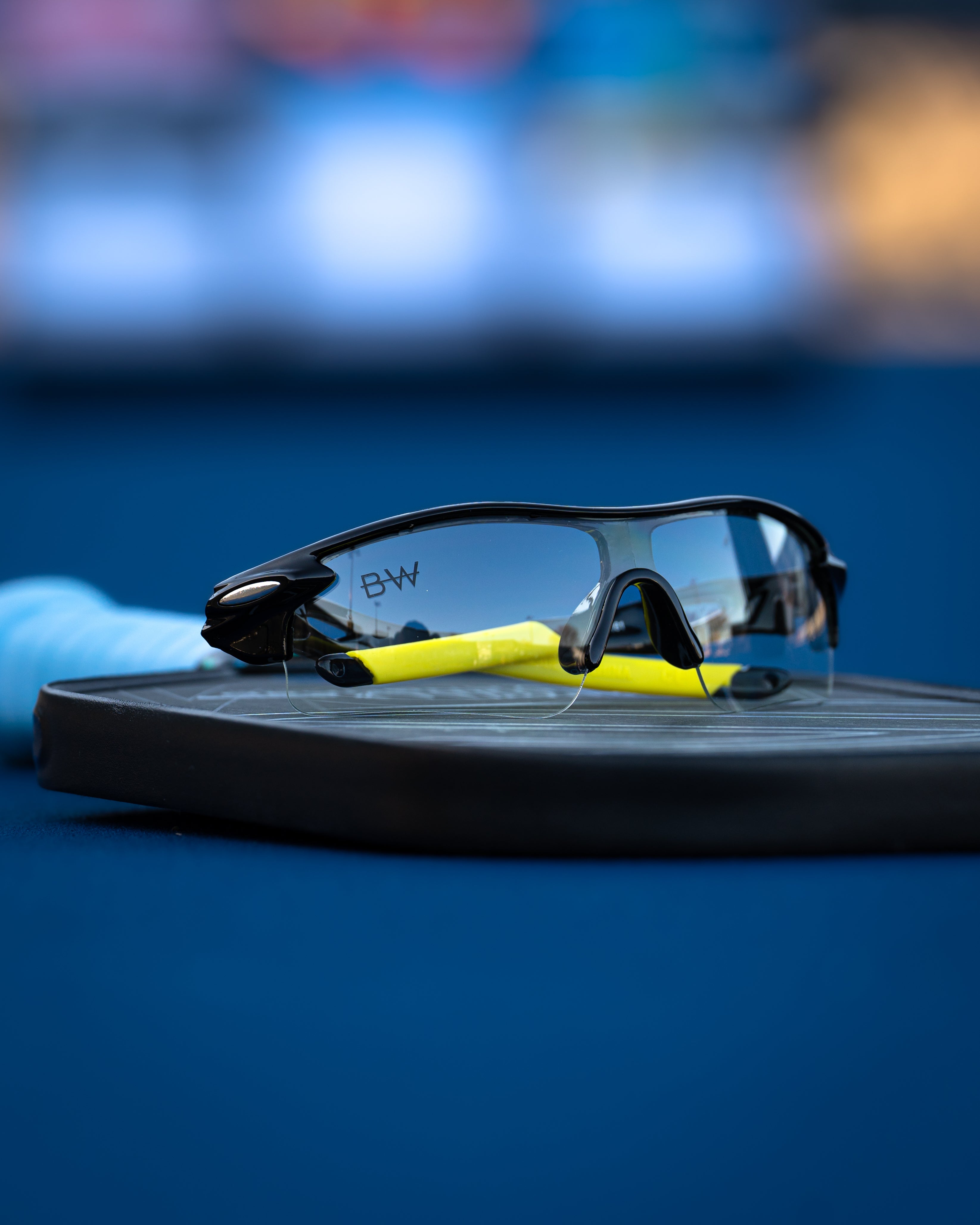
For players who require prescription correction, RX sports glasses can provide that correction during play. The eyewear does not automatically expand your natural visual field, increase peripheral-processing speed, or create full-court awareness. Those claims should be separated from the court-awareness skills players can actually practice.
Build Your Pickleball Eyewear Setup
What Is Peripheral Vision?
Peripheral vision generally refers to visual information outside the central area toward which you are directly directing your gaze.
If you are looking primarily toward the opponent contacting the ball, for example, other information may still be present elsewhere in your visual field.
That does not mean peripheral vision provides the same information as central vision or that you can identify every detail without looking toward it.
| Concept | Practical Description |
|---|---|
| Central Vision | Information near the point toward which gaze is directly directed |
| Peripheral Vision | Visual information outside that central area |
| Visual Attention | Which available information receives processing priority |
| Court Awareness | A broader sports skill involving vision, attention, positioning, experience, and tactical understanding |
| Anticipation | Using cues and previous experience to prepare for likely possibilities |
Why Does Peripheral Awareness Matter in Pickleball?
A pickleball rally contains more visual information than just the ball.
Depending on the situation, useful information can include:
- Your opponent's position
- Your partner's position
- Movement around the kitchen line
- Open court space
- Changes in opponent positioning
- The ball itself
- The overall developing rally
You cannot directly stare at every one of those things simultaneously.
Instead, players learn where to direct their gaze while using broader visual information, positioning, experience, and anticipation to understand the point.
That makes peripheral awareness relevant—but it does not mean every piece of peripheral information needs to be consciously identified during every rally.
Peripheral Vision Is Not the Same as Court Awareness
This distinction is important.
Someone can have normal peripheral vision and still make poor positional decisions on a pickleball court. Another player may appear highly aware because years of experience have taught them where opponents are likely to move.
Court awareness can involve:
- Peripheral visual information
- Central visual information
- Attention
- Anticipation
- Pattern recognition
- Positioning
- Partner communication
- Tactical knowledge
So when an experienced player seems to “see everything,” the explanation is usually more complex than simply having superior peripheral eyesight.
Can RX Sports Glasses Improve Peripheral Vision?
Prescription sports glasses provide the correction required by the wearer. That should not automatically be converted into a claim that the glasses expand a person's natural visual field or improve peripheral processing.
| RX Eyewear Can... | RX Eyewear Shouldn't Automatically Be Claimed to... |
|---|---|
| Provide prescribed vision correction | Expand your biological visual field |
| Use a sports-oriented frame | Increase peripheral-processing speed |
| Use impact-resistant lenses | Make lateral reactions faster |
| Use non-polarized lenses | Improve peripheral awareness automatically |
| Become familiar through practice | Prevent tunnel vision |
| Support active-use prescription needs | Guarantee full-court awareness |
Can the Frame Affect What You See Around It?
Frame geometry can influence the physical eyewear sitting within a wearer's field of view. However, that is different from claiming a frame expands the person's biological peripheral vision.
When comparing sports eyewear, consider the actual frame design and dimensions rather than relying on unsupported descriptions such as:
- “Unlimited peripheral vision”
- “180-degree court awareness”
- “Expanded visual field”
- “Zero peripheral obstruction”
- “Panoramic RX vision”
Unless an exact field-of-view characteristic has been measured and verified for a particular product, those phrases can overstate what the frame does.
If peripheral frame visibility matters to you, compare the current dimensions and design with eyewear you already know fits your face well.
Do Curved RX Lenses Automatically Give You Better Peripheral Vision?
Lens curvature and prescription optics can become technically complex. A curved-looking sports frame should not automatically be marketed as producing better peripheral vision, perfect edge clarity, or distortion-free vision at every viewing angle.
Those effects depend on the exact optical design and prescription.
Likewise, terms such as wide-angle RX geometry, low-distortion curvature, and edge-to-edge clarity should only be used when they describe verified characteristics of the specific product.
The safer buying approach is to evaluate the actual prescription configuration and frame rather than assuming more curvature always means more usable peripheral vision.
Does High-Index RX Expand Your Field of View?
No automatic field-of-view advantage should be attributed to high-index material.
High-index refers to a prescription lens-material category. It does not inherently mean:
- Wider peripheral vision
- Faster peripheral processing
- Better depth perception
- Improved reaction time
- Perfect edge clarity
- Greater court awareness
Blinded Wear includes high-index prescription lenses at no additional cost with RX eyewear.
Does Peripheral Vision Make You React Faster?
Peripheral information can be relevant during sport, but it is too broad to claim that enhanced peripheral vision automatically produces a specific reaction-time improvement.
A pickleball response involves multiple stages:
- Visual information is available.
- Attention is directed toward relevant information.
- The player interprets the situation.
- The player selects a response.
- The body executes that response.
That is why claims such as “23% faster lateral reactions” should not be generalized to pickleball players or attributed to a pair of RX sports glasses without evidence supporting the exact product, population, task, and measured outcome.
Awareness and Reaction Are Different Skills
Noticing that an opponent is moving is different from physically reacting correctly to the next shot.
For example, you might become aware that the right-side opponent is moving toward the middle. You still have to:
- Interpret why they are moving.
- Continue processing the ball.
- Decide whether their movement changes your shot.
- Select an appropriate response.
- Execute it.
Peripheral information can contribute to the situation, but it does not make the decision for you.
Peripheral Vision vs. Anticipation: Don't Confuse the Two
Players sometimes describe anticipation as though they “saw” a shot before it happened.
In reality, they may have recognized useful cues such as:
- An opponent shifting position
- Paddle preparation
- Body orientation
- Open court space
- A repeated tactical pattern
- The location of their partner
Some information may be central and some may be peripheral, but anticipation depends heavily on experience and pattern recognition.
No RX lens predicts where an opponent will hit next.
Why Peripheral Awareness Is Especially Interesting in Doubles
Doubles places four players on the court, making spatial awareness especially important.
During a rally, you may be primarily focused on the opponent interacting with the ball while still needing a broader understanding of:
- Your partner's general position
- The second opponent's movement
- Middle coverage
- Open court space
- Whether both opponents have reached the kitchen
Trying to look directly at every player during a fast rally would be inefficient.
Instead, doubles players develop positioning systems, communication habits, and pattern recognition that reduce how much information must be consciously checked.
Do You Need to See Your Partner During Every Doubles Rally?
Not necessarily.
Experienced teams often use predictable positioning principles and communication so each player does not need to visually confirm the partner's exact location every fraction of a second.
For example, awareness can come from:
- Knowing where your partner started the point
- Understanding standard movement patterns
- Hearing communication
- Recognizing where the ball has forced your team to move
- Using peripheral information when available
This demonstrates why court awareness is larger than peripheral eyesight alone.
Peripheral Awareness and the Middle Ball
Middle balls can create hesitation when both partners believe the other player may take the shot.
Better peripheral awareness may provide useful information about nearby movement, but the strongest solution is not necessarily trying to watch your partner more closely.
Teams can also reduce uncertainty through:
- Clear middle-ball responsibilities
- Communication
- Understanding forehand/backhand preferences
- Consistent positioning
- Practice together
No eyewear feature replaces those doubles systems.
Peripheral Awareness During Fast Kitchen Exchanges
At the kitchen line, players may have very little time between an opponent's contact and their own response.
Useful preparation includes:
- A stable ready position
- Compact paddle preparation
- Appropriate court positioning
- Recognition of attackable balls
- Repeated exposure to fast exchanges
Peripheral information may contribute to broader awareness, but a pair of glasses should not be credited with producing “microsecond timing” or instant volley reactions.
Can RX Glasses Prevent Tunnel Vision Under Pressure?
No conventional RX sports lens should automatically be claimed to prevent psychological tunnel vision.
When pressure rises, attention can become narrowly focused. Managing attention is a mental and perceptual skill rather than a feature automatically created by prescription eyewear.
A simple between-point reset can help a player redirect attention:
- Finish the previous point mentally.
- Confirm the score.
- Return to position.
- Identify the immediate tactical situation.
- Direct attention toward the next rally.
Can You Train Peripheral Awareness for Pickleball?
You can practice pickleball situations that require broader court awareness, recognition, and attention.
That is different from promising that a drill permanently expands your biological visual field.
A useful goal is therefore:
Learn to use available visual information more effectively during realistic pickleball situations.
This keeps the training focused on a sport skill rather than making unsupported claims about physically enlarging the eye's field of view.
5 Pickleball Drills for Better Court Awareness
1. Random Placement Drill
Have a partner vary shot placement without telling you where the next ball will go. Respond naturally while maintaining appropriate court position.
2. Two-Opponent Recognition Drill
In doubles practice, have opponents vary which player initiates an attack. Learn to recognize the developing rally without constantly shifting your gaze between every player.
3. Middle-Ball Communication Drill
Feed balls toward the middle while partners practice established responsibilities and verbal communication.
4. Dink-to-Speed-Up Drill
Begin with controlled dinks and allow either opponent to attack an appropriate ball. This forces players to process changing intent within a realistic rally.
5. Open-Point Awareness Drill
Play normal points with one objective: after each rally, identify where all four players finished and what movement created the open space.
These drills train awareness in the context where you actually need it.
What About Light-Reaction Training?
Reaction-light systems and app-based drills can create visual-response exercises, but success on a light board should not automatically be interpreted as improved pickleball performance.
A flashing light is not an opponent preparing a speed-up.
Pickleball contains:
- Ball movement
- Opponent movement
- Shot patterns
- Positioning
- Decisions
- Uncertainty
- Physical execution
If you use reaction-light training, consider it supplemental rather than a substitute for sport-specific practice.
Do Mirror-Tracking Drills Improve Pickleball Peripheral Vision?
Mirror exercises can create unusual visual tasks, but do not assume they expand the visual field, strengthen ocular muscles in a way that improves pickleball, or create faster sports reactions.
If your objective is better awareness during actual rallies, direct pickleball practice provides a closer match to the visual and tactical demands of the sport.
Do Near-Far Focus Drills Improve Peripheral Awareness?
Alternating gaze between near and distant targets is different from processing peripheral information during a pickleball rally.
Do not assume near-far drills automatically:
- Expand peripheral vision
- Improve reaction speed
- Increase court awareness
- Improve depth perception
- Improve ball tracking
When the goal is pickleball-specific awareness, train with pickleball-specific uncertainty.
A Better Progression for Training Court Awareness
| Stage | Training Environment | Primary Goal |
|---|---|---|
| 1. Predictable | Known shot location | Establish positioning and technique |
| 2. Limited Choice | Two possible shot locations | Introduce recognition |
| 3. Randomized | Multiple possible placements | Develop attention and decisions |
| 4. Doubles Pattern | Four-player structured rally | Add partner and opponent awareness |
| 5. Open Play | Normal competitive points | Integrate awareness with the full game |
The progression becomes increasingly realistic without pretending that the eyewear itself is training the athlete's peripheral nervous system.
Should You Wear Your RX Sports Glasses During Awareness Training?
If you require prescription correction and intend to compete in your RX sports glasses, practicing in that same eyewear can make the equipment familiar before competition.
This does not mean the glasses amplify the training effect.
The practical logic is:
Train the sport in the equipment you expect to use for the sport.
RX Pickleball Glasses to Compare
Rather than ranking frames according to unsupported “maximum peripheral vision” claims, compare your prescription needs, frame preferences, environment, dimensions, and verified product characteristics.
| RX Frame | What to Compare | Explore |
|---|---|---|
| Phantom II RX | Current RX configuration, frame design, and dimensions | Phantom II RX |
| Ocean Wave RX | Current RX configuration, design, and dimensions | Ocean Wave RX |
| Silver Line RX | Current prescription sunglass configuration and design | Silver Line RX |
| Rocket Fire RX | Current RX configuration, frame design, and dimensions | Rocket Fire RX |
| Frost RX | Current RX configuration, frame design, and dimensions | Frost RX |
| H Blue Shield RX | Compare when blue-light filtering is specifically part of your preferences | H Blue Shield RX |
What Blinded Wear RX Eyewear Actually Offers
Peripheral-vision marketing can quickly become exaggerated. A better comparison starts with verified characteristics.
- Designed for pickleball players
- Lightweight sports frames
- Impact-resistant lenses
- Non-polarized lenses
- Comfortable for extended matches
- Suitable for recreational and competitive players
- Performance-first design
- High-index prescription lenses included at no additional cost
- 50% lifetime replacement support if glasses break, subject to current policy terms
None of those characteristics requires claiming that the eyewear expands your visual field or makes your lateral reactions faster.
8 Peripheral Vision Myths Pickleball Players Should Know
1. “Wide Sports Glasses Expand Your Biological Visual Field”
A frame design and a person's biological visual field are not the same thing.
2. “RX Lenses Automatically Improve Peripheral Vision”
Prescription eyewear provides corrective vision. Do not automatically claim it expands peripheral awareness.
3. “Better Peripheral Vision Means Faster Reactions”
Reaction involves attention, recognition, decisions, and physical execution in addition to visual information.
4. “Curved Lenses Always Provide Better Side Vision”
The optical result depends on the exact lens design and prescription.
5. “High-Index Lenses Increase Peripheral Clarity”
High-index is a lens-material category, not an automatic peripheral-performance feature.
6. “A Tint Can Improve Lateral Awareness”
Do not assume a particular tint expands awareness or improves peripheral processing.
7. “Peripheral Training Expands Your Field of View”
Pickleball training can develop court awareness and use of available information without claiming the biological field of view physically expands.
8. “Great Players Watch Everything at Once”
Experienced players use positioning, attention, anticipation, communication, and pattern recognition to manage the court efficiently.
FAQs About Peripheral Vision in Pickleball
What is peripheral vision?
Peripheral vision generally refers to visual information outside the central area toward which you are directly directing your gaze.
Why is peripheral awareness useful in pickleball?
Pickleball includes movement and positioning beyond the exact point of central gaze. Peripheral information can contribute to broader awareness of the developing rally.
Can RX glasses expand my peripheral vision?
Do not automatically attribute an expanded biological visual field to prescription sports glasses.
Can a wide frame help me see more?
Frame design can affect the physical eyewear present within your field of view, but that should not be converted into an unverified claim about expanding biological peripheral vision.
Do curved lenses improve peripheral vision?
Do not assume curvature automatically creates superior peripheral vision or perfect edge clarity. The optical result depends on the specific design and prescription.
Can peripheral vision training improve reaction time?
Do not assume a universal reaction-time improvement. Pickleball-specific awareness training can practice recognition and decision-making in realistic situations.
Can peripheral training improve anticipation?
Sport-specific practice can help players learn cues and patterns that contribute to anticipation. That is different from claiming a generic peripheral exercise directly increases predictive ability.
Do I need to watch my partner during doubles?
You do not necessarily need direct visual fixation on your partner throughout every rally. Positioning systems, communication, experience, and available peripheral information can all contribute to partner awareness.
Can RX eyewear prevent tunnel vision?
Conventional RX sports glasses should not automatically be claimed to prevent psychological tunnel vision or control attention.
Does Blinded Wear use non-polarized lenses?
Yes. Blinded Wear sports eyewear uses non-polarized lenses.
Does Blinded Wear include high-index RX lenses?
Yes. High-index prescription lenses are included at no additional cost with Blinded Wear RX eyewear.
How do I submit my prescription?
Upload a clear photo or picture of your eyeglass prescription before purchasing RX eyewear.
Where Should You Look During a Pickleball Rally?
Peripheral-awareness training becomes more useful when it is paired with a sensible gaze strategy. The goal is not to stare straight ahead and attempt to play entirely through side vision.
Instead, direct vision toward the most relevant information while allowing broader court information to remain available around that central focus.
| Situation | Useful Visual Priority | Broader Awareness |
|---|---|---|
| Opponent Preparing to Hit | Opponent, contact area, and developing ball | General positioning of other players |
| Ball Traveling Toward You | Ball and information needed for your response | Court position and developing space |
| Crosscourt Dink Rally | Ball and opponent involved in the exchange | Other opponent and partner positioning |
| Fast Kitchen Exchange | Immediate rally information | Movement occurring around the primary action |
| Between Points | Score, positioning, and tactical reset | Overall court setup |
Peripheral vision complements direct visual attention. It does not replace it.
Should You Watch the Ball or the Opponent?
This does not have to be treated as an all-or-nothing choice.
Before and around contact, information from an opponent's positioning, preparation, and movement can help you understand the developing shot. Once the ball is traveling, the ball itself becomes critical information for your response.
The exact gaze strategy can vary with the situation, but the larger lesson is important:
Effective pickleball vision involves shifting attention toward useful information rather than attempting to stare at every element of the court simultaneously.
The Four-Player Awareness Map for Doubles
Doubles players can simplify court awareness by thinking of the rally as a changing four-player map.
You do not need to inspect every player's exact location continuously. Instead, maintain a general understanding of the court structure.
1. Where Are You?
Your own position determines which court space you can realistically cover.
2. Where Is Your Partner?
Partner positioning affects middle coverage, open space, and team movement.
3. Where Is the Ball-Side Opponent?
The opponent interacting with the ball usually deserves significant immediate attention.
4. Where Is the Other Opponent?
You may not be directly looking at this player, but their general location remains relevant to the developing point.
With practice, these relationships can become increasingly familiar instead of requiring four separate conscious visual checks.
Good Positioning Reduces How Much You Need to Visually Chase
One overlooked part of court awareness is positioning.
If you repeatedly move into poor positions, you may feel as though opponents and balls are constantly appearing unexpectedly around you. Better positioning can make the developing rally easier to understand because your body is already located where the next response is more manageable.
| Problem | Possible Cause Beyond Vision |
|---|---|
| Opponent's attack feels surprising | Attack cues were recognized late |
| Partner constantly seems out of position | Team movement expectations are unclear |
| Middle balls create hesitation | Responsibilities have not been established |
| Open court appears too late | Attention may be staying on the previous shot too long |
| Fast volleys feel impossible to react to | Ready position or paddle preparation may be late |
| Opponent seems to appear unexpectedly | Positioning and pattern recognition may need work |
Before assuming you need “wider vision,” determine whether positioning or anticipation is actually the limiting factor.
How Peripheral Awareness Changes Across the Pickleball Court
The visual and tactical demands of pickleball change as you move through different court zones.
| Court Zone | Common Awareness Demand |
|---|---|
| Baseline | Ball, opponent positioning, return or drive preparation, and movement forward |
| Transition Zone | Ball recognition, balance, opponent positioning, and deciding when to continue forward |
| Kitchen Line | Rapid ball exchanges, opponent preparation, partner positioning, and middle coverage |
| Wide Court Position | Recovery position, exposed court space, and opponent movement |
This is another reason full-court practice is valuable. Awareness is not one fixed skill performed identically from every position.
The Transition Zone Is an Awareness Test
The transition zone can become visually and tactically demanding because players may be moving while simultaneously evaluating the incoming ball and opponent positions.
Rather than attempting to consciously monitor the entire court, prioritize:
- The incoming ball
- Your balance
- Your current court position
- The opponent interacting with the rally
- Whether continuing forward is appropriate
Repeated transition practice helps these decisions become more familiar. No lens can make the positional decision for you.
Peripheral Awareness When an Opponent Lobs
Lobs illustrate why court awareness involves more than side vision.
Once you recognize a lob, you may need to process:
- The ball's movement
- Your own position
- Your partner's likely movement
- Available recovery space
- Who should play the ball
Trying to visually inspect each factor individually can make the response unnecessarily complicated.
Team communication and practiced movement patterns help organize the situation.
Can Peripheral Awareness Help You Recognize a Poach?
In doubles, an opponent may move across the court to intercept a ball. Their movement can become part of the visual information available during the point.
But recognizing a poach does not require a lens that claims to expand peripheral vision.
Players can become more prepared for this situation by practicing against opponents who:
- Stay home
- Fake movement
- Cross aggressively
- Shift toward the middle
Randomizing those choices teaches the player to respond to actual movement instead of memorizing a predetermined feed.
A 20-Minute Pickleball Court-Awareness Drill Circuit
Instead of relying entirely on generic vision exercises, build awareness directly into pickleball practice.
Minutes 0–5: Random Dink Placement
Use crosscourt, middle, and controlled straight-ahead placement. Keep the rally realistic rather than announcing every destination.
Minutes 5–10: Dink or Speed-Up
Allow the feeder to continue the dink rally or attack an appropriate ball. The receiving player must recognize the changing situation.
Minutes 10–15: Two-on-Two Movement
Play structured doubles rallies while deliberately varying opponent movement and middle coverage.
Minutes 15–20: Open Points
Remove the restrictions and play normal points. After selected rallies, briefly identify what movement or positioning you noticed before the point ended.
This creates direct practice using the visual, tactical, and physical information present in pickleball.
A 4-Week Peripheral Awareness Training Plan for Pickleball
Week 1: Learn the Court Map
- Practice basic doubles positioning.
- Establish middle-ball responsibilities.
- Use controlled rallies.
- Notice where all four players finish each point.
Week 2: Add Unpredictable Placement
- Randomize dink locations.
- Mix forehand and backhand responses.
- Allow opponents to change positions.
- Practice recovering after being pulled wide.
Week 3: Add Tactical Uncertainty
- Mix dinks and speed-ups.
- Practice poaches.
- Add lobs.
- Use drive-or-drop patterns.
- Play points beginning from the transition zone.
Week 4: Add Competition
- Play open doubles games.
- Rotate partners and opponents.
- Start games at pressure scores.
- Use the eyewear you intend to wear in competition.
The objective is not to physically enlarge your visual field in four weeks. It is to become more experienced at recognizing and using relevant information during realistic play.
How Do You Know Whether Your Court Awareness Is Improving?
Instead of trying to measure whether your peripheral vision has “expanded,” track pickleball-specific behaviors.
| Training Question | What You're Evaluating |
|---|---|
| Am I surprised by fewer obvious speed-ups? | Recognition and preparation |
| Do my partner and I hesitate less on middle balls? | Communication and team structure |
| Am I recovering toward useful positions more consistently? | Positioning awareness |
| Do I recognize open space earlier? | Tactical awareness |
| Can I identify why an opponent's movement created an opening? | Pattern recognition |
| Do I maintain better court structure during long rallies? | Positioning and awareness |
These observations are more directly connected to pickleball than claiming that a drill increased your visual field by a certain percentage.
Use Video to Train Awareness Without Guessing
Video can be particularly useful because it allows you to review court positioning after the rally has already happened.
When watching a recorded point, pause immediately before an important shot and ask:
- Where is the ball?
- Where are both opponents?
- Where is my partner?
- What court space is open?
- What movement is beginning?
- What options appear most likely?
- Where was I positioned?
Then continue the video and compare your expectation with what actually happened.
This trains tactical observation without pretending that software or eyewear can automatically transfer awareness into match performance.
Does Better Peripheral Awareness Make You Mentally Calmer?
Do not promise that expanding peripheral awareness automatically reduces mental fatigue, creates calm, or sharpens decision-making.
However, familiarity with common court situations can reduce how unfamiliar those situations feel.
A player who has repeatedly practiced:
- Middle balls
- Speed-ups
- Poaches
- Lobs
- Wide dinks
- Transition-zone attacks
has previous experience to draw from when those situations occur again.
That is a training effect—not a mental-calming property of the lens.
Does Peripheral Vision Get Worse Late in a Match?
If your court awareness declines late in play, do not automatically assume your peripheral vision itself is failing.
Other factors can affect late-match performance, including:
- Physical fatigue
- Reduced movement quality
- Slower recovery to position
- Attention changes
- Poor decisions
- Competitive pressure
If you experience persistent or concerning changes in your actual vision, that is different from normal sports-performance fatigue and is an appropriate issue to discuss with an eye-care professional.
Indoor vs. Outdoor Peripheral Awareness
The surrounding visual environment can look very different between an indoor facility and an outdoor court, but that does not mean you need a special “peripheral enhancement” lens for each one.
| Routine | Eyewear Category to Consider |
|---|---|
| Primarily Indoor | Clear RX when prescription correction is required and dark sunglass tint is not preferred |
| Primarily Outdoor | Compare current outdoor RX configurations |
| Indoor + Outdoor | Compare photochromic RX with separate environment-specific pairs |
| Specific Blue-Light Preference | Compare available blue-light-filtering RX options |
| Contacts Provide Correction | Compare non-RX pickleball eyewear |
Choose according to your prescription and environment rather than an unsupported promise of greater lateral awareness.
Clear RX Glasses for Indoor Court Awareness
Players who require prescription correction indoors may consider clear RX eyewear when they do not want dark sunglass tint.
Clear lenses should not automatically be described as:
- Expanding peripheral vision
- Increasing available light
- Improving lateral clarity
- Increasing reaction speed
- Enhancing depth perception
The verified distinction is straightforward: clear lenses provide a configuration without dark sunglass tint.
Do Non-Polarized Lenses Improve Peripheral Awareness?
Blinded Wear sports eyewear uses non-polarized lenses. A non-polarized lens does not add a polarization filter, preserving the visual information available without that filter.
Some court players prefer non-polarized eyewear.
That does not mean non-polarized lenses inherently:
- Expand peripheral vision
- Improve side awareness
- Improve depth perception
- Increase reaction speed
- Improve ball tracking
Keep the lens characteristic separate from performance claims that have not been established.
Impact-Resistant Does Not Mean Wider Vision
Blinded Wear sports eyewear uses impact-resistant lenses. Impact resistance describes a lens characteristic and should not be blended with unrelated visual-performance claims.
It does not mean the lens automatically provides:
- A wider field of view
- Better peripheral processing
- Faster reactions
- Enhanced spatial awareness
Impact-resistant also should not automatically be interpreted as shatterproof, unbreakable, or as evidence of a specific protective certification.
How to Shop for RX Sports Glasses When Peripheral Visibility Matters
If you dislike feeling visually crowded by your current eyewear, use a practical comparison process instead of relying on “maximum field-of-view” marketing.
Step 1: Start With Your Prescription
Determine the correction you actually require.
Step 2: Look at Frame Dimensions
Compare current product measurements with glasses you already know fit comfortably.
Step 3: Look at the Actual Frame Design
Use product images and verified specifications rather than assuming terms such as “wide-angle” guarantee a particular field of view.
Step 4: Choose for Your Environment
Consider whether you primarily play indoors, outdoors, or across changing environments.
Step 5: Evaluate Verified Lens Characteristics
Separate high-index, non-polarized, impact-resistant, clear, tinted, photochromic, and other lens characteristics according to what they actually mean.
Step 6: Practice Before Competition
Use the eyewear during realistic rallies so the frame becomes familiar before an important event.
Peripheral Vision Eyewear Claims to Question
Sports-eyewear marketing can make legitimate optical concepts sound more powerful than they are.
Look more carefully when you see claims such as:
- “Expands your natural field of vision”
- “23% faster lateral reactions”
- “Zero peripheral distortion”
- “Instant spatial mapping”
- “Enhances eye-brain synchronization”
- “Strengthens ocular muscles”
- “Improves reflex accuracy”
- “Creates panoramic awareness”
- “Automatically improves depth perception”
- “Prevents tunnel vision”
For a measurable sports-performance claim, look for evidence involving the exact product, relevant population, comparison condition, task, and measured outcome.
How to Order Blinded Wear RX Pickleball Glasses
- Have your current eyeglass prescription available.
- Browse the RX pickleball collection.
- Compare frame designs, dimensions, and current lens configurations.
- Choose eyewear appropriate to your prescription needs and playing environment.
- Upload a clear photo or picture of your eyeglass prescription before purchasing.
High-index prescription lenses are included at no additional cost with Blinded Wear RX eyewear.
Replacement Support for Your Pickleball Eyewear
Blinded Wear offers 50% lifetime replacement support if glasses break, subject to current policy terms.
This should not be interpreted as an unlimited replacement promise for every circumstance or as meaning the glasses cannot break.
Review the current policy for complete details.
More Questions About Peripheral Vision Training
Can peripheral vision help me know where my partner is?
Peripheral visual information can contribute to broader awareness, but partner positioning is also understood through communication, starting position, team movement patterns, and experience.
Should I try to see the entire court at once?
No. Direct attention toward useful information while maintaining broader awareness of the developing rally.
Should I stare at the ball throughout the entire point?
Visual priorities can change throughout a rally. Opponent preparation, contact, ball movement, positioning, and other information can all become relevant at different moments.
Can peripheral vision help with middle balls?
Available peripheral information may contribute to awareness of partner movement, but clear responsibilities, communication, and practice are also important.
Can peripheral awareness help against speed-ups?
Awareness is part of the broader response, but recognizing attack cues, maintaining a ready position, positioning well, and repeatedly practicing fast exchanges are also important.
Can peripheral awareness help with poaching?
Opponent movement can become part of the information available during the rally. Practice against variable movement can help develop recognition of those situations.
Can peripheral training make my vision wider?
Do not assume sports drills physically expand your biological field of view. A more appropriate goal is improving how you use available information during play.
Do reaction-light drills transfer directly to pickleball?
They can create a visual-response task, but success with lights should not automatically be interpreted as improved pickleball performance. Sport-specific practice remains important.
Does frame size determine peripheral vision?
Frame design can affect what physical eyewear is present within your field of view, but it does not by itself determine your biological peripheral vision.
Are wider lenses always better?
No universal rule applies. Consider your prescription, frame fit, current dimensions, optical design, environment, and preferences.
Can RX lenses eliminate peripheral distortion?
Do not assume perfect edge-to-edge or distortion-free vision unless the exact optical characteristic has been verified for the specific prescription and lens design.
Does the Blinded Wear quiz measure peripheral vision?
No. The quiz is a shopping tool designed to help narrow eyewear options. It is not a peripheral-field examination or sports-vision diagnostic test.
What if I notice an actual loss of peripheral vision?
An unexpected change or loss in your visual field is different from sports court-awareness training and should be evaluated appropriately rather than treated as a pickleball-performance problem.
Turn Peripheral Awareness Training Into Match-Day Awareness
Training only matters if you can use the skill when rallies become unpredictable. Before competition, move from isolated awareness drills toward normal pickleball points.
A practical progression is:
- Practice predictable shots while establishing positioning.
- Add randomized placement.
- Add multiple possible opponent responses.
- Add partner and opponent movement.
- Add score pressure.
- Finish with unrestricted points and games.
If you require prescription correction, complete that progression in the RX sports glasses you expect to use during competition. The eyewear provides the correction; the increasingly realistic practice develops the player's familiarity with the game situations.
Your 30-Second Court-Awareness Checklist
You should not run through a long mental checklist in the middle of every rally. Instead, use a few simple questions between points to keep your attention organized.
- Where am I? Check your court position.
- Where is my partner? Reestablish your team's structure.
- Where are the opponents? Notice their starting positions.
- What happened last point? Identify a useful pattern without dwelling on the result.
- What matters next? Return attention to the upcoming rally.
Once the ball is in play, compete rather than continuing to consciously inventory the entire court.
Peripheral Awareness in 6 Common Pickleball Situations
| Situation | Primary Challenge | Useful Skill |
|---|---|---|
| Crosscourt Dink | Processing the ball while maintaining broader doubles awareness | Positioning and recognition |
| Middle Ball | Partner uncertainty | Communication and established responsibilities |
| Speed-Up | Limited response time | Preparation and recognition of attack cues |
| Poach | Opponent movement changes the expected court picture | Movement recognition and anticipation |
| Lob | Ball movement changes positioning requirements | Communication and recovery |
| Wide Dink | Movement creates open space elsewhere | Recovery and court awareness |
Notice that none of these situations has “buy wider lenses” as the primary solution. Eyewear can provide needed prescription correction, while the player develops the awareness required to solve the rally.
What to Do When a Ball “Comes Out of Nowhere”
After being surprised by a shot, players sometimes conclude that they simply did not see it.
Before blaming peripheral vision, review what actually happened:
- Where were you positioned?
- Where was your attention immediately before contact?
- Was your opponent showing an attack cue?
- Was your paddle prepared?
- Did you expect a different shot?
- Did your partner's movement affect your position?
- Had the opponent used the same pattern earlier?
The answer may involve vision, but it may also involve anticipation, positioning, attention, or an incorrect tactical expectation.
Is It an Eyewear Problem or an Awareness Problem?
| What You're Experiencing | What to Investigate |
|---|---|
| Frame feels physically noticeable at the edge of vision | Compare frame dimensions and design |
| Prescription vision seems unexpectedly blurry | Consider whether the correction needs professional evaluation |
| You repeatedly miss opponent movement | Review attention, positioning, and awareness practice |
| You hesitate on middle balls | Establish partner responsibilities and communication |
| Speed-ups repeatedly surprise you | Practice recognizing attackable balls and opponent preparation |
| You see the attack but still respond late | Review ready position, paddle preparation, decision-making, and technique |
| You lose court structure during long rallies | Practice positioning and recovery during open play |
Correctly identifying the problem prevents you from trying to solve a tactical issue with a new lens—or an actual corrective vision issue with another drill.
What Should a Prescription Player Bring to a Tournament?
If prescription correction is important to your ability to play, losing access to your primary eyewear can create an avoidable problem.
Consider preparing:
- Your primary RX sports glasses
- Another suitable corrective option
- An appropriate case
- Any eyewear items you normally use
- A plan for different playing environments if the tournament changes venues or conditions
A backup does not improve peripheral vision. It provides redundancy if your primary corrective option becomes unavailable.
Which Pickleball Eyewear Setup Fits Your Routine?
| Player Situation | Starting Point |
|---|---|
| I need prescription correction while playing | Compare RX pickleball glasses |
| I primarily play indoors without dark sunglass tint | Compare clear lens options |
| I frequently move between environments | Compare photochromic RX with dedicated pairs |
| Blue-light filtering is specifically important to me | Compare H Blue Shield RX |
| I use contacts for my correction | Compare non-RX pickleball eyewear |
| I compete frequently and rely on RX eyewear | Consider a primary pair plus another suitable corrective option |
| I'm unsure which category fits me | Use the Pickleball Glasses Quiz |
What Should Matter Most When Choosing RX Pickleball Glasses?
Peripheral-vision marketing can distract from more fundamental buying questions. Keep your priorities centered on your actual needs.
- Prescription needs: Start with the correction you require.
- Playing environment: Consider where you actually play.
- Frame dimensions and design: Compare them with eyewear you already know fits.
- Verified lens characteristics: Understand what each available feature actually does.
- Comfort during extended play: Choose sports eyewear you can realistically use through matches and practice.
- Familiarity: Practice in your competition setup.
- Backup planning: Consider another corrective option when appropriate.
Those considerations are more useful than choosing a frame because it promises to “unlock 180-degree awareness.”
Final FAQs: Peripheral Vision, RX Glasses & Pickleball
Can I play pickleball using only peripheral vision?
No. Peripheral information complements direct visual attention. Pickleball requires players to direct their gaze toward important visual information throughout the rally.
Should I keep my eyes in the middle of the court?
There is no universal instruction to stare at one fixed location throughout every point. Visual priorities change as the rally develops.
Should I watch my opponent's paddle?
Opponent preparation and contact can provide useful information, but pickleball vision involves more than maintaining fixation on one object throughout the entire rally.
Why do I lose track of the other opponent in doubles?
The issue may involve attention, positioning, experience, or court-awareness habits rather than an abnormality in peripheral vision.
How can I get better at knowing where everyone is?
Practice doubles positioning, communication, randomized rallies, and post-point court awareness. Over time, common movement patterns can become more familiar.
Can peripheral vision help me find open court?
Peripheral information can contribute to awareness, but identifying open court also depends on opponent positioning, tactical understanding, and pattern recognition.
Does better peripheral awareness improve shot accuracy?
Do not assume a direct improvement in shot accuracy. Shot execution depends on technique, positioning, decisions, movement, and other factors.
Does peripheral training improve balance?
Do not automatically claim pickleball peripheral-awareness drills improve balance. Balance is a separate physical and sensory function.
Does peripheral training reduce fatigue?
No automatic reduction in physical, visual, or mental fatigue should be promised from peripheral-awareness training.
Can sports glasses improve spatial awareness?
RX sports glasses provide prescribed correction when required. Spatial and court awareness involve broader visual, perceptual, tactical, and experiential factors.
Are wraparound glasses always better for peripheral vision?
No universal advantage should be assumed solely from a wraparound appearance. Prescription optics, frame geometry, dimensions, and individual needs all matter.
Do bigger lenses automatically mean better peripheral vision?
No. Lens size alone does not establish an expanded biological visual field or superior peripheral processing.
Can I test my peripheral vision myself with pickleball drills?
Pickleball drills can evaluate sport-specific awareness, but they are not a clinical visual-field examination.
What if one side of my peripheral vision seems different?
A new or concerning change in your actual visual field is different from normal pickleball court-awareness training and should not be treated as an equipment or practice problem.
Can RX glasses make me react instantly?
No. Reaction involves perception, decisions, movement, and technique. RX eyewear should not be marketed as producing instant reactions.
How long should I practice awareness drills?
Rather than chasing a fixed number of minutes, integrate awareness into normal pickleball training and progressively increase the uncertainty and realism of the drills.
Continue Building Your Pickleball Vision & Eyewear Setup
Peripheral Vision in Pickleball: The 30-Second Summary
| Question | Bottom Line |
|---|---|
| What is peripheral vision? | Visual information outside the central area toward which gaze is directly directed |
| Is peripheral vision the same as court awareness? | No |
| Can RX glasses expand your biological visual field? | That should not automatically be claimed |
| Do wider frames automatically make reactions faster? | No |
| Can pickleball awareness be trained? | Yes, through realistic practice involving attention, positioning, recognition, and decisions |
| Does peripheral information matter in doubles? | It can contribute to broader awareness of movement and positioning |
| What does RX eyewear directly provide? | The prescription correction required by the wearer |
| What creates strong court awareness? | Vision, attention, positioning, communication, anticipation, pattern recognition, and experience |
Train the Player Behind the Lenses
Peripheral awareness matters in pickleball because the game is larger than the exact point you are staring at. Opponents move, partners reposition, openings develop, and rallies change quickly.
But the solution is not a lens that promises to magically expand your field of view.
Train doubles positioning. Practice unpredictable rallies. Learn opponent cues. Establish communication with your partner. Recognize common patterns. Play against different styles. Review your mistakes. Gradually make practice more realistic.
If you require prescription correction, Blinded Wear RX eyewear provides a sports-oriented way to bring that correction onto the court, with lightweight sports frames, impact-resistant non-polarized lenses, comfort for extended matches, performance-first design, and high-index prescription lenses included at no additional cost.
The Bottom Line: Court Awareness Is Bigger Than Peripheral Vision
Peripheral vision is a real part of how humans receive visual information, but pickleball court awareness is not simply a measurement of how far to the side you can see.
A strong player combines central and peripheral information with positioning, attention, anticipation, communication, tactical knowledge, and thousands of previous experiences.
That is why an advanced doubles player can seem to know where everyone is without constantly looking directly at every person on the court.
Prescription sports glasses should support the corrective vision needs of the athlete—not be marketed as a shortcut around learning those skills.
Use the correction you require. Choose eyewear for your real needs. Then train yourself to recognize more of what the court is already telling you.
That is the overlooked edge: not magically seeing a bigger court, but becoming better at understanding the one already in front of you.