
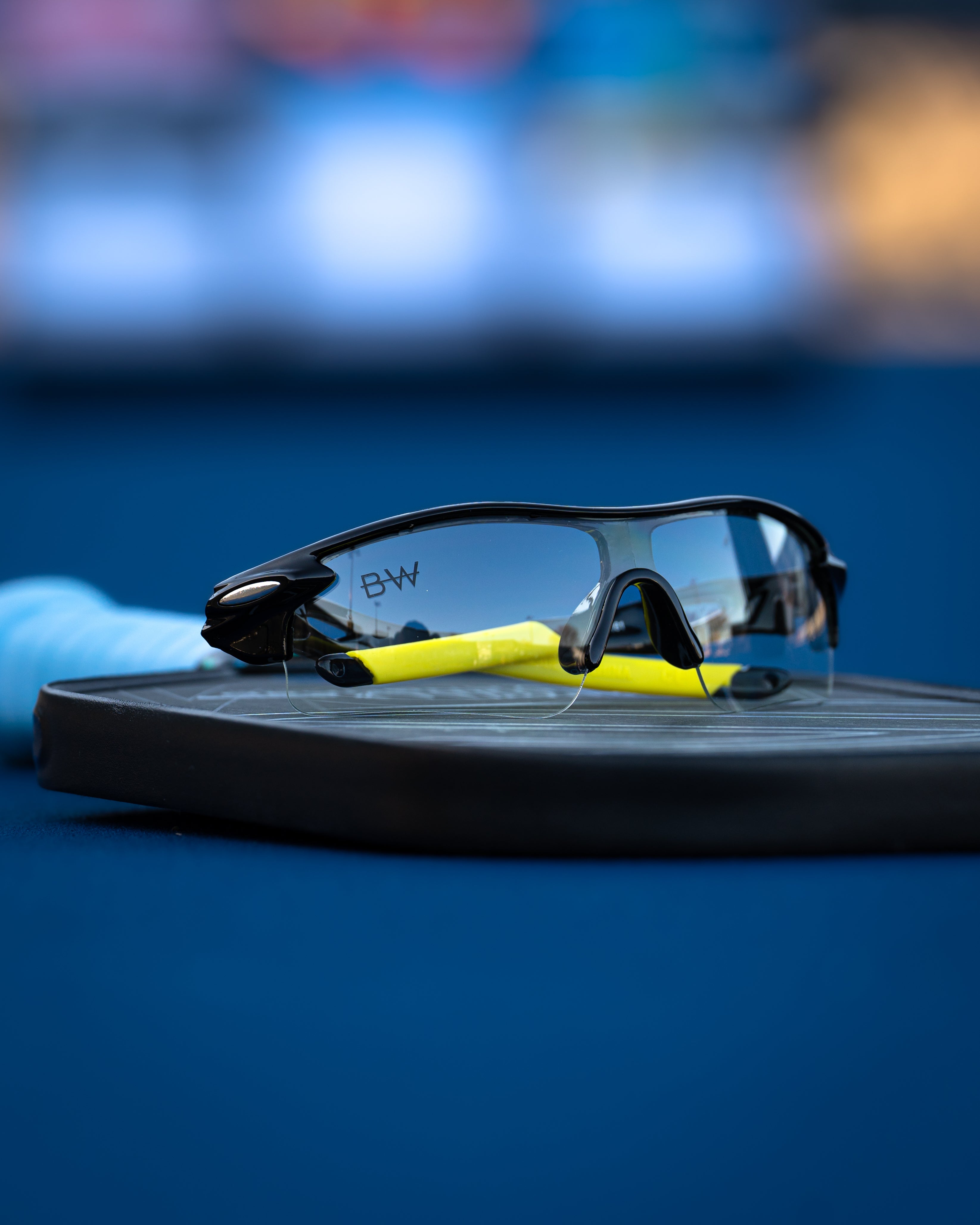
Prescription Sports Glasses for Teens: Ages 14+
Share
Prescription Sports Glasses for Teens Ages 14+: A Guide for Teen Athletes & Parents
Teen athletes who require prescription correction need eyewear that starts with the most important requirement: the correct RX for their individual vision needs. From pickleball and tennis to gym training and other compatible sports, prescription sports glasses can incorporate that correction into eyewear designed with active use in mind.
For teens ages 14 and older, choosing sports eyewear should not be based on promises of faster reactions, better depth perception, or automatic athletic improvement. Parents and teens should instead compare the prescription, frame dimensions, training environment, verified lens characteristics, individual fit preferences, and any protective requirements of the sport.
This guide explains how to compare prescription sports glasses for teens, when a dedicated RX pair may make sense, what parents should verify before ordering, and how to separate useful eyewear characteristics from sports-marketing claims.
Find Prescription Sports Eyewear for Your Teen
What Are Prescription Sports Glasses for Teens?
Prescription sports glasses are sports-oriented eyewear that incorporates the wearer's prescribed refractive correction.
For a teen who needs correction during activity, this can provide an alternative to relying exclusively on everyday glasses or contacts.
Teen athletes may consider prescription sports eyewear for activities such as:
- Pickleball
- Tennis
- Gym and fitness training
- Running
- Other compatible recreational activities
However, “sports glasses” does not automatically mean that one pair is appropriate or certified for every sport. Some activities can have specific protective-equipment requirements that should be checked separately.
Why Does This Guide Focus on Teens Ages 14+?
Age 14 is a useful audience category for this guide, but it is not a medical cutoff that determines when someone should begin wearing prescription sports glasses.
A teen should use prescription correction according to their individual vision needs and appropriate eye-care guidance—not simply because they reached a particular birthday.
Likewise, a 14-year-old and an 18-year-old can have very different:
- Prescriptions
- Frame sizes
- Sports schedules
- Training environments
- Corrective needs
- Eyewear preferences
Parents should therefore treat age as one part of the shopping context rather than the deciding factor.
Does Your Teen Need Dedicated Prescription Sports Glasses?
Not every teenager who wears prescription glasses needs a separate sports pair.
A dedicated RX sports setup becomes worth comparing when a teen requires correction during activity and wants that correction incorporated into sports-oriented eyewear.
| Teen's Current Situation | What to Consider |
|---|---|
| Needs RX and plays frequently | A dedicated prescription sports pair may receive regular use. |
| Needs RX but plays occasionally | Compare dedicated sports eyewear with the corrective setup already being used. |
| Uses contacts during sports | Contacts paired with non-RX sports eyewear may be another option. |
| Does not require correction during activity | Prescription lenses may be unnecessary. |
| Plays several sports | Check whether one RX setup can appropriately cover multiple compatible activities. |
What Are the Benefits of RX Sports Glasses for Teen Athletes?
The clearest benefit is also the simplest: prescription sports glasses provide prescribed vision correction in sports-oriented eyewear.
Depending on the specific product, they can combine correction with verified characteristics selected for active use.
| What RX Sports Eyewear Can Provide | What It Does Not Automatically Provide |
|---|---|
| Prescribed refractive correction | Faster reaction time |
| A sports-oriented frame | Better athletic technique |
| Verified lens characteristics | Enhanced depth perception |
| A dedicated corrective setup for activity | Improved hand-eye coordination |
| Potential use across compatible activities | Guaranteed improvement in ball tracking |
Teen athletes do not need exaggerated performance promises for prescription sports eyewear to be useful. If correction is needed during play, providing that correction in an appropriate active-use setup is already meaningful.
What Should Parents Look for in Prescription Sports Glasses?
Parents comparing teen RX eyewear can simplify the process by focusing on a few concrete questions.
- Does my teen currently require prescription correction?
- Is the prescription information being used current and appropriate?
- Which sport will the eyewear be used for most?
- Will it primarily be worn indoors, outdoors, or both?
- What frame dimensions already fit my teen?
- Which lens and frame characteristics are actually verified?
- Does the sport require a specific type of protective eyewear?
- Will my teen realistically wear the frame consistently?
This approach is more useful than choosing according to the longest list of performance claims.
How Important Is an Accurate Prescription for Teen Sports Glasses?
Prescription sports eyewear should be built around the teen's actual corrective needs.
Do not intentionally make a prescription stronger or weaker because the eyewear will be used for sports. Prescription strength is not an athletic-performance setting.
If there is uncertainty about whether a teen's current prescription remains appropriate, seek professional eye-care evaluation rather than trying to compensate through sports-lens features.
What Are High-Index Prescription Lenses for Teens?
High-index refers to a category of prescription lens material. It is a prescription-eyewear characteristic rather than a technology that automatically improves athletic performance.
Blinded Wear includes high-index prescription lenses at no additional cost with RX eyewear.
High-index lenses should not automatically be described as providing:
- Less eye strain
- Better reaction time
- Improved depth perception
- Better ball tracking
- Enhanced athletic performance
There is also no need to assign one exact refractive index to every order unless that specification has been verified for the current RX configuration.
Why Does Blinded Wear Use Non-Polarized Sports Lenses?
Blinded Wear sports eyewear uses non-polarized lenses. Non-polarized lenses do not add a polarization filter and preserve visual information available without that filter.
Some court players prefer non-polarized eyewear. However, parents should be cautious of turning that preference into an unsupported promise.
Non-polarized lenses do not automatically:
- Improve depth perception
- Improve ball tracking
- Increase reaction speed
- Improve spin recognition
- Make a teen a better athlete
The presence or absence of a polarization filter should be treated as a lens characteristic rather than a guarantee of athletic improvement.
Are Prescription Sports Glasses for Teens Impact-Resistant?
Blinded Wear sports eyewear uses impact-resistant lenses. For parents comparing active-use eyewear, that is a useful physical lens characteristic.
It is equally important to understand what the term does not establish.
| Verified Description | Do Not Automatically Assume |
|---|---|
| Impact-Resistant | Shatterproof or indestructible |
| Sports-Oriented Frame | Certified for every sport |
| Active-Use Eyewear | Guaranteed prevention of eye injury |
| Lightweight Sports Frame | Guaranteed fit or stability for every teen |
If a teen participates in a sport requiring a particular protective standard, parents should verify that requirement rather than assuming general sports eyewear satisfies it.
Sports Glasses vs. Protective Sports Eyewear: Parents Should Know the Difference
The terms sports eyewear and certified protective eyewear should not automatically be treated as interchangeable.
This distinction becomes especially important for younger athletes who participate in school, club, recreational, or competitive sports with different equipment requirements.
Before using the same RX pair across multiple activities, ask:
- Does this sport have an eyewear requirement?
- Is a specific protective standard required?
- Does the exact product carry that verified certification?
- Is general sports eyewear appropriate for the intended activity?
Impact resistance is useful information, but it should remain separate from an unverified certification claim.
Everyday Prescription Glasses vs. Sports RX Glasses for Teens
Everyday prescription glasses may work for some teens during some activities. A dedicated sports pair is not automatically required.
Sports RX eyewear becomes worth comparing when a teen needs correction and a separate active-use setup solves a practical problem.
| Everyday RX Glasses | RX Sports Glasses |
|---|---|
| Primarily selected for everyday use | Sports-oriented frame |
| May already work for certain activities | Can serve as a dedicated corrective sports setup |
| Features vary by model | Sports features also vary and should be verified |
| May prioritize everyday style preferences | Can be selected around a teen's athletic routine |
The goal is not to convince every parent that their teen needs another pair of glasses. It is to determine whether dedicated RX sports eyewear has a useful role in the teen's routine.
Prescription Sports Glasses vs. Contacts for Teen Athletes
Teens who require correction may have more than one possible setup, depending on their individual eye-care needs and preferences.
| Setup | How Correction Is Provided | Approach |
|---|---|---|
| RX Sports Glasses | Prescription is incorporated into the eyewear. | A dedicated corrective sports setup. |
| Contacts + Non-RX Sports Eyewear | Contacts provide correction. | Sports eyewear can be selected separately. |
| Everyday RX Glasses | Everyday lenses provide correction. | May already meet some teens' needs during certain activities. |
For questions about whether contacts are appropriate for an individual teen, follow guidance from the teen's eye-care professional.
Prescription Pickleball Glasses for Teens
For a teen pickleball player who requires correction, prescription sports eyewear can incorporate that RX directly into an active-use frame.
When comparing prescription pickleball glasses, parents and teens should consider:
- The teen's prescription needs
- Available frame dimensions
- Indoor vs. outdoor play
- Current lens configuration
- Impact resistance
- Polarized vs. non-polarized configuration
- Verified product characteristics
- Individual fit and style preferences
Whether a teen is a beginner, recreational player, or competitive athlete does not determine whether prescription correction is necessary.
What RX Sports Glasses Work for Indoor Teen Athletes?
If a teen requires prescription correction and frequently trains indoors, a clear or other non-dark-tinted RX configuration may be worth comparing.
Clear lenses can be considered for environments such as:
- Indoor pickleball courts
- Indoor training facilities
- Gym sessions
- Evening activity
- Lower-light settings where a dark sunglass tint is not preferred
Clear means there is no dark sunglass tint. It should not automatically be interpreted as increasing available light, improving contrast, enhancing depth perception, or making a ball easier to track.
What Should Parents Consider for Outdoor Teen RX Eyewear?
For teens who primarily play outdoors, compare currently available prescription sunglass configurations according to the athlete's corrective needs and preferences.
Consider:
- The current prescription
- Typical training environment
- Available lens configuration
- Verified lens characteristics
- Available frame dimensions
- The teen's individual preferences
- Any sport-specific equipment requirements
A particular tint should not automatically be credited with improving reaction time, tracking, contrast, or overall athletic performance.
Can Teens Use One Pair of Prescription Glasses for Multiple Sports?
Potentially. One RX sports pair may cover multiple compatible activities when the prescription, frame, lens configuration, environment, and protective requirements align.
| Activity | What Parents Should Check |
|---|---|
| Pickleball | RX needs, environment, frame dimensions, lens configuration, and impact resistance |
| Tennis | Prescription, environment, frame preferences, and any relevant equipment requirements |
| Gym Training | Correction, frame preferences, environment, and verified characteristics |
| Running | Correction, frame design, environment, and individual fit preferences |
| Other Sports | Check whether specialized protective eyewear is required |
Do not assume that a pair suitable for one activity is automatically appropriate for basketball, baseball, racquet sports, cycling, or every other sport simply because it is described as “multi-sport.”
How Should Parents Check the Fit of Teen Sports Glasses?
Fit is especially important to evaluate carefully because teens can differ significantly in face size and frame preferences.
A useful starting point is a pair the teen already wears comfortably.
- Find an existing frame that fits the teen well.
- Check its available measurements.
- Compare those dimensions with the sports frame being considered.
- Account for differences in overall frame shape.
- Ask the teen how the current eyewear feels during longer wear.
- Include the teen in the final style and fit decision.
Measurements cannot guarantee comfort, but they are more useful than assuming that a product marketed to athletes will automatically fit every teen.
Does Style Matter When Choosing Sports Glasses for a Teen?
Yes—as a practical preference rather than a performance feature.
If a teen strongly dislikes how a frame looks or feels, that can matter when choosing among appropriate options. Parents can involve the teen in comparing:
- Frame shape
- Available colors
- Overall appearance
- Frame dimensions
- Clear vs. sunglass configurations
- Which appropriate option they would actually prefer to wear
Style does not replace prescription accuracy, appropriate fit, or sport-specific requirements, but there is no reason to ignore it when several suitable options are available.
Blinded Wear RX Sports Glasses for Teens to Compare
There is no universal “best teen frame.” Parents and teens should compare current RX configurations, frame dimensions, design, environment, and verified product characteristics.
| RX Model | What to Compare | Explore |
|---|---|---|
| Frost RX | Current RX configuration, available dimensions, frame design, and intended environment | View Frost RX → |
| Crystal Wave II RX | Current RX sunglass configuration, dimensions, design, and intended use | View Crystal Wave II RX → |
| Rocket Fire RX | Prescription configuration, available dimensions, design, and environment | View Rocket Fire RX → |
| Phantom II RX | Current RX configuration, frame dimensions, design, and intended use | View Phantom II RX → |
| Ocean Wave RX | RX configuration, available dimensions, design, and intended environment | View Ocean Wave RX → |
How Do Parents Order Blinded Wear RX Glasses for a Teen?
When ordering prescription eyewear, start with the teen's actual prescription and the current product configuration.
- Browse the Blinded Wear RX collection.
- Choose an RX product rather than a non-prescription version.
- Review available frame dimensions and verified characteristics.
- Have a clear photo or picture of the teen's eyeglass prescription ready.
- Upload the prescription before purchasing the RX eyewear.
- Review current processing and delivery information.
- Review the current replacement-support terms.
Blinded Wear includes high-index prescription lenses at no additional cost with RX eyewear.
What Replacement Support Does Blinded Wear Offer?
Blinded Wear offers 50% lifetime replacement support if glasses break, subject to current policy terms.
For parents buying eyewear that may be used frequently during sports, replacement support can be one factor in the overall purchase decision.
This should not be interpreted as an unlimited warranty covering every type of loss, scratch, damage, upgrade, or replacement scenario.
Prescription Sports Glasses for Teens: FAQs
What age should a teen start wearing prescription sports glasses?
There is no universal age when sports RX becomes necessary. Prescription correction should be based on the teen's individual vision needs and appropriate eye-care guidance. This guide focuses on ages 14+ as an audience category rather than a medical cutoff.
Does my 14-year-old need special sports lenses?
Age alone does not establish a need for a particular sports lens. Start with the teen's prescription, activities, environment, and any sport-specific protective requirements.
Are high-index lenses included with Blinded Wear teen RX eyewear?
Blinded Wear includes high-index prescription lenses at no additional cost with RX eyewear.
Do high-index lenses reduce eye fatigue for teens?
Do not automatically attribute reduced eye fatigue to high-index lenses. High-index describes a prescription lens-material category.
Are Blinded Wear teen sports glasses non-polarized?
Blinded Wear sports eyewear uses non-polarized lenses.
Do non-polarized lenses improve a teen's depth perception?
Do not automatically attribute improved depth perception to non-polarized lenses. Some court players prefer a non-polarized configuration.
Are Blinded Wear RX sports lenses impact-resistant?
Blinded Wear sports eyewear uses impact-resistant lenses. Impact resistance should not automatically be interpreted as shatterproof or as a specific unverified safety certification.
Can teens use one RX pair for multiple sports?
Potentially, when the prescription, lens configuration, frame, environment, and protective requirements are compatible across those activities.
Can teens wear prescription sports glasses at school?
Potentially. Whether a teen chooses to use sports-oriented RX eyewear outside athletic activity depends on the prescription, frame, lens configuration, and individual preferences.
Do prescription sports glasses make teens react faster?
RX lenses provide prescribed refractive correction. They should not automatically be credited with increasing neurological reaction speed.
Can sports glasses replace a teen's eye exam?
No. Sports eyewear does not determine the teen's prescription or replace appropriate professional eye-care evaluation.
Clear RX vs. Prescription Sunglasses for Teen Athletes
One of the most practical choices for a teen athlete is deciding which lens configuration matches where they actually practice and compete.
| RX Setup | When to Compare It |
|---|---|
| Clear RX | For indoor, evening, or lower-light environments where a dark sunglass tint is not preferred. |
| RX Sunglasses | For teens who primarily participate in outdoor activities and prefer a sunglass configuration. |
| Clear RX + RX Sunglasses | For athletes who regularly switch between distinctly different indoor and outdoor environments. |
| Changing-Light Configuration | Worth comparing when available if the teen frequently moves between changing environments and the specific RX configuration meets their needs. |
Parents do not necessarily need to purchase multiple pairs immediately. Start with the environment where the teen spends the most time and add another configuration only when it solves a genuine limitation.
Can a Teen Use the Same RX Sports Glasses Indoors and Outdoors?
Potentially. The question is less about whether the frame is labeled “multi-sport” and more about whether the same prescription and lens configuration make sense across both environments.
One pair may be practical when:
- The teen requires the same prescription correction across activities
- The lens configuration works for the environments where it will be worn
- The frame dimensions suit the teen's preferences
- The verified product characteristics match the intended uses
- The activities do not require different specialized protective eyewear
If indoor and outdoor conditions create substantially different preferences, separate RX configurations can serve different purposes rather than forcing one pair to cover everything.
Choosing RX Glasses Around a Teen's School and Sports Schedule
Teen athletes often have a more complicated daily eyewear routine than simply “practice for two hours.” School, transportation, practice, club competition, and recreational activities may all happen on the same day.
A teen who requires correction might use:
- Everyday prescription glasses during school and change into RX sports eyewear for practice
- Contacts during the day with non-RX sports eyewear during activity
- A dedicated RX sports pair kept in a backpack or athletic bag
- The same RX sports setup across multiple compatible activities
The best routine is one that provides the correction the teen needs while remaining practical enough to use consistently.
What If Your Teen Is Still Growing?
Teenagers can change physically over time, which makes periodically reassessing frame fit useful. A frame that worked previously should not automatically be assumed to remain the best fit indefinitely.
Parents can periodically check:
- Whether the current frame still feels comfortable
- Whether the available frame dimensions remain appropriate
- Whether the teen's fit preferences have changed
- Whether the eyewear still suits the activities being played
- Whether the prescription remains appropriate
Do not intentionally buy an excessively large sports frame simply because a teen may grow. Compare current dimensions with eyewear that already fits and choose around present needs.
Should Teens Practice in New Prescription Sports Glasses Before Competing?
Yes. A teen should become familiar with new corrective eyewear during normal activity before relying on it during an important game, match, or tournament.
A practical progression can look like this:
- Wear the new RX eyewear during normal daily activity when appropriate.
- Try it during a controlled practice or workout.
- Add basic sport-specific drills.
- Use it during normal movement and gameplay.
- Complete a full practice session.
- Use it during other intended activities if the pair will serve a multi-sport role.
There is no universal number of hours or days required for every teen to become comfortable with new prescription eyewear.
If a teen experiences persistent unexpected distortion, double vision, significant discomfort, or another concerning visual change, parents should seek appropriate professional evaluation rather than assuming the teen simply needs to tolerate it.
Will Teen Sports Glasses Stay in Place During Fast Movement?
Individual fit varies. A sports-oriented frame should not automatically be described as guaranteed to stay perfectly positioned during every sprint, rally, jump, or workout.
Parents and teens should instead evaluate:
- Available frame dimensions
- Overall frame shape
- How the dimensions compare with eyewear that already fits
- How the teen feels wearing the frame during activity
- Whether any specific fit features are verified for that exact model
Do not assume a frame has adjustable nose pads, anti-slip materials, grip temples, or other retention features unless they are specifically confirmed for the product.
What About Fogging and Sweat During Teen Sports?
Teen athletes can encounter sweat, humidity, temperature changes, and other conditions that affect eyewear during activity.
Fogging can be influenced by factors including:
- Temperature differences
- Moisture
- Airflow
- Activity intensity
- Frame and lens configuration
- Environmental conditions
Sports eyewear should not automatically be described as anti-fog simply because it is designed for active use.
If anti-fog performance is important, verify whether that characteristic is actually offered for the specific product or lens configuration. The same principle applies to hydrophobic, anti-reflective, and scratch-resistant treatments.
Can Prescription Sports Glasses Improve a Teen's Athletic Performance?
Parents should be cautious when sports-eyewear marketing turns a physical product characteristic into a guaranteed athletic outcome.
Prescription correction has a clear purpose: providing the refractive correction prescribed for the wearer. That does not mean the glasses automatically improve athletic ability.
| Athletic Outcome | Should It Automatically Be Credited to RX Sports Glasses? |
|---|---|
| Faster Reaction Time | No |
| Better Ball Tracking | No |
| Improved Depth Perception | No |
| Better Hand-Eye Coordination | No |
| Improved Technique | No |
| More Accurate Prescription Correction | RX eyewear should provide the prescribed correction appropriate to the wearer. |
A teen's sports performance involves vision, anticipation, decision-making, technique, movement, practice, and many other factors. Eyewear should not be marketed as a shortcut around those skills.
What Should Parents Know About Depth Perception and Sports Eyewear?
Depth perception is more complex than a single lens characteristic. Parents should be cautious of claims that one lens type automatically creates better depth perception for a teen athlete.
Blinded Wear sports eyewear uses non-polarized lenses, meaning a polarization filter is not added. Some court players prefer this configuration, but it should not be presented as a guarantee of improved depth perception.
Likewise, lens color, high-index material, frame shape, and sports branding should not automatically be credited with enhancing depth perception.
Do RX Lenses Help Teens React Faster in Pickleball or Tennis?
Prescription lenses should not automatically be credited with increasing neurological reaction speed.
During a fast rally, a teen athlete must receive visual information, recognize what is happening, anticipate or decide on a response, initiate movement, and execute the appropriate action.
If prescription correction is required, RX lenses belong to the corrective portion of that process. They do not automatically accelerate every stage that follows.
Practice, anticipation, decision-making, movement, and sport-specific skill remain separate parts of athletic performance.
Parents vs. Teens: Who Should Choose the Sports Glasses?
The strongest shopping process can involve both.
Parents can focus on practical requirements such as:
- Prescription information
- Verified product characteristics
- Frame dimensions
- Intended environment
- Sport-specific requirements
- Replacement terms
The teen can help compare:
- Frame appearance
- Individual fit preferences
- Clear vs. sunglass preferences
- Which appropriate frame they would prefer to wear
- How the eyewear feels during normal use
That combination keeps the decision grounded in practical requirements while giving the athlete meaningful input into eyewear they will actually be using.
Can One RX Pair Cover a Teen's Entire Sports Week?
Potentially. Consider a teen who plays pickleball, trains at the gym, runs recreationally, and occasionally participates in another sport.
A single RX sports pair becomes more practical when:
- The same prescription correction is needed across those activities
- The lens configuration suits the environments involved
- The frame works for the teen's preferences
- The verified characteristics are appropriate for the intended uses
- No activity requires different specialized protective eyewear
When those requirements stop overlapping, a second purposeful setup may make more sense.
When Might a Teen Need More Than One RX Sports Pair?
More eyewear is not automatically better. A second pair is most useful when it has a different job.
| Primary Setup | Second Setup | Why It May Be Useful |
|---|---|---|
| Clear RX | RX Sunglasses | The teen frequently switches between indoor and outdoor environments. |
| Primary RX Sports Pair | Backup Corrective Pair | The teen depends on correction during tournaments or travel. |
| General Sports RX | Specialized Protective Eyewear | Another sport has different protective requirements. |
Parents can start with the setup that solves the teen's most frequent need and expand only when another pair serves a clearly different purpose.
Should Teen Athletes Carry Backup Prescription Glasses?
A backup is not required for every teen, but it can become useful when prescription correction is important during activity.
Consider a suitable backup corrective option when the teen:
- Competes in tournaments
- Travels for sports
- Practices frequently
- Uses the same RX pair across multiple activities
- Would have difficulty participating without their corrective eyewear
The purpose of the backup is practical redundancy—not improved athletic performance.
Teen Tournament RX Eyewear Checklist
For teens who depend on prescription correction during competition, eyewear should be planned alongside the rest of their sports equipment.
- Primary RX sports glasses
- A suitable backup corrective option when appropriate
- An appropriate storage case
- Accessible prescription information when traveling
- Lens-care items appropriate for the eyewear
- A second lens configuration if environments differ substantially
- Any specialized protective eyewear required for the sport
Parents can also help make sure a new corrective setup is tested during normal practice rather than introduced for the first time at an important event.
Sports Eyewear Claims Parents Should Verify
Parents shopping for teen sports glasses may encounter product descriptions that mix real characteristics with implied athletic benefits. Separate the two before making a decision.
| Claim or Term | How to Evaluate It |
|---|---|
| Impact-Resistant | Useful when verified, but it does not automatically mean shatterproof. |
| Anti-Fog | Verify whether this characteristic is actually offered for the exact configuration. |
| Scratch-Resistant | Confirm it rather than assuming every sports lens includes it. |
| Hydrophobic | Verify whether the treatment is included. |
| Anti-Reflective | Confirm the current lens configuration. |
| UV400 / Specific UV Rating | Verify the exact rating for the specific product and lens configuration. |
| Anti-Slip | Verify specific frame characteristics and remember that individual fit varies. |
| Shatterproof | Do not substitute this term for impact-resistant. |
| Enhanced Depth Perception | Do not automatically infer this outcome from polarization, lens material, or tint. |
| Faster Reaction Time | Do not infer neurological performance improvement from RX correction. |
| Better Ball Tracking | Do not assume a particular lens automatically creates this athletic outcome. |
Specific, verified characteristics are more useful than a large collection of vague performance promises.
Are Prescription Sports Glasses Worth It for a Teen?
The answer depends largely on how much the teen needs prescription correction during sports and how frequently the eyewear would be used.
Consider:
- How often the teen practices or competes
- Whether prescription correction is needed during those activities
- Whether the teen's current corrective setup already works well
- Whether one RX pair could cover several compatible activities
- Whether the teen would realistically wear the selected frame
- Whether replacement support matters for frequent use
A teen who trains several times per week may use dedicated sports eyewear much more frequently than someone participating in occasional recreational activity.
The relevant question is therefore not whether RX sports glasses are worth it for every teenager. It is whether they solve a recurring corrective need for your teen.
What Does Blinded Wear RX Eyewear Offer Teen Athletes?
When comparing Blinded Wear prescription sports eyewear, parents can focus on concrete product characteristics rather than unsupported athletic promises.
- Prescription correction for customers who require RX eyewear
- High-index prescription lenses included at no additional cost
- Impact-resistant lenses
- Non-polarized lenses
- Lightweight sports frames
- Comfort-oriented designs for extended matches
- Multiple RX styles for parents and teens to compare
- 50% lifetime replacement support if glasses break, subject to current policy terms
Those are concrete comparison points. They do not require claims that the eyewear automatically improves a teen's reactions, tracking, depth perception, or athletic performance.
Parent's 60-Second Teen RX Sports Glasses Checklist
-
Does your teen need prescription correction during sports?
If yes, start with RX eyewear. If not, compare non-prescription sports options.
-
Where does your teen play most?
Compare a non-dark-tinted configuration for indoor or lower-light environments and current RX sunglass configurations for outdoor preferences.
-
Does your teen play both indoors and outdoors?
Determine whether one configuration is practical or whether two purposeful setups would better cover those environments.
-
Does your teen play multiple sports?
Verify that the activities have compatible eyewear requirements.
-
Do you know what frame size currently fits?
Compare available measurements with eyewear your teen already finds comfortable.
-
Does the sport require specific protective eyewear?
Verify the required standard rather than assuming general sports eyewear qualifies.
-
Will your teen actually wear the selected frame?
Include them in appropriate style and fit decisions.
- Still comparing styles?
More Questions About Prescription Sports Glasses for Teens
Are prescription sports glasses worth it for a 14-year-old?
They can be practical when the teen requires prescription correction during frequent sports or training. Age alone does not determine whether a dedicated pair is necessary.
Are RX sports glasses worth it for high school athletes?
They may be useful for high school athletes who need prescription correction during activity and want a dedicated sports-oriented corrective setup.
Can my teen wear the same RX glasses for pickleball and tennis?
Potentially, if the prescription, lens configuration, frame, environment, and any sport-specific protective requirements are compatible.
Can teens wear prescription sports glasses at the gym?
Potentially. A teen who requires correction may use appropriate RX sports eyewear during gym training according to individual needs and preferences.
Should my teen have clear RX glasses for indoor sports?
A clear or other non-dark-tinted configuration can be worth comparing when the teen requires RX correction indoors and does not want a dark sunglass tint.
Do clear lenses make indoor courts brighter?
No automatic brightness enhancement should be attributed to clear lenses. Clear means the lens does not use a dark sunglass tint.
Do teen athletes need RX sunglasses outdoors?
Not automatically. Teens who require correction and prefer a sunglass configuration outdoors can compare current RX sunglass options.
Are sports glasses automatically anti-fog?
No. Anti-fog is a separate characteristic that should be verified for the specific product or lens configuration.
Are sports glasses automatically scratch-resistant?
No. Scratch resistance should be verified rather than assumed.
Do lightweight frames fit teens better?
Not automatically. Weight and fit are different characteristics, and individual fit varies.
Should I buy a larger frame so my teen can grow into it?
Choose according to current fit needs rather than assuming an oversized frame will become appropriate later.
Can prescription sports glasses improve my teen's confidence?
Confidence is individual and should not be guaranteed as a product outcome. Parents can involve teens in choosing among appropriate styles they prefer to wear.
Should my teen carry backup RX glasses?
A backup can be useful when the teen relies on prescription correction during frequent practices, tournaments, or travel.
How often should teen sports glasses be replaced?
There is no universal replacement schedule. Changes in prescription, fit, damage, activities, or professional eye-care guidance may create a reason to update the eyewear.
Can teen prescription sports glasses replace protective goggles?
Do not assume general prescription sports eyewear satisfies a sport's specific protective requirements. Verify the appropriate standard and exact product certification when required.
How Should a Teen Evaluate New RX Sports Glasses?
Once a teen begins using new prescription sports eyewear, the first goal is not to judge whether the glasses suddenly improve athletic performance. Instead, evaluate whether the corrective setup and frame are practical for the situations where they will actually be worn.
During the first several uses, parents and teens can pay attention to:
- Whether the prescription eyewear is being used comfortably during normal activity
- Whether the frame dimensions feel appropriate for the teen
- Whether the chosen lens configuration matches the training environment
- Whether the teen prefers the eyewear during the intended sport
- Whether the pair is practical to carry between school, practice, and home
- Whether any unexpected visual symptoms or significant discomfort occur
There is no universal adaptation period for every prescription. Persistent unexpected distortion, double vision, significant discomfort, or other concerning visual changes should be evaluated appropriately rather than dismissed as part of sports-glasses adjustment.
7 Mistakes Parents Can Avoid When Buying Teen Prescription Sports Glasses
-
Shopping by age alone.
Ages 14+ covers teens with very different prescriptions, face sizes, activities, and preferences.
-
Assuming “sports” means certified protective eyewear.
Verify any protective standard required for the teen's specific sport.
-
Buying based on performance promises.
RX correction should not automatically be marketed as improving reaction time, tracking, depth perception, or athletic ability.
-
Ignoring frame dimensions.
Compare available measurements with eyewear that already fits the teen.
-
Ignoring the training environment.
A teen who primarily trains indoors may have different lens preferences from one who primarily plays outdoors.
-
Assuming every listed lens technology is included.
Verify anti-fog, anti-reflective, scratch-resistant, UV-rating, hydrophobic, and other characteristics for the exact configuration.
-
Leaving the teen completely out of the decision.
Once appropriate options have been identified, the teen's fit and style preferences can help determine which frame they are more comfortable using.
When Are Prescription Sports Glasses Worth It for Teens?
Dedicated RX sports glasses can make sense when they solve a recurring corrective need during a teen's active routine.
They may be worth comparing when your teen:
- Requires prescription correction during sports
- Practices or competes several times per week
- Plays pickleball or another compatible sport regularly
- Wants a dedicated alternative to everyday glasses during activity
- Can use one RX setup across several compatible activities
- Travels for tournaments or competition
- Would realistically use the eyewear throughout the season
The value does not depend on the glasses making the teen faster or more skilled. The value comes from combining needed prescription correction with eyewear selected around an active routine.
When Might a Teen Not Need Dedicated RX Sports Glasses?
A separate RX sports pair is not automatically necessary for every teen who wears prescription glasses.
It may be less necessary when:
- The teen's existing corrective setup already meets their needs during activity
- The teen rarely participates in sports
- Contacts are already being used appropriately with non-RX sports eyewear
- The teen does not require prescription correction during the activity
- The primary sport requires specialized protective eyewear that should be selected separately
- The dedicated pair would receive very little use
The goal is to solve a real corrective and practical need rather than add another pair simply because it carries a sports label.
Teen Prescription Sports Glasses: Myths vs. Facts
| Common Claim | What Parents Should Know |
|---|---|
| “RX sports glasses make teens react faster.” | Prescription lenses provide prescribed refractive correction. Reaction time involves additional neurological and physical processes. |
| “Non-polarized lenses improve depth perception.” | Non-polarized lenses do not add a polarization filter. Improved depth perception should not automatically be attributed to that characteristic. |
| “High-index lenses improve performance.” | High-index describes a prescription lens-material category rather than an athletic-performance technology. |
| “Sports glasses cannot break.” | Impact-resistant does not mean indestructible or shatterproof. |
| “All sports glasses are protective goggles.” | Specific protective certifications and sport requirements must be verified. |
| “Clear lenses make indoor courts brighter.” | Clear means there is no dark sunglass tint. It does not automatically increase available light. |
| “A lightweight frame automatically fits better.” | Weight and fit are separate characteristics, and individual fit varies. |
| “Sports glasses never fog.” | Anti-fog is a separate characteristic that should be verified. |
| “More expensive means better for my teen.” | Price alone does not determine prescription suitability, fit, environment, or sport compatibility. |
| “Competitive teens need more advanced prescriptions.” | Prescription needs should be determined individually rather than by competitive level. |
When Should Parents Replace Teen Prescription Sports Glasses?
There is no single replacement schedule that applies to every teen athlete.
It may be time to reassess the eyewear when:
- The teen's prescription changes
- The glasses break
- The current frame no longer fits appropriately
- The teen's activities change
- The training environment changes substantially
- The current lens configuration no longer suits the intended use
- An eye-care professional recommends updating the corrective lenses
Because teens can experience changes in both prescription needs and physical fit, periodically reassessing the entire setup can be more useful than following an arbitrary replacement timeline.
How Should Teens Care for Prescription Sports Glasses?
Specific care requirements can vary by frame, lens material, and lens treatment. Follow the instructions appropriate for the exact eyewear.
Useful habits include:
- Store the glasses appropriately when they are not being worn
- Avoid placing lenses directly against abrasive surfaces
- Use cleaning methods appropriate for the specific lenses
- Inspect the eyewear after a significant impact
- Keep the pair organized in a backpack or sports bag
- Avoid assuming impact-resistant lenses are immune to damage
For younger athletes, making eyewear storage part of the normal post-practice routine can also reduce the chance of the glasses being misplaced or left loose with other equipment.
Parent's Checklist Before Ordering Teen RX Sports Glasses
Before checkout, make sure you can answer these questions:
- Does my teen require prescription correction during sports?
- Do I have the prescription information needed for the order?
- Am I purchasing an RX product rather than a non-prescription version?
- Which activity will the eyewear be used for most?
- Will it primarily be used indoors, outdoors, or both?
- How do the available frame dimensions compare with eyewear that already fits?
- Which lens characteristics are specifically verified?
- Does the sport require specialized protective eyewear?
- Has my teen had input on appropriate fit and style options?
- Would one pair cover multiple compatible activities?
- Would a backup corrective option be useful?
- Have I reviewed the current replacement terms?
Prescription Sports Glasses for Teens: Final FAQs for Parents
What are the best prescription sports glasses for teenagers?
There is no universal best pair for every teen. Compare the teen's prescription, primary sport, training environment, available frame dimensions, verified product characteristics, and individual preferences.
Can a 14-year-old wear adult sports glasses?
Age labels alone do not determine frame fit. Compare available dimensions with eyewear that already fits the teen rather than assuming an adult or teen label guarantees the correct size.
What if my teen has a strong prescription?
Prescription requirements are individual. Use appropriate prescription information and verify that the selected RX configuration can accommodate the teen's needs.
Does my teen need a stronger prescription for sports?
Do not intentionally increase prescription strength simply because the eyewear will be used during sports. Prescription correction should reflect the teen's individual visual needs.
Can my teen wear RX sports glasses for pickleball and tennis?
Potentially, if the prescription, frame, lens configuration, environment, and any sport-specific protective requirements are compatible.
Can the same RX pair be used for school and sports?
Potentially. Whether a teen wants to use sports-oriented prescription eyewear outside athletic activity depends on the lens configuration, frame, prescription, and individual preferences.
Are prescription sports glasses safer than everyday glasses?
A broad safety comparison should not be assumed from the sports label alone. Review verified product characteristics and any specific protective requirements for the teen's sport.
Are impact-resistant lenses shatterproof?
No. Impact-resistant should not be interpreted as shatterproof or indestructible.
Do RX sports glasses improve hand-eye coordination?
Do not automatically attribute improved hand-eye coordination to prescription sports eyewear. RX lenses provide prescribed refractive correction.
Will non-polarized lenses help my teen track the ball?
Do not automatically attribute improved ball tracking to a non-polarized lens. Some court players prefer non-polarized eyewear, but preference should remain separate from a guaranteed performance outcome.
Are clear lenses good for indoor teen sports?
A clear or other non-dark-tinted configuration can be worth comparing when a teen requires RX correction indoors and does not want a dark sunglass tint.
Does clear mean the lens increases light?
No. Clear means the lens does not have a dark sunglass tint. It does not create additional light in the environment.
Are Blinded Wear teen RX glasses anti-fog?
Do not assume anti-fog performance unless that characteristic is verified for the exact product or lens configuration.
Are Blinded Wear teen RX glasses scratch-resistant?
Scratch resistance should be verified for the exact configuration rather than assumed from the sports-eyewear category.
Are Blinded Wear sports glasses UV400?
Verify the current UV characteristics for the exact product and lens configuration rather than assuming a specific rating.
Does Blinded Wear offer high-index prescription lenses for teens?
Blinded Wear includes high-index prescription lenses at no additional cost with RX eyewear.
How do parents submit a teen's prescription?
Have a clear photo or picture of the teen's eyeglass prescription ready to upload before purchasing RX eyewear.
How long will teen prescription glasses take to arrive?
Review the current ordering information for the latest processing and delivery estimates rather than relying on an older fixed timeframe.
Should my teen test new RX glasses before a tournament?
Yes. It is practical to become familiar with new corrective eyewear during normal training before relying on it during an important competition.
What if my teen says the new prescription sports glasses feel wrong?
Do not automatically dismiss persistent unexpected visual symptoms or significant discomfort as normal adjustment. Appropriate professional evaluation may be needed.
Teen Prescription Sports Eyewear Resource Hub
Key Takeaways for Parents of Teen Athletes Ages 14+
- Prescription sports glasses provide prescribed refractive correction in sports-oriented eyewear.
- Age 14 is not a medical cutoff for needing RX sports glasses; prescription needs are individual.
- A teen does not need to be a competitive athlete to consider dedicated sports eyewear.
- Blinded Wear includes high-index prescription lenses at no additional cost with RX eyewear.
- Blinded Wear sports eyewear uses impact-resistant lenses, but impact-resistant does not mean shatterproof or indestructible.
- Blinded Wear uses non-polarized sports lenses, but non-polarized should not automatically be credited with improved depth perception, ball tracking, or reaction time.
- Clear lenses provide a non-dark-tinted configuration and may be worth comparing for indoor, evening, and lower-light use.
- One RX pair may cover multiple compatible activities when prescription, environment, frame, and protective requirements align.
- A second pair is most useful when it solves a different need, such as indoor vs. outdoor use or backup correction.
- Individual fit varies, so compare available dimensions with eyewear that already fits the teen.
- Anti-fog, scratch-resistant, hydrophobic, anti-reflective, UV-rating, and similar claims should be verified for the exact product.
- General sports eyewear should not automatically be treated as certified protective eyewear for every activity.
- Parents should involve teens in appropriate fit and style decisions when possible.
- New corrective eyewear should be tested during normal practice before an important competition.
Find Prescription Sports Glasses for Your Teen Athlete
Choosing teen sports eyewear does not have to mean chasing promises of faster reactions, perfect depth perception, or instant athletic improvement.
Start with what actually matters:
your teen's prescription + primary sport + training environment + frame fit + verified lens characteristics + any sport-specific protective requirements.
Blinded Wear RX eyewear offers prescription correction, high-index prescription lenses included at no additional cost, impact-resistant non-polarized lenses, lightweight sports frames, comfort-oriented designs for extended matches, and multiple RX styles for teens and parents to compare.
Blinded Wear also offers 50% lifetime replacement support if glasses break, subject to current policy terms.
The Bottom Line: Choose Teen RX Sports Glasses Around the Athlete, Not the Marketing
For teen athletes ages 14+, the right prescription sports setup begins with the teen's actual corrective needs—not their age alone and not a list of promised performance benefits.
A teen who plays indoor pickleball twice a week can have very different eyewear needs from a teen who practices outdoors, travels for tournaments, or participates in several sports.
Parents can narrow the decision by asking a few simple questions:
Does my teen need RX correction during sports? Where will the glasses be worn? What frame dimensions fit? Which product characteristics are verified? Does the sport have specialized protective requirements? And which appropriate option will my teen actually want to wear?
Answer those questions first. Then choose the RX setup that best fits the teen's real routine.