
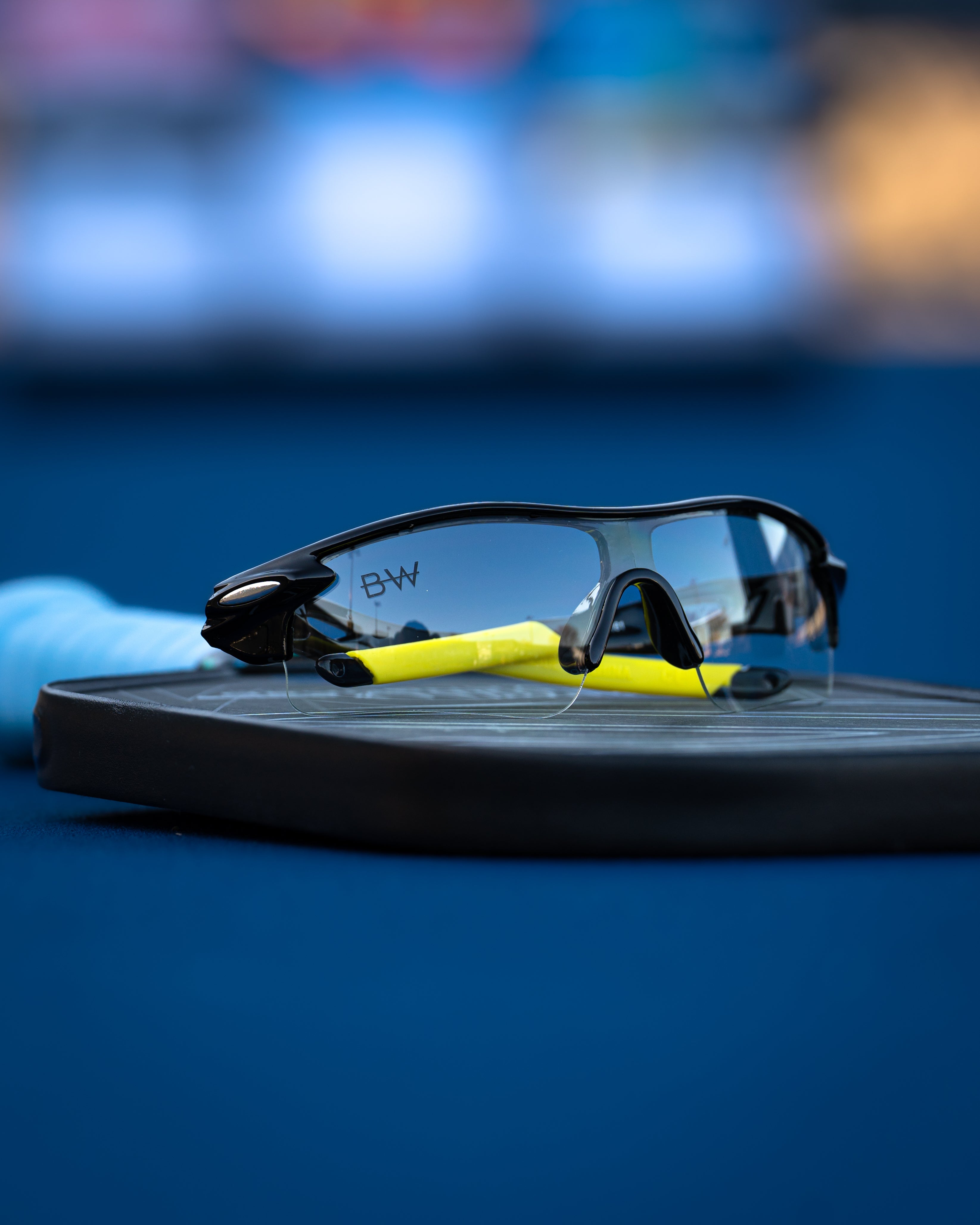
Why Athletes Choose Prescription Sports Glasses Over Contacts
Share
Why Athletes Choose Prescription Sports Glasses Over Contacts
For athletes who need vision correction, prescription sports glasses and contact lenses offer two very different ways to see clearly during competition. Contacts provide correction directly on the eye and can work well for many athletes. Prescription sports glasses combine vision correction with a physical eyewear barrier and eliminate the need to place a lens directly on the eye.
Neither option is universally better. The right choice depends on your prescription, sport, eye-care needs, playing environment, comfort preferences, and whether you want your sports eyewear itself to provide your vision correction.
This guide explains why some athletes choose prescription sports glasses instead of contacts, where contacts may still make sense, and how to compare the two options for pickleball, tennis, basketball, running, training, and other sports.
Find Your Prescription Sports Eyewear
Are Prescription Sports Glasses Better Than Contacts for Athletes?
Prescription sports glasses can be a strong alternative to contact lenses for athletes who want their vision correction built directly into their sports eyewear. They can also provide a physical lens barrier in front of the eyes—something contact lenses alone do not provide.
Some athletes prefer RX sports glasses because they:
- Do not require placing contact lenses directly on the eyes
- Combine prescription correction and sports eyewear into one setup
- Provide a physical eyewear barrier in front of the eyes
- Avoid contact-lens dryness or irritation for people who experience those issues
- Can be removed quickly without removing a lens from the eye
- Can simplify sports vision for people who already prefer glasses
- Can be configured for different sports and lighting environments depending on available lens options
Contacts can still be a practical choice for athletes who comfortably wear them and prefer combining contacts with separate non-prescription sports eyewear.
Prescription Sports Glasses vs. Contacts: Quick Comparison
| Factor | Prescription Sports Glasses | Contact Lenses |
|---|---|---|
| Vision Correction | Built into the sports lenses | Provided directly on the eye |
| Physical Barrier in Front of Eyes | Yes—the eyewear provides a physical lens barrier | Contacts alone do not |
| Direct Eye Contact | No lens is placed directly on the eye | Contact lens sits on the eye |
| Dryness / Irritation | Avoids contact-lens-related dryness or irritation | Some wearers may experience dryness or irritation |
| Fogging | Can fog under certain temperature, humidity, perspiration, and airflow conditions | Does not create an external spectacle lens that can fog in the same way |
| Sports Sunglasses | Prescription can be incorporated into compatible sports eyewear | Can be combined with separate non-RX sports sunglasses |
| Clear Sports Eyewear | Available in compatible RX configurations | Can be combined with separate clear non-RX eyewear |
| Cleaning / Care | Requires appropriate frame and lens care | Requires contact-lens hygiene according to the lens and eye-care instructions |
| Backup | A spare RX pair can provide redundancy | Backup contacts and/or glasses may be useful |
| Best Choice | Depends on the athlete, prescription, sport, environment, and eye-care needs | |
Why Do Athletes Choose Prescription Sports Glasses Instead of Contacts?
There is no single reason. For some athletes, the decision is about comfort. For others, it is about simplifying their vision setup or adding a physical eyewear barrier while still getting prescription correction.
Here are the major differences worth considering.
1. Prescription Sports Glasses Provide a Physical Barrier
One of the clearest differences between prescription sports glasses and contact lenses is physical.
A contact lens corrects vision while sitting directly on the eye, but it does not place an external lens barrier in front of the eye. Sports glasses do.
Depending on the frame and lens configuration, eyewear can place a barrier between the eyes and environmental hazards such as:
- Wind
- Dust
- Airborne debris
- Accidental contact
- Fast-moving sports equipment
However, this distinction should not be overstated. Impact-resistant sports eyewear is not automatically the same as certified protective eyewear.
If your sport requires a particular protective standard, verify that the exact frame and lens configuration meets that standard rather than assuming any pair of prescription sports glasses qualifies.
2. Sports Eyewear Can Combine RX Correction With Impact-Resistant Lenses
For athletes who require prescription correction, sports eyewear can combine two useful functions in one pair:
- Your prescription correction
- An impact-resistant lens in front of the eyes
Blinded Wear prescription sports eyewear uses impact-resistant lenses.
That does not mean the eyewear should be described as:
- Indestructible
- Shatterproof
- Guaranteed to prevent eye injury
- Certified to a particular sports standard unless specifically verified
Impact resistance is an important eyewear characteristic, but it should be represented accurately.
Do Contact Lenses Protect Your Eyes During Sports?
Contact lenses provide vision correction, but contacts alone do not provide an external physical barrier in front of the eyes.
This is an important distinction because choosing contacts does not necessarily mean choosing between contacts or sports eyewear.
An athlete can potentially use:
- Prescription sports glasses without contacts
- Contacts with non-prescription sports eyewear
- Contacts without additional sports eyewear when appropriate for the activity
For athletes who like contacts but also want a physical eyewear barrier, contacts plus non-prescription sports glasses can therefore be another setup to consider.
3. Some Athletes Prefer Glasses Because Contacts Can Feel Dry or Irritating
Contact lenses work well for many people, but individual comfort varies.
Some contact-lens wearers can experience:
- Dryness
- Irritation
- Awareness of the lens
- Discomfort in certain environments
- Difficulty wearing contacts for extended periods
Wind, environmental conditions, wear time, lens type, and individual eye characteristics can all influence comfort.
An athlete who already struggles with contact-lens comfort may prefer prescription sports glasses because the vision-correcting lens is not sitting directly on the eye.
That does not mean contacts are inherently uncomfortable. Many athletes wear them successfully. Comfort is highly individual.
Does Sweat Affect Contact Lenses During Sports?
Sweat around the face does not automatically make contact lenses unsuitable for sports. However, athletes should avoid rubbing their eyes with dirty or sweaty hands and should follow appropriate contact-lens hygiene.
Prescription sports glasses create a different experience because there is no corrective contact lens sitting directly on the eye.
The tradeoff is that external spectacle lenses can collect:
- Perspiration
- Skin oils
- Dust
- Fingerprints
- Condensation
So neither option is completely maintenance-free.
4. Prescription Sports Glasses Avoid Contact-Lens Handling
Contact lenses require proper handling and hygiene according to the specific lens type and instructions from your eye-care professional.
That can involve tasks such as:
- Washing and drying hands before handling lenses
- Applying lenses correctly
- Removing lenses correctly
- Following the appropriate replacement schedule
- Using compatible care products when required
- Avoiding inappropriate exposure or handling
Prescription sports glasses have their own maintenance requirements, but they eliminate the need to place and remove the corrective lens from the eye.
For an athlete who simply prefers wearing glasses, that can make the sports setup feel more straightforward.
Do Prescription Sports Glasses Have a Lower Infection Risk Than Contacts?
It is more accurate to focus on contact-lens hygiene than to claim that sports glasses automatically prevent eye infections.
Contact lenses are medical devices worn directly on the eye and should be used according to appropriate eye-care and hygiene instructions. Improper contact-lens use can create eye-health risks.
Prescription sports glasses do not place a corrective lens directly on the eye, so they avoid contact-lens-specific handling and hygiene concerns.
However, sports glasses still need to be kept appropriately clean, and they should not be presented as a medical guarantee against infection.
5. RX Sports Glasses Can Simplify Vision Correction
For someone who normally wears glasses, prescription sports eyewear can offer a familiar setup:
Put on one pair and your prescription correction is already built into the sports lenses.
You do not necessarily need to:
- Insert contacts before playing
- Carry contact-lens supplies for every session
- Wear contacts underneath another pair of sports glasses
- Remove contacts after the activity
For athletes who dislike contact lenses or rarely wear them outside sports, prescription sports glasses can be a particularly straightforward option.
When Can Contacts Be More Convenient for Sports?
Contacts can also simplify an athlete's setup in different ways.
An athlete who already wears contacts comfortably may prefer to keep the same vision correction while changing only the non-prescription eyewear worn over them.
For example:
- Contacts + clear sports eyewear indoors
- Contacts + tinted sports sunglasses outdoors
- Contacts + sport-specific protective eyewear when appropriate
This can give the athlete flexibility without purchasing multiple prescription lens configurations.
So convenience can favor either setup depending on how you already manage your vision.
6. Contacts Avoid Spectacle-Lens Fogging—but RX Sports Glasses Have Other Advantages
This is one area where contacts have a clear practical distinction: a contact lens does not create an external spectacle lens in front of the eye that can develop condensation in the same way glasses can.
Prescription sports glasses can fog when conditions favor condensation, including combinations of:
- Perspiration
- Humidity
- Temperature changes
- Warm air around the face
- Limited airflow around the eyewear
That does not make RX sports glasses a poor choice. It simply means fogging should be included honestly in the comparison.
If you frequently play in hot, humid, or rapidly changing environments, consider how important fog management is to you when choosing between contacts and prescription sports glasses.
7. What About Peripheral Vision?
Contacts move with the eye and do not introduce a physical frame into your field of view. Prescription glasses use lenses positioned within a frame.
How noticeable a frame feels during sports depends on factors including:
- Frame dimensions
- Lens shape
- How the frame sits on your face
- Your prescription
- Your normal eyewear habits
- Your sport
Do not assume every sports frame automatically provides unrestricted or “perfect” peripheral vision.
Athletes accustomed to glasses may barely notice their frame during play, while someone who strongly prefers an unobstructed field may favor contacts.
8. Do Prescription Sports Glasses Stay in Place Better Than Contacts?
Contacts and sports glasses stay positioned in fundamentally different ways, so a simple “which stays in place better?” claim is misleading.
A contact lens sits directly on the eye. Sports glasses depend on the frame's dimensions, design, and interaction with the wearer's face.
When shopping for RX sports eyewear, evaluate:
- Overall frame width
- Bridge dimensions
- Temple dimensions
- Lens dimensions
- How the frame behaves during movement
- Compatibility with hats, visors, helmets, or other equipment
Do not assume that every sports frame includes rubberized temples, adjustable nose pads, non-slip components, or other retention features unless they are verified for that exact product.
Why Pickleball Players May Choose Prescription Sports Glasses
Pickleball creates a practical use case for RX sports eyewear because players who require prescription correction still need that correction while moving through an active court environment.
A pickleball player may choose prescription sports glasses because they want:
- Their RX correction built directly into their court eyewear
- An impact-resistant lens between their eyes and the playing environment
- To avoid wearing contact lenses
- A dedicated pair for sports
- Clear or tinted options suited to their playing environment, where available
None of these characteristics means prescription sports glasses automatically improve reaction time, depth perception, ball tracking, or competitive performance.
The primary goal is to combine the athlete's needed vision correction with eyewear appropriate for their use.
Prescription Sports Glasses vs. Contacts for Tennis
Tennis players face many of the same tradeoffs.
Contacts may appeal to players who already wear them comfortably and prefer having no spectacle frame in front of their field of view.
Prescription sports glasses may appeal to players who:
- Prefer glasses over contacts
- Want prescription correction built into their sports eyewear
- Want an external eyewear barrier
- Experience contact-lens discomfort
- Prefer not to handle contacts around training sessions
Outdoor tennis players should separately evaluate the exact tint and verified UV characteristics of the lenses they are considering rather than assuming every prescription sports lens has identical specifications.
Prescription Sports Glasses vs. Contacts for Basketball
Basketball presents another decision between contacts, prescription sports eyewear, or contacts combined with appropriate non-prescription eyewear.
Because basketball includes close player movement and potential contact, athletes interested in protective eyewear should pay particular attention to the exact product's construction and any relevant protective certification.
Do not assume that the phrase “prescription sports glasses” automatically means certified basketball protective eyewear.
Contacts can provide correction without an external frame, while properly selected RX sports eyewear can combine correction with a physical lens barrier.
Prescription Sports Glasses vs. Contacts for Running
For runners, the decision often comes down to comfort, weather, environment, and personal preference.
Contacts eliminate spectacle-lens fogging and do not introduce a frame into the visual field. Prescription sports glasses avoid contact-lens wear and can provide an external barrier against some wind and airborne debris.
Runners should consider:
- Contact-lens comfort during long sessions
- Wind and environmental exposure
- Fogging conditions
- Prescription needs
- Daylight and tint requirements
- How the frame behaves during sustained movement
Prescription Sports Glasses vs. Contacts for Indoor Sports
Indoor athletes may not need a dark sunglass tint, making clear prescription sports glasses one possible setup.
If you already wear contacts comfortably, contacts combined with clear non-prescription sports eyewear can be another option.
| Indoor Setup | How Vision Is Corrected | Physical Eyewear Barrier |
|---|---|---|
| Clear RX Sports Glasses | Prescription built into sports lenses | Yes |
| Contacts Only | Contact lenses | No external sports-eyewear barrier |
| Contacts + Clear Sports Eyewear | Contact lenses | Yes, from the separate eyewear |
Prescription Sports Glasses vs. Contacts for Outdoor Sports
Outdoor athletes have an additional decision: how they want to manage changing or bright light conditions.
Potential setups include:
- Fixed-tint prescription sports glasses
- Compatible photochromic prescription sports glasses
- Contacts with non-prescription sports sunglasses
- Clear RX sports glasses when an untinted lens is preferred
Do not assume every prescription sports lens includes the same UV specification, tint characteristics, photochromic technology, polarization, or other treatments. Verify the exact configuration you are considering.
What if You Play in Both Indoor and Outdoor Conditions?
Athletes who frequently switch environments have several possible approaches.
Option 1: Multiple RX Sports Glasses
Use a dedicated prescription configuration for different environments, such as clear RX eyewear indoors and a tinted RX pair outdoors.
Option 2: Compatible Photochromic RX Sports Glasses
Where available, photochromic lenses can change tint as activating light conditions change, reducing how often you need to swap prescription eyewear.
Option 3: Contacts + Multiple Non-RX Sports Glasses
Keep the prescription correction on your eyes while switching between clear and tinted non-prescription eyewear.
Each setup has advantages. The best system depends on whether you prioritize convenience, dedicated lens configurations, contact-lens comfort, or having your prescription built directly into your sports eyewear.
What Are High-Index Prescription Sports Lenses?
High-index describes a prescription lens material/index characteristic. It should not be confused with a sports-performance feature.
Blinded Wear includes high-index prescription lenses at no additional cost with its RX eyewear.
High-index does not automatically mean:
- Photochromic
- Anti-fog
- Polarized
- Anti-reflective
- Hydrophobic
- Scratch-proof
- Better ball tracking
- Improved reaction time
Those characteristics should be evaluated separately for the exact lens configuration.
Are Blinded Wear Prescription Sports Glasses Polarized?
Blinded Wear sports lenses are non-polarized.
That means a polarization filter is not added to the lens. Some court-sport players prefer non-polarized eyewear, but non-polarized should not automatically be described as improving depth perception, reaction time, spin recognition, or ball tracking.
Choose polarization status according to your preferences and intended environment rather than treating either option as a universal performance advantage.
How Do You Order Prescription Sports Glasses?
When purchasing Blinded Wear RX eyewear, customers can upload a clear photo or picture of their eyeglass prescription.
Before ordering:
- Have your current eyeglass prescription available.
- Choose an RX product appropriate for your intended use.
- Review the frame dimensions.
- Review the available lens configuration.
- Upload a clear image of your prescription as required.
- Verify any product-specific feature that is important to your purchase.
Do not assume every frame accommodates every prescription or every optional lens configuration.
Who May Prefer Prescription Sports Glasses?
RX sports glasses may be particularly appealing if:
- You already prefer glasses in everyday life
- You dislike inserting or removing contact lenses
- Contacts feel dry or irritating to you
- You want your prescription built directly into your sports eyewear
- You want an external lens barrier while playing
- You want dedicated eyewear for your sport
- You prefer not to rely on contacts during long training or tournament days
Who May Prefer Contact Lenses for Sports?
Contacts may make more sense if:
- You already wear them comfortably
- You strongly prefer not having a spectacle frame in your visual field
- Fogging is a major concern in your environment
- You want to switch among different non-prescription sports glasses while keeping the same vision correction
- Your chosen sport or equipment setup works better with contacts
- Your eye-care professional recommends them for your individual needs
Choosing contacts does not prevent you from wearing non-prescription sports eyewear over them when appropriate.
Should You Wear Prescription Sports Glasses or Contacts?
| If This Sounds Like You... | Setup to Consider |
|---|---|
| “I don't like wearing contacts.” | Prescription sports glasses |
| “My contacts frequently feel dry or uncomfortable.” | Discuss the issue with your eye-care professional and consider RX sports glasses as an alternative. |
| “I already wear contacts comfortably every day.” | Contacts may remain practical, with separate sports eyewear when appropriate. |
| “I want vision correction and a physical eyewear barrier in one pair.” | Prescription sports glasses |
| “I want no spectacle frame in my field of view.” | Contacts may better match that preference. |
| “My glasses constantly fog in my playing environment.” | Contacts avoid external spectacle-lens fogging; RX eyewear may require a fog-management strategy. |
| “I play indoors and outdoors.” | Compare multiple RX pairs, compatible photochromic RX, or contacts + different non-RX eyewear. |
| “I want a backup vision solution for tournaments.” | Consider maintaining a second appropriate prescription option. |
The Biggest Difference: How You Want Your Sports Vision Setup to Work
The prescription sports glasses vs. contacts decision is not simply a contest between two products.
It is a choice between different vision setups.
Prescription sports glasses put your vision correction into the eyewear itself and place a physical lens barrier in front of your eyes.
Contact lenses put the correction directly on the eye and allow you to wear different non-prescription eyewear—or no additional eyewear when appropriate—over them.
For athletes who dislike contacts, want their prescription built directly into their sports eyewear, or value having an external lens barrier, RX sports glasses can be a compelling option.
For athletes who already wear contacts comfortably, value having no spectacle frame in their field of view, or want to switch freely among non-prescription sports glasses, contacts can remain a practical solution.
The next step is comparing those setups across cost, tournaments, travel, fogging, outdoor conditions, backup eyewear, prescription strength, maintenance, and sport-specific use.
Prescription Sports Glasses vs. Contacts: Which Costs More?
There is no universal answer because the long-term cost depends on your prescription, contact-lens type, replacement schedule, eyewear choices, and how often your prescription changes.
The two setups also create costs in different ways.
Prescription Sports Glasses
An RX sports-glasses setup typically concentrates more of the cost into the eyewear itself. Once you have an appropriate pair, there is no contact lens to replace according to a daily, biweekly, monthly, or other prescribed replacement schedule.
Contact Lenses
Contacts may involve recurring purchases depending on the type of lenses you wear. Athletes may also choose additional non-prescription sports eyewear for different environments.
| Potential Cost | RX Sports Glasses | Contacts |
|---|---|---|
| Prescription Eyewear | Primary purchase | Regular glasses may still be needed outside contact wear |
| Recurring Corrective Lens Purchases | No disposable contact lens required | Depends on prescribed contact-lens replacement schedule |
| Sports Sunglasses | May require a separate RX configuration depending on your setup | Can use compatible non-RX sunglasses over contacts |
| Clear Sports Eyewear | May require a dedicated clear RX pair depending on your setup | Can use compatible non-RX clear eyewear over contacts |
| Backup Vision Correction | Spare RX glasses if desired | Backup contacts and/or prescription glasses |
Rather than assuming one option is cheaper, compare the total setup you would realistically use over time.
Are Prescription Sports Glasses Worth It if You Already Own Contacts?
They can be, especially if sports glasses solve a problem that contacts do not solve for you.
Owning contacts does not make prescription sports glasses redundant. Some athletes maintain both because they want different options for different situations.
For example, RX sports glasses may be useful when:
- Your contacts feel uncomfortable that day
- You do not want to wear contacts for a long tournament
- You want an external eyewear barrier
- You need a backup vision-correction option
- You simply prefer glasses for certain activities
Likewise, someone who primarily wears prescription sports glasses may keep contacts available for situations where wearing a frame is less convenient.
The two options do not have to be mutually exclusive.
Prescription Sports Glasses vs. Contacts for Tournament Days
Tournament days can make vision planning more important because an athlete may be away from home for hours and depend on reliable prescription correction throughout the event.
If you compete in prescription sports glasses, consider bringing:
- Your primary RX sports glasses
- A backup prescription pair when practical
- Appropriate lens-cleaning supplies
- Protective storage
- A copy or accessible record of your prescription when useful for travel
If you compete in contacts, plan around the care requirements of your specific lenses and bring any appropriate backup vision solution.
Whichever setup you use, competition day is not the ideal time to experiment with unfamiliar vision correction. Test new sports eyewear or contact-lens setups during normal practice first.
Should Athletes Have Backup Prescription Glasses?
A backup pair can be especially valuable when your prescription correction is necessary for normal participation.
Imagine arriving at a tournament and:
- Breaking your primary frame
- Damaging a lens
- Losing your glasses
- Experiencing unexpected contact-lens discomfort
- Being unable to use your normal correction for another reason
A second appropriate prescription option provides redundancy.
This does not mean every athlete needs to carry multiple pairs during every casual practice. The value of backup eyewear increases when you are traveling, competing far from home, or participating in an event that would be difficult to replace.
Prescription Sports Glasses vs. Contacts for Sports Travel
Travel creates additional considerations for both setups.
Traveling With Prescription Sports Glasses
You need to protect the eyewear from physical damage and keep the lenses appropriately clean.
Traveling With Contacts
You need to account for the supplies, replacement lenses, hygiene, and care requirements associated with your particular contact lenses.
For prescription-dependent athletes, a practical travel strategy can include more than one method of vision correction when appropriate.
For example:
- Primary RX sports glasses + backup RX glasses
- Contacts + backup prescription glasses
- Primary RX sports glasses + contacts as an alternative if you already wear them appropriately
The important principle is redundancy. If losing access to your normal vision correction would interfere with your trip or competition, plan accordingly.
Which Is Better for Long Practices: Contacts or Prescription Sports Glasses?
Comfort over a long training session is highly individual.
An athlete who comfortably wears contacts for extended periods may have no reason to switch simply because practice is long.
Another athlete may prefer prescription sports glasses because they do not want corrective lenses sitting directly on their eyes throughout an extended training or tournament day.
When evaluating long-session comfort, consider:
- How your contacts normally feel after extended wear
- How your sports glasses feel after extended wear
- Environmental conditions
- Perspiration
- Frame fit
- Fogging
- Your individual eye-care needs
A product being marketed for sports does not guarantee all-day comfort for every wearer.
Prescription Sports Glasses vs. Contacts in Hot Weather
Hot-weather sports can expose each setup to different challenges.
With prescription sports glasses, athletes may deal with:
- Perspiration on the lenses
- Perspiration around the frame
- Fogging under certain conditions
- Frequent lens cleaning
With contacts, individual comfort can be influenced by the wearer, lens type, wear time, and environmental conditions.
Neither option should automatically be labeled superior for hot weather. Use the correction method that remains appropriate and comfortable for you under your actual playing conditions.
What About Prescription Sports Glasses vs. Contacts in Humid Conditions?
Humidity is particularly relevant to external sports lenses because it can contribute to condensation when combined with temperature differences, perspiration, and limited airflow.
That gives contacts a practical advantage for athletes whose primary complaint is spectacle-lens fogging.
However, athletes choosing contacts specifically to avoid fogging should still consider whether they want separate non-prescription sports eyewear over the contacts for their activity.
Prescription sports glasses remain an option if you prefer not to wear contacts and are willing to manage fogging when environmental conditions create it.
Prescription Sports Glasses vs. Contacts in Windy Conditions
Wind can affect the experience of both eyewear setups differently.
Sports glasses place an external lens and frame in front of the eyes, while contacts sit directly on the eye. Some contact-lens wearers may find particular windy or dry environments uncomfortable.
Sports eyewear can also provide a physical barrier against some airborne material, although the amount of coverage varies considerably by frame.
Do not assume every sports frame seals the eye area or provides complete protection from wind, dust, or debris.
Prescription Sports Glasses vs. Contacts in Rain
Rain highlights one limitation of external eyewear: water can collect on the lens surface.
Contacts do not have an external spectacle lens for raindrops to land on, although athletes may still choose to wear sports eyewear over contacts.
Prescription sports glasses can still be used in changing weather, but lens cleanliness and visibility may require more attention when the eyewear becomes wet.
Do not assume an RX sports lens includes a hydrophobic or water-repellent treatment unless that feature is verified for the exact product.
Prescription Sports Glasses vs. Contacts Around Dust and Debris
Sports glasses can place a physical lens barrier between the eyes and some airborne material. Contacts alone do not provide that external barrier.
However, the amount of coverage depends on the eyewear. A conventional sports frame should not automatically be treated as sealed protective eyewear.
If your activity involves substantial dust, debris, chemicals, or another eye hazard, use eyewear appropriate for that specific hazard rather than assuming ordinary prescription sports glasses provide sufficient protection.
What if You Prefer RX Sports Glasses but They Keep Fogging?
Fogging does not automatically mean you need to abandon prescription sports glasses for contacts.
First identify when the condensation occurs.
| When Fogging Happens | What to Evaluate |
|---|---|
| After You Begin Sweating | Moisture around the face, lens cleanliness, and airflow |
| Moving From Cool to Warm Conditions | Temperature change and condensation |
| Hot / Humid Outdoor Play | Humidity, perspiration, and airflow around the eyewear |
| While Wearing a Hat or Headband | Whether other equipment changes airflow or directs perspiration |
| Immediately After Wiping the Lens | Whether the material used for cleaning is leaving oils or residue |
Anti-fog products may be an option for some lenses, but verify compatibility with your exact prescription eyewear before applying a treatment.
Do not assume Blinded Wear RX lenses automatically include an anti-fog coating unless that characteristic is specifically verified for the exact configuration.
Does Prescription Strength Affect the Glasses vs. Contacts Decision?
It can.
The complete prescription influences which lens and frame combinations are available, and contact-lens prescriptions are not simply interchangeable with eyeglass prescriptions.
If you have a stronger or more complex prescription, confirm:
- Whether the sports frame can accommodate your prescription
- Which prescription lens materials are available
- Whether your desired lens options are compatible
- Whether contacts are appropriate for your individual prescription and eyes
Do not assume that every prescription can be placed into every sports frame or that every eyeglass prescription can simply be used to order contacts.
Do High-Index Sports Lenses Make RX Glasses a Better Alternative to Contacts?
High-index lenses can be relevant to prescription eyewear, but they do not make glasses universally better than contacts.
High-index refers to a prescription lens material/index characteristic. Blinded Wear includes high-index prescription lenses at no additional cost with RX eyewear.
Whether an RX sports-glasses setup works well for you still depends on:
- Your complete prescription
- Frame compatibility
- Frame dimensions
- Playing environment
- Comfort preferences
- Available lens configurations
High-index should not be interpreted as an automatic performance, impact, anti-fog, or visual-tracking advantage.
Do Prescription Sports Glasses Improve Athletic Performance?
Prescription correction and athletic-performance enhancement are not the same claim.
An appropriate prescription is intended to correct vision according to the wearer's prescription. That does not mean prescription sports glasses automatically:
- Improve reaction time
- Increase depth perception
- Improve hand-eye coordination
- Make a ball easier to track
- Help identify spin
- Make an athlete faster
- Improve competitive results
The same caution applies to contact lenses.
Both are methods of providing vision correction. Neither should be marketed as a guaranteed shortcut to better athletic performance.
Do Contacts Give Athletes Faster Reaction Times Than Glasses?
Do not assume that simply switching between contacts and prescription sports glasses will inherently make an athlete react faster.
Reaction time involves many variables beyond the method used to provide vision correction.
Likewise, Blinded Wear RX eyewear should not be described as automatically increasing reaction speed simply because it is designed for sports use.
The more useful comparison is whether each correction method provides appropriate vision and works comfortably within your particular sport.
Are Contacts Better Than Prescription Glasses for Depth Perception?
This question cannot responsibly be answered with a universal yes or no.
Vision depends on the individual's eyes, prescription, correction, lens design, and other factors. Neither contacts nor prescription sports glasses should automatically be marketed as providing superior depth perception for every athlete.
If you have concerns about depth perception or how your prescription affects sports vision, discuss them with an appropriate eye-care professional.
Which Is Better for Ball Tracking: Contacts or RX Sports Glasses?
Neither option should automatically be claimed to improve ball tracking.
The important first step is having appropriate vision correction for your needs.
After that, athletes can compare practical factors such as:
- Comfort
- Frame visibility
- Lens tint
- Environmental conditions
- Fogging
- Fit
- Eyewear coverage
Those considerations are more useful than unsupported claims that one correction method inherently makes a fast-moving ball easier to track.
Prescription Sports Sunglasses vs. Contacts + Non-RX Sunglasses
Outdoor athletes who need prescription correction generally have more than one way to build their eyewear setup.
Prescription Sports Sunglasses
Your prescription and selected sunglass lens configuration are incorporated into the same eyewear.
Contacts + Non-Prescription Sports Sunglasses
Your contacts provide the vision correction while the separate sports sunglasses provide the external eyewear.
| Factor | RX Sports Sunglasses | Contacts + Non-RX Sunglasses |
|---|---|---|
| Prescription Location | Sports lenses | Contact lenses |
| Contact Lens Required | No | Yes |
| Changing Sunglasses | Additional RX pair may be needed for a different lens configuration | Can switch compatible non-RX eyewear while retaining contacts |
| Contact-Lens Handling | No | Yes |
| External Lens Fogging | Possible | Possible on the non-RX eyewear worn over contacts |
Clear Prescription Sports Glasses vs. Contacts + Clear Eyewear
For indoor, evening, or other environments where you do not want a dark sunglass tint, the same two-setup comparison applies.
You can use:
- Clear RX sports glasses: prescription correction is incorporated into the sports lenses.
- Contacts + clear non-RX sports eyewear: contacts provide correction while the clear eyewear provides the external lens barrier.
Clear does not automatically mean anti-fog, contrast-enhancing, or performance-enhancing. It simply means the eyewear does not use a dark sunglass tint.
Can Transition RX Lenses Reduce the Need for Contacts?
For some athletes, compatible photochromic prescription lenses can make an RX glasses setup more versatile.
Instead of using contacts so you can easily switch between clear and tinted non-prescription eyewear, an available photochromic RX configuration can change tint as activating light conditions change.
This can be useful for athletes who:
- Move between indoor and outdoor environments
- Train from afternoon into evening
- Play across changing daylight
- Travel between different facilities
- Prefer one primary prescription pair
However, photochromic availability should be verified for the exact product and prescription configuration. Photochromic lenses also change over time rather than necessarily changing instantly.
How Important Is Fit for Prescription Sports Glasses?
Fit is one of the most important practical considerations when choosing an RX sports frame.
A prescription can be appropriate while the frame itself is still a poor match for the wearer.
Evaluate:
- Frame width
- Bridge dimensions
- Temple dimensions
- Lens dimensions
- How the frame sits on your face
- How it behaves during movement
- Whether it interferes with other sports equipment
A frame that is too loose, too tight, or poorly matched to your face can create distractions regardless of the quality of the prescription lenses.
Do not assume every sports frame has a “secure fit” simply because it is marketed for athletes.
Are Prescription Sports Glasses the Same as Protective Sports Goggles?
No. These terms should not automatically be treated as interchangeable.
Prescription sports glasses describes eyewear intended for active use that incorporates prescription correction.
Certified protective sports eyewear must satisfy the requirements of the particular standard being claimed.
A product can use impact-resistant lenses without necessarily carrying a particular sports-safety certification.
If your league, sport, workplace, or activity requires certified eye protection, verify the exact standard for the exact product before relying on it.
Can Prescription Sports Glasses Prevent Eye Injuries?
No pair of ordinary sports glasses should be described as guaranteeing prevention of eye injuries.
Eyewear can place a physical barrier in front of the eyes, and impact-resistant lenses are relevant to active use. But protection depends on the exact eyewear, impact, fit, coverage, construction, and whether a particular protective standard applies.
Use appropriately certified protective eyewear whenever your sport or activity requires it.
What About Prescription Sports Glasses vs. Contacts for Young Athletes?
The appropriate form of vision correction for a child or young athlete depends on individual vision needs, maturity, ability to handle contact lenses appropriately, sport, and professional eye-care guidance.
Do not assume prescription sports glasses or contacts are universally the correct choice for every child.
If protective eyewear is needed for a youth sport, verify the relevant requirements and product certification separately from the athlete's prescription correction.
Which Requires More Maintenance: Contacts or Prescription Sports Glasses?
They require different kinds of maintenance.
| Task | Prescription Sports Glasses | Contact Lenses |
|---|---|---|
| Daily Lens Surface Cleaning | As needed based on perspiration, oils, debris, and use | Depends on the prescribed contact-lens type and care system |
| Hand Hygiene Before Handling | Good practice when cleaning or handling eyewear | Particularly important because the lens is handled in relation to the eye |
| Replacement Schedule | Based on prescription changes, damage, condition, and suitability | Follow the replacement schedule prescribed for the contact lens |
| Storage | Protective storage when not being worn | Depends on lens type and prescribed care requirements |
| Mid-Game Issue | Lens may need appropriate cleaning if dirty or fogged | Handling an uncomfortable or displaced contact requires appropriate hygiene |
Prescription sports glasses are not maintenance-free, and contacts should not be portrayed as inherently difficult to maintain. The better system is the one you can use correctly and consistently.
How Should Athletes Care for Prescription Sports Glasses?
After active use, inspect and clean the eyewear using methods compatible with your exact lenses.
Good general habits include:
- Remove loose debris appropriately before rubbing the lens
- Use clean lens-care material
- Avoid wiping dirty lenses with sweaty clothing
- Clean accumulated perspiration and skin oils when needed
- Store the eyewear away from hard or abrasive objects
- Inspect the frame and lenses periodically for damage
Do not assume every prescription sports lens can safely be cleaned with every household chemical or DIY solution.
10 Mistakes to Avoid When Choosing Between Sports Glasses and Contacts
- Assuming contacts provide physical eye protection. Contacts correct vision but do not create an external eyewear barrier.
- Assuming all sports glasses are certified protective eyewear. Verify any required standard.
- Assuming impact-resistant means shatterproof. These terms are not interchangeable.
- Assuming contacts are uncomfortable for everyone. Many athletes wear them comfortably.
- Assuming prescription glasses cannot work for fast-paced sports. Suitability depends on the athlete, prescription, frame, and activity.
- Ignoring fogging. External sports lenses can develop condensation under certain conditions.
- Ignoring frame fit. Prescription accuracy does not compensate for a poorly fitting frame.
- Buying based on unsupported performance claims. Neither contacts nor RX glasses automatically improve reaction time, depth perception, or ball tracking.
- Assuming every RX frame supports every prescription. Compatibility must be checked.
- Having no backup plan for important events. Prescription-dependent athletes may benefit from redundant vision correction during tournaments and travel.
Prescription Sports Glasses vs. Contacts: Myths and Facts
| Claim | What Athletes Should Know |
|---|---|
| “Contacts are always better for sports.” | Neither correction method is universally better. The right choice depends on the athlete and activity. |
| “Sports glasses always protect against eye injuries.” | No eyewear should be given a universal injury-prevention guarantee. |
| “Contacts protect your eyes from impacts.” | Contacts alone do not provide an external physical barrier. |
| “Sports glasses never move.” | Frame stability depends on dimensions, design, fit, movement, and the wearer. |
| “Contacts always dry out during sports.” | Some wearers experience dryness or irritation; many others wear contacts comfortably. |
| “Prescription sports glasses don't fog.” | External lenses can fog when conditions favor condensation. |
| “RX sports glasses improve reaction time.” | Prescription correction should not automatically be turned into a reaction-time claim. |
| “Non-polarized lenses improve depth perception.” | Non-polarized means no polarization filter is added; it does not establish superior depth perception. |
| “High-index lenses improve sports performance.” | High-index is a prescription lens material/index characteristic, not a performance guarantee. |
| “You must choose either contacts or sports glasses forever.” | Many athletes can maintain more than one appropriate vision-correction setup. |
Blinded Wear Prescription Sports Glasses: What Is Actually Included?
When comparing prescription sports eyewear, separate verified characteristics from features that depend on an individual product or lens configuration.
| Characteristic | Blinded Wear RX Eyewear |
|---|---|
| Prescription Correction | Available through Blinded Wear RX products |
| High-Index Prescription Lenses | Included at no additional cost |
| Impact-Resistant Lenses | Yes |
| Polarization | Non-polarized sports lenses |
| Prescription Upload | Customers can upload a clear photo or picture of their eyeglass prescription |
| Photochromic / Transition | Verify availability for the exact configuration |
| Anti-Fog | Do not assume unless verified for the exact configuration |
| Scratch Resistance | Do not assume unless verified for the exact configuration |
| Hydrophobic Treatment | Do not assume unless verified for the exact configuration |
| Exact UV Specification | Verify for the exact lens configuration |
| Protective Certification | Verify any required certification for the exact product |
Explore Blinded Wear Prescription Sports Glasses
If you prefer prescription sports glasses over contacts, start with the RX collection rather than choosing a non-prescription product and assuming prescription lenses can be added later.
Available Blinded Wear RX products include options such as:
- H Blue Shield RX →
- Lava Rock RX →
- Phantom II RX →
- Crystal Wave II RX →
- Rocket Fire RX →
- Silver Line RX →
- Frost RX →
- Ocean Wave RX →
Individual frame dimensions, lens options, and prescription compatibility should be checked on the exact product you are considering.
FAQ: Prescription Sports Glasses vs. Contact Lenses
Can you play sports with prescription glasses?
Yes. Athletes can use appropriately selected prescription eyewear for many sports. The exact frame, prescription compatibility, fit, lens characteristics, and any required protective standard should be evaluated for the specific activity.
Are prescription sports glasses better than regular glasses for sports?
Sports-focused eyewear is intended for active use, but specific characteristics vary by product. Do not assume every sports frame automatically includes the same fit, coverage, impact characteristics, or certification.
Can athletes wear contacts instead of sports glasses?
Many athletes wear contacts successfully. Whether contacts are appropriate for you depends on your eyes, prescription, lens type, comfort, care routine, and professional eye-care guidance.
Can you wear sports glasses over contacts?
Yes, an athlete who uses contacts for prescription correction can also wear compatible non-prescription sports eyewear when appropriate.
Do contacts protect your eyes from a pickleball?
Contacts alone do not create an external physical barrier in front of the eye. Athletes concerned about impact protection should evaluate appropriate sports eyewear separately.
Do prescription sports glasses fog?
They can. Fogging can occur when moisture condenses on external lenses under certain combinations of temperature, humidity, perspiration, and airflow.
Do contacts fog during sports?
Contacts do not create an external spectacle lens, so they do not develop spectacle-lens condensation in the same way glasses can.
Are contacts more comfortable than sports glasses?
Comfort is individual. Some athletes strongly prefer contacts, while others experience dryness or irritation and prefer prescription glasses.
Are prescription sports glasses safer than contacts?
They provide an external physical lens barrier that contacts alone do not provide, but the amount and type of protection depend on the exact eyewear. Any required protective certification should be verified separately.
Can prescription sports glasses improve my performance?
Prescription correction can provide the vision correction prescribed for the wearer, but RX sports glasses should not automatically be claimed to improve reaction time, depth perception, ball tracking, or athletic performance.
Can I use my normal eyeglass prescription to buy contacts?
Eyeglass and contact-lens prescriptions are not simply interchangeable. Contact lenses require appropriate fitting and prescription information for contact-lens use.
Should I bring backup glasses if I wear contacts?
A backup prescription option can be useful, especially during tournaments, long training days, or travel where losing access to your normal vision correction would create a problem.
Game-Day Checklist: RX Sports Glasses vs. Contacts
Whichever vision-correction setup you choose, preparation matters more on competition day than during an ordinary practice.
If You Compete in Prescription Sports Glasses
- Clean the lenses before leaving for the event.
- Inspect the lenses and frame for visible damage.
- Confirm the eyewear still fits appropriately during movement.
- Pack compatible lens-cleaning supplies.
- Use protective storage when the glasses are not being worn.
- Bring backup prescription eyewear when the event or travel situation makes redundancy valuable.
- If fogging is common for you, use the fog-management routine you have already tested during practice.
If You Compete in Contact Lenses
- Follow the wear and hygiene instructions for your particular contacts.
- Bring any appropriate supplies required for your lenses.
- Avoid handling contacts with dirty or sweaty hands.
- Consider backup prescription glasses in case you cannot comfortably continue wearing your contacts.
- If you wear non-RX sports eyewear over contacts, inspect and clean that eyewear too.
A tournament is not the ideal place to test an unfamiliar prescription, frame, contact lens, or lens configuration for the first time.
What Happens if Your Contacts or Sports Glasses Fail During a Tournament?
This is where a backup vision plan becomes particularly useful.
If prescription correction is important for your normal vision, losing access to your primary setup can create a much bigger problem than simply forgetting another piece of sports gear.
| Problem | Possible Backup Strategy |
|---|---|
| Primary RX glasses break | Use an appropriate backup prescription pair if available. |
| Primary RX glasses are lost | Use backup RX eyewear or another appropriate correction method you already use. |
| Contact becomes uncomfortable | Follow appropriate contact-lens guidance and switch to backup prescription glasses if needed. |
| Contact is lost | Use an appropriate replacement contact according to your normal lens routine or switch to backup glasses. |
| RX lenses become dirty | Clean them appropriately using compatible lens-care supplies. |
| RX glasses repeatedly fog | Use a previously tested fog-management routine rather than experimenting during competition. |
What About Prescription Glasses for Fast-Paced Sports?
A fast-paced sport does not automatically require contact lenses.
Prescription sports glasses can be considered for active sports when the frame, prescription, lens configuration, and any relevant protective requirements are appropriate for the activity.
When evaluating RX eyewear for faster movement, focus on practical factors such as:
- Frame dimensions
- Fit during movement
- Prescription compatibility
- Lens characteristics
- Physical condition of the frame
- Interaction with other equipment
- Any protective standard required for the sport
Likewise, do not assume contacts automatically create a competitive advantage simply because there is no spectacle frame.
What Is Better for Multi-Sport Athletes?
Multi-sport athletes may benefit from having more than one vision-correction option because different activities can create different eyewear requirements.
For example, the same athlete might participate in:
- Pickleball
- Tennis
- Running
- Basketball
- Gym training
- Outdoor recreational sports
Prescription sports glasses may be convenient if you want dedicated RX eyewear for active use. Contacts may be convenient if you prefer keeping your prescription correction constant while changing the non-prescription eyewear used for different sports.
Some athletes may use both approaches depending on the activity.
When Might an Athlete Switch From Contacts to Prescription Sports Glasses?
You do not need to wait until contacts become completely unusable before considering RX sports eyewear.
You may want to compare prescription sports glasses if:
- You increasingly prefer glasses in everyday life
- You dislike inserting and removing contacts before and after sports
- You frequently experience contact-lens discomfort
- You want an external lens barrier while playing
- You want dedicated prescription eyewear for your sport
- You want another prescription option for tournaments or travel
- You want to reduce your reliance on contacts during long sports days
Persistent contact-lens discomfort, redness, pain, unusual sensitivity to light, discharge, or changes in vision should not simply be treated as an eyewear-shopping problem. Stop relying on generic troubleshooting and seek appropriate eye-care guidance.
When Might Contacts Still Be the Better Fit for Your Routine?
Prescription sports glasses are not the right answer for every athlete.
You may prefer contacts if:
- You already wear them comfortably and appropriately
- You strongly prefer not having a spectacle frame in your field of view
- You frequently switch between different non-prescription sports eyewear
- Spectacle-lens fogging is a recurring problem in your environment
- Your sport or equipment makes your current contact-lens setup more practical
- You simply prefer how contacts feel during activity
The goal is not to replace contacts for the sake of replacing them. It is to choose a vision setup that works for your prescription, eyes, sport, and preferences.
You Don't Have to Choose Only One: The Hybrid Approach
For many athletes, the most flexible answer is not “glasses or contacts forever.” It is having access to both when appropriate.
A hybrid setup might look like:
- RX sports glasses for normal practices and games
- Contacts for activities where you prefer them
- Backup RX glasses during tournaments and travel
- Non-RX sports eyewear worn over contacts when you want an external eyewear barrier
This gives you options when weather, comfort, travel, equipment, or your playing environment changes.
If you use both contacts and glasses, make sure each prescription and correction method is appropriate for you rather than treating one prescription format as interchangeable with another.
Prescription Sports Glasses Buying Checklist
If you decide RX sports glasses fit your needs better than contacts, evaluate the complete product rather than shopping on appearance alone.
- Prescription compatibility: Can the exact frame and lens configuration accommodate your RX?
- Frame dimensions: Compare measurements with eyewear that already fits you appropriately.
- Sport: Is the eyewear appropriate for how you intend to use it?
- Impact resistance: Verify this separately from other lens characteristics.
- Protective requirements: If your sport requires a particular certification, verify the exact standard.
- Lens tint: Choose according to your actual playing environment.
- Indoor use: Consider whether you prefer an untinted lens.
- Outdoor use: Evaluate the exact lens configuration and verified specifications.
- Changing light: Verify photochromic availability if adaptive tint matters to you.
- Fogging: Do not assume the lenses are anti-fog unless specifically verified.
- Polarization: Know whether the exact sports lens is polarized or non-polarized.
- Maintenance: Understand how the lenses should be cleaned and stored.
- Backup: Decide whether you need a second prescription option for tournaments or travel.
Prescription Sports Glasses or Contacts? Quick Decision Guide
| Your Priority | Option to Consider | Why |
|---|---|---|
| No contact lens on the eye | RX sports glasses | Prescription correction is built into the eyewear. |
| External lens barrier + RX in one pair | RX sports glasses | The sports lenses provide both prescription correction and a physical barrier. |
| No spectacle frame in your field of view | Contacts | The corrective lens sits directly on the eye. |
| Avoid spectacle-lens fogging | Contacts | Contacts do not create an external corrective lens that fogs like glasses. |
| Switch among several non-RX sports glasses | Contacts + non-RX eyewear | Your prescription remains on the eye while the external eyewear changes. |
| Avoid contact-lens handling | RX sports glasses | No corrective lens needs to be inserted or removed from the eye. |
| You experience contact-lens discomfort | RX sports glasses may be worth considering | They provide correction without a contact lens on the eye. |
| Indoor + outdoor prescription use | Compare multiple RX pairs, compatible photochromic RX, or contacts + multiple non-RX pairs | Each strategy handles changing environments differently. |
| Maximum flexibility | Maintain both options when appropriate | You can choose according to the activity and environment. |
Questions to Ask Before Replacing Contacts With RX Sports Glasses
- Can this frame accommodate my complete prescription?
- What are the exact frame measurements?
- What lens material or index will be used?
- Are the lenses impact-resistant?
- Does my sport require a specific protective certification?
- Is the lens clear, tinted, or photochromic?
- What verified UV specification applies to this exact lens?
- Is the lens polarized or non-polarized?
- Does it include an anti-fog treatment?
- Does it include scratch-resistant, hydrophobic, or anti-reflective characteristics?
- How should the eyewear be cleaned?
- What happens if the glasses break?
- Should I keep my contacts or another RX pair as a backup?
These questions help separate the features you actually need from assumptions commonly attached to the words “sports glasses.”
Why Consider Blinded Wear Prescription Sports Glasses?
Blinded Wear offers prescription sports eyewear for athletes who want their vision correction built directly into their active eyewear rather than relying exclusively on contacts.
Verified characteristics of Blinded Wear RX eyewear include:
- Sports-focused prescription eyewear options
- Impact-resistant lenses
- High-index prescription lenses included at no additional cost
- Non-polarized sports lenses
- Online prescription upload using a clear photo or picture of your eyeglass prescription
- 50% lifetime replacement support if glasses break, subject to current policy terms
Features such as anti-fog treatments, hydrophobic treatments, scratch resistance, exact UV specifications, photochromic availability, and protective certifications should be verified for the exact product or lens configuration rather than assumed across the entire collection.
What if Your Blinded Wear Prescription Sports Glasses Break?
Blinded Wear provides 50% lifetime replacement support if glasses break, subject to the current policy terms.
This should not be interpreted as a blanket free lifetime warranty or automatic coverage for every situation.
Review the current policy for applicable terms before relying on replacement support as part of your purchase decision.
More Questions About Sports Glasses vs. Contacts
Why do athletes wear prescription sports glasses?
Athletes may choose RX sports glasses because they need prescription correction during activity, prefer glasses over contacts, want an external lens barrier, or want dedicated prescription eyewear for sports.
Can I wear my regular prescription glasses for sports?
That depends on the activity and the eyewear. Regular glasses and sports-focused eyewear may differ in frame design, lens characteristics, fit, and protective properties. If a sport requires certified protective eyewear, ordinary prescription glasses should not be assumed to meet that requirement.
Are sports glasses better than contacts for pickleball?
Neither is universally better. RX sports glasses combine prescription correction with an external lens barrier, while contacts eliminate the external corrective spectacle lens and can be combined with separate non-RX eyewear.
Are contacts better than glasses for basketball?
Some basketball players prefer contacts because there is no spectacle frame in their field of view. Others may prefer appropriate prescription sports eyewear. If protective eyewear is needed, verify the exact requirements separately.
Are prescription sports glasses good for running?
They can be. Runners who prefer glasses may appreciate having their RX correction built into their sports eyewear, while contact wearers may prefer avoiding an external corrective spectacle lens. Fit, weather, fogging, and comfort should all be considered.
Can sports glasses be worn all day?
Whether a pair remains comfortable for extended wear depends on the individual, frame dimensions, prescription, lens configuration, and use. “Sports eyewear” does not guarantee all-day comfort for every wearer.
Can I switch between contacts and prescription glasses?
Many people use both correction methods when each has been appropriately prescribed or fitted for them. Contact and eyeglass prescriptions should not be assumed to be interchangeable.
Should I stop wearing contacts if they get dry during sports?
Recurring dryness or discomfort is a reason to discuss your contact-lens wear with an appropriate eye-care professional rather than simply pushing through symptoms. Prescription sports glasses can be an alternative correction method for some athletes.
Are prescription sports glasses shatterproof?
Do not assume so. Impact-resistant and shatterproof are not interchangeable claims. Blinded Wear uses impact-resistant lenses, but that should not be represented as a guarantee that the eyewear cannot break.
Do prescription sports glasses have anti-fog lenses?
Not automatically. Anti-fog should be verified for the exact lens configuration rather than assumed because eyewear is intended for sports.
Are prescription sports glasses polarized?
Blinded Wear sports lenses are non-polarized. Other brands and products may differ.
Do non-polarized sports glasses improve depth perception?
Non-polarized means a polarization filter is not added. That characteristic alone does not establish improved depth perception or better athletic performance.
Can strong prescriptions be made into sports glasses?
Compatibility depends on the complete prescription, frame, and available lens configuration. Do not assume every prescription works with every frame.
Can prescription sports glasses use transition lenses?
Photochromic or transition options may be available in compatible configurations, but availability should be verified for the exact product and prescription.
Do I need prescription sports glasses if I already wear contacts?
Not necessarily. Some athletes use contacts successfully for sports. RX sports glasses may still be useful as an alternative or backup, especially if you prefer glasses, experience contact discomfort, or want your prescription built directly into your sports eyewear.
Can I wear non-prescription sports glasses over contacts?
Yes, when the eyewear and contacts are appropriate for you. This setup allows contacts to provide prescription correction while the external eyewear serves a separate sports-eyewear role.
Key Takeaways: Prescription Sports Glasses vs. Contacts
- Both prescription sports glasses and contacts can provide vision correction for athletes.
- RX sports glasses put the prescription directly into the sports eyewear.
- Contacts provide correction directly on the eye.
- Sports glasses provide an external physical lens barrier; contacts alone do not.
- Contacts avoid external corrective spectacle-lens fogging.
- Some athletes experience contact-lens dryness or irritation, while others wear contacts comfortably.
- Prescription sports glasses eliminate contact-lens insertion, removal, and contact-lens-specific handling.
- Contacts can make it easier to switch among different non-RX sports eyewear.
- RX sports glasses can combine prescription correction with impact-resistant lenses.
- Impact-resistant does not mean shatterproof or automatically certified protective eyewear.
- Neither contacts nor prescription sports glasses should automatically be claimed to improve reaction time, depth perception, ball tracking, or athletic performance.
- The right setup depends on your prescription, sport, environment, eye-care needs, and preferences.
- You do not necessarily have to choose only one—some athletes maintain both options.
Related Prescription Sports Eyewear Guides
Ready to Try Prescription Sports Glasses?
If you prefer having your prescription built directly into your sports eyewear, explore Blinded Wear's RX collection.
Blinded Wear prescription sports eyewear includes impact-resistant lenses, non-polarized sports lenses, and high-index prescription lenses at no additional cost. Customers can upload a clear photo or picture of their eyeglass prescription when ordering.
Choose based on your prescription, frame dimensions, playing environment, and the verified characteristics of the exact product—not unsupported promises of better athletic performance.
Bottom Line: Why Athletes Choose Prescription Sports Glasses Over Contacts
Athletes choose prescription sports glasses over contacts when they prefer having their vision correction built directly into their sports eyewear, want an external lens barrier, dislike contact-lens wear, or simply find glasses more practical for their routine.
Contacts have legitimate advantages too. They do not create an external corrective spectacle lens that can fog, they do not introduce a spectacle frame into the field of view, and they can make it easy to switch among different non-prescription sports eyewear.
That is why there is no universal winner.
The better question is:
Which vision setup fits your eyes, prescription, sport, environment, and preferences?
If you already wear contacts comfortably and they work well for your sport, there may be no reason to stop. If you dislike contacts, experience recurring discomfort, want your prescription integrated into your sports eyewear, or want another reliable vision option, prescription sports glasses are worth considering.
And for athletes who want maximum flexibility, the answer may be both: RX sports glasses as one option and contacts as another.