
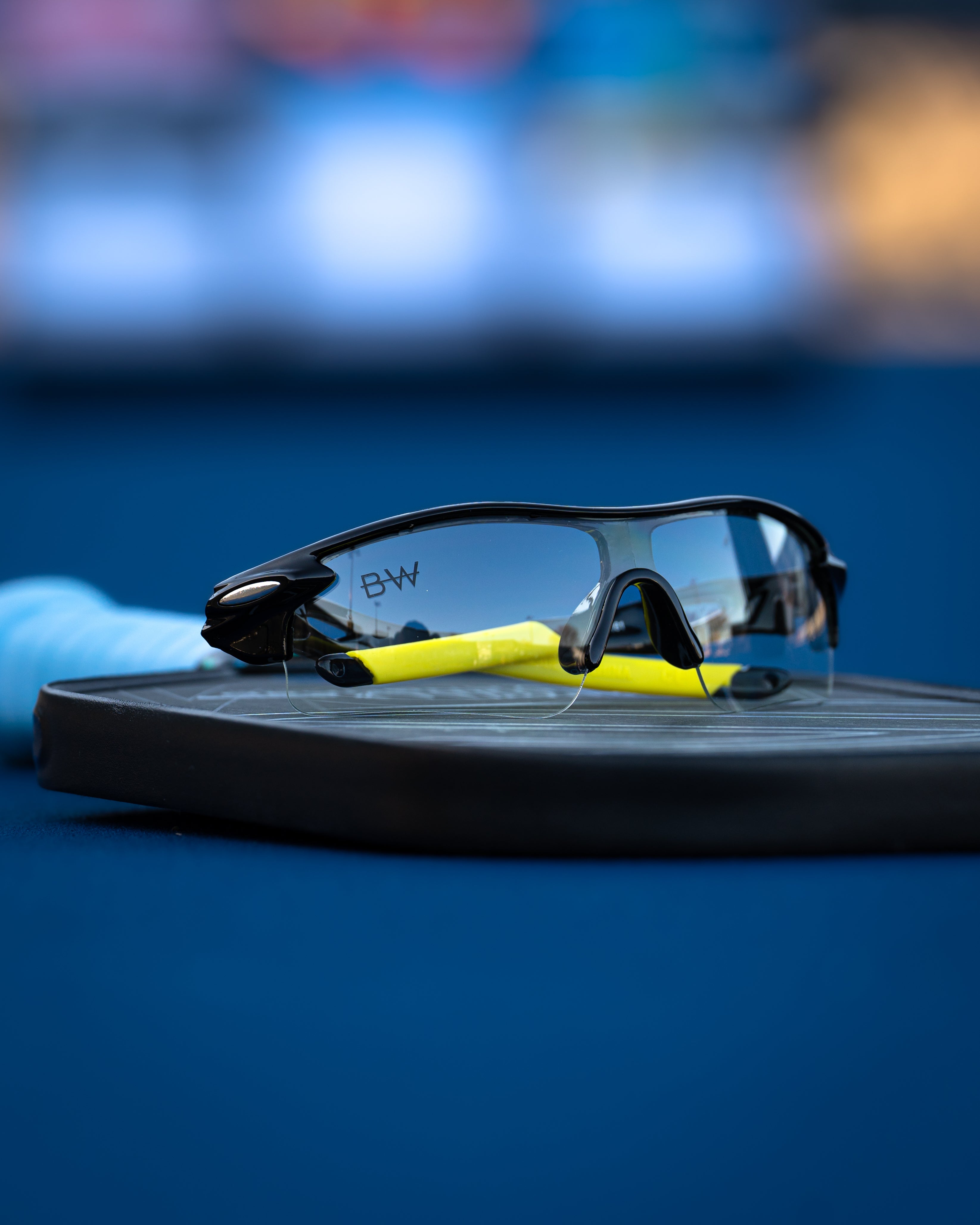
Pupillary Distance for RX Glasses: How and Why to Measure
Share
Find Your Perfect Pickleball Glasses
Whether you need prescription (RX) or non-prescription eyewear, use Blinded Wear's current guides and collections to compare options for your prescription needs, playing environment, and preferences.
Pupillary Distance for RX Glasses: How and Why to Measure
When ordering prescription glasses, the prescription itself is only part of the information involved in making lenses for a particular wearer. Pupillary distance, commonly abbreviated PD, is a measurement used when positioning prescription lenses relative to your eyes.
PD is important, but it is easy to oversimplify. It is not a measurement of prescription strength, and proper prescription-lens positioning is more nuanced than simply placing the geometric center of every lens directly over the center of each pupil.
This guide explains what PD means, the difference between binocular and monocular PD, why accurate measurements matter, when you should avoid guessing, and how PD fits into the larger process of ordering RX sports glasses.
What Is Pupillary Distance?
Pupillary distance is a measurement, generally expressed in millimeters, describing the horizontal relationship between your pupils.
You may encounter PD in two common formats:
- Binocular PD: one overall measurement representing the distance between the pupils.
- Monocular PD: separate right-eye and left-eye measurements referenced from the center of the bridge area to each pupil.
These measurements help with the horizontal positioning of prescription lenses. They should not be confused with the SPH, CYL, AXIS, ADD, or prism values that may appear on an eyeglass prescription.
Binocular PD vs. Monocular PD
| Measurement | How It Is Expressed | What It Describes |
|---|---|---|
| Binocular PD | One number | The overall horizontal distance between the pupils |
| Monocular PD | Separate right and left measurements | The horizontal position of each pupil relative to the center reference |
One format should not automatically be converted into the other by guessing.
In particular, do not assume that dividing a binocular PD exactly in half always produces the correct right and left monocular PD values. Faces are not necessarily perfectly symmetrical, so the two monocular measurements can differ.
Is PD Part of Your Prescription?
PD is related to the fabrication and positioning of prescription eyewear, but it is not a refractive-power value like SPH or CYL.
An eyeglass prescription may include information such as:
- OD: right eye
- OS: left eye
- SPH: spherical lens power
- CYL: cylindrical correction when prescribed
- AXIS: orientation associated with prescribed cylinder correction
- ADD: additional near power when prescribed
- Prism: prism correction when prescribed
PD is different. It helps describe where the prescription lenses need to be positioned horizontally relative to the wearer.
Why Is Pupillary Distance Important for RX Glasses?
Prescription lenses are designed to provide particular optical correction. How those lenses are positioned relative to the wearer's eyes is part of the finished-eyewear equation.
PD contributes to that positioning.
This does not mean that PD alone determines whether a pair of glasses will feel perfect. The wearing experience can also involve:
- The prescription itself
- Lens design
- Frame dimensions
- How the frame sits on the face
- Lens positioning
- Prescription complexity
- Other fitting measurements when applicable
Does PD Determine the Optical Center of the Lens?
PD is commonly discussed in connection with optical centering, but saying “PD puts the optical center directly over the pupil” can be too simplistic.
Prescription lenses can have different optical reference points depending on the lens design and prescription. Appropriate positioning can also involve more than one horizontal measurement.
A better way to think about PD is this: PD provides important horizontal positioning information used when prescription lenses are made for the wearer.
PD Is Not the Same as the Geometric Center of a Lens
The geometric center of a lens shape is simply the physical center of that shape. It is not automatically the point that should align with the wearer's pupil.
Prescription lenses may be intentionally positioned or decentered within a frame based on the prescription, measurements, frame dimensions, and lens design.
That is why looking at a pair of glasses and judging whether the pupil appears perfectly centered inside each lens opening is not a reliable way to determine whether the prescription lenses were positioned correctly.
Is PD More Important for Sports Glasses?
PD is important to prescription eyewear generally. Sports use does not create a separate biological PD or a special “athletic PD.”
What can differ is the eyewear itself. Sports-oriented frames can have different dimensions, shapes, and wearing positions than everyday optical frames.
That makes it useful to treat prescription information and frame fit as related but separate parts of the buying process.
PD should not be marketed as something that directly improves reaction time, ball tracking, depth perception, or athletic performance.
Does Correct PD Make You React Faster?
There is no reason to promise that a particular PD measurement will make an athlete react faster.
PD helps with prescription-lens positioning. Reaction time is a much broader process involving perception, attention, decision-making, anticipation, physical response, experience, and other factors.
The purpose of measuring PD is to provide appropriate information for prescription eyewear, not to create a guaranteed sports-performance advantage.
Does PD Improve Ball Tracking?
PD should not be described as a ball-tracking technology.
Appropriate prescription correction can help a wearer see according to the correction prescribed for them, while PD contributes to positioning that correction. Neither should be converted into unsupported claims that the glasses automatically improve tracking ability, anticipation, or shot accuracy.
Does PD Control Depth Perception?
No single eyewear measurement should be described as controlling depth perception.
PD is important prescription-positioning information, but depth perception is a broader visual function. Do not assume that changing PD by a particular amount automatically produces a predictable change in depth perception.
What Happens If Your PD Is Wrong?
An inaccurate measurement can result in prescription lenses being positioned differently from the intended configuration. How noticeable that is depends on the complete optical situation rather than a universal millimeter threshold.
Do not assume that being off by exactly 1 mm, 2 mm, or another fixed amount will produce the same symptoms for every person and every prescription.
If new glasses feel wrong, possible factors can include:
- Prescription information
- PD or other positioning measurements
- Frame position
- Lens design
- Lens fabrication
- Unfamiliarity with a new prescription or frame
- Dirty, scratched, or damaged lenses
- A change in the wearer's vision
Symptoms alone do not prove that PD is the problem.
Can an Incorrect PD Cause Blur or Discomfort?
Lens positioning can affect the wearing experience, but it is not appropriate to diagnose a PD error solely from symptoms such as blur, discomfort, headache, or an unusual visual sensation.
The same complaint can have multiple possible causes.
If a new pair consistently feels wrong, an eye-care or optical professional can help determine whether the issue involves the prescription, measurements, finished lenses, frame position, or another factor.
Is Being 1–2 mm Off Always a Problem?
No universal rule says that a particular PD difference will create a specific symptom in every wearer.
The effect of lens positioning depends on factors such as:
- Prescription power
- Prescription complexity
- Direction and amount of displacement
- Lens design
- How the eyewear sits
- Other optical requirements
For that reason, avoid statements such as “1 mm always causes distortion” or “2 mm is always acceptable.”
Does PD Matter More With a Strong Prescription?
Positioning can become particularly relevant as prescription and lens-design requirements become more demanding, but there is no single prescription threshold where PD suddenly becomes important.
PD is useful prescription-eyewear information across a wide range of corrections.
People with stronger or more complex prescriptions should be especially cautious about guessing measurements or trying to diagnose an optical problem using a simple online rule.
What About PD With Astigmatism?
If your prescription includes CYL and AXIS values, those values should be entered or submitted exactly as prescribed.
PD remains a separate positioning measurement. It does not replace CYL or AXIS, and changing PD does not correct an incorrectly entered astigmatism prescription.
What If My Prescription Includes Prism?
Prism is intentional optical correction when prescribed. It should not be confused with an error caused by an incorrect PD.
If your prescription includes prism, do not remove, change, or reinterpret those values yourself in an attempt to simplify an online eyewear order.
Use the prescription information provided by your eye-care professional and seek clarification when needed.
Does High-Index Lens Material Change Your PD?
No. High-index and PD describe different things.
PD relates to horizontal prescription-lens positioning. High-index describes a category of lens material with a higher refractive index than conventional lens materials.
Blinded Wear includes high-index prescription lenses at no additional cost, but high-index material does not eliminate the need for appropriate prescription information and positioning.
Does PD Determine Lens Thickness?
PD can be one factor involved in how a prescription lens must be positioned within a particular frame, but finished lens thickness cannot be predicted from PD alone.
Thickness can also depend on:
- SPH
- CYL
- Frame dimensions
- Lens dimensions
- Lens material
- Lens design
- Decentration and positioning
- Other optical requirements
Do not assume that a particular PD automatically produces thinner or thicker lenses.
Does Frame Size Affect How PD Is Used?
Frame dimensions and prescription positioning interact when finished lenses are made. A person's PD does not change merely because they select a different frame, but a different frame can change the physical lens dimensions and the positioning required within that frame.
This is another reason PD should not be treated as the only measurement that matters in prescription eyewear.
Does Frame Fit Change Your PD?
Your anatomical PD is not rewritten because a frame sits differently.
However, the position of the finished eyewear relative to your eyes can change if a frame:
- Sits unusually high or low
- Slides substantially
- Is visibly crooked
- Has been bent or damaged
- Sits differently after an impact
That is a frame-position issue rather than proof that the PD measurement itself changed.
What About PD With Curved or Sport-Style Frames?
Frame geometry and wearing position can matter when prescription eyewear is designed and fabricated. PD remains important, but it should not be treated as the only variable involved.
Depending on the exact eyewear and lens design, optical professionals may consider factors beyond a simple binocular PD.
Do not attempt to compensate for frame curvature by manually changing your PD.
Is PD the Same as Fitting Height?
No. PD is primarily a horizontal measurement. Fitting-height information, when required for a particular lens design, addresses vertical positioning.
A horizontal PD cannot simply replace a vertical measurement.
The exact measurements required depend on the prescription eyewear being ordered and the lens design.
What About PD for Progressive Lenses?
Progressive lens fitting can involve measurements beyond a single overall PD. Do not assume that a basic binocular PD is the only measurement needed for every progressive-lens order.
Likewise, do not assume that every Blinded Wear RX product supports progressive prescriptions unless the exact current product configuration confirms it.
What About PD for Single-Vision Glasses?
PD is commonly used when positioning single-vision prescription lenses, but the exact information required for an order should be based on the product and prescription rather than a universal rule.
A single binocular PD and separate monocular PD measurements are not identical forms of information.
Distance PD vs. Near PD
PD measurements can be discussed in relation to different viewing distances. Do not assume that every PD number you encounter is automatically interchangeable for every type of eyewear.
If you are unsure what a measurement on your records represents, confirm it rather than guessing which value should be submitted.
Where Can You Find Your Pupillary Distance?
Your PD may appear in optical records or other eyewear information available to you, but it is not guaranteed to appear on every written eyeglass prescription.
If you already have a professionally measured PD, that can be more useful than creating a new estimate without understanding the measurement method.
If you cannot identify the measurement or are unsure whether a number represents binocular PD, monocular PD, distance PD, or another value, ask an appropriate optical professional for clarification.
How Do You Measure Pupillary Distance?
PD can be measured using appropriate optical methods. Some consumers also attempt home measurements with a millimeter ruler, a helper, or digital tools.
However, a home measurement should be treated as a measurement attempt rather than automatically assumed to have the same reliability as a professional measurement.
If accuracy is particularly important because of your prescription or lens design, obtaining or confirming the measurement through an optical professional can reduce uncertainty.
Can You Measure PD at Home?
A basic home measurement is possible, but several sources of error can affect the result, including head position, ruler position, fixation point, parallax, and identifying the pupil centers.
If you choose to perform a home check, use it carefully:
- Use a ruler clearly marked in millimeters.
- Keep your head in a natural, stable position.
- Keep the ruler level rather than noticeably tilted.
- Use a consistent viewing target.
- Avoid shifting your head while reading the measurement.
- Repeat the measurement rather than trusting one attempt.
- If repeated measurements disagree meaningfully, do not simply choose the number you prefer.
- Seek professional confirmation when you are uncertain.
Why Mirror PD Measurements Can Be Tricky
When measuring your own PD in a mirror, you are simultaneously trying to hold the ruler, maintain fixation, identify pupil centers, and read a small millimeter scale.
Small changes in viewing angle can alter what you think you see on the ruler. This is one reason a self-measured value should not be treated as unquestionably correct merely because the measurement process looked simple.
Can Someone Else Measure Your PD?
A helper can make ruler positioning and reading easier, but the measurement can still be affected by where the wearer is looking and where the helper is positioned.
If you use a helper, keep the measurement setup consistent and repeat it. Large disagreement between attempts is a reason to seek a more reliable measurement rather than averaging conflicting numbers without understanding why they differ.
Can a Phone App Measure PD?
Digital tools may estimate PD, but a phone or app should not automatically be treated as equivalent to professional optical measurement.
Accuracy can depend on the specific tool, camera setup, calibration, user technique, and other factors.
If an app result conflicts with professional records or repeated measurements, do not silently choose one value without resolving the discrepancy.
Can You Measure PD From a Selfie?
A normal selfie by itself does not provide a reliable millimeter scale. Camera distance, perspective, lens distortion, head angle, and image scaling can all affect apparent distances.
Do not estimate a prescription PD simply by looking at an uncalibrated photo.
Can You Determine PD From Your Old Glasses?
Looking at an old pair does not automatically reveal your anatomical PD. Finished lenses can contain intentional positioning based on the previous prescription, frame, and lens design.
If you have records from the previous order, use the documented measurements rather than trying to reverse-engineer PD visually from the old frame.
Can You Reuse an Old PD?
Do not use a universal rule such as “PD is valid for exactly one year” or “PD must be remeasured every two years.”
If you have an existing professionally measured value and are unsure whether it is appropriate for a new order, confirm the measurement rather than relying on an arbitrary age cutoff.
This is particularly important if there is uncertainty about what the old number represents or if the new eyewear has different measurement requirements.
Is There a Normal Adult PD Range?
Population ranges can be useful educationally, but they should not be used to manufacture an individual measurement.
If your measured PD seems different from a number you saw online, that does not automatically mean your measurement is wrong.
Never replace an actual measurement with an “average PD” simply because the average looks more typical.
Why You Should Never Guess Your PD
An average, estimate, or convenient round number is not a substitute for an actual measurement.
Avoid:
- Choosing an average adult PD
- Copying another person's PD
- Dividing binocular PD in half without knowing whether that is appropriate
- Rounding a measurement because the number looks unusual
- Changing PD to compensate for frame size
- Changing PD because a previous pair felt different
If you do not know your PD and the order requires it, obtain or confirm the measurement instead of inventing one.
How PD Fits Into the Blinded Wear RX Ordering Process
Blinded Wear customers ordering RX eyewear upload a clear picture of their eyeglass prescription on the product page before adding the eyewear to the cart and purchasing.
The prescription image should be readable and should not be altered to make unclear values appear certain.
Do not assume that every eyeglass prescription automatically contains every measurement that may be relevant to every eyewear configuration.
For current ordering instructions, visit How to Order RX Glasses.
What If PD Is Not Written on Your Prescription?
Do not invent a PD because it is missing from the written prescription.
PD is not guaranteed to appear on every prescription document. If a measurement is needed and you do not have it, obtain or confirm it through an appropriate measurement method rather than changing other prescription values.
Does Every Blinded Wear RX Order Require the Same PD Format?
Do not assume that every RX configuration has identical measurement requirements.
The safest approach is to follow the current instructions for the exact product and prescription configuration being ordered.
Likewise, do not assume that Blinded Wear independently measures or calculates a customer's PD unless that service is specifically provided for the current order.
Is PD the Same as Prescription Expiration?
No. PD and prescription validity are separate topics.
PD is a positioning measurement. Prescription validity involves the prescription and applicable requirements surrounding its use.
Do not assume that a PD becomes invalid merely because a prescription document changes, and do not assume that having a PD makes an otherwise inappropriate prescription suitable for ordering.
Can You Use Information From a Contact-Lens Prescription?
A contact-lens prescription should not be substituted for an eyeglass prescription.
Contact lenses sit directly on the eye, while eyeglass lenses are positioned in front of the eye. The prescriptions are not interchangeable documents.
If you are ordering Blinded Wear RX glasses, use the appropriate eyeglass prescription.
Does Buying a New Frame Mean You Need a New PD?
Changing frames does not automatically change your anatomical pupillary distance.
However, the new frame can have different dimensions and a different wearing position, which can affect how the prescription lenses are designed and positioned within that frame.
Do not manually alter your PD simply because the new frame is larger, smaller, wider, or more curved.
Does Frame Movement Mean Your PD Is Wrong?
No. If sports glasses move on the face, that is first a fit and wearing-position question.
Frame movement does not rewrite the PD measurement or the prescription.
Likewise, a secure sports fit should not be described as correcting an inaccurate PD. Prescription information and physical frame fit remain separate considerations.
Can Frame Damage Affect Prescription-Lens Positioning?
Potentially. A significantly bent or damaged frame can change where the finished lenses sit relative to the eyes.
That does not mean the original PD measurement changed. It means the physical eyewear may no longer be sitting in its intended position.
If your vision suddenly feels different after a substantial impact or frame deformation, inspect the eyewear rather than immediately changing your prescription measurements.
Can a Scratch or Crack Change Your PD?
No. A scratch or crack is physical lens damage and does not change your anatomical pupillary distance.
A damaged lens may affect the wearing experience for other reasons, but changing PD is not a repair for physical lens damage.
Does Lens Tint Change PD?
No. PD is separate from lens tint.
Grey, clear-looking, colored, polarized, and photochromic characteristics should not be confused with prescription positioning.
Changing a lens color does not change the distance between your pupils.
Does Photochromic Technology Affect PD?
No. Photochromic technology concerns how the lens changes tint under the activating conditions of the specific technology.
PD concerns prescription positioning. One does not replace or determine the other.
Does Polarization Affect PD?
No. Polarization is a separate lens characteristic and does not change your pupillary distance.
Likewise, PD does not determine whether a lens is polarized.
Does PD Affect Impact Resistance?
No. PD is not a durability measurement.
It does not determine whether a lens is impact resistant, scratch resistant, heat resistant, shatterproof, or safety certified.
These characteristics should be evaluated separately.
What If New RX Glasses Cause Visual Symptoms?
Do not diagnose the cause from PD alone.
If a new pair seems unusual, first make sure the lenses are clean and the frame has not been damaged. Then consider whether the issue may involve prescription information, positioning, lens design, or fit.
If symptoms are persistent, significant, or concerning, professional evaluation is more appropriate than repeatedly changing measurements yourself.
What If You Experience New Double Vision?
New or persistent double vision should not simply be labeled a PD problem based on an online article.
If you experience new double vision or another meaningful change in vision, seek appropriate professional evaluation.
PD Measurement Checklist
Before submitting a PD measurement, ask:
- Do I know whether this is binocular or monocular PD?
- Do I know whether the number came from professional records, a home measurement, or a digital estimate?
- If I have two numbers, do I know which belongs to the right and left eye?
- Have I avoided simply dividing a binocular measurement in half?
- Have I avoided replacing my measurement with an average?
- If I measured at home, did repeated attempts produce reasonably consistent results?
- If two sources disagree, have I resolved the discrepancy instead of guessing?
- Am I using an eyeglass prescription rather than a contact-lens prescription?
- Is my prescription image clear enough to read?
- Have I followed the requirements for the exact RX product I am ordering?
Common PD Mistakes to Avoid
- Guessing the number
- Using an average adult PD
- Assuming right and left monocular PD must be identical
- Automatically dividing binocular PD in half
- Confusing PD with SPH or CYL
- Confusing PD with fitting height
- Using a random selfie as a precise measurement
- Changing PD to compensate for a different frame
- Assuming symptoms prove the PD is wrong
- Assuming a new frame changes your anatomical PD
- Submitting a contact-lens prescription as an eyeglass prescription
- Guessing unclear prescription information
Pupillary Distance Myths vs. Facts
| Myth | Reality |
|---|---|
| “PD is my prescription strength.” | PD is a positioning measurement, not refractive power. |
| “Every prescription includes PD.” | PD is not guaranteed to appear on every written eyeglass prescription. |
| “Binocular PD divided by two always equals monocular PD.” | The right and left measurements do not have to be identical. |
| “A different frame changes my PD.” | Your anatomical PD does not change merely because you select another frame. |
| “PD tells me whether my lenses are impact resistant.” | PD and impact resistance are unrelated characteristics. |
| “Correct PD guarantees faster reactions.” | PD should not be marketed as a reaction-time enhancement. |
| “Correct PD guarantees better ball tracking.” | PD is prescription-positioning information, not a ball-tracking technology. |
| “I can use an average PD if I don't know mine.” | An average is not a substitute for an individual measurement. |
| “A selfie tells me my exact PD.” | An uncalibrated image cannot reliably establish an exact millimeter measurement. |
| “High-index lenses eliminate the importance of PD.” | Lens material and prescription positioning are separate considerations. |
Explore Blinded Wear Prescription Pickleball Glasses
Once you have the appropriate prescription information for your order, explore current Blinded Wear RX options based on your fit preferences, playing environment, and available product configurations.
- Steel Ice RX
- Blue Shield RX
- Havana Melt RX
- Gray Wash RX
- Zebra II RX
- Lava Rock RX
- Frost RX
- Rippled X RX
- Crystal Wave II RX
Browse the complete Prescription Pickleball Glasses Collection for current options.
How to Order Blinded Wear RX Glasses
When ordering customized RX eyewear, upload a clear picture of your eyeglass prescription on the product page before adding the eyewear to your cart.
Before submitting your order:
- Confirm that the prescription belongs to the intended wearer.
- Make sure the image is clear and readable.
- Check OD and OS.
- Check plus and minus signs.
- Do not guess missing values.
- Do not substitute a contact-lens prescription.
- Provide measurements required for the exact order rather than inventing missing information.
Read the complete Blinded Wear RX Ordering Guide before purchasing if you have questions about the process.
Check Your RX Information Carefully Before Ordering
Customized Blinded Wear RX eyewear is final sale and excluded from the standard 30-day return policy.
That makes it particularly important to submit clear and appropriate prescription information rather than guessing at values you do not know.
Eligible broken eyewear can still have applicable 50% lifetime replacement support, subject to current policy terms, but replacement support should not be treated as a solution for intentionally submitting inaccurate prescription information.
Review the Protection Plan, Replacement & Returns information for current policy details.
FAQ: Pupillary Distance for Prescription Sports Glasses
What does PD stand for?
PD stands for pupillary distance, a measurement used in the positioning of prescription lenses relative to the wearer.
Is PD measured in millimeters?
Yes. Pupillary distance is generally expressed in millimeters.
Is PD the same as my prescription?
No. PD is positioning information rather than a refractive-power value such as SPH or CYL.
What is binocular PD?
Binocular PD is a single overall measurement describing the horizontal distance between the pupils.
What is monocular PD?
Monocular PD provides separate right-eye and left-eye measurements relative to a center reference.
Can I divide my binocular PD in half?
Do not assume that dividing the total exactly in half produces accurate monocular values. The two sides can differ.
Does every eyeglass prescription show PD?
No. PD is not guaranteed to appear on every written prescription.
Can I guess my PD?
No. Use an actual measurement rather than an average or invented value.
Can I measure PD from a selfie?
A normal uncalibrated selfie should not be treated as a precise millimeter measurement.
Does PD change when I buy a different frame?
Your anatomical PD does not change simply because you choose a different frame.
Does PD affect reaction time?
PD should not be described as a direct reaction-time enhancement. It is prescription-positioning information.
Does PD affect ball tracking?
PD is not a ball-tracking technology and should not be used to promise improved tracking performance.
Does high-index change my PD?
No. High-index lens material and PD are separate characteristics.
Can an incorrect PD cause problems?
Inappropriate prescription-lens positioning can affect the wearing experience, but symptoms alone cannot diagnose a PD error.
Is there an acceptable number of millimeters my PD can be off?
There is no universal tolerance that predicts the same experience for every prescription and wearer. Avoid intentionally altering a known measurement based on a generic threshold.
What should I do if two PD measurements disagree?
Resolve the discrepancy rather than simply choosing one or averaging them without understanding why they differ. Professional confirmation can be useful when uncertainty remains.
The Bottom Line on Pupillary Distance
Pupillary distance is an important measurement used in prescription-lens positioning, but it should not be exaggerated into a sports-performance metric.
The most important principles are simple: measure rather than guess, understand whether you have binocular or monocular PD, do not automatically divide one measurement into another, and do not alter prescription information to compensate for a frame or visual symptom.
PD is also only one part of properly specified prescription eyewear. The prescription, frame, lens design, positioning, and other applicable measurements can all matter.
If you are confident in your prescription information, explore the Blinded Wear Prescription Pickleball Glasses Collection. If you are uncertain about your PD or another optical measurement, confirm it before submitting a customized RX order.
How Is Pupillary Distance Measured Professionally?
Optical professionals can measure pupillary distance using methods designed specifically for eyewear measurements. The exact equipment and procedure can vary, but the goal is to obtain reliable horizontal positioning information for the wearer.
A professional measurement can be particularly useful when:
- You cannot find an existing PD measurement.
- Your home measurements repeatedly disagree.
- You are unsure whether an existing number is binocular or monocular PD.
- Your prescription is stronger or more complex.
- Your lens design requires additional fitting information.
- You have received conflicting measurements from different sources.
The advantage is not that a professional measurement magically changes your prescription. It reduces uncertainty about a measurement used when positioning prescription lenses.
What Tools Can Be Used to Measure PD?
Different measurement methods can produce PD information, but they should not automatically be treated as equally reliable in every situation.
| Method | Potential Use | Important Consideration |
|---|---|---|
| Professional optical measurement | Obtaining or confirming PD | Can reduce uncertainty and help distinguish the measurements required |
| Millimeter ruler | Basic manual measurement | Technique, fixation, ruler position, and parallax can affect the result |
| Helper-assisted measurement | Allows another person to position and read the ruler | The wearer's gaze and helper's viewing position still matter |
| Digital PD tool or app | Can provide an estimated measurement when properly used | Accuracy depends on the specific tool and measurement method |
| Ordinary selfie | Not a reliable standalone millimeter measurement | Perspective and lack of calibrated scale can distort apparent distance |
What Is Parallax and Why Does It Matter When Measuring PD?
Parallax is the apparent change in the position of an object when it is viewed from different angles. It is one reason manual PD measurements can change when the person reading the ruler moves their head or changes viewing position.
Imagine trying to identify the center of a pupil against a millimeter ruler while looking from slightly to the left and then slightly to the right. The ruler itself has not changed, but the apparent alignment can.
Keeping the measurement setup consistent helps reduce this source of error.
Why Does Where You Look Matter During a PD Measurement?
Eye position changes with the viewing target. That is one reason a measurement procedure should use a consistent fixation point rather than having the wearer repeatedly look in different directions.
Do not deliberately move your eyes toward ruler markings in an attempt to read the measurement while simultaneously trying to maintain the original eye position.
If self-measurement becomes confusing or repeated measurements vary substantially, professional confirmation is preferable to guessing.
Should You Measure PD More Than Once?
If you are measuring at home, repeating the measurement can help reveal inconsistent technique.
For example, if several careful attempts produce similar values and one attempt is substantially different, that may indicate a measurement error occurred during the outlying attempt.
However, repeated measurements should not be used as an excuse to choose whichever number you prefer. If careful attempts continue to disagree, resolve the uncertainty rather than manufacturing a final value by guesswork.
Should You Average Different PD Measurements?
Not automatically.
If two measurements differ because one was performed incorrectly, averaging them does not necessarily create a correct measurement. It simply creates a third number.
If repeated measurements are inconsistent, first investigate the technique, measurement type, and source of the discrepancy.
How Do You Keep Right and Left Monocular PD Straight?
If you have separate monocular measurements, make sure you know which value corresponds to the right eye and which corresponds to the left eye.
Do not assume that the larger number belongs to a particular eye, and do not swap the values simply because the numbers look unusual.
Remember that prescription terminology commonly uses:
- OD for the right eye
- OS for the left eye
Keep the original labeling with the measurements whenever possible.
Why Can Right and Left Monocular PD Be Different?
Human faces are not necessarily perfectly symmetrical. The horizontal distance from a central reference point to one pupil can therefore differ from the corresponding distance to the other pupil.
That is why two separate monocular measurements should not be considered suspicious merely because they are different.
It is also why automatically dividing a total binocular PD exactly in half can discard useful information.
How Should You Read a Single PD Number?
If your records show one PD number, first determine what the number represents rather than assuming.
A single number may represent an overall binocular measurement, but the context of the record matters. Do not automatically relabel it as a right-eye or left-eye measurement.
If the documentation is unclear, confirm the meaning with the source of the measurement.
How Should You Read Two PD Numbers?
Two PD values may represent separate monocular measurements, but do not rely on formatting alone when the source is unclear.
Confirm:
- Which value corresponds to the right eye
- Which value corresponds to the left eye
- What reference was used
- Whether the measurements are intended for the type of eyewear you are ordering
Never swap or reinterpret values merely to make them look more symmetrical.
Why Can Near and Distance PD Be Different?
The eyes change their orientation when viewing objects at different distances. That is why measurements associated with distance viewing and near viewing should not automatically be assumed to be identical or interchangeable.
When ordering eyewear, use the measurement appropriate for the lens design and intended configuration rather than choosing whichever PD value happens to appear first in your records.
Is PD for Reading Glasses the Same as Distance RX Glasses?
Do not assume that a PD associated with near viewing should automatically be used for distance eyewear, or vice versa.
The intended viewing distance and lens design matter. If you have multiple PD values in your records and are uncertain which one applies, obtain clarification rather than guessing.
What PD Is Relevant for Prescription Sports Eyewear?
Sports eyewear intended for distance-oriented activities should be ordered using the measurements appropriate to the actual prescription and lens configuration being made.
There is no separate “pickleball PD” that increases court performance.
Your measurement should come from your individual optical information, not from the sport you play.
Does Pickleball Require a Special Pupillary Distance?
No. Playing pickleball does not change the anatomical distance between your pupils.
Pickleball-specific eyewear can differ in frame style, lens shape, coverage, fit, and available lens configurations, but those characteristics do not create a new PD measurement.
This distinction is important because sports marketing should not turn a legitimate optical measurement into an unsupported performance claim.
Why Positioning Still Matters in Sports RX Glasses
Although there is no special athletic PD, prescription lenses still need to be made using appropriate optical information.
Sports involve frequent changes in head and body position, but those movements do not change the prescription or PD itself.
A well-specified RX order therefore starts with accurate prescription information and appropriate measurements, while the physical frame should separately provide a fit suitable for the wearer.
Can a Stable Frame Replace Accurate PD?
No. Fit and prescription positioning solve different problems.
A frame can sit securely while the submitted prescription information is incorrect. Likewise, accurate prescription information does not guarantee that every frame will fit every wearer perfectly.
For sports eyewear, consider both:
- Optical information: prescription and applicable positioning measurements
- Physical fit: how the finished eyewear sits and feels on the wearer
Should Sports Glasses Be Extremely Tight to Keep PD Alignment?
No. The goal should not be to make eyewear as tight as possible.
Excessive pressure can be uncomfortable, while an unstable frame can move more than the wearer prefers. Fit is individual and should be evaluated separately from the PD measurement.
Tightening a frame does not correct an inaccurate PD.
What If Your RX Sports Glasses Slide During Play?
Frame slippage is first a fit issue rather than evidence that the submitted PD was incorrect.
If a pair moves substantially during normal activity, evaluate the physical fit and condition of the frame. Do not change your PD value in an attempt to compensate for movement.
If the frame has been damaged or deformed, that can also affect how the finished eyewear sits.
Does Adjusting a Frame Change Your PD?
No. Adjusting a frame does not change your anatomical pupillary distance.
An adjustment can change the wearing position of the eyewear relative to your face, which is a different issue.
Do not edit your PD measurement every time a frame's physical fit changes.
What Is Vertex Distance and Is It the Same as PD?
No. Vertex distance generally refers to the distance between the eye and the lens. PD describes horizontal pupil-related positioning.
They are different measurements.
Depending on the prescription and eyewear design, wearing position can involve several variables. This is another reason prescription eyewear cannot always be reduced to “put the center of the lens over the pupil.”
What Is Pantoscopic Tilt?
Pantoscopic tilt describes an aspect of how a spectacle frame and lenses are angled when worn. It is separate from PD.
PD does not tell you the frame's tilt, and changing the frame's tilt does not change the wearer's anatomical PD.
These concepts can interact within the broader subject of finished-lens positioning, but they should not be treated as interchangeable measurements.
What Is Frame Wrap and How Is It Different From PD?
Wrap describes aspects of frame and lens curvature around the face. PD describes horizontal pupil-related measurement.
A sport-style frame can have different geometry from a conventional optical frame, but you should not manually increase or decrease your PD to compensate for that geometry.
Appropriate lens design and fabrication should address the actual eyewear configuration.
What Does Lens Decentration Mean?
Decentration generally refers to positioning a lens reference point away from the geometric center of the physical lens shape.
This can be intentional and appropriate.
For example, a frame can be wider than the wearer's PD requires, so the relevant prescription-lens positioning does not necessarily coincide with the geometric center of each lens opening.
Seeing a pupil positioned away from the physical center of a large lens therefore does not automatically indicate an error.
Does a Large Frame Mean Your PD Is Wrong?
No. A person's PD and a frame's physical width describe different things.
A wide frame can still be used with prescription lenses positioned according to the required optical information, assuming the prescription and eyewear configuration are otherwise appropriate.
Do not alter your PD merely to make it look closer to the center of a large frame.
Does a Smaller Frame Change Your PD?
No. Your anatomical measurement does not become smaller when you choose a smaller frame.
Frame size can affect lens geometry and other aspects of the finished prescription lenses, but it does not rewrite the distance between your pupils.
Does Lens Shape Affect PD?
Changing the physical shape of a lens does not change the wearer's anatomical PD.
However, lens shape and frame dimensions are part of the finished-eyewear geometry. The prescription lenses must still be positioned appropriately within that shape.
Does a Plus or Minus Prescription Change PD?
No. The PD measurement itself is not created by whether your SPH value has a plus or minus sign.
However, prescription power can influence the optical consequences of lens positioning. That is one reason you should not use a generic millimeter rule to decide whether an inaccurate PD is “close enough.”
Always preserve the plus and minus signs exactly as prescribed when submitting RX information.
PD, CYL, and AXIS: Do Not Mix Them Up
These values describe different parts of an RX order:
| Term | General Role |
|---|---|
| PD | Horizontal positioning information |
| CYL | Cylindrical lens power when prescribed |
| AXIS | Orientation associated with the prescribed cylinder correction |
AXIS is not measured in diopters, and PD is not prescription power. Do not alter one value in an attempt to compensate for another.
What Does Induced Prism Have to Do With PD?
In optical education, lens power and displacement from an intended optical reference can be related to induced prismatic effects. This concept is one reason lens positioning can become more consequential depending on the prescription.
However, consumers should not use an online formula to decide how much they can intentionally alter their PD or prescription.
If there is concern that finished eyewear has been positioned incorrectly, professional measurement and inspection are more useful than DIY optical calculations.
Can an Optician Check Finished RX Glasses?
An optical professional can use appropriate equipment, such as a lensmeter or focimeter, to evaluate characteristics of finished prescription lenses.
This is different from simply looking through the glasses or comparing the pupil position to the visual center of the frame.
If you suspect an issue with finished eyewear, professional inspection can help separate prescription-lens questions from fit, damage, or other causes.
Can You Tell If PD Is Correct Just by Looking at the Glasses?
Not reliably.
The physical center of the frame opening is not automatically the relevant optical reference point, and some optical reference information cannot be determined accurately from casual visual inspection.
A selfie of someone wearing glasses is therefore not sufficient proof that their prescription lenses are correctly or incorrectly positioned.
Why Symptoms Alone Cannot Diagnose a PD Error
Suppose a new pair of RX glasses feels strange. It may be tempting to conclude that PD must be wrong, but several variables can produce an unfamiliar visual experience.
Possible considerations include:
- Prescription change
- Incorrectly entered prescription information
- Lens positioning
- Frame fit
- Frame deformation
- Lens design
- Lens damage
- Surface contamination
- A change in the wearer's vision
PD is one possibility, not a universal explanation.
Do Headaches Prove Your PD Is Wrong?
No. A headache is not a PD measurement.
There are many possible causes of headaches, and an online article cannot determine that a particular symptom was caused by prescription-lens positioning.
If symptoms are persistent or concerning, seek appropriate professional evaluation instead of repeatedly changing optical measurements yourself.
Does Eye Strain Prove a PD Problem?
No. Eye strain can have multiple possible causes and should not automatically be attributed to PD.
If discomfort appears specifically with new eyewear and persists, an optical professional can help evaluate the prescription, measurements, finished lenses, and fit.
Does Dizziness Mean the PD Is Wrong?
Not necessarily. Dizziness is not specific enough to diagnose a PD error.
Persistent or significant dizziness deserves appropriate evaluation rather than assuming that changing an eyewear measurement will solve it.
What If Only One Eye Seems Blurry?
Do not automatically change one monocular PD value.
First confirm that:
- The correct OD and OS prescription information was submitted.
- The lens is clean.
- The lens is not scratched or cracked.
- The frame is not visibly damaged.
- The lens is properly seated.
If meaningful blur persists, professional evaluation can help identify whether the issue involves the prescription, finished lens, positioning, or the eye itself.
Why Can Two Pairs With the Same Prescription Feel Different?
Two pairs can use the same written prescription while differing in:
- Frame dimensions
- Lens dimensions
- Lens material
- Lens design
- Wearing position
- Physical fit
- Lens condition
That does not automatically mean one pair has the wrong PD.
How Long Should It Take to Get Used to a New PD?
A universal adaptation period should not be promised.
If new eyewear feels different, the appropriate response depends on what changed and how significant the symptoms are. Do not assume that every problem should simply be tolerated for a fixed number of days.
Persistent or concerning problems deserve evaluation.
Can PD Change Over Time?
Measurements associated with facial anatomy can differ as a person grows, particularly across childhood and development. For an individual order, use appropriate current information rather than relying on assumptions about how much a measurement “should” change.
For adults, do not invent a mandatory remeasurement schedule based solely on an arbitrary number of years. If an old measurement is uncertain or conflicts with newer information, confirm it.
Does Pupillary Distance Have an Expiration Date?
PD itself should not be treated as though it has a universal expiration date like a coupon.
Whether an older measurement is appropriate for a new order depends on the individual circumstances and confidence in the measurement.
Prescription validity is a separate issue and should not be confused with PD.
Does a New Prescription Automatically Mean a New PD?
No. A change in refractive prescription does not automatically mean the anatomical distance between your pupils changed.
However, if you are uncertain about an old measurement or your new eyewear requires different fitting information, confirming the relevant measurements can be useful.
Why Don't Contact Lenses Use PD the Same Way?
Contact lenses and eyeglass lenses occupy very different positions. Contacts sit directly on the eyes, while spectacle lenses sit in a frame in front of them.
This is one reason contact-lens prescriptions and eyeglass prescriptions should not be treated as interchangeable.
When ordering Blinded Wear RX glasses, use the appropriate eyeglass prescription.
What About PD for an RX Clip?
In an RX clip configuration, prescription correction is provided by a separate inner prescription insert within compatible eyewear rather than the primary outer sports lens.
Prescription positioning still matters, but do not assume the measurements or optical behavior are identical to every direct-RX configuration.
Follow the ordering requirements for the exact compatible RX product rather than manually modifying PD based on assumptions about the clip.
Is Direct RX More Accurate Than an RX Clip?
Do not assume that direct RX is universally more accurate than a properly made compatible RX clip, or vice versa.
They are different eyewear configurations. Prescription accuracy depends on the finished optical system and appropriate fabrication rather than the category name alone.
PD does not establish a universal winner between the two designs.
PD and High-Index Lenses Solve Different Problems
This distinction is useful when comparing prescription options:
| Feature | Primary Relevance |
|---|---|
| PD | Horizontal prescription-lens positioning |
| High-index material | Refractive properties and thickness management |
| Impact resistance | Response to impact |
| Tint | Visible-light transmission and appearance according to the exact lens |
| Polarization | Filtering certain orientations of light |
| Photochromic technology | Changing tint under activating conditions |
| Frame fit | How the physical eyewear sits on the wearer |
None of these characteristics should be substituted for another.
Does PD Alone Determine Optical Clarity?
No. PD is one piece of prescription-eyewear information.
The overall visual experience can involve the prescription, lens design, positioning, frame, fit, lens condition, and the wearer's visual needs.
Calling PD “the secret to perfect clarity” would overstate what a single measurement can establish.
Does PD Determine Peripheral Vision?
No. Pupillary distance should not be marketed as a measurement that expands biological peripheral vision.
Frame and lens geometry can influence what portions of the eyewear are physically in the wearer's field of view, but that is different from saying PD increases peripheral visual ability.
Does a More Precise PD Automatically Improve Depth Perception?
A properly obtained PD is useful for prescription positioning, but it should not be converted into a promise of improved depth perception.
Depth perception is a broader visual function and cannot be reduced to one eyewear measurement.
Does PD Make Vision “Faster”?
No. PD does not control the speed of neural processing.
An accurate prescription and appropriate eyewear positioning are important for the optical task they are intended to perform, but they do not transform the brain into a faster processor.
Claims about reaction speed, decision speed, or faster visual processing require evidence beyond the existence of an accurate PD.
Does PD Guarantee Shot Accuracy?
No. Pickleball shot accuracy depends on many factors, including technique, timing, positioning, decision-making, practice, and physical execution.
PD is an eyewear measurement. It should not be presented as a guarantee of athletic accuracy.
Sports Performance Claims to Avoid With PD
Accurate optical information is valuable without exaggerating what it does.
PD should not be used to promise:
- Faster reactions
- Better ball tracking
- Improved hand-eye coordination
- Improved depth perception
- Faster visual processing
- Better anticipation
- More court awareness
- Higher shot accuracy
- Better tournament results
The accurate benefit is simpler: PD provides information used when positioning prescription lenses for the wearer.
Common Sources of Error When Measuring PD at Home
If you choose to perform a home measurement, watch for these common problems:
- Tilting the ruler
- Holding the ruler away from a consistent reference position
- Moving the head while measuring
- Changing fixation targets
- Reading the ruler from an angle
- Confusing the pupil edge with the pupil center
- Switching right and left monocular values
- Mixing near and distance measurements
- Rounding because the result looks unusual
- Using an uncalibrated photo as a precise scale
What Does a Consistent Home PD Measurement Look Like?
Consistency means that repeated careful measurements using the same method produce similar results rather than jumping unpredictably between substantially different values.
Consistency alone does not prove accuracy, but poor consistency is a warning that the technique may not be reliable enough for an RX order.
If you cannot reproduce the measurement, obtain professional confirmation.
Should You Round Your PD?
Do not intentionally change a known measurement simply to make it a cleaner number.
If your measurement source provides a particular value, preserve the information rather than applying your own rounding rule unless the ordering process specifically instructs you how the measurement should be entered.
Why Average PD Values Are Not a Substitute for Measurement
Population averages describe groups. Prescription eyewear is made for an individual.
Even if your actual PD falls near a commonly cited average, that does not mean the average should replace your measurement.
Likewise, an individual value outside a commonly cited range is not automatically incorrect.
Should You Trust an Online PD Calculator?
An online tool is only as reliable as its measurement method, calibration, inputs, and user technique.
Do not assume that every calculator produces a professional-grade measurement simply because it outputs a precise-looking number.
If the result conflicts with a professionally measured value or repeated careful measurements, resolve the discrepancy before ordering.
How Can Camera Perspective Affect PD Estimates?
Camera distance, angle, lens characteristics, head rotation, and image scaling can change apparent facial proportions in a photograph.
That is why a casual front-facing photo should not be treated as an exact physical ruler.
Digital measurement methods need an appropriate way to establish scale and account for the method being used.
Can You Use the PD From a Previous Eyeglass Order?
If a previous order contains clearly documented PD information, it can provide useful information. Before reusing it, make sure you understand:
- Whether it is binocular or monocular
- Whether separate values are labeled right and left
- Whether it relates to distance or near viewing
- Whether the record actually lists PD rather than another measurement
If the old record is ambiguous, clarify it rather than guessing.
Who Can Help With PD Questions?
Different professionals can have different roles in the eyewear process.
An eye-care professional can determine and evaluate your refractive prescription and eye health. An optical professional can help with eyewear measurements, fitting, and evaluation of finished glasses within their professional role.
If you are uncertain about a measurement, seek appropriate professional help rather than modifying the prescription yourself.
PD Measurement Does Not Mean You Should Self-Prescribe
Knowing your PD does not tell you what SPH, CYL, AXIS, ADD, or prism values you need.
Do not use online vision tests, old glasses, or subjective trial and error to invent prescription values for a customized RX order.
Use the appropriate eyeglass prescription provided for you.
Audit Your RX Information Before You Buy
Before submitting a customized prescription-eyewear order, review each category separately:
| Information | What to Check |
|---|---|
| Wearer | The prescription belongs to the person who will use the eyewear |
| OD / OS | Right and left eye information has not been reversed |
| SPH | Value and plus/minus sign match the prescription |
| CYL / AXIS | Entered exactly as prescribed when present |
| ADD / prism | Preserved when prescribed and applicable |
| PD | Measurement type and right/left labeling are understood |
| Prescription image | Clear and readable |
| Product | Exact RX configuration has been reviewed |
What Makes a Good Prescription Upload?
A clear prescription upload should allow the relevant information to be read without guessing.
Before uploading:
- Use a sharp image.
- Keep the prescription in focus.
- Avoid cutting off relevant portions of the document.
- Reduce glare that obscures numbers.
- Check that plus and minus signs remain visible.
- Do not digitally alter unclear values.
If the document is unreadable to you, do not assume someone else will be able to reconstruct the missing information reliably.
Do Not Upload a Contact-Lens Prescription for RX Glasses
A contact-lens prescription and an eyeglass prescription are not interchangeable.
Even if some values appear similar, contacts sit directly on the eye while spectacle lenses are positioned in front of the eye.
PD is relevant to spectacle-lens positioning and does not transform a contact-lens prescription into an eyeglass prescription.
Ordering Blinded Wear RX Glasses With Your Prescription Information
For Blinded Wear RX eyewear, upload a clear picture of your eyeglass prescription on the applicable product page before adding the eyewear to your cart.
Do not alter prescription values to match what you think the product requires. If something is missing or unclear, resolve the question rather than guessing.
Review How to Order RX Glasses for the current ordering process.
PD and Blinded Wear High-Index RX Lenses
Blinded Wear includes high-index prescription lenses at no additional cost with RX eyewear.
High-index material can help manage finished lens thickness, particularly as prescription strength increases, but it does not make PD less important or automatically correct inaccurate positioning information.
Keep these concepts separate:
- High-index: lens-material refractive properties
- PD: horizontal positioning information
- Prescription: refractive correction prescribed for the wearer
- Frame fit: physical relationship between eyewear and wearer
Choosing RX Pickleball Glasses After You Know Your PD
Once the appropriate prescription information and measurements are available, choose eyewear based on the exact current product rather than assuming every RX model has identical features.
Current options include:
- Steel Ice RX
- Blue Shield RX
- Havana Melt RX
- Gray Wash RX
- Zebra II RX
- Lava Rock RX
- Frost RX
- Rippled X RX
- Crystal Wave II RX
Browse the full Blinded Wear Prescription Pickleball Glasses Collection for current product information.
Do Different Blinded Wear Frames Need Different Anatomical PDs?
No. A Steel Ice RX, Blue Shield RX, Havana Melt RX, or another frame does not create a different anatomical distance between your pupils.
The physical eyewear geometry can differ between products, and the finished prescription lenses are made within the geometry of the selected eyewear, but customers should not manually change their PD to match a particular model.
Does Your Lens Option Change Your PD?
Lens color or light-management characteristics do not change your anatomical PD.
Keep PD separate from characteristics such as:
- Clear-looking lenses
- Grey tint
- Other lens colors
- Photochromic technology
- Polarization
- Visible Light Transmission
Verify the available lens options for the exact product rather than assuming every configuration is available on every RX model.
PD and Impact-Resistant Lenses Are Separate
Blinded Wear can offer impact-resistant lens options, but PD does not determine impact resistance.
Likewise, impact resistance does not mean:
- Shatterproof
- Scratchproof
- Crushproof
- Ballistic
- Safety certified
Optical positioning and physical durability should be evaluated as separate product characteristics.
What If Your RX Glasses Are Damaged After You Order?
Damage can change how eyewear sits without changing the anatomical PD or written prescription.
After a significant impact or compression event, inspect for:
- Visible frame deformation
- Cracked lenses
- Lens displacement
- Broken frame components
- A meaningful change in how the eyewear sits
Do not alter your PD in an attempt to compensate for damaged eyewear.
Does Blinded Wear Replacement Support Cover a Wrong PD?
Blinded Wear offers 50% lifetime replacement support for eligible broken eyewear, subject to current policy terms.
That benefit should not be treated as permission to intentionally guess or submit inaccurate prescription information. A measurement or ordering error and physical breakage are different situations.
Customized RX eyewear is final sale, so review your prescription information carefully before purchasing.
For current policy details, see the Protection Plan, Replacement & Returns information.
Troubleshooting RX Glasses: Is PD Really the Problem?
| Problem | Possible Consideration | What Not to Assume |
|---|---|---|
| Lens looks cloudy | Residue or condensation | PD is wrong |
| Frame sits crooked after a drop | Physical frame change | Anatomical PD changed |
| One lens has a visible scratch | Surface damage | Prescription power changed |
| Vision feels different with a new pair | Prescription, positioning, fit, lens design, or other factors | Symptoms alone prove a PD error |
| Lens is displaced | Possible frame or retention issue | Changing PD will repair it |
| Persistent new double vision | Requires appropriate evaluation | It is definitely a PD problem |
When Should You Ask for Professional Help?
Consider professional measurement or evaluation when:
- You cannot obtain a consistent PD.
- Your existing PD records conflict.
- You do not know whether a measurement is binocular or monocular.
- You are unsure which right/left value belongs to which eye.
- Your prescription or lens design has more complex requirements.
- New eyewear produces persistent visual difficulty.
- You experience new or persistent double vision.
- You notice another meaningful change in your vision.
Accurate information is more useful than trying to force an uncertain measurement into an online order.
More FAQs About Pupillary Distance for RX Glasses
Is PD measured in diopters?
No. PD is generally measured in millimeters. Diopters are used for certain optical-power measurements.
Is AXIS measured in millimeters?
No. AXIS and PD are different types of information.
Can my right and left monocular PD be different?
Yes. The two sides do not have to be identical.
Does an uneven monocular PD mean my face is abnormal?
No. Human facial anatomy is not necessarily perfectly symmetrical.
Should I make my two monocular PD numbers equal?
No. Do not alter measured values merely to make them symmetrical.
Can I average my friend's PD with mine?
No. Another person's measurement is irrelevant to your individual prescription eyewear.
Can I use an average adult PD?
No. Population averages are not substitutes for individual measurement.
Can I estimate PD based on frame width?
No. Frame dimensions and anatomical PD are different measurements.
Does a wide frame require a wider PD?
No. Selecting a wider frame does not increase the distance between your pupils.
Does a narrow frame require a smaller PD?
No. Your anatomical PD does not shrink because the frame is narrower.
Can PD be different in sports glasses and everyday glasses?
Your anatomical PD does not change because the eyewear is marketed for sports. The finished lens and frame configuration can differ.
Is there a special pickleball PD?
No.
Can a frame adjustment fix an incorrect PD?
Frame adjustment and prescription-lens positioning are different issues. Do not assume an adjustment can correct inaccurate submitted measurements.
Can changing PD fix a crooked frame?
No. A physical frame problem should not be addressed by changing an anatomical measurement.
Does lens tint affect PD?
No.
Does polarization affect PD?
No.
Does photochromic technology affect PD?
No.
Does high-index material affect PD?
No. High-index and PD describe different characteristics.
Does PD determine scratch resistance?
No.
Does PD determine impact resistance?
No.
Can I diagnose a PD error from a headache?
No. Symptoms alone are not enough to identify the cause of an eyewear problem.
Can I tell whether PD is correct from a selfie wearing my glasses?
Not reliably. A photograph does not establish all of the optical information needed to verify finished prescription eyewear.
Can an optical professional inspect finished lenses?
Yes. Appropriate optical equipment and measurements can provide information that casual visual inspection cannot.
Part Two Takeaway: Measure PD, but Don't Treat It as the Only Measurement That Matters
Pupillary distance is important because it contributes to the horizontal positioning of prescription lenses. The best approach is to use a reliable individual measurement, preserve its original right/left information, and avoid changing it based on averages, frame size, sports marketing, or symptoms alone.
At the same time, PD is only one part of prescription eyewear. Your actual prescription, lens design, frame geometry, wearing position, physical fit, and any additional measurements required for the configuration can also matter.
If your PD is uncertain, confirm it instead of guessing. If new eyewear feels wrong, investigate the complete situation instead of automatically blaming PD.
When your prescription information is ready, review the Blinded Wear RX Ordering Guide or browse the Prescription Pickleball Glasses Collection.
A Complete PD Framework for Ordering RX Glasses
Pupillary distance is easiest to understand when it is placed alongside the other information involved in prescription eyewear rather than treated as a standalone number.
A practical order of priorities is:
- Start with the appropriate eyeglass prescription.
- Identify the wearer correctly.
- Preserve OD and OS exactly.
- Preserve SPH, CYL, AXIS, ADD, and prism when prescribed.
- Use an appropriate PD measurement rather than guessing.
- Understand whether the PD is binocular or monocular.
- Provide other fitting information when required by the lens configuration.
- Select an RX-compatible product.
- Review the uploaded prescription image before ordering.
- Evaluate physical fit separately from prescription measurements.
This process keeps PD in its proper role: an important part of prescription-lens positioning rather than a substitute for the rest of the prescription or fitting process.
PD vs. the Other Numbers on an Eyeglass Prescription
| Term | What It Generally Describes | Should You Guess It? |
|---|---|---|
| OD | Right eye | No |
| OS | Left eye | No |
| SPH | Spherical refractive power | No |
| CYL | Cylindrical correction when prescribed | No |
| AXIS | Orientation associated with cylinder correction | No |
| ADD | Additional near power when prescribed | No |
| Prism | Intentional prism correction when prescribed | No |
| PD | Horizontal pupil-related positioning information | No |
None of these values should be changed simply because a different number looks more typical or because an online calculator suggests something else.
Single PD vs. Dual PD: Which One Do You Have?
Customers sometimes refer to one-number PD as “single PD” and separate right and left measurements as “dual PD.” More precise terminology is binocular PD and monocular PD.
If you have one documented number, determine what it represents before entering it. If you have two numbers, preserve their right-eye and left-eye labels.
Do not convert between the two formats unless you have a valid basis for doing so. In particular, a binocular measurement should not automatically be divided equally because right and left monocular measurements can differ.
What Is the Best Source for Your PD?
The best source is one that provides a reliable measurement you understand and can correctly associate with the eyewear being ordered.
A practical hierarchy when uncertainty exists is:
- Clearly documented professional measurement
- Confirmed optical records from prior eyewear
- A carefully performed measurement using an appropriate method
- A properly designed digital measurement tool used according to its instructions
An ordinary selfie, population average, another person's PD, or a number chosen because it “looks right” should not replace an actual measurement.
Before Trusting a Home PD Measurement
If you measure at home, perform a quality check before using the result for customized prescription eyewear.
- Use millimeter measurements.
- Keep the measurement setup stable.
- Keep the ruler level if using a ruler.
- Use a consistent fixation point.
- Avoid reading the ruler from a changing angle.
- Repeat the measurement carefully.
- Keep right and left values correctly labeled if measuring monocular PD.
- Do not round merely to make the result look normal.
- Do not substitute an average value.
- Seek confirmation if careful measurements remain inconsistent.
The goal is not to force repeated measurements to produce a particular number. The goal is to reduce uncertainty about the actual measurement.
When Should You Stop Trying to Measure PD Yourself?
Self-measurement is not useful if the process produces more uncertainty than information.
Consider professional confirmation when:
- Repeated measurements vary substantially.
- You cannot confidently identify the pupil centers.
- You are unsure which PD format you need.
- You have conflicting professional and home measurements.
- You do not know whether an old measurement is for distance or near use.
- You have a more complex prescription or lens design.
- You are uncertain about other fitting measurements.
Do not resolve uncertainty by selecting the measurement that produces the most convenient order.
Can You Use Someone Else's PD?
No. PD is an individual measurement.
Even two people with similar face shapes, frame sizes, or prescriptions can have different pupillary distances.
Never copy a spouse's, sibling's, friend's, or teammate's PD because it falls within a range that seems reasonable.
Can You Use an Average PD If You Cannot Find Yours?
No. A population average is useful for describing a population, not for determining an individual prescription-eyewear measurement.
Do not replace a missing PD with an average adult value. Obtain or confirm your individual measurement instead.
What If Your PD Looks Unusually High or Low?
A value that differs from an average you found online is not automatically wrong.
Instead of changing the number to fit a typical range:
- Check what type of PD was measured.
- Confirm that the measurement is in millimeters.
- Repeat the measurement if it was self-measured.
- Verify that right and left values were not confused.
- Seek professional confirmation if the result remains uncertain.
Individual measurements should not be edited merely to resemble population averages.
Should You Choose a Frame Based on Your PD?
PD and frame dimensions can both matter to the finished eyewear, but they should not be treated as the same measurement.
When selecting prescription sports glasses, consider the complete product rather than looking for a frame whose geometric lens centers appear to match your pupils in a product photo.
Frame selection can involve:
- Overall fit
- Comfort
- Frame dimensions
- Lens dimensions
- Prescription compatibility
- Available lens configuration
- Your intended playing environment
A frame does not need to visually place each pupil at the geometric center of the lens opening to prove that prescription positioning is appropriate.
Can Product Photos Tell You Whether a Frame Will Match Your PD?
No. Product photography cannot establish prescription-lens positioning for an individual wearer.
A model's facial dimensions are not your measurements, and the appearance of a non-prescription display lens does not show how your customized prescription lenses will be positioned.
Use actual prescription and measurement information instead of estimating PD compatibility from product photos.
Frame Width and PD Are Not Interchangeable
A frame can be physically wider than the distance between a wearer's pupils. That does not mean the PD is incorrect.
The relevant prescription-lens reference points can be positioned within the physical lens shape according to the optical requirements of the finished eyewear.
Never change your PD to make it resemble a frame-width measurement.
Does the Optical Center Always Have to Sit Directly Over the Pupil?
That statement is too simplistic for all prescription-lens designs.
Prescription eyewear can involve optical reference points, intentional decentration, lens design, frame geometry, and other fitting considerations. PD provides important horizontal information, but it should not be interpreted as a universal instruction to place the geometric or optical center of every lens directly over the pupil in every design.
This is one reason professional verification of finished eyewear is more meaningful than trying to judge optical positioning from appearance alone.
Does PD Tell You Where the Lens Should Sit Vertically?
No. PD primarily provides horizontal information.
When vertical positioning information is required for a particular lens design, that information is separate from PD.
Do not use a horizontal PD measurement as a substitute for fitting height or another required vertical measurement.
Why Prescription Strength Can Make Positioning More Relevant
The optical consequences of displacement can depend partly on lens power, which is why there is no universal statement such as “being off by 2 mm never matters” or “being off by 1 mm always causes symptoms.”
The complete prescription and finished eyewear configuration matter.
If you have a stronger or more complex prescription and are uncertain about your measurements, confirmation is preferable to applying a generic tolerance found online.
What Is an Acceptable PD Tolerance?
Consumers should not use a single universal millimeter tolerance to intentionally change a known PD.
Finished prescription eyewear can be evaluated according to applicable optical requirements, but the acceptable result cannot be reduced to one consumer rule that applies equally to every prescription, lens design, and wearer.
If you suspect a finished pair is incorrect, have the eyewear evaluated rather than trying to calculate whether the suspected error is “close enough.”
Why Lens Positioning Can Have Optical Consequences
When a wearer looks through a powered lens away from an intended optical reference, the optical effect can differ from looking through the intended position. In optical education, relationships between lens power, displacement, and induced prism help explain why positioning can matter.
This principle should not be turned into a home prescription-adjustment exercise.
Do not calculate a new PD, alter prescription power, or intentionally create compensation based on an online formula. If finished eyewear appears incorrect, professional evaluation is the appropriate next step.
Prescribed Prism Is Not the Same as an Accidental Positioning Error
If an eye-care professional intentionally prescribes prism, preserve that information exactly as provided.
Do not remove prescribed prism because you believe PD will accomplish the same thing, and do not alter PD in an attempt to create your own prism correction.
Prescription prism and unintended optical effects from inappropriate positioning are not interchangeable concepts.
What Should You Check When Your Prescription Changes?
If you receive a new eyeglass prescription, compare the document carefully rather than assuming only one number changed.
Check:
- OD and OS
- SPH
- CYL when present
- AXIS when present
- ADD when present
- Prism when present
- Any applicable measurements supplied with your eyewear records
A new refractive prescription does not automatically mean your anatomical PD changed, but it is still a good time to make sure you understand the information being used for the new order.
Should You Use the PD From an Old Prescription?
The age of the prescription document alone does not tell you whether a PD measurement is accurate today.
Before reusing an old PD, determine whether:
- The number is clearly identified as PD.
- You know whether it is binocular or monocular.
- Right and left measurements are correctly labeled.
- You know whether the measurement relates to distance or near viewing.
- You have a reason to question whether the measurement remains appropriate.
If those details are unclear, confirm the measurement rather than relying on an arbitrary “PD expires after X years” rule.
What If You Accidentally Submit the Wrong PD?
If you discover an ordering error, do not assume that continuing to wear the eyewear will automatically correct the problem or that your eyes will simply adapt to any measurement.
The appropriate response depends on the order status and the finished eyewear. Contact the eyewear provider as soon as you identify a potential submission error and explain exactly which information may have been incorrect.
Do not submit a second altered measurement until you have determined which value is actually appropriate.
Will Your Eyes Eventually Adapt to Any PD?
No universal adaptation claim should be made.
People can experience new eyewear differently, but “just wear it until your eyes adjust” should not be used as a blanket response to persistent or significant visual problems.
If something continues to feel wrong, investigate the prescription, finished lenses, positioning, frame, and your vision rather than assuming adaptation will solve every issue.
How Should You Test New RX Sports Glasses Before Competition?
Do not make a major tournament the first time you meaningfully use unfamiliar prescription eyewear.
Before important play:
- Inspect the eyewear for visible damage.
- Make sure the lenses are clean.
- Wear the glasses in a safe, familiar environment.
- Evaluate ordinary distance vision.
- Check how the frame fits during normal head movement.
- Use the eyewear during routine practice before relying on it for competition.
- Address persistent visual or fit concerns rather than ignoring them.
This is a practical familiarity check, not a home test that proves optical fabrication or PD accuracy.
Does Rapid Head Movement Change PD?
No. Turning your head, running, serving, volleying, or changing direction does not rewrite your anatomical PD.
If vision seems different during movement, possible factors can include frame movement, lens condition, prescription characteristics, environmental conditions, or other visual factors.
Do not automatically diagnose a PD error from movement alone.
Does Sweat Affect Pupillary Distance?
No. Sweat does not change your PD.
Perspiration can affect comfort, leave residue on lenses, or contribute to frame movement depending on the individual situation, but those are different issues.
Clean and inspect the eyewear appropriately rather than changing prescription measurements.
Does Lens Fog Mean the PD Is Wrong?
No. Fogging is condensation and is separate from pupillary distance.
If vision becomes temporarily hazy because the lens surface is fogged, changing PD would not address the cause.
Do Lens Scratches Affect PD?
No. A scratch is physical surface damage and does not change your anatomical PD.
A scratch in a noticeable area may affect the wearing experience, but it does not rewrite SPH, CYL, AXIS, or PD.
Avoid abrasive DIY polishing methods that could further damage the lens or its surface.
Does a Cracked Lens Change PD?
No. A crack is structural damage, not a new pupillary-distance measurement.
Do not attempt to compensate for a damaged lens by changing prescription information. Inspect the eyewear and address the physical damage.
What If the Frame Changes Position After an Impact?
A substantial impact can potentially bend or deform eyewear, changing how the finished lenses sit relative to the eyes.
That does not mean the wearer's PD changed.
If a pair suddenly sits differently after impact, inspect the frame and lenses for damage rather than editing the original measurement.
What If an RX Lens Moves in the Frame?
A displaced lens is a physical eyewear issue. Do not force a prescription lens back into place if doing so could damage the lens or frame.
Changing PD does not repair lens displacement.
If the lens or frame appears damaged, obtain appropriate assistance.
Clean the Lenses Before Diagnosing an Optical Problem
Residue, dust, fingerprints, sunscreen, and condensation can make vision through otherwise intact eyewear appear different.
Before concluding that the prescription or PD is incorrect:
- Inspect the lens surface.
- Remove loose debris using an appropriate lens-care method.
- Clean the lenses with materials suitable for the eyewear.
- Recheck vision once the lenses are clean.
Do not aggressively rub visible grit across the lens surface.
Dirty Lens vs. PD Problem
| Observation | Possible Category |
|---|---|
| Visible fingerprints or oily film | Surface contamination |
| Temporary haze during temperature change | Condensation |
| Permanent visible line on lens surface | Possible scratch or other physical issue |
| Visible structural line or damaged lens | Possible crack |
| Frame suddenly sits crooked after impact | Physical frame issue |
| Persistent optical concern with clean, intact eyewear | Prescription, positioning, lens design, fit, or another factor may need evaluation |
How Can Finished Prescription Glasses Be Evaluated?
Optical professionals can use equipment such as a lensmeter or focimeter to evaluate characteristics of finished prescription lenses.
Professional inspection can also consider the frame and how the eyewear sits.
This is more informative than trying to verify an RX pair by:
- Holding it up to a light
- Looking at a selfie
- Comparing lens thickness by eye
- Measuring only the frame width
- Assuming symptoms prove a specific fabrication error
Can You Verify Prescription Accuracy at Home?
A home visual check cannot fully verify the optical characteristics of finished prescription lenses.
You can check whether:
- The correct product arrived.
- The frame appears physically intact.
- The lenses are visibly clean.
- There are obvious scratches or cracks.
- The frame sits reasonably and comfortably.
Those observations are useful, but they do not replace appropriate optical measurement of finished lenses.
What If Your Vision Changes Even Though the Glasses Look Fine?
If previously usable eyewear suddenly seems different while the lenses and frame appear intact, do not assume that PD physically changed overnight.
Changes in vision can have causes unrelated to the glasses themselves.
New, persistent, or meaningful changes in vision deserve appropriate professional evaluation, particularly when accompanied by symptoms such as new double vision or other concerning changes.
PD Is an Eyewear Measurement, Not an Eye-Health Diagnosis
A PD measurement cannot determine whether your eyes are healthy.
It does not diagnose:
- Eye disease
- Injury
- Causes of sudden vision changes
- Causes of persistent double vision
- Causes of eye pain or significant discomfort
Those concerns require appropriate professional evaluation.
Why Measurement Accuracy Matters Before a Customized RX Purchase
Customized Blinded Wear RX eyewear is final sale, which makes careful ordering particularly important.
Before purchasing:
- Use the appropriate eyeglass prescription.
- Upload a clear prescription image.
- Do not reverse OD and OS.
- Preserve plus and minus signs.
- Do not guess missing prescription values.
- Use appropriate PD information when required.
- Resolve conflicting measurements before ordering.
- Review the exact RX product configuration.
For the current process, review How to Order RX Glasses.
Does Lifetime Replacement Support Replace the Need for Accurate Measurements?
No.
Blinded Wear offers 50% lifetime replacement support for eligible broken eyewear, subject to current policy terms. This is support for eligible physical breakage and should not be interpreted as a guarantee covering every prescription-submission or measurement error.
Eligible damaged eyewear must be returned according to the applicable process. For damaged RX eyewear, contact blindedwearco@gmail.com before returning the pair.
Review the Blinded Wear Protection Plan, Replacement & Returns information for current details.
What to Consider When Shopping for RX Pickleball Glasses
PD matters, but it should not become the only factor in the purchase decision.
Use this hierarchy:
- Appropriate eyeglass prescription
- Accurate required measurements
- Compatible RX configuration
- Frame fit and comfort
- Lens characteristics appropriate to your needs
- Verified product features
- Care and storage plan
- Backup correction when appropriate
- Return and replacement policies
Do not choose eyewear solely because a product page uses terms such as “precision,” “performance,” or “sports optics.” Evaluate the actual prescription requirements and verified product features.
Current Blinded Wear RX Pickleball Glasses
Blinded Wear offers multiple prescription options for pickleball players. Verify the exact current configuration and features of the product you are considering.
- Steel Ice RX
- Blue Shield RX
- Havana Melt RX
- Gray Wash RX
- Zebra II RX
- Lava Rock RX
- Frost RX
- Rippled X RX
- Crystal Wave II RX
See the full Prescription Pickleball Glasses Collection for current options.
Related Blinded Wear RX Resources
- How to Order RX Glasses – Review the current prescription-ordering process.
- Prescription Pickleball Glasses – Browse current RX eyewear.
- Pickleball Performance Lens Guide – Learn about lens colors, RX options, and other lens considerations.
- 2026 Pickleball Glasses Hub – Explore the broader Blinded Wear eyewear guide.
- Protection Plan, Replacement & Returns – Review current support and policy information.
Final FAQ: Pupillary Distance for RX Sports Glasses
What is pupillary distance?
Pupillary distance is a measurement, generally expressed in millimeters, used as part of the horizontal positioning of prescription lenses relative to the wearer.
Is PD the distance between my pupils?
A binocular PD commonly describes the overall horizontal distance between the pupils. Monocular PD provides separate right-eye and left-eye measurements relative to a center reference.
Is PD part of SPH?
No. SPH describes spherical lens power. PD is positioning information.
Is PD the same as CYL?
No. CYL describes cylindrical correction when prescribed.
Is PD the same as AXIS?
No. AXIS describes the orientation associated with prescribed cylinder correction.
Is PD the same as prism?
No. Prescribed prism and pupillary distance are different optical information.
Is PD the same as fitting height?
No. PD primarily concerns horizontal positioning, while fitting height concerns vertical positioning when applicable.
Can my two monocular PD measurements be different?
Yes. Right and left monocular measurements do not have to be identical.
Can I divide my binocular PD by two?
Do not assume that an equal split accurately reproduces separate monocular measurements.
Can I use an average PD?
No. An average population value is not a substitute for your individual measurement.
Can I copy my sibling's PD?
No. PD is individual.
Can I determine PD from my frame size?
No. Frame dimensions and anatomical pupillary distance are separate measurements.
Does a bigger frame mean I need a bigger PD?
No.
Does a smaller frame mean I need a smaller PD?
No.
Does my PD change when I play pickleball?
No. There is no special pickleball PD.
Does sweating change PD?
No.
Does moving my head change PD?
No.
Does a scratched lens change PD?
No.
Does a cracked lens change PD?
No.
Does a bent frame change my PD?
No. A bent frame can change how the eyewear sits, but it does not change the anatomical distance between your pupils.
Does high-index lens material change PD?
No. High-index material and PD describe different characteristics.
Does polarization change PD?
No.
Does a grey tint change PD?
No.
Does photochromic technology change PD?
No.
Does PD tell me whether a lens is impact resistant?
No. Prescription positioning and impact resistance are separate.
Does accurate PD make me react faster in pickleball?
PD should not be presented as a direct reaction-time enhancement.
Does accurate PD improve ball tracking?
PD is not a ball-tracking technology. Its role is in prescription-lens positioning.
Does accurate PD improve depth perception?
PD should not be used to promise improved depth perception. Depth perception is a broader visual function.
Can I tell if my PD is wrong because I have a headache?
No. Symptoms alone cannot diagnose a PD error.
Can I tell from a photo whether my RX lenses are centered correctly?
Not reliably. A normal photograph cannot establish all of the optical information needed to verify finished prescription eyewear.
What should I do if two measurements disagree?
Resolve the discrepancy rather than choosing whichever number you prefer. Professional confirmation can be useful when uncertainty remains.
What should I do if my new RX glasses consistently feel wrong?
Check that the lenses are clean and the frame is intact, then consider professional evaluation of the prescription, finished lenses, positioning, and fit if the problem persists.
Should I keep wearing glasses that cause persistent visual problems until I adapt?
Do not assume every problem requires a fixed adaptation period. Persistent or concerning visual problems deserve evaluation.
Can I use my contact-lens prescription to order Blinded Wear RX glasses?
No. Use the appropriate eyeglass prescription rather than substituting a contact-lens prescription.
How do I submit my prescription to Blinded Wear?
Upload a clear picture of your eyeglass prescription on the applicable RX product page before adding the eyewear to your cart. Review the RX Ordering Guide for current instructions.
Are customized Blinded Wear RX glasses returnable?
Customized RX eyewear is final sale and excluded from the standard 30-day return policy.
What happens if eligible Blinded Wear RX glasses physically break later?
Blinded Wear offers 50% lifetime replacement support for eligible broken eyewear, subject to current policy terms. Review the current replacement and returns information for details.
10 Rules for Getting Pupillary Distance Right
- Measure instead of guessing.
- Know whether the value is binocular or monocular.
- Keep right and left monocular values correctly labeled.
- Do not automatically divide binocular PD in half.
- Do not substitute an average population value.
- Do not change PD because you choose a different frame.
- Do not confuse PD with prescription power or fitting height.
- Do not use symptoms alone to diagnose a PD error.
- Resolve conflicting measurements before ordering customized RX eyewear.
- Seek professional confirmation when the measurement remains uncertain.
Final Checklist Before Ordering RX Pickleball Glasses
- I am using an appropriate eyeglass prescription.
- I am not substituting a contact-lens prescription.
- I verified OD and OS.
- I checked all plus and minus signs.
- I preserved CYL and AXIS when prescribed.
- I preserved ADD or prism when prescribed and applicable.
- I understand the PD measurement I am using.
- I know whether it is binocular or monocular.
- I have not guessed or substituted an average PD.
- I have resolved any meaningful disagreement between measurements.
- I understand that PD is not the same as fitting height.
- I reviewed the exact RX product I am ordering.
- My prescription image is clear and readable.
- I understand that customized RX eyewear is final sale.
- I have reviewed the current ordering and replacement information where relevant.
Final Verdict: Why Pupillary Distance Matters for RX Glasses
Pupillary distance matters because prescription eyewear involves both the prescribed optical correction and appropriate positioning of that correction relative to the wearer. PD supplies important horizontal positioning information used in that process.
But PD should not be exaggerated. It is not a measure of prescription strength, frame size, impact resistance, lens quality, athletic ability, reaction time, ball tracking, or depth perception. It is also not the only measurement that can matter when prescription lenses are made.
The best approach is to use a reliable individual PD, understand whether the measurement is binocular or monocular, preserve right and left information correctly, and avoid guessing when the value is missing or uncertain.
If a home measurement is inconsistent, if different records disagree, or if you are uncertain about what a number represents, confirm the measurement before ordering customized prescription eyewear.
For Blinded Wear RX orders, upload a clear picture of your eyeglass prescription on the applicable product page before adding the eyewear to your cart. Use the Blinded Wear RX Ordering Guide for current ordering instructions.
When you are ready to compare current options, browse the Blinded Wear Prescription Pickleball Glasses Collection or use the Pickleball Performance Lens Guide to learn more about RX and lens considerations.