
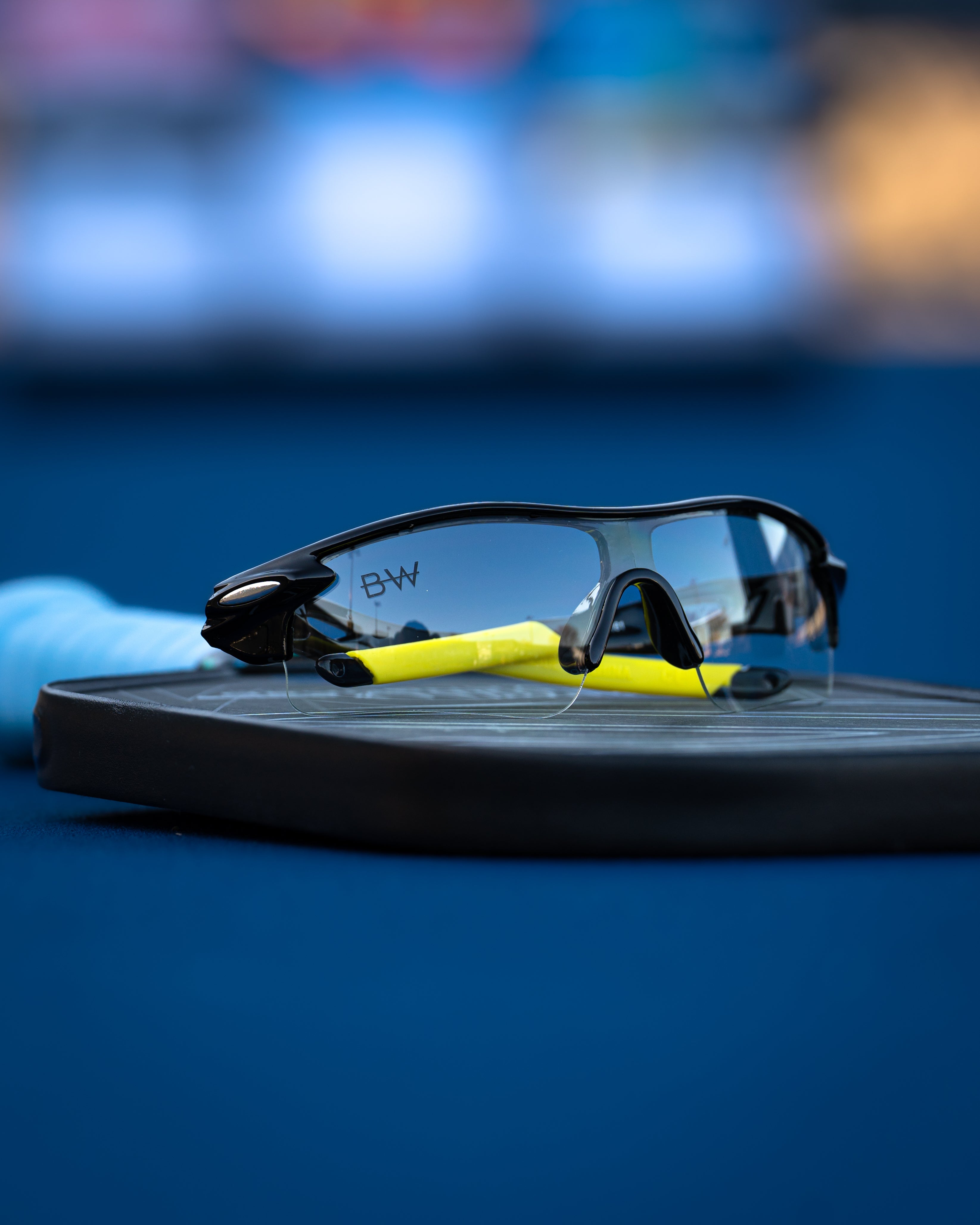
How to Choose the Right Sunglasses for Outdoor Sports
Share
How to Choose the Right Sunglasses for Outdoor Sports: 2026 Guide
The right sunglasses for outdoor sports should match your environment, vision needs, activity, and fit—not simply have the darkest lens or the longest list of performance claims.
Outdoor athletes can encounter bright sun, shade, changing weather, wind, movement, and long periods of wear. That makes lens configuration, impact resistance, frame dimensions, prescription compatibility, and verified UV specifications more useful shopping considerations than claims that sunglasses automatically improve reaction time, depth perception, or athletic performance.
This guide explains how to choose sports sunglasses for pickleball, running, cycling, outdoor training, and other active use, including what to consider if you need prescription sports sunglasses.
Find Sports Eyewear for Your Needs
Why Wear Sunglasses for Outdoor Sports?
Outdoor sports place eyewear in a different environment from everyday indoor use. Depending on the activity, you may encounter:
- Bright sunlight
- Changing cloud cover
- Shade
- Wind
- Dust or airborne debris
- Perspiration
- Rapid movement
- Changing directions
- Long training sessions
Sports sunglasses can provide a tinted lens when you prefer visible-light reduction in bright conditions, while a sports-oriented frame can provide a different fit and amount of physical coverage than some everyday eyewear.
If you require prescription correction, RX sports sunglasses can also incorporate the correction prescribed for your vision.
These practical benefits are more accurate than promising that sunglasses inherently make athletes faster, improve reflexes, or guarantee better performance.
Do You Need Prescription Sports Sunglasses?
Prescription sports sunglasses may make sense if you require vision correction while participating in your outdoor activity and prefer not to rely on contact lenses.
The original version of this guide correctly centered prescription eyewear as an important option for athletes, but it also attached several broader performance and lens claims to that recommendation. :contentReference[oaicite:0]{index=0}
A more useful first question is:
Do you require prescription correction while participating in your sport?
| Your Vision Situation | Eyewear to Consider |
|---|---|
| You require eyeglass correction during sports | RX-compatible sports eyewear |
| You wear contact lenses during sports | Non-RX sports sunglasses can potentially be worn while contacts provide correction |
| You do not require vision correction | Non-prescription sports sunglasses |
| You are unsure whether you need correction | Have your vision appropriately evaluated rather than diagnosing yourself from sports performance |
How to Choose Sunglasses for Outdoor Sports
Use these factors to narrow your options before choosing a specific frame.
- Determine whether you need RX or non-RX eyewear.
- Identify the lighting conditions where you normally play or train.
- Verify the lens's UV specification.
- Choose an appropriate lens tint or adaptive configuration.
- Look for impact resistance.
- Compare frame dimensions and fit.
- Consider physical lens and frame coverage.
- Verify any additional treatments instead of assuming they are included.
- Consider whether your sport requires a specific protective certification.
- Test the eyewear during your actual activity.
1. Verify UV Protection
UV performance is an important specification to evaluate for eyewear intended for regular outdoor use.
However, do not determine UV performance by looking at lens darkness alone. A dark lens and a verified UV specification are not the same characteristic.
When comparing outdoor sports sunglasses, look for an exact manufacturer-supported specification rather than assuming:
- Every dark lens is UV400
- Every sports lens blocks 100% of UVA and UVB
- Every clear lens lacks UV protection
- A mirrored appearance proves a particular UV rating
Visible tint and UV performance should be evaluated separately.
If UV protection is important to your purchase, verify the specification for the exact lens you are considering.
2. Choose a Lens Tint for Your Environment
Lens tint changes how much visible light reaches your eyes and can alter the appearance of your surroundings. Different athletes may prefer different tint levels and colors.
A darker-looking lens should not automatically be described as providing better UV protection, better contrast, or better sports performance.
| Environment | Lens Direction to Compare | Why |
|---|---|---|
| Bright Outdoor Sun | Tinted sports lens | Provides visible-light reduction according to the selected tint |
| Mixed Sun and Shade | Fixed tint or compatible photochromic option | Choice depends on how much conditions change during your activity |
| Overcast Conditions | Lighter tint or clear lens depending on preference | A very dark tint may not be preferred when ambient light is lower |
| Dusk / Evening | Clear or lighter configuration | A dark sunglass tint may not be preferred as available light decreases |
| Night | Clear | Does not intentionally darken the environment |
| Frequently Changing Light | Compare compatible photochromic options | Designed to change darkness in response to relevant conditions |
Are Gray Lenses Good for Outdoor Sports?
Gray is a common sunglass tint worth comparing for bright outdoor use. The tint reduces visible light according to the specific lens configuration.
Do not assume that every gray lens automatically:
- Preserves color perfectly
- Enhances contrast
- Improves depth perception
- Reduces eye strain
- Improves ball tracking
Those are separate claims that require support for the exact lens.
If you like the visual experience of a gray tint and it suits the conditions where you play, it can be a practical outdoor option.
What About Yellow, Amber, Rose, or Other Sports Lens Tints?
Colored lenses are often marketed with strong claims about contrast, depth perception, and object tracking.
Lens color can change the visual appearance of your surroundings, but a particular tint should not automatically be described as improving athletic performance, depth perception, or ball tracking for every wearer.
When comparing colored lenses, consider:
- How bright your normal environment is
- How much visible tint you prefer
- Whether you like the color shift produced by the lens
- Whether the exact lens has any separately verified characteristics
Personal preference can play a significant role in tint selection.
Are Mirrored Sunglasses Good for Sports?
A mirrored appearance is a lens characteristic that can be useful aesthetically and may be part of a particular lens design, but it should not be treated as proof of every other performance feature.
A mirrored lens does not automatically prove:
- A particular UV rating
- Polarization
- Anti-reflective treatment on all lens surfaces
- Improved contrast
- Better ball tracking
- Improved depth perception
Evaluate the actual specifications of the mirrored lens rather than buying based on appearance alone.
3. Consider Photochromic Lenses for Changing Conditions
Photochromic lenses are designed to change darkness in response to relevant light conditions. They can be worth comparing for athletes who regularly move through different environments during one session.
Examples can include:
- A run that begins in daylight and ends near dusk
- A long outdoor training session with changing conditions
- Travel between outdoor and indoor environments
- Activities that repeatedly move between open sun and shaded areas
Photochromic performance can vary by exact lens technology, temperature, environment, and other conditions. Do not assume every photochromic lens changes at the same speed, reaches the same darkness, or behaves identically in every setting.
Clear vs. Tinted Sports Glasses Outdoors
Clear sports glasses and tinted sports sunglasses serve different purposes.
| Characteristic | Clear Lens | Tinted Lens |
|---|---|---|
| Traditional Dark Tint | No | Yes, depending on tint |
| Visible-Light Reduction | No intentional dark sunglass tint | Depends on exact tint |
| Bright Outdoor Conditions | Can be worn, but remains clear | Often preferred when visible-light reduction is desired |
| Dusk / Night | Worth considering | Dark tint may not be preferred |
| UV Specification | Must be verified | Must be verified |
| Impact Resistance | Depends on exact lens | Depends on exact lens |
4. Decide Whether Polarization Matters for Your Sport
Polarized lenses use a polarization filter. They are commonly associated with reducing certain reflected glare, but polarization should not automatically be treated as necessary for every outdoor sport.
Blinded Wear sports lenses are non-polarized.
Some court-sport players prefer non-polarized eyewear, but non-polarized lenses should not be described as inherently improving:
- Depth perception
- Reaction time
- Ball tracking
- Distance judgment
- Overall athletic performance
Choose polarization or non-polarization based on the characteristics you actually need rather than assuming one category is universally superior.
5. Look for Impact-Resistant Sports Lenses
Outdoor activities can expose eyewear to impacts, falls, equipment, balls, branches, dust, or airborne debris depending on the sport.
Blinded Wear sports eyewear uses impact-resistant lenses.
That distinction should be kept accurate. Impact-resistant does not automatically mean:
- Shatterproof
- Indestructible
- Guaranteed to prevent eye injury
- Certified to a particular sports standard
- Suitable as safety eyewear for every activity
If your sport or use requires a specific protective certification, verify that exact standard for the exact eyewear.
Are Sports Sunglasses the Same as Protective Eyewear?
No. “Sports sunglasses” describes a broad eyewear category. It does not automatically establish a specific level of certified protection.
When protection is a major purchasing priority, evaluate:
- Lens material
- Impact resistance
- Frame construction
- Physical coverage
- Any verified protective certification
- The requirements of your specific activity
A product can be impact-resistant without being certified protective eyewear.
6. Get the Frame Fit Right
Outdoor sports involve movement, so frame fit deserves more attention than it might when choosing casual sunglasses.
Compare:
- Overall frame width
- Bridge dimensions
- Temple length
- Lens width
- Lens height
- Overall weight
- Physical coverage
- Comfort during movement
If you already own eyewear that fits well, its measurements can provide a useful reference when comparing sports frames online.
Do not assume that every sports frame includes adjustable nose pads, rubberized temples, or a guaranteed non-slip fit unless those characteristics are verified for the exact product.
Should Sports Sunglasses Have a Secure Fit?
Most athletes do not want to repeatedly adjust their eyewear during activity, but “secure fit” should not become a universal guarantee.
How much a frame moves can depend on:
- Face shape
- Frame dimensions
- Bridge fit
- Temple fit
- Perspiration
- Your movement
- The specific activity
Test new eyewear during training before relying on it for a race, tournament, competition, or long outdoor session.
7. Consider Physical Coverage
Frame and lens geometry determine how much physical area the eyewear covers around your eyes.
Depending on the activity, athletes may consider:
- Lens width
- Lens height
- Side coverage
- Frame curvature
- How the eyewear sits relative to the face
More coverage can change how the eyewear interacts with wind and airborne debris, but coverage should not automatically be translated into claims of complete wind, dust, or impact protection.
Physical coverage and certified protection are separate considerations.
Are Wraparound Sunglasses Better for Outdoor Sports?
Wrap-style sports sunglasses can provide a different frame geometry and amount of side coverage than flatter frames.
Whether that is better depends on:
- Your sport
- Your face shape
- Your preferred coverage
- Prescription requirements
- Frame comfort
- Compatibility with other equipment
Do not assume that a wraparound frame automatically provides better peripheral vision, blocks all wind, prevents dust exposure, or guarantees a secure fit.
Highly curved frames can also introduce additional considerations for prescription compatibility.
8. Consider Weight and Long-Wear Comfort
Weight can become more noticeable during long runs, rides, matches, training sessions, or tournaments.
Blinded Wear offers lightweight sports-frame options.
However, lightweight should not automatically be interpreted as:
- More secure
- More durable
- Better fitting
- Better for reaction time
- Better for athletic performance
The best frame weight is one component of overall comfort and fit.
9. Check Prescription Compatibility
If you require prescription sports sunglasses, begin with your prescription rather than choosing a frame solely by appearance.
Not every prescription works with every sports frame.
Compatibility can depend on:
- Sphere power
- Cylinder and axis values
- Frame dimensions
- Frame curvature
- Lens geometry
- Available lens material
- Other prescription requirements
Blinded Wear RX customers can upload a clear photo or picture of their eyeglass prescription when ordering.
High-Index Prescription Lenses for Outdoor Sports
Blinded Wear includes high-index prescription lenses at no additional cost with RX eyewear.
High-index refers to a lens-material characteristic. It does not automatically mean the lens includes:
- UV400 protection
- Polarization
- Anti-fog treatment
- Anti-reflective treatment
- Scratch resistance
- Photochromic behavior
- Improved contrast
- Improved sports performance
Those characteristics must be evaluated separately.
How to Choose Sunglasses by Outdoor Sport
Different activities create different priorities. Start with the conditions you actually encounter rather than assuming one pair is universally best for every sport.
| Sport | Useful Factors to Compare |
|---|---|
| Pickleball | RX needs, tint preference, fit, physical coverage, impact resistance, changing light conditions |
| Running | Fit during movement, comfort, weight, lens tint, environmental conditions |
| Cycling | Helmet compatibility, physical coverage, fit, changing light, prescription needs |
| Tennis | Fit, tint preference, impact resistance, coverage, prescription needs |
| Outdoor Training | Comfort, frame dimensions, tint, prescription needs, length of wear |
| Multi-Sport Use | Whether the same frame and lens configuration actually suits each activity |
How to Choose Sunglasses for Outdoor Pickleball
Outdoor pickleball can include bright sun, shade, cloud cover, and changing conditions across a longer session.
Prioritize:
- Your prescription needs
- A lens tint appropriate for the environment
- Verified UV specifications
- Impact resistance
- Frame fit
- Physical coverage
- Comfort during longer matches
Do not assume that a specific tint automatically improves ball tracking, contrast, reaction time, or depth perception.
If you regularly move between indoor and outdoor pickleball, compare dedicated clear and tinted pairs with compatible photochromic options.
How to Choose Sunglasses for Running
For running, comfort and fit during repetitive movement can matter as much as lens appearance.
Compare:
- Frame dimensions
- Overall weight
- How the frame feels during movement
- Your preferred visible tint
- Verified UV specifications
- Physical coverage
- Prescription needs
- The lighting conditions where you normally run
If your runs frequently begin in daylight and end near dusk, a fixed dark tint may not be your only option. A compatible photochromic configuration or separate clear eyewear may also be worth comparing.
Do not assume a running frame is fog-proof, sweat-proof, or slip-proof unless those characteristics are verified.
How to Choose Sunglasses for Cycling
Cyclists should evaluate sports sunglasses as part of their complete riding setup.
Consider:
- Helmet compatibility
- Frame dimensions
- Physical lens coverage
- Prescription needs
- Typical riding conditions
- Changes between sun and shade
- Comfort in your riding position
A larger or more curved lens may provide different physical coverage, but do not automatically claim that every cycling-style frame completely blocks wind or road debris.
If you require RX lenses, verify prescription compatibility with the exact frame geometry.
How to Choose Sunglasses for Outdoor Tennis
Outdoor tennis shares several eyewear considerations with other court sports.
Evaluate:
- RX vs. non-RX needs
- Lens tint
- Verified UV specification
- Impact resistance
- Frame fit
- Physical coverage
- Comfort during repeated head and body movement
A sports tint can change the appearance of the court and surroundings, but do not assume that any particular color automatically improves tracking of the tennis ball.
Do Outdoor Sports Sunglasses Fog?
They can. Outdoor eyewear may encounter perspiration, humidity, temperature changes, and varying airflow.
Fogging can be influenced by:
- Temperature
- Humidity
- Perspiration
- Frame-to-face spacing
- Airflow
- Lens-surface characteristics
Do not assume that a sports frame is automatically anti-fog because it is intended for outdoor use.
If anti-fog technology matters to you, verify the exact lens or product specification.
Do Sports Sunglasses Need Anti-Glare or Anti-Reflective Lenses?
Anti-reflective treatments, polarization, visible tint, and mirrored finishes are separate characteristics.
Do not treat the terms as interchangeable.
- Tint changes visible light transmission and appearance.
- Polarization uses a polarization filter.
- Anti-reflective treatment is a separate lens treatment.
- Mirror finish describes another lens-surface characteristic.
If a specific treatment matters for your activity, verify it rather than assuming it is included because the product is marketed as sports eyewear.
FAQ: Choosing Sunglasses for Outdoor Sports
What sunglasses are best for outdoor sports?
The best pair depends on your prescription needs, environment, preferred tint, verified UV specifications, impact resistance, frame fit, physical coverage, and any protective standard required for your activity.
Should sports sunglasses be polarized?
Not necessarily. Polarization can be useful in some situations, but it is not universally required for outdoor sports. Blinded Wear sports lenses are non-polarized.
What color sunglasses are best for sports?
There is no universal best lens color for every athlete or sport. Consider brightness, environment, personal preference, and the verified characteristics of the exact lens.
Are darker sunglasses better for outdoor sports?
Not automatically. Darker tint changes visible-light transmission but does not, by itself, establish UV protection or better athletic performance.
Do sports sunglasses need UV protection?
UV performance is an important specification to evaluate for outdoor eyewear. Verify the exact UV claim for the lens rather than assuming it from darkness or color.
Are sports sunglasses impact-resistant?
Some are. Blinded Wear sports eyewear uses impact-resistant lenses, but impact-resistant does not mean shatterproof or automatically certified protective eyewear.
Can you get prescription sports sunglasses?
Yes. Compatible sports frames can use prescription lenses when your prescription works with the selected frame and lens configuration.
Can I wear sports sunglasses over contacts?
Yes. Contact lenses can provide prescription correction while non-RX sports sunglasses are worn separately.
Are photochromic lenses good for outdoor sports?
They can be worth comparing if your activity regularly involves changing light conditions. Exact behavior varies by lens technology and environment.
Are wraparound sunglasses better for sports?
They can provide different physical coverage and frame geometry, but they are not universally better. Fit, prescription compatibility, activity, and personal preference all matter.
10. Think About Sweat, Heat & Long Outdoor Sessions
Outdoor sports can mean hours of movement in warm conditions. Perspiration can affect both comfort and how eyewear behaves on your face.
When comparing sports sunglasses, consider:
- Bridge comfort
- Temple pressure
- Overall frame weight
- Frame-to-face spacing
- How the frame feels when your face is damp
- Whether you frequently need to adjust the eyewear
- How comfortable it remains after extended wear
Do not assume that every sports frame includes sweat-resistant grips, rubberized temple pieces, adjustable nose pads, or a guaranteed non-slip design. Those characteristics should be verified for the exact frame.
Does Ventilation Matter in Sports Sunglasses?
Airflow around eyewear can be relevant to comfort and condensation, but “ventilated” should not become a blanket anti-fog claim.
How much air moves around a lens can be affected by:
- Frame geometry
- Frame-to-face distance
- Lens size
- Your movement speed
- Wind
- Temperature
- Humidity
- Other equipment you are wearing
If a specific frame has vents or another airflow-related design feature, verify that characteristic on the exact product rather than assuming all sports sunglasses use the same construction.
11. Check Compatibility With Your Other Sports Gear
Your sunglasses do not exist in isolation. Depending on your sport, they may need to work alongside other equipment.
That can include:
- Cycling helmets
- Running hats
- Visors
- Headbands
- Earbuds or headphones
- Other sport-specific equipment
Temple placement and frame dimensions can affect comfort when another piece of equipment presses against or overlaps the eyewear.
If you regularly use additional gear, test the complete setup together rather than evaluating the sunglasses by themselves.
Prescription Sports Sunglasses vs. Contacts + Non-RX Sunglasses
Athletes who require vision correction generally have more than one possible eyewear setup.
| Setup | How Vision Correction Works | What to Consider |
|---|---|---|
| RX Sports Sunglasses | Prescription is incorporated into the sports eyewear | RX compatibility, frame geometry, tint options, fit |
| Contacts + Non-RX Sports Sunglasses | Contacts provide correction; sunglasses are non-prescription | Contact comfort, frame fit, lens configuration, environment |
| Contacts + Clear Sports Glasses | Contacts provide correction; clear eyewear remains untinted | Useful when a dark sunglass tint is not desired |
Neither setup is universally better. Your prescription, comfort, eye-care guidance, activity, and personal preference should guide the decision.
Can Any Prescription Be Made Into Sports Sunglasses?
No. A sports frame being offered in an RX version does not mean every possible prescription can be produced in that frame.
Compatibility can be influenced by:
- Sphere power
- Cylinder and axis
- Frame curvature
- Frame dimensions
- Lens dimensions
- Lens geometry
- Available lens material
- Multifocal requirements when applicable
This becomes especially important with highly curved sports frames.
If you have a stronger or more complex prescription, verify compatibility before assuming a particular frame will work.
How to Order Prescription Sports Sunglasses From Blinded Wear
If you need prescription sports eyewear, use your actual eyeglass prescription rather than attempting to estimate your correction.
A practical process is:
- Have appropriate eyeglass prescription information available.
- Browse RX-compatible sports frames.
- Compare frame dimensions and styling.
- Consider where and when you will use the eyewear.
- Verify that your prescription is compatible with the selected frame.
- Review the available lens configuration.
- Upload a clear photo or picture of your eyeglass prescription.
- Review your information before submitting the order.
Blinded Wear includes high-index prescription lenses at no additional cost with RX eyewear.
Can Sports Sunglasses Correct Astigmatism?
Compatible prescription sports eyewear can support some prescriptions that include cylinder and axis correction for astigmatism.
Whether your prescription works depends on the complete RX, frame, lens geometry, and available lens configuration.
Do not assume that every RX sports frame supports every level of astigmatism correction.
What if You Have a Strong Prescription?
A stronger prescription does not automatically rule out sports eyewear, but frame and lens compatibility become especially important.
Consider:
- Prescription strength
- Frame size
- Frame curvature
- Lens dimensions
- Available lens material
- Other prescription requirements
Blinded Wear includes high-index prescription lenses at no additional cost with RX eyewear. High-index material, however, does not guarantee that every prescription will work with every sports frame.
Can Sports Sunglasses Have Progressive Lenses?
Progressive or multifocal compatibility depends on the exact frame, prescription, and available lens configuration.
Do not assume that every RX sports frame automatically supports:
- Progressive lenses
- Bifocals
- Every add power
- Every prescription range
If you require multifocal correction, verify compatibility for the exact frame before purchasing.
UV Protection vs. Lens Darkness: What's the Difference?
This distinction is especially important when choosing outdoor sunglasses.
Lens darkness describes visible tint. UV protection describes the lens's performance regarding ultraviolet radiation.
They should not be treated as interchangeable.
| Characteristic | What It Describes |
|---|---|
| Dark Tint | How dark the lens appears and its visible-light characteristics |
| Lens Color | The visible color or tint of the lens |
| Mirror Finish | A lens-surface appearance or treatment |
| Polarization | Use of a polarization filter |
| UV Specification | A separate performance specification that should be verified for the exact lens |
This is why buying the darkest-looking sports sunglasses is not a reliable substitute for checking the actual lens specifications.
Do Sports Sunglasses Improve Depth Perception?
Sports sunglasses do not inherently improve depth perception.
Depth perception involves binocular vision and multiple visual factors. If a person has refractive blur that is appropriately addressed by prescription correction, RX lenses can provide the correction they were prescribed to provide.
That is different from claiming that:
- A particular tint improves depth perception
- Non-polarized lenses improve depth perception
- Sports frames improve depth perception
- Dark lenses improve distance judgment
Do Sports Sunglasses Improve Ball Tracking?
No pair of sunglasses should automatically be described as improving ball tracking simply because it has a sports frame, a particular tint, or a non-polarized lens.
Following a moving ball involves multiple factors, including:
- Vision
- Attention
- Anticipation
- Experience
- Head and eye movement
- Lighting
- Background conditions
If an athlete requires prescription correction, appropriately prescribed lenses can address the refractive blur they are intended to correct. That should not be expanded into an unsupported claim that the eyewear automatically improves tracking performance.
Do Sports Sunglasses Make You React Faster?
No. Sports sunglasses do not directly make the nervous system react faster.
Reaction in sports involves visual information, anticipation, decision-making, experience, and physical response.
Appropriate prescription correction can address refractive blur when correction is needed. A tinted, clear, mirrored, photochromic, polarized, or non-polarized lens should not automatically be credited with faster reactions.
Do Sports Sunglasses Reduce Eye Strain?
Be careful with broad “eye strain” claims because visual discomfort can have multiple causes.
A tinted lens changes visible-light transmission and may be preferred by some athletes in bright conditions, but a sports sunglass should not automatically be presented as treating or preventing every form of eye strain.
If you experience persistent visual discomfort, headaches, unusual light sensitivity, or changes in vision, eyewear shopping should not replace appropriate professional evaluation.
Do Wraparound Sports Sunglasses Improve Peripheral Vision?
Not automatically.
A frame's geometry can affect how noticeable the frame itself is within your field of view and how much physical area the lenses cover, but sunglasses do not inherently expand your natural peripheral vision.
When evaluating a sports frame, ask:
- Do I notice the frame excessively?
- Are the lens dimensions comfortable for my activity?
- Does the frame shape work with my head and eye movement?
- Does the curvature work with my prescription, if applicable?
Those are more useful questions than assuming a wide or curved lens automatically improves sports awareness.
What Sunglasses Should You Choose for Bright Sun?
For consistently bright outdoor conditions, compare tinted sports sunglasses that provide a level of visible-light reduction you find comfortable.
Then separately verify:
- UV specifications
- Impact resistance
- Frame fit
- Physical coverage
- Prescription compatibility if needed
- Any additional lens treatments you specifically want
Do not use lens darkness as a shortcut for determining UV performance.
What Sports Glasses Work for Overcast Conditions?
Some athletes prefer a lighter tint or clear lens when ambient light is lower.
The best choice depends on your visual preference and activity. Avoid assuming that yellow, amber, or another color universally improves contrast or depth perception under cloudy skies.
If your session frequently moves between bright sun and overcast conditions, a compatible photochromic lens may also be worth comparing.
What Should You Wear for Sports at Dusk?
As daylight decreases, a dark sunglass tint may become less desirable.
Depending on your activity and environment, consider:
- A lighter tint
- A clear sports lens
- A compatible photochromic configuration
- Switching to dedicated clear eyewear when appropriate
Clear lenses do not amplify available light. They simply avoid intentionally darkening the scene with a traditional sunglass tint.
What if Your Sport Has Constantly Changing Light?
Changing light is common in outdoor activities. A runner may move beneath trees, a cyclist may enter shaded roads, and a court can move between sun and cloud cover.
You generally have three strategies to compare:
| Strategy | Potential Use | What to Consider |
|---|---|---|
| One Fixed Tint | Relatively consistent outdoor conditions | Choose a tint that works for most of your session |
| Separate Tinted + Clear Pairs | Athletes who regularly use very different environments | Requires carrying or storing a second pair |
| Photochromic Lens | Variable lighting | Verify exact lens behavior and compatibility with your needs |
Can One Pair of Sports Sunglasses Work for Everything?
Possibly, but one pair does not have to be the goal.
An athlete who only trains outdoors in similar daytime conditions may be satisfied with one fixed-tint pair. Someone who alternates among bright outdoor courts, indoor gyms, dusk training, and night sessions may benefit from multiple lens configurations.
Ask yourself:
- How often do I play indoors?
- How often do I play outdoors?
- Do I regularly train near sunrise or sunset?
- Does my sport move between sun and shade?
- Do I need prescription correction?
- Would carrying two pairs be inconvenient?
The answers can help determine whether a fixed tint, clear lens, photochromic option, or multiple-pair setup makes the most sense.
How to Choose Sunglasses for Multiple Sports
If you participate in several outdoor sports, focus on the requirements they share.
For example, you might prioritize:
- Prescription compatibility
- Impact resistance
- Comfort during movement
- A lens configuration suitable for your most common lighting conditions
- Physical coverage
- Compatibility with equipment used across your activities
Then identify where the sports differ. Cycling helmet compatibility, for example, may matter on a bike but not on a pickleball court.
Outdoor Sports Sunglasses Buying Checklist
| Feature | Question to Ask |
|---|---|
| RX / Non-RX | Do I require prescription correction during my sport? |
| Lens Tint | What lighting conditions do I encounter most often? |
| UV Specification | What UV performance is actually verified for this lens? |
| Impact Resistance | Is impact resistance verified? |
| Protective Certification | Does my sport or intended use require a specific standard? |
| Frame Dimensions | How do the measurements compare with eyewear that fits me? |
| Coverage | Does the frame geometry provide the physical coverage I want? |
| Weight | Will I be comfortable wearing the frame for the length of my activity? |
| Polarization | Do I actually want a polarization filter for my intended use? |
| Photochromic | Do my lighting conditions change enough to make an adaptive lens useful? |
| Anti-Fog | Is anti-fog technology specifically verified? |
| Anti-Reflective | Is the treatment actually included in the exact lens? |
| Equipment Compatibility | Does the frame work with my helmet, hat, headband, or other equipment? |
| RX Compatibility | Can my complete prescription be produced in this frame? |
12 Mistakes to Avoid When Buying Sports Sunglasses
- Choosing the darkest lens and assuming it has the best UV protection. Verify UV specifications separately.
- Assuming every sports lens is polarized. Polarization is a distinct lens characteristic.
- Assuming non-polarized lenses improve depth perception. That should not be treated as an automatic benefit.
- Buying a tint because it promises better ball tracking. Lens color does not automatically improve tracking performance.
- Ignoring your prescription. If you need correction during sports, start with RX compatibility.
- Assuming every RX works in every frame. Frame geometry and prescription values matter.
- Confusing impact-resistant with shatterproof. These are not interchangeable claims.
- Assuming sports sunglasses are certified protective eyewear. Verify any required standard.
- Ignoring frame dimensions. A great lens cannot compensate for a frame that does not fit appropriately.
- Assuming every sports frame is anti-fog or non-slip. Verify those features for the exact product.
- Forgetting your other equipment. Test eyewear with helmets, hats, headbands, or other gear you regularly use.
- Buying immediately before a major event. Test new sports eyewear during training first.
How to Clean and Maintain Sports Sunglasses
Outdoor sports eyewear can collect sweat, dust, fingerprints, and debris. Appropriate care can help keep the eyewear usable and avoid unnecessary lens damage.
Follow the care instructions for your exact eyewear. In general:
- Check for loose dirt or debris before rubbing the lenses.
- Use an appropriate lens-safe cleaning method.
- Use suitable lens-cleaning material rather than abrasive fabric.
- Avoid harsh chemicals unless they are confirmed safe for the lens.
- Allow wet eyewear to dry appropriately before long-term storage.
- Periodically inspect the frame and lenses for damage.
Impact-resistant lenses should not automatically be treated as scratch-proof.
How Should You Store Sports Sunglasses?
Avoid leaving sports eyewear loose in a gym bag, backpack, cycling bag, or vehicle compartment where the lenses can repeatedly contact harder objects.
Keep eyewear separated from:
- Keys
- Tools
- Water bottles
- Sports equipment
- Shoes
- Other hard or abrasive objects
If you rely on prescription sports eyewear, protecting your primary pair becomes especially important because damage can leave you without your preferred correction for your next activity.
Should You Carry a Backup Pair of Sports Glasses?
A backup pair can make sense when eyewear is essential to your vision or when you are traveling for competition.
Consider a backup when:
- You depend on prescription correction
- You are traveling away from home
- You have multiple matches or events in one day
- Your activity spans significantly different lighting conditions
- Replacing damaged eyewear quickly would be difficult
You do not automatically need two pairs because you participate in sports. The value of a backup depends on your circumstances.
How to Pack Sports Sunglasses for Travel
If you travel for tournaments, races, matches, or training, treat essential eyewear like other important sports equipment.
Consider bringing:
- Your primary sports eyewear
- A backup RX pair when appropriate
- Appropriate storage
- Lens-safe cleaning supplies
- Your prescription information if you depend on RX eyewear
- A different lens configuration if your destination has significantly different conditions
When Should You Replace Sports Sunglasses?
There is no universal replacement schedule for sports sunglasses.
Instead, inspect them periodically and reconsider the eyewear if:
- The frame is damaged
- The lenses are damaged
- The fit has changed
- Your prescription changes
- Your sports or playing conditions change
- You require a specification your existing eyewear does not provide
- The eyewear no longer works appropriately with your other equipment
Visible damage deserves attention, particularly when you rely on the eyewear during active sports.
What Does Blinded Wear Offer Outdoor Athletes?
Blinded Wear offers prescription and non-prescription sports eyewear that athletes can compare according to their individual sport, vision needs, and environment.
| Blinded Wear Feature | What It Means |
|---|---|
| Prescription Sports Eyewear | RX-compatible sports frames for athletes who require prescription correction. |
| Non-RX Sports Eyewear | Sports frames for athletes who do not require correction or who receive correction from contacts. |
| Clear Lens Collection | Untinted non-RX sports eyewear for conditions where a dark sunglass tint is not preferred. |
| Impact-Resistant Lenses | Blinded Wear sports eyewear uses impact-resistant lenses. |
| Non-Polarized Sports Lenses | Blinded Wear sports lenses are non-polarized. |
| Lightweight Sports Frames | Lightweight frame options are available for active use. |
| High-Index RX Lenses | Included at no additional cost with Blinded Wear RX eyewear. |
| RX Upload | RX customers can upload a clear photo or picture of their eyeglass prescription. |
| Replacement Support | 50% lifetime replacement support if glasses break, subject to current policy terms. |
What if Your Blinded Wear Sports Glasses Break?
Blinded Wear provides 50% lifetime replacement support if glasses break, subject to the current policy terms.
Replacement support should not be confused with a claim that the eyewear cannot break or that every type of damage is covered.
It also does not automatically mean:
- A free replacement
- Coverage for loss
- A shatterproof guarantee
- Coverage for every scratch
- A particular protective certification
- A free prescription update whenever your RX changes
Review the current policy for complete terms before relying on replacement support.
Not Sure Which Sports Sunglasses to Choose?
The Blinded Wear eyewear quiz can help narrow your shopping preferences if you are comparing sports frames and lens categories.
Use it as a shopping tool, not as a vision test or medical assessment.
The quiz cannot:
- Determine your eyeglass prescription
- Diagnose nearsightedness or farsightedness
- Diagnose astigmatism
- Determine whether you medically need corrective lenses
- Guarantee a frame will fit
If you are unsure whether you need prescription correction, have your vision appropriately evaluated.
More Questions About Outdoor Sports Sunglasses
Can I use regular sunglasses for sports?
You can wear ordinary sunglasses during some activities, but casual sunglasses and sports-oriented or certified protective eyewear should not automatically be treated as equivalent. Consider fit, impact resistance, coverage, and the requirements of your sport.
Should sports sunglasses be lightweight?
Weight can affect comfort during longer activities. Lightweight frames may be preferred by some athletes, but low weight does not automatically mean better fit, durability, or performance.
What is the best lens tint for bright outdoor sports?
There is no universal best tint. Compare visible-light reduction, your environment, personal preference, and the verified specifications of the exact lens.
Are gray lenses good for sports?
Gray is a common tint worth comparing for bright conditions. Do not assume it automatically improves contrast, depth perception, or tracking.
Are yellow lenses good for sports?
Some athletes prefer colored tints in certain environments, but yellow should not automatically be described as improving contrast, depth perception, or sports performance.
Are mirrored sunglasses better for outdoor sports?
Not inherently. A mirror finish is one lens characteristic and should not be treated as proof of UV protection, polarization, contrast enhancement, or better performance.
Can clear glasses be used for outdoor sports?
Yes. Clear sports glasses can be worn outdoors when a dark tint is not desired. Verify any UV or other lens specification you require separately.
Are transition lenses useful for sports?
Photochromic lenses can be worth considering for changing conditions. Exact behavior varies by lens technology and environment.
Can I wear prescription sunglasses for pickleball?
Yes, when the frame and lens configuration are compatible with your prescription and appropriate for your intended use.
Can I wear the same sports sunglasses for running and cycling?
Potentially. Evaluate fit, helmet compatibility, coverage, prescription needs, and lighting conditions for both activities before deciding whether one pair meets both needs.
Do sports sunglasses prevent eye injuries?
No eyewear should be described as guaranteeing prevention of injury. If impact protection is important, evaluate the exact construction and any relevant protective certification.
Do expensive sports sunglasses automatically perform better?
Price alone does not establish fit, UV specifications, impact resistance, prescription compatibility, or suitability for your sport. Compare the actual characteristics you need.
Sports Sunglasses Myths vs. Facts
Outdoor sports eyewear is often marketed with claims that combine several unrelated lens characteristics. Before choosing a pair, separate what the eyewear actually does from what the marketing language implies.
| Common Claim | What to Know |
|---|---|
| “Darker sunglasses provide more UV protection.” | Lens darkness and UV performance are separate characteristics. Verify the exact UV specification. |
| “Polarized sunglasses are always better for sports.” | Polarization is a lens characteristic, not a universal requirement for athletic eyewear. |
| “Non-polarized lenses improve depth perception.” | Non-polarized eyewear should not automatically be credited with improving depth perception. |
| “Yellow or amber lenses improve ball tracking.” | A colored tint changes the appearance of the environment but should not automatically be described as improving tracking performance. |
| “Mirrored lenses provide maximum UV protection.” | A mirror finish does not establish an exact UV specification. |
| “Sports sunglasses don't fog.” | Fogging can occur depending on temperature, humidity, perspiration, airflow, and other conditions. |
| “Wraparound sunglasses improve peripheral vision.” | Frame geometry affects coverage and how noticeable the frame may be, but it does not inherently expand natural peripheral vision. |
| “Impact-resistant means shatterproof.” | Impact resistance does not mean a lens is indestructible. |
| “Sports sunglasses are automatically safety glasses.” | Any protective certification must be verified for the exact eyewear. |
| “Prescription sports sunglasses improve performance.” | RX lenses provide the vision correction they are prescribed to provide. Athletic performance involves many additional factors. |
Sports Sunglasses Features: What Is Verified vs. What Should You Check?
A strong buying decision depends on knowing which characteristics are established and which need to be confirmed for the exact product or lens configuration.
| Feature | What to Know |
|---|---|
| Impact-Resistant Lenses | Blinded Wear sports eyewear uses impact-resistant lenses. |
| Non-Polarized Sports Lenses | Blinded Wear sports lenses are non-polarized. |
| Lightweight Sports Frames | Lightweight sports-frame options are available. |
| High-Index RX Lenses | Included at no additional cost with Blinded Wear prescription eyewear. |
| Prescription Upload | RX customers can upload a clear photo or picture of their eyeglass prescription. |
| 50% Lifetime Replacement Support | Available if glasses break, subject to current policy terms. |
| Exact UV Rating | Verify the specification for the exact lens. |
| Anti-Fog | Verify for the exact product or lens configuration. |
| Anti-Reflective / Anti-Glare | Verify for the exact product or lens configuration. |
| Scratch Resistance | Verify for the exact product or lens configuration. |
| Hydrophobic Treatment | Verify for the exact product or lens configuration. |
| Photochromic | Verify availability and behavior for the exact lens configuration. |
| Protective Certification | Verify the exact product and exact standard required for your activity. |
| Shatterproof | Do not infer this from impact resistance. |
Quick Guide: Which Sports Lens Should You Consider?
Start with the environment where you actually spend the most time.
| Typical Conditions | Lens Direction to Compare | Main Reason |
|---|---|---|
| Bright Daytime Sun | Tinted sports sunglasses | Visible-light reduction |
| Normal Outdoor Daylight | Tint based on personal preference | Choose the visible-light experience you prefer |
| Frequent Sun / Shade Changes | Fixed tint or compatible photochromic lens | Depends on how variable your conditions are |
| Overcast | Lighter tint or clear | A dark tint may not be preferred in lower ambient light |
| Dusk | Lighter tint, clear, or compatible photochromic option | Available light is decreasing |
| Night | Clear | Avoids intentionally darkening the environment |
| Indoor + Outdoor | Multiple pairs or compatible adaptive option | One fixed tint may not suit both environments equally well |
Which Type of Sports Sunglasses Should You Buy?
If You Need Prescription Correction
Start with an RX-compatible sports frame. Verify your prescription compatibility first, then compare tint, frame dimensions, physical coverage, and other lens specifications.
If You Wear Contact Lenses
Your contacts can provide vision correction while you use non-prescription sports sunglasses. This gives you the ability to choose non-RX eyewear according to your sport and environment.
If You Don't Need Prescription Correction
Focus on non-RX sports sunglasses and compare fit, tint, impact resistance, physical coverage, verified UV specifications, and your activity.
Shop Non-RX Sports Sunglasses →
If You Mostly Play Indoors or at Night
A clear sports lens may make more sense than a traditional dark sunglass tint.
Shop Clear Lens Sports Glasses →
If Your Lighting Constantly Changes
Compare a fixed tint with compatible photochromic eyewear or a multiple-pair setup.
If Protection Is Your Main Priority
Shop according to the exact impact characteristics and protective certification you require rather than relying on the words “sports sunglasses.”
Questions to Ask Before Buying Sports Sunglasses
Before purchasing a pair, make sure you can answer these questions:
- Do I need prescription correction?
- Where will I use these sunglasses most often?
- How bright are those conditions?
- Do I want a fixed tint, clear lens, or compatible photochromic option?
- What UV specification is verified for the exact lens?
- Is impact resistance verified?
- Does my sport require a particular protective certification?
- How much physical coverage do I want?
- Do the frame dimensions suit me?
- Will the frame work with my helmet, hat, headband, or other equipment?
- If I need RX, is my complete prescription compatible?
- Am I assuming anti-fog, anti-glare, scratch-resistant, or other features that have not actually been verified?
- Have I tested the eyewear during my actual activity?
- What replacement support is available if the eyewear breaks?
Outdoor Sports Sunglasses FAQ
What should I look for when buying sports sunglasses?
Start with prescription needs, lighting conditions, verified UV specifications, lens tint, impact resistance, frame fit, physical coverage, and any protective certification required for your activity.
What type of sunglasses are best for outdoor exercise?
The right type depends on the exercise and environment. Running, cycling, court sports, and general outdoor training can have different fit, coverage, equipment-compatibility, and lens requirements.
What sunglasses are best for very sunny conditions?
Compare tinted sports sunglasses that provide a visible-light level you find comfortable, then separately verify UV specifications, impact resistance, fit, and any additional characteristics you need.
Are polarized or non-polarized sunglasses better for sports?
Neither category is universally better for every sport. Polarization uses a polarization filter, while non-polarized lenses do not. Blinded Wear sports lenses are non-polarized.
Do non-polarized sunglasses still work in bright sunlight?
Yes. Polarization and visible tint are separate characteristics. A non-polarized lens can still be tinted for bright outdoor conditions.
Are photochromic lenses better than sunglasses?
Neither is universally better. A fixed sunglass tint can work well in relatively consistent conditions, while a compatible photochromic lens may appeal to athletes whose lighting conditions frequently change.
Can photochromic sports glasses replace clear and tinted glasses?
They may reduce the need to switch eyewear for some athletes, but exact photochromic behavior varies. Some athletes may still prefer dedicated clear and tinted pairs.
Can you wear clear sports glasses in sunlight?
Yes, if the clear configuration suits your preferences and the exact lens provides any specifications you require. Clear lenses do not provide the visible-light reduction of a traditional dark tint.
Does lens color affect UV protection?
Do not use visible lens color as a substitute for checking the actual UV specification. UV performance and visible tint are separate characteristics.
Does a mirror coating mean sunglasses are polarized?
No. A mirror finish and polarization are separate characteristics.
Do all prescription sunglasses have UV protection?
Do not assume that an RX lens automatically has a particular UV specification. Verify the exact lens configuration.
Are prescription sports sunglasses worth it?
They can be useful for athletes who require prescription correction and want that correction incorporated into their sports eyewear. Whether they make sense for you depends on your RX needs, activity, and preferred setup.
Should I buy separate sunglasses for different sports?
Not necessarily. One pair may work across multiple activities if its fit, lens configuration, prescription compatibility, physical coverage, and equipment compatibility suit each sport.
How should sports sunglasses fit?
They should be appropriately sized and comfortable during the movement involved in your activity. Avoid assuming that any frame is universally non-slip.
Are sports sunglasses scratch-proof?
Do not assume so. Impact resistance and scratch resistance are different characteristics.
Are sports sunglasses shatterproof?
Impact-resistant lenses should not automatically be described as shatterproof. Verify exact construction and any relevant protective certification.
Can sports sunglasses protect against wind and debris?
Frame and lens geometry can provide physical coverage, but do not assume complete protection against wind, dust, or debris without appropriate supporting specifications.
Should runners wear sunglasses?
Runners may choose sports sunglasses for visible-light reduction, their preferred physical coverage, or prescription correction. The appropriate configuration depends on conditions and individual needs.
Should cyclists wear wraparound sunglasses?
Wrap-style eyewear can provide different side coverage and geometry, but cyclists should also consider helmet compatibility, fit, prescription needs, and the exact lens specifications.
What sunglasses are good for outdoor pickleball?
Compare sports sunglasses according to your RX needs, lighting conditions, tint preference, verified UV specifications, impact resistance, fit, and physical coverage. No single tint automatically improves ball tracking or depth perception.
Key Takeaways: Choosing Sports Sunglasses in 2026
- Choose sports sunglasses according to your activity and environment rather than marketing claims.
- Determine whether you need RX or non-RX eyewear first.
- Visible lens darkness and UV protection are separate characteristics.
- Verify the exact UV specification for outdoor eyewear rather than assuming it from lens color.
- No single tint is universally best for every outdoor sport.
- A colored lens does not automatically improve contrast, ball tracking, depth perception, or athletic performance.
- Polarized and non-polarized lenses are different configurations; neither is universally best for every sport.
- Blinded Wear sports lenses are non-polarized.
- Photochromic lenses are worth comparing when lighting conditions regularly change.
- Clear sports glasses can be useful when a dark tint is not preferred.
- Blinded Wear sports eyewear uses impact-resistant lenses.
- Impact-resistant does not mean shatterproof or automatically safety-certified.
- Physical coverage and protective certification are separate considerations.
- Frame dimensions, weight, and comfort matter during movement.
- Wraparound styling does not automatically improve peripheral vision.
- Sports sunglasses are not automatically anti-fog, scratch-resistant, anti-glare, or slip-proof.
- Blinded Wear includes high-index prescription lenses at no additional cost with RX eyewear.
- RX customers can upload a clear photo or picture of their eyeglass prescription.
- Blinded Wear provides 50% lifetime replacement support if glasses break, subject to current policy terms.
Related Sports Eyewear Guides
Final Checklist Before You Buy Outdoor Sports Sunglasses
Before checking out, confirm the factors that actually matter for your use:
- Vision: Do I need RX correction, contacts + non-RX eyewear, or no correction?
- Environment: Will I primarily use these in bright sun, mixed conditions, overcast weather, dusk, or several environments?
- Tint: Does the lens provide the visible-light experience I want?
- UV: Have I verified the exact UV specification instead of assuming it?
- Impact Resistance: Is it actually verified?
- Protection: Does my activity require a specific protective certification?
- Fit: Do the frame dimensions suit me?
- Coverage: Does the frame provide the physical coverage I want?
- Comfort: Can I comfortably wear it for the duration of my activity?
- Equipment: Does it work with everything else I wear?
- RX Compatibility: If applicable, does my complete prescription work with the frame?
- Claims: Have I verified any anti-fog, anti-glare, scratch-resistant, or other feature I care about?
- Testing: Have I tried the eyewear during training before relying on it in competition?
- Support: Do I understand the replacement policy if the eyewear breaks?
Find the Right Sports Sunglasses for Your Next Outdoor Session
The best sports sunglasses are not necessarily the darkest pair, the most expensive pair, or the pair with the most aggressive performance claims.
Start with your vision, your sport, and your environment. Then compare tint, verified UV specifications, impact resistance, frame dimensions, physical coverage, prescription compatibility, and any additional features you actually need.
Bottom Line: How Do You Choose the Right Sunglasses for Outdoor Sports?
Choose outdoor sports sunglasses by matching the eyewear to your prescription needs, lighting conditions, activity, frame fit, physical coverage, and verified lens specifications.
For bright outdoor conditions, a tinted sports lens may provide the visible-light reduction you prefer. For frequently changing environments, compatible photochromic eyewear may be worth comparing. For dusk, nighttime, or environments where you do not want a dark tint, clear sports glasses can be another option.
If you require prescription correction, begin with an RX-compatible frame rather than choosing sunglasses first and assuming your prescription will fit later. If you already wear contacts or do not require correction, non-RX sports sunglasses provide another path.
Most importantly, separate characteristics that are often grouped together in sports-eyewear marketing. Dark does not automatically mean better UV protection. Non-polarized does not automatically mean better depth perception. A colored tint does not automatically mean better ball tracking. Impact-resistant does not mean shatterproof. And “sports sunglasses” does not automatically mean certified protective eyewear.
Choose the lens for your environment. Choose the frame for your fit and activity. Verify the specifications that matter.