RX Eyewear That Won’t Break Mid-Tournament
Share
RX Eyewear That Won’t Break Mid-Tournament: A Durability Guide for Pickleball
No pair of prescription sports glasses can honestly be guaranteed to “never break” during a tournament. Pickleball eyewear can be dropped, stepped on, crushed inside a bag, struck during play, or damaged while traveling. What you can do is choose sports-focused RX eyewear with impact-resistant lenses, evaluate the frame carefully, store it properly, and have a backup plan before tournament day.
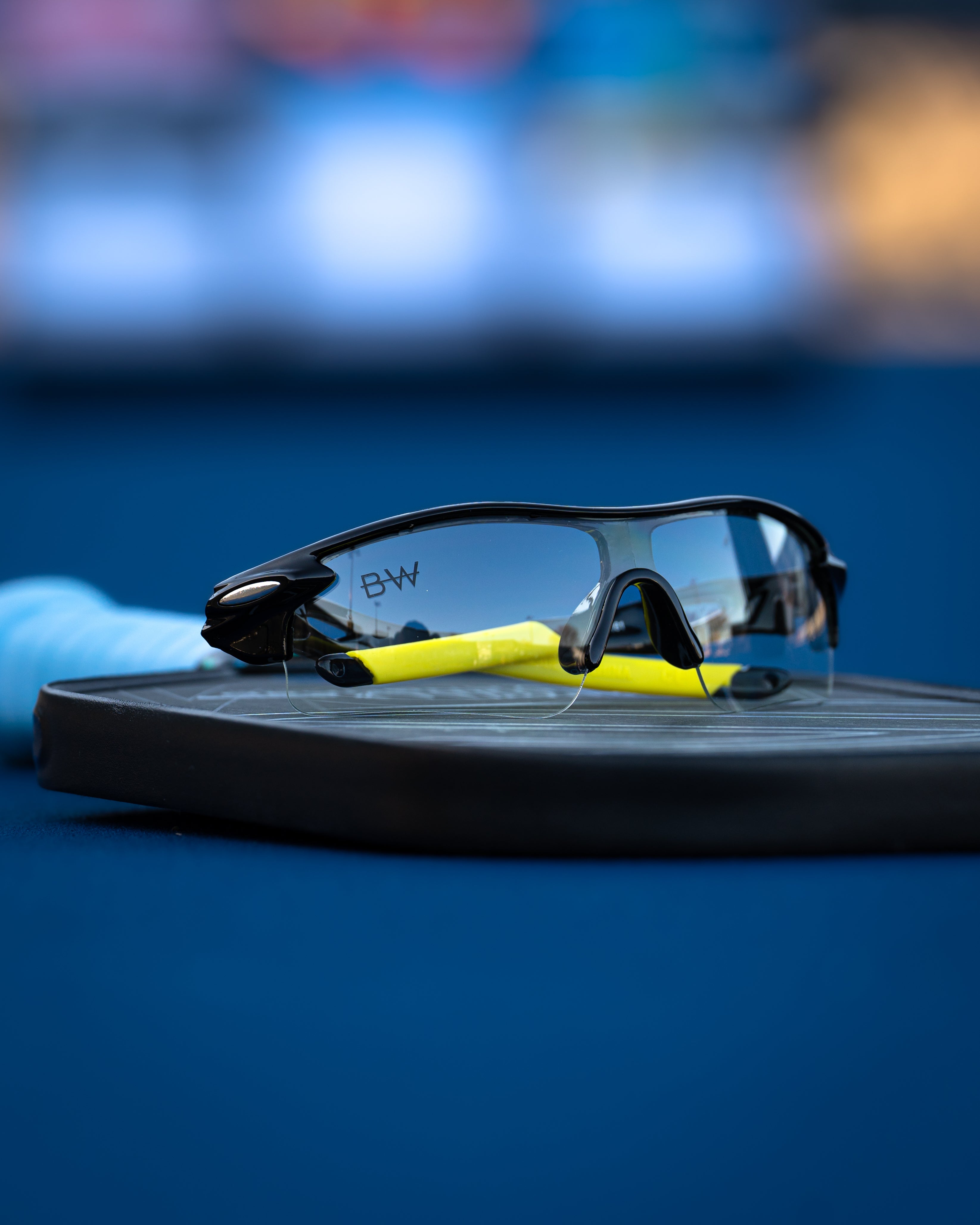
Blinded Wear RX eyewear is designed for pickleball players and uses impact-resistant, non-polarized sports lenses. High-index prescription lenses are also included at no additional cost. Those are meaningful characteristics without calling the eyewear shatterproof, indestructible, or “tournament-proof.”
This guide explains what actually matters when you're choosing prescription eyewear for long tournament days—and how to reduce the chance that damaged glasses end your event early.
Find Your Pickleball Glasses
Compare RX and non-RX sports eyewear based on your prescription, frame dimensions, playing environment, and individual fit.
The original article also directs readers to these RX, non-RX, and 2026 guide resources. :chatgpt-content-reference{index="0"}
Quick Answer: What Should You Look for in Tournament RX Eyewear?
Don't shop for an impossible “unbreakable” promise. Look for an RX setup that addresses the practical demands of tournament play.
| Priority | Why It Matters |
|---|---|
| Impact-resistant lenses | Relevant for active sports where accidental impacts can occur |
| Prescription compatibility | The frame needs to work with your actual RX requirements |
| Frame fit | A poorly fitting pair can become distracting during long sessions |
| Comfort | Tournament days may involve hours of wear |
| Proper storage | Eyewear can be damaged off court as well as during play |
| Backup RX pair | Gives you another option if your primary pair becomes unusable |
| Replacement support | Can reduce replacement cost after eligible breakage |
Why Durable RX Eyewear Matters During Pickleball Tournaments
A tournament creates more opportunities for eyewear damage than a short recreational session. Your glasses may go through warm-ups, multiple matches, breaks between rounds, travel, repeated packing and unpacking, and hours around other equipment.
The original article correctly focuses on durability as an important tournament consideration, but it also describes Blinded Wear eyewear as “shatter-resistant,” “high-impact ready,” and effectively immune to fogging and snapping. :chatgpt-content-reference{index="1"}
Those stronger promises aren't necessary.
A better tournament strategy is to assume that any eyewear can potentially be damaged and prepare accordingly.
Can RX Sports Glasses Really Be Guaranteed Not to Break?
No.
Even sports-focused prescription eyewear can potentially break when exposed to enough force. That's why terms such as “tournament-proof,” “smash-proof,” “won't crack,” or “unbreakable” should be avoided unless extremely specific testing supports them.
Durability isn't one characteristic. It can involve:
- Lens material
- Frame construction
- Hinges
- How the completed prescription lenses interact with the frame
- How the eyewear fits
- How it's stored
- The type and severity of an impact
- Repeated wear over time
A durable design can reduce certain risks. It can't eliminate every possible failure.
Impact-Resistant vs. Shatterproof: Know the Difference
Blinded Wear sports eyewear uses impact-resistant lenses. That's the accurate characteristic to focus on.
| Term | What You Should Understand |
|---|---|
| Impact-resistant | The lens is designed to resist physical impact better than a lens without that characteristic |
| Shatterproof | A much stronger claim that shouldn't be assumed |
| Unbreakable | No |
| Tournament-proof | Marketing language, not a guarantee that damage can't occur |
| Certified protective eyewear | Requires applicable verified testing or certification |
The original article repeatedly uses stronger durability language, including “shatter-resistant,” “high-impact ready,” and materials that supposedly flex instead of cracking. :chatgpt-content-reference{index="2"} :chatgpt-content-reference{index="3"}
Impact resistance is valuable without turning it into an indestructibility claim.
Does Frame Material Determine Whether RX Glasses Will Break?
Frame material matters, but don't assume every Blinded Wear frame uses the same material.
The original article says tournament eyewear uses materials such as TR-90 and composite polycarbonate, while Zebra II RX is specifically described as a “heat-tempered composite with internal flex.” :chatgpt-content-reference{index="4"} :chatgpt-content-reference{index="5"}
Those product-specific materials shouldn't be applied across the RX collection without current verification.
When evaluating a frame, use the specifications available for that exact model rather than assuming:
- Every sports frame uses TR-90
- Every frame is highly flexible
- Flexibility prevents cracking
- Every hinge is spring-loaded
- Every frame has the same impact behavior
What About Hinges?
The original article claims spring-loaded hinges reduce breakage under torque and physical play. :chatgpt-content-reference{index="6"}
Don't generalize that characteristic across the collection unless the exact frame is verified to use that hinge system.
Regardless of hinge type, inspect your tournament eyewear periodically. If a hinge becomes loose, damaged, or noticeably different from normal, address it before an important match rather than waiting for complete failure.
Can Impact-Resistant Prescription Lenses Still Crack?
Yes.
Impact resistance shouldn't be interpreted as immunity from damage. A sufficiently strong impact, crushing force, accident, or other stress can still damage sports eyewear.
If a prescription lens becomes visibly cracked:
- Stop normal sports use of the damaged pair.
- Inspect the rest of the frame.
- Keep the broken eyewear if you may submit a replacement claim.
- Switch to appropriate backup RX eyewear if available.
- Review the current replacement-support terms.
For a deeper explanation, see Why Impact Resistance Matters in Sports Eyewear.
What If the Frame Breaks but the Prescription Lenses Look Fine?
A frame can be structurally compromised even if both lenses appear intact.
Potential warning signs include:
- A snapped frame section
- A significantly damaged hinge
- A lens that no longer stays seated correctly
- Sharp broken areas
- A major change in how the frame sits
Don't continue competitive use simply because the prescription lenses themselves appear undamaged.
Are Non-Polarized Lenses More Durable?
No. Polarization and impact resistance are separate characteristics.
Blinded Wear sports lenses are non-polarized, meaning a polarization filter isn't added. That doesn't inherently make the lenses stronger or weaker.
The original article also says polarized lenses distort depth perception and presents non-polarized lenses as the solution. :chatgpt-content-reference{index="7"}
That's too broad. Non-polarized lenses don't automatically provide better depth perception, ball tracking, reaction time, or durability.
What About Progressive RX Lenses for Tournament Play?
The original guide says progressive lenses are available on every RX frame. :chatgpt-content-reference{index="8"}
Don't assume universal progressive compatibility. Progressive prescriptions can depend on the exact frame, prescription, lens design, fitting height, and optical measurements.
Whether a prescription is single-vision or progressive also doesn't inherently make the eyewear more or less durable.
Confirm the exact RX configuration before ordering.
Do High-Index Lenses Make RX Glasses More Durable?
High-index and impact resistance shouldn't be treated as interchangeable.
Blinded Wear includes high-index prescription lenses at no additional cost. Higher-index material can help manage lens thickness for some prescriptions compared with a lower-index material for the same prescription and comparable design.
But high-index doesn't automatically mean:
- Impact-resistant
- Shatterproof
- Scratch-resistant
- Anti-fog
- More durable in every situation
- Lighter in every prescription and frame combination
Those characteristics should be evaluated separately.
How RX Glasses Actually Get Damaged During Tournaments
On-court impacts are only part of the durability equation.
Common tournament risks can include:
- Dropping eyewear
- Accidentally stepping on it
- Direct impacts during play
- Putting heavy equipment on top of it
- Leaving glasses loose inside a packed bag
- Damage during transportation
- Repeatedly tossing eyewear onto benches or into gear
The original article similarly highlights backpack crushing, sideline handling, transportation, and environmental exposure as concerns. :chatgpt-content-reference{index="9"}
That means protecting your eyewear between matches can be just as important as what happens during a rally.
Don't Treat a Hot Car as Eyewear Storage
The original article mentions dashboard heat as one of the conditions tournament eyewear may encounter. :chatgpt-content-reference{index="10"}
Rather than promising that every frame is “temperature-resistant,” avoid unnecessary extreme-heat exposure. Don't leave prescription sports eyewear sitting on a hot dashboard simply to test its durability.
Good durability habits include preventing avoidable stress in the first place.
Protect RX Glasses From Bag Pressure
A pickleball bag can contain paddles, shoes, balls, water bottles, clothing, and other equipment. Leaving prescription eyewear loose underneath those items creates avoidable risk.
For tournament travel:
- Give your RX eyewear a dedicated storage location
- Avoid placing heavy equipment directly on top of it
- Don't toss the pair loose into a packed bag
- Check where your glasses are before moving or compressing your gear
For more preparation tips, read How to Pack Prescription Glasses for Sports Trips and How to Store and Protect RX Glasses on the Go.
RX Pickleball Glasses to Compare for Tournament Use
The original article ranks several frames using highly specific durability, grip, lens, and tournament-performance claims. :chatgpt-content-reference{index="11"} A safer comparison is to use verified current models and evaluate the characteristics that matter for your individual order.
| RX Model | What to Compare |
|---|---|
| Frost RX | Prescription compatibility, dimensions, current configuration, individual fit |
| Crystal Wave II RX | Prescription compatibility, frame dimensions, current lens configuration |
| Havana Melt RX | Frame dimensions, prescription compatibility, current configuration |
| H Blue Shield RX | Prescription compatibility, dimensions, current lens configuration |
| Ocean Wave RX | Frame dimensions, prescription compatibility, individual fit |
| Lava Rock RX | Prescription compatibility, dimensions, current specifications |
Don't rank one model as inherently tougher than another without comparable product-specific durability testing.
What About Frost RX?
The original article describes Frost RX as designed for high-impact play with breathable frame ports, rubber temple grips, and multiple specific lens options. :chatgpt-content-reference{index="12"}
Unless each feature is verified for the current configuration, evaluate Frost RX using its current specifications, frame dimensions, prescription compatibility, and individual fit rather than carrying those older claims forward.
What About Crystal Wave II RX?
The source describes Crystal Wave II RX as having a dual-density wrap frame, anti-slip fit, multiple lens configurations, and Clip Shield compatibility. :chatgpt-content-reference{index="13"}
Those details should be verified against the current product configuration before publication.
For Crystal Wave II RX, prioritize your prescription requirements, frame dimensions, current configuration, and fit.
What About H Blue Shield RX?
The original guide assigns H Blue Shield RX all-weather visibility, glare resistance, long-match endurance, and a shield system. :chatgpt-content-reference{index="14"}
Those features shouldn't be assumed from the product name or appearance.
Compare H Blue Shield RX based on its current configuration and your prescription requirements instead.
What About the “Survived the Impact” Testimonials?
The original article includes named customer testimonials describing Frost RX surviving a fall and Zebra II RX taking a direct ball impact with “zero damage.” :chatgpt-content-reference{index="15"}
Only publish those quotes if the customer, purchase, statement, experience, and permission to use the testimonial can be verified.
Even a legitimate story about one pair surviving an impact doesn't establish that every pair will survive the same event.
The Night-Before Tournament Eyewear Check
Instead of discovering a problem during your first match, inspect your RX eyewear beforehand.
- Inspect the lenses. Look for significant damage.
- Check the frame. Look for cracks or obvious structural problems.
- Check the hinges. Make sure nothing appears damaged or unusually loose.
- Put the glasses on. Confirm they still sit as expected.
- Pack them carefully. Don't bury RX eyewear beneath heavy equipment.
- Pack backup prescription eyewear if appropriate.
Durability isn't just about buying stronger eyewear. It's also about arriving at the tournament with equipment that's already been checked and properly packed.
Why a Backup RX Pair Matters Even With Durable Eyewear
Durability reduces risk; it doesn't eliminate it. If you rely on prescription correction to play comfortably, a backup pair can be one of the most practical pieces of tournament equipment you bring.
A second suitable RX pair can help if your primary eyewear is:
- Dropped or stepped on
- Damaged during a rally
- Crushed inside your bag
- Lost or misplaced between matches
- Otherwise unusable during the event
The original article suggests many athletes keep a second pair for different lens conditions. :chatgpt-content-reference{index="0"} The stronger reason for RX-dependent players is simpler: your tournament doesn't have to depend entirely on one prescription pair remaining available all day.
What Should Your Primary and Backup RX Pairs Look Like?
Your backup doesn't necessarily need to duplicate every characteristic of your primary pair. It needs to be a suitable prescription option you can actually use if something happens.
| Primary Pair | Backup Pair |
|---|---|
| Current appropriate prescription | Suitable prescription correction |
| Preferred sports frame | Frame you can comfortably use |
| Preferred lens configuration | Configuration suitable for expected conditions |
| Tested during practice | Also tested before tournament day |
| Used for normal competition | Available if the primary pair becomes unusable |
Don't pack an unfamiliar pair as your emergency option and assume it will work perfectly when you need it.
Most Tournament Eyewear Damage Doesn't Have to Happen During a Point
It's easy to focus entirely on paddle or ball impacts, but prescription glasses remain vulnerable when you're off the court.
Between matches, avoid:
- Leaving glasses on the ground beside your bag
- Putting them lens-down on hard surfaces
- Tossing them loose into crowded gear
- Placing heavy equipment on top of them
- Leaving them where another player can accidentally step on them
- Forcing them into an overloaded compartment
The source specifically identifies backpack crushing and sideline handling among the conditions tournament eyewear may encounter. :chatgpt-content-reference{index="1"}
The easiest impact to recover from is often the one you prevent entirely.
Create a Between-Match Storage Routine
Give your prescription eyewear a consistent place whenever it isn't on your face.
- Finish your match.
- If you're changing eyewear, put the first pair directly into appropriate storage.
- Return that storage to a dedicated section of your bag.
- Keep heavier equipment away from that compartment.
- Before leaving the court, confirm both your primary and backup eyewear are accounted for.
A routine takes seconds and can reduce the chance that expensive prescription eyewear disappears beneath paddles, shoes, bottles, or other equipment.
Tournament Durability Starts Before You Reach the Court
Travel can expose RX eyewear to compression, repeated handling, packed bags, and other avoidable stresses. The source describes tournament eyewear as needing to handle travel-related conditions as well as actual match play. :chatgpt-content-reference{index="2"}
Instead of promising that a frame can survive every travel scenario, pack it as though it can be damaged.
For tournament travel:
- Keep prescription eyewear in a dedicated location
- Avoid crushing it between other items
- Don't use the glasses themselves to absorb bag pressure
- Know where your backup pair is stored
- Check both pairs after arriving
Read Best RX Glasses for Travel and Tournament Days for more tournament-specific planning.
Does Airplane Pressure Damage Prescription Glasses?
The original article lists “airplane pressure” as something tournament eyewear needs to survive. :chatgpt-content-reference{index="3"} That wording can make the risk sound more specific than necessary.
For normal tournament travel, focus instead on practical handling risks: where the glasses are packed, whether other items can crush them, and whether the eyewear is protected from unnecessary physical stress.
There's no need to market a frame as specially resistant to airplane pressure without product-specific evidence.
Does Sweat Make RX Glasses More Likely to Break?
Sweat and structural durability are different issues.
The original article repeatedly refers to “sweat-lock,” moisture-gripping, and sweat-resistant fit systems. :chatgpt-content-reference{index="4"} :chatgpt-content-reference{index="5"}
Those characteristics shouldn't be applied across every RX frame unless verified for the exact product.
If perspiration causes you to repeatedly reposition a frame, that's primarily a fit and comfort consideration. It doesn't establish that the frame itself is structurally weak.
Anti-Fog and Durability Are Separate Features
The original article opens with the promise “No fog, no snap, no quit.” :chatgpt-content-reference{index="6"}
Those characteristics shouldn't be grouped together.
A durable frame isn't automatically anti-fog, and an anti-fog lens treatment wouldn't automatically make a frame more impact-resistant.
| Characteristic | What It Relates To |
|---|---|
| Impact resistance | Resistance to physical impact |
| Frame durability | How the frame handles use and physical stress |
| Anti-fog | Fog-management performance |
| Prescription correction | Vision correction prescribed for the wearer |
| Non-polarized | No polarization filter added |
| High-index | Prescription lens material/index considerations |
Evaluate each characteristic separately instead of assuming “sports eyewear” includes all of them.
Does Impact Resistance Mean Scratch Resistance?
No. A lens being impact-resistant doesn't automatically establish that it has a scratch-resistant treatment.
Reduce avoidable lens wear by:
- Not placing lenses face-down on rough surfaces
- Keeping eyewear away from loose abrasive objects
- Using appropriate cleaning practices
- Storing the pair when it isn't being worn
A scratched lens and a structurally broken lens are also different problems and may be treated differently under current replacement terms.
Does a Clip Shield Make RX Eyewear More Durable?
Not inherently.
The original article repeatedly assigns Clip Shield compatibility to several models and describes it as part of “tournament-proof” eyewear. :chatgpt-content-reference{index="7"} :chatgpt-content-reference{index="8"}
Any current Clip Shield compatibility should be verified for the exact model before publication. Even when a removable shield or clip-on option is available, that feature shouldn't automatically be interpreted as increasing structural durability.
Lens configuration flexibility and impact durability are separate considerations.
Do Clear, Gray, or Changing-Tint Lenses Affect Tournament Durability?
Lens color or tint category alone doesn't establish durability.
The source assigns combinations of clear, gray, blue-light, and transitional lenses to individual RX models. :chatgpt-content-reference{index="9"} :chatgpt-content-reference{index="10"}
Because current availability can vary, verify the exact lens configuration for the product you're considering.
Don't assume:
- Clear lenses are stronger
- Gray lenses are more impact-resistant
- Photochromic lenses are automatically scratch-resistant
- Blue-light filtering makes a lens more durable
- A specific tint makes eyewear tournament-proof
Durable Sports Eyewear vs. Certified Protective Eyewear
These terms shouldn't be used interchangeably.
Sports-focused eyewear may use impact-resistant lenses and designs intended for active use. A formal protective-eyewear claim, however, can involve specific standards and testing.
Unless a particular model's applicable certification is verified, don't describe it as:
- Certified protective eyewear
- Ballistic eyewear
- Guaranteed eye protection
- Impact-certified to a named standard
- Shatterproof
Impact-resistant sports lenses are a meaningful feature without implying a certification that hasn't been established.
Don't Rank RX Frames by Durability Without Comparable Testing
The original article uses a comparison table that gives Frost RX, Zebra II RX, Crystal Wave II RX, Blue Shield RX, and Blue Ghost RX identical checkmarks for “Impact Frame” and “Built for Long Tournaments.” :chatgpt-content-reference{index="11"}
That creates a product-ranking impression without showing comparable durability testing.
A more useful comparison looks like this:
| Factor | Question to Ask |
|---|---|
| Prescription | Is the frame compatible with my RX? |
| Dimensions | How does it compare with eyewear that already fits me? |
| Lens | Does the sports eyewear use impact-resistant lenses? |
| Configuration | Which current lens options are actually available? |
| Fit | Does the completed pair work comfortably for me? |
| Replacement support | What happens if eligible eyewear eventually breaks? |
What About Blue Ghost RX?
The source describes Blue Ghost RX as having a gray-tinted non-polarized lens and calls the frame low-glare and sweat-proof. :chatgpt-content-reference{index="12"}
The exact current configuration isn't established here, so avoid carrying those product-specific characteristics into a new durability guide without verification.
The same rule applies to any older product listing: current product information should control current product claims.
What About Zebra II RX?
The original article makes particularly strong claims about Zebra II RX, including a heat-tempered composite frame, internal flex, Clip Shield compatibility, specific lens options, and suitability for advanced tournament play. :chatgpt-content-reference{index="13"}
Because those exact current specifications aren't verified here, don't use Zebra II RX as proof of superior tournament durability.
If the product is currently available, verify its present specifications before assigning frame materials, lens options, shield compatibility, or impact behavior.
What Should You Do If RX Glasses Break Mid-Tournament?
If your primary pair becomes structurally damaged, prioritize having a usable prescription solution rather than trying to force a broken frame through the rest of the event.
- Stop and inspect the eyewear.
- Don't continue normal sports use if the pair is obviously compromised.
- Keep the damaged pair.
- Switch to suitable backup RX eyewear if available.
- After the event, review the current replacement-support terms.
Don't attempt an improvised repair that leaves sharp pieces, loose lenses, or an unstable frame in active use.
Blinded Wear's 50% Lifetime Replacement Support
The source describes an older protection arrangement as one-year accidental damage coverage and says it covers scratched lenses as well as lost or broken frames. :chatgpt-content-reference{index="14"}
That wording shouldn't be carried forward as the current offer.
Blinded Wear currently provides 50% lifetime replacement support for eligible broken eyewear, subject to current policy terms.
This is not the same as:
- A free replacement pair
- A full refund
- A guarantee that eyewear can't break
- Automatic coverage for loss or theft
- Automatic coverage for ordinary cosmetic wear
Why Replacement Support Still Matters With Durable RX Eyewear
Durability and replacement support solve different problems.
Durability is about choosing eyewear intended for active use and taking reasonable steps to protect it.
Replacement support addresses what happens if eligible eyewear eventually breaks anyway.
Neither should be marketed as eliminating risk. Together, they create a more realistic ownership strategy: choose appropriate sports eyewear, protect it, carry backup RX when needed, and know your options if damage occurs.
Repair or Replace Broken RX Sports Glasses?
The answer depends on what was damaged.
| Situation | Practical Next Step |
|---|---|
| Minor adjustment issue | Have the fit or hardware appropriately evaluated |
| Loose component | Address it before returning to competitive use |
| Cracked prescription lens | Stop using the damaged lens for normal sports play and evaluate replacement |
| Snapped structural frame section | Evaluate replacement rather than assuming the pair remains suitable |
| Loose or displaced lens | Don't rely on it during active competition until addressed |
| Sharp broken section | Stop normal sports use |
When in doubt about a damaged prescription frame or lens, have the eyewear appropriately evaluated rather than assuming a temporary fix restores its original condition.
Use Your Current Prescription When Replacing Tournament Eyewear
If your RX glasses break and you need another pair, don't automatically reorder from an old prescription without checking whether it's still the prescription you should use.
When ordering Blinded Wear RX eyewear, provide a clear photo of your eyeglass prescription before purchasing.
Also confirm:
- The replacement frame is compatible with your prescription
- The frame dimensions suit your needs
- The desired lens configuration is currently available
- Any progressive or stronger-prescription requirements are compatible with that frame
Should You Replace a Broken Pair With the Same RX Frame?
Not necessarily.
If the previous model worked well for your prescription and fit, choosing it again may simplify your decision. But a replacement is also an opportunity to reconsider your needs.
Ask:
- Did the original frame fit comfortably?
- Was I repeatedly adjusting it?
- Has my prescription changed?
- Do I now play primarily indoors or outdoors?
- Would another frame's dimensions suit me better?
- Has the product configuration changed since my original purchase?
Replacement support shouldn't prevent you from evaluating the current RX collection before choosing your next pair.
The Tournament RX Durability Plan
For players who depend on prescription eyewear, the strongest strategy isn't searching for glasses that supposedly cannot break. It's reducing the number of ways one damaged pair can derail the day.
- Choose sports-focused RX eyewear.
- Confirm prescription compatibility.
- Use impact-resistant sports lenses.
- Practice in the completed pair.
- Inspect it before tournament day.
- Store it carefully between matches.
- Avoid unnecessary heat and crushing pressure.
- Bring suitable backup RX eyewear when appropriate.
- Know the replacement-support terms before you need them.
That's a much stronger tournament plan than relying on an “unbreakable” claim.
FAQ: Durable RX Eyewear for Pickleball Tournaments
Can prescription pickleball glasses break during a tournament?
Yes. Any sports eyewear can potentially be damaged. Impact-resistant lenses and sports-focused frames don't make a pair indestructible, so tournament players should still inspect, store, and transport their eyewear carefully.
Are Blinded Wear RX lenses impact-resistant?
Yes. Blinded Wear sports eyewear uses impact-resistant lenses. Impact-resistant doesn't mean shatterproof, unbreakable, or certified to a particular protective-eyewear standard unless that certification is separately verified.
Are Blinded Wear RX glasses shatterproof?
No shatterproof guarantee should be assumed. The original article describes the RX eyewear as “shatter-resistant” and “high-impact ready,” but those stronger claims shouldn't replace the more specific verified characteristic of impact-resistant sports lenses. :chatgpt-content-reference{index="0"}
Can an impact-resistant lens still crack?
Yes. Impact resistance doesn't mean a lens is immune to damage. Sufficient physical force, crushing, or another accident can still damage prescription sports eyewear.
Does non-polarized mean more impact-resistant?
No. Polarization and impact resistance describe different lens characteristics. Blinded Wear sports lenses are non-polarized, but that doesn't inherently make them more durable.
Do non-polarized lenses provide better depth perception?
Don't make that universal claim. The source says polarized lenses distort depth perception and presents non-polarized lenses as the solution. :chatgpt-content-reference{index="1"} Non-polarized simply means a polarization filter isn't added; it doesn't inherently guarantee better depth perception, tracking, or reaction time.
Are every Blinded Wear RX frame's hinges spring-loaded?
Don't assume so. The original article describes spring-loaded hinges as a tournament-eyewear feature, but hinge construction should be verified for the exact frame. :chatgpt-content-reference{index="2"}
Are Blinded Wear RX glasses sweat-proof?
Don't apply a collection-wide sweat-proof claim without model-specific verification. Perspiration can also affect how eyewear feels or sits without meaning that the frame itself is structurally weak.
Are Blinded Wear RX glasses anti-fog?
Anti-fog performance shouldn't be assumed across the RX collection. The original article uses “no fog” language, but fog management and structural durability are separate characteristics. :chatgpt-content-reference{index="3"}
Should I bring backup prescription glasses to a tournament?
If you depend on prescription correction and losing your primary pair would disrupt your tournament, bringing another suitable RX pair can be a practical precaution.
What should I do if my RX glasses break during a match?
Inspect the damage and stop normal sports use if the eyewear is structurally compromised. Keep the damaged pair, switch to suitable backup RX eyewear if available, and review the current replacement-support terms after the event.
Tournament RX Durability: Myths vs. Reality
| Claim | Reality |
|---|---|
| “Sports glasses can't break.” | Any eyewear can potentially be damaged. |
| “Impact-resistant means shatterproof.” | Impact resistance doesn't mean immunity from breakage. |
| “A flexible frame can't crack.” | Flexibility doesn't guarantee that a frame will survive every force. |
| “Non-polarized lenses are more durable.” | Polarization and impact resistance are separate characteristics. |
| “High-index means impact-resistant.” | High-index primarily relates to prescription lens construction. |
| “Sports eyewear is automatically anti-fog.” | Anti-fog performance must be separately established. |
| “Sweat-resistant means break-resistant.” | Fit around perspiration and structural durability are different issues. |
| “A tournament frame doesn't need a backup.” | A second suitable RX pair can still be valuable if the primary pair becomes unusable. |
Where Is Your RX Eyewear Most at Risk?
| Situation | Potential Problem | Practical Response |
|---|---|---|
| During a rally | Unexpected impact or fall | Inspect eyewear after significant damage or impact |
| Between matches | Glasses dropped or stepped on | Return eyewear to a consistent storage location |
| Inside your bag | Compression from other equipment | Keep eyewear away from heavy items |
| Travel | Repeated handling and packed luggage | Use dedicated storage and know where both RX pairs are |
| Hot environments | Unnecessary environmental stress | Avoid leaving eyewear on a hot dashboard |
| Long tournament day | Wear, repeated handling, or accidental damage | Check the pair periodically and keep a backup available |
60-Second RX Eyewear Check Before Your Match
You don't need laboratory equipment to notice obvious damage before stepping onto the court.
- Look at both lenses. Check for visible cracks or significant damage.
- Inspect the frame. Look for broken or sharply damaged areas.
- Check the hinges. Notice anything unusually loose or damaged.
- Check lens seating. Make sure a lens hasn't become visibly displaced.
- Put the eyewear on. Confirm that it sits normally.
- Locate your backup. Know where your second RX pair is if you're carrying one.
If something looks structurally wrong, tournament day isn't the time to pretend it isn't there.
What to Check After Your Glasses Take an Impact
A pair can look generally intact at first glance while still deserving a closer inspection.
After a significant impact, look for:
- Visible lens cracks
- A lens that has shifted or become loose
- Broken frame sections
- Damaged hinges
- Sharp edges
- A significant change in frame alignment
- A major change in how the eyewear fits
If the pair is obviously compromised, stop normal sports use rather than assuming impact-resistant means safe to continue indefinitely.
What Happens If Your Only RX Pair Breaks Mid-Tournament?
This is where tournament preparation matters most.
If your only suitable prescription pair becomes unusable, replacement support won't instantly put another completed RX pair in your hands on the sideline. That is why durability and backup planning should work together.
A stronger setup is:
- Primary RX sports eyewear
- Suitable backup prescription eyewear
- Dedicated storage for each pair
- A current prescription
- Knowledge of the replacement process if eligible eyewear breaks
For players who can't comfortably compete without their prescription, redundancy can matter more than claims that one pair is “tournament-proof.”
How to Choose an RX Frame for Tournament Use
Instead of asking which frame is impossible to break, ask questions you can actually answer.
- Is it compatible with my prescription?
- How do its dimensions compare with glasses that fit me?
- Does the eyewear use impact-resistant sports lenses?
- Which lens configurations are currently available?
- Does the completed pair fit comfortably during movement?
- Have I practiced in it before tournament day?
- What will I wear if this pair becomes unusable?
RX Pickleball Frames to Compare
The source recommends Frost RX, Zebra II RX, Crystal Wave II RX, Havana Melt RX, Blue Shield RX, and Blue Ghost RX while assigning specific durability and tournament features to each. :chatgpt-content-reference{index="4"} Rather than carrying those older claims forward, compare currently verified RX products according to your prescription and fit.
| RX Model | Start With |
|---|---|
| Frost RX | Prescription compatibility, dimensions, current configuration |
| Crystal Wave II RX | Prescription compatibility, frame dimensions, current configuration |
| Havana Melt RX | Frame dimensions, prescription compatibility, individual fit |
| H Blue Shield RX | Prescription compatibility, dimensions, current lens configuration |
| Ocean Wave RX | Frame dimensions, prescription compatibility, current configuration |
| Lava Rock RX | Prescription compatibility, dimensions, individual fit |
No model should be labeled the “most durable” without comparable product-specific testing supporting that ranking.
Know Your Replacement Support Before the Tournament
The older article describes one-year accidental-damage coverage and claims coverage for scratched lenses, cracked lenses, lost frames, and broken frames. :chatgpt-content-reference{index="5"} Those older terms shouldn't be treated as the current policy.
Blinded Wear offers 50% lifetime replacement support for eligible broken eyewear, subject to current policy terms.
That support can matter if your eyewear eventually breaks, but it doesn't mean:
- The original pair can't break
- Every type of damage qualifies
- Lost eyewear automatically qualifies
- A replacement is free
- A replacement appears instantly during a tournament
Tournament RX Eyewear Packing Checklist
- Primary RX sports eyewear
- Suitable backup prescription eyewear
- Appropriate storage for each pair
- Current prescription information
- Any additional eyewear you expect to use for different playing conditions
- A dedicated location in your bag away from heavy equipment
Then make one habit non-negotiable: whenever your RX glasses come off your face, know exactly where they go.
8 Tournament RX Eyewear Mistakes to Avoid
- Buying based on an “unbreakable” claim.
- Assuming impact-resistant means shatterproof.
- Ignoring prescription compatibility.
- Assuming every sports frame uses the same materials or hinges.
- Throwing RX eyewear loose into a packed tournament bag.
- Using a damaged pair simply because the lenses haven't completely broken.
- Depending on replacement support as your only tournament backup plan.
- Bringing no second RX option when you can't comfortably play without prescription correction.
Related RX Durability & Tournament Guides
Final Verdict: Don't Look for Unbreakable RX Glasses—Build a Better Tournament Setup
The title “RX Eyewear That Won't Break Mid-Tournament” captures a real concern. Nobody wants damaged prescription glasses to interrupt an important match.
But the strongest answer isn't to promise that a particular pair can never break.
Any eyewear can potentially be damaged. A better tournament strategy combines sports-focused RX eyewear, impact-resistant lenses, appropriate fit, careful storage, pre-match inspection, and backup prescription eyewear when needed.
Blinded Wear RX eyewear provides:
- Prescription correction
- Sports-focused frames
- Impact-resistant sports lenses
- Non-polarized lenses
- High-index prescription lenses at no additional cost
- 50% lifetime replacement support for eligible broken eyewear, subject to current terms
Those are useful characteristics without calling the glasses shatterproof, indestructible, or guaranteed to survive every tournament.
The goal isn't to pretend your RX glasses can't break. It's to make sure one accident doesn't leave you without a plan.