
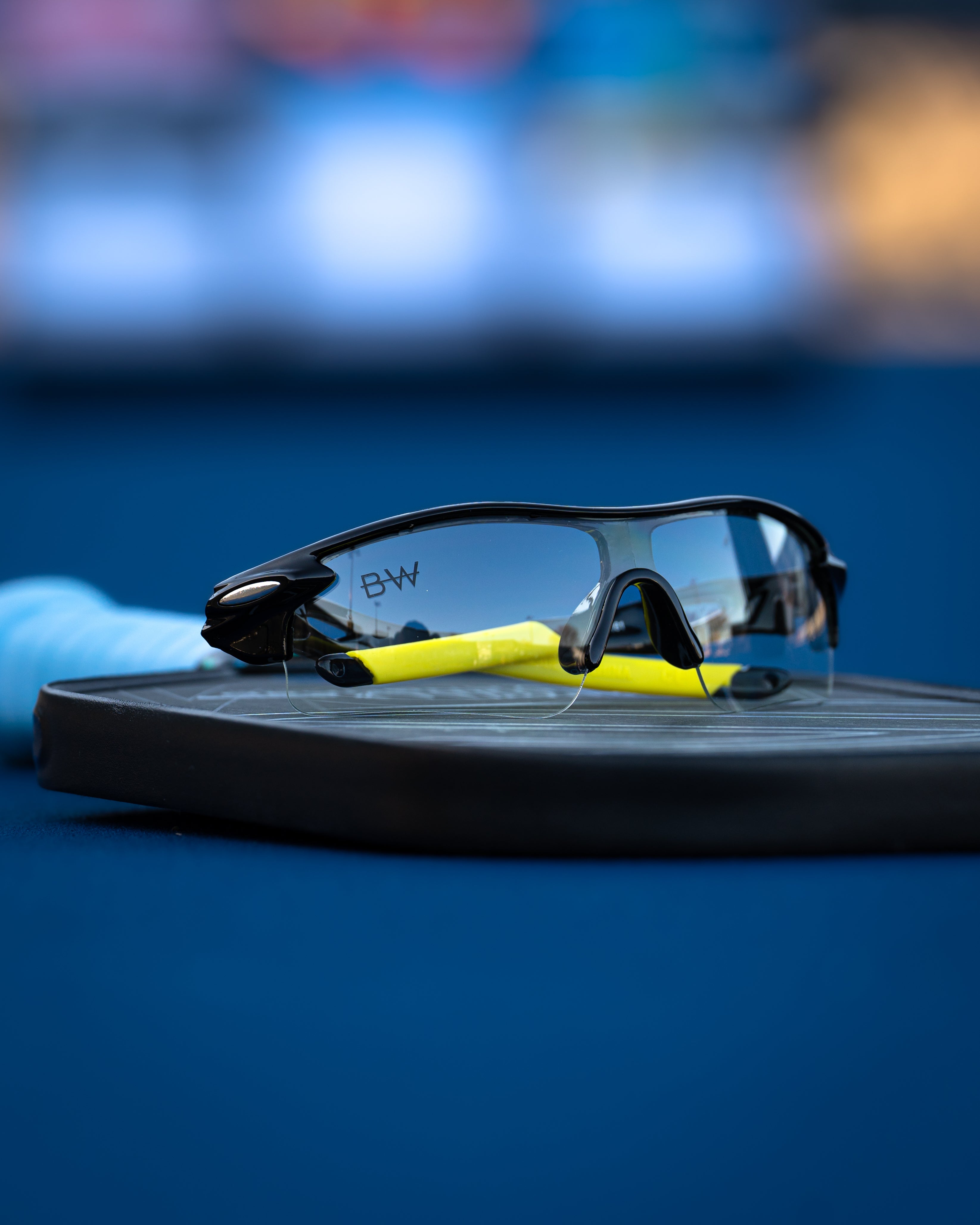
Choosing the Right RX Glasses for Pickleball Referees
Share
Choosing the Right RX Glasses for Pickleball Referees
Pickleball referees depend on clear vision for far more than simply following the ball. Officials may need to monitor serves, foot placement, the non-volley zone, net contact, player positioning, and fast sequences from different areas of the court. For referees who require vision correction, choosing the right prescription glasses for pickleball can therefore be an important part of their officiating setup.
The goal is not to find the darkest or most aggressive-looking sports frame. It is to find RX pickleball glasses that provide your prescription correction while remaining comfortable, practical, and appropriate for the conditions in which you officiate.
This guide explains what pickleball referees should consider when comparing prescription sports eyewear, including lens type, frame fit, high-index lenses, indoor versus outdoor conditions, changing light, and Blinded Wear RX options.
What Are the Best RX Glasses for Pickleball Referees?
The best RX glasses for pickleball referees combine accurate prescription correction, lightweight comfort, impact-resistant lenses, useful coverage, a stable sports-oriented fit, and lenses appropriate for the referee's normal lighting conditions.
If you officiate outdoors during the day, your priorities may differ from someone working primarily under indoor court lighting. Referees covering tournaments that extend from afternoon into evening should also consider how their lens choice handles changing available light.
Blinded Wear offers high-index prescription lenses at no additional cost, meaning RX buyers do not have to pay a separate high-index upcharge.
Compare Prescription Pickleball Glasses
If you already know you need prescription correction, start with the Blinded Wear RX Pickleball Glasses Collection.
Why Vision Matters for Pickleball Referees
Players and referees use their vision differently. A player is primarily reacting to the ball and opponents while moving through the point. A referee must observe the match from an officiating perspective and continually redirect visual attention as play develops.
Depending on the match and officiating assignment, that can mean paying attention to:
- Fast ball movement
- Player positioning
- Foot placement
- Non-volley-zone activity
- Net-area activity
- Serves and service sequences
- Multiple areas of the court in rapid succession
That makes accurate vision especially relevant for an official who already requires prescription correction. In fact, USA Pickleball's referee certification materials include a visual-acuity requirement, reinforcing that visual ability is a genuine component of officiating rather than simply an eyewear preference.
For someone who normally needs corrective lenses, going without the appropriate prescription during a match is therefore a poor tradeoff simply to wear conventional sunglasses.
Do You Need RX or Non-RX Pickleball Referee Glasses?
The first buying decision is straightforward: do you require prescription correction to see the court clearly?
| Your Vision Needs | Better Starting Point |
|---|---|
| You normally require corrective lenses | Prescription (RX) pickleball glasses |
| You do not require vision correction | Non-prescription pickleball glasses |
| You normally wear contacts | Compare your existing contact setup with RX sports eyewear based on comfort and preference |
| Your prescription has changed or vision seems unclear | Have your vision and prescription evaluated by an eye-care professional before ordering |
Do not buy non-prescription sunglasses simply because you like the frame if doing so means sacrificing the correction you need to officiate clearly.
If you do not require prescription correction, read our guide to choosing non-RX glasses for pickleball referees instead.
What to Look for in Prescription Glasses for Pickleball Referees
A good referee frame should be evaluated as a complete system. Prescription strength matters, but so do lens material, frame weight, coverage, comfort, and the lighting conditions in which the eyewear will actually be used.
1. Accurate Prescription Correction
Start with the most important requirement: your prescription. Sports styling cannot compensate for incorrect vision correction.
Use a current prescription from your eye-care professional and make sure the eyewear you order is appropriate for your individual vision needs.
2. High-Index Prescription Lenses
High-index lenses are designed to bend light more efficiently than conventional lower-index lens materials, allowing some prescriptions to be produced with thinner lenses. The practical difference depends on prescription strength, frame dimensions, lens design, and other factors.
Blinded Wear includes high-index prescription lenses at no additional cost. There is no separate high-index upcharge on its RX eyewear.
This is particularly worth considering when comparing the total price of prescription sports glasses, because an advertised frame price does not necessarily tell you what the finished prescription eyewear will cost after lens upgrades elsewhere.
For a deeper explanation, read Do High-Index Lenses Perform Better in Sports Frames?
3. Lightweight Frames for Long Officiating Sessions
A referee may wear the same glasses through multiple matches. What feels fine for ten minutes can become distracting after hours of use.
When comparing RX referee glasses, consider:
- Overall frame weight
- Pressure around the temples
- How the bridge feels over extended wear
- Whether the frame stays comfortably positioned
- Whether the shape interferes with your preferred viewing area
Blinded Wear uses lightweight sports frames designed with extended court use in mind.
4. Impact-Resistant Lenses
Referees are not participating in every rally, but they are still working around an active court and fast-moving equipment. Lens durability is therefore a sensible buying consideration.
Blinded Wear uses impact-resistant lenses in its performance-focused eyewear.
5. Comfortable Coverage
More coverage is not automatically better. The objective is sufficient coverage without creating a frame that feels unnecessarily heavy, restrictive, or distracting.
Think about where the frame sits within your normal field of view and how naturally you can redirect your attention around the court.
6. A Lens Appropriate for Your Lighting
The right prescription does not automatically mean the right lens for every environment. Referees should also consider whether they normally work:
- Bright outdoor tournaments
- Indoor courts
- Overcast outdoor matches
- Late-afternoon matches
- Evening events
- Sessions that transition between different lighting conditions
A lens suited to strong midday sunlight may not be your preferred option in a dim indoor facility. Likewise, a lens selected primarily for indoor use may not address the comfort preferences you have in bright outdoor conditions.
Polarized vs. Non-Polarized RX Glasses for Pickleball Referees
One of the most common questions when shopping for sports sunglasses is whether polarized lenses are automatically better.
They are not automatically better for every situation. Polarization is a specific lens technology designed to reduce certain reflected glare. It should not be treated as a universal indicator of sports-eyewear quality.
Blinded Wear takes a non-polarized, performance-first approach to its pickleball eyewear. For pickleball, non-polarized lenses are intended to preserve natural visual information used for depth perception and ball tracking rather than filtering light through a polarization layer.
For referees, the buying decision should ultimately account for your environment, visual preferences, prescription, and advice from your eye-care professional rather than choosing a lens simply because "polarized" appears on a feature list.
Indoor vs. Outdoor RX Glasses for Pickleball Referees
RX Glasses for Indoor Pickleball Referees
Indoor officials generally need to preserve available light rather than block large amounts of it. Court facilities can also vary considerably in brightness and lighting placement.
If most of your officiating happens indoors, prioritize your prescription correction, comfort, and a lens appropriate for the facility rather than automatically choosing a dark sunglass tint.
RX Sunglasses for Outdoor Pickleball Referees
Outdoor referees may spend hours exposed to bright conditions. In that environment, lens choice becomes an important part of overall comfort.
Consider how the lens performs during the part of the day when you referee most often rather than selecting eyewear solely by appearance.
RX Glasses for Dusk and Changing Light
Tournament schedules do not always stay within one lighting environment. An afternoon match can continue as the sun drops, and officials may move between courts with different levels of available light.
If changing conditions are common for you, consider an appropriate lens configuration for those transitions instead of assuming one dark tint will be ideal throughout the entire day.
Read our guide to RX pickleball glasses for dusk and changing light for a more detailed comparison.
RX Pickleball Referee Glasses Buying Checklist
Before ordering prescription eyewear for officiating, work through these questions:
- Is my prescription current? Start with accurate vision correction.
- Where do I referee most? Indoor and outdoor environments can call for different lens choices.
- How long will I wear the glasses? Long tournament sessions make lightweight comfort particularly important.
- How much coverage do I prefer? Consider your viewing preferences rather than automatically choosing the largest lens.
- Are the lenses impact resistant? Sports environments make lens durability relevant.
- Does the frame feel appropriate for extended wear? Pressure and constant adjustment can become distracting.
- What will my completed RX eyewear actually cost? Include prescription lens upgrades when comparing prices.
- What happens if the glasses break? Compare warranty and replacement policies rather than only the initial purchase price.
Why Consider Blinded Wear RX Glasses for Pickleball Refereeing?
Blinded Wear focuses on prescription sports eyewear for pickleball players and other people who need performance-oriented eyewear around the court.
For RX buyers, several features are worth comparing:
- Prescription available: designed for people who require corrective lenses.
- High-index lenses included: high-index RX lenses are provided at no additional cost.
- No high-index upcharge: the lens feature is included rather than treated as a separate premium upgrade.
- Non-polarized lenses: a performance-first approach intended to preserve natural depth and ball-tracking information for pickleball.
- Lightweight sports frames: useful when eyewear will be worn for extended periods.
- Impact-resistant lenses: designed with active sports environments in mind.
- 50% lifetime replacement warranty: if the glasses break, Blinded Wear provides 50% replacement coverage.
Those factors make the total RX package worth comparing against eyewear where the frame price and finished prescription price can differ substantially after lens options are added.
Best RX Glasses for Pickleball Referees
Once you know you need prescription correction, the next step is choosing a frame and lens setup that fits the conditions in which you actually officiate. A referee working long outdoor tournament days may prioritize different features from someone who primarily officiates indoors or under changing light.
Rather than choosing prescription pickleball glasses based on appearance alone, compare prescription compatibility, frame comfort, coverage, lens construction, lighting conditions, and total RX value.
Lava Rock RX
Best for: Referees looking for a performance-focused prescription option for active court use.
Lava Rock RX is one of the Blinded Wear prescription options worth comparing when you want vision correction built directly into sports-oriented eyewear. For officials, that means you can prioritize your prescription while still choosing a frame intended for active use around the court.
- Prescription lens option
- High-index RX lenses included at no additional cost
- Non-polarized performance-first lens approach
- Impact-resistant lenses
- Lightweight sports-oriented design
- Suitable for extended court use
Why referees may consider it: it combines prescription correction with the sports-oriented characteristics an official may want during long sessions around active courts.
Havana Melt RX
Best for: Referees who want another prescription sports option while comparing frame fit, coverage, and personal style.
Havana Melt RX provides another route to prescription pickleball eyewear without giving up a sports-focused design. Because fit is personal, comparing more than one frame can be especially useful for officials who expect to wear their glasses through several matches.
- Prescription lens option
- High-index RX lenses included at no additional cost
- Non-polarized lens approach
- Impact-resistant lenses
- Lightweight construction
- Designed for active court use
Buying consideration: choose between RX frames based on your prescription, preferred fit, coverage, and court environment rather than assuming one model is universally better for every referee.
Compare RX Pickleball Glasses for Referees
| Feature | Lava Rock RX | Havana Melt RX |
|---|---|---|
| Prescription available | Yes | Yes |
| High-index RX lenses | Included at no additional cost | Included at no additional cost |
| High-index upcharge | No | No |
| Lens approach | Non-polarized | Non-polarized |
| Lens construction | Impact resistant | Impact resistant |
| Frame approach | Lightweight sports design | Lightweight sports design |
| Good starting point for | Performance-focused RX court eyewear | Referees comparing another RX frame shape and fit |
These are not the only prescription options available. Referees can browse the complete Prescription Pickleball Glasses Collection to compare additional frames.
Are High-Index Lenses Worth It for Pickleball Referees?
High-index lenses can be particularly relevant when shopping for prescription sports eyewear because some prescriptions can otherwise produce thicker lenses. High-index materials bend light more efficiently, which can allow certain prescriptions to be made thinner than they would be in a lower-index material.
The actual finished lens thickness depends on more than lens index. Your prescription, pupillary distance, frame size, lens shape, and optical design can all influence the finished result.
For referees, the practical goal is simple: get the vision correction you need in a sports frame that remains comfortable enough for extended officiating.
Blinded Wear includes high-index prescription lenses at no additional cost. There is no separate high-index upgrade charge, which makes the feature important when comparing the total cost of RX pickleball glasses rather than comparing frame prices alone.
Why Total RX Price Matters
When comparing prescription sports eyewear, an advertised starting price may not represent the final price after prescription lens options are selected. Before buying, compare what is actually included in the finished pair.
- Frame
- Prescription lenses
- Lens material
- Any high-index upgrade cost
- Sports-oriented features
- Warranty or replacement coverage
For Blinded Wear RX eyewear, high-index lenses are included without an additional high-index charge.
Learn more in the High-Index Lenses for Sports Frames Guide.
How to Choose RX Lenses for Pickleball Refereeing
Your prescription is only one part of the lens decision. Referees should also think about when and where the glasses will be worn.
| Officiating Environment | What to Prioritize |
|---|---|
| Bright outdoor courts | Prescription clarity plus a lens appropriate for strong available light |
| Indoor courts | Prescription correction while preserving sufficient available light |
| Overcast outdoor courts | A lens that does not unnecessarily darken lower-light conditions |
| Late afternoon | Comfort as brightness begins to decrease |
| Dusk or evening | Maintaining useful visibility as available light falls |
| All-day tournaments | A practical balance of prescription clarity, comfort, and changing-light usability |
Buying tip: avoid selecting a prescription lens solely because its tint looks good in product photos. The lens needs to make sense for the environment in which you will actually referee.
Which RX Pickleball Glasses Fit Your Refereeing Situation?
If You Referee Long Outdoor Tournaments
Extended wear makes frame comfort particularly important. Look for lightweight construction, a secure fit, impact-resistant lenses, and an RX setup appropriate for the brightness you encounter.
Remember that a tournament beginning in strong afternoon sun may continue into different lighting later in the day. Consider the entire session rather than only the brightest hour.
If You Referee Primarily Indoors
Prescription accuracy remains the priority, but indoor referees should be careful about using lenses that remove more available light than necessary.
Facility lighting varies, so evaluate the conditions where you normally officiate instead of assuming the same setup used outdoors is automatically appropriate indoors.
If You Alternate Between Indoor and Outdoor Courts
Versatility becomes more important when your schedule moves between environments. Think about whether one lens configuration adequately covers your typical conditions or whether your eyewear strategy needs to account for significantly different lighting.
If You Referee Near Sunset
Changing light deserves special attention. Dark lenses that feel comfortable earlier in the afternoon may become less practical as available light decreases.
Read Pickleball at Dusk: RX Glasses for Changing Light for more information.
If You Have a Stronger Prescription
Ask your eye-care professional about the lens material and design appropriate for your prescription. High-index materials can allow some prescriptions to be produced with thinner lenses, although the finished result also depends on frame and optical factors.
Because Blinded Wear includes high-index RX lenses at no additional cost, referees can compare frames without a separate high-index upcharge.
Contacts vs. RX Glasses for Pickleball Referees
Some referees who require vision correction already wear contact lenses. That does not automatically mean you need to switch to prescription sports glasses. Both approaches can work depending on your needs and preferences.
| Consider RX Sports Glasses If... | You May Prefer Contacts If... |
|---|---|
| You want prescription correction built directly into your court eyewear | You already wear contacts comfortably during long officiating sessions |
| You prefer not to rely on contacts while officiating | You prefer wearing non-RX sports eyewear over your existing correction method |
| You want one integrated prescription sports-eyewear setup | Your eye-care professional recommends your current contact setup |
| You experience personal comfort issues wearing contacts around the court | You are comfortable with contacts in your normal indoor and outdoor environments |
Neither option is universally superior. Your prescription, eye health, comfort, and professional eye-care guidance should determine which method of vision correction makes the most sense for you.
Common Mistakes When Buying RX Glasses for Pickleball Referees
Using an Outdated Prescription
The most feature-rich sports frame cannot compensate for an inaccurate prescription. If your vision has changed or your prescription is outdated, start with an eye exam before ordering new RX eyewear.
Choosing the Frame Before Considering Your Prescription
Not every frame and lens combination is equally appropriate for every prescription. Prescription requirements should come before style when selecting sports eyewear.
Comparing Only the Advertised Frame Price
Prescription eyewear can involve additional lens costs. Compare the price of the finished RX glasses, including relevant lens materials and upgrades, rather than assuming the lowest frame price represents the lowest total cost.
Blinded Wear includes high-index prescription lenses without a separate high-index upcharge.
Assuming Darker Lenses Are Always Better
A very dark lens can make sense in certain bright conditions but may be less useful as available light decreases. Match the lens to the conditions in which you actually officiate.
Ignoring Long-Term Comfort
Referees may wear their eyewear much longer than someone playing a single recreational game. Frame weight, fit, and pressure points can become increasingly noticeable during a full tournament schedule.
Assuming Polarized Means Better for Every Referee
Polarization can reduce certain reflected glare, but it is not a universal requirement for sports eyewear. Blinded Wear uses a non-polarized performance-first approach for its pickleball lenses.
Buying Non-RX Glasses When You Need Correction
If your prescription is necessary to see the court clearly, conventional non-prescription sunglasses are not a substitute for appropriate corrective lenses.
RX Pickleball Glasses for Referees: Pros and Considerations
| Potential Advantages | Considerations |
|---|---|
| Prescription correction built directly into sports eyewear | Requires an accurate prescription |
| No need to sacrifice corrective vision to wear sports sunglasses | Prescription suitability should be considered when choosing a frame |
| High-index lenses can reduce thickness for some prescriptions | Finished thickness varies by prescription, frame, and lens design |
| Sports-oriented frames can provide lightweight, active-use comfort | Fit remains personal |
| Impact-resistant lenses are appropriate for active environments | Lens tint still needs to match the lighting conditions |
| Blinded Wear includes high-index RX lenses at no additional cost | Referees should still choose eyewear based on their individual prescription needs |
What Should You Compare Before Buying Prescription Pickleball Glasses?
When comparing RX sports eyewear, evaluate the complete purchase rather than focusing on one specification.
- Prescription compatibility: Can the eyewear appropriately accommodate your prescription?
- Finished RX price: What will you actually pay after the prescription lenses and relevant options are included?
- Lens material: Is the material appropriate for your prescription and intended use?
- Frame weight: Will the glasses remain comfortable through long officiating sessions?
- Impact resistance: Are the lenses appropriate for an active sports environment?
- Coverage: Does the frame provide the viewing experience you prefer?
- Lighting suitability: Does the lens make sense for indoor, outdoor, dusk, or variable conditions?
- Warranty: What happens if the eyewear breaks?
Blinded Wear combines prescription availability with high-index RX lenses at no additional cost, lightweight sports frames, impact-resistant lenses, non-polarized performance-focused lens designs, and a 50% lifetime replacement warranty if the glasses break.
Who Should Consider RX Pickleball Referee Glasses?
Prescription pickleball eyewear may be a good fit for:
- Referees who require corrective lenses to see the court clearly
- Officials who prefer glasses instead of contacts while working matches
- Referees looking for prescription correction in a sports-oriented frame
- Officials who spend long periods around active outdoor courts
- Referees who want high-index prescription lenses without a separate high-index upcharge
- Players who also referee and want RX eyewear suitable for active court use
Who Should Avoid RX Pickleball Glasses?
You may not need prescription pickleball eyewear if you do not require vision correction. In that case, paying for RX lenses provides no practical benefit.
Instead, read Choosing the Right Glasses for Pickleball Referees: Non-RX Edition and browse the Non-RX Pickleball Glasses Collection.
Ready to Compare RX Pickleball Glasses?
If you already have a current prescription, the next step is comparing frames based on fit, coverage, lighting needs, and the conditions in which you referee.
Browse All RX Pickleball Glasses
If you are still narrowing down your options, take the Pickleball Sunglasses Quiz or compare additional eyewear in the 2026 Pickleball Glasses Buying Guide.
Frequently Asked Questions About RX Glasses for Pickleball Referees
What are the best RX glasses for pickleball referees?
The best RX glasses for pickleball referees combine accurate prescription correction with a lightweight sports-oriented frame, impact-resistant lenses, comfortable coverage, and a lens configuration appropriate for the conditions in which you officiate. There is no single best frame for every referee because prescription needs, fit preferences, and court lighting vary.
Do pickleball referees need prescription sports glasses?
Referees who require vision correction should use an appropriate method of correction while officiating. Prescription sports glasses can be a practical option for officials who want their corrective lenses integrated directly into their court eyewear. If you do not require prescription correction, non-RX pickleball glasses may be the better choice.
Can I get prescription pickleball sunglasses?
Yes. Blinded Wear offers prescription pickleball eyewear designed for active court use. RX options combine prescription correction with lightweight sports frames and impact-resistant lenses.
Does Blinded Wear charge extra for high-index prescription lenses?
No. High-index prescription lenses are included at no additional cost with Blinded Wear RX eyewear. There is no separate high-index upcharge.
Why would a pickleball referee consider high-index lenses?
High-index lens materials can allow some prescriptions to be produced with thinner lenses than lower-index materials. The finished thickness still depends on factors such as prescription strength, frame size, lens shape, and optical design. Referees should choose the lens material appropriate for their prescription rather than assuming one index is ideal for everyone.
Should RX glasses for pickleball referees be polarized?
Polarization is not automatically required for pickleball officiating. Polarized lenses are designed to reduce certain reflected glare, while non-polarized lenses do not use that filtering layer. Blinded Wear uses a non-polarized, performance-first approach for its pickleball eyewear, with the goal of preserving natural visual information used for depth perception and ball tracking.
What lens tint should a pickleball referee choose?
Choose according to the environment where you referee. Bright outdoor courts may call for a different tint than indoor facilities, cloudy conditions, or evening matches. The darkest lens is not automatically the best lens for every officiating situation.
Are RX pickleball glasses good for indoor referees?
Prescription sports glasses can be used indoors when the lens configuration is appropriate for the available light. Referees working indoors should prioritize accurate prescription correction and sufficient visibility rather than automatically choosing a dark outdoor sunglass tint.
What should referees wear for matches around sunset?
Referees working matches that continue toward dusk should consider how their lenses perform as available light decreases. A lens comfortable in strong afternoon sunlight may become less practical later in the evening. Learn more in the RX Pickleball Glasses for Dusk and Changing Light Guide.
Are prescription pickleball glasses only for referees?
No. Recreational and competitive pickleball players who require vision correction can also use prescription sports eyewear. The same fundamentals apply: prioritize your prescription, appropriate lens construction, comfortable fit, and the conditions in which you play.
Where can I shop for RX pickleball glasses?
Browse the Blinded Wear Prescription Pickleball Glasses Collection to compare available RX options.
Quick Decision Guide: Which RX Pickleball Glasses Do You Need?
| Your Situation | What to Prioritize | Next Step |
|---|---|---|
| You referee primarily outdoors | Prescription clarity, comfort, impact resistance, and a lens appropriate for outdoor brightness | Compare RX sports frames and outdoor lens options |
| You referee primarily indoors | Prescription clarity and preserving sufficient available light | Avoid choosing a lens solely because it is designed for bright sunlight |
| You referee all-day tournaments | Lightweight comfort and versatility across changing conditions | Prioritize extended-wear comfort |
| You referee near dusk | Visibility as available light decreases | Choose with changing light in mind |
| You have a stronger prescription | Prescription compatibility, lens material, frame selection, and finished lens thickness | Consider high-index lenses and consult your eye-care professional |
| You do not require vision correction | Non-prescription sports eyewear | Shop non-RX pickleball glasses instead |
How to Make Your Final RX Pickleball Glasses Decision
If you have narrowed your choices but still cannot decide, prioritize the factors in this order:
- Your prescription: the eyewear must provide the correction you need.
- Prescription compatibility: make sure the frame and lens combination is appropriate for your individual RX requirements.
- Lighting conditions: choose lenses around where and when you actually referee.
- Comfort: consider whether the frame can remain comfortable through multiple matches.
- Fit: look for a sports-oriented setup that remains comfortably positioned during normal movement.
- Lens construction: consider impact resistance for an active court environment.
- Coverage: choose the viewing experience that feels appropriate for you.
- Total RX price: compare the finished prescription eyewear cost rather than only the advertised frame price.
- Warranty: consider the long-term value if the glasses are damaged or broken.
This approach keeps the most important factor—clear corrected vision—ahead of cosmetic features and marketing terminology.
Consider the Warranty When Comparing RX Sports Glasses
Prescription sports eyewear is something you may use repeatedly around an active court, so replacement coverage deserves consideration alongside frame and lens specifications.
Blinded Wear provides a 50% lifetime replacement warranty if your glasses break. That means long-term replacement value can be considered as part of the purchase rather than focusing exclusively on the initial cost.
For referees who officiate frequently—or players who use the same RX eyewear when playing—the warranty can become particularly relevant because the glasses may see substantially more use than an ordinary pair of casual sunglasses.
Related Prescription Pickleball Eyewear Guides
If you are still researching prescription sports eyewear, these guides can help you make a more informed decision:
Key Takeaways for Pickleball Referees Who Need RX Glasses
- Start with your prescription. Clear corrective vision should come before frame style or lens marketing features.
- Choose sports-oriented eyewear. Lightweight construction, impact-resistant lenses, comfortable coverage, and secure fit are useful characteristics around an active court.
- Consider high-index lenses. They can allow some prescriptions to be made thinner than lower-index materials, although finished thickness depends on several factors.
- Blinded Wear includes high-index RX lenses at no additional cost. There is no separate high-index upcharge.
- Match your lens to the environment. Indoor, outdoor, midday, overcast, and dusk conditions can create different needs.
- Do not assume polarized automatically means better. Blinded Wear uses a non-polarized, performance-first approach for its pickleball eyewear.
- Compare finished RX prices. Frame price alone does not always represent the total cost of prescription sports eyewear.
- Consider long-term protection. Blinded Wear provides a 50% lifetime replacement warranty if the glasses break.
Final Verdict: Choosing the Right RX Glasses for Pickleball Referees
The right prescription glasses for a pickleball referee should solve the most important problem first: providing the vision correction you need to see the court clearly.
From there, compare lightweight comfort, impact-resistant lens construction, coverage, frame fit, lens material, and suitability for your normal lighting environment. Officials who work long tournaments should pay particular attention to extended-wear comfort, while referees moving between bright daylight and evening conditions should consider how their lens choice performs as available light changes.
For referees with prescriptions where high-index lenses are appropriate, the fact that Blinded Wear includes high-index RX lenses at no additional cost is also worth factoring into the total-value comparison.
There is no universal frame or tint that is best for every official. The best RX pickleball glasses are the ones that match your prescription, your face, your officiating environment, and your individual vision needs.
Shop RX Glasses for Pickleball Referees
Ready to compare prescription options? Browse Blinded Wear's collection of RX pickleball glasses designed for active court use.
Shop Prescription Pickleball Glasses
Blinded Wear RX eyewear includes high-index prescription lenses at no additional cost, lightweight sports frames, impact-resistant lenses, and a non-polarized performance-first lens approach.
If you are not sure which frame to start with, take the Pickleball Sunglasses Quiz to narrow down your options.
Need RX or Non-RX Pickleball Referee Glasses?
If you require corrective lenses, continue with the RX Pickleball Glasses Collection.
If you do not need prescription correction, use our Non-RX Pickleball Referee Glasses Guide instead.
For a broader comparison of both categories, visit the Best Pickleball Glasses 2026 Buying Guide.
Find Your Prescription Pickleball Glasses
Your prescription eyewear should allow you to concentrate on officiating—not on whether your glasses are comfortable, whether you can see clearly, or whether your eyewear is appropriate for the court.
Start with a current prescription, identify the conditions in which you referee most often, and compare frames based on the features that actually matter for your use.