
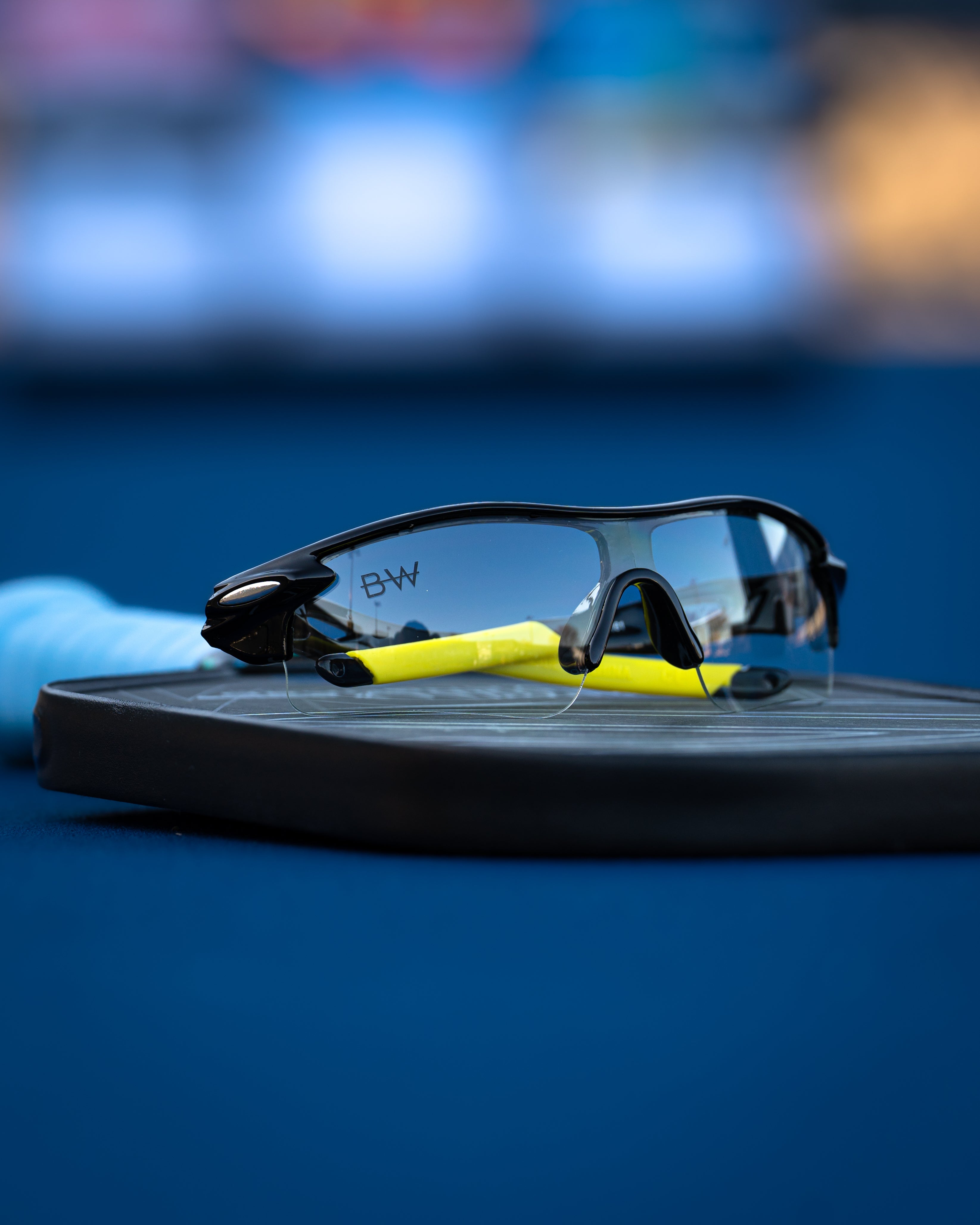
The RX Glasses That Help You Track Fast-Moving Pickleballs
Share
The RX Glasses That Help You Track Fast-Moving Pickleballs
Fast rallies are one of the hardest situations for any pickleball player who depends on prescription correction. The ball can change direction quickly, opponents can redirect pace at the kitchen, and you may have only a brief moment to recognize what's developing and respond.
That makes vision important—but it doesn't mean a particular pair of prescription glasses can automatically make your eyes track faster or improve your reaction time.
The better question is: how do you choose RX pickleball glasses that provide the prescription correction you need while staying practical for fast-paced court movement?
Find Your Pickleball Glasses
Compare prescription and non-prescription options or start with the complete Blinded Wear pickleball eyewear guide.
Quick Answer: Can RX Glasses Help You Track a Pickleball?
If you need prescription correction, appropriate RX eyewear lets you use that correction while tracking the ball during play. But the glasses themselves shouldn't be marketed as automatically improving visual tracking, reaction speed, spin recognition, or athletic performance.
Tracking a moving pickleball involves more than the lenses you're wearing. It can involve:
- Your underlying vision
- Your prescribed correction
- Attention
- Anticipation
- Eye and head movement
- Experience reading opponents
- Ball trajectory
- Ball speed
- Court and lighting conditions
RX eyewear is one part of that system—not a shortcut around the skills involved in reading a fast rally.
Why Fast Pickleball Rallies Are Visually Demanding
The original guide describes pickleballs traveling around 30–40 mph while spin, trajectory changes, lighting, glare, and reflective surfaces make the ball harder to follow.
You don't need an exact speed claim to understand the search intent behind this article. During a fast exchange, a player may have to repeatedly:
- Watch the opponent's preparation.
- Follow the developing ball path.
- Recognize where the ball is heading.
- Move into position.
- Prepare the paddle.
- Choose a response.
- Execute the shot.
- Recover for the next ball.
If you require prescription correction, your RX eyewear provides that correction throughout the sequence. The anticipation, decision-making, movement, and execution remain player skills.
Prescription Correction vs. Ball-Tracking Skill
The original article says standard glasses and non-prescription sunglasses can lead to missed shots, slower reactions, and frustration, while its RX lenses improve tracking.
That comparison is too broad. Someone who doesn't need prescription correction doesn't automatically have a disadvantage because they're wearing non-prescription sports eyewear.
| Factor | Role During a Fast Rally |
|---|---|
| Prescription correction | Addresses your prescribed visual needs |
| Attention | Keeps you engaged with the developing point |
| Anticipation | Helps you read what may happen next |
| Positioning | Changes the time and space available to respond |
| Footwork | Moves you into position for the ball |
| Paddle preparation | Prepares you to execute the response |
| Experience | Helps you recognize familiar patterns |
Do High-Index RX Lenses Improve Ball Tracking?
Blinded Wear includes high-index prescription lenses at no additional cost.
The original guide specifically describes 1.61 high-index lenses as thinner, lighter, lower-distortion lenses that make the ball appear sharper and more accurately positioned so the eyes and brain can react faster.
That bundles several different ideas together.
Higher-index lens material can allow a thinner lens for the same prescription compared with a lower-index material in a comparable design. Final thickness and weight can still depend on factors such as:
- Prescription strength
- Frame dimensions
- Lens shape
- Lens material
- Overall lens design
An exact 1.61 index shouldn't be promised across every configuration unless it is currently verified.
What High-Index Lenses Don't Automatically Do
| Claim | Does High-Index Alone Establish It? |
|---|---|
| Potential for a thinner lens | Yes, depending on prescription and comparable design |
| Faster reaction time | No |
| Better ball tracking | No |
| Better spin recognition | No |
| Improved depth perception | No |
| Reduced distortion in every prescription | No |
| Impact resistance | No—this is a separate characteristic |
| Anti-fog performance | No—this is a separate feature |
| Anti-reflective coating | No—this is a separate feature |
Start With the Prescription You Actually Need
If you're shopping for RX pickleball glasses because the ball is difficult to see, don't start by searching for a lens that promises “faster tracking.” Start with your prescription.
Blinded Wear RX customers provide a clear photo of their eyeglass prescription before purchasing.
A practical buying process is:
- Use your current eyeglass prescription.
- Confirm that the frame can accommodate your prescription.
- Compare frame dimensions and shape.
- Consider whether you primarily play indoors, outdoors, or both.
- Compare the currently available lens configurations.
- Verify any additional lens feature that matters to you.
Don't assume every prescription works with every sports frame.
Do Specialized Lens Tints Improve Pickleball Tracking?
The original guide says clear, gray, and transitional lenses improve court contrast, make the ball easier to see against the background, and help players read spin and judge speed.
Those benefits shouldn't automatically be attributed to a tint.
A safer way to choose is based on playing environment and preference:
| Lens Configuration | Practical Consideration |
|---|---|
| Clear | No intentional dark sunglass tint; may suit players who prefer this indoors or in lower-light environments |
| Tinted | An option to compare for brighter outdoor environments |
| Changing-tint | If currently available and compatible, may suit routines involving changing light |
A tint alone doesn't establish improved contrast, tracking, spin recognition, depth perception, or reaction speed.
Clear RX Glasses for Indoor Pickleball
If you need prescription correction and play indoors, a clear RX configuration can be useful when you don't want a dark sunglass tint.
Clear lenses shouldn't be described as inherently increasing the amount of usable light, sharpening reactions, or making the ball easier to track.
The useful distinction is simpler: you can use your prescription correction without intentionally adding a dark sunglass tint.
Tinted RX Glasses for Outdoor Pickleball
For outdoor play, compare the tinted RX configurations currently available for your prescription and frame.
Don't assume darker automatically means better. Tint appearance by itself doesn't establish:
- UV400 protection
- 100% UVA/UVB protection
- Polarization
- Glare reduction
- Enhanced contrast
- Better ball tracking
Those characteristics should be verified separately when they're important to your purchase.
What About Changing-Tint RX Lenses?
The original guide recommends transitional lenses for mixed indoor and outdoor play and describes Runway RX as automatically adapting to changing light.
If a compatible changing-tint configuration is currently available, it may be worth considering when your playing environment changes throughout the day.
Changing-tint functionality doesn't automatically mean:
- Instant adjustment
- Polarization
- Anti-fog performance
- Scratch resistance
- A particular UV specification
- Better tracking
- Faster reactions
What About Glare During Fast Rallies?
The original article says Blinded Wear lenses use anti-reflective and glare-reducing coatings that minimize reflections from sunlight, indoor lights, and court surfaces.
Anti-reflective treatment and glare reduction shouldn't be treated as universal collection-wide features unless the exact lens configuration confirms them.
Keep these characteristics separate:
- Tint
- Polarization
- Anti-reflective treatment
- UV specification
- Photochromic functionality
One doesn't automatically establish the others.
Non-Polarized RX Sports Lenses
Blinded Wear sports lenses are non-polarized, meaning a polarization filter isn't added.
That's a useful product characteristic to disclose, but it shouldn't be expanded into unsupported promises that non-polarized lenses inherently provide:
- Better depth perception
- More accurate ball tracking
- Better spin recognition
- Faster reactions
- More accurate shots
Non-polarized describes the lens configuration—not the player's ability.
Impact-Resistant Lenses for Active Pickleball Play
Blinded Wear sports eyewear uses impact-resistant lenses.
That's relevant to sports eyewear, but impact resistance shouldn't be expanded into claims such as “shatterproof” or “unbreakable.”
| Term | What It Means for This Guide |
|---|---|
| Impact-resistant | A verified sports-lens characteristic |
| Shatterproof | Don't infer this from impact resistance |
| Unbreakable | No |
| Certified protective eyewear | Requires verification of the specific standard |
| Guaranteed injury prevention | No |
Frame Fit Matters During Fast Lateral Movement
The original article says Blinded Wear frames are engineered to stay securely in place through lateral movement, jumps, and dives.
Fit varies by wearer, so no frame should guarantee a universal no-slip experience.
Instead, evaluate a completed RX pair during movements that resemble actual pickleball:
- Start in your normal ready position.
- Perform several split steps.
- Shuffle quickly in both directions.
- Move forward toward the kitchen.
- Look upward as you would for a lob or overhead.
- Continue after perspiration begins.
- Notice whether you're repeatedly adjusting the frame.
If you're constantly repositioning your glasses during rallies, that's useful fit information.
Do You Need Adjustable Nose Pads or “Secure Temples”?
The original buying guide specifically recommends adjustable nose pads and secure temples to prevent slipping.
Those aren't verified collection-wide features, so don't assume every Blinded Wear RX frame includes them.
Instead, compare the actual construction and dimensions of the individual frame you're considering and evaluate how it fits you.
RX Pickleball Glasses to Compare
The original article recommends Frost RX, Ocean Wave RX, Heatseek RX, and Runway RX for fast-ball tracking, attaching claims about contrast enhancement, reaction speed, glare reduction, transitional behavior, and clear optics.
Those performance claims shouldn't be carried forward without product-level verification. You can still compare verified current RX products based on prescription compatibility, frame dimensions, appearance, and current lens configuration.
| RX Model | What to Compare |
|---|---|
| Frost RX | Prescription compatibility, dimensions, appearance, current lens configuration |
| Ocean Wave RX | Prescription compatibility, dimensions, appearance, current lens configuration |
| H Blue Shield RX | Prescription compatibility, dimensions, appearance, current lens configuration |
| Rocket Fire RX | Prescription compatibility, dimensions, appearance, current lens configuration |
| Crystal Wave II RX | Prescription compatibility, dimensions, appearance, current lens configuration |
Do Scientific Studies Prove These RX Glasses Make You React Faster?
The original article says scientific studies show improved visual clarity reduces brain-processing time and therefore produces faster physical reactions.
No studies are cited in the supplied article, so that statement isn't sufficiently supported to use as evidence that Blinded Wear RX glasses improve reaction speed.
It's also important to distinguish between:
- Correcting an individual's refractive error
- Visual perception
- Anticipation
- Decision-making
- Neurological reaction time
- Physical execution
A prescription lens shouldn't be marketed as automatically improving every stage of that process.
Verify Ball-Tracking Testimonials Before Publishing
The original article includes testimonials attributed to Mark S. of Texas, Leah D. of Arizona, and David K. of Florida. They describe easier ball tracking, improved reaction time, better spin recognition, and successful light adjustment.
Only republish those testimonials if the customers, purchases, wording, experiences, and permission to use the statements can be verified.
Even verified customer experiences shouldn't become guarantees that another player will experience better tracking, faster reactions, improved spin recognition, or better match results.
The Goal Isn't a “Faster” Lens—It's the Right RX Setup
The best RX glasses for fast pickleball don't need to promise that they'll make your brain react faster.
If you depend on prescription correction, focus first on:
- Your current prescription
- Prescription compatibility
- Impact-resistant sports lenses
- Frame dimensions and individual fit
- Your indoor or outdoor environment
- The current lens configurations available
- Comfort during realistic pickleball movement
Your RX glasses provide the correction. Your eyes, brain, anticipation, positioning, and technique do the tracking and reacting.
RX Glasses During Fast Hands Exchanges
Fast exchanges near the kitchen are one of the clearest examples of why this topic matters. The ball can be redirected quickly, but your eyewear isn't doing the tracking for you.
If you require prescription correction, your RX glasses provide that correction while you:
- Watch your opponent's paddle preparation.
- Follow the developing ball path.
- Recognize whether the ball is attacking your body, forehand, or backhand side.
- Prepare the paddle.
- Choose a response.
- Move and execute.
- Recover for the next exchange.
Prescription correction can be part of your visual setup. Anticipation, preparation, decision-making, and physical reaction remain player skills.
Can RX Glasses Help You Read Pickleball Spin?
The original article says specialized lens tints can make it easier to spot the ball against the background and that enhanced contrast is critical for reading spin.
That goes beyond what should be promised from tint alone.
Reading spin can involve several visual and strategic cues, including:
- Opponent paddle path
- Paddle-face orientation
- Ball flight
- Ball behavior after the bounce
- Your positioning
- Experience recognizing familiar shots
If you need prescription correction, appropriate RX lenses provide that correction while you interpret those cues. A tint shouldn't automatically be credited with improving spin recognition.
What About Judging Ball Trajectory?
The source also connects its RX lenses with seeing the ball's position more accurately and judging its speed and trajectory.
Again, separate prescription correction from an athletic-performance guarantee.
During play, your visual system and experience help you judge where the ball is going. Your positioning and anticipation also matter. Prescription eyewear can provide the optical correction prescribed for you, but it shouldn't promise more accurate trajectory judgment for every player.
Tracking the Ball at the Kitchen Line
At the kitchen, players may move from slower dink exchanges into much faster attacks within the same rally.
That makes anticipation especially important. Instead of waiting until the ball is already moving quickly toward you, experienced players often use information available earlier in the sequence:
- Opponent position
- Paddle preparation
- Ball height
- Contact point
- Developing court space
RX eyewear doesn't teach you to recognize those patterns. If you need prescription correction, its job is to provide that correction while you develop and use those skills.
Tracking Drives From the Baseline
Ball tracking isn't limited to fast hands at the kitchen. Baseline drives can also require you to follow the developing shot while moving and preparing your response.
When evaluating RX sports glasses for this type of play, consider practical equipment factors:
- Does the prescription feel appropriate?
- Is the frame comfortable?
- Does it remain comfortable during lateral movement?
- Does the lens configuration suit your environment?
- Are you repeatedly adjusting the frame?
Those questions are more useful than looking for a lens that claims to automatically increase tracking speed.
Tracking Lobs & Overheads in RX Glasses
Lobs create a different visual and fit situation because you may need to look upward while moving backward or repositioning.
Use overhead practice as part of your RX frame test:
- Begin in your normal ready position.
- Track a high ball naturally.
- Turn and move as you normally would.
- Look upward through your normal head position.
- Notice whether the frame becomes uncomfortable or needs adjustment.
The goal isn't to prove the frame can never move. It's to determine whether it works comfortably during the movements you actually make.
Indoor vs. Outdoor Ball Tracking: What Changes?
The original guide recommends different lens configurations depending on whether you're playing indoors, outdoors, or across changing environments.
| Environment | What to Consider |
|---|---|
| Indoor court | Whether you prefer prescription correction without a dark sunglass tint |
| Bright outdoor court | Currently available tinted RX configurations and verified lens specifications |
| Evening play | Whether your current tint remains appropriate as available light changes |
| Mixed environments | Whether separate pairs or a compatible changing-tint configuration makes sense |
There isn't one universally superior lens configuration for every court and every player.
Does the Court Background Affect How You See the Ball?
The original article emphasizes making the pickleball stand out from the background through specialized contrast-enhancing tints.
Real playing environments can vary considerably. Backgrounds may include walls, fencing, spectators, neighboring courts, trees, sky, or other visual elements.
However, don't turn that observation into a universal claim that a particular tint will make the ball stand out better for every player and environment. If contrast-enhancing properties are important to your purchase, verify the exact lens characteristics rather than assuming them from lens color.
Ball Tracking and Reaction Time Aren't the Same Thing
The original guide repeatedly connects easier ball tracking with faster physical reactions.
It's useful to separate the sequence:
| Stage | What's Happening |
|---|---|
| Visual input | You receive information about the developing play |
| Recognition | You interpret what's happening |
| Decision | You choose a response |
| Preparation | Your body and paddle prepare to execute |
| Physical response | You perform the movement |
Your prescription correction is relevant to your visual input if you need it. That doesn't mean the lens automatically speeds up every later stage.
Do Non-Polarized Lenses Improve Depth Perception?
Blinded Wear sports lenses are non-polarized, but that shouldn't be translated into a universal depth-perception advantage.
Non-polarized simply means a polarization filter isn't added.
Don't automatically claim that this results in:
- More accurate distance judgment
- Better depth perception
- Faster tracking
- Better spin recognition
- More accurate contact
Those conclusions go beyond the verified lens characteristic.
Comfort Matters During Long Pickleball Sessions
A frame doesn't need to improve tracking to be relevant to your playing experience.
If you're wearing prescription eyewear for several games, evaluate how the frame feels over time:
- Pressure around the nose
- Pressure near the temples
- Comfort around the ears
- Fit after perspiration
- Whether you repeatedly adjust the frame
- Whether discomfort develops later in the session
Comfort doesn't make your eyes track faster, but an uncomfortable frame can become equipment you repeatedly think about.
The Fast-Ball RX Eyewear Practice Test
Don't judge new RX sports glasses only by wearing them around the house. Test the completed pair during the type of pickleball you actually play.
- Start with dinks. Get familiar with the prescription and frame.
- Add volleys. Increase the pace gradually.
- Practice speed-ups. Evaluate the eyewear during faster exchanges.
- Hit baseline drives. Include longer ball paths and lateral movement.
- Practice overheads. Test upward head movement.
- Play full games. Evaluate comfort over time.
- Continue after perspiration begins. See whether your fit experience changes.
This tells you much more about your individual setup than a generic promise that a frame is “made for fast balls.”
Troubleshooting Difficulty Tracking the Pickleball
| What You're Experiencing | What to Evaluate |
|---|---|
| Your corrected vision consistently feels wrong | Your prescription and completed lens setup |
| Frame moves during fast exchanges | Individual frame fit and dimensions |
| Frame becomes uncomfortable | Pressure points and long-session fit |
| Lenses become cloudy during play | Condensation, environment, airflow, fit, and any verified anti-fog features |
| Your tint feels too dark as conditions change | Lens configuration and available light |
| You consistently react late | Don't automatically blame the lens; consider anticipation, positioning, preparation, and reaction ability |
| You struggle to read spin | Consider opponent cues, ball flight, experience, and your underlying vision rather than assuming tint is the cause |
What if Your RX Lenses Fog During a Rally?
Fogging can obviously interfere with what you're seeing, but high-index material, impact resistance, and non-polarized construction don't automatically provide anti-fog performance.
Fogging can be influenced by:
- Humidity
- Temperature changes
- Perspiration
- Airflow around the frame
- How the eyewear sits on your face
- Any verified anti-fog treatment
If anti-fog performance is important to you, verify the exact current product or lens feature rather than assuming all sports eyewear includes it.
Impact Resistance Doesn't Mean Scratch Resistance
Blinded Wear sports lenses are impact-resistant. That doesn't automatically mean they include a scratch-resistant treatment.
| Lens Characteristic | Separate Feature? |
|---|---|
| Impact resistance | Verified sports-lens characteristic |
| Scratch resistance | Yes |
| Anti-fog | Yes |
| Anti-reflective treatment | Yes |
| UV400 rating | Yes |
| Photochromic functionality | Yes |
Verify the characteristics that matter for your exact configuration.
Keep Your RX Lenses Ready for Fast Play
Before a match or practice session:
- Inspect the lenses for visible dirt or debris.
- Clean them using an appropriate method.
- Check the frame for obvious damage.
- Put the glasses on during warm-up.
- Make sure the prescription experience feels familiar.
- Store the glasses safely when you're not wearing them.
Why Fast-Play Athletes Should Consider Backup RX Eyewear
If you depend on prescription correction, having a second familiar pair can be useful during tournaments and longer playing days.
A backup can help if your primary pair is:
- Lost
- Damaged
- Temporarily unusable
- Using a tint you don't prefer after conditions change
A backup pair doesn't improve your tracking ability. It simply gives you another way to use your prescription correction if your primary eyewear becomes unavailable.
RX Glasses for Fast Tournament Play
Tournament days can expose eyewear issues that aren't obvious during a short practice session.
| Tournament Situation | What to Check |
|---|---|
| Warm-up | Prescription experience and initial comfort |
| Fast early rallies | Frame fit during realistic movement |
| Multiple matches | Long-session comfort |
| Changing light | Whether your current lens configuration still suits the environment |
| Perspiration | Whether your individual fit changes |
| Damage or loss | Backup RX eyewear and replacement options |
What if Your RX Pickleball Glasses Break?
The original article recommends Blinded Wear's Protection Plan for peace of mind against damage and later describes flexible returns and exchanges if a prescription changes.
Those broader promises shouldn't be assumed without checking the current policy.
The verified framing is: Blinded Wear offers 50% lifetime replacement support for eligible broken eyewear, subject to current policy terms.
How Long Do RX Pickleball Glasses Take to Arrive?
The original FAQ gives an approximate two-week shipping timeframe.
Prescription production and shipping estimates can change, so confirm the current estimate when ordering rather than relying on an evergreen blog article for a fixed delivery window.
If you're ordering for a tournament, leave time for production, delivery, and practice in the completed pair before the event.
Not Sure Which RX Pickleball Glasses to Choose?
If you're deciding between frames or lens configurations, use the Blinded Wear quiz as a product-discovery tool and then confirm the current specifications of the pair you're considering.
Better Tracking Starts With More Than the Lens
If you're struggling with fast pickleballs, don't reduce the entire problem to finding a “faster” pair of glasses.
Your prescription correction matters if you need it. So do frame comfort, fit, playing conditions, anticipation, positioning, practice, and experience reading the ball and your opponent.
Choose RX eyewear that handles its job well—then train the skills that handle the rally.
FAQ: RX Glasses for Tracking Fast-Moving Pickleballs
Can RX glasses help me track a fast-moving pickleball?
If you need prescription correction, appropriate RX glasses provide that correction while you follow the ball during play. They shouldn't be presented as automatically increasing visual tracking ability, reaction speed, or athletic performance.
Do high-index lenses improve pickleball tracking?
High-index describes a lens material, not a ball-tracking technology. Higher-index material can allow a thinner lens for some prescriptions compared with a lower-index material in a comparable design, but it doesn't inherently improve tracking, reaction time, depth perception, or spin recognition.
Are Blinded Wear RX lenses non-polarized?
Yes. Blinded Wear sports lenses are non-polarized, meaning a polarization filter isn't added. Non-polarized construction alone doesn't establish better depth perception or ball tracking.
Are Blinded Wear RX lenses impact-resistant?
Yes. Blinded Wear sports eyewear uses impact-resistant lenses. Impact-resistant doesn't mean shatterproof, unbreakable, or certified to a particular protective standard.
What lens tint is best for tracking pickleballs indoors?
If you don't want a dark sunglass tint indoors, a clear RX configuration may be worth considering. Clear lenses don't automatically improve contrast, tracking, depth perception, or reaction speed.
What lens tint is best for outdoor pickleball?
Compare the tinted configurations currently available for your prescription and frame. Choose according to your environment and preferences rather than assuming one tint universally improves ball tracking.
Are changing-tint RX lenses good for mixed lighting?
If a compatible changing-tint configuration is currently available, it may be useful when your playing conditions change. Changing-tint functionality doesn't inherently improve reaction time or tracking and shouldn't be described as instantaneous.
Do Blinded Wear RX glasses reduce glare?
The original article says the lenses use anti-reflective and glare-reducing coatings. That feature should be verified for the exact current lens configuration before being advertised across the collection.
Will RX glasses help me read pickleball spin?
Prescription correction may be relevant to how you see while playing if you require it, but no RX lens should guarantee better spin recognition. Reading spin can also involve paddle-path cues, ball flight, bounce behavior, anticipation, and experience.
Can RX glasses make my reactions faster?
They shouldn't be marketed as neurological reaction-time boosters. Your prescription lenses provide optical correction; recognizing the shot, choosing a response, moving, and executing remain part of the athlete's reaction.
Fast-Ball Tracking Myths vs. Reality
| Claim | Reality |
|---|---|
| “High-index lenses make you track faster.” | Lens index doesn't measure visual tracking speed. |
| “Tint automatically improves contrast.” | Tint alone doesn't establish contrast enhancement. |
| “Non-polarized lenses improve depth perception.” | Non-polarized means a polarization filter isn't added. |
| “RX glasses make reactions faster.” | Prescription correction shouldn't be marketed as a neurological reaction-time booster. |
| “Impact-resistant means shatterproof.” | Impact-resistant lenses can still be damaged. |
| “Sports glasses never slip.” | Frame fit varies by wearer. |
| “Changing-tint lenses adjust instantly.” | Changing-tint functionality shouldn't be described as instantaneous. |
| “The right glasses make you read spin better.” | Spin recognition involves multiple visual and experience-based cues. |
What Actually Happens During a Fast Pickleball Rally?
Fast-ball tracking is easier to understand when you separate the role of your eyewear from the role of the athlete.
| Moment | Role of RX Eyewear | Role of the Player |
|---|---|---|
| Opponent prepares to hit | Provides your prescribed correction | Reads position and preparation |
| Opponent contacts the ball | Continues providing correction | Uses visual and anticipatory cues |
| Ball approaches quickly | Doesn't choose your response | Recognizes trajectory and prepares |
| You move to the ball | Should remain comfortable during movement | Uses positioning and footwork |
| You make contact | Doesn't execute the stroke | Controls timing and paddle movement |
| Ball is redirected | Continues serving as your eyewear | Recovers and prepares again |
The Secret to “Tracking Faster” Often Starts Before the Ball Is Hit
One of the biggest mistakes in thinking about fast-ball tracking is treating it as nothing more than following an already-moving ball.
Pickleball players can also use information available before and around contact:
- Opponent court position
- Paddle preparation
- Paddle path
- Ball height
- Contact point
- Open court space
- Previous shot patterns
Recognizing those cues can give you more information about the developing rally. That's a skill built through practice and experience—not a feature manufactured by an RX lens.
How to Practice Fast-Ball Tracking in Your RX Glasses
If you plan to compete in a new RX pair, practice in the completed eyewear before relying on it during an important match.
- Start with controlled volleys. Become familiar with the prescription and frame.
- Increase rally speed gradually. Avoid judging the eyewear from only a few shots.
- Practice speed-ups and counters. Add realistic kitchen-line pace.
- Mix in dinks. Force yourself to transition between slower and faster exchanges.
- Add drives and blocks. Change distance and ball trajectory.
- Practice lobs and overheads. Include upward head movement.
- Play full games. Evaluate comfort and fit when you're no longer thinking about the test.
What to Look for in RX Glasses for Fast Pickleball
Instead of searching for eyewear that promises “faster tracking,” compare characteristics you can actually evaluate.
| Priority | What to Check |
|---|---|
| Prescription | Compatibility with your current prescription |
| Lens material | Current high-index configuration and prescription suitability |
| Active use | Impact-resistant sports lenses |
| Frame | Dimensions, shape, and individual fit |
| Indoor play | Whether you prefer prescription correction without a dark tint |
| Outdoor play | Currently available tint options and verified specifications |
| Changing light | Whether a compatible changing-tint configuration is available |
| Long sessions | Comfort after extended play and perspiration |
RX Pickleball Glasses to Explore
The original guide recommends Frost RX, Ocean Wave RX, Heatseek RX, and Runway RX specifically for ball tracking. Some of the accompanying claims—such as contrast-enhanced spin recognition, faster reactions, glare reduction, and automatic light adaptation—should be verified at the individual product level before being used.
Current RX options you can compare include:
| RX Model | Start By Comparing |
|---|---|
| Frost RX | Prescription compatibility, dimensions, appearance, current lens configuration |
| Ocean Wave RX | Prescription compatibility, dimensions, appearance, current lens configuration |
| H Blue Shield RX | Prescription compatibility, dimensions, appearance, current lens configuration |
| Rocket Fire RX | Prescription compatibility, dimensions, appearance, current lens configuration |
| Crystal Wave II RX | Prescription compatibility, dimensions, appearance, current lens configuration |
| Havana Melt RX | Prescription compatibility, dimensions, appearance, current lens configuration |
12 Questions to Ask Before Buying RX Pickleball Glasses
- Is my eyeglass prescription current?
- Can this frame accommodate my prescription?
- What are the frame dimensions?
- Does the frame feel comfortable during movement?
- Are the lenses impact-resistant?
- Do I primarily play indoors, outdoors, or both?
- Which lens configurations are currently available?
- Are any glare, UV, anti-fog, or scratch-resistance claims verified for this configuration?
- Am I expecting a tint to provide a performance benefit that hasn't actually been verified?
- Have I practiced in the completed RX pair?
- Do I need backup prescription eyewear?
- What replacement support applies if the glasses break?
How to Evaluate Player Reviews About Ball Tracking
The original article includes customer statements describing easier tracking, improved reaction time, better spin recognition, and clearer vision across changing light.
If those testimonials are verified and authorized, they can represent individual customer experiences. They shouldn't establish that every customer will experience the same results.
When reading sports-eyewear reviews, look for concrete information such as:
- Which frame the player used
- Which lens configuration they purchased
- Whether they played indoors or outdoors
- How the frame fit them
- Comfort during longer sessions
- How long they used the product
Those details can be more useful to another shopper than broad claims about automatically reacting faster.
Replacement Support for RX Pickleball Glasses
Sports eyewear can still be damaged. Impact resistance doesn't make a pair indestructible.
Blinded Wear offers 50% lifetime replacement support for eligible broken eyewear, subject to current policy terms.
Related Pickleball Vision & RX Guides
Final Verdict: Can RX Glasses Help You Track Fast-Moving Pickleballs?
The original takeaway says the right RX glasses provide sharper vision, better contrast, reduced glare, and stable fit—ultimately helping players react faster and win more matches.
That's more certainty than the eyewear itself can support.
A stronger answer is:
If you require prescription correction, appropriate RX sports eyewear allows you to use that correction while following fast-moving pickleballs.
A well-chosen pair can also give you practical sports-eyewear characteristics such as impact-resistant lenses while matching your prescription, preferred frame, and playing environment.
But the eyewear doesn't:
- Read the opponent for you
- Predict the ball's path
- Automatically identify spin
- Increase neurological reaction speed
- Move your feet
- Prepare your paddle
- Execute the shot
The player still does all of that.
The goal isn't to find a pair of glasses that promises to track the pickleball for you. It's to find RX eyewear that handles your prescription and active-use needs while you develop the anticipation, positioning, and technique required to keep up with fast play.
Find Your RX Pickleball Glasses
Compare prescription frames, explore the complete eyewear guide, or use the quiz to narrow your options before confirming the current specifications of your chosen pair.
FAQ: RX Glasses for Tracking Fast-Moving Pickleballs
Can RX glasses help me track a fast-moving pickleball?
If you need prescription correction, appropriate RX glasses provide that correction while you follow the ball during play. They shouldn't be presented as automatically increasing visual tracking ability, reaction speed, or athletic performance.
Do high-index lenses improve pickleball tracking?
High-index describes a lens material, not a ball-tracking technology. Higher-index material can allow a thinner lens for some prescriptions compared with a lower-index material in a comparable design, but it doesn't inherently improve tracking, reaction time, depth perception, or spin recognition.
Are Blinded Wear RX lenses non-polarized?
Yes. Blinded Wear sports lenses are non-polarized, meaning a polarization filter isn't added. Non-polarized construction alone doesn't establish better depth perception or ball tracking.
Are Blinded Wear RX lenses impact-resistant?
Yes. Blinded Wear sports eyewear uses impact-resistant lenses. Impact-resistant doesn't mean shatterproof, unbreakable, or certified to a particular protective standard.
What lens tint is best for tracking pickleballs indoors?
If you don't want a dark sunglass tint indoors, a clear RX configuration may be worth considering. Clear lenses don't automatically improve contrast, tracking, depth perception, or reaction speed.
What lens tint is best for outdoor pickleball?
Compare the tinted configurations currently available for your prescription and frame. Choose according to your environment and preferences rather than assuming one tint universally improves ball tracking.
Are changing-tint RX lenses good for mixed lighting?
If a compatible changing-tint configuration is currently available, it may be useful when your playing conditions change. Changing-tint functionality doesn't inherently improve reaction time or tracking and shouldn't be described as instantaneous.
Do Blinded Wear RX glasses reduce glare?
The original article says the lenses use anti-reflective and glare-reducing coatings. That feature should be verified for the exact current lens configuration before being advertised across the collection.
Will RX glasses help me read pickleball spin?
Prescription correction may be relevant to how you see while playing if you require it, but no RX lens should guarantee better spin recognition. Reading spin can also involve paddle-path cues, ball flight, bounce behavior, anticipation, and experience.
Can RX glasses make my reactions faster?
They shouldn't be marketed as neurological reaction-time boosters. Your prescription lenses provide optical correction; recognizing the shot, choosing a response, moving, and executing remain part of the athlete's reaction.
Fast-Ball Tracking Myths vs. Reality
| Claim | Reality |
|---|---|
| “High-index lenses make you track faster.” | Lens index doesn't measure visual tracking speed. |
| “Tint automatically improves contrast.” | Tint alone doesn't establish contrast enhancement. |
| “Non-polarized lenses improve depth perception.” | Non-polarized means a polarization filter isn't added. |
| “RX glasses make reactions faster.” | Prescription correction shouldn't be marketed as a neurological reaction-time booster. |
| “Impact-resistant means shatterproof.” | Impact-resistant lenses can still be damaged. |
| “Sports glasses never slip.” | Frame fit varies by wearer. |
| “Changing-tint lenses adjust instantly.” | Changing-tint functionality shouldn't be described as instantaneous. |
| “The right glasses make you read spin better.” | Spin recognition involves multiple visual and experience-based cues. |
What Actually Happens During a Fast Pickleball Rally?
Fast-ball tracking is easier to understand when you separate the role of your eyewear from the role of the athlete.
| Moment | Role of RX Eyewear | Role of the Player |
|---|---|---|
| Opponent prepares to hit | Provides your prescribed correction | Reads position and preparation |
| Opponent contacts the ball | Continues providing correction | Uses visual and anticipatory cues |
| Ball approaches quickly | Doesn't choose your response | Recognizes trajectory and prepares |
| You move to the ball | Should remain comfortable during movement | Uses positioning and footwork |
| You make contact | Doesn't execute the stroke | Controls timing and paddle movement |
| Ball is redirected | Continues serving as your eyewear | Recovers and prepares again |
The Secret to “Tracking Faster” Often Starts Before the Ball Is Hit
One of the biggest mistakes in thinking about fast-ball tracking is treating it as nothing more than following an already-moving ball.
Pickleball players can also use information available before and around contact:
- Opponent court position
- Paddle preparation
- Paddle path
- Ball height
- Contact point
- Open court space
- Previous shot patterns
Recognizing those cues can give you more information about the developing rally. That's a skill built through practice and experience—not a feature manufactured by an RX lens.
How to Practice Fast-Ball Tracking in Your RX Glasses
If you plan to compete in a new RX pair, practice in the completed eyewear before relying on it during an important match.
- Start with controlled volleys. Become familiar with the prescription and frame.
- Increase rally speed gradually. Avoid judging the eyewear from only a few shots.
- Practice speed-ups and counters. Add realistic kitchen-line pace.
- Mix in dinks. Force yourself to transition between slower and faster exchanges.
- Add drives and blocks. Change distance and ball trajectory.
- Practice lobs and overheads. Include upward head movement.
- Play full games. Evaluate comfort and fit when you're no longer thinking about the test.
What to Look for in RX Glasses for Fast Pickleball
Instead of searching for eyewear that promises “faster tracking,” compare characteristics you can actually evaluate.
| Priority | What to Check |
|---|---|
| Prescription | Compatibility with your current prescription |
| Lens material | Current high-index configuration and prescription suitability |
| Active use | Impact-resistant sports lenses |
| Frame | Dimensions, shape, and individual fit |
| Indoor play | Whether you prefer prescription correction without a dark tint |
| Outdoor play | Currently available tint options and verified specifications |
| Changing light | Whether a compatible changing-tint configuration is available |
| Long sessions | Comfort after extended play and perspiration |
RX Pickleball Glasses to Explore
The original guide recommends Frost RX, Ocean Wave RX, Heatseek RX, and Runway RX specifically for ball tracking. Some of the accompanying claims—such as contrast-enhanced spin recognition, faster reactions, glare reduction, and automatic light adaptation—should be verified at the individual product level before being used.
Current RX options you can compare include:
| RX Model | Start By Comparing |
|---|---|
| Frost RX | Prescription compatibility, dimensions, appearance, current lens configuration |
| Ocean Wave RX | Prescription compatibility, dimensions, appearance, current lens configuration |
| H Blue Shield RX | Prescription compatibility, dimensions, appearance, current lens configuration |
| Rocket Fire RX | Prescription compatibility, dimensions, appearance, current lens configuration |
| Crystal Wave II RX | Prescription compatibility, dimensions, appearance, current lens configuration |
| Havana Melt RX | Prescription compatibility, dimensions, appearance, current lens configuration |
12 Questions to Ask Before Buying RX Pickleball Glasses
- Is my eyeglass prescription current?
- Can this frame accommodate my prescription?
- What are the frame dimensions?
- Does the frame feel comfortable during movement?
- Are the lenses impact-resistant?
- Do I primarily play indoors, outdoors, or both?
- Which lens configurations are currently available?
- Are any glare, UV, anti-fog, or scratch-resistance claims verified for this configuration?
- Am I expecting a tint to provide a performance benefit that hasn't actually been verified?
- Have I practiced in the completed RX pair?
- Do I need backup prescription eyewear?
- What replacement support applies if the glasses break?
How to Evaluate Player Reviews About Ball Tracking
The original article includes customer statements describing easier tracking, improved reaction time, better spin recognition, and clearer vision across changing light.
If those testimonials are verified and authorized, they can represent individual customer experiences. They shouldn't establish that every customer will experience the same results.
When reading sports-eyewear reviews, look for concrete information such as:
- Which frame the player used
- Which lens configuration they purchased
- Whether they played indoors or outdoors
- How the frame fit them
- Comfort during longer sessions
- How long they used the product
Those details can be more useful to another shopper than broad claims about automatically reacting faster.
Replacement Support for RX Pickleball Glasses
Sports eyewear can still be damaged. Impact resistance doesn't make a pair indestructible.
Blinded Wear offers 50% lifetime replacement support for eligible broken eyewear, subject to current policy terms.
Related Pickleball Vision & RX Guides
Final Verdict: Can RX Glasses Help You Track Fast-Moving Pickleballs?
The original takeaway says the right RX glasses provide sharper vision, better contrast, reduced glare, and stable fit—ultimately helping players react faster and win more matches.
That's more certainty than the eyewear itself can support.
A stronger answer is:
If you require prescription correction, appropriate RX sports eyewear allows you to use that correction while following fast-moving pickleballs.
A well-chosen pair can also give you practical sports-eyewear characteristics such as impact-resistant lenses while matching your prescription, preferred frame, and playing environment.
But the eyewear doesn't:
- Read the opponent for you
- Predict the ball's path
- Automatically identify spin
- Increase neurological reaction speed
- Move your feet
- Prepare your paddle
- Execute the shot
The player still does all of that.
The goal isn't to find a pair of glasses that promises to track the pickleball for you. It's to find RX eyewear that handles your prescription and active-use needs while you develop the anticipation, positioning, and technique required to keep up with fast play.
Find Your RX Pickleball Glasses
Compare prescription frames, explore the complete eyewear guide, or use the quiz to narrow your options before confirming the current specifications of your chosen pair.