
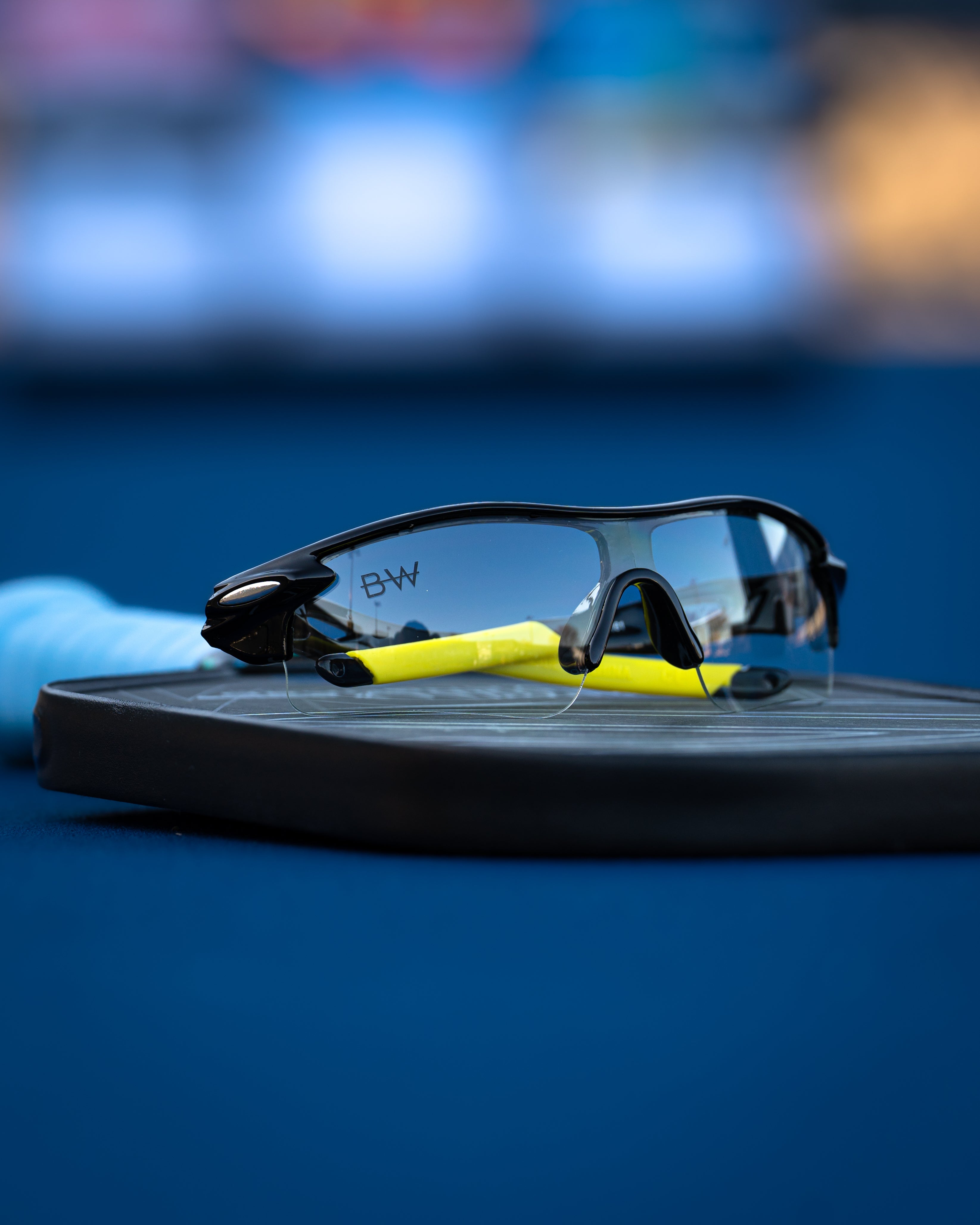
The RX Sports Glasses Pros Recommend for Peak Performance
Share
The RX Sports Glasses Pros Recommend for Peak Performance
Competitive athletes pay attention to small equipment details, and prescription eyewear is no exception. If you need vision correction for pickleball or another fast-paced sport, the goal is straightforward: choose RX glasses that provide the correction you need, work with your playing environment, and feel comfortable during actual movement.
The original guide goes much further, describing Blinded Wear RX glasses as the “gold standard” for competitive athletes and saying professional players choose them to play better, react faster, and win. :chatgpt-content-reference{index="0"} Those are powerful claims, but professional endorsements and direct performance improvements should only be stated when they can be verified.
You don't need exaggerated “pro-level” promises to make a strong case for RX sports eyewear. Prescription correction, high-index lens options, impact-resistant lenses, lightweight sports frames, different lens configurations, and individual fit give serious players plenty to evaluate.
Find Your Pickleball Glasses
Compare prescription and non-prescription eyewear or use the complete guide to narrow your options. :chatgpt-content-reference{index="1"}
Quick Answer: What Should You Look for in RX Sports Glasses?
Whether you're a recreational player or competing at a high level, don't shop for prescription sports glasses based solely on claims that a frame is “pro-approved.” Compare the features that actually affect the eyewear you receive.
| Feature | Why to Compare It | What It Doesn't Guarantee |
|---|---|---|
| Prescription correction | Provides the vision correction prescribed for you | Better athletic ability |
| High-index lenses | Can allow a thinner lens for the same prescription compared with a lower-index material in a comparable design | Faster reactions or better tracking |
| Impact-resistant lenses | Relevant lens characteristic for active sports use | Shatterproof or certified protective eyewear |
| Clear lenses | No intentional dark sunglass tint | Automatic contrast enhancement |
| Fixed tint | Provides a consistent tinted configuration | Automatic glare, tracking, or depth-perception improvement |
| Changing tint | Can change tint as environmental conditions change over time when available | Instant adjustment |
| Frame fit | Determines how the completed eyewear fits the individual athlete | Universal no-slip performance |
Are These RX Sports Glasses Actually Recommended by Pros?
The source describes the RX lineup as “athlete-approved,” labels several products as glasses “the pros recommend,” and concludes that professional players choose Blinded Wear. :chatgpt-content-reference{index="2"} :chatgpt-content-reference{index="3"}
Those statements should only be published as endorsements when the professional athletes, their use of the products, the exact models, and permission to use the endorsement can be verified.
That doesn't mean competitive players shouldn't consider Blinded Wear. It means the buying case should stand on the eyewear itself rather than an unverified endorsement.
Look at:
- Prescription compatibility
- Frame dimensions
- High-index lens availability
- Impact-resistant lens construction
- Current tint options
- Individual fit and comfort
- Replacement support
1. Start With the Prescription
The most important distinction between RX and non-RX sports glasses is simple: RX eyewear provides prescription correction.
If you require corrective lenses to see clearly, that correction comes before tint, frame style, coatings, or other sports-eyewear features.
Blinded Wear RX customers upload a clear photo of their eyeglass prescription before purchasing. The selected frame and lens configuration then need to work with that individual prescription.
Prescription correction shouldn't be converted into promises that the eyewear will automatically:
- Improve reaction time
- Improve anticipation
- Improve hand-eye coordination
- Improve spin recognition
- Increase shot accuracy
- Improve athletic performance
The purpose of RX eyewear is to provide the prescribed correction—not to create athletic skill.
2. Understand High-Index RX Lenses
The original article lists 1.61 high-index lenses as a standard feature and describes them as slim and lightweight. It later says lightweight 1.61 lenses prevent nose fatigue during long sets. :chatgpt-content-reference{index="4"} :chatgpt-content-reference{index="5"}
High-index refers to the lens material's refractive index. Its most useful advantage should be explained precisely:
A higher-index material can allow a thinner lens for the same prescription compared with a lower-index material in a comparable lens design.
Actual lens thickness and finished eyewear weight can also depend on:
- Prescription strength
- Lens dimensions
- Frame dimensions
- Lens design
- Material density
- Frame weight
Blinded Wear includes high-index prescription lenses at no additional cost. The exact index should only be advertised when confirmed for the current configuration.
What High-Index Lenses Don't Automatically Provide
A higher lens index shouldn't be treated as a bundle of unrelated performance features.
| Claim | Does High Index Alone Establish It? |
|---|---|
| Potentially thinner lenses | Yes, compared with a lower-index material for the same prescription and comparable design |
| Lighter finished glasses | Not universally |
| Better ball tracking | No |
| Faster reaction time | No |
| Better depth perception | No |
| Scratch resistance | No |
| Anti-fog performance | No |
| Impact resistance | Separate characteristic |
| Polarization | No |
3. Impact-Resistant Lenses for Active Sports
Impact resistance is a meaningful characteristic to evaluate in sports eyewear because active play can expose glasses to bumps, drops, and accidental contact.
Blinded Wear sports eyewear uses impact-resistant lenses.
Keep the terminology precise, however. Impact-resistant doesn't automatically mean:
- Shatterproof
- Unbreakable
- Impossible to crack
- Certified safety goggles
- ANSI-certified
- ASTM F803-certified
- Guaranteed to prevent an eye injury
The original FAQ acknowledges that the eyewear isn't rated as safety goggles but then says athletes use it in aggressive play without issues because of its durability and flex. :chatgpt-content-reference{index="6"} The first distinction is important; the second shouldn't substitute for verified protective certification.
4. Lightweight Sports Frames
The source repeatedly connects lightweight construction with competitive use, including claims that the glasses avoid nose fatigue and remain comfortable throughout long matches. :chatgpt-content-reference{index="7"}
Blinded Wear offers lightweight sports frames, but comfort is still individual.
When comparing frames, consider:
- Overall frame dimensions
- Bridge dimensions and fit
- Temple fit
- Lens dimensions
- Your prescription
- How the completed eyewear feels during movement
A lightweight frame can be desirable without promising that every athlete will forget they're wearing it or experience zero pressure during a long tournament.
5. Fit Matters During Fast-Paced Movement
The original guide promises “no-slip comfort” and says secure-fit temples allow athletes to play five or more matches without adjusting their frames. :chatgpt-content-reference{index="8"} :chatgpt-content-reference{index="9"}
That's too absolute because frame stability depends on the individual wearer.
Instead of assuming any frame will never move, evaluate the completed eyewear during the movements you actually make:
- Split steps
- Lateral movement
- Quick direction changes
- Overhead shots
- Serves
- Long rallies
- Extended practice sessions
A frame that fits one athlete securely may fit another differently.
6. Non-Polarized Sports Lenses
The source describes non-polarized lens technology as maintaining depth perception that is critical for ball tracking. :chatgpt-content-reference{index="10"}
Blinded Wear sports lenses are non-polarized, meaning a polarization filter isn't added. Some court players prefer non-polarized eyewear, but the absence of polarization shouldn't be turned into a universal performance claim.
Non-polarized lenses don't inherently:
- Improve depth perception
- Improve ball tracking
- Improve spin recognition
- Increase reaction speed
- Improve shot placement
- Make an athlete perform better
Polarization is simply a separate lens characteristic to consider when choosing eyewear.
7. Choose the RX Lens Configuration for Your Environment
The original article divides its recommendations into transitional, gray, and clear lenses, assigning each to different playing environments. :chatgpt-content-reference{index="11"}
That framework is useful as long as the performance claims are removed.
| RX Configuration | What It Means | Environment to Consider |
|---|---|---|
| Clear RX | Prescription correction without an intentional dark sunglass tint | Indoor, evening, or lower-light use |
| Fixed-Tint RX | Prescription correction with a consistent tint | Outdoor use depending on preference |
| Changing-Tint RX | Tint changes in response to environmental conditions over time | Changing indoor/outdoor environments when available |
None of these configurations automatically improves reaction time, tracking, contrast, or depth perception.
Clear RX Sports Glasses for Indoor Play
The source calls clear lenses best for night matches and indoor court play and describes them as providing “high-contrast clarity.” :chatgpt-content-reference{index="12"}
The safer distinction is simpler: clear RX lenses provide prescription correction without an intentional dark sunglass tint.
That makes clear RX eyewear worth comparing for:
- Indoor pickleball
- Indoor training
- Evening play
- Lower-light environments
- Players who don't want a dark tint
A clear lens doesn't inherently increase light, enhance contrast, improve tracking, or produce faster reactions.
Fixed-Tint RX Sports Glasses for Outdoor Play
The source recommends gray lenses for all-day outdoor tournaments and says they reduce glare without distortion. :chatgpt-content-reference{index="13"}
A fixed-tint RX lens can be an option for athletes who prefer a consistent tint outdoors. But tint by itself shouldn't be used to promise glare elimination, distortion reduction, improved contrast, better tracking, or better athletic performance.
Also remember that a tinted RX lens isn't automatically:
- Polarized
- Photochromic
- Anti-reflective
- Anti-fog
- Scratch-resistant
- UV400
Those characteristics should be verified separately.
Changing-Tint RX Glasses for Indoor-to-Outdoor Athletes
The original article says transitional lenses react automatically to changing light and elsewhere says they adjust “in seconds.” It recommends Havana Melt RX and Crystal Wave II RX as transitional options. :chatgpt-content-reference{index="14"} :chatgpt-content-reference{index="15"}
When currently available for a specific RX configuration, changing-tint lenses can be useful for athletes who move between different environments because their tint changes in response to environmental conditions over time.
But avoid describing that process as instantaneous or promising a universal number of seconds.
Changing-tint technology also doesn't automatically mean:
- Polarized
- Anti-fog
- Scratch-resistant
- Anti-reflective
- Impact-resistant
- A specific UV rating
- Performance-enhancing
RX Sports Glasses vs. Contact Lenses
The source argues that professional athletes choose prescription glasses over contacts because contacts shift, sweat affects their placement, they cause more blinking and dryness, and they can't adapt to changing light. :chatgpt-content-reference{index="16"}
Those statements are too broad to apply to every contact-lens wearer.
Prescription sports glasses and contact lenses are different approaches to vision correction. The right choice can depend on the individual athlete, their prescription, eye-care needs, sport, preferences, and guidance from their eye-care professional.
| RX Sports Glasses | Contact Lenses |
|---|---|
| Prescription correction is built into the eyewear | Prescription correction is worn directly on the eye |
| Can combine correction with a sports frame | Can be paired with separate non-RX sports eyewear |
| Can be removed or switched between pairs | Different wearing and care routine |
| Frame fit matters | Contact-lens fit and eye-care requirements matter |
Neither option should universally be described as better for every athlete.
RX Sports Glasses vs. LASIK
The original article states that “LASIK fades with time,” says many athletes experience regression after a few years, and specifically associates that regression with heavy UV exposure. :chatgpt-content-reference{index="17"}
Those medical claims shouldn't be used in an eyewear sales article without appropriate medical evidence and context.
LASIK is a medical procedure, while prescription sports glasses are removable corrective eyewear. Anyone deciding whether vision surgery is appropriate should discuss the risks, benefits, eligibility, and long-term expectations with a qualified eye-care professional.
RX Pickleball Glasses to Compare
The original article recommends Frost RX, Heatseek RX, Runway RX, Zebra II RX, Havana Melt RX, Crystal Wave II RX, and Blue Ghost RX, attaching different professional-level performance claims to each model. :chatgpt-content-reference{index="18"}
Instead of carrying forward unverified endorsements or older product-specific claims, compare current RX models using their current configurations.
| RX Model | What to Compare |
|---|---|
| Frost RX | Prescription compatibility, dimensions, current lens options |
| Havana Melt RX | Prescription compatibility, dimensions, current lens options |
| Crystal Wave II RX | Prescription compatibility, dimensions, current lens options |
| H Blue Shield RX | Prescription compatibility, dimensions, current lens options |
| Ocean Wave RX | Prescription compatibility, dimensions, current lens options |
| Rocket Fire RX | Prescription compatibility, dimensions, current lens options |
Verify Athlete Reviews Before Calling a Product “Pro-Recommended”
The source includes testimonials attributed to Caleb J. in Texas, Aria V. in California, Marcus L. in North Carolina, and Joey P. in Florida. Their quotes claim improvements in ball-spin tracking, fog resistance, frame stability, contrast, and tournament performance. :chatgpt-content-reference{index="19"} :chatgpt-content-reference{index="20"}
Only publish these testimonials if the customers, wording, purchases, product configurations, star ratings, experiences, and permission to use their statements can be verified.
Even a verified athlete testimonial represents that person's experience. It shouldn't automatically become a universal promise that every wearer will experience the same tracking, fogging, fit, or performance results.
Avoid Turning Sports Design Into Unsupported Performance Claims
The source says Blinded Wear RX glasses are engineered specifically for high-speed court vision, quick-focus changes, glare and light adaptation, sweat-heavy conditions, and repeated matches. :chatgpt-content-reference{index="21"}
A stronger description focuses on verified characteristics rather than implying the eyewear directly changes an athlete's visual processing or performance.
Blinded Wear RX eyewear can instead be evaluated through:
- Prescription correction
- Sports-focused frame designs
- Lightweight frames
- Impact-resistant lenses
- High-index prescription lenses
- Available lens configurations
- Individual fit and comfort
What Makes an RX Sports Glasses Setup Competition-Ready?
The original article frames the “RX difference” as a way to stop guessing at spin, compensate for difficult light, and begin playing like a professional. :chatgpt-content-reference{index="22"}
A more credible definition of competition-ready eyewear is practical:
Choose RX sports glasses that work with your prescription, match your playing environment, use verified lens characteristics, fit you comfortably, and have been tested by you during practice before an important match.
That's valuable whether you're entering your first local tournament or competing at a much higher level—and it doesn't require promising that eyewear itself will create “peak performance.”
What Does “Peak Performance” Mean for RX Sports Eyewear?
For prescription sports glasses, “peak performance” shouldn't mean that the glasses make an athlete faster, more accurate, or more skilled. Instead, the eyewear should support the athlete's existing vision needs without creating unrealistic expectations.
The original article ties RX eyewear to split-second decisions, high-speed court vision, quick-focus changes, light adaptation, and competitive performance. :chatgpt-content-reference{index="0"} :chatgpt-content-reference{index="1"}
A more useful definition focuses on choosing eyewear that:
- Provides your prescribed correction
- Uses a frame compatible with your prescription
- Matches the environments where you play
- Uses impact-resistant lenses
- Fits comfortably during your actual movement
- Has been tested during practice before competition
Match Your RX Sports Glasses to Where You Actually Play
The source separates lens choices into transitional, gray, and clear configurations, recommending them for different playing environments. :chatgpt-content-reference{index="2"}
That's one of the most useful ways to narrow your options. Instead of asking which lens is universally “best,” start with where you'll wear it.
| Playing Situation | RX Option to Compare | Primary Reason to Consider It |
|---|---|---|
| Indoor courts | Clear RX | No intentional dark sunglass tint |
| Evening play | Clear RX | Useful when you don't want a dark tint |
| Outdoor courts | Fixed-tint RX | Consistent tinted configuration |
| Indoor + outdoor events | Changing-tint RX when available | Tint can change as environmental conditions change |
| Predictable mixed environments | Separate clear and tinted RX pairs | Direct control over which configuration you wear |
Choosing RX Sports Glasses for Tournament Days
Tournament days can involve multiple matches, changing court locations, long periods of wear, and different lighting environments. The original article specifically markets its RX lineup around long-duration competition and multi-match use. :chatgpt-content-reference{index="3"} :chatgpt-content-reference{index="4"}
For tournament use, think beyond one headline feature. Your checklist should include:
- Your current prescription
- Frame compatibility with that prescription
- Frame dimensions and individual fit
- Lens material
- Impact resistance
- Clear, fixed-tint, or changing-tint configuration
- Familiarity with the eyewear during practice
- A backup RX option when practical
Can RX Sports Glasses Handle Multiple Matches?
The source repeatedly emphasizes extended tournament wear. It says secure-fit temples can allow five or more matches without adjustment and includes a testimonial claiming Frost RX was worn through four tournaments without fogging or slipping. :chatgpt-content-reference{index="5"} :chatgpt-content-reference{index="6"}
Those exact outcomes shouldn't be guaranteed for every wearer.
Instead, test your RX eyewear during realistic practice conditions before depending on it for a full tournament. Pay attention to:
- How the bridge feels over time
- How the temples fit
- Whether the frame moves during your normal movements
- Whether you're comfortable after longer sessions
- How the lens configuration works in your usual environment
Actual use is more informative than assuming a frame will perform identically for every athlete.
Test New RX Glasses Before Competition
A new prescription, frame, lens material, or tint configuration deserves practice time before an important match.
Use the completed eyewear during:
- Warm-ups
- Serving practice
- Fast exchanges
- Overhead shots
- Lateral movement
- Longer rallies
- A full practice session
The goal isn't to prove that the glasses improve performance. It's to determine whether the specific pair works well for you before competition.
Can RX Sports Glasses Help You Read Spin?
The source contains several strong spin and tracking claims. One testimonial says the wearer could “track the ball spin again,” while Zebra II RX is described as helping players pick up spin quickly through contrast. :chatgpt-content-reference{index="7"} :chatgpt-content-reference{index="8"}
Prescription correction can address the wearer's refractive vision needs, but an RX lens shouldn't automatically be credited with improving spin recognition.
Spin recognition involves the visual information available to the athlete as well as experience, attention, anticipation, and other factors. Don't promise that a particular lens index, tint, or non-polarized design will make spin easier to read.
Do Non-Polarized RX Lenses Improve Depth Perception?
The original feature table specifically says non-polarized lenses maintain depth perception that's critical for ball tracking. :chatgpt-content-reference{index="9"}
Blinded Wear sports lenses are non-polarized, but that characteristic alone shouldn't be described as improving or preserving depth perception for every athlete.
Some court players prefer non-polarized eyewear. That preference can be explained without claiming that polarization universally harms depth perception or that removing polarization inherently improves tracking.
What About Fogging During Competitive Play?
The source includes a testimonial saying Frost RX “never once fogged” across a four-tournament stretch. :chatgpt-content-reference{index="10"}
Unless an exact product has a verified anti-fog feature, don't convert an individual experience into an anti-fog specification.
Fogging can vary with environmental conditions and use. If fog management is especially important to you, verify the exact current lens and frame features before purchasing rather than assuming every sports frame is anti-fog.
Are Blinded Wear RX Lenses Scratch-Resistant?
The original feature table advertises a scratch-resistant coating and says the glasses can be tossed into a duffel or wiped during a set while holding up. :chatgpt-content-reference{index="11"}
Scratch resistance is a separate lens characteristic and shouldn't be inferred from high-index material, impact resistance, or sports use.
Only describe a specific RX lens as scratch-resistant when that characteristic is verified for the current configuration. Even when a scratch-resistant feature is present, proper storage and cleaning still matter.
Don't Treat “Included Coatings” as One Universal RX Feature
The source says every RX order includes coatings but doesn't identify the exact coating or treatment in that section. :chatgpt-content-reference{index="12"}
Different lens treatments address different characteristics. Don't use the generic word “coating” to imply that an RX order automatically includes:
- Anti-reflective treatment
- Anti-fog treatment
- Scratch resistance
- Hydrophobic treatment
- Blue-light filtering
- A particular UV specification
Verify the exact current configuration before advertising any of those features.
Do Changing-Tint RX Lenses Adjust Instantly?
The source says transitional tint adjusts “in seconds” and elsewhere describes certain models as darkening or lightening “on command.” :chatgpt-content-reference{index="13"} :chatgpt-content-reference{index="14"}
Those descriptions are too absolute.
Changing-tint lenses respond to environmental conditions over time. They shouldn't be described as instantly switching between clear and dark states or changing on command.
For athletes moving between environments, the value is convenience—not instantaneous transformation.
Changing-Tint RX vs. Separate Clear and Tinted RX Glasses
Players who regularly compete indoors and outdoors have two practical approaches to compare.
| Setup | Potential Advantage | Consideration |
|---|---|---|
| Changing-tint RX | One pair can change tint as environmental conditions change | Tint changes over time rather than instantly |
| Clear RX + tinted RX | Dedicated configuration for each environment | Requires carrying and switching pairs |
Neither approach is universally superior. Your schedule, playing environment, prescription, and preferences should drive the decision.
How to Compare RX Sports Frames
The original product recommendations assign different performance benefits to Frost RX, Heatseek RX, Runway RX, Zebra II RX, Havana Melt RX, Crystal Wave II RX, and Blue Ghost RX. :chatgpt-content-reference{index="15"}
A better comparison starts with measurable and verifiable factors:
| Comparison Point | Why It Matters |
|---|---|
| Frame dimensions | Helps determine whether the size is appropriate for you |
| Prescription compatibility | Not every frame/prescription combination is necessarily interchangeable |
| Lens configuration | Determines whether you're choosing clear, tinted, or another available option |
| Lens material | Relevant to the completed prescription lens |
| Impact resistance | Relevant for active sports use |
| Individual fit | Determines how the frame actually feels and moves on you |
RX Pickleball Models Worth Comparing
Rather than labeling individual models “pro picks” without a verified endorsement, compare the current specifications and available RX configurations.
| RX Model | Best Next Step |
|---|---|
| Frost RX | Check dimensions, prescription compatibility, and current lens options |
| Havana Melt RX | Check dimensions, prescription compatibility, and current lens options |
| Crystal Wave II RX | Check dimensions, prescription compatibility, and current lens options |
| H Blue Shield RX | Check dimensions, prescription compatibility, and current lens options |
| Ocean Wave RX | Check dimensions, prescription compatibility, and current lens options |
| Rocket Fire RX | Check dimensions, prescription compatibility, and current lens options |
How Ordering Prescription Sports Glasses Works
If you're buying Blinded Wear RX eyewear, have a clear image of your current eyeglass prescription ready to upload before purchasing.
Before submitting an order:
- Review your current prescription.
- Select an RX frame.
- Check the frame dimensions.
- Review the currently available lens options.
- Upload a clear photo of your eyeglass prescription.
- Review the order details before purchasing.
Don't assume that every frame supports every prescription or every possible lens configuration. Confirm compatibility for your specific order.
What About the Advertised Two-Week RX Turnaround?
The original article lists a two-week turnaround near the top and later repeats a two-week ship time as part of the RX package. :chatgpt-content-reference{index="16"} :chatgpt-content-reference{index="17"}
Production and shipping estimates can change. Unless that exact timeline is part of the current fulfillment policy, an evergreen article shouldn't promise that every RX order will ship within two weeks.
Use the current ordering information provided at purchase for the most relevant production and delivery expectations.
Be Precise About RX Guarantees
The source says every RX order includes a “prescription match guarantee,” alongside a protection plan, included coatings, two-week shipping, and 1.61 high-index lenses. :chatgpt-content-reference{index="18"}
A prescription guarantee should only be advertised using the exact current terms of that policy. Don't imply an unlimited remake, refund, or prescription guarantee unless those terms are specifically provided by the current policy.
What can be clearly communicated is that customers should submit a clear photo of their eyeglass prescription and carefully review the current RX ordering requirements.
Replacement Support for Active Players
The original article links customers to Blinded Wear's protection information as part of its RX buying process. :chatgpt-content-reference{index="19"}
Blinded Wear offers 50% lifetime replacement support for eligible broken eyewear, subject to current policy terms.
For athletes who regularly practice, compete, and travel with their glasses, replacement support is a practical feature to consider separately from lens performance.
Why Competitive Players Should Consider a Backup RX Pair
If you rely on prescription correction to play, a familiar backup pair can be one of the most practical additions to a tournament bag.
A backup can give you another prescription option if your primary pair is:
- Lost
- Damaged
- Unavailable
- Uncomfortable unexpectedly
The backup doesn't need to contain more technology than your primary pair. Familiarity and usable prescription correction are the priorities.
RX Sports Glasses Buying Checklist
Before buying prescription sports eyewear for competitive play, work through this checklist:
- Start with your current eyeglass prescription.
- Choose a frame compatible with your RX needs.
- Compare the frame dimensions.
- Review the high-index lens option included with your order.
- Confirm impact-resistant lens construction.
- Choose clear, fixed-tint, or changing-tint RX based on where you play.
- Verify additional coatings or lens features individually.
- Don't assume “sports” means certified protective eyewear.
- Test your finished glasses during practice.
- Consider carrying backup prescription eyewear for tournaments.
- Review current replacement-support terms.
The Best RX Sports Glasses Aren't Defined by a “Pro” Label
The source positions Blinded Wear RX eyewear as a professional-performance advantage and says its glasses are engineered for high-speed vision, quick focus, changing light, sweat, and repeated matches. :chatgpt-content-reference{index="20"}
A more useful buying standard is whether the eyewear fits the athlete's actual requirements.
For a serious player, the strongest RX setup combines the right prescription, a compatible frame, appropriate lens material, impact resistance, an environment-appropriate lens configuration, individual fit, and enough practice time to become familiar with the finished glasses.
Those are meaningful characteristics without claiming that a pair of glasses creates peak athletic performance on its own.
FAQ: RX Sports Glasses for Competitive Athletes
What should athletes look for in prescription sports glasses?
Start with your prescription and frame compatibility. From there, compare lens material, impact resistance, frame dimensions, fit, and the lens configuration that makes sense for where you play. The original guide emphasizes high-index lenses, lightweight construction, different tint options, and sports-oriented frame designs. :chatgpt-content-reference{index="0"}
Do professional athletes need special RX lenses?
The source presents Blinded Wear's RX lineup as professional-level eyewear, but it doesn't establish that professional athletes universally require a special prescription-lens technology. :chatgpt-content-reference{index="1"} Athletes should choose lenses according to their individual prescription and playing needs.
Do high-index lenses improve sports performance?
High-index material shouldn't be marketed as a direct performance enhancement. A higher-index material can allow a thinner lens for the same prescription compared with a lower-index material in a comparable design. It doesn't inherently improve reaction time, tracking, depth perception, or athletic ability.
Are high-index lenses always lighter?
Not necessarily. Prescription strength, lens dimensions, material density, frame dimensions, lens design, and frame weight can all influence the weight of the completed eyewear.
Are Blinded Wear RX sports glasses impact-resistant?
Blinded Wear sports eyewear uses impact-resistant lenses. Impact-resistant doesn't mean shatterproof, unbreakable, or automatically certified to a particular protective-eyewear standard.
Are Blinded Wear sports lenses polarized?
Blinded Wear sports lenses are non-polarized, meaning a polarization filter isn't added. This shouldn't be interpreted as a guarantee of better depth perception, tracking, or reaction time.
Are clear RX lenses good for indoor pickleball?
Clear RX lenses provide prescription correction without an intentional dark sunglass tint. That makes them an option to compare for indoor, evening, and lower-light play.
Can I use tinted RX glasses outdoors?
A fixed-tint RX configuration can be an option for outdoor play depending on your preferences. Tint alone shouldn't be treated as proof of polarization, anti-reflective treatment, enhanced contrast, or better ball tracking.
Can changing-tint RX glasses work indoors and outdoors?
When available for your prescription and frame, changing-tint lenses can be useful for athletes moving between different environments because the tint changes in response to environmental conditions over time. The process shouldn't be described as instantaneous.
Should I practice in new RX sports glasses before a tournament?
Yes. Practicing in your completed eyewear gives you an opportunity to evaluate the fit, comfort, and lens configuration before depending on the glasses during an important match.
RX Sports Glasses: Performance Claims vs. Reality
The original guide makes several aggressive performance claims, including faster reactions, better ball-spin tracking, maintained depth perception, zero slipping, automatic light adaptation, and professional-level performance. :chatgpt-content-reference{index="2"}
| Claim | Better Way to Understand It |
|---|---|
| “RX glasses make you react faster.” | Prescription eyewear provides vision correction; it shouldn't guarantee faster reactions. |
| “High-index improves tracking.” | High-index describes lens material, not athletic tracking ability. |
| “Non-polarized improves depth perception.” | Some court players prefer non-polarized lenses, but don't promise a universal depth-perception benefit. |
| “Clear lenses increase contrast.” | Clear means no intentional dark sunglass tint; contrast improvement shouldn't be assumed. |
| “Tint improves ball tracking.” | Tint alone doesn't establish a tracking benefit. |
| “Changing-tint lenses adjust instantly.” | Tint changes over time as environmental conditions change. |
| “Impact-resistant means shatterproof.” | Impact resistance doesn't mean a lens is impossible to break. |
| “Sports eyewear means safety-certified.” | Specific protective standards must be verified separately. |
| “Lightweight means it won't slip.” | Frame stability depends on individual fit. |
| “Pro-recommended means better.” | Professional endorsements require verification and don't guarantee another athlete's experience. |
What Matters Specifically for RX Pickleball Glasses?
Pickleball involves repeated movement, quick exchanges, indoor and outdoor facilities, and potentially long playing sessions. That makes prescription compatibility and practical sports-eyewear characteristics worth comparing.
For pickleball, consider:
- Your current eyeglass prescription
- Frame and prescription compatibility
- Frame dimensions
- Impact-resistant lenses
- High-index lens material when appropriate
- Clear, fixed-tint, or changing-tint options
- Individual fit during movement
- Comfort during longer sessions
- A backup RX pair for tournament days
None of these features should be presented as a shortcut to better pickleball technique or strategy.
What About RX Glasses for Fast-Paced Sports?
The source says Blinded Wear RX glasses are engineered specifically for “high-speed court vision” and “quick-focus changes.” :chatgpt-content-reference{index="3"} Those phrases can imply that the eyewear changes the athlete's visual processing speed.
A stronger description is that RX sports glasses combine prescription correction with sports-oriented frames and lens characteristics intended for active use.
That distinction matters. Eyewear can provide the prescribed correction without promising to accelerate visual processing, decision-making, or reaction time.
How to Test RX Sports Glasses Before Competition
Once your prescription glasses arrive, don't make tournament day the first time you wear them during intense movement.
- Check basic fit. Evaluate the bridge and temples.
- Wear them casually. Become familiar with the completed prescription eyewear.
- Practice in them. Use the glasses during your normal training.
- Add movement. Test lateral movement, serves, overheads, and quick direction changes.
- Use them for a longer session. Evaluate comfort over time.
- Try your normal environment. Test the lens configuration where you actually play.
- Prepare your backup. Bring familiar RX eyewear to important events when practical.
RX Sports Glasses for Travel and Tournament Weekends
Travel adds another reason to think beyond a single pair of glasses. If prescription correction is important to your play, losing or damaging your primary eyewear away from home can be inconvenient.
A tournament travel setup can include:
- Your primary RX sports glasses
- A familiar backup prescription pair
- Appropriate storage
- Lens-cleaning supplies
- Any separate clear or tinted RX configuration you plan to use
Why a Backup RX Pair Can Matter More Than Another “Performance Feature”
If you depend on prescription correction, a backup pair provides redundancy if your primary eyewear is lost or damaged.
For a serious tournament player, that's a practical advantage that doesn't require claims about reaction time, contrast enhancement, or professional-level optics.
Your backup should ideally be familiar enough that you aren't introducing completely unfamiliar eyewear in the middle of an important event.
How to Protect RX Sports Glasses Between Matches
The original article describes its lenses and frames as highly durable and promotes scratch resistance as part of the competitive-athlete package. :chatgpt-content-reference{index="4"} Even durable sports eyewear benefits from careful handling.
- Store glasses safely when you're not wearing them.
- Avoid putting lenses face-down on hard surfaces.
- Use appropriate lens-cleaning materials.
- Don't assume impact-resistant means damage-proof.
- Don't assume scratch-resistant means scratch-proof.
- Inspect eyewear after significant impacts.
- Protect backup RX glasses during travel.
How Much Weight Should You Give Athlete Reviews?
The source uses customer testimonials to support claims about ball-spin tracking, fog resistance, secure fit, contrast, and tournament use. :chatgpt-content-reference{index="5"} :chatgpt-content-reference{index="6"}
Verified customer experiences can be useful, but they should remain individual experiences rather than universal product promises.
When evaluating an athlete review, look for context:
- Which exact RX frame did they use?
- Which lens configuration did they order?
- What was their playing environment?
- How long did they use the glasses?
- What specifically did they like or dislike?
- Is their competitive level accurately described?
What Makes a Legitimate “Pro-Recommended” Claim?
The article title and original copy strongly target professional-player recommendations. The source calls the products “athlete-approved,” says they're trusted by professional players, and repeatedly presents individual models as pro choices. :chatgpt-content-reference{index="7"} :chatgpt-content-reference{index="8"}
If you want to make that claim literally, establish a real endorsement first.
A strong professional endorsement should clearly establish:
- The athlete's identity
- The athlete's legitimate competitive status
- The exact Blinded Wear product used
- The athlete's genuine experience
- Permission to use the endorsement
- Any material relationship that should be disclosed
Until then, the article can answer what competitive athletes should look for without implying endorsements that haven't been verified.
Compare Blinded Wear RX Sports Glasses
The original article recommends numerous RX models for different competitive situations. :chatgpt-content-reference{index="9"} Current shoppers should compare available models using current product information rather than relying on older feature assignments.
| RX Model | Start By Comparing |
|---|---|
| Frost RX | Prescription compatibility, dimensions, current lens options |
| Havana Melt RX | Prescription compatibility, dimensions, current lens options |
| Crystal Wave II RX | Prescription compatibility, dimensions, current lens options |
| H Blue Shield RX | Prescription compatibility, dimensions, current lens options |
| Ocean Wave RX | Prescription compatibility, dimensions, current lens options |
| Rocket Fire RX | Prescription compatibility, dimensions, current lens options |
Final Pre-Purchase Checklist
Before ordering RX sports glasses, make sure you can answer these questions:
- Is my eyeglass prescription current?
- Is this frame compatible with my prescription?
- Have I checked the frame dimensions?
- Which high-index lens material is included?
- Are the lenses impact-resistant?
- Am I choosing clear, fixed-tint, or changing-tint RX?
- Which additional lens treatments are actually verified?
- Am I assuming a feature that isn't listed?
- Will I have time to practice in the glasses before competition?
- Do I need a backup prescription pair?
- Have I reviewed the current replacement-support terms?
50% Lifetime Replacement Support
For athletes who regularly train, travel, and compete, what happens after accidental damage can matter just as much as the original purchase.
Blinded Wear offers 50% lifetime replacement support for eligible broken eyewear, subject to current policy terms.
This is separate from claims about lens durability. Impact-resistant eyewear can still be damaged, and replacement support shouldn't be interpreted as meaning the glasses are unbreakable.
Related RX Sports Eyewear Guides
Final Verdict: Which RX Sports Glasses Are Best for Peak Performance?
The original guide argues that professional athletes choose Blinded Wear because its RX glasses help players react faster, track spin, adapt to light, maintain depth perception, and compete without distraction. :chatgpt-content-reference{index="10"} :chatgpt-content-reference{index="11"}
The more credible conclusion is that RX sports glasses shouldn't be expected to create peak athletic performance by themselves.
Instead, look for a complete setup that matches your actual needs:
- Accurate prescription correction
- A compatible sports frame
- High-index lenses when appropriate
- Impact-resistant lenses
- A clear, fixed-tint, or changing-tint configuration suited to your environment
- Verified lens characteristics
- Individual fit and comfort
- Practice time in the completed eyewear
- A backup RX plan for important competition
Those factors won't replace training, anticipation, movement, technique, or decision-making. What they can do is help you choose prescription eyewear based on concrete features instead of unsupported performance promises.
The best RX sports glasses are the ones that provide the correction you need, fit your playing environment, and work comfortably for you when competition starts.
Find Your RX Sports Glasses
Compare Blinded Wear prescription frames, explore clear-lens options, or use the 2026 pickleball eyewear guide to narrow your choices.