
Prescription Sunglasses vs. Contact Lenses: Which Is Better for Athletes?
Share
Compare Prescription Sports Eyewear for Pickleball
If you need vision correction for pickleball, tennis, running, cycling, or another sport, two common approaches are prescription sports glasses or contact lenses paired with appropriate Non-RX eyewear. Neither option is automatically better for every athlete.
Prescription Sunglasses vs. Contact Lenses for Athletes: What Is the Difference?
Athletes who need vision correction generally have several ways to approach sports eyewear. Two of the most common are prescription sports sunglasses and contact lenses paired with Non-RX sports eyewear.
Both can address the same fundamental need—correcting refractive error—but they do it differently.
With prescription sunglasses, your vision correction is incorporated into the eyewear itself. With contact lenses, prescription correction sits directly on the eye, allowing a separate pair of Non-RX sports glasses or sunglasses to be worn when desired.
The better setup depends on factors such as:
- Your prescription
- Whether contact lenses are appropriate for you
- Your sport
- Indoor or outdoor use
- How long you wear your correction
- Frame and lens preferences
- Comfort
- Convenience
- Environmental conditions
- Any sport-specific protective-eyewear requirements
Rather than asking which option is universally better, compare how each method fits your individual vision and athletic needs.
Prescription Sports Sunglasses vs. Contacts: Quick Comparison
| Factor | Prescription Sports Sunglasses | Contact Lenses + Non-RX Eyewear |
|---|---|---|
| Vision Correction | Built into the prescription eyewear | Provided by contact lenses |
| Frame in Field of View | Frame and lens geometry remain physically present | Contacts themselves do not have an eyeglass frame |
| Separate Sports Eyewear | Prescription and sports eyewear can be combined in one product | Non-RX sports eyewear can be worn over the contacts |
| Daily Handling | No contact-lens insertion or removal | Requires appropriate contact-lens handling and care |
| Lens Tint | Depends on available RX lens options | Can be selected through separate Non-RX eyewear |
| Prescription Compatibility | Depends on frame and available RX configuration | Depends on whether contacts are appropriate for the individual's prescription and eyes |
| Protective Certification | Must be verified for the complete eyewear product when required | Contacts do not provide physical eye protection; separate protective eyewear may be required |
How Prescription Sports Sunglasses Work
Prescription sports sunglasses combine vision correction with a sports-oriented frame and sunglass lens configuration.
Instead of placing a contact lens directly on the eye and then adding separate sunglasses, the prescription correction is incorporated into the eyewear system.
Depending on the product, prescription sports eyewear can use:
- Direct RX: prescription correction incorporated into the primary prescription lenses
- RX Clip: prescription correction incorporated into a separate inner prescription insert
These configurations should not be treated as identical. Frame geometry, prescription compatibility, physical coverage, lens options, and finished eyewear characteristics can differ.
Advantages of Prescription Sports Sunglasses
Prescription Correction and Eyewear in One Setup
One practical advantage is integration. Your prescription correction is contained within the eyewear system, so you do not need to insert contact lenses before putting on your sports sunglasses.
For athletes who do not wear contacts or prefer glasses, this can simplify preparation for practices, matches, and recreational play.
No Contact Lens on the Eye
Prescription glasses provide correction without placing a contact lens directly on the eye.
This can make RX eyewear worth considering for people who do not use contacts, cannot comfortably wear them, or simply prefer glasses.
Physical Lens and Frame Coverage
Sports sunglasses can provide physical coverage around the eye area according to the dimensions and geometry of the specific frame and lenses.
However, physical coverage should not automatically be interpreted as certified eye protection. If a sport requires a particular protective-eyewear standard, verify the certification of the complete product.
No Daily Contact-Lens Insertion and Removal
Prescription sports glasses eliminate the contact-lens insertion and removal steps because the correction remains in the eyewear.
They still require appropriate cleaning, storage, and general eyewear care.
Prescription Sunglass Lens Options
Depending on the specific product, prescription sunglasses may be available in different lens appearances or configurations.
Do not assume every RX product automatically offers clear, polarized, photochromic, progressive, anti-reflective, anti-fog, or other specialized lens options. Availability should be verified for the individual product and prescription.
Limitations of Prescription Sports Sunglasses
Prescription sports sunglasses also have tradeoffs.
The Frame Remains in Front of Your Face
Unlike contacts, glasses include a physical frame and lenses. Frame geometry can therefore be noticeable within portions of your field of view depending on the design and fit.
This does not mean glasses automatically produce poor peripheral vision, but it is a physical difference between glasses and contacts.
Prescription Compatibility Can Vary by Frame
Not every prescription works with every sports frame or lens configuration.
Compatibility can depend on:
- Prescription strength
- Frame dimensions
- Lens dimensions
- Frame curvature
- Lens design
- Other optical requirements
One Lens Configuration May Not Suit Every Environment
A dark prescription sunglass configuration intended for bright outdoor conditions may not be appropriate for indoor or nighttime use.
Some athletes therefore maintain more than one eyewear setup for different environments.
Prescription Changes Can Require New RX Eyewear
If your prescription changes, your existing prescription sports glasses do not automatically update with it. You may need new prescription lenses or another appropriate eyewear configuration.
How Contact Lenses Work for Athletes
Contact lenses provide vision correction directly on the eye rather than through an eyeglass lens positioned in front of it.
This separates prescription correction from sports eyewear.
An athlete who appropriately uses contacts can potentially pair them with:
- Non-RX sunglasses
- Non-RX clear-lens sports eyewear
- Other appropriate sports eyewear
- Certified protective eyewear when required
Contact lenses are medical devices, and suitability, prescription, replacement schedule, wear time, hygiene, and care should follow appropriate eye-care guidance.
Advantages of Contact Lenses for Sports
No Eyeglass Frame Around the Eyes
Contact lenses themselves do not have an eyeglass frame, which removes the physical frame boundaries associated with traditional glasses.
That is different from claiming contacts improve biological peripheral vision beyond a person's normal visual capabilities.
Prescription Correction Moves With the Eye
Because contact lenses sit on the eye, they move differently from an eyeglass lens positioned in a frame.
Whether contacts are appropriate and comfortable during a particular sport remains individual.
Freedom to Change Non-RX Sports Eyewear
Separating vision correction from the sports frame can make it easier to use different Non-RX eyewear for different environments.
For example, an athlete might choose one Non-RX setup for bright outdoor play and another for indoor activity while keeping prescription correction in the contacts.
No Prescription Sports Frame Required
If contacts provide the needed correction, the outer sports eyewear does not also need to contain the prescription.
This can expand the range of Non-RX eyewear configurations available to the wearer.
Limitations of Contact Lenses for Athletes
Contacts Require Proper Handling and Hygiene
Contact lenses require appropriate insertion, removal, cleaning or replacement practices according to the specific lens type and professional guidance.
Poor contact-lens hygiene can create eye-health risks, so proper handling should not be treated as optional.
Not Everyone Can or Wants to Wear Contacts
Contact-lens comfort and suitability vary by person.
Factors such as prescription, eye health, lens type, environment, and individual tolerance can affect whether contacts are a practical sports-vision option.
Contacts Do Not Replace Physical Sports Eyewear
A contact lens provides vision correction. It does not provide the physical coverage of a sports frame and lens in front of the eyes.
If sunglasses or protective eyewear are needed, those are separate considerations.
Environmental Conditions Can Matter
Wind, dry environments, dust, and other conditions may influence the contact-lens experience for some wearers.
Responses vary, so avoid assuming that contacts are universally more comfortable or less comfortable than prescription glasses in any particular environment.
Prescription Sunglasses vs. Contacts for Pickleball
Pickleball players who need vision correction can use either approach when it is appropriate for their individual needs.
Prescription pickleball glasses may appeal if you prefer correction built directly into your sports eyewear and do not want to wear contacts.
Contacts with Non-RX pickleball glasses may appeal if you already wear contacts comfortably and want prescription correction separated from your outer sports eyewear.
Neither option automatically improves:
- Reaction time
- Ball tracking
- Depth perception
- Hand-eye coordination
- Shot accuracy
- Athletic performance
The purpose of either approach is to address your vision-correction needs while allowing you to choose an eyewear setup appropriate for the activity.
Prescription Sunglasses vs. Contacts for Tennis
The same decision applies to tennis.
A player who prefers glasses may choose prescription sports sunglasses, while a comfortable contact-lens wearer may prefer contacts with separate Non-RX sports eyewear.
Consider:
- Your prescription
- Contact-lens suitability
- Outdoor brightness
- Frame fit
- Physical lens coverage
- How long you expect to play
- Personal comfort
Prescription Sunglasses vs. Contacts for Running
Runners may compare the convenience of integrated prescription sunglasses with the flexibility of contacts and separate Non-RX eyewear.
Prescription sports sunglasses keep correction within the eyewear system. Contacts separate correction from the outer frame.
Neither option is automatically more stable or comfortable during running. Fit, individual contact-lens experience, environmental conditions, and the specific eyewear all contribute.
Prescription Sunglasses vs. Contacts for Cycling
Cycling can involve extended outdoor exposure, different riding positions, and interaction with helmets or other equipment.
Prescription sports sunglasses can combine correction with an outer eyewear system, while contacts allow prescription correction to remain separate from the cycling glasses.
When comparing the two, consider:
- Prescription requirements
- Contact-lens suitability
- Frame geometry
- Physical coverage
- Helmet compatibility
- Environmental conditions
- Available lens configurations
Prescription Sunglasses vs. Contacts for Golf
Golf can involve several hours of outdoor wear, making comfort and convenience important.
Some golfers may prefer prescription sunglasses because there is no contact-lens handling. Others may prefer contacts so they can change Non-RX sunglasses independently of their prescription correction.
Neither setup should automatically be credited with improving putting, swing accuracy, depth perception, or distance judgment.
Which Option Has Better Peripheral Vision?
This question needs a careful distinction.
Contact lenses do not have an eyeglass frame around the eye, so there is no physical frame boundary from the contact lens itself.
Prescription glasses include a frame and lenses whose dimensions and geometry can occupy portions of the wearer's field of view.
However, this does not mean contacts biologically expand peripheral vision or that prescription sports glasses inherently produce poor peripheral vision.
The physical eyewear configuration and the eye's visual field are related but different concepts.
Which Is Better for Ball Tracking?
Neither prescription sunglasses nor contact lenses should automatically be declared better for ball tracking.
Ball tracking can involve:
- Appropriate vision correction
- Individual visual abilities
- Eye and head movement
- Attention
- Experience
- Ball speed
- Lighting
- Background conditions
The appropriate goal is to use a vision-correction method that works for your individual prescription and activity rather than expecting one category to provide an automatic tracking advantage.
Which Is Better for Reaction Time?
Neither option should be marketed as automatically producing faster neurological reaction time.
Prescription glasses and contacts correct vision in different ways, but reaction time involves visual detection, neurological processing, decision-making, and physical response.
Appropriate vision correction matters when correction is needed, but the correction method itself should not be turned into a guaranteed sports-performance claim.
Which Is Better for Depth Perception?
Neither contacts nor prescription sunglasses should automatically be described as enhancing depth perception simply because of the correction format.
Depth perception involves binocular vision and multiple visual cues. Individual prescription and eye-health factors can also matter.
If you have concerns about depth perception or binocular vision, appropriate professional evaluation is more useful than selecting eyewear based on marketing claims.
Which Is More Comfortable During Long Matches?
Comfort is highly individual.
For prescription sunglasses, comfort can depend on:
- Frame weight
- Weight distribution
- Bridge fit
- Temple fit
- Lens dimensions
- Prescription configuration
For contact lenses, comfort can depend on:
- Contact-lens type
- Individual eye characteristics
- Wear time
- Environment
- Proper fit and care
There is no universal comfort winner for every athlete.
Which Is More Convenient?
Convenience depends on your routine.
Prescription sports sunglasses keep vision correction within the eyewear itself. Put on the glasses and the prescription is part of the same setup.
Contacts require insertion and removal but allow prescription correction to remain independent from the outer sports eyewear.
Some athletes prefer the simplicity of RX glasses. Others value the flexibility of contacts. The better workflow depends on your habits and preferences.
Which Is Better for Indoor and Outdoor Sports?
If you move frequently between indoor and outdoor environments, separating prescription correction from sunglass tint can offer flexibility.
A contact-lens wearer can potentially change between Non-RX clear and tinted sports eyewear without changing the prescription correction.
A prescription-glasses wearer may instead use separate RX configurations for different environments when needed and available.
Another possibility is an appropriate available lens configuration designed for changing conditions, but specialized lens technologies should be verified for the individual product rather than assumed.
Contacts With Non-RX Sports Glasses: Why Athletes Consider This Setup
Contacts and Non-RX sports eyewear can function as two separate layers:
- Contact lenses: provide prescription correction.
- Non-RX sports eyewear: provides the physical frame, lens coverage, tint, and other verified characteristics of the selected product.
This separation can be useful for athletes who already wear contacts comfortably and want to switch outer eyewear without ordering each frame in their prescription.
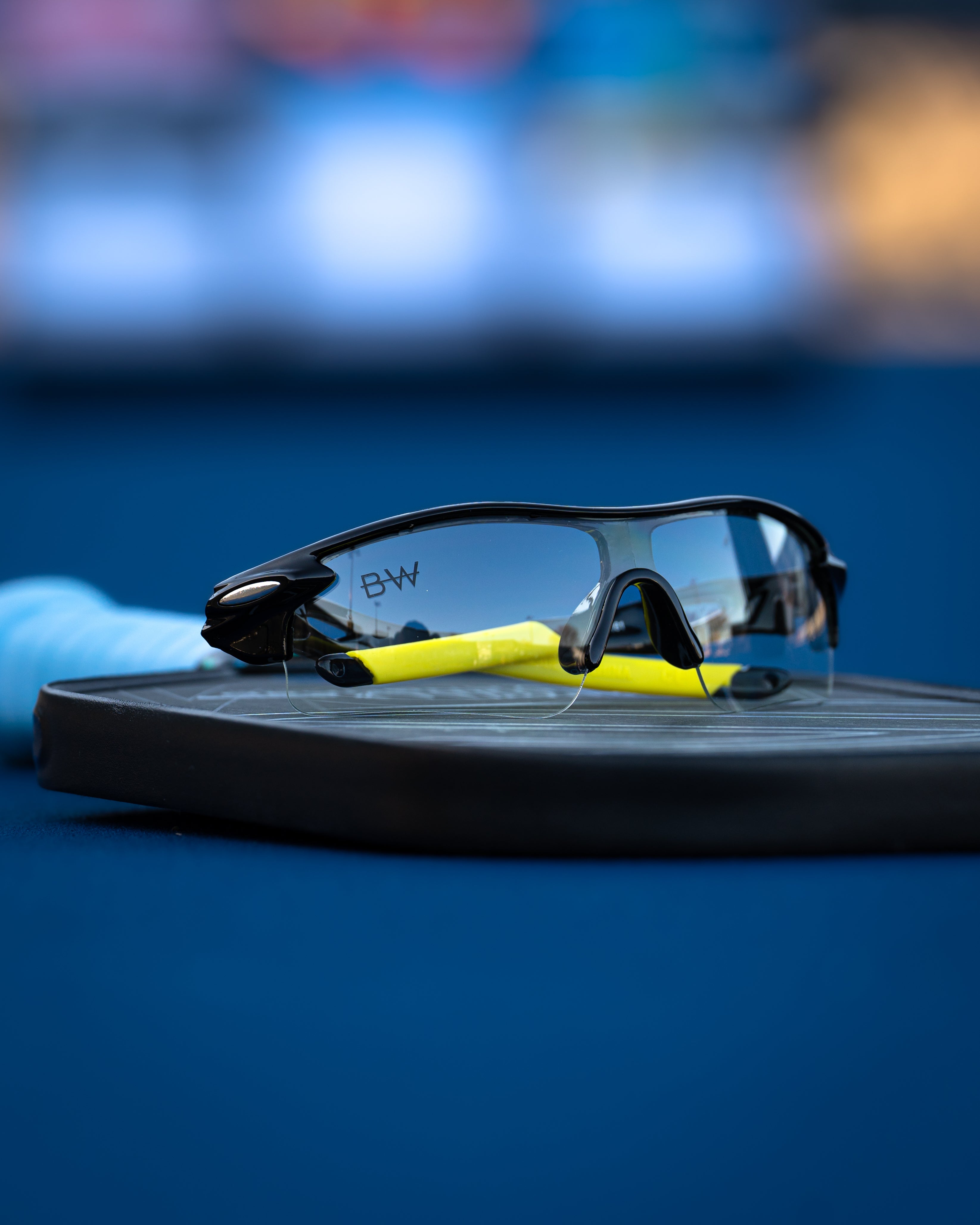
Blinded Wear offers a Non-RX Pickleball Sunglasses Collection for athletes who do not need prescription correction incorporated into the eyewear.
Contacts With Clear Non-RX Sports Glasses
A contact-lens wearer who does not want dark sunglass tint for indoor, evening, or lower-light activities may consider separate clear Non-RX sports eyewear.
Blinded Wear's Clear Lens Collection contains Non-RX clear-lens eyewear.
Clear means the lens does not use a dark sunglass tint. It should not automatically be interpreted as improving contrast, reaction time, ball tracking, or low-light vision.
Prescription Sunglasses and High-Index Lenses
Blinded Wear RX products include high-index prescription lenses at no additional cost.
High-index refers to a category of prescription lens material commonly used to help manage lens thickness, particularly as prescription strength increases.
Final lens thickness depends on factors including:
- Your prescription
- Frame dimensions
- Lens dimensions
- Lens shape
- Lens design
- Other optical requirements
High-index does not automatically mean lighter, more impact-resistant, shatterproof, or safety-certified.
Prescription Sunglasses and Physical Eye Coverage
One distinction between contact lenses and sports glasses is physical coverage.
A contact lens sits directly on the eye and provides vision correction. It does not create an outer physical lens or frame in front of the eye area.
Sports glasses provide physical coverage according to their lens and frame geometry.
However, physical coverage is not the same as certified eye protection. If you need eyewear meeting a particular sports or occupational safety standard, verify that certification for the complete product.
Can You Wear Contacts Under Sports Sunglasses?
Many contact-lens wearers use separate sunglasses or sports eyewear, but contact-lens use should follow the instructions and guidance applicable to the individual's lenses and eyes.
The outer sunglasses remain a separate product. Their tint, polarization, physical coverage, impact resistance, UV specifications, and protective certification should each be verified independently when relevant.
Can You Wear Contacts With Prescription Sunglasses?
Prescription sunglasses are designed to contain vision correction themselves, so wearing contacts that also provide correction may create an inappropriate combined prescription unless specifically directed otherwise by an eye-care professional.
If your contacts already provide your required correction, the outer sports eyewear would typically be selected according to the vision setup appropriate for you rather than independently adding another prescription.
Prescription Sunglasses vs. Contacts: Cost Considerations
The cost comparison depends on how each person uses and replaces their vision correction.
Prescription sports eyewear can involve the cost of a customized RX product. Contact lenses can involve recurring lens purchases as well as any separate Non-RX sports eyewear you choose to use.
Instead of assuming one is always cheaper, compare:
- Initial RX eyewear cost
- Contact-lens replacement schedule
- Separate sports-eyewear purchases
- Prescription changes
- How many different sports-eyewear configurations you want
- Your expected period of use
Actual costs vary significantly by prescription, products, contact-lens type, and individual needs.
Prescription Sunglasses vs. Contacts: Which Setup Fits Your Priorities?
| If You Prioritize... | Consider Exploring... |
|---|---|
| Correction integrated into your sports eyewear | Prescription sports sunglasses |
| No contact-lens insertion or removal | Prescription sports sunglasses |
| Prescription correction separate from your sports frame | Contacts + Non-RX sports eyewear |
| Changing between different Non-RX frames | Contacts + compatible Non-RX eyewear may offer flexibility |
| A glasses-based solution | Direct RX or RX Clip sports eyewear |
| A contact-based solution | Discuss contact-lens suitability with an eye-care professional |
This is a decision framework, not a universal ranking. Your prescription and individual eye needs come first.
Blinded Wear Prescription Sports Glasses to Explore
For athletes who prefer prescription correction built into their sports eyewear, Blinded Wear offers multiple RX models to compare.
Frost RX
Frost RX is a direct RX design with a white sports frame and bright blue lens appearance. Compare it according to your prescription needs, fit preferences, frame design, and current available options.
Crystal Wave II RX
Crystal Wave II RX provides another direct prescription option for athletes comparing sports-frame designs and lens appearances.
Steel Ice RX
Steel Ice RX is a direct RX sports-eyewear option that can be compared according to prescription compatibility, fit, design, and verified current lens characteristics.
Zebra II RX
Zebra II RX offers a distinctive direct RX design for athletes seeking prescription sports eyewear.
Do not assume that every model automatically includes polarization, photochromic lenses, anti-glare treatment, anti-fog technology, or multiple tint choices unless those characteristics are verified for the specific product.
How to Order Blinded Wear Prescription Sports Glasses
- Browse the Prescription Sports Glasses Collection.
- Select your preferred RX product and available options.
- Have your current eyeglass prescription ready.
- Upload a clear photo or picture of your eyeglass prescription on the product page before adding the eyewear to your cart.
- Your prescription information will be associated with your custom RX order.
For RX Clip products, your prescription information will be associated with the custom RX clip included with your order.
Read How to Order Your Prescription Pickleball Glasses for additional information.
Prescription Sunglasses vs. Contacts: Start With Your Actual Vision Needs
The most useful first question is not, "Which option makes athletes perform better?"
Instead, ask:
- What prescription correction do I need?
- Are contact lenses appropriate and comfortable for me?
- Do I prefer correction built into my eyewear?
- What sports will I use the setup for?
- Will I primarily play indoors, outdoors, or both?
- What type of physical coverage do I want?
- Do I need certified protective eyewear for my activity?
- How important is the ability to change outer sports eyewear independently of my prescription?
Those questions create a much more useful comparison than assuming one correction method gives every athlete a competitive advantage.
Prescription Sunglasses vs. Contact Lenses for Outdoor Sports
Outdoor athletes have two separate decisions to make: how to correct their vision and what outer eyewear characteristics they want for the environment.
Prescription sunglasses combine those decisions into one eyewear system. Contacts separate them, allowing the athlete to select Non-RX sunglasses independently.
| Outdoor Consideration | Prescription Sunglasses | Contacts + Non-RX Sunglasses |
|---|---|---|
| Prescription Correction | Built into the RX eyewear | Provided by contacts |
| Sunglass Tint | Part of the RX lens configuration | Selected through separate Non-RX sunglasses |
| Changing Sunglasses | May require another RX pair or available lens configuration | Outer Non-RX eyewear can be changed while keeping the same contact correction |
| Physical Coverage | Provided according to the RX frame and lens geometry | Provided by the separate Non-RX eyewear |
Prescription Glasses vs. Contacts for Indoor Sports
Indoor sports introduce a different consideration: dark sunglass tint may not be appropriate for the available lighting.
If you wear contacts, you can potentially pair them with separate Non-RX clear-lens eyewear when appropriate.
If you prefer prescription glasses, an appropriate clear or other RX lens configuration would need to be available for the prescription product you choose.
Do not assume that every prescription sports frame automatically offers a clear RX option.
Blinded Wear's Clear Lens Collection contains Non-RX clear-lens eyewear for shoppers who do not need prescription correction incorporated into those glasses.
Prescription Sunglasses vs. Contacts for Athletes Who Play Indoors and Outdoors
Multi-environment athletes may place a higher value on flexibility.
Consider a pickleball player who practices indoors during the week but competes outdoors on weekends.
Possible approaches include:
- Separate prescription eyewear configurations for indoor and outdoor use
- Contacts paired with different Non-RX eyewear for each environment
- An available prescription lens configuration appropriate for changing conditions
There is no universal best setup. The appropriate choice depends on your prescription, available lens options, contact-lens suitability, playing environments, and preferences.
Can Prescription Sunglasses Replace Contact Lenses for Sports?
For some athletes, prescription sports glasses can provide the necessary vision correction without contacts.
Whether they can replace your contact-lens setup depends on your prescription and the available RX configuration.
Do not assume that every prescription can be accommodated by every sports frame.
If you currently wear contacts and are considering switching to prescription sports glasses, compare the available RX eyewear against your individual prescription requirements rather than treating the two correction methods as interchangeable in every situation.
Can Contacts Replace Prescription Sports Sunglasses?
Contacts can provide prescription correction, but they do not replace every function of outer eyewear.
Contacts do not themselves provide:
- A sports frame
- Outer physical lens coverage
- Sunglass tint from an external sports lens
- A complete protective-eyewear system
An athlete using contacts may therefore still choose separate Non-RX sports sunglasses, clear eyewear, or appropriate protective eyewear according to the activity.
Do Contacts Provide UV Protection?
UV characteristics vary among contact-lens products and should be verified for the specific lenses being used.
Even when a contact lens has a verified UV-related characteristic, a contact lens covers only part of the eye and does not provide the same physical coverage as outer eyewear.
Likewise, do not assume that sports sunglasses provide a particular level of UV protection based solely on lens darkness, color, mirrored appearance, polarization, or sports styling. Verify the actual lens specifications.
Do Prescription Sunglasses Block UV?
Prescription status does not automatically establish a specific UV specification.
A lens can contain prescription correction while having other characteristics that must be verified separately.
These include:
- UV specifications
- Tint
- Polarization
- Photochromic technology
- Mirrored appearance
- Specialized coatings
Do not assume that a prescription sunglass lens includes a particular feature unless that characteristic is confirmed for the product.
Prescription Sunglasses vs. Contacts for Windy Conditions
Wind can be relevant to both eyewear approaches.
A sports frame with substantial physical lens coverage places an outer lens in front of the eye area. Contacts remain directly on the eye and do not create that outer physical barrier.
However, the amount of physical coverage provided by sports eyewear depends on the actual frame and lens geometry.
Do not describe any frame as completely blocking wind unless that characteristic has been specifically established.
Prescription Sunglasses vs. Contacts in Dusty Environments
Dust and airborne particles can make outer eyewear coverage worth considering, but neither prescription sports glasses nor contacts should be treated as a substitute for certified protective eyewear when that protection is required.
Contact-lens wearers should follow appropriate lens-care guidance if environmental conditions affect their eyes or contacts.
Prescription sports-glasses wearers should evaluate the physical coverage and verified characteristics of the specific frame rather than assuming that a wraparound appearance creates a sealed barrier.
Prescription Sunglasses vs. Contacts in Hot and Humid Conditions
Heat and humidity can influence how both vision-correction setups feel, but there is no universal winner.
With prescription glasses, the experience can depend on:
- Frame fit
- Physical coverage
- Air movement
- Perspiration
- Lens characteristics
With contacts, the experience can depend on:
- Contact-lens type
- Individual eye characteristics
- Wear duration
- Environmental conditions
- Appropriate lens care
A sports frame should not automatically be described as anti-fog, hydrophobic, sweat-resistant, or non-slip unless those features are verified.
Prescription Sunglasses vs. Contacts for Long Tournaments
Long tournament days make comfort, convenience, and wear duration particularly relevant.
Prescription sports-glasses wearers may value having correction contained in one eyewear system without inserting and removing contacts.
Contact-lens wearers may value the ability to switch between different Non-RX outer eyewear while keeping the prescription correction separate.
For either setup, consider:
- How long you expect to wear your correction
- Your established comfort with the setup
- Indoor versus outdoor play
- Environmental conditions
- Whether you need backup eyewear
- Your prescription requirements
Trying a completely unfamiliar vision-correction setup for the first time during an important tournament is generally less practical than becoming familiar with it beforehand.
Should Athletes Carry Backup Glasses?
Having access to appropriate backup vision correction can be useful for athletes who depend on prescription correction.
A contact-lens wearer may want access to glasses in case the contacts cannot be comfortably or appropriately worn.
A prescription sports-glasses wearer may choose to keep another appropriate prescription pair available during travel or tournament days.
The specific backup setup depends on your prescription, activities, and individual needs.
Prescription Sunglasses vs. Contacts When Traveling for Sports
Travel introduces additional practical considerations.
For prescription sunglasses, consider:
- Secure storage
- Keeping the eyewear accessible during travel
- Having another appropriate prescription option if desired
For contact lenses, consider:
- Your normal replacement schedule
- Appropriate contact-lens supplies
- Proper hygiene
- Backup vision correction
Neither setup is automatically more travel-friendly for every athlete.
Direct RX vs. Contacts
Direct prescription sports glasses place the correction in the primary prescription lenses.
This creates a relatively straightforward comparison with contacts:
| Feature | Direct RX | Contacts |
|---|---|---|
| Prescription Location | Primary eyeglass lenses | Directly on the eye |
| Sports Frame | Part of the prescription eyewear | Separate outer frame optional or selected according to activity |
| Contact-Lens Handling | Not required | Required according to lens type |
| Changing Outer Eyewear | Prescription remains tied to the RX eyewear | Prescription remains in the contacts while outer Non-RX eyewear can change |
RX Clip vs. Contact Lenses
An RX Clip system creates another option between traditional direct prescription eyewear and contacts.
With an RX Clip sports-eyewear system, the prescription correction is located in a separate inner insert rather than directly in the primary outer sports lens.
| Feature | RX Clip System | Contact Lenses |
|---|---|---|
| Prescription Location | Inner prescription insert | Directly on the eye |
| Outer Sports Lens | Separate from prescription insert | Separate Non-RX eyewear can be selected |
| Contact Lens Required | No | Yes |
| Prescription Compatibility | Depends on the RX insert and individual prescription | Depends on contact-lens suitability and prescription |
Do not assume an RX Clip attaches to arbitrary or existing sunglasses. It should be understood as a prescription insert within the compatible eyewear system.
Direct RX vs. RX Clip vs. Contacts
| Setup | Where Is the Prescription? | Outer Sports Eyewear | Contact Lens Needed? |
|---|---|---|---|
| Direct RX | Primary prescription lenses | Part of the RX eyewear | No |
| RX Clip | Separate inner prescription insert | Part of the compatible eyewear system | No |
| Contacts + Non-RX | Contact lenses on the eye | Separate Non-RX eyewear | Yes |
Each approach has different practical tradeoffs. Prescription needs and individual suitability should come before assumptions about sports performance.
Prescription Sunglasses vs. Contacts for Strong Prescriptions
A stronger prescription does not automatically determine whether glasses or contacts are the better sports solution.
With prescription sports glasses, stronger prescriptions can influence:
- Lens thickness
- Lens geometry
- Frame compatibility
- Available lens configurations
High-index lens materials can help manage lens thickness in many prescription situations, but the finished result depends on the prescription, frame, lens dimensions, and other optical requirements.
Contact-lens suitability for a particular prescription is a separate question and should be determined appropriately for the individual.
Prescription Sunglasses vs. Contacts for Astigmatism
People with astigmatism may have options involving either eyeglass correction or appropriate contact lenses, depending on their individual prescription and eye needs.
Do not assume that the presence of astigmatism automatically rules out either sports glasses or contacts.
The relevant question is whether the chosen correction method can appropriately address the individual's prescription.
Prescription Sunglasses vs. Contacts for Progressive or Multifocal Needs
Athletes who need correction at more than one viewing distance have additional considerations.
Progressive eyeglass lenses and multifocal contact lenses are different optical approaches, and neither should automatically be considered superior for sports.
Suitability depends on:
- The prescription
- Near, intermediate, and distance needs
- The sport
- Individual adaptation
- Frame compatibility for progressive eyewear
- Contact-lens suitability
Read Progressive Lenses for Multi-Sport Athletes for a deeper look at multifocal sports-eyewear considerations.
Prescription Sunglasses vs. Contacts for Athletes Over 40
As near focusing ability changes with age, some athletes begin considering multifocal or other prescription strategies in addition to their distance correction.
This does not automatically make prescription glasses or contacts the better option.
Instead, consider:
- Which distances require correction
- Whether you need near correction during your sport
- Your current prescription
- Contact-lens suitability
- Available RX eyewear configurations
- Your comfort with each correction method
Prescription Sunglasses vs. Contacts for People Who Do Not Like Touching Their Eyes
Contact lenses require handling around the eye during insertion and removal.
If that is something you strongly prefer to avoid, prescription sports glasses provide a glasses-based alternative that keeps correction within the eyewear.
That does not make prescription glasses medically or optically superior; it simply makes them potentially better aligned with that personal preference.
Prescription Sunglasses vs. Contacts for Athletes Who Already Wear Contacts
If you already wear contacts comfortably and appropriately, pairing them with separate Non-RX sports eyewear may fit naturally into your existing routine.
Potential reasons to consider prescription sports glasses anyway include:
- Wanting a glasses-based sports setup
- Wanting an alternative when contacts are not being worn
- Preferring prescription correction integrated into your sports eyewear
- Wanting another prescription option for certain activities
You do not necessarily have to treat the decision as permanent. Some athletes may use different correction methods in different situations when appropriate.
Can Athletes Use Both Prescription Sports Glasses and Contacts?
An athlete can potentially have both types of vision-correction options available and use them in different situations, provided each is appropriate for the individual's prescription and eye needs.
For example, someone might use contacts with Non-RX sports eyewear on some days while keeping prescription glasses as another option.
This does not mean wearing full prescription contacts underneath full prescription glasses unless that combined correction has specifically been prescribed.
Are Contacts Better Because There Is No Frame?
The absence of an eyeglass frame is a legitimate physical difference, but it does not automatically make contacts better for every athlete.
A frame can influence:
- Physical coverage
- Fit
- Weight
- What the wearer sees around the frame edges
Contacts eliminate the eyeglass frame from the prescription correction itself, but separate outer sports eyewear may still be worn.
The importance of the frame difference depends on the wearer and activity.
Are Prescription Sunglasses Better Because They Provide Coverage?
Prescription sports sunglasses provide physical frame and lens coverage that contacts alone do not provide.
However, greater physical coverage should not automatically be interpreted as:
- Certified eye protection
- Better peripheral vision
- Better ball tracking
- Improved reaction time
- Better depth perception
- Greater sports performance
Physical coverage is one characteristic to evaluate alongside prescription, fit, lens configuration, and any actual protective requirements.
Do Contacts Improve Sports Performance?
Contact lenses should not automatically be marketed as performance-enhancing equipment.
When appropriately prescribed, contacts correct the refractive needs they are intended to address.
That is different from claiming they inherently improve:
- Reaction speed
- Coordination
- Accuracy
- Ball tracking
- Athletic endurance
The same distinction applies to prescription sports glasses.
Do Prescription Sunglasses Improve Sports Performance?
Prescription sports sunglasses should also not be described as automatically making an athlete perform better.
Their primary role is to provide the prescribed vision correction within a sports-eyewear configuration.
An appropriate prescription can address refractive error, but the eyewear should not be credited with neurological or athletic improvements that have not been established.
Contacts vs. RX Glasses: Common Myths
Myth: Contacts Automatically Give Athletes Better Peripheral Vision
Reality: Contacts eliminate the physical eyeglass frame from the prescription correction, but they do not expand the eye's biological peripheral visual field.
Myth: Prescription Sunglasses Automatically Improve Ball Tracking
Reality: Prescription correction addresses refractive error. It should not automatically be credited with enhancing ball tracking.
Myth: Contacts Make Reaction Time Faster
Reality: Contact lenses do not automatically make neurological reactions faster.
Myth: RX Sports Glasses Are Automatically Protective Eyewear
Reality: Sports styling and prescription correction do not establish a particular safety certification.
Myth: Contacts Protect Your Eyes From Sports Impacts
Reality: Contacts provide vision correction, not an outer physical protective barrier.
Myth: Contacts Are Always More Comfortable
Reality: Contact-lens comfort varies by individual, lens type, wear duration, environment, and other factors.
Myth: Glasses Are Always More Comfortable
Reality: Eyeglass comfort also varies according to frame fit, weight, weight distribution, prescription configuration, and the wearer.
Myth: Prescription Sunglasses Are Always More Expensive
Reality: Cost depends on the RX eyewear, contact-lens replacement schedule, separate sports eyewear, prescription changes, and length of use.
Common Mistakes Athletes Make When Comparing Contacts and RX Sunglasses
1. Choosing Based Only on Sports-Performance Claims
Neither correction method should be chosen because of unsupported promises about reaction time, ball tracking, or athletic performance.
2. Ignoring Contact-Lens Suitability
Contacts are not simply an accessory. They need to be appropriate for the individual's eyes and prescription.
3. Assuming Every Sports Frame Supports Every Prescription
RX compatibility depends on the actual prescription, frame, and lens configuration.
4. Confusing Physical Coverage With Safety Certification
A sports frame can provide physical coverage without necessarily meeting a particular protective standard.
5. Assuming Dark Lenses Mean UV Protection
Tint darkness and verified UV characteristics are separate.
6. Assuming Polarization Is Required for Sports
Polarization is a separate lens characteristic and is not universally required for pickleball, tennis, running, cycling, or other sports.
7. Forgetting About Indoor Use
A dark outdoor sunglass setup may not be appropriate for indoor or nighttime conditions.
8. Ignoring Backup Vision Correction
If you depend on prescription correction, having an appropriate backup strategy can be useful during travel and tournaments.
9. Wearing an Unfamiliar Setup for an Important Event
Become familiar with new prescription eyewear or contact lenses before relying on them during an important competition.
10. Treating the Decision as Permanent
When appropriate for the individual, different correction approaches can potentially be used in different situations.
How to Decide Between Prescription Sunglasses and Contacts
Use this decision framework rather than looking for a universal winner:
- Start with your prescription. Identify the correction you actually need.
- Determine whether contacts are appropriate for you. Contact-lens suitability is individual.
- Consider your sports. Think about movement, environment, equipment, and wear duration.
- Identify your playing environments. Indoor and outdoor conditions may call for different outer eyewear.
- Decide whether you prefer integrated correction. RX sports glasses keep correction within the eyewear.
- Consider flexibility. Contacts allow separate Non-RX outer eyewear to be changed independently.
- Consider physical coverage. Contacts alone do not provide an outer sports lens.
- Check protective requirements. Verify any required safety certification separately.
- Consider maintenance. Compare eyewear cleaning and storage with contact-lens handling and care.
- Consider backup correction. Decide what you would use if your primary setup were unavailable.
Prescription Sunglasses vs. Contacts: The Decision in One Table
| Question | RX Sports Sunglasses | Contacts + Non-RX Eyewear |
|---|---|---|
| Want correction built into your eyewear? | Yes | No |
| Want correction separate from your sports frame? | No | Yes |
| Want to avoid contact-lens insertion? | Yes | No |
| Want to change Non-RX outer eyewear independently? | Less flexible because prescription is tied to the RX eyewear | More flexible because prescription remains in the contacts |
| Need outer physical lens coverage? | Provided by the RX sports eyewear according to its geometry | Requires separate outer eyewear |
| Want no eyeglass frame from the correction itself? | No | Yes |
| Automatically better for performance? | No | No |
FAQ: Prescription Sunglasses vs. Contact Lenses for Athletes
Are prescription sunglasses or contacts better for sports?
Neither is universally better. Prescription sports sunglasses integrate vision correction into the eyewear, while contacts place correction directly on the eye and allow separate Non-RX sports eyewear to be worn. The appropriate option depends on your prescription, contact-lens suitability, sport, environment, comfort, and preferences.
Are contacts better than glasses for pickleball?
Not automatically. Contacts eliminate the physical eyeglass frame from the prescription correction and can be paired with separate Non-RX pickleball eyewear. Prescription pickleball glasses provide correction without requiring contact lenses. Neither setup automatically improves pickleball performance.
Are prescription glasses good for pickleball?
Prescription sports glasses can be an option for pickleball players who require vision correction and prefer a glasses-based setup. Consider your prescription, frame fit, physical coverage, lens configuration, playing environment, and individual comfort.
Are contacts better for peripheral vision during sports?
Contacts do not have an eyeglass frame surrounding the eye, which removes the physical frame boundaries associated with glasses. That does not mean contacts expand the eye's biological peripheral visual field.
Do prescription sports glasses improve ball tracking?
Not automatically. Prescription correction addresses the refractive needs for which it is prescribed. Ball tracking also involves individual vision, attention, eye and head movement, experience, lighting, background conditions, and ball speed.
Do contacts improve reaction time?
No automatic reaction-time improvement should be attributed to contact lenses. Reaction time involves visual detection, neurological processing, decision-making, and physical response.
Do prescription sunglasses improve depth perception?
Prescription sunglasses should not automatically be described as enhancing depth perception. Appropriate prescription correction addresses refractive error, while depth perception involves multiple visual processes and cues.
Can I wear contact lenses with sports sunglasses?
Contact-lens wearers can potentially pair their prescribed contacts with separate Non-RX sports eyewear. Contact-lens use should follow the guidance appropriate to the individual's eyes, prescription, and lens type.
Can I wear contacts under prescription sunglasses?
If your contacts already provide your required correction, adding prescription sunglasses with additional correction could create an inappropriate combined prescription unless specifically directed otherwise by an eye-care professional.
Can I wear contacts with clear sports glasses?
A contact-lens wearer can potentially pair contacts with Non-RX clear-lens sports eyewear. This can be useful when you want outer physical eyewear without a dark sunglass tint.
Are contact lenses protective eyewear?
No. Contacts provide vision correction but do not create an outer physical barrier in front of the eye. If an activity requires certified protective eyewear, appropriate outer eyewear should be selected according to that requirement.
Are prescription sports sunglasses protective eyewear?
Not automatically. Prescription correction, sports styling, wraparound geometry, or impact-resistant terminology does not by itself establish a particular protective-eyewear certification.
Are prescription sports glasses shatterproof?
No lens should automatically be described as shatterproof. Impact-resistant does not mean shatterproof and does not establish a particular protective-eyewear certification or safety rating.
Are contacts better in hot weather?
There is no universal answer. Contact-lens comfort varies by person, lens type, wear duration, environment, and other factors. Sports-glasses comfort also varies according to fit, physical coverage, weight, and environmental conditions.
Are prescription sunglasses better in windy conditions?
Sports glasses place an outer frame and lenses in front of the eye area, providing physical coverage according to their geometry. However, they should not automatically be described as completely blocking wind.
Can contacts dry out during sports?
Contact-lens comfort can be influenced by individual eye characteristics, lens type, wear duration, and environmental conditions. If you experience persistent dryness or discomfort while wearing contacts, appropriate eye-care guidance is recommended.
Can sweat damage contact lenses?
Contact-lens wear and care should follow the instructions appropriate to the specific lens type. If sweat, water, or another environmental exposure creates concerns about your contacts or eyes, follow appropriate professional guidance rather than relying on general sports-eyewear assumptions.
Are contacts better for running?
Some runners prefer contacts because prescription correction remains separate from the outer sports eyewear. Others prefer prescription glasses because they do not want to wear contacts. Neither approach is universally better.
Are contacts better for cycling?
Not universally. Cyclists should consider prescription needs, contact-lens suitability, outer eyewear coverage, frame fit, riding position, environmental conditions, and interaction with other equipment.
Are contacts better for tennis?
Contacts can work for some tennis players, while others prefer prescription sports glasses. Neither correction method should automatically be credited with better reaction time, ball tracking, or tennis performance.
Are contacts better for golf?
Neither option is universally better for golf. Comfort, prescription requirements, wear duration, environmental conditions, and personal preference can influence the choice.
Are prescription sunglasses better for strong prescriptions?
Not automatically. Stronger prescriptions can influence lens thickness, geometry, and frame compatibility. Contact-lens suitability is a separate individual consideration. The appropriate correction method depends on the specific prescription and visual needs.
Can athletes with astigmatism wear contacts?
Some people with astigmatism use appropriately prescribed contact lenses, while others use eyeglasses. Suitability depends on the individual's prescription, eyes, and available correction options.
Can progressive-lens wearers use contacts for sports?
People who need correction at multiple distances may have different eyeglass or contact-lens options. Progressive eyeglass lenses and multifocal contact lenses are different approaches, and individual suitability should be considered rather than assuming one is universally better for sports.
Which option is easier for all-day tournaments?
That depends on your established routine. Some athletes prefer prescription glasses because they avoid contact-lens handling, while experienced contact-lens wearers may prefer contacts with interchangeable Non-RX outer eyewear.
Should I carry backup glasses if I wear contacts?
Having access to appropriate backup vision correction can be useful when you depend on prescription correction, particularly during travel or long competition days.
Can I alternate between contacts and prescription glasses?
Some people use different prescribed correction methods at different times when each is appropriate for them. Follow the prescription and wear guidance applicable to your individual eyewear and contact lenses.
Which Option Works Better for Changing Light Conditions?
Changing light does not necessarily determine whether contacts or prescription glasses are the better form of vision correction.
The more relevant distinction is whether your prescription correction and sunglass function are combined or separate.
With contacts:
- Prescription correction remains on the eye
- Outer Non-RX eyewear can potentially be changed independently
- You can select different outer eyewear for different environments
With prescription sports glasses:
- Prescription correction remains tied to the RX eyewear
- Different environments may call for different RX configurations
- Specialized lens technologies should only be assumed when verified for the product
Photochromic technology, polarization, tint, and prescription correction are separate characteristics.
Prescription Sunglasses vs. Contacts for Day-to-Night Sports
Athletes who begin outside during daylight and continue into evening conditions should pay particular attention to lens tint.
A dark sunglass lens that is comfortable in bright daylight may become less appropriate as available environmental light decreases.
Contact-lens wearers may be able to change their outer Non-RX eyewear while maintaining the same prescription correction.
Prescription-eyewear users may use another appropriate RX configuration when needed.
Do not assume every RX product automatically offers photochromic, clear, interchangeable, or multiple tint configurations.
Contacts vs. Prescription Sunglasses for Athletes With Multiple Sports
Multi-sport athletes often have more variables to consider because each activity can involve different environments, equipment, movement patterns, and physical coverage preferences.
Contacts can provide flexibility by separating prescription correction from the outer sports eyewear.
Prescription sports glasses can provide convenience by keeping correction within a glasses-based system.
Before choosing one approach for several sports, ask:
- Will I play indoors and outdoors?
- Do my sports have different protective requirements?
- Will I wear helmets or other equipment?
- How long will I wear my vision correction?
- Do I already wear contacts comfortably?
- Do I want prescription correction integrated into my eyewear?
- Would I benefit from changing outer eyewear independently?
Prescription Sunglasses vs. Contacts: Hygiene and Maintenance
The two approaches require different maintenance routines.
Prescription Sports Glasses
Eyewear requires appropriate cleaning, handling, and storage to help maintain the frame and lenses.
Contact Lenses
Contacts require appropriate hygiene, handling, wear, replacement, and care according to the specific lens type and professional guidance.
Because contacts are medical devices worn directly on the eye, proper contact-lens hygiene is especially important.
What Happens if Your Prescription Changes?
A prescription change can affect either correction strategy.
With prescription sports glasses, a new prescription may require new prescription lenses or another appropriate RX configuration.
With contacts, the prescribed contact-lens correction may need to change.
Blinded Wear's lifetime replacement support should not be interpreted as automatic replacement coverage simply because your prescription changes.
What About Prescription Sports Glasses Without a Dark Tint?
Prescription sports eyewear does not inherently have to use a dark sunglass tint, but available configurations vary by product.
If you need prescription correction for indoor or lower-light sports, verify which RX lens options are actually available for the frame you are considering.
Do not confuse Blinded Wear's Clear Lens Collection with a clear prescription collection. The Clear Lens Collection is Non-RX.
Prescription Sunglasses vs. Contacts: Claims vs. Reality
| Claim | More Accurate Explanation |
|---|---|
| "Contacts improve peripheral vision." | Contacts remove the physical eyeglass frame from the prescription correction, but do not expand biological peripheral vision. |
| "RX sunglasses improve ball tracking." | Appropriate RX lenses correct refractive error; ball tracking involves additional visual and athletic factors. |
| "Contacts make reactions faster." | Contact lenses do not automatically improve neurological reaction time. |
| "Sports glasses protect your eyes." | Physical coverage and certified protective performance are different. Verify any required certification. |
| "Contacts are always more comfortable." | Comfort varies by wearer, lens type, environment, wear duration, and other individual factors. |
| "Prescription glasses are always easier." | They eliminate contact-lens handling, but individual convenience depends on the wearer's routine and needs. |
| "Dark prescription lenses automatically block UV." | Tint darkness and verified UV specifications are separate characteristics. |
| "Polarized lenses are always better for athletes." | Polarization is a separate lens characteristic and is not universally required for sports. |
Questions to Ask Before Choosing Contacts for Sports
- Are contact lenses appropriate for my eyes and prescription?
- Am I comfortable inserting and removing contacts?
- What wear and replacement schedule applies to my lenses?
- How do my contacts feel during longer periods of activity?
- How do different environments affect my experience?
- What outer sports eyewear do I want to pair with them?
- Does my activity require certified protective eyewear?
- What backup vision correction will I have available?
Questions to Ask Before Choosing Prescription Sports Sunglasses
- Can the frame accommodate my prescription?
- Do I want direct RX or an RX Clip configuration?
- Does the frame fit my face appropriately?
- How much physical coverage do I want?
- Which lens configurations are actually available?
- Will I use the glasses indoors, outdoors, or both?
- Do I need another RX setup for lower-light conditions?
- Does my sport require a particular protective standard?
- Have I reviewed the policy for customized RX eyewear?
How to Order Blinded Wear Prescription Sports Glasses
If a glasses-based sports setup fits your needs, Blinded Wear offers prescription sports eyewear for pickleball and other active use.
- Browse the Prescription Sports Glasses Collection.
- Select the product and available options you want.
- Have your current eyeglass prescription ready.
- Upload a clear photo or picture of your eyeglass prescription on the product page before adding the eyewear to your cart.
- Your prescription information will be associated with your custom RX order.
For an RX Clip product, your prescription information will be associated with the custom RX clip included with your order.
Blinded Wear RX products include high-index prescription lenses at no additional cost.
High-index is a category of prescription lens material commonly used to help manage lens thickness, particularly as prescription strength increases. Final thickness and weight depend on the prescription, frame dimensions, lens dimensions, and other optical requirements.
Read How to Order Your Prescription Pickleball Glasses for additional information.
Blinded Wear RX Returns and Replacement Support
Customized prescription eyewear is final sale and excluded from Blinded Wear's standard 30-day return policy.
That makes it important to review your prescription needs, product selection, and available options before ordering.
RX final-sale status does not eliminate applicable 50% lifetime replacement support for eligible broken glasses.
For an eligible replacement claim, damaged eyewear must be returned. Once the claim and returned eyewear meet the applicable policy requirements, you can receive 50% credit toward a replacement pair.
This should not be interpreted as:
- A free full-replacement guarantee
- A guarantee against breakage
- Coverage for lost eyewear
- Automatic replacement because your prescription changes
- Automatic replacement because you decide to switch between glasses and contacts
Review the Blinded Wear Protection Plan, Replacement & Returns information for current eligibility and policy details.
Related Guides for Athletes Who Need Vision Correction
- Progressive Lenses for Multi-Sport Athletes — understand multifocal prescription considerations for active use.
- Lightweight RX Glasses for Athletes — learn how frame and lens weight relate to physical comfort without exaggerated performance claims.
- Clear vs. Tinted RX Lenses for Multi-Sport Athletes — compare prescription lens configurations for different environments.
- 5 Mistakes Athletes Make When Choosing Prescription Sports Glasses — avoid common prescription, lens, frame, and product-selection mistakes.
- Prescription Glasses for Pickleball Players Over 40 — explore age-related prescription considerations for the court.
- Pickleball Performance Lens Guide — compare lens colors, prescription options, and other lens characteristics.
Prescription Sunglasses vs. Contacts: Final Decision Framework
| Decision | Question to Ask |
|---|---|
| Prescription | What correction do I actually need? |
| Contact Suitability | Are contact lenses appropriate and comfortable for me? |
| Correction Location | Do I want correction in my eyewear or directly on my eyes? |
| Frame Preference | Do I mind having an eyeglass frame as part of my prescription setup? |
| Flexibility | How important is changing outer sports eyewear independently of my prescription? |
| Environment | Will I play indoors, outdoors, at night, or across changing conditions? |
| Physical Coverage | What type of outer eyewear coverage do I want? |
| Protection | Does my sport require certified protective eyewear? |
| Maintenance | Which care routine fits my preferences? |
| Backup | What will I use if my primary correction method is unavailable? |
Explore Prescription and Non-Prescription Sports Eyewear
If you prefer prescription correction built directly into your sports eyewear, explore Blinded Wear's RX collection.
If you already wear contacts and want separate outer sports eyewear, explore the Non-RX collection and choose according to your environment, fit preferences, and verified product characteristics.
Final Takeaway: The Better Choice Depends on the Athlete
There is no universal winner between prescription sports sunglasses and contact lenses.
Prescription sports sunglasses may make sense if you want your vision correction integrated into your eyewear, prefer not to wear contacts, or simply prefer a glasses-based setup.
Contact lenses with Non-RX sports eyewear may make sense if contacts are appropriate and comfortable for you and you value keeping prescription correction separate from your outer sports glasses.
Neither option automatically gives you:
- Faster reaction time
- Better ball tracking
- Improved depth perception
- Better hand-eye coordination
- Greater accuracy
- Improved athletic performance
The goal is simpler: use an appropriate vision-correction method that works with your prescription, eyes, sport, environment, and preferences.
From there, consider physical coverage, frame fit, lens configuration, comfort, maintenance, protective requirements, and how easily the setup fits into your routine.
If prescription sports glasses fit your needs, explore Blinded Wear RX eyewear. If you already wear contacts and want separate sports eyewear, browse the Non-RX Pickleball Sunglasses Collection.