
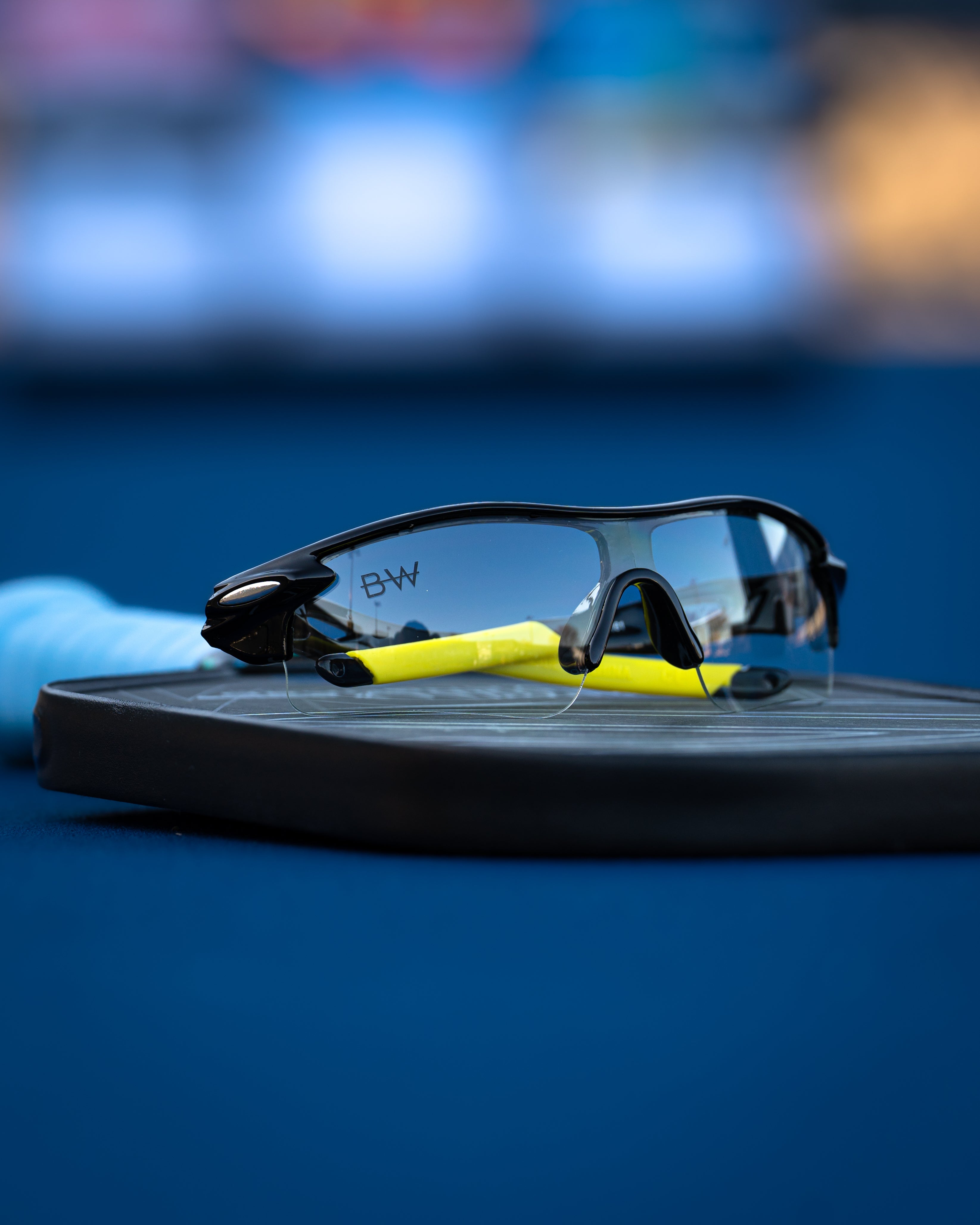
The Science Behind Prescription Sports Lenses
Share
The Science Behind Prescription Sports Lenses: A 2026 Guide to RX Sports Vision
Prescription sports lenses sit at the intersection of optics, refractive correction, lens materials, frame design, and athletic vision. For athletes who require corrective lenses, RX sports eyewear provides prescribed correction in a setup intended for active use—but understanding the science means separating what prescription lenses actually do from broader claims about sports performance.
RX lenses do not automatically make an athlete react faster, improve depth perception, increase contrast sensitivity, or create better hand-eye coordination. Their primary optical role is to correct refractive error according to the wearer's prescription. The athlete then uses that corrected visual information alongside anticipation, decision-making, technique, coordination, and movement.
This guide breaks down the science behind prescription sports lenses, including refractive correction, SPH, CYL and Axis, high-index lens materials, impact resistance, non-polarized lenses, dynamic vision, depth perception, and the relationship between corrected vision and sports performance.
Prescription Sports Lens Quick Access
What Is the Science Behind Prescription Sports Lenses?
Prescription lenses alter the path of light entering the eye according to the corrective power prescribed for the wearer. Different refractive errors require different lens powers and, when astigmatism is present, additional cylinder power and orientation.
In sports eyewear, that optical correction is incorporated into a physical frame and lens configuration intended for active use.
| Part of RX Sports Eyewear | Scientific / Practical Role |
|---|---|
| SPH | Provides spherical corrective power when prescribed |
| CYL | Provides cylinder correction for astigmatism when prescribed |
| Axis | Specifies the orientation associated with cylinder correction |
| High-Index Material | Describes a category of prescription lens material with a higher refractive index |
| Impact Resistance | Describes resistance of the lens material to impact; it does not automatically establish shatterproof construction or certification |
| Non-Polarized Lens | Means a polarization filter is not added |
| Sports Frame | Provides the physical structure holding the prescription lenses during active use |
How Do Prescription Lenses Correct Vision?
To understand sports RX lenses, start with basic optics. Light entering the eye must be focused appropriately for clear retinal imagery. A refractive error means the eye's optical system requires corrective power to appropriately address that error.
Prescription lenses change how incoming light is refracted before it enters the eye. The required correction varies by person and can differ between the right and left eyes.
This is why prescription sports eyewear is fundamentally different from simply choosing a non-RX sports lens: the prescription itself contains individualized optical information.
What Refractive Errors Can an Eyeglass Prescription Address?
An eyeglass prescription can contain correction associated with common refractive conditions such as myopia, hyperopia, and astigmatism. The exact values required are individual to the wearer.
| Term | General Meaning | How It Appears in an RX |
|---|---|---|
| Myopia | Nearsighted refractive error | Typically associated with minus spherical power |
| Hyperopia | Farsighted refractive error | Typically associated with plus spherical power |
| Astigmatism | Refractive error requiring directional correction when prescribed | Typically represented through CYL and Axis |
| Additional Near Correction | Additional power prescribed for near viewing when required | May appear as ADD |
Reading these fields helps explain an existing prescription. It does not determine what prescription an athlete should have.
SPH: The Science of Spherical Prescription Power
SPH stands for sphere. It represents spherical corrective power and is measured in diopters.
A minus sign is generally associated with correction for myopia, while a plus sign is generally associated with correction for hyperopia.
For example, fictional prescription values might look like:
- OD SPH: -2.00
- OS SPH: -1.75
The numbers themselves are prescription values—not measurements of athletic ability. A stronger or weaker SPH does not tell you whether someone has better reaction time, anticipation, coordination, or sports skill.
CYL and Axis: Understanding Astigmatism Correction
When astigmatism correction is prescribed, CYL and Axis work together.
CYL represents cylinder power. Axis describes the orientation associated with that cylinder correction and is expressed from 1 to 180 degrees.
Consider this fictional example:
| Eye | SPH | CYL | Axis |
|---|---|---|---|
| OD | -2.00 | -0.75 | 175 |
| OS | -1.75 | -0.50 | 010 |
A higher Axis number does not mean more severe astigmatism. Axis specifies orientation; CYL represents the cylinder power.
These values need to be copied accurately when ordering prescription eyewear. Do not guess, round, or independently alter them.
Why Are the Right and Left Eyes Listed Separately?
Eyeglass prescriptions typically distinguish between:
- OD: right eye
- OS: left eye
- OU: both eyes, when the notation is used
The two eyes do not necessarily require identical correction. That is one reason prescription eyewear is individualized rather than simply being categorized as “weak,” “medium,” or “strong.”
For athletes ordering RX sports glasses online, accidentally switching OD and OS values can materially change the information being submitted. A clear prescription image helps reduce the need to manually interpret unclear numbers.
What Is a High-Index Prescription Lens?
Refractive index describes how strongly a lens material refracts light relative to another medium. High-index lens materials have a higher refractive index than lower-index alternatives, allowing a required optical power to be produced differently in the finished lens.
Blinded Wear includes high-index prescription lenses at no additional cost with RX eyewear.
However, high-index is an optical material category—not a sports-performance technology.
| High-Index Can Describe... | High-Index Does Not Automatically Mean... |
|---|---|
| A prescription lens material with a higher refractive index | Faster reaction time |
| Part of the finished RX lens design | Better depth perception |
| A lens-material choice relevant to prescription eyewear | Better ball tracking |
| A factor that can influence finished lens characteristics | Better contrast sensitivity |
| Included with Blinded Wear RX eyewear | A guaranteed athletic advantage |
Does the Exact High-Index Number Matter?
Prescription lens materials can have different refractive indices, which is why numbers such as 1.60, 1.67, or other index values may appear when researching eyeglass lenses.
However, an exact numerical index should only be attributed to a product when that specification is verified for the current configuration.
For Blinded Wear, the supported statement is:
High-index prescription lenses are included at no additional cost with RX eyewear.
Do not automatically state that every RX product uses 1.67, 1.61, or another exact index unless that exact specification has been confirmed.
Do High-Index Lenses Always Mean Thin Prescription Glasses?
High-index materials can influence the physical characteristics of a finished prescription lens, but the final result is not determined by refractive index alone.
Finished lens characteristics can also depend on factors such as:
- Prescription power
- Astigmatism correction
- Lens dimensions
- Frame selection
- Lens geometry
- Other details of the finished configuration
That is why statements such as “high-index always produces ultra-thin sports lenses” are too absolute. The finished result depends on the complete prescription and eyewear setup.
The Science of Impact-Resistant Sports Lenses
Sports eyewear is used in environments involving movement and physical activity, making lens material an important consideration. Blinded Wear sports eyewear uses impact-resistant lenses.
Impact resistance describes the lens material's ability to resist impact relative to less impact-resistant alternatives. But the terminology should remain precise.
Impact-resistant does not automatically mean:
- Shatterproof
- Unbreakable
- Indestructible
- Certified to a specific protective-eyewear standard
- Suitable for every possible sports impact
Lens impact resistance and formal sports-protection requirements are related safety considerations, but they are not interchangeable claims. If your sport requires a particular protective standard, verify the exact requirement and product certification separately.
What Does Non-Polarized Actually Mean?
Blinded Wear sports eyewear uses non-polarized lenses. Scientifically, the important distinction is straightforward: a polarization filter is not added.
Some court players prefer non-polarized eyewear. However, the absence of a polarization filter should not automatically be translated into claims about better depth perception or athletic performance.
| Supported Description | Unsupported Automatic Conclusion |
|---|---|
| No polarization filter is added | Depth perception automatically improves |
| Some court players prefer non-polarized eyewear | Reaction time becomes faster |
| Polarization is separate from prescription power | Ball tracking automatically improves |
| It is one characteristic to consider when selecting eyewear | Spin recognition automatically improves |
The Science of Depth Perception in Sports
Depth perception is the ability to interpret spatial relationships and three-dimensional structure from visual information. It uses multiple cues rather than depending on one lens characteristic.
These cues can include both binocular information from the relationship between the two eyes and monocular information that can be interpreted from a single viewpoint.
In pickleball, spatial information may be relevant when judging:
- Ball trajectory
- Distance to the net
- Opponent position
- Partner position
- Court spacing
- Expected bounce location
Prescription correction may be part of an individual's overall visual system when correction is required, but RX status alone does not establish an independent improvement in depth perception.
Explore the topic in detail in Depth Perception Science for Pickleball →.
What Is Dynamic Visual Acuity?
Dynamic visual acuity generally refers to resolving visual detail when the observer, target, or both are moving. That makes it relevant to discussions of sports vision, where athletes rarely interact with completely stationary scenes.
However, the existence of dynamic visual acuity as a visual function does not mean that every prescription sports lens independently enhances it.
Keep the distinction clear:
- Dynamic visual acuity is a visual ability.
- Prescription lenses provide prescribed optical correction.
- A sports frame holds the finished lenses during activity.
- An improvement in a specific sports-vision ability should not be assumed from RX status alone.
What Is Contrast Sensitivity?
Contrast sensitivity concerns the ability to distinguish differences between an object and its background under varying contrast conditions. It is different from standard high-contrast visual-acuity testing.
Because contrast is relevant to visual perception, it frequently appears in sports-eyewear marketing. But that does not mean every tinted, clear, high-index, or prescription lens improves contrast sensitivity.
If a sports lens is marketed as enhancing contrast, ask:
- What specific lens technology produces the claimed effect?
- Is the claim supported for the exact lens?
- Is the effect being attributed merely to tint color?
- Does the claim apply to the actual configuration being purchased?
Prescription correction and contrast enhancement are separate claims and should be evaluated separately.
Do Prescription Sports Lenses Improve Reaction Time?
Reaction time in sports is a multi-stage process. A simplified model can look like:
Visual information → recognition → interpretation / anticipation → decision → motor response → physical execution.
If an athlete requires prescription correction, RX lenses address the corrective component of visual input. That is scientifically different from saying the lens independently makes the entire reaction process faster.
Reaction performance can also depend on:
- Attention
- Anticipation
- Experience
- Decision-making
- Sport-specific technique
- Coordination
- Physical readiness
For the pickleball-specific breakdown, read RX Lenses & Reaction Time in Pickleball →.
Do RX Lenses Improve Hand-Eye Coordination?
Hand-eye coordination describes a much broader relationship between visual information and physical movement. Prescription correction can be part of an athlete's visual setup, but RX lenses should not automatically be described as improving coordination itself.
During a pickleball volley, for example, successful execution can involve:
- Receiving visual information
- Recognizing the developing shot
- Anticipating trajectory
- Selecting a response
- Positioning the body and paddle
- Timing the movement
- Executing the shot
The prescription belongs to the visual-correction portion of that sequence. Practice and athletic skill influence the rest.
Do Prescription Sports Lenses Improve Ball Tracking?
“Ball tracking” is often used as if it were a single lens feature, but following a moving object involves a combination of visual information, eye movements, attention, prediction, and experience.
If an athlete requires correction, RX lenses provide prescribed optical correction while the athlete performs these tasks. That does not mean the prescription lens itself is a dedicated tracking technology.
Likewise, do not automatically attribute improved ball tracking to:
- High-index material
- Non-polarized lenses
- Clear lenses
- Grey tint
- A lightweight frame
- Prescription status by itself
Do Lightweight or High-Index RX Lenses Reduce Eye Fatigue?
Be careful with claims that a specific lens material automatically “reduces eye fatigue.” Frame weight, prescription correction, visual demands, individual comfort, session duration, and playing environment are different variables.
Blinded Wear offers lightweight sports-frame options and includes high-index prescription lenses with RX eyewear. Those are useful product characteristics, but they should not be converted into a guaranteed reduction in visual fatigue.
If an athlete experiences persistent headaches, unusual visual discomfort, or other vision concerns, it is better to address the underlying issue than assume a particular sports frame or lens index will automatically resolve it.
Clear vs. Tinted Prescription Sports Lenses: What Changes?
The most defensible distinction begins with the actual lens configuration rather than a performance promise.
| Lens Configuration | Basic Distinction | Do Not Automatically Claim |
|---|---|---|
| Clear RX | Does not add a dark sunglass tint | Improved tracking, reaction time, contrast, or depth perception |
| Tinted RX Sunglasses | Adds the characteristics of the selected sunglass tint/configuration | Automatic athletic-performance improvement |
| Transition / Photochromic RX | Changes according to the characteristics of the verified photochromic configuration | Automatic improvement in sports vision |
Match the configuration to the environment and your individual needs while verifying what the exact product actually offers.
Indoor vs. Outdoor Prescription Sports Lenses
Your refractive prescription does not automatically become different because you move from an indoor court to an outdoor court. What may change is the lens configuration you prefer for the environment.
For example:
- Indoor / lower-light use: a non-dark RX configuration can be a logical option to compare.
- Outdoor use: an RX sunglass configuration may be appropriate to compare.
- Changing environments: separate pairs or a verified transition/photochromic configuration may be worth considering.
Clear lenses should not be described as creating more available light, and tint should not automatically be described as enhancing athletic performance.
The Lens Is Only One Part of Prescription Sports Eyewear
Optical correction may happen through the prescription lens, but the finished sports-eyewear system involves more than the lens.
| Component | What to Evaluate |
|---|---|
| Prescription | Corrective requirements for the wearer |
| Lens Material | Verified material characteristics and prescription suitability |
| Lens Configuration | Clear, sunglass, transition/photochromic, or another verified option |
| Frame | Dimensions, design, prescription compatibility |
| Individual Fit | How the finished frame works for the specific wearer |
| Sport | Movement patterns and any activity-specific requirements |
| Environment | Indoor, outdoor, lower-light, or changing conditions |
Blinded Wear Prescription Sports Glasses to Compare
There is no scientifically universal “best” RX sports frame. Instead, compare prescription compatibility, environment, available dimensions, individual fit, and verified product characteristics.
| RX Model | Category | What to Evaluate |
|---|---|---|
| Frost RX | Prescription pickleball eyewear | Prescription, configuration, dimensions, individual fit |
| Lava Rock RX | Lightweight RX option | Prescription, dimensions, configuration, fit |
| Phantom II RX | RX sports eyewear | Prescription requirements, dimensions, current configuration |
| Ocean Wave RX | Prescription pickleball eyewear | Prescription, configuration, dimensions, individual fit |
| Havana Melt RX | RX sunglass option | Outdoor environment, prescription, dimensions, configuration |
| Silver Line RX | Prescription pickleball sunglasses | Outdoor use, prescription, current configuration, fit |
| Gray Hound RX | Prescription sunglasses | Environment, prescription, dimensions, configuration |
Browse the complete Prescription Eyewear Collection →.
Science vs. Marketing: Prescription Sports Lens Claim Decoder
Scientific terminology can make an eyewear claim sound stronger than the underlying evidence. When comparing sports lenses, identify exactly what is being claimed.
| Claim | Question to Ask |
|---|---|
| “Scientifically engineered for faster reactions” | What evidence shows that the lens itself changes reaction speed? |
| “Preserves depth perception” | What exact mechanism and evidence support this claim? |
| “Enhances dynamic visual acuity” | Was dynamic visual acuity actually measured for the exact lens? |
| “Improves contrast sensitivity” | What specific lens technology supports the effect? |
| “Reduces eye fatigue” | What evidence separates the lens effect from prescription, fit, environment, and individual differences? |
| “High-index performance lens” | Which benefits come from refractive index, and which are unrelated performance claims? |
| “Shatterproof sports lens” | Is shatterproof construction actually supported, or is impact resistance being overstated? |
Prescription Sports Lens Science FAQ
How do prescription sports lenses work?
Prescription lenses refract incoming light according to the corrective power prescribed for the wearer. In sports eyewear, that correction is incorporated into a compatible active-use frame and lens configuration.
What is the difference between SPH, CYL, and Axis?
SPH represents spherical corrective power. CYL represents cylinder correction when astigmatism correction is prescribed, and Axis specifies the orientation associated with that cylinder correction.
What does high-index mean in prescription sports glasses?
High-index refers to prescription lens materials with a higher refractive index. Blinded Wear includes high-index prescription lenses at no additional cost with RX eyewear.
Does Blinded Wear use 1.67 high-index lenses?
Blinded Wear includes high-index prescription lenses with RX eyewear. An exact index such as 1.67 should not be assumed unless that specification is verified for the current configuration.
Are high-index lenses always thinner?
Refractive index can influence finished lens characteristics, but final thickness also depends on prescription power, lens dimensions, frame choice, lens geometry, and other configuration details.
Do prescription sports lenses improve reaction time?
Prescription correction addresses the wearer's corrective needs. Reaction also involves recognition, anticipation, decision-making, motor response, and physical execution, so an independent reaction-time improvement should not be assumed.
Do non-polarized lenses improve depth perception?
Non-polarized means a polarization filter is not added. That characteristic alone does not establish improved depth perception.
Do RX lenses improve dynamic visual acuity?
Dynamic visual acuity is a visual ability involving moving targets, observers, or both. Prescription lenses provide prescribed correction, but RX status alone does not establish an independent enhancement in dynamic visual acuity.
Do prescription sports lenses improve contrast sensitivity?
Prescription correction and contrast enhancement are separate claims. Improved contrast sensitivity should not be assumed unless supported for the exact lens technology or configuration.
Are Blinded Wear sports lenses impact-resistant?
Yes. Blinded Wear sports eyewear uses impact-resistant lenses. Impact resistance should not automatically be interpreted as shatterproof construction or certification to a particular protective standard.
Are progressive prescription sports lenses available?
Progressive or other multifocal compatibility should be verified for the exact product and prescription rather than assumed across every RX model.
Can prescription sports glasses be used for multiple sports?
Potentially, but each sport should be evaluated independently. Prescription compatibility, individual fit, environment, movement, and any activity-specific protective requirements can differ.
How do I submit my prescription to Blinded Wear?
Have a clear photo or picture of your eyeglass prescription ready to upload before purchasing RX eyewear.
Prescription Correction vs. Sports Performance: What the Science Actually Separates
One of the most important distinctions in prescription sports eyewear is the difference between correcting refractive error and improving athletic performance.
A prescription lens has an optical job: provide the corrective power prescribed for the wearer. Athletic performance is the result of a much larger system involving visual information, attention, anticipation, decisions, movement, technique, coordination, and experience.
| Function | Primary Role | Should RX Lenses Alone Get Credit? |
|---|---|---|
| Refractive Correction | Corrects the wearer's refractive error according to the prescription | Yes—this is the fundamental purpose of the prescription lens |
| Ball Recognition | Involves receiving and interpreting visual information | No automatic independent improvement should be claimed |
| Depth Perception | Uses multiple visual cues to interpret spatial relationships | No automatic improvement should be claimed from RX or non-polarized status alone |
| Reaction Time | Combines perception, processing, decision, and physical response | No automatic improvement should be claimed |
| Anticipation | Uses patterns, experience, positioning, and available information | No—this is not created by a prescription lens |
| Technique | Controls how the athlete physically executes a response | No—this is developed through practice and instruction |
This distinction does not make prescription correction unimportant. It makes the explanation more precise: athletes who require correction can use RX sports eyewear to address that visual requirement while developing the other components of performance through practice and experience.
The Visual-to-Motor Chain in Fast Sports
Pickleball, tennis, basketball, and other fast sports require athletes to respond to rapidly changing information. A useful simplified model is:
Light and visual information → corrected optical input when needed → recognition → interpretation → anticipation → decision → motor response → physical execution.
Prescription sports lenses primarily affect the corrective optical portion of this sequence for athletes who require an eyeglass prescription.
Consider a fast pickleball volley:
- The ball and surrounding court provide visual information.
- The athlete's optical system receives that information with any required prescription correction.
- The athlete recognizes the developing shot.
- Previous experience may help anticipate direction or pace.
- The athlete chooses a response.
- The nervous and muscular systems initiate movement.
- The paddle is positioned and the shot is executed.
Calling the entire sequence “reaction time” can hide how many separate processes are involved. This is also why one lens characteristic should not be credited with improving every stage.
Static Vision vs. Dynamic Sports Vision
Reading stationary letters during a vision assessment and responding to a moving ball during sport are different visual tasks.
| Visual Situation | Example | What Changes? |
|---|---|---|
| Static Viewing | Viewing a stationary target while relatively still | Target and observer have limited movement |
| Moving Target | Watching a pickleball travel across the court | Target position changes continuously |
| Moving Observer | Watching the court while running or changing direction | The athlete's own position changes |
| Dynamic Sport | Player and ball moving simultaneously | Multiple spatial relationships change at once |
Prescription correction can remain relevant across these situations for athletes who require it, but dynamic sports performance cannot be reduced to a standard prescription value.
Why Pickleball Is a Useful Example of Sports Vision Science
Pickleball combines short court distances with changing ball speeds, player movement, partner positioning, and rapid exchanges. The visual scene can change substantially between a serve, return, third shot, dink exchange, speed-up, and volley.
During one point, a player may need to process information about:
- The ball's current location
- Ball direction and trajectory
- Opponent paddle preparation
- Opponent court position
- Partner position
- Available court space
- Net location
- Boundary lines
- Previous shot patterns
If that player requires prescription correction, RX eyewear provides that correction while this information is being processed. The player's ability to interpret and respond to the information still depends on factors beyond the lenses.
Why Anticipation Can Look Like Faster Reaction Time
Experienced athletes do not always wait for an event to fully unfold before beginning a response. They can use available information and previous experience to anticipate what may happen next.
In pickleball, possible anticipatory information includes:
- Paddle preparation
- Body orientation
- Contact position
- Court positioning
- Previous shot selection
- Patterns established earlier in the match
This matters when evaluating claims that eyewear makes an athlete “react faster.” A player may appear faster because of better recognition or anticipation rather than because the physical reaction process itself changed.
Prescription correction can support the wearer's corrective needs while this happens, but anticipation is developed through sport-specific experience and learning.
Binocular and Monocular Depth Cues in Sports
Depth perception is more complex than a single “depth” signal. The visual system can use multiple types of information when interpreting distance and spatial relationships.
Binocular Information
Binocular cues involve information created by using both eyes together. Because the eyes view the world from slightly different positions, the visual system can use differences between those views as part of spatial perception.
Monocular Information
Spatial relationships can also be interpreted from information available to one eye, including contextual and motion-related cues.
In sports, these sources of information operate within a constantly changing visual scene. That is why claims that a single lens feature “preserves” or “improves” depth perception should be treated carefully.
For a deeper explanation, visit Depth Perception Science for Pickleball →.
Why Prescription Accuracy Matters More Than Performance Buzzwords
When buying RX sports eyewear, the prescription information is more fundamental than claims about “enhanced vision” or a “competitive edge.”
Before ordering, make sure the prescription image clearly shows the information needed for the order. Depending on the prescription, this can include:
- OD and OS
- SPH
- CYL when prescribed
- Axis when prescribed
- ADD when applicable
- Other relevant prescription information
Plus and minus signs matter. Right-eye and left-eye values matter. CYL and Axis should not be independently changed or guessed.
If you want a field-by-field explanation, read How to Read Your Prescription for Sports Eyewear →.
Why the Same Prescription Does Not Work Identically With Every Frame
A prescription describes corrective requirements; it does not automatically establish that every frame is suitable for that prescription.
Prescription-to-frame compatibility can depend on the complete eyewear configuration. This becomes especially important when comparing different frame shapes and dimensions or when the prescription has specialized requirements.
Before selecting a frame, consider:
- Whether the exact RX product can accommodate the prescription
- Available frame dimensions
- Individual physical fit
- Available lens configurations
- The sport in which the eyewear will be used
- The primary playing environment
For this reason, “prescription compatible” should not be interpreted as “compatible with every possible prescription.”
The Physics and Practical Importance of Frame Fit
The lens provides optical correction, but the frame determines the physical position of the finished eyewear on the wearer. That makes frame selection another important part of the complete RX sports setup.
When evaluating a sports frame, consider available measurements such as:
- Lens width
- Bridge width
- Temple length
- Overall dimensions when provided
Comparing these measurements with glasses that already fit you well can provide a useful reference.
Then test the finished eyewear during realistic movement. Prescription compatibility does not automatically guarantee a good physical fit, and a lightweight frame should not automatically be described as secure or non-slip.
See the RX Pickleball Frame Fit Guide → for a more detailed fit framework.
Why Playing Environment Matters to Lens Selection
The athlete's prescription addresses refractive correction, while the selected lens configuration can also be evaluated according to the environment in which the eyewear will be used.
| Environment | Configuration to Compare | Important Limitation |
|---|---|---|
| Indoor Court | Non-dark or clear RX configuration when available | Clear does not mean additional light is created |
| Outdoor Court | RX sunglass configuration | Tint alone does not establish improved sports performance |
| Changing Conditions | Separate appropriate pairs or verified transition/photochromic RX | Availability and compatibility must be confirmed |
| Multiple Sports | Configuration evaluated for each activity | One sports designation does not guarantee universal suitability |
How Do Transition or Photochromic RX Lenses Fit Into Sports Eyewear?
Photochromic lenses are designed to change their tint characteristics in response to environmental conditions according to the technology used in the specific lens.
For athletes who move between different environments, a verified transition/photochromic RX option may be worth comparing when available.
However, photochromic technology should not automatically be described as:
- Improving reaction time
- Improving depth perception
- Improving ball tracking
- Enhancing athletic ability
- Replacing every possible indoor and outdoor lens configuration
The practical question is whether the exact available configuration matches your prescription and intended use.
Learn more in Transition RX Lenses for Travel & Training →.
What About Progressive or Multifocal Sports Prescriptions?
Some prescriptions include an ADD value or other requirements associated with multifocal correction. That does not mean every sports frame automatically supports every multifocal configuration.
If you require progressive, bifocal, or another specialized prescription setup:
- Review your current prescription.
- Identify the exact RX frame you are considering.
- Verify that your required configuration is available.
- Do not assume compatibility from the word “RX” alone.
This is particularly important when online content makes broad statements such as “all models are available in progressive.” Exact compatibility should be confirmed rather than generalized.
Prescription Sports Glasses vs. Everyday Prescription Glasses
Both categories can provide corrective vision. The distinction is better understood by looking at the complete eyewear rather than assuming the prescription itself is fundamentally different because one pair is marketed for sports.
| Consideration | Everyday RX Eyewear | RX Sports Eyewear |
|---|---|---|
| Prescription Correction | Provides prescribed correction | Provides prescribed correction when compatible |
| Primary Use | General daily wear | Active / sports use |
| Frame Selection | Often chosen around everyday needs | Can be chosen around activity, environment, dimensions, and movement |
| Movement Evaluation | May not have been selected specifically for sport | Can be deliberately evaluated during athletic movement |
| Lens Configuration | Depends on the everyday eyewear | Can be compared according to available sports-use configurations |
| Impact Resistance | Depends on the exact lens | Blinded Wear sports eyewear uses impact-resistant lenses |
Dedicated prescription sports eyewear can therefore be useful when an athlete wants corrective eyewear selected specifically around active use.
Prescription Sports Glasses vs. Contact Lenses
Athletes who require correction may use different strategies depending on their individual needs. Some wear prescription sports glasses, while others use contact lenses with non-prescription sports eyewear.
These approaches should not be framed as having a universal winner.
| Setup | How Correction Is Provided | Additional Eyewear Decision |
|---|---|---|
| RX Sports Glasses | Prescription correction is incorporated into the eyewear | Choose compatible frame and lens configuration |
| Contacts + Non-RX Sports Eyewear | Corrective power comes from the contact lenses | Sports eyewear itself does not need to provide the prescription |
The appropriate corrective strategy depends on the individual rather than a universal rule for all athletes.
Does the Science Change From Pickleball to Tennis, Basketball, or Running?
The basic optical principles behind an eyeglass prescription do not become entirely different because the athlete changes sports. What does change is the visual environment, movement pattern, equipment, and activity-specific requirements.
| Sport | Example Visual / Movement Context | RX Question to Ask |
|---|---|---|
| Pickleball | Short-court exchanges, volleys, dinks, drives, lobs | Does the complete RX setup work for my prescription, environment, and court movement? |
| Tennis | Larger court, changing ball trajectories, lateral movement | Does the eyewear suit my prescription and tennis use? |
| Basketball | Player movement, changing directions, court awareness | Does the eyewear meet my individual and sport-specific requirements? |
| Running | Forward movement and changing outdoor environments | Does the configuration suit my prescription, fit, and environment? |
Do not assume that every RX model is automatically appropriate for every sport. Evaluate the requirements of each activity independently.
For broader multi-sport selection, read the Multi-Sport Prescription Glasses Guide →.
Why Athletes Should Practice in New RX Sports Glasses
Even when the prescription information is correct, the finished pair is a complete piece of equipment that includes lenses, frame dimensions, physical fit, and the selected configuration.
A practical progression is:
- Controlled wear: become familiar with the finished pair.
- Normal movement: introduce ordinary head and body movement.
- Sport-specific drills: use the eyewear during movements relevant to your activity.
- Realistic pace: increase intensity toward normal play.
- Full practice: evaluate the setup over a normal session.
- Competition: use the pair after you have already become familiar with it.
This is not a claim that an adaptation period is universally required for every prescription. It is simply a practical way to evaluate new sports equipment before relying on it during an important event.
The Science Is Optical, but the Backup Plan Is Practical
For athletes who cannot comfortably compete without prescription correction, losing or damaging a primary RX pair can create an immediate equipment problem regardless of how well the athlete has trained.
Backup correction may therefore make sense for:
- Tournament players
- Frequent competitors
- Athletes traveling for events
- Players competing across multiple days
- Anyone heavily dependent on their prescription during play
A backup pair does not need to provide a performance advantage to be useful—it simply provides another corrective option if the primary pair becomes unavailable.
Impact Resistance, Damage, and Lifetime Replacement Support
Impact-resistant lenses are still physical products and should not be described as impossible to damage.
Blinded Wear offers 50% lifetime replacement support if glasses break, subject to current policy terms.
This is different from saying every RX pair has an unlimited free lifetime warranty. The distinction matters when comparing the long-term value of sports eyewear.
A Science-Based Framework for Choosing Prescription Sports Lenses
Rather than starting with a promise such as “faster reactions” or “better tracking,” work through the factors that can actually be evaluated.
-
Prescription requirements
Start with the corrective information prescribed for you.
-
Prescription compatibility
Verify that the exact RX frame can accommodate your requirements.
-
Sport
Identify the activity in which you will use the eyewear.
-
Environment
Determine whether your primary use is indoors, outdoors, lower-light, or changing conditions.
-
Lens material and configuration
Evaluate verified characteristics rather than assumed performance benefits.
-
Frame dimensions
Compare measurements with eyewear that already fits you when possible.
-
Individual fit
Evaluate the finished frame during realistic movement.
-
Practice familiarity
Become familiar with the complete setup before important competition.
10 Science and Buying Mistakes to Avoid
-
Assuming RX lenses automatically improve reaction time.
Reaction involves several perceptual, cognitive, and physical stages.
-
Assuming non-polarized means better depth perception.
It means a polarization filter is not added.
-
Assuming high-index means better sports vision.
High-index describes a lens-material property.
-
Assuming every RX lens is exactly 1.67.
Verify exact index specifications before making a numerical claim.
-
Calling impact-resistant lenses shatterproof.
Those claims are not interchangeable.
-
Assuming clear lenses improve ball tracking.
Clear describes the absence of a dark sunglass tint, not a tracking technology.
-
Assuming tint automatically enhances contrast.
Contrast-enhancement claims require support for the exact lens technology.
-
Assuming every RX frame supports every prescription.
Compatibility should be verified for the exact configuration.
-
Ignoring physical frame fit.
Correct optical power does not automatically mean the frame fits the wearer appropriately.
-
Trying new equipment for the first time during competition.
Practice is a better environment for evaluating the complete finished setup.
More Questions About the Science of RX Sports Eyewear
Are sports prescriptions different from normal eyeglass prescriptions?
The fundamental prescription values describe corrective requirements for the wearer. The complete sports-eyewear setup can differ because the frame, lens material, configuration, fit, and intended activity are selected around active use.
Does a stronger prescription mean an athlete has worse sports vision?
A prescription value describes corrective power, not overall athletic ability. Sports performance includes many visual, cognitive, technical, and physical factors.
Why are prescription lenses measured in diopters?
Diopters are the unit used to express optical power in an eyeglass prescription.
Does Axis measure how severe astigmatism is?
No. Axis specifies the orientation associated with cylinder correction. It should not be interpreted as an astigmatism severity score.
Can the right and left eyes have different prescriptions?
Yes. OD and OS are listed separately because each eye can require different corrective values.
Are high-index lenses a sports technology?
High-index describes a category of prescription lens material. It should not automatically be described as a technology that improves athletic performance.
Does lightweight eyewear reduce eye strain?
Lightweight construction can affect the physical characteristics of eyewear, but it should not automatically be claimed to reduce eye strain or visual fatigue.
Do clear RX lenses improve indoor sports vision?
Clear lenses do not add a dark sunglass tint, which can make them a configuration to compare for indoor or lower-light use. They should not automatically be described as improving contrast, tracking, reaction time, or depth perception.
Are tinted RX lenses scientifically better outdoors?
Tinted RX configurations can be selected for outdoor use, but tint alone does not establish superior athletic performance.
Can one RX pair work indoors and outdoors?
Potentially. Some athletes use one setup, while others compare separate configurations or verified transition/photochromic options when available.
Why does prescription compatibility matter?
Not every frame or lens configuration should be assumed to accommodate every prescription. Compatibility is part of selecting the complete RX setup.
Can prescription glasses improve sports confidence?
Prescription eyewear should not automatically be described as creating confidence. Familiarity with equipment and preparation can be part of an athlete's routine, while confidence itself depends on broader individual factors.
Should I use my RX sports glasses before a tournament?
Practicing in the finished pair allows you to evaluate the prescription experience, frame, configuration, and individual fit before relying on it during competition.
How do I order Blinded Wear RX sports eyewear?
Choose a current RX model, review the available configuration and dimensions, verify prescription compatibility, and have a clear photo or picture of your eyeglass prescription ready to upload before purchasing.
Prescription Sports Lens Science Checklist
Before buying RX sports eyewear, use this checklist to separate optical facts, product characteristics, and performance claims.
- ☐ I have the appropriate eyeglass prescription.
- ☐ I understand that OD and OS identify the right and left eyes.
- ☐ I know that SPH represents spherical corrective power.
- ☐ I know that CYL and Axis work together when astigmatism correction is prescribed.
- ☐ I am not changing or guessing prescription values myself.
- ☐ I have verified that the exact frame can accommodate my prescription requirements.
- ☐ I understand that high-index describes a lens-material category rather than a sports-performance technology.
- ☐ I am not assuming an exact high-index number such as 1.61 or 1.67 unless it is verified.
- ☐ I understand that impact-resistant does not automatically mean shatterproof or certified protective eyewear.
- ☐ I understand that non-polarized means a polarization filter is not added.
- ☐ I am not assuming non-polarized lenses improve depth perception, tracking, or reaction time.
- ☐ I am not assuming clear or tinted lenses automatically enhance contrast.
- ☐ I have considered whether my primary use is indoor, outdoor, or mixed.
- ☐ I have compared available frame dimensions with eyewear that already fits me when possible.
- ☐ I have verified specialized prescription requirements instead of assuming compatibility.
- ☐ I plan to evaluate the finished pair during realistic practice.
How to Evaluate the Evidence Behind a Sports Lens Claim
Not every statement that uses scientific terminology has the same evidentiary strength. When researching prescription sports lenses, separate a verified physical characteristic from an interpretation of what that characteristic supposedly does for an athlete.
| Type of Statement | Example | How to Evaluate It |
|---|---|---|
| Prescription Fact | “CYL represents cylinder correction when prescribed.” | Established optical terminology |
| Product Characteristic | “These lenses are impact-resistant.” | Verify that the characteristic applies to the exact product |
| Configuration | “This model is available as an RX sunglass.” | Verify the current product configuration |
| Performance Claim | “This lens makes you react faster.” | Requires evidence supporting that specific performance effect |
| Universal Claim | “Non-polarized lenses improve depth perception for every athlete.” | Be especially cautious of broad conclusions applied to all wearers |
This distinction helps athletes compare prescription eyewear without mistaking technical vocabulary for proof of a competitive advantage.
Correlation vs. Causation in Sports-Vision Claims
Another useful scientific principle is the difference between correlation and causation.
Suppose athletes with appropriate vision correction perform well in a particular task. That observation alone does not establish that a specific lens material, tint, polarization status, or frame caused the performance result.
Many variables can exist at the same time:
- Prescription needs
- Experience level
- Practice history
- Age
- Attention
- Anticipation
- Physical ability
- Technique
- Playing environment
- Familiarity with equipment
A scientifically responsible sports-eyewear claim should therefore identify what was actually measured and avoid assigning an athletic result to a lens characteristic without supporting evidence.
Why Individual Differences Matter in Prescription Sports Vision
Sports vision is inherently individual. Two players can compete on the same court, use the same frame model, and still have very different visual and prescription requirements.
Differences can include:
- Right-eye prescription
- Left-eye prescription
- Astigmatism correction
- Multifocal requirements
- Frame dimensions that fit appropriately
- Preferred lens configuration
- Indoor versus outdoor playing frequency
- Experience with prescription sports eyewear
This is why prescription sports glasses should be selected around the individual rather than a universal claim that one lens configuration is scientifically best for every athlete.
How to Evaluate Finished RX Sports Glasses
Once your prescription sports eyewear arrives, evaluate the finished product systematically rather than judging it from appearance alone.
-
Confirm the order.
Check that the frame and selected configuration match what you intended to purchase.
-
Become familiar with the prescription experience.
Wear the finished pair in a controlled environment before introducing high-intensity sport movement.
-
Evaluate frame fit at rest.
Consider how the physical eyewear fits your individual face.
-
Add normal movement.
Move your head and body naturally while evaluating the complete setup.
-
Add sport-specific movement.
Introduce lateral movement, directional changes, and other actions relevant to your activity.
-
Practice at realistic intensity.
Use the eyewear during normal drills and play.
-
Evaluate a full session.
Determine how the complete setup works for you over your typical playing duration.
When Should You Reevaluate Prescription Sports Eyewear?
There is no need to invent a universal replacement schedule for every athlete. Instead, reevaluate your RX sports setup when something relevant changes.
Examples include:
- You receive an updated eyeglass prescription.
- Your corrective requirements change.
- Your primary sport changes.
- Your playing environment changes substantially.
- Your current eyewear becomes damaged.
- Your current frame no longer works well for your intended use.
- You begin competing or traveling more frequently.
- You develop a practical need for backup correction.
- You need a different RX configuration than your current pair provides.
This keeps replacement decisions tied to actual vision and equipment needs rather than arbitrary timelines.
Prescription Sports Lens Myths: Science vs. Marketing
Myth: Prescription sports lenses make athletes react faster.
Reality: Prescription lenses provide corrective power. Reaction involves perceptual, cognitive, and physical processes beyond the lens.
Myth: Non-polarized lenses preserve or improve depth perception.
Reality: Non-polarized means a polarization filter is not added. That characteristic alone does not establish improved depth perception.
Myth: High-index lenses create better sports vision.
Reality: High-index describes a lens-material property. It should not automatically be turned into a sports-performance claim.
Myth: A higher refractive index means a better lens for every athlete.
Reality: Lens selection depends on the prescription and complete eyewear configuration, not simply choosing the largest index number.
Myth: Impact-resistant means shatterproof.
Reality: Impact resistance and shatterproof construction are different claims.
Myth: Impact-resistant automatically means certified protective eyewear.
Reality: A particular protective certification should be verified separately.
Myth: Clear RX lenses improve indoor reaction time.
Reality: Clear lenses do not add a dark sunglass tint. That fact does not establish faster reactions.
Myth: Grey or tinted RX lenses automatically improve contrast.
Reality: Tint alone does not establish a measurable contrast-sensitivity improvement.
Myth: Lightweight lenses automatically reduce eye fatigue.
Reality: Lens material, prescription, frame characteristics, individual comfort, environment, and visual demands are separate variables.
Myth: Every RX sports frame can accommodate every prescription.
Reality: Prescription compatibility should be verified for the exact product and configuration.
Myth: Progressive lenses are automatically available in every RX frame.
Reality: Multifocal compatibility should be confirmed rather than assumed.
Myth: Better equipment eliminates the need for anticipation and practice.
Reality: Prescription correction and sport-specific skill development serve different purposes.
2026 Prescription Sports Lens Science FAQ
What is the main purpose of prescription sports lenses?
Their primary optical purpose is to provide the corrective power prescribed for the wearer in a compatible sports-eyewear setup.
What science is involved in prescription sports lenses?
Relevant concepts include refraction, optical power, refractive error, astigmatism correction, lens materials, refractive index, impact resistance, and the broader science of visual perception during movement.
Are prescription sports lenses scientifically proven to improve athletic performance?
Prescription correction should not automatically be treated as proof of improved overall athletic performance. Performance involves visual, cognitive, technical, and physical factors beyond corrective lenses.
Can corrected vision and athletic performance still be related?
An athlete who requires prescription correction uses that corrected visual input while performing. That relationship does not mean a particular lens independently improves reaction time, anticipation, coordination, or technique.
What does refractive index mean?
Refractive index describes how a material refracts light. High-index prescription lens materials have a higher refractive index than lower-index alternatives.
Does Blinded Wear include high-index RX lenses?
Yes. High-index prescription lenses are included at no additional cost with Blinded Wear RX eyewear.
Are Blinded Wear lenses 1.67 high-index?
Do not assume an exact numerical index such as 1.67 unless that specification is verified for the current configuration. The supported statement is that Blinded Wear includes high-index prescription lenses with RX eyewear.
Why are Blinded Wear sports lenses non-polarized?
Blinded Wear sports eyewear uses non-polarized lenses, meaning a polarization filter is not added. Some court players prefer non-polarized eyewear, but the characteristic itself does not establish improved depth perception or reaction time.
Are Blinded Wear RX lenses impact-resistant?
Yes. Blinded Wear sports eyewear uses impact-resistant lenses. Impact resistance does not automatically mean shatterproof construction or certification to a particular protective standard.
Does prescription correction improve depth perception?
Depth perception uses multiple visual cues and depends on the individual's visual system. RX status alone should not be treated as proof of an independent depth-perception improvement.
Does prescription correction improve ball tracking?
Prescription lenses provide corrective power for the wearer. Ball tracking involves visual information, eye movements, attention, prediction, and experience, so an independent tracking improvement should not be assumed from RX status alone.
Does prescription correction improve hand-eye coordination?
Prescription correction and hand-eye coordination are different concepts. Coordination involves the relationship between visual information and physical execution.
What RX lenses should I use for indoor pickleball?
If you require prescription correction indoors, a non-dark RX configuration can be a logical option to compare when available. Verify prescription compatibility, dimensions, individual fit, and the exact product configuration.
What RX lenses should I use for outdoor pickleball?
RX sunglass configurations can be compared for outdoor use according to prescription requirements, available tint, frame dimensions, individual fit, and verified product characteristics.
Can I use transition RX lenses for sports?
A verified transition/photochromic RX configuration may be worth comparing for changing environments when available and compatible with your prescription.
How do I choose prescription sports glasses scientifically?
Start with your prescription, verify frame compatibility, identify your sport and environment, evaluate verified lens characteristics, compare frame dimensions, assess individual fit, and test the finished eyewear during realistic practice.
How do I submit my prescription to Blinded Wear?
Have a clear photo or picture of your eyeglass prescription ready to upload before purchasing RX eyewear.
Continue Learning About Prescription Sports Vision
Key Takeaways: The Science Behind Prescription Sports Lenses
- Prescription lenses work by refracting light according to the corrective power prescribed for the wearer.
- SPH represents spherical corrective power.
- CYL and Axis work together when astigmatism correction is prescribed.
- OD refers to the right eye and OS refers to the left eye.
- Prescription values describe corrective requirements—not athletic ability.
- High-index describes a prescription lens-material category.
- Blinded Wear includes high-index prescription lenses at no additional cost with RX eyewear.
- An exact high-index value such as 1.61 or 1.67 should not be assumed unless verified.
- Finished lens characteristics depend on more than refractive index alone.
- Blinded Wear sports eyewear uses impact-resistant lenses.
- Impact-resistant does not automatically mean shatterproof, indestructible, or certified to a specific protective standard.
- Blinded Wear sports eyewear uses non-polarized lenses.
- Non-polarized means a polarization filter is not added; it does not automatically establish improved depth perception.
- Dynamic visual acuity is a visual ability and should not automatically be attributed to RX lens technology.
- Contrast sensitivity and prescription correction are separate concepts.
- Ball tracking involves more than a lens characteristic.
- Reaction time involves perception, recognition, anticipation, decision-making, motor response, and physical execution.
- Prescription correction should not automatically be described as improving hand-eye coordination.
- Clear RX lenses do not add a dark sunglass tint and can be compared for indoor or lower-light use.
- Tinted RX configurations can be compared for outdoor use without assuming an automatic athletic advantage.
- Prescription compatibility, frame dimensions, and individual fit should all be evaluated separately.
- Progressive or specialized prescription compatibility should be verified for the exact product.
- Practice is a useful environment for evaluating a new finished RX setup before competition.
- Blinded Wear offers 50% lifetime replacement support if glasses break, subject to current policy terms.
Choose RX Sports Eyewear Based on the Science That Matters
The science behind prescription sports lenses starts with optics—not performance buzzwords. If you require vision correction, your RX lenses provide prescribed corrective power while the rest of your sports performance depends on a much broader system of perception, anticipation, decision-making, technique, movement, and experience.
When comparing prescription sports glasses, focus on what can actually be evaluated: your prescription, frame compatibility, lens material, verified lens characteristics, playing environment, frame dimensions, individual fit, and intended sport.
Blinded Wear RX eyewear includes high-index prescription lenses at no additional cost and uses impact-resistant, non-polarized lenses.
Bottom Line: What Does Science Actually Tell Us About RX Sports Lenses?
Prescription sports lenses have a clear and important optical purpose: providing the corrective power required by the individual wearer. Lens materials, refractive index, impact resistance, polarization status, frame compatibility, and physical fit are additional characteristics of the complete eyewear system.
What science does not justify is turning every lens characteristic into an automatic performance advantage. High-index does not inherently mean faster reactions. Non-polarized does not inherently mean better depth perception. Clear lenses do not inherently mean better tracking. Impact-resistant does not mean indestructible.
For pickleball and other fast sports, corrected vision operates alongside recognition, anticipation, positioning, decision-making, coordination, technique, movement, and experience. Understanding those distinctions makes it easier to choose prescription sports eyewear based on real optical needs and verified product characteristics instead of exaggerated claims.