
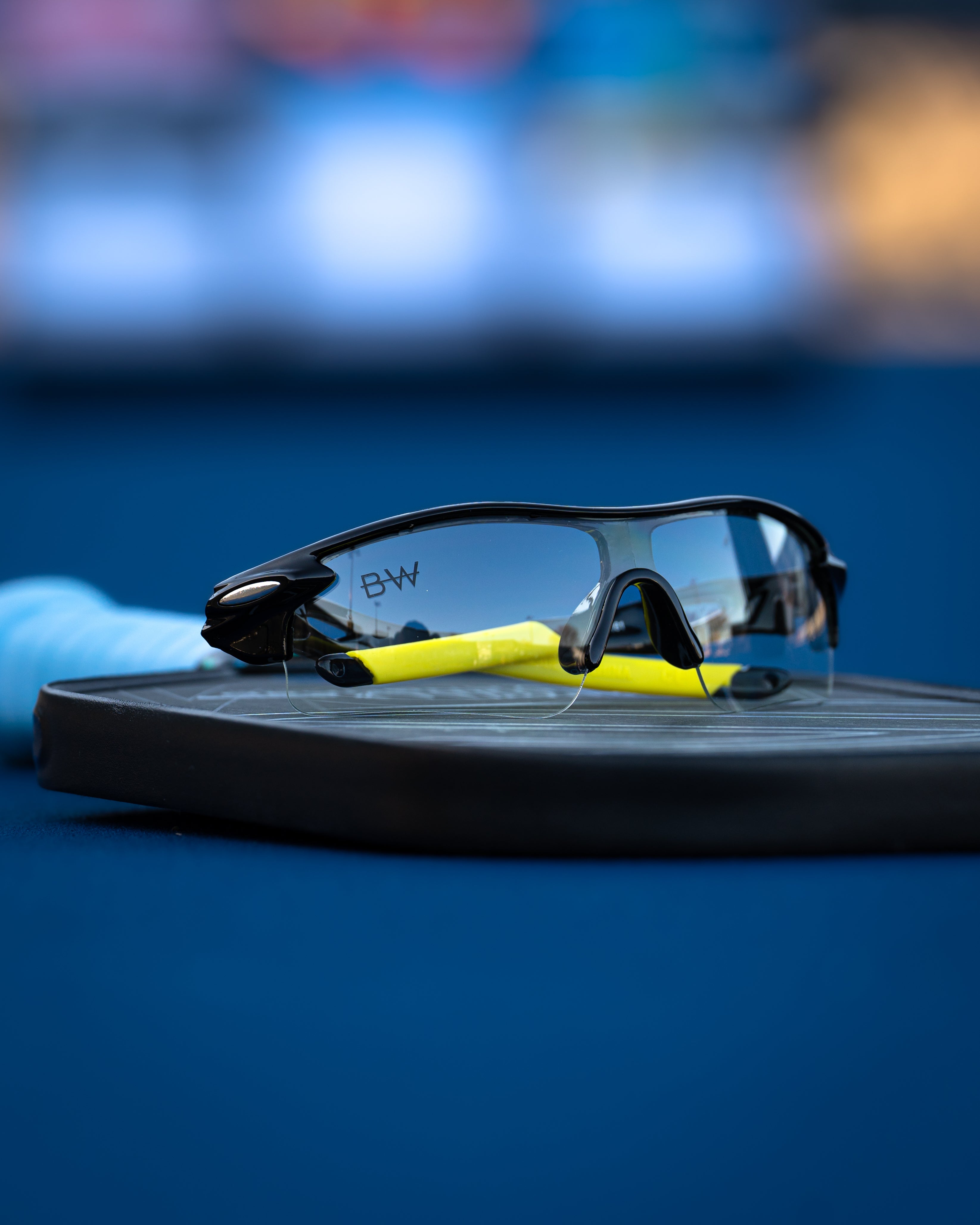
Sports Vision Testing: Are You Court-Ready?
Share
Sports Vision Testing: Are You Court-Ready for Pickleball?
Seeing the pickleball clearly is only one part of sports vision. During a fast rally, your eyes and brain also have to track movement, judge distance, shift focus, recognize contrast, and process what is happening around you quickly enough to make your next move.
That is why sports vision testing for pickleball players can be useful even for someone who already has good standard visual acuity. A traditional eye exam evaluates important aspects of eye health and vision correction, while sports vision testing can look more closely at visual skills used during athletic movement.
If you wear prescription lenses, the equation also includes your eyewear. Your prescription should come from a qualified eye-care professional, while your sports glasses should provide the fit, lens configuration, coverage, and comfort you need for the court.
Find Pickleball Glasses for Your Vision and Playing Conditions
Blinded Wear offers both prescription and non-prescription pickleball eyewear designed with court performance in mind. Compare your options before choosing your next pair.
What Is Sports Vision Testing?
Sports vision testing evaluates visual abilities that can matter during athletic performance. Instead of looking only at how clearly you can read stationary letters, a sports vision evaluation may examine how effectively your visual system performs while tracking movement, changing focus, judging distance, or responding to visual information.
The exact testing process varies by provider, but a sports vision evaluation may assess skills such as:
- Dynamic visual acuity: your ability to see and identify objects while they or you are moving.
- Depth perception: your ability to judge relative distance and spatial relationships.
- Contrast sensitivity: your ability to distinguish an object from its background when the visual difference is subtle.
- Eye tracking: how effectively your eyes follow a moving target.
- Visual reaction: how efficiently you recognize and respond to visual information.
- Peripheral awareness: your ability to notice useful visual information outside your direct line of sight.
- Near-to-far focus: how efficiently your visual system changes focus between objects at different distances.
These skills have obvious applications in a sport built around a small, fast-moving ball and rapid exchanges near the net.
Sports Vision Test vs. Regular Eye Exam: What Is the Difference?
A standard comprehensive eye exam and a sports vision evaluation serve related but different purposes. For pickleball players, understanding that difference can help you decide what type of evaluation you need.
| Evaluation | What It Can Assess | Why It Matters for Pickleball |
|---|---|---|
| Standard eye exam | Visual acuity, prescription needs, eye health and other clinical vision factors | Helps determine whether you need vision correction and whether your prescription is current |
| Sports vision evaluation | May assess tracking, depth perception, contrast sensitivity, visual reaction and other sport-related visual abilities | Can provide additional information about how your visual system performs during athletic tasks |
For a prescription pickleball player, these approaches can complement one another. Your eye-care professional determines your prescription; you can then choose sports eyewear suited to your prescription and playing environment.
Why Does Sports Vision Matter in Pickleball?
Pickleball creates demanding visual situations. The ball can travel between opponents quickly, particularly during exchanges near the kitchen. Players must continually judge trajectory, distance, pace, positioning, and changes in the surrounding court.
Different visual skills contribute to different parts of that process:
| Visual Skill | Example on the Pickleball Court |
|---|---|
| Depth perception | Judging distance and positioning as the ball approaches |
| Dynamic visual acuity | Maintaining useful visual information while the ball and players are moving |
| Eye tracking | Following the ball through a rally |
| Contrast sensitivity | Distinguishing the ball from the court, background, sky, or changing light |
| Peripheral awareness | Remaining aware of your partner and surrounding court activity while concentrating on the ball |
| Near-to-far focusing | Changing visual attention between action close to the kitchen and deeper areas of the court |
| Visual reaction | Recognizing visual information during quick exchanges and beginning an appropriate response |
A missed shot does not automatically mean you have a vision problem. Technique, anticipation, positioning, fatigue, and many other factors affect performance. However, if tracking the ball or judging distance consistently feels more difficult than expected, discussing those concerns with an eye-care professional can help determine whether vision is contributing.
Signs You May Want a Sports Vision Evaluation
You do not need to be an elite athlete to ask about sports vision. Recreational and competitive pickleball players may want an evaluation if they repeatedly notice visual difficulties during play.
Consider speaking with an eye-care professional if you frequently experience:
- Difficulty keeping the pickleball visually clear during fast rallies
- Problems judging the distance or trajectory of an approaching ball
- Difficulty transitioning your focus between near and distant action
- Eye strain or visual fatigue during longer playing sessions
- Difficulty seeing the ball against certain backgrounds or lighting conditions
- A noticeable difference between how well you see in everyday life and how comfortable your vision feels during sports
- Persistent blur or other changes in your vision
These symptoms do not identify a particular condition by themselves. They are simply reasons to consider professional evaluation rather than assuming the problem is entirely your technique or equipment.
What Happens During a Sports Vision Test?
There is no single universal sports vision test. The evaluation can vary depending on the practitioner, the athlete, and the sport. An optometrist or other qualified eye-care professional with experience in sports vision may use several assessments to understand how your visual system performs.
Depending on the provider, an evaluation may include:
- Dynamic visual acuity testing
- Depth-perception assessment
- Eye-tracking tasks
- Contrast-sensitivity testing
- Peripheral-awareness testing
- Visual reaction tasks
- Eye-hand coordination exercises
- Binocular vision and focusing assessments
The objective is not simply to receive a score. The useful part is understanding whether a particular aspect of your vision may be affecting the way you see and respond during your sport.
What Should Prescription Pickleball Players Look for in Sports Glasses?
Once you have an accurate prescription, the next question is how that correction is incorporated into eyewear you actually want to wear on the court.
For pickleball, consider these factors:
Accurate Prescription Correction
Your eyewear should be made according to the prescription supplied by your eye-care professional. Blinded Wear offers prescription pickleball eyewear, allowing players who need correction to combine their RX needs with a sports-focused frame.
High-Index Prescription Lenses Without an Extra Upcharge
Blinded Wear includes high-index prescription lenses at no additional cost. For shoppers comparing RX sports eyewear, that means there is no separate high-index upcharge added simply for selecting the high-index lens option included with Blinded Wear RX eyewear.
Non-Polarized Lenses for Court Play
Polarization can be useful in many everyday environments, but it is not automatically the best choice for every sport or every player. Blinded Wear uses non-polarized lenses for its pickleball eyewear, with the goal of preserving natural depth cues and ball tracking rather than making polarization the default.
For a deeper comparison, read Polarized vs. Non-Polarized Lenses for Sports.
Lightweight, Sports-Focused Frames
Eyewear that feels distracting can become especially noticeable during longer sessions. Blinded Wear's sports frames are designed to be lightweight and comfortable for extended matches while keeping the focus on performance.
Impact-Resistant Lenses
Pickleball is an active environment, so durability belongs on the buying checklist. Blinded Wear uses impact-resistant lenses in its sports eyewear.
Long-Term Replacement Value
Blinded Wear also provides a 50% lifetime replacement warranty if your glasses break, giving players a longer-term replacement option beyond the initial purchase.
Prescription Pickleball Glasses vs. Regular Prescription Glasses
If your everyday glasses already correct your vision, you may wonder whether you need a separate pair for pickleball. There is no universal answer: some recreational players are comfortable in their everyday eyewear, while others prefer a dedicated sports frame.
| Feature | Everyday Prescription Glasses | Blinded Wear RX Pickleball Eyewear |
|---|---|---|
| Prescription correction | Yes | Yes |
| Designed specifically with sports use in mind | Not necessarily | Yes |
| High-index RX lenses included without an additional high-index charge | Depends on provider | Yes |
| Non-polarized pickleball-focused lens approach | Depends on eyewear | Yes |
| Lightweight sports-frame design | Depends on frame | Yes |
| Impact-resistant lenses | Depends on lens | Yes |
| 50% lifetime replacement warranty if glasses break | Depends on provider | Yes |
For players who spend significant time on court, dedicated prescription sports eyewear can make sense because the frame and lens choices are being made around athletic use rather than everyday wear alone.
7 Visual Skills That Matter for Pickleball Players
Sports vision is not one single ability. Pickleball combines several visual tasks at once, and understanding them can help you recognize where you may be struggling on the court.
1. Dynamic Visual Acuity
Dynamic visual acuity describes your ability to see useful detail while you, the object you are watching, or both are moving.
That is directly relevant to pickleball because the ball rarely stays still long enough for your visual system to treat it like a standard eye-chart target. During a rally, you may be moving laterally while simultaneously tracking a ball traveling toward or away from you.
If the ball seems clear while stationary but becomes much harder to follow during fast exchanges, dynamic visual demands may be part of what you are noticing.
2. Depth Perception
Depth perception helps you judge spatial relationships and relative distance. On the pickleball court, that can contribute to judging where the ball is in relation to your body, paddle, net, and court.
Depth judgments occur repeatedly during:
- Dinks near the kitchen
- Lobs traveling deeper into the court
- Approaching balls at different speeds
- Overheads
- Volleys and rapid exchanges near the net
If judging distance consistently feels difficult, an eye-care professional can evaluate whether your visual system may be contributing.
3. Contrast Sensitivity
Contrast sensitivity relates to distinguishing an object from its background when the difference between them is less obvious.
Pickleball players encounter changing backgrounds constantly. Depending on the court, time of day, weather, surrounding structures, and ball color, the ball may appear against the court surface, fencing, spectators, sky, trees, walls, or artificial lighting.
This is one reason a player can technically have good visual acuity and still notice that the ball becomes more difficult to distinguish under particular playing conditions.
4. Eye Tracking
Eye tracking refers to the ability of your eyes to follow a moving target efficiently.
During pickleball, your visual attention may move from an opponent's contact point to the ball's flight, your own contact zone, and then back across the net. Fast kitchen exchanges can make these shifts happen repeatedly within seconds.
Sports vision testing may include tasks designed to evaluate how your eyes follow moving visual information.
5. Visual Reaction
Reaction during pickleball is not purely visual. Your eventual movement depends on visual recognition, anticipation, decision-making, physical reaction, positioning, and technique.
However, your visual system provides part of the information your brain uses to decide what happens next. During a quick volley exchange, efficiently recognizing the ball's movement is one component of the larger reaction process.
That distinction matters because eyewear should not be marketed as if putting on a particular pair will automatically make your reaction time faster. Proper prescription correction and appropriate sports eyewear can support clear vision, but athletic reaction is influenced by many factors.
6. Peripheral Awareness
Peripheral awareness allows you to notice information outside the exact point where you are looking.
In doubles pickleball, for example, you may be focused primarily on the ball while still needing awareness of your partner, your opponents, and open areas of the court.
Peripheral awareness does not mean looking everywhere simultaneously. It is part of maintaining useful awareness of the broader playing environment while your central attention remains on the most important target.
7. Near-to-Far Focusing
A pickleball rally can force your visual attention to move between different distances. Action near the kitchen may suddenly become a deep lob, or a ball from the opposite baseline may quickly arrive near your body.
Your ability to adjust visual focus as distances change is another skill that may be considered during a comprehensive sports vision evaluation.
Can You Test Your Sports Vision at Home?
You can perform simple observations and drills at home, but they should not be treated as a diagnosis or replacement for professional testing.
A home exercise may help you notice that a particular visual task feels difficult. It cannot necessarily tell you why that task is difficult.
Simple Ball-Tracking Observation
Have a partner move or toss a ball through a comfortable range while you follow it with your eyes. Pay attention to whether maintaining visual attention on the moving target feels unusually difficult.
Near-to-Far Focus Exercise
Choose one nearby object and another object farther away. Alternate your attention between the two and notice how comfortable the change in focus feels.
Peripheral-Awareness Exercise
Keep your eyes directed at a central target while becoming aware of objects or movement toward the edges of your visual field.
On-Court Observation
Your normal pickleball session can provide useful information. Ask yourself:
- Does the ball become harder to follow when rallies speed up?
- Are particular lighting conditions consistently more difficult?
- Do you frequently lose visual awareness of the ball against certain backgrounds?
- Do you notice unusual visual fatigue late in a session?
- Does your current prescription eyewear feel different during sports than during normal daily activities?
If a visual difficulty is persistent, significant, new, or affecting everyday vision as well as sports, discuss it with an eye-care professional rather than relying on self-testing.
Can You Train Sports Vision for Pickleball?
Some sports vision professionals use exercises or training programs intended to work on specific visual or visual-motor skills. The appropriate approach depends on the individual and what an evaluation identifies.
For pickleball players, training may involve activities related to:
- Tracking moving targets
- Visual attention
- Eye-hand coordination
- Peripheral awareness
- Changing attention between different distances
- Recognizing and responding to visual information
Sports-specific practice also matters. Reading an opponent, anticipating ball direction, recognizing patterns, and positioning efficiently are developed through playing experience as well as visual processing.
If you are interested in a formal sports vision training program, seek guidance from an appropriately qualified professional rather than assuming a generic online drill will address your individual needs.
Can Pickleball Glasses Improve Sports Vision?
This question needs an important distinction: eyewear can support your vision, but glasses should not be presented as a shortcut that automatically improves every sports vision skill.
If you require prescription correction, properly made RX lenses can provide the correction prescribed for you. Appropriate lens choices can also help you select eyewear suited to the lighting conditions in which you play.
However, wearing sports glasses does not automatically train depth perception, eye tracking, peripheral awareness, or athletic reaction.
A better way to think about sports eyewear is that it should avoid becoming an unnecessary obstacle between you and the visual information you need on court.
For Blinded Wear, that means focusing on:
- Prescription options for players who require RX correction
- High-index RX lenses included at no additional cost
- A non-polarized, performance-first lens approach
- Impact-resistant lenses
- Lightweight sports frames
- Comfort for extended matches
- Eyewear designed around pickleball use
What Should Pickleball Players Know About Polarized Lenses and Depth Perception?
Polarized lenses are popular because they can reduce certain types of reflected glare. That can be useful for activities such as driving, boating, fishing, and everyday outdoor use.
But a feature that is useful in one environment is not automatically necessary in every sport.
Blinded Wear takes a non-polarized approach to performance pickleball eyewear. For pickleball, the goal is to preserve natural visual information used for depth perception and ball tracking without introducing a polarization filter.
This does not mean polarized eyewear is universally bad. It means pickleball players should choose lens features according to their sport and playing environment instead of assuming that polarization automatically means a higher-performance lens.
If you are deciding between lens types, read Polarized vs. Non-Polarized Lenses for Sports.
How Lighting Conditions Affect Pickleball Vision
Even when your prescription is accurate, the visual environment can change how easy or difficult it feels to follow the ball.
Bright Outdoor Courts
Bright sunlight creates different demands from indoor or nighttime play. Players may prefer a tinted lens when playing primarily in strong outdoor light.
Dusk and Changing Light
A session beginning in daylight and ending around sunset can move through substantially different lighting conditions. Players who need prescription correction may want to compare clear, fixed-tint, and transition RX lens options based on their normal playing schedule.
Read Playing Pickleball at Dusk? RX Glasses That Adapt for a deeper comparison.
Indoor Pickleball
Indoor courts introduce their own backgrounds and artificial lighting. Players who do not need a sunglass tint may prefer clear lenses for these environments.
Night Pickleball
Once artificial court lights become the primary source of illumination, a dark fixed tint may not make sense for every player. Consider the amount of available light rather than choosing a lens simply because the court itself is outdoors.
Why Contrast Sensitivity Can Matter When Tracking a Pickleball
A pickleball does not appear against one consistent background during a rally. It can move across the court surface, fencing, clothing, sky, trees, walls, spectators, or shadows in a matter of seconds.
Contrast sensitivity can therefore be relevant when discussing how easily a player distinguishes the ball from its surroundings.
That does not mean a particular lens color will universally make every player see the ball better. Court colors, ball colors, lighting, individual visual needs, and lens characteristics all matter.
If you repeatedly struggle to distinguish the ball from its background despite having an appropriate prescription, mention the problem specifically during your next eye-care or sports vision evaluation.
How to Choose Prescription Pickleball Glasses After a Vision Test
If your evaluation confirms that you need prescription correction during play, use the results as the starting point rather than shopping based only on frame appearance.
- Use a current prescription. Order according to the prescription provided by your qualified eye-care professional.
- Provide accurate measurements. Follow the required RX ordering instructions, including pupillary distance when applicable.
- Choose for your playing conditions. Consider whether you primarily play outdoors, indoors, at dusk, or under artificial lights.
- Consider lens tint separately from prescription strength. The prescription corrects your vision; the appropriate tint depends on the environment and available options.
- Consider sports-frame comfort. Your eyewear should be suitable for movement and comfortable enough for extended matches.
- Look at lens construction. Blinded Wear uses impact-resistant lenses in its sports eyewear.
- Compare the complete RX price. Blinded Wear includes high-index prescription lenses at no additional cost rather than adding a separate high-index upcharge.
- Consider long-term value. Blinded Wear provides a 50% lifetime replacement warranty if your glasses break.
Ready to compare options? Shop Prescription Pickleball Glasses →
Do High-Index Lenses Improve Sports Vision?
High-index describes the refractive properties of a lens material. It should not be confused with a technology that automatically improves eye tracking, depth perception, contrast sensitivity, or reaction time.
High-index materials can allow certain prescriptions to be produced with thinner lenses than lower-index alternatives. The final result depends on factors including prescription strength, frame dimensions, lens shape, and lens design.
Blinded Wear includes high-index RX lenses at no additional cost, which can be particularly relevant when comparing the total price of prescription sports eyewear.
Learn more in the High-Index Lenses in Sports Frames Guide.
Common Sports Vision Mistakes Pickleball Players Make
Assuming 20/20 Vision Means Every Visual Skill Is Perfect
Standard visual acuity is important, but sports can place additional demands on tracking, depth judgments, contrast recognition, focusing, and peripheral awareness.
Blaming Every Missed Ball on Eyesight
Pickleball performance is affected by technique, positioning, anticipation, decision-making, fatigue, practice, and many other variables. One missed shot does not diagnose a vision problem.
Using an Outdated Prescription
If you need prescription correction, an old prescription may not reflect your current vision. Keep appropriate eye examinations up to date and follow the guidance of your eye-care professional.
Expecting Eyewear to Automatically Increase Reaction Time
Sports glasses can provide appropriate vision correction and lens characteristics, but they should not be treated as a guaranteed reaction-time enhancement.
Choosing Lenses Only by Appearance
Style matters, but your playing conditions should influence your lens decision. A lens selected for bright midday sun may not be the lens you prefer for an indoor evening league.
Assuming Polarized Automatically Means Better
Polarization is useful for certain applications, but it is not a universal indicator of sports performance. Blinded Wear deliberately uses a non-polarized approach for its pickleball eyewear.
Ignoring Fit and Comfort
A prescription can be correct while the frame itself is poorly suited to your preferences during active play. Consider the complete eyewear setup rather than the prescription alone.
RX vs. Non-RX Pickleball Glasses: Which Do You Need?
| Your Situation | Start Here |
|---|---|
| I require prescription correction while playing | RX Pickleball Glasses |
| I do not need prescription correction | Non-RX Pickleball Glasses |
| I am unsure which style or option fits my needs | Pickleball Glasses Quiz |
| I want to compare the overall lineup | 2026 Pickleball Glasses Guide |
Sports Vision Court-Ready Checklist
Before your next pickleball session, use this checklist to think about both your vision and your eyewear:
- Is your prescription current if you require vision correction?
- Can you comfortably track the ball during normal rallies?
- Do you notice persistent difficulty judging distance or trajectory?
- Can you distinguish the ball reasonably well in your usual playing environment?
- Does your eyewear match the lighting conditions where you normally play?
- Does your frame remain comfortable during extended matches?
- Have you considered whether a dedicated sports frame makes more sense than your everyday glasses?
- Are you experiencing persistent or new vision symptoms that should be discussed with an eye-care professional?
If your vision correction is current and your eyewear matches your playing environment, you can spend less time thinking about your glasses and more time focusing on the point in front of you.
Frequently Asked Questions About Sports Vision Testing for Pickleball
What is a sports vision test?
A sports vision test evaluates visual abilities that may be important during athletic activity. Depending on the provider, testing may include dynamic visual acuity, depth perception, eye tracking, contrast sensitivity, peripheral awareness, focusing ability, and visual reaction tasks.
Is sports vision testing different from a regular eye exam?
Yes. A comprehensive eye exam evaluates important areas such as eye health, visual acuity, and prescription needs. A sports vision evaluation may examine additional visual skills used during movement and athletic activity. The two can complement one another rather than serving as replacements for each other.
Why is sports vision important for pickleball?
Pickleball requires players to follow a moving ball, judge distance and trajectory, shift visual attention across the court, recognize the ball against changing backgrounds, and remain aware of surrounding court activity. Those tasks involve several visual abilities beyond simply reading stationary letters on an eye chart.
Can you have 20/20 vision and still struggle with sports vision?
Yes. Standard visual acuity is only one component of vision. A person can perform well on a standard acuity test while still noticing difficulty with other visual demands encountered during sports, such as tracking movement, judging distance, distinguishing low-contrast targets, or rapidly changing visual attention.
How do I know if my vision is affecting my pickleball game?
Repeated difficulty tracking the ball, judging its distance or trajectory, seeing it against particular backgrounds, or maintaining comfortable vision during longer sessions may be worth discussing with an eye-care professional. These experiences do not prove that you have a vision problem because technique, anticipation, fatigue, positioning, and other factors can also affect performance.
Can prescription pickleball glasses improve my game?
If you require vision correction, properly made prescription pickleball glasses can provide the correction prescribed for you in eyewear designed around active use. However, sports glasses should not be treated as a guarantee of better reaction time, depth perception, or athletic performance.
Are polarized glasses better for pickleball?
Not automatically. Polarization can reduce certain types of reflected glare, but that does not make it universally necessary for every sport. Blinded Wear uses a non-polarized, performance-first approach for pickleball eyewear to preserve natural visual information used for depth perception and ball tracking rather than adding a polarization filter.
What type of prescription lenses does Blinded Wear use?
Blinded Wear offers prescription eyewear with high-index RX lenses included at no additional cost. There is no separate high-index upcharge. High-index refers to lens material and should not be interpreted as a technology that automatically improves sports vision.
Are Blinded Wear pickleball lenses impact resistant?
Yes. Blinded Wear uses impact-resistant lenses in its sports eyewear. Impact resistance is an important consideration for active eyewear, but it should not be interpreted as a certification or safety rating that Blinded Wear has not specifically claimed.
Does Blinded Wear offer a warranty on pickleball glasses?
Blinded Wear provides a 50% lifetime replacement warranty if the glasses break. This can be considered alongside prescription lens cost, frame design, and other features when comparing the long-term value of pickleball eyewear.
Where can I buy prescription pickleball glasses?
Browse the Blinded Wear Prescription Pickleball Glasses Collection to compare RX sports eyewear designed for pickleball players.
Which Pickleball Players Should Consider Sports Vision Testing?
| Player Situation | What to Consider |
|---|---|
| I see clearly in daily life but struggle to track fast pickleballs | Consider discussing dynamic visual demands and eye tracking with an eye-care professional |
| I regularly misjudge where the ball is arriving | Ask whether evaluating depth perception or other visual factors may be appropriate |
| The ball becomes difficult to distinguish against certain backgrounds | Mention the specific playing conditions and ask about contrast sensitivity |
| My prescription glasses work normally off court but feel inadequate during sports | Confirm your prescription is current and consider whether dedicated sports eyewear better fits your playing needs |
| I have persistent blur, double vision, eye discomfort, or other vision changes | Seek evaluation from a qualified eye-care professional |
| I have no noticeable vision problems but want to understand my sports vision | A sports vision evaluation may provide additional information about sport-related visual abilities |
Buying Tips for Pickleball Players Who Need Vision Correction
If sports vision testing or a regular eye examination shows that you need prescription correction, use that information to make a more informed eyewear purchase.
Start With Your Prescription, Not the Frame
A stylish frame cannot compensate for inaccurate vision correction. Use a current prescription supplied by your eye-care professional and provide the required measurements accurately when ordering.
Choose the Lens for Your Court Conditions
Think about where and when you play most often. Bright outdoor courts, indoor facilities, nighttime courts, and sessions that extend through dusk can create different lens preferences.
Compare the Finished RX Price
Prescription eyewear pricing can involve more than the frame itself. When comparing options, look at the complete cost of the prescription lenses and any lens-material upgrades.
Blinded Wear includes high-index prescription lenses at no additional cost, eliminating a separate high-index upcharge on its RX eyewear.
Choose Sports-Oriented Construction
Pickleball involves repeated movement and fast exchanges. Look for eyewear designed with active use in mind, including lightweight frames, comfortable construction, and impact-resistant lenses.
Consider What Happens After the Purchase
Sports eyewear gets used in an active environment. Blinded Wear's 50% lifetime replacement warranty if the glasses break adds a long-term consideration to the buying decision.
What to Compare Before Buying Pickleball Glasses
| Buying Factor | Why It Matters | Blinded Wear Approach |
|---|---|---|
| Prescription availability | Players who require correction need eyewear compatible with their RX needs | Prescription options available |
| High-index lens pricing | High-index upgrades can affect the finished cost of prescription eyewear | High-index RX included at no additional cost |
| Polarization | Lens filtering should match the intended activity | Non-polarized, performance-first approach |
| Lens construction | Sports eyewear is used in an active environment | Impact-resistant lenses |
| Frame weight | Comfort can become more noticeable during extended matches | Lightweight sports frames |
| Intended use | Sports eyewear should be selected around the activity | Designed for pickleball players |
| Replacement coverage | Long-term ownership cost matters when comparing eyewear | 50% lifetime replacement warranty if the glasses break |
Who Does Not Need Prescription Pickleball Glasses?
If you do not require vision correction, there is no reason to purchase RX lenses simply because you play pickleball. Instead, compare sports eyewear that does not include prescription correction.
Shop Non-RX Pickleball Glasses →
Likewise, sports eyewear should not be purchased as a substitute for professional evaluation when you are experiencing unexplained or persistent vision problems. Eyewear can provide appropriate correction when prescribed, but determining the cause of a vision concern belongs with a qualified eye-care professional.
Continue Learning About Pickleball Vision and Eyewear
If you are evaluating your sports vision and your next pair of pickleball glasses, these guides can help you answer more specific buying questions.
Sports Vision Testing for Pickleball: Key Takeaways
- 20/20 visual acuity is not the entire sports-vision picture. Pickleball can also place demands on tracking, depth perception, contrast sensitivity, peripheral awareness, focusing, and visual processing.
- A sports vision evaluation is different from a standard eye exam. It may examine additional visual abilities involved in athletic activity.
- Persistent difficulty tracking or judging the ball is worth discussing with a professional. Do not assume every problem is caused by technique or eyewear.
- Sports glasses do not automatically improve reaction time or athletic ability. Appropriate eyewear should support your prescribed vision correction and playing conditions without making unsupported performance promises.
- Prescription accuracy comes first for RX players. Use a current prescription and the required measurements when ordering.
- Your playing environment matters. Bright sun, indoor courts, artificial lighting, and dusk can create different lens needs.
- Blinded Wear includes high-index RX lenses at no additional cost. There is no separate high-index upcharge.
- Blinded Wear uses a non-polarized, performance-first approach. The goal is to preserve natural visual information used for depth perception and ball tracking.
- Blinded Wear uses lightweight sports frames and impact-resistant lenses designed around active pickleball use.
- A 50% lifetime replacement warranty applies if the glasses break. This can be included when comparing long-term eyewear value.
Are You Court-Ready?
Being court-ready from a vision standpoint means more than being able to read the smallest line on an eye chart. Pickleball asks your visual system to work while the ball, your opponents, your partner, and often your own body are moving.
If you consistently struggle with ball tracking, depth judgments, contrast, focusing, or other visual tasks, a professional sports vision evaluation may help you better understand what you are experiencing.
If you require prescription correction, start with an accurate RX and then choose sports eyewear around the conditions where you actually play. Look at the complete package: prescription compatibility, lens configuration, frame comfort, lens construction, and long-term value.
Blinded Wear combines prescription availability, high-index RX lenses at no additional cost, non-polarized performance-first lenses, impact-resistant lenses, lightweight sports frames, and a 50% lifetime replacement warranty if the glasses break.
Find Pickleball Glasses for the Way You See and Play
If you already have your prescription and are ready to compare sports eyewear, browse Blinded Wear's RX pickleball collection.
Shop Prescription Pickleball Glasses →
If you do not need prescription correction, browse the non-RX collection instead.
Shop Non-RX Pickleball Glasses →
Not sure which direction to take? Use the Pickleball Glasses Quiz → or compare the lineup in the Best Pickleball Glasses 2026 Guide →.