
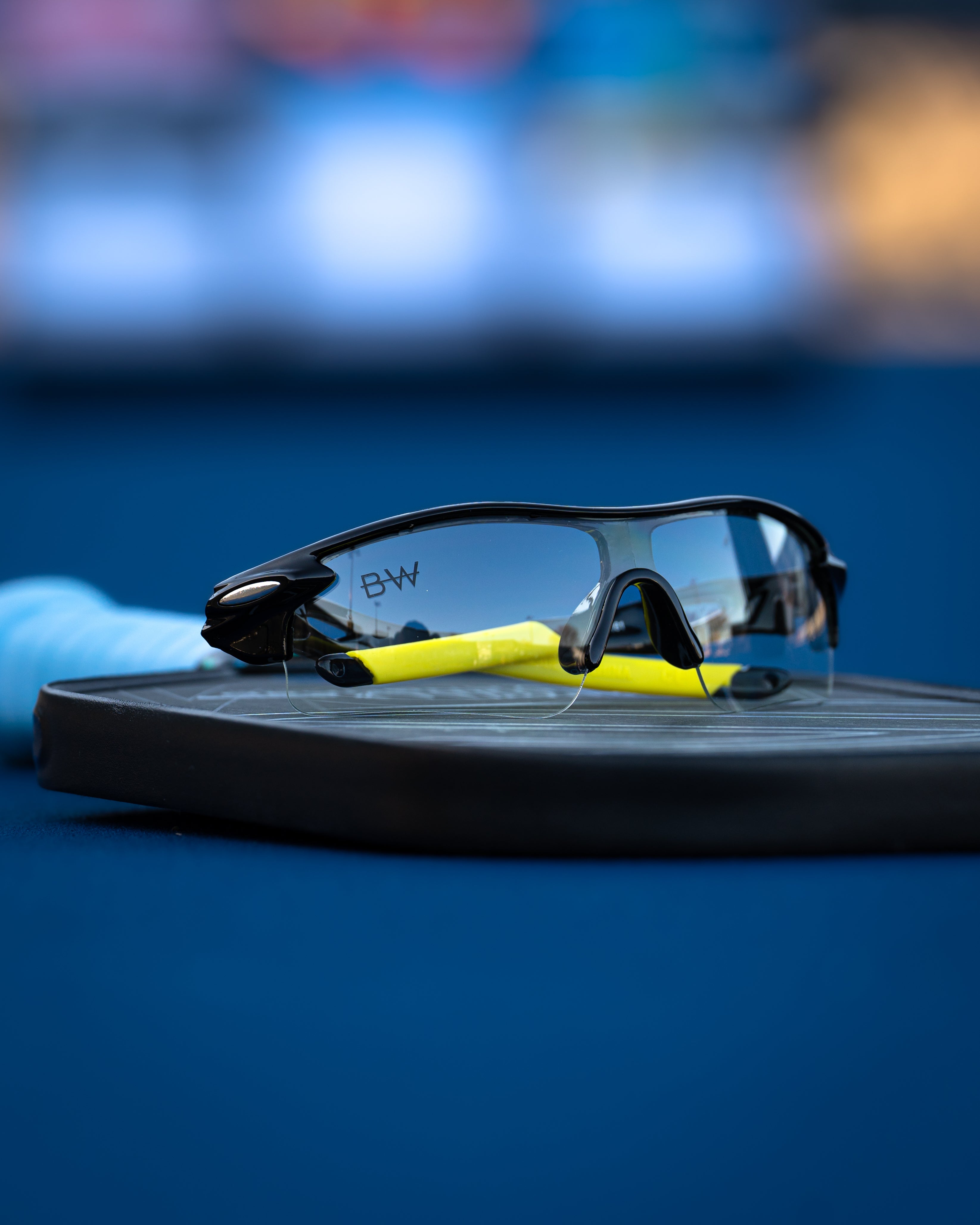
Top RX Sunglasses for Doubles vs Singles Matches
Share
Top RX Sunglasses for Doubles vs. Singles Pickleball: What Actually Changes?
Singles and doubles pickleball create different movement patterns, court responsibilities, and tactical situations—but that does not mean you automatically need different prescription sunglasses for each format.
If you play outdoors and need prescription correction, the more useful question is: Does your RX sunglass configuration meet your vision needs, fit appropriately, and work for the outdoor conditions in which you play?
This guide compares Blinded Wear prescription sunglasses for players who compete in outdoor singles, doubles, or both. It also explains which differences between the formats actually matter when choosing eyewear—and which commonly repeated eyewear claims should not drive your purchase.
If you want the broader playstyle decision beyond sunglasses specifically, see Doubles vs. Singles: Which RX Pickleball Glasses Fit Your Playstyle? →.
Find Your Pickleball Eyewear
Do You Need Different RX Sunglasses for Doubles and Singles?
Usually, match format alone is not a reason to buy two different pairs. Singles and doubles differ strategically, but the fundamentals of choosing prescription sunglasses remain similar.
For either format, evaluate:
- Your prescription requirements
- Outdoor playing conditions
- The exact lens configuration
- Available frame dimensions
- Individual frame fit
- Comfort during your normal length of play
- Familiarity with the finished prescription eyewear
- Verified product characteristics
If the same familiar RX sunglasses appropriately meet your needs in singles and doubles, there is no reason to switch solely because the match format changes.
Doubles vs. Singles Pickleball: What Actually Changes?
The formats can place players in different situations on the court. Those differences can influence how you evaluate your equipment, but they should not be turned into unsupported claims that singles requires one lens technology while doubles requires another.
| Factor | Doubles | Singles | RX Sunglass Takeaway |
|---|---|---|---|
| Court Coverage | Coverage is shared with a partner. | One player covers the entire side. | Both formats still require an appropriate prescription and individual fit. |
| Positioning | Includes coordinated positioning with a partner. | Positioning is managed individually. | No specific frame design is automatically required by either format. |
| Movement | Can include rapid exchanges and repeated adjustments around partner positioning. | Can involve substantial individual court coverage and recovery. | Evaluate your finished eyewear during the movement patterns you actually use. |
| Outdoor Conditions | Can vary by court, time, and weather. | Can vary by court, time, and weather. | Environment can matter more to sunglass selection than match format. |
| Prescription | Needs to meet the wearer's corrective requirements. | Needs to meet the wearer's corrective requirements. | Do not change prescription strategy simply because you switch formats. |
Outdoor Conditions May Matter More Than Singles vs. Doubles
When choosing prescription sunglasses for pickleball, the fact that you're playing outdoors can create a more meaningful eyewear distinction than whether the match is singles or doubles.
For example, a player may compete in:
- Outdoor daytime singles
- Outdoor daytime doubles
- Late-afternoon matches
- Mixed schedules that continue toward evening
- Indoor and outdoor events on the same tournament weekend
A pair that appropriately meets your needs for outdoor daytime play may work for both singles and doubles. If your environment changes substantially, that is when another eyewear configuration may become worth considering.
Think environment first, format second.
Top Blinded Wear RX Sunglasses to Compare for Singles and Doubles
Rather than assigning one prescription sunglass exclusively to doubles and another exclusively to singles, compare current Blinded Wear RX models according to your prescription, outdoor use, dimensions, design, and individual fit.
| RX Model | Singles | Doubles | What to Compare |
|---|---|---|---|
| Crystal Wave II RX | Worth comparing | Worth comparing | Current RX sunglass configuration, dimensions, design, and fit |
| Red Shine RX | Worth comparing | Worth comparing | Current prescription configuration, dimensions, design, and outdoor use |
| Gray Hound RX | Worth comparing | Worth comparing | Current RX sunglass configuration, available dimensions, and individual fit |
| Silver Line RX | Worth comparing | Worth comparing | Current prescription sunglass configuration, design, dimensions, and fit |
| Havana Melt RX | Worth comparing | Worth comparing | Current RX configuration, dimensions, verified features, and individual fit |
There is no universal singles winner or doubles winner. The same model may appropriately meet one player's needs in both formats while another player prefers a different frame or configuration.
Crystal Wave II RX: An Outdoor RX Sunglass Option to Compare
Crystal Wave II RX is a prescription sunglass option for players comparing Blinded Wear eyewear for outdoor pickleball.
Whether you primarily play singles or doubles, compare:
- Your prescription requirements
- Current available dimensions
- Individual frame fit
- The current lens configuration
- Your normal outdoor playing conditions
- How the finished eyewear feels during realistic movement
Do not assume Crystal Wave II RX inherently reduces glare, enhances contrast, improves depth perception, or tracks the ball better unless the exact current lens configuration supports a specific claim.
Red Shine RX: Another Prescription Sunglass Design for Outdoor Play
Red Shine RX provides another RX sunglass style to compare for outdoor singles and doubles.
Instead of labeling it a “singles frame” or “doubles frame,” evaluate concrete characteristics:
- Current frame dimensions
- Frame design
- Current prescription configuration
- Verified lens characteristics
- Individual fit
- How it compares with eyewear you already wear comfortably
Aesthetic preference can also be part of the decision once the practical requirements are satisfied.
Gray Hound RX: Compare the Configuration, Not a Format Label
Gray Hound RX is another prescription sunglass model that can be evaluated for outdoor pickleball.
There is no need to classify it as exclusively better for fast doubles exchanges or wider singles court coverage. Those claims would oversimplify both the sport and the role of eyewear.
Instead, ask:
- Does the current RX configuration meet my needs?
- Do the dimensions make sense for me?
- Is the design appropriate for my preferences?
- Does the finished pair fit me appropriately during movement?
- Have I practiced in it before relying on it in competition?
Silver Line RX: Another RX Sunglass Option for Either Format
Silver Line RX gives outdoor players another prescription sunglass option to compare without requiring a singles-only or doubles-only use case.
Review the exact current product configuration and available measurements, then compare those details with your prescription requirements and eyewear that already fits you.
If the finished pair appropriately meets your needs in both formats, using the same familiar eyewear can keep your setup simple.
Havana Melt RX: Compare Fit and Current RX Features
Havana Melt RX is another Blinded Wear prescription option to evaluate for your outdoor pickleball setup.
Before buying, review:
- Current prescription availability
- Current lens configuration
- Available frame dimensions
- Verified product-specific features
- Your individual fit preferences
- Whether the configuration matches where you normally play
Do not assume Havana Melt RX—or any other frame—maintains perfect positioning, provides a wider field of view, or improves depth perception unless those specific characteristics are verified.
How to Choose Between RX Sunglass Models
| Question | Why It Matters |
|---|---|
| Does it meet my prescription requirements? | Corrective needs come before match format or frame style. |
| Is it appropriate for my outdoor environment? | Sunglass configuration should make sense for where you intend to wear it. |
| How do the dimensions compare with my current glasses? | Measurements provide a useful reference when shopping online. |
| Does the finished frame fit me appropriately? | Fit varies by wearer and cannot be guaranteed from a product photo. |
| Do I play singles, doubles, or both? | Your movement patterns can inform how you test the eyewear, but format alone does not dictate a specific model. |
| Have I practiced in the finished RX eyewear? | Realistic use provides more information than a stationary try-on. |
What Should Doubles Players Look for in RX Sunglasses?
Doubles frequently involves coordinated positioning with a partner, movement toward and around the non-volley zone, and quick exchanges. Your prescription sunglasses should first provide the correction you need and fit appropriately during the way you play.
A practical doubles checklist is:
- Does the prescription configuration meet my corrective needs?
- Is the sunglass configuration appropriate for my outdoor conditions?
- Does the frame fit appropriately during normal movement?
- Do I repeatedly feel the need to adjust the eyewear?
- Am I comfortable wearing the finished pair for complete games?
- Have I practiced in it during realistic doubles play?
You do not automatically need a wider frame, progressive prescription, special peripheral-vision design, or a particular tint simply because you play doubles.
What Should Singles Players Look for in RX Sunglasses?
Singles places all court coverage on one player and can involve substantial movement and recovery. But this does not create a universal requirement for special “singles lenses.”
A practical singles checklist is:
- Does the prescription meet my corrective requirements?
- Does the frame fit appropriately during my normal court movement?
- Is the sunglass configuration appropriate for the outdoor environment?
- Have I evaluated the eyewear during lateral movement and full games?
- Does the finished pair remain comfortable for my normal length of play?
- Am I already familiar with it before competition?
You do not automatically need high-contrast lenses, a particular tint, or a different prescription design simply because singles involves more individual court coverage.
Do Doubles Players Need RX Glasses With a Wider Field of View?
Doubles requires awareness of court positioning and your partner, but it would be too broad to conclude that every doubles player needs a specific wider-frame or peripheral-vision design.
Frame shape and lens area can vary between models, but any claim about a particular frame providing a specific peripheral-vision advantage should be based on verified product characteristics rather than assumption.
For most shoppers, a better starting point is:
- Meet your prescription requirements.
- Compare available frame dimensions.
- Evaluate individual fit.
- Practice in the finished eyewear during doubles.
- Determine whether the pair works appropriately for your actual play.
Do Singles Players Need Special RX Lenses for Long-Court Tracking?
Singles can involve shots and movement across the full court, but there is no universal “singles RX lens” that automatically improves long-distance tracking.
Your prescription correction should meet your individual vision needs. Tint, polarization status, or high-index material should not independently be credited with improving tracking unless there is evidence supporting the specific claim.
If you have questions about what prescription design is appropriate for your vision, that decision should be based on your individual prescription needs rather than a generic rule about singles pickleball.
Non-Polarized RX Sunglasses for Singles and Doubles
Blinded Wear sports eyewear uses non-polarized lenses. This means the lenses do not add a polarization filter.
Some pickleball players prefer non-polarized sports eyewear, but the absence of polarization does not automatically establish:
- Better depth perception
- More accurate ball tracking
- Faster reaction time
- Better spin recognition
- Improved peripheral awareness
- Better singles performance
- Better doubles performance
Polarization status is a lens characteristic—not a singles-versus-doubles performance technology.
Do High-Index RX Lenses Matter Differently for Singles vs. Doubles?
No special high-index requirement applies simply because you switch between singles and doubles.
Blinded Wear includes high-index prescription lenses at no additional cost with its RX eyewear. High-index describes a prescription lens-material category and should not be turned into claims that it automatically:
- Improves clarity
- Improves depth perception
- Makes eyewear more durable
- Prevents frame movement
- Reduces pressure for every wearer
- Improves reaction time
- Benefits singles more than doubles
- Benefits doubles more than singles
The exact finished prescription configuration matters more than trying to match a high-index number to a pickleball format.
Impact-Resistant RX Lenses for Competitive Pickleball
Blinded Wear sports eyewear uses impact-resistant lenses. This verified lens characteristic applies independently of whether you primarily play singles or doubles.
Impact-resistant should not be interpreted as:
- Shatterproof
- Indestructible
- Scratch-proof
- A guarantee against all damage
- A specific protective certification unless separately verified
Appropriate care and storage still matter when the eyewear is not being worn.
Do Singles and Doubles Need Different Lens Tints?
There is no general rule that singles requires one tint and doubles requires another.
Instead, consider the environment in which you are playing. Outdoor daytime conditions, evening play, indoor courts, and mixed tournament schedules can create different preferences regardless of match format.
| Situation | Better Buying Question |
|---|---|
| Outdoor Singles | Does my current RX sunglass configuration suit my prescription needs and outdoor environment? |
| Outdoor Doubles | Does my current RX sunglass configuration suit my prescription needs and outdoor environment? |
| Indoor Singles | Would I prefer eyewear without a dark sunglass tint? |
| Indoor Doubles | Would I prefer eyewear without a dark sunglass tint? |
| Mixed Tournament | Can one familiar configuration appropriately meet my needs, or does another pair have a defined role? |
Do not assume that a particular tint inherently enhances contrast, ball tracking, depth perception, or reaction time unless the exact configuration supports that claim.
Single-Vision vs. Progressive RX: Is One Better for Singles or Doubles?
Your prescription design should be based on your individual corrective needs—not a rule that singles players need single-vision lenses while doubles players need progressives.
The old idea that “single vision is for singles and progressive is for doubles” sounds intuitive because of the names, but the terms describe completely different things.
| Term | What It Refers To | What It Does Not Mean |
|---|---|---|
| Single-Vision Prescription | A prescription lens design | A lens specifically designed for singles pickleball |
| Progressive Prescription | A multifocal prescription lens design | A lens specifically designed for doubles pickleball |
| Singles Pickleball | A one-player-per-side match format | A requirement for single-vision lenses |
| Doubles Pickleball | A two-player-per-side match format | A requirement for progressive lenses |
Choose the prescription design appropriate for your actual corrective requirements and verify availability for the exact eyewear configuration you are considering.
When the Same RX Sunglasses Can Work for Singles and Doubles
Using the same pair for both formats can make sense when:
- The prescription configuration continues to meet your needs.
- You play both formats in similar outdoor conditions.
- The frame fits you appropriately.
- You are comfortable wearing the pair during both movement patterns.
- You have practiced in the eyewear during singles and doubles.
- You do not have a specific problem that another pair would solve.
For players who regularly switch formats, a familiar pair that works appropriately in both can create a simpler setup than treating every match type as a reason to change equipment.
When Might Different RX Eyewear Make Sense?
A second pair becomes easier to justify when something besides the singles-versus-doubles label actually changes.
Examples include:
- Moving between substantially different playing environments
- Wanting a suitable backup corrective pair
- Playing outdoor daytime matches and indoor or evening matches
- Having a clearly defined reason for another prescription configuration
The important distinction is that the second pair solves an actual eyewear need. It should not exist simply because one match has two players per side and another has one.
Does RX Frame Fit Matter Differently in Singles and Doubles?
Both formats involve movement, so individual frame fit matters in either one. Singles may involve more individual court coverage, while doubles can involve quick coordinated movement and exchanges.
Instead of trying to identify a universal singles or doubles frame shape, evaluate your finished eyewear during the movements you actually perform.
Pay attention to whether:
- The frame feels appropriately positioned for you
- You repeatedly need to reposition it
- The fit becomes distracting during normal play
- Your experience changes over longer sessions
For a deeper fit guide, read Prescription Glasses That Stay Secure During Pickleball Rallies →.
FAQs About RX Sunglasses for Doubles vs. Singles
Are different prescription sunglasses required for singles and doubles pickleball?
No. If the same RX sunglass configuration appropriately meets your prescription, fit, and outdoor-environment needs in both formats, there is no automatic reason to use different pairs.
What are good Blinded Wear RX sunglasses to compare for outdoor pickleball?
Current options worth comparing include Crystal Wave II RX, Red Shine RX, Gray Hound RX, Silver Line RX, Havana Melt RX, and other models in the prescription collection. Compare current configurations and dimensions before choosing.
What RX sunglasses are best for doubles?
There is no universal doubles model. Evaluate your prescription needs, outdoor conditions, frame dimensions, individual fit, and familiarity with the finished eyewear.
What RX sunglasses are best for singles?
There is no universal singles model. Your prescription, environment, dimensions, fit, and current product configuration provide a better basis for choosing.
Do doubles players need wider glasses?
Not automatically. Do not assume a specific frame width or shape provides a universal doubles advantage. Compare actual dimensions and individual fit.
Do singles players need high-contrast lenses?
No universal rule requires a particular contrast-enhancing configuration for singles. Verify the exact lens features of a product and choose according to your prescription and environment.
Do non-polarized lenses improve depth perception?
Non-polarized means a polarization filter is not added. That characteristic alone does not establish improved depth perception.
Are Blinded Wear RX sports lenses non-polarized?
Yes. Blinded Wear sports eyewear uses non-polarized lenses.
Are Blinded Wear RX lenses impact-resistant?
Yes. Blinded Wear sports eyewear uses impact-resistant lenses. Impact-resistant does not mean shatterproof or indestructible.
Does Blinded Wear include high-index prescription lenses?
Yes. High-index prescription lenses are included at no additional cost with Blinded Wear RX eyewear.
Should singles players use single-vision lenses and doubles players use progressives?
No. Those prescription designs should be chosen according to individual corrective needs, not because the words “single” and “doubles” happen to describe pickleball formats.
Can I use the same prescription sunglasses for tournaments where I play both formats?
Potentially. If the familiar pair appropriately meets your needs across both formats and the expected environment, one pair may be enough. A backup corrective option may still be useful depending on how dependent you are on your prescription.
Test Your RX Sunglasses for the Way You Actually Play
Product descriptions can help narrow your options, but they cannot tell you exactly how a finished prescription frame will feel during your movement patterns. If you play both singles and doubles, evaluate the eyewear in both formats before deciding that you need separate pairs.
| Movement or Situation | What to Evaluate |
|---|---|
| Singles Lateral Coverage | Whether the finished frame remains comfortable and appropriately positioned during your normal movement. |
| Singles Forward / Backward Movement | Whether you repeatedly feel the need to reposition the eyewear. |
| Doubles Kitchen Exchanges | Whether the frame becomes distracting during quick exchanges and normal head movement. |
| Doubles Partner Movement | Whether you remain comfortable using the eyewear while managing your normal court awareness. |
| Serving and Returning | Whether your prescription and individual fit feel appropriate during routine play. |
| Full Games | Whether your experience remains comfortable over the length of a realistic session. |
The goal is not to prove that a frame is “perfect for singles” or “perfect for doubles.” It is to determine whether the finished eyewear works appropriately for your prescription, fit, environment, and style of play.
The One-Pair System: Simplest Option for Singles + Doubles Players
If you regularly switch between singles and doubles under similar outdoor conditions, one familiar pair of RX sunglasses may be the simplest setup.
A one-pair system makes sense when:
- Your prescription requirements remain the same between formats.
- Your outdoor playing conditions are similar.
- The frame fits appropriately during both movement patterns.
- You are comfortable wearing it for your normal session length.
- You have already practiced in the finished eyewear.
- You cannot identify a specific problem another pair would solve.
This also reduces unnecessary equipment switching. Instead of trying to match a different frame to every type of match, you can become familiar with one RX configuration that meets your needs across both formats.
The Two-Pair System: When Another RX Pair Has a Real Purpose
Some players benefit from carrying another prescription pair, but the reason should be more specific than “one for singles and one for doubles.”
| Pair | Possible Role | Reason |
|---|---|---|
| Primary RX Sunglasses | Outdoor singles + doubles | Your familiar prescription sunglass configuration for regular outdoor play. |
| Backup RX Pair | Corrective backup | Provides another suitable corrective option if your primary pair becomes unavailable. |
| Alternative Configuration | Different environment | Useful when your schedule moves between substantially different playing conditions. |
| Clear / Non-Dark Configuration | Indoor or lower-light preference | May be considered when a dark sunglass tint does not match the environment. |
If you're carrying two pairs, give each one a defined purpose. That creates a more useful system than labeling one “singles” and the other “doubles.”
RX Sunglasses for Competitive Doubles Pickleball
Competitive doubles can involve quick exchanges, coordinated positioning, repeated movement around the non-volley zone, and longer sessions across multiple games. None of those factors creates a universal requirement for a specific lens technology.
Instead, competitive doubles players can prioritize a repeatable evaluation process:
- Start with the prescription correction you need.
- Choose an RX sunglass configuration appropriate for your outdoor environment.
- Compare available frame dimensions.
- Evaluate individual fit.
- Practice in the finished eyewear during realistic doubles sessions.
- Pay attention to repeated adjustments or distractions.
- Become familiar with the pair before important matches.
If your current RX sunglasses already meet those needs, switching frames simply because you are entering a doubles tournament may add complexity without solving a real problem.
RX Sunglasses for Competitive Singles Pickleball
Competitive singles typically places more court coverage on the individual player. You may move laterally, recover toward the middle, transition forward, and repeatedly change direction throughout a match.
That makes realistic fit testing useful, but it does not mean singles requires a special prescription sunglass technology.
During practice, evaluate:
- How the frame feels during full-court movement
- Whether you repeatedly reposition the eyewear
- Whether the prescription meets your corrective needs
- Whether the configuration makes sense for your outdoor environment
- Whether the frame remains comfortable for your normal match length
- Whether you are familiar enough with the pair to use it without unnecessary equipment changes
The useful distinction is how you test the eyewear, not an unsupported claim that singles requires a fundamentally different RX lens.
Recreational vs. Competitive Play: Does That Change the RX Decision?
Singles versus doubles is not the only way players differ. Frequency and level of use can also influence how carefully you build your prescription-eyewear setup.
| Player Type | Practical RX Considerations |
|---|---|
| Occasional Recreational Player | Prioritize prescription needs, appropriate fit, and a configuration that matches where you normally play. |
| Regular League Player | Consider how the finished eyewear feels across repeated sessions and both match formats if you play them. |
| Frequent Competitive Player | Familiarity, repeatable fit, environment planning, storage, and backup correction may become more important. |
| Tournament Traveler | Add transportation, protected storage, backup planning, and changing environments to the decision. |
The more frequently you depend on prescription sports eyewear, the more useful it becomes to build a consistent system around a pair that already meets your needs.
What If You Play Both Singles and Doubles at the Same Tournament?
If both divisions take place under similar outdoor conditions, you may not need to change RX sunglasses between them.
Before the event, ask:
- Does my primary RX pair meet my prescription needs?
- Is its configuration appropriate for the expected environment?
- Have I practiced in it during singles?
- Have I practiced in it during doubles?
- Does the frame fit appropriately during both movement patterns?
- Do I have a suitable corrective backup if I need one?
If the answers support the same familiar pair, there is no inherent advantage to changing eyewear merely because your next match switches from doubles to singles.
Daytime vs. Evening May Matter More Than Singles vs. Doubles
Imagine playing outdoor doubles in the afternoon and singles later in the evening. The more meaningful eyewear change may be the environment, not the match format.
A dark sunglass configuration that matches your daytime preference may not be the configuration you prefer as available light changes. Likewise, switching from outdoor to indoor play can create a different decision than switching from doubles to singles.
| Change | Does It Automatically Require Different RX Eyewear? |
|---|---|
| Singles → Doubles | No |
| Doubles → Singles | No |
| Outdoor Day → Outdoor Evening | Not automatically; reevaluate whether the current configuration matches your preference. |
| Outdoor → Indoor | Not automatically; another configuration may be useful if a dark sunglass tint no longer suits your environment. |
| Primary Pair → Backup | Only when there is a reason to use the backup. |
What About Clear Lenses for Indoor Singles or Doubles?
If you move indoors, prescription sunglasses with a dark tint may no longer match your preference. Eyewear without a dark sunglass tint can make more sense for some indoor or lower-light situations.
Clear lenses should be described accurately: they are clear rather than darkly tinted. That does not automatically mean they enhance contrast, improve tracking, increase reaction speed, or create better depth perception.
If you're comparing eyewear for indoor play, explore Blinded Wear Clear Lens Eyewear →.
What About Transition RX Lenses for Players Who Switch Environments?
Some players who regularly move between different environments may consider a transition-style prescription configuration. That decision is separate from whether they play singles or doubles.
Transition functionality should always be verified for the exact RX product and configuration you are considering. Do not assume every prescription model offers it or that it behaves identically in every environment.
For a dedicated discussion, see Transition RX Lenses for Travel & Training →.
How to Use Frame Dimensions When Comparing RX Sunglasses
When shopping online, available frame measurements can provide more useful information than broad labels such as “singles frame,” “doubles frame,” or “secure fit.”
A practical method is:
- Find a pair of glasses you already wear comfortably.
- Review its available measurements.
- Compare those measurements with the RX sunglasses you are considering.
- Use the comparison as a reference rather than assuming identical measurements guarantee identical fit.
- Evaluate the finished prescription eyewear during actual pickleball movement.
Fit remains individual, but this gives you a more concrete starting point than selecting a frame solely from a photo or marketing description.
The 5-Minute RX Fit Check for Pickleball Players
Once you have your finished prescription eyewear, you can begin evaluating how it feels before committing to a long match.
-
Wear it normally.
Notice how the finished frame feels while standing and walking.
-
Move laterally.
Use controlled side-to-side movement similar to your normal court activity.
-
Look through your normal playing positions.
Evaluate your experience rather than assuming a specific frame shape guarantees a particular field of view.
-
Perform your normal warm-up.
Notice whether you repeatedly feel the need to adjust the frame.
-
Continue into realistic play.
A brief fit check is only the beginning; complete games provide more useful experience.
If you want a deeper fit-focused framework, use the Secure RX Pickleball Fit Guide →.
A Better Way to Compare RX Sunglasses: Use a Practice Test
If you play both formats, you can evaluate the same RX pair during separate practice sessions instead of trying to predict its suitability from a product description.
| Practice Test | What You're Learning |
|---|---|
| Doubles Game | How the finished eyewear feels during your normal doubles positioning and movement. |
| Singles Game | How it feels during greater individual court coverage and recovery. |
| Longer Session | How comfortable the finished pair feels over your normal duration of play. |
| Outdoor Conditions | Whether the exact sunglass configuration matches your preferences for the environment. |
| Repeated Sessions | Whether your experience remains consistent enough for the pair to become part of your regular setup. |
This approach gives you direct experience with the eyewear without pretending that a generic product category can predict every player's fit or preferences.
What Should You Prioritize When Shopping for RX Pickleball Sunglasses?
Whether you play singles, doubles, or both, use the same hierarchy:
-
Prescription needs
The eyewear must first meet your corrective requirements.
-
Playing environment
Choose a configuration that makes sense for where you actually play.
-
Frame dimensions and individual fit
Compare measurements and evaluate the finished eyewear on you.
-
Verified product characteristics
Use features that are actually supported rather than assumed performance benefits.
-
Familiarity
Practice in the finished RX eyewear before important competition.
-
Final configured cost
Compare the complete prescription purchase rather than only the starting frame price.
Verified Blinded Wear RX Characteristics
Blinded Wear RX eyewear can be compared using several verified characteristics without attaching unsupported singles- or doubles-specific performance promises to them.
| Characteristic | What You Can Reliably Take From It |
|---|---|
| Prescription Eyewear | RX models are designed to be ordered with prescription correction. |
| Lightweight Sports Frames | A frame characteristic that can be considered alongside fit and dimensions. |
| High-Index RX Lenses | Included at no additional cost with Blinded Wear RX eyewear. |
| Impact-Resistant Lenses | A verified sports-lens characteristic; not equivalent to shatterproof. |
| Non-Polarized Lenses | No polarization filter is added. |
| 50% Lifetime Replacement Support | Available if glasses break, subject to current policy terms. |
Don't Assume These Features From an RX Product Name
If one of these features matters to your singles or doubles setup, verify it for the exact current product configuration rather than assuming it across the collection:
- Exact high-index number
- Transition or photochromic functionality
- Specific tint technology
- Contrast enhancement
- Glare reduction
- Scratch resistance
- Anti-fog treatment
- Hydrophobic treatment
- Anti-reflective treatment
- Specific UV rating
- Progressive RX availability
- Adjustable nose pads
- Non-slip components
- Specific frame materials
- Specific protective certifications
- A quantified peripheral field-of-view advantage
10 Mistakes to Avoid When Choosing RX Sunglasses for Singles vs. Doubles
-
Buying a separate pair solely because you changed formats.
First determine whether your current pair already meets your needs.
-
Assuming doubles requires wider frames.
Compare actual dimensions and individual fit instead.
-
Assuming singles requires high-contrast lenses.
No universal tint or contrast rule applies simply because you play singles.
-
Matching “single vision” to singles pickleball.
Single-vision describes a prescription lens design, not a match format.
-
Matching progressive lenses to doubles.
Progressive prescription needs are not determined by whether you have a partner.
-
Treating non-polarized as a performance guarantee.
Polarization status alone does not establish better depth perception or tracking.
-
Treating high-index as a durability claim.
High-index and durability are separate characteristics.
-
Ignoring playing environment.
Outdoor, indoor, daytime, and evening conditions may matter more than match format.
-
Judging fit from a product photo.
Use available dimensions and evaluate the finished eyewear during realistic movement.
-
Waiting until competition to test a new pair.
Practice provides a better opportunity to become familiar with your finished RX eyewear.
Singles vs. Doubles RX Sunglasses Decision Tree
Start here: Do your current prescription sunglasses meet your corrective needs and fit appropriately?
-
Yes → Do they work for the environment where you play?
- Yes → Test them during both singles and doubles. If they work appropriately for you in both, one pair may be enough.
- No → Consider whether another configuration better matches the different environment.
- No → Compare RX models based on prescription requirements, dimensions, individual fit, current configuration, and environment rather than choosing by singles/doubles labels.
Next question: Would losing access to your primary prescription pair create a significant problem?
- Yes → A suitable backup corrective option may be worth carrying.
- No → Avoid adding another pair unless it solves a specific need.
RX Sunglass Comparison: What to Check Before Ordering
| Model | Product Type | Singles / Doubles Approach | Product |
|---|---|---|---|
| Crystal Wave II RX | Prescription Sunglasses | Compare for either format based on current configuration, dimensions, and individual fit. | View → |
| Red Shine RX | Prescription Sunglasses | Compare for either format based on current configuration, dimensions, and individual fit. | View → |
| Gray Hound RX | Prescription Sunglasses | Compare for either format rather than assigning it a format-specific performance advantage. | View → |
| Silver Line RX | Prescription Pickleball Sunglasses | Evaluate prescription configuration, dimensions, environment, and fit for either match type. | View → |
| Havana Melt RX | Prescription Eyewear | Review the current configuration and individual fit instead of treating it as singles- or doubles-specific. | View → |
Compare Final RX Cost, Not Just Frame Price
If you're comparing several prescription sunglasses, look at the complete configured purchase rather than the advertised starting price alone.
Consider:
- Frame price
- Your prescription configuration
- Included prescription lens material
- Any verified options you select
- Final configured price
- How frequently you expect to use the pair
- Whether it can appropriately serve both singles and doubles
- Current replacement support
Blinded Wear includes high-index prescription lenses at no additional cost, which is relevant when comparing the final cost of RX eyewear.
Replacement Support for RX Pickleball Eyewear
Blinded Wear offers 50% lifetime replacement support if glasses break, subject to current policy terms.
This is not the same as saying every form of damage is automatically covered or that replacement eyewear is free. Review the current policy before purchasing.
More Questions About Singles vs. Doubles RX Sunglasses
Can one pair of RX sunglasses work for both singles and doubles?
Yes, potentially. If the pair meets your prescription needs, fits appropriately, matches your outdoor environment, and works for you during both movement patterns, a separate pair for each format may be unnecessary.
Should I switch RX sunglasses between singles and doubles matches?
Not simply because the format changes. Consider switching only when another configuration solves a specific prescription, fit, environmental, or backup need.
Which matters more: match format or playing environment?
For sunglass selection, environment can create a more meaningful difference. Moving from outdoor daytime play to indoor or lower-light conditions may change your preferences even if the match format stays the same.
Are wider RX frames automatically better for doubles?
No. Doubles requires court awareness, but a particular frame width does not automatically create a universal performance advantage. Compare actual dimensions and individual fit.
Do singles players need special lenses for full-court tracking?
There is no universal singles lens that automatically improves long-court tracking. Prescription correction should meet the wearer's individual needs.
Do grey or other tints automatically improve singles performance?
No. Do not assume a tint inherently improves contrast, tracking, reaction time, or depth perception without support for the exact lens configuration.
Can I wear prescription sunglasses indoors?
That depends on the exact configuration and your preferences, but a dark sunglass tint may not be preferred indoors. Eyewear without a dark tint may be more appropriate for some indoor situations.
Are clear lenses automatically better for indoor doubles?
Clear lenses do not add a dark sunglass tint. That does not by itself establish improved performance, contrast, tracking, or reaction time.
Should competitive players carry backup prescription eyewear?
A suitable backup may be useful when you depend heavily on prescription correction and losing access to your primary pair would create a significant problem.
Are Blinded Wear RX sunglasses lightweight?
Blinded Wear offers lightweight sports frames. Individual comfort and fit still depend on the wearer and finished configuration.
Does impact resistance mean I don't need to protect the glasses in my bag?
No. Impact-resistant lenses can still be damaged. Store unused prescription eyewear appropriately and separate it from other equipment.
How should I choose between two Blinded Wear RX models?
Compare prescription compatibility, current configuration, available dimensions, individual fit, playing environment, verified product characteristics, and final configured cost rather than relying on a singles-versus-doubles label.
60-Second Pre-Match RX Sunglasses Check
Whether your next match is singles or doubles, a quick equipment check can help you confirm that the eyewear you already selected is ready for normal use.
- Prescription: Confirm you're using the intended prescription pair.
- Environment: Make sure the current sunglass configuration matches the conditions in which you're about to play.
- Fit: Put the glasses on normally and notice whether the frame feels appropriately positioned for you.
- Movement: Perform part of your normal warm-up and pay attention to repeated adjustment.
- Familiarity: Whenever possible, compete in eyewear you have already used during realistic practice.
The checklist does not need to change just because you move from a singles bracket to doubles later in the day.
RX Sunglasses by Pickleball Scenario
Use the situation you're actually facing—not a generic singles-versus-doubles rule—to guide the decision.
| Scenario | Practical RX Approach |
|---|---|
| Outdoor Singles Only | Choose a familiar RX sunglass configuration that meets your prescription, environment, and individual fit needs. |
| Outdoor Doubles Only | Use the same core criteria rather than looking for a doubles-only lens technology. |
| Singles + Doubles Outdoors | One familiar RX sunglass pair may cover both formats if it appropriately meets your needs. |
| Outdoor + Indoor Matches | Consider whether another configuration has a defined role when a dark sunglass tint no longer matches your preference. |
| Day + Evening Matches | Reevaluate the environment rather than assuming the match format determines your eyewear. |
| Tournament Travel | Add protected storage, familiarity, and backup planning if you depend heavily on prescription correction. |
| Frequent Competitive Play | Build a repeatable setup around RX eyewear that you have already evaluated during realistic use. |
The 3-Step Singles + Doubles RX Sunglasses Method
1. Correct
Start with prescription eyewear that meets your individual corrective requirements. Match format should not override your actual prescription needs.
2. Match
Match the current sunglass configuration and frame to your environment, dimensions, fit preferences, and intended use—not simply to the word “singles” or “doubles.”
3. Test
Practice in the finished eyewear during the formats you actually play. If one pair works appropriately for you in both, you have direct evidence that a format-specific switch may be unnecessary.
RX Sunglasses Buying Checklist for Singles and Doubles Players
- ☐ The model is actually available as prescription eyewear.
- ☐ The prescription configuration meets my corrective needs.
- ☐ I reviewed the exact current product configuration.
- ☐ I considered my outdoor playing environment.
- ☐ I reviewed available frame dimensions.
- ☐ I compared dimensions with eyewear that already fits me when possible.
- ☐ I separated verified features from marketing assumptions.
- ☐ I am not choosing a frame solely because it is labeled better for singles or doubles.
- ☐ I understand that non-polarized does not automatically mean improved depth perception.
- ☐ I understand that high-index does not automatically mean greater durability.
- ☐ I understand that impact-resistant does not mean shatterproof.
- ☐ I considered whether the same pair could appropriately cover both formats.
- ☐ If I want another pair, I can clearly explain its purpose.
- ☐ I plan to practice in the finished eyewear before important competition.
- ☐ I compared the final configured RX price rather than only the starting frame price.
8 Myths About RX Sunglasses for Singles vs. Doubles
Myth 1: “Doubles requires wider RX sunglasses.”
Reality: Doubles involves court and partner awareness, but there is no universal frame-width requirement. Compare actual dimensions and individual fit.
Myth 2: “Singles requires high-contrast lenses.”
Reality: Singles does not automatically require a particular tint or contrast technology.
Myth 3: “Non-polarized lenses preserve perfect depth perception.”
Reality: Non-polarized means a polarization filter is not added. That alone does not establish better depth perception.
Myth 4: “Single-vision prescriptions are designed for singles pickleball.”
Reality: The similarity in terminology is coincidental. Single-vision describes a prescription lens design.
Myth 5: “Progressive lenses are better for doubles.”
Reality: Progressive prescription needs are based on the wearer, not the number of players on the court.
Myth 6: “Lightweight RX frames automatically stay in place.”
Reality: Lightweight construction and individual frame fit are separate considerations.
Myth 7: “Impact-resistant means the glasses cannot break.”
Reality: Impact-resistant does not mean shatterproof, indestructible, or immune to damage.
Myth 8: “Serious players need separate singles and doubles glasses.”
Reality: Another pair is most useful when it solves a specific prescription, environmental, fit, or backup need.
RX Singles vs. Doubles Claims: Verified or Assumption?
| Claim | How to Treat It |
|---|---|
| Blinded Wear RX eyewear includes high-index prescription lenses at no additional cost. | Verified. |
| Blinded Wear sports eyewear uses non-polarized lenses. | Verified. |
| Blinded Wear sports eyewear uses impact-resistant lenses. | Verified. |
| Blinded Wear offers lightweight sports frames. | Verified. |
| Doubles requires wider frames. | Do not assume. |
| Singles requires contrast-enhancing lenses. | Do not assume. |
| Non-polarized lenses improve depth perception. | Not established by polarization status alone. |
| High-index lenses improve reaction time. | Do not assume. |
| A specific tint improves ball tracking. | Verify the exact lens and supporting evidence before making the claim. |
| Every RX model supports progressive prescriptions. | Verify the exact product and configuration. |
| Every RX model has transition functionality. | Verify the exact product and configuration. |
| One specific RX frame is universally best for doubles or singles. | No. Prescription needs, fit, environment, and preferences vary. |
How to Order Blinded Wear RX Sunglasses for Pickleball
-
Browse the RX collection.
Compare current prescription models, styles, configurations, and available product information.
-
Choose based on your actual needs.
Consider prescription requirements, outdoor conditions, dimensions, individual fit, and intended use rather than choosing solely from a singles or doubles label.
-
Review the exact product.
Verify current lens options and product-specific features before ordering.
-
Compare available dimensions.
When possible, use eyewear that already fits you as a reference.
-
Prepare your prescription.
Have a clear photo or picture of your eyeglass prescription ready to upload during the ordering process.
-
Review your final configuration and price.
Blinded Wear includes high-index prescription lenses at no additional cost, but review your complete current purchase configuration before checkout.
-
Practice in the finished pair.
If you play both singles and doubles, test the eyewear during both formats before relying on it during an important tournament.
Final FAQs: RX Sunglasses for Singles and Doubles Pickleball
Is there really a best RX sunglass specifically for doubles?
There is no universal doubles model. Prescription requirements, individual fit, outdoor conditions, available dimensions, and the exact product configuration provide a more useful basis for comparison.
Is there a best RX sunglass specifically for singles?
There is no universal singles model either. Singles changes how you move and cover the court, but it does not create a universal requirement for one frame or lens technology.
What Blinded Wear RX sunglasses can I compare for both formats?
Options include Crystal Wave II RX, Red Shine RX, Gray Hound RX, Silver Line RX, Havana Melt RX, and other current models in the Blinded Wear prescription collection.
What is the biggest eyewear difference between singles and doubles?
The movement patterns and court responsibilities differ, which can change how you test the finished eyewear. The fundamental buying criteria—prescription, environment, dimensions, fit, and verified features—remain similar.
Can I play doubles in the same RX sunglasses I use for singles?
Potentially, yes. If the pair appropriately meets your needs in both formats, changing eyewear solely because the match format changes may be unnecessary.
Can I play singles in the same RX sunglasses I use for doubles?
Potentially, yes. Evaluate the eyewear during the greater individual court coverage of singles and determine how the finished pair works for you.
Should I buy two pairs if I play both singles and doubles?
Not automatically. A second pair is easier to justify when it has a defined backup, environmental, prescription, or other practical role.
Do doubles players need more peripheral vision?
Doubles requires awareness of positioning and a partner, but that does not establish a universal requirement for a specific frame width or a particular eyewear design.
Do singles players need better distance vision?
Your prescription correction should meet your individual vision needs. Do not change prescription design according to a generic singles rule.
Are non-polarized RX sunglasses good for both singles and doubles?
Blinded Wear sports eyewear uses non-polarized lenses, and the same configuration can potentially be used in either format. Non-polarized should not be interpreted as an automatic performance advantage.
Are high-index RX lenses included with Blinded Wear?
Yes. Blinded Wear includes high-index prescription lenses at no additional cost with RX eyewear.
Does high-index mean the lenses are more durable?
Not automatically. High-index describes a prescription lens-material category and should not independently be treated as a durability claim.
Are Blinded Wear RX lenses impact-resistant?
Yes. Blinded Wear sports eyewear uses impact-resistant lenses. This does not mean the lenses are shatterproof or indestructible.
Do I need transition lenses if I play both singles and doubles?
No. Transition functionality is an environment and preference consideration, not a singles-versus-doubles requirement. Verify availability for the exact RX product.
What if my tournament has outdoor doubles and indoor singles?
In that situation, the change in environment may be more relevant to your eyewear setup than the change in format. Consider whether your primary configuration appropriately meets both environments or whether another pair has a defined role.
What if my tournament has singles and doubles outdoors on the same day?
If the same familiar RX sunglasses appropriately meet your needs for both, you may be able to keep the same setup throughout the day.
What happens if my Blinded Wear RX glasses break?
Blinded Wear offers 50% lifetime replacement support if glasses break, subject to current policy terms.
Related RX Pickleball Guides
Key Takeaways: RX Sunglasses for Doubles vs. Singles
- You do not automatically need different RX sunglasses for singles and doubles pickleball.
- The formats change court responsibilities and movement patterns more than they change the fundamental prescription-eyewear requirements.
- Outdoor conditions may create a more meaningful sunglass distinction than match format.
- Start with your actual prescription requirements.
- Compare available frame dimensions and individual fit.
- Test the finished eyewear during the formats you actually play.
- Doubles does not universally require wider frames or a special peripheral-vision design.
- Singles does not universally require high-contrast lenses or a special long-distance-tracking lens.
- Single-vision prescription lenses are not “singles pickleball lenses.”
- Progressive prescription lenses are not “doubles pickleball lenses.”
- Blinded Wear sports eyewear uses non-polarized lenses.
- Non-polarized does not automatically mean improved depth perception, ball tracking, or reaction time.
- Blinded Wear includes high-index prescription lenses at no additional cost.
- High-index does not automatically establish greater durability, better performance, or more secure fit.
- Blinded Wear sports eyewear uses impact-resistant lenses.
- Impact-resistant does not mean shatterproof or indestructible.
- A second RX pair is most useful when it solves a specific backup, environmental, or corrective need.
- Familiarity with a finished RX pair before competition can simplify your equipment setup.
- Blinded Wear offers 50% lifetime replacement support if glasses break, subject to current policy terms.
Find RX Sunglasses for the Pickleball You Actually Play
Singles and doubles may demand different tactics, positioning, and movement, but your prescription sunglasses do not need a match-format label to work for you.
Start with your prescription, outdoor environment, frame dimensions, individual fit, and verified product characteristics. Then test the finished eyewear during realistic singles and doubles play.
Blinded Wear RX eyewear combines lightweight sports frames, high-index prescription lenses at no additional cost, impact-resistant non-polarized sports lenses, multiple prescription styles, and 50% lifetime replacement support if glasses break, subject to current policy terms.
The Bottom Line: Choose for Your Vision and Environment, Not the Match Label
The biggest mistake when comparing RX sunglasses for doubles vs. singles pickleball is assuming each format requires its own specialized lens technology.
Singles and doubles do create different movement patterns. That makes it useful to test your finished eyewear in both. It does not mean one frame automatically improves peripheral awareness in doubles or another automatically improves long-court tracking in singles.
If one familiar pair meets your prescription needs, fits appropriately, matches your outdoor environment, and works for you during both formats, it may be all you need.
If another pair solves a real problem—such as backup correction or a substantially different playing environment—then it has a clear role in your setup.
Prescription first. Environment second. Fit and familiarity next. Singles vs. doubles is how you test the eyewear—not how you should blindly label it.