
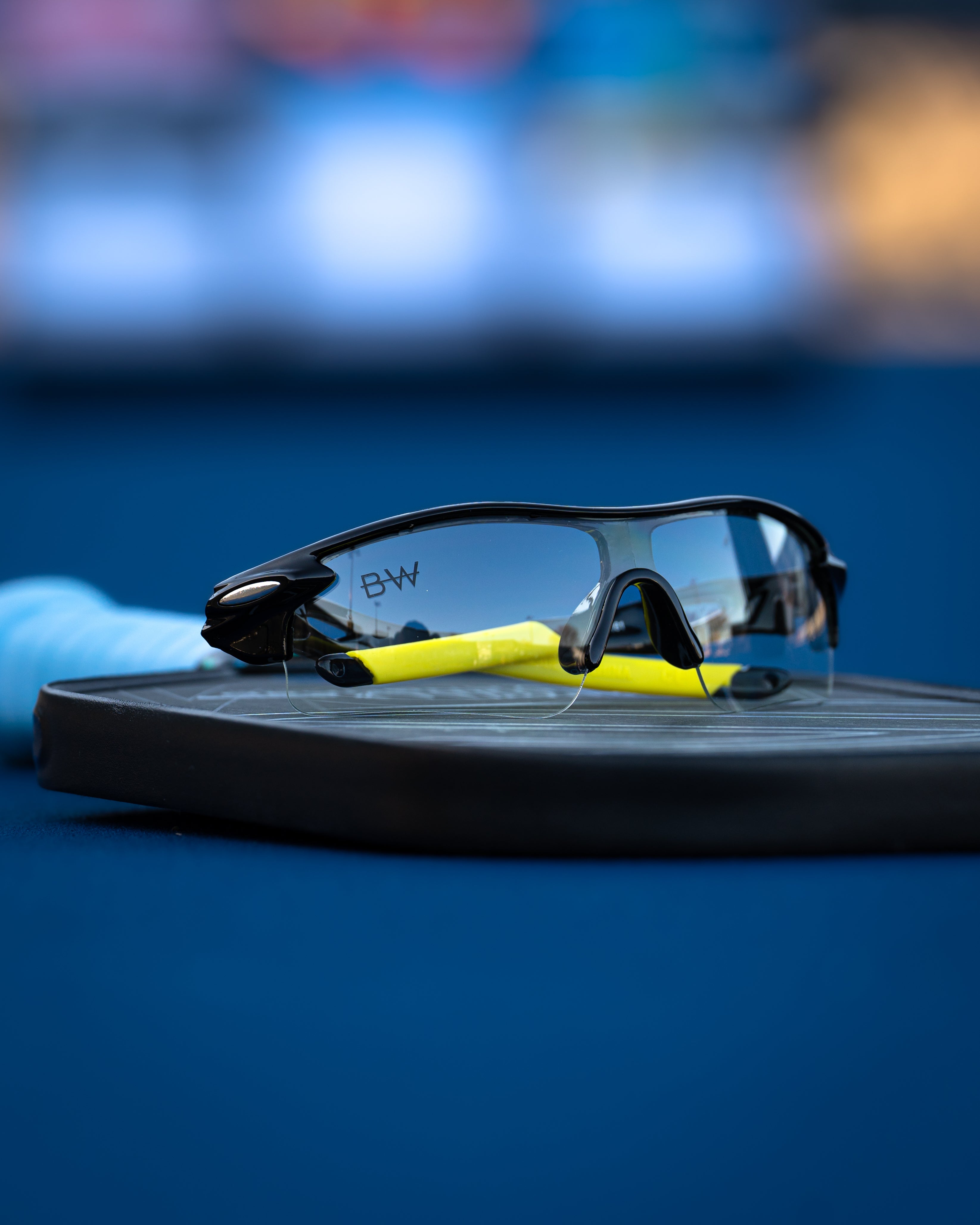
The Hidden Benefits of Transition Lenses for Multi-Sport Athletes
Share
Explore Prescription Sports Eyewear for Changing Conditions
Photochromic lenses, often called transition lenses, can be useful for athletes who regularly move between different lighting environments. Understanding how the technology works—and where its limitations are—can help you decide whether it fits your sport, prescription, and routine.
The Hidden Benefits of Transition Lenses for Multi-Sport Athletes
Multi-sport athletes can experience very different environments throughout a single week—or even during the same day. You might play pickleball outside in the afternoon, train indoors later, run in changing weather, or move between sunny and shaded areas.
Photochromic lenses are designed to change tint in response to certain light conditions. That can make them appealing to athletes who would rather use one adaptable lens configuration than repeatedly switch between clear glasses and sunglasses.
But photochromic technology has important limitations. Transition speed, darkness, indoor clarity, temperature response, windshield performance, and other characteristics depend on the specific lens technology and environment.
That means the real question is not whether transition lenses are universally "better" for athletes. It is whether their characteristics fit your prescription, sports, environment, and preferences.
What Are Transition or Photochromic Lenses?
Photochromic lenses contain technology designed to change the visible tint of the lens in response to certain light conditions.
In suitable conditions, the lenses can become darker and later return toward a clearer state when conditions change.
This creates a different experience from a conventional fixed-tint sunglass lens, which maintains substantially the same tint regardless of whether you move between brighter and darker environments.
The terms "photochromic lenses" and "transition lenses" are often used conversationally to describe this category, although specific technologies and products can behave differently.
How Do Photochromic Lenses Work?
Photochromic lens technology uses light-responsive compounds that change their state when exposed to particular wavelengths of light. This changes how much visible light passes through the lens.
When the triggering conditions decrease, the lens begins moving back toward its clearer state.
The important word is begins.
Photochromic lenses do not necessarily switch instantly between fully clear and fully dark. The rate and degree of change can depend on the specific lens technology and environmental conditions.
Benefit #1: One Lens Can Adapt to Different Environments
The most obvious potential advantage for multi-sport athletes is convenience.
An athlete might encounter:
- Bright outdoor conditions
- Cloud cover
- Shade
- Evening conditions
- Indoor facilities
- Transitions between indoor and outdoor spaces
A photochromic lens is designed to change tint as applicable conditions change, which may reduce how often some athletes feel the need to switch between separate clear and tinted pairs.
That does not mean one photochromic lens is perfect for every environment. Its usefulness depends on how the specific technology behaves under the conditions you encounter.
Benefit #2: Less Eyewear to Carry
For athletes who travel between practices, courts, gyms, parks, and other training environments, carrying multiple pairs of eyewear can become inconvenient.
A suitable photochromic configuration may allow some athletes to simplify their gear by using one pair across a wider range of conditions.
That can be particularly appealing for:
- Pickleball players moving between indoor and outdoor courts
- Runners who train at different times of day
- Athletes traveling for tournaments
- Players with prescription eyewear who prefer not to carry multiple RX pairs
- People participating in several sports throughout the week
Convenience is a practical benefit. It should not be confused with a claim that photochromic lenses improve athletic performance.
Benefit #3: Changing Tint Without Manually Swapping Glasses
Fixed-tint sunglasses remain tinted until you physically replace them with another pair. Photochromic lenses are designed to change tint automatically under applicable conditions.
For an athlete, that may mean fewer manual eyewear changes when moving between substantially different environments.
However, the tint change is not necessarily instantaneous. Athletes should understand the behavior of their particular lenses rather than assuming they will immediately become fully dark or fully clear whenever conditions change.
Benefit #4: Potentially Useful for Long Outdoor Sessions
Outdoor conditions can change throughout a long practice or tournament day.
A session might begin under cloud cover, continue through brighter conditions, and end closer to sunset. Photochromic technology may appeal to athletes who prefer a lens capable of changing tint rather than using a single fixed tint throughout the entire session.
Whether that works well in practice depends on:
- The specific photochromic technology
- Available light
- Temperature
- Time of day
- How quickly conditions change
- Your individual tint preferences
Benefit #5: Convenience for Prescription Athletes
Photochromic technology can be particularly interesting to prescription athletes because switching eyewear can be more complicated when every pair also needs to provide individualized vision correction.
If an appropriate photochromic option is available for your prescription and selected eyewear, one adaptable RX configuration may be more convenient than carrying separate prescription clear glasses and prescription sunglasses.
Availability varies, so do not assume every prescription sports frame or Blinded Wear RX model automatically supports photochromic lenses.
Verify available lens options for the specific product before ordering.
Do Transition Lenses Improve Athletic Performance?
Photochromic lenses should not automatically be described as improving athletic performance.
Their ability to change tint does not inherently establish:
- Faster reaction time
- Better ball tracking
- Improved depth perception
- Greater accuracy
- Improved hand-eye coordination
- Better focus
- Higher athletic performance
The primary advantage is adaptability of lens tint under applicable conditions, not neurological or athletic enhancement.
Do Transition Lenses Reduce Eye Fatigue?
It is better not to promise that photochromic lenses universally reduce eye fatigue.
Visual discomfort or fatigue can have many causes, including individual vision, prescription needs, environmental conditions, prolonged visual tasks, dryness, and other factors.
A changing lens tint may be preferred by some people in changing environments, but that does not establish a universal reduction in eye fatigue.
If you regularly experience significant eye strain, headaches, blurred vision, or other visual symptoms, consider discussing them with an eye-care professional.
Do Transition Lenses Improve Reaction Time?
No inherent reaction-time advantage should be attributed to photochromic lenses.
Reaction time involves multiple processes, including:
- Visual information
- Attention
- Anticipation
- Decision-making
- Experience
- Nervous-system activity
- Physical movement
A lens changing tint does not establish that those processes occur faster.
Do Transition Lenses Improve Contrast?
A broad claim that all transition lenses enhance contrast should be avoided.
Contrast characteristics depend on the specific lens technology, tint, transmission properties, environment, and individual visual system.
The fact that a lens becomes darker under certain conditions does not by itself establish improved contrast or better visibility of a ball, court, trail, or other sports environment.
Do Transition Lenses Automatically Reduce Glare?
Photochromic tint and polarization are separate technologies.
A lens becoming darker should not automatically be described as providing the same reflected-light filtering associated with polarization.
Likewise, a photochromic lens should not automatically be assumed to be polarized unless that feature is specifically verified.
When comparing sports eyewear, evaluate photochromic technology, polarization, visible tint, and UV specifications separately.
Transition Lenses vs. Polarized Lenses
| Lens Characteristic | Photochromic | Polarized |
|---|---|---|
| Primary Function | Designed to change tint under certain light conditions | Designed to reduce certain reflected light |
| Changes Tint Automatically | Yes, according to the specific technology and conditions | Not inherently |
| Polarization Filter | Not automatically | Yes |
| UV Protection | Must be verified for the specific lens | Must be verified separately |
| Improves Reaction Time | Not established by photochromic technology alone | Not established by polarization alone |
Some lens products may combine multiple technologies, but never assume one feature automatically establishes another.
Do Transition Lenses Provide UV Protection?
UV protection is an important specification to verify independently.
Photochromic technology describes a lens's ability to change tint in response to particular conditions. It should not be used as a substitute for checking the actual UV specification of the lens.
If UV protection is important for your sport or outdoor use, verify the level provided by the specific lens product rather than assuming every photochromic lens has the same UV characteristics.
Transition Lenses for Pickleball
Pickleball players can encounter dramatically different environments depending on where and when they play.
Photochromic lenses may be worth considering if you regularly move between conditions such as:
- Outdoor daytime courts
- Shaded courts
- Changing cloud cover
- Late-afternoon sessions
- Evening play
- Indoor and outdoor facilities
Whether they are the right choice depends on how the specific lens responds to those conditions and how quickly you need the tint to change.
For a broader comparison of pickleball lens options, read the Pickleball Performance Lens Guide.
Transition Lenses for Tennis and Court Sports
Tennis and other court-sport athletes may encounter similar changes between bright outdoor courts, shade, cloud cover, and indoor facilities.
Photochromic technology can offer an adaptable tint configuration, but it should not automatically be described as improving ball tracking, depth perception, or reaction speed.
Choose based on your prescription needs, environment, frame fit, lens behavior, and personal preference.
Transition Lenses for Running and Outdoor Training
Runners may move through open sunlight, tree cover, shade, cloud cover, and changing conditions over a single route.
An adaptable lens may be convenient for some runners, particularly those who do not want to carry multiple pairs.
However, rapidly changing environments can also expose one of the limitations of photochromic technology: the lens may not change tint at the exact speed an athlete moves between environments.
Consider your typical route and the actual behavior of the lens technology before deciding whether photochromic or fixed-tint eyewear better fits your training.
Transition Lenses for Cycling
Cyclists can encounter open sun, tree cover, tunnels, shadows, cloud cover, and other changing conditions.
Photochromic lenses may appeal to riders who want an adaptable tint, but cycling can also involve rapid environmental transitions.
The specific activation and clearing behavior of the lens matters. Never assume that a photochromic lens will change instantaneously when entering a darker area.
For cycling or any activity where visibility under rapidly changing conditions is critical, evaluate the specific lens technology for your intended environment.
Transition Lenses for Multi-Sport Athletes
The strongest case for photochromic sports eyewear may be convenience across multiple activities rather than a direct performance benefit.
An athlete who plays pickleball, runs, trains outdoors, and uses indoor facilities may value an eyewear configuration that can function across a wider range of lighting environments.
Before choosing photochromic lenses, consider:
- Which sports you participate in
- How quickly your lighting environment changes
- Whether you require prescription correction
- How dark you prefer outdoor eyewear
- Whether you need polarization
- Whether your sport requires certified protective eyewear
- Whether photochromic technology is available for your selected frame
Transition Lenses vs. Clear Sports Glasses
Clear sports glasses and photochromic lenses serve different preferences.
Clear lenses remain without a dark sunglass tint and can be useful when you do not want darkened eyewear.
Photochromic lenses are designed to change tint according to applicable light conditions.
Neither configuration should automatically be described as better for reaction time, ball tracking, depth perception, or athletic performance.
Explore clear-lens sports eyewear if a non-darkened configuration better matches your environment.
Transition Lenses vs. Fixed-Tint Sports Sunglasses
The key difference is adaptability versus consistency.
| Consideration | Photochromic Lenses | Fixed-Tint Sunglasses |
|---|---|---|
| Tint | Designed to change according to applicable conditions | Maintains its fixed tint |
| Changing Environments | May reduce the need to manually switch eyewear | May require another pair when conditions change substantially |
| Transition Time | Requires time to change tint | No transition required |
| Predictability | Behavior depends on technology and conditions | Tint remains substantially consistent |
| Best Choice | Depends on environment and preferences | Depends on environment and preferences |
Can One Pair of Transition Glasses Replace Multiple Sports Glasses?
Sometimes photochromic eyewear may reduce how many pairs an athlete chooses to carry, but it should not automatically be considered a replacement for every type of sports eyewear.
You may still prefer or require separate eyewear when:
- You need a particular fixed tint
- You want dedicated clear eyewear
- You require polarization
- Your activity requires a specific protective certification
- Your environments change faster than the lens can adapt
- You need different prescription or frame configurations
Think of photochromic technology as another lens option rather than a universal replacement for every pair of sports glasses.
How Fast Do Transition Lenses Change?
There is no universal transition time that applies to every photochromic lens.
The original claim that all transition lenses darken within 30–60 seconds and quickly become clear indoors is too specific without knowing the exact lens technology.
Activation and clearing behavior can vary based on:
- The specific photochromic lens technology
- Light conditions
- Temperature
- Lens material
- How dark the lens has become
- The environment you move into
For athletes, the practical question is whether the transition behavior works well for the environments in which you actually train or compete.
Do Transition Lenses Become Completely Clear Indoors?
Do not assume that every photochromic lens behaves identically indoors or reaches exactly the same clear state.
The final appearance depends on the specific technology and conditions. If having a consistently clear lens indoors is important to you, compare that requirement with the specifications of the photochromic lens you are considering.
A dedicated clear-lens sports option may be worth considering if you specifically want eyewear without a dark sunglass tint.
Do Transition Lenses Work Behind a Car Windshield?
Windshield performance is an important limitation to investigate before buying photochromic eyewear.
Many conventional photochromic technologies rely heavily on ultraviolet exposure for activation, while automotive glass can filter substantial amounts of UV. As a result, some photochromic lenses may not darken inside a vehicle the way they do outdoors.
However, technologies differ. Do not assume that every photochromic lens behaves identically behind a windshield.
If driving performance matters to you, verify the specifications of the exact lens technology rather than relying on a general statement about all transition lenses.
Does Temperature Affect Transition Lenses?
Temperature can affect the behavior of some photochromic technologies.
The degree and speed of the effect depend on the particular lens, so broad claims such as "transition lenses always work faster in heat" or "they always become slow in winter" should be avoided.
For athletes who regularly train in very hot or cold conditions, temperature response is a useful specification to investigate before choosing a photochromic lens.
Are Transition Lenses Good for Indoor and Outdoor Sports?
They can be a convenient option for some athletes who regularly move between indoor and outdoor environments, but suitability depends on the actual lens technology and the athlete's preferences.
Consider how often you move between environments and how quickly those transitions happen.
For example, someone who spends hours outside before moving indoors may have different priorities from an athlete repeatedly moving between bright and dark areas within minutes.
Photochromic lenses should therefore be evaluated as an adaptable option—not automatically the best indoor-outdoor lens for every athlete.
Are Transition Lenses Good for Evening Sports?
That depends on how clear the specific lens becomes and the lighting conditions in which you are playing.
If you frequently play after sunset or under artificial lighting, consider whether a dedicated clear-lens configuration better matches those conditions.
Do not assume that every photochromic lens is appropriate for every low-light environment simply because it is capable of returning toward a clearer state.
Are Transition Lenses Good for Fast-Changing Light?
This is one of the most important questions for athletes.
Photochromic lenses need time to respond. If your sport involves extremely rapid movement between substantially different lighting environments, the lens may not immediately reach its new state before your environment changes again.
Examples can include:
- Cycling between open sunlight and dense tree cover
- Running through alternating sun and shade
- Moving through tunnels
- Quickly entering or leaving indoor facilities
That does not make photochromic lenses unsuitable for these activities, but transition behavior becomes particularly important when comparing options.
Can Transition Lenses Get Too Dark or Stay Too Light?
The amount a photochromic lens darkens depends on its design and environmental conditions.
One athlete may prefer the resulting tint while another may want a consistently darker or lighter fixed lens.
This is one reason photochromic lenses should not automatically be described as replacing dedicated sunglasses for every athlete.
If you have a strong preference for a particular outdoor tint, compare that preference with the actual performance characteristics of the photochromic lens you're considering.
Do Transition Lenses Have a Fixed Tint Color?
Photochromic lenses can be offered in different tint appearances depending on the product. The visible color should be treated separately from claims about performance.
A gray, brown, or other photochromic tint does not automatically establish:
- Better contrast
- Improved depth perception
- Faster reaction time
- Better ball tracking
- Reduced eye fatigue
Choose tint appearance according to the available product specifications, environment, and your personal preferences.
Are Transition Lenses Anti-Fog?
No anti-fog capability should be assumed simply because a lens is photochromic.
Photochromic technology and anti-fog technology are separate characteristics.
Fogging can be influenced by humidity, temperature, airflow, body heat, lens position, and frame configuration. If anti-fog technology matters to you, verify whether the specific product actually includes it.
Are Transition Lenses Scratch-Resistant?
Photochromic technology does not automatically establish scratch resistance.
Scratch-related performance can depend on the specific lens material, coatings, care, and construction. Do not assume a dedicated scratch-resistant treatment is included unless that feature is verified for the particular lens.
Are Transition Lenses Hydrophobic?
Photochromic and hydrophobic technologies are also separate.
A lens changing tint does not establish that it includes a coating designed to repel water, sweat, or other moisture.
If a hydrophobic coating is important to your intended use, confirm that it is actually included with the specific lens configuration.
Are Transition Lenses Impact Resistant?
Photochromic behavior alone does not determine impact resistance.
Impact characteristics depend on the underlying lens material, construction, and complete eyewear system rather than the lens's ability to change tint.
Likewise, impact-resistant does not mean shatterproof and does not establish a particular protective-eyewear certification or safety rating.
If your sport requires eyewear meeting a specific protective standard, verify the certification of the complete product.
Transition Lenses and High-Index Prescription Lenses
High-index and photochromic describe different lens characteristics.
High-index refers to a category of prescription lens material commonly used to help manage lens thickness, particularly as prescription strength increases.
Photochromic describes technology designed to change lens tint in response to certain light conditions.
A lens configuration may potentially involve multiple characteristics, but one does not automatically establish the other.
Blinded Wear RX products include high-index prescription lenses at no additional cost. Photochromic availability should be verified for the specific product and prescription configuration rather than assumed across the entire RX collection.
Prescription Transition Lenses vs. Standard RX Sports Glasses
| Consideration | Photochromic RX | Standard Clear or Fixed-Tint RX |
|---|---|---|
| Prescription Correction | Can provide individualized correction when available in the required prescription | Provides individualized correction according to the RX configuration |
| Tint | Designed to change under applicable conditions | Remains clear or maintains its fixed tint |
| Transition Time | Requires time to change | No tint transition occurs |
| Consistency | Appearance can vary with conditions | More consistent lens appearance |
| Convenience Across Environments | May reduce manual eyewear changes | May require another pair for substantially different conditions |
| Best Choice | Depends on prescription, sport, and environment | Depends on prescription, sport, and environment |
Direct RX vs. RX Clip With Changing Light Conditions
Blinded Wear prescription eyewear can use different RX configurations depending on the model.
Direct RX
Direct RX models incorporate individualized prescription correction into the primary prescription lenses.
RX Clip
RX Clip models use a separate inner prescription insert within the eyewear system. The prescription correction is located in that RX insert rather than directly in the primary outer sports lens.
Photochromic availability and behavior should be verified for the actual lens component and product configuration you are considering.
Do not assume that every direct RX or RX Clip product automatically includes or supports transition technology.
Who May Benefit Most From Photochromic Sports Glasses?
Photochromic lenses may be worth considering if you:
- Frequently move between indoor and outdoor environments
- Train under changing daylight conditions
- Participate in multiple outdoor and indoor sports
- Prefer carrying fewer pairs of glasses
- Require prescription correction and want an adaptable tint option
- Play or train for long periods while outdoor conditions change
These are practical reasons to consider photochromic technology—not guarantees that it will be the best choice for every athlete.
Who Might Prefer Fixed-Tint or Clear Sports Glasses?
A different lens configuration may make more sense if you:
- Want a consistent tint throughout an entire session
- Frequently move between light and dark environments faster than you want the lens to transition
- Primarily play indoors and prefer a consistently clear lens
- Primarily play in similar bright outdoor conditions
- Need a specific polarization configuration
- Need eyewear meeting a particular protective standard
- Prefer separate glasses optimized around substantially different environments
Browse Non-RX sports sunglasses or clear-lens sports glasses if those categories better match your needs.
Questions to Ask Before Buying Transition Sports Glasses
- Is photochromic technology actually available for this product?
- Does the lens support my prescription?
- How does the specific technology activate and clear?
- How does temperature affect its behavior?
- How does it perform behind a windshield if driving matters to me?
- How dark can the lens become under my typical conditions?
- How clear does it become in the environments where I train?
- Is the lens polarized or non-polarized?
- What UV specifications are verified?
- What impact characteristics or protective certifications are verified?
- Would clear or fixed-tint eyewear better fit my primary sport?
These questions are more useful than assuming every product labeled "transition" provides the same experience.
How to Choose Transition Lenses for Multiple Sports
If you participate in several sports, start by mapping out the conditions you actually encounter.
- List your sports. Pickleball, tennis, running, cycling, training, or other activities can involve different environments.
- Identify where you play. Consider indoor, outdoor, shaded, bright, evening, and mixed environments.
- Determine your prescription needs. If you require vision correction, confirm that the desired lens configuration supports your prescription.
- Think about transition speed. Consider how rapidly you move between substantially different lighting conditions.
- Separate lens technologies. Photochromic, polarization, UV protection, anti-fog treatments, and impact characteristics should be evaluated independently.
- Compare convenience with consistency. Decide whether you value an adaptable tint or a predictable fixed lens more.
How to Order Blinded Wear Prescription Sports Glasses
If you choose a Blinded Wear RX model, the prescription-ordering process begins on the product page.
- Select your preferred RX model and available options.
- Have your current eyeglass prescription ready.
- Upload a clear photo or picture of your eyeglass prescription on the product page before adding the eyewear to your cart.
- Your prescription information will be associated with your custom RX order.
Blinded Wear RX products include high-index prescription lenses at no additional cost.
For a complete walkthrough, visit How to Order Your Prescription Pickleball Glasses.
Common Transition Lens Myths for Athletes
Myth: Transition Lenses Change Instantly
Reality: Photochromic lenses require time to change tint. Activation and clearing behavior vary by the specific lens technology and environmental conditions.
Myth: Every Transition Lens Works the Same Way
Reality: Photochromic technologies can differ in activation, clearing behavior, tint appearance, temperature response, and performance in different environments.
Myth: Transition Lenses Automatically Improve Reaction Time
Reality: Tint adaptation does not establish faster neurological reaction speed.
Myth: Photochromic Lenses Automatically Improve Contrast
Reality: Contrast characteristics depend on the actual lens, tint, transmission properties, environment, and individual visual system.
Myth: Transition Lenses Are Automatically Polarized
Reality: Photochromic technology and polarization are separate characteristics. A lens should only be described as polarized when that feature is verified.
Myth: Transition Lenses Are Automatically Anti-Fog
Reality: Photochromic and anti-fog technologies are separate. Verify any anti-fog feature for the specific lens.
Myth: Every Transition Lens Works Perfectly Behind a Windshield
Reality: Many conventional photochromic technologies rely heavily on UV exposure, and automotive glass can affect activation. Behavior varies by technology.
Myth: Transition Lenses Replace Every Other Pair of Sports Glasses
Reality: Some athletes may still prefer dedicated clear, fixed-tint, polarized, or activity-specific protective eyewear.
FAQ: Transition Lenses for Multi-Sport Athletes
Are transition lenses good for sports?
They can be useful for athletes who encounter changing lighting environments and value an adaptable tint. Whether they are appropriate depends on the sport, prescription, specific lens technology, transition behavior, and personal preference.
Are photochromic and transition lenses the same thing?
Photochromic is the general term for lenses designed to change tint under certain light conditions. "Transition lenses" is commonly used conversationally when referring to this category, although individual technologies and products can differ.
How quickly do transition lenses get dark?
There is no single activation time that applies to every photochromic lens. The specific technology, light conditions, temperature, lens material, and other factors can affect how the lens changes.
How quickly do transition lenses become clear again?
Clearing time also varies by lens technology and environmental conditions. Do not assume every lens returns to its clearer state at the same speed.
Are transition lenses good for pickleball?
They may appeal to pickleball players who regularly encounter changing outdoor conditions or move between indoor and outdoor courts. They should not automatically be described as improving reaction time, ball tracking, or depth perception.
Are transition lenses good for tennis?
They can be considered by tennis players who want an adaptable tint, particularly when playing under changing outdoor conditions. Suitability depends on the specific lens and environment.
Are transition lenses good for running?
Some runners may value an adaptable tint and the convenience of carrying fewer pairs. If your route involves rapid changes between bright sun and deep shade, consider how quickly the specific lens responds.
Are transition lenses good for cycling?
They can be an option for cycling, but riders can experience rapid changes between sunlight, shade, and tunnels. Transition behavior should be considered carefully for the intended route and conditions.
Do transition lenses work indoors?
Photochromic lenses are designed to move toward a clearer state when the conditions that activate darkening are reduced. The exact indoor appearance depends on the specific lens technology and environment.
Do transition lenses work at night?
Do not assume every photochromic lens is appropriate for every nighttime or low-light activity. If you need eyewear for those conditions, verify the lens's characteristics and consider whether a dedicated clear-lens option is more appropriate.
Do transition lenses work on cloudy days?
Photochromic behavior depends on the wavelengths and intensity reaching the lens, not simply whether the sky looks sunny or cloudy. The amount of tint can therefore vary with conditions.
Do transition lenses work in winter?
Photochromic lenses can function in cold conditions, but temperature can influence the behavior of some technologies. Check the specifications of the particular lens rather than assuming identical performance in every temperature.
Do transition lenses work in hot weather?
Temperature can affect some photochromic technologies. The specific response varies by product, so athletes who regularly train in high temperatures should evaluate the actual lens technology.
Do transition lenses work in cars?
Many conventional photochromic lenses may not darken inside a vehicle the same way they do outdoors because automotive glass can filter substantial UV. Some technologies behave differently, so verify the exact product if in-car use matters to you.
Are transition lenses polarized?
Not automatically. Photochromic technology and polarization are separate features. Verify polarization for the specific lens.
Do transition lenses provide UV protection?
UV specifications should be verified for the specific lens rather than assumed solely because it is photochromic.
Do transition lenses reduce glare?
A darker tint and polarization are not the same thing. Photochromic lenses should not automatically be described as providing the reflected-light filtering associated with polarization.
Do transition lenses prevent eye fatigue?
No universal reduction in eye fatigue should be promised. Some people may prefer an adaptable tint, but visual fatigue can have many causes.
Do transition lenses improve sports performance?
Photochromic technology should not automatically be described as improving reaction time, accuracy, depth perception, ball tracking, hand-eye coordination, or overall athletic performance.
Are transition lenses impact resistant?
Photochromic behavior does not determine impact resistance. Impact characteristics depend on the underlying lens material and complete eyewear construction.
Can I get prescription transition sports glasses?
Photochromic technology can be available in prescription lens configurations, but availability depends on the lens, prescription, and eyewear product. Verify the options available for the specific frame you are considering.
Transition Lenses: Benefits vs. Limitations
| Potential Benefit | Important Limitation |
|---|---|
| Adaptable Tint | The lens requires time to change and behavior varies by technology. |
| Fewer Manual Eyewear Changes | One pair may not replace every clear or fixed-tint option. |
| Useful Across Multiple Environments | Rapid light changes may occur faster than the lens can respond. |
| Convenience for RX Athletes | Photochromic availability depends on the prescription and product. |
| Potentially Less Gear to Carry | Some sports still require specialized or certified eyewear. |
| Changing Outdoor Tint | Darkness can vary with environmental conditions. |
| Automatic Operation | Automatic does not mean instantaneous. |
Are Transition Lenses Worth It for Athletes?
The answer depends on what problem you are trying to solve.
Photochromic lenses may offer meaningful convenience if you regularly move between different lighting environments and would prefer not to manually switch between clear and tinted eyewear.
They may be especially worth considering if:
- You participate in both indoor and outdoor sports
- You train at different times throughout the day
- You regularly experience changing outdoor conditions
- You require prescription correction
- You prefer carrying fewer pairs of eyewear
A fixed-tint or clear lens may make more sense if you primarily use your eyewear in one consistent environment or want a predictable lens appearance throughout your activity.
Neither choice is universally better. The useful choice is the one that matches your actual routine.
How to Decide Between Transition, Clear, and Tinted Sports Lenses
| Your Priority | Option to Consider |
|---|---|
| Changing indoor and outdoor environments | Photochromic lenses, when available and appropriate |
| No dark sunglass tint | Clear lenses |
| Consistent sunglass tint | Fixed-tint lenses |
| Prescription correction | Compatible RX configuration |
| Reduced certain reflected light | Verify whether a polarized option is available |
| Specific protective requirement | Verify complete-product certification for the intended activity |
This approach keeps the decision focused on the lens characteristic you actually need rather than treating one technology as universally superior.
More Guides for Choosing Sports Lenses
- Pickleball Performance Lens Guide — compare lens colors, clear lenses, prescription options, and polarization.
- Best Pickleball Glasses 2026 — explore Blinded Wear RX and Non-RX eyewear options.
- Transition Lenses: Smart or Gimmick? — take a closer look at where adaptable tint technology may and may not make sense.
- RX Transition Lens Speed in Tournaments — understand why activation and clearing behavior matter during competition.
- Are Transitional RX Lenses Worth It for Athletes? — compare the practical benefits and limitations for active use.
- How to Order Prescription Pickleball Glasses — follow the Blinded Wear RX ordering process.
50% Lifetime Replacement Support
Blinded Wear offers 50% lifetime replacement support if eligible glasses break, subject to current policy terms.
For eligible replacement claims, damaged eyewear must be returned. Once the claim and returned eyewear meet the applicable policy requirements, the customer can receive 50% credit toward a replacement pair.
Customized prescription eyewear is final sale and excluded from the standard 30-day return policy. That final-sale status does not eliminate applicable 50% lifetime replacement support for eligible broken glasses.
The replacement program should not be interpreted as a free full-replacement guarantee or automatic coverage for routine prescription changes.
Review the Blinded Wear Protection Plan, Replacement & Returns information for current eligibility and policy details.
Final Takeaway: The Biggest Benefit Is Adaptability
The most defensible benefit of transition lenses for multi-sport athletes is simple: an adaptable tint can make one pair of eyewear useful across a wider range of lighting environments.
For athletes who move between outdoor courts, indoor facilities, changing weather, shade, and different times of day, that adaptability may mean fewer manual eyewear changes and less gear to carry.
But photochromic technology has limitations. It does not change instantaneously, performance can vary with environmental conditions, windshield behavior differs between technologies, and it does not automatically provide polarization, anti-fog performance, impact certification, improved contrast, or better athletic performance.
Before choosing transition sports glasses, compare the specific lens technology with your prescription, sports, environment, and preferences.
If photochromic technology is available for the RX product and prescription configuration you need, it can be a practical option—not because it makes you faster or more accurate, but because it may simplify how your eyewear works across changing conditions.
Explore Blinded Wear Prescription Sports Glasses, or take the Pickleball Sunglasses Quiz to narrow your eyewear options.