
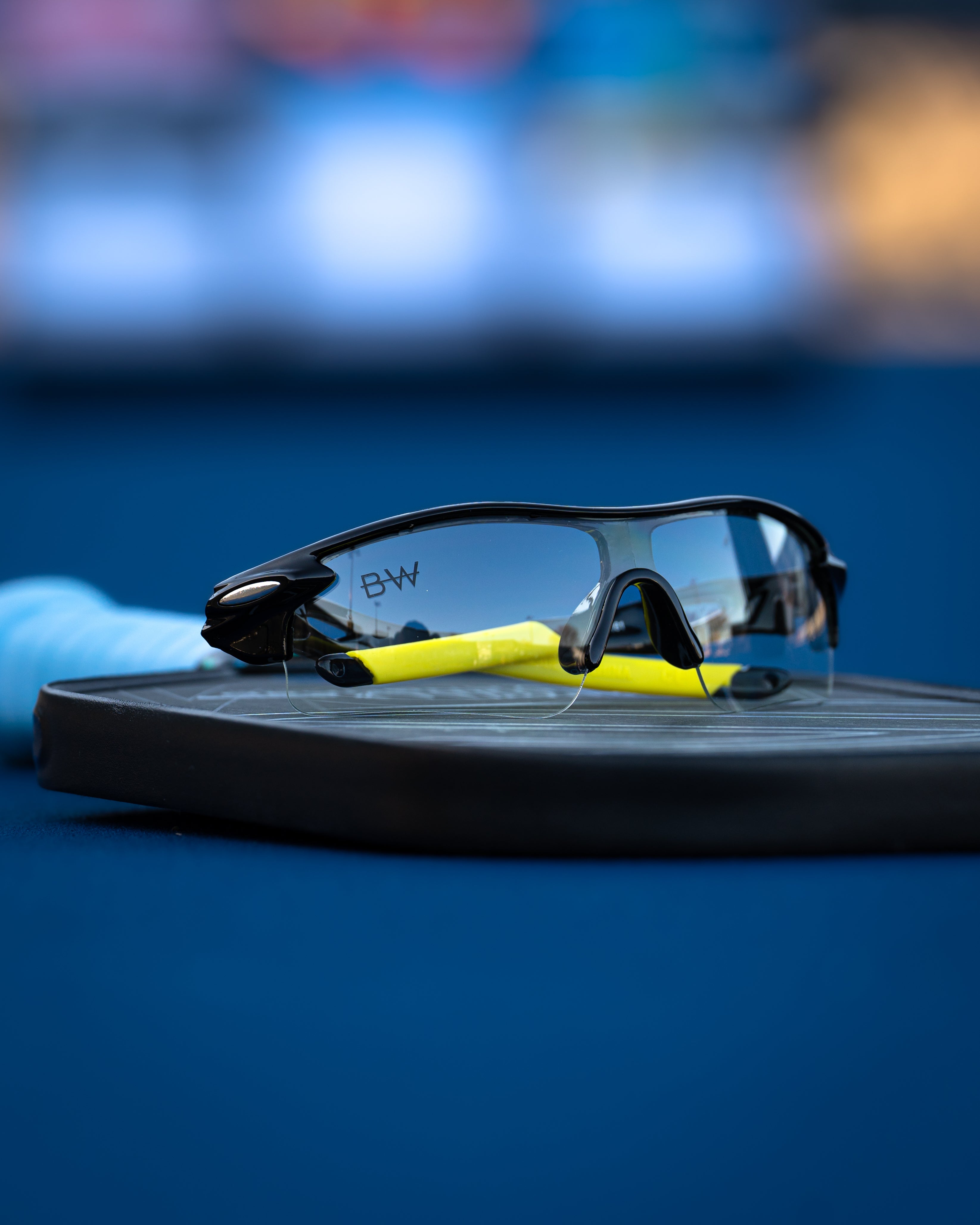
The Truth About RX Glasses and Depth Perception in Pickleball
Share
The Truth About RX Glasses and Depth Perception in Pickleball
Depth perception matters in pickleball because the game constantly asks you to judge where the ball is, how it is traveling, where you are relative to the net, and how much time you have before contact. If you wear prescription glasses, that naturally raises an important question: can RX lenses affect your depth perception on the court?
The original guide says depth perception contributes to judging distance, timing shots, positioning, and interpreting the ball's path. :chatgpt-content-reference{index="0"} Those are useful concepts, but some of the article's later claims go too far by treating particular lens materials, tints, and non-polarized lenses as automatic depth-perception enhancers.
This updated guide separates prescription correction from athletic skill and explains what pickleball players should actually consider when choosing RX eyewear.
Find Your Pickleball Glasses
Compare RX and non-prescription options or start with the complete 2026 pickleball eyewear guide.
Quick Answer: Do RX Glasses Affect Depth Perception in Pickleball?
Prescription glasses provide optical correction based on your prescription. They shouldn't automatically be described as either harming or improving your depth perception.
Your experience can depend on factors including:
- Your individual prescription
- Whether your prescription is current
- Lens design
- Frame dimensions and fit
- How the completed lenses are positioned relative to your eyes
- How accustomed you are to the prescription
- Your own visual system
High-index material, tint, polarization status, or a sports frame alone doesn't guarantee better depth perception.
What Is Depth Perception?
In simple terms, depth perception is your ability to perceive spatial relationships and judge how objects are positioned relative to you and one another.
On a pickleball court, you're constantly making spatial judgments involving:
- The approaching ball
- The net
- The kitchen line
- Your partner
- Your opponents
- Your own court position
Those judgments occur while the ball and players may be moving, which makes pickleball a useful example of why vision and athletic skill shouldn't be treated as separate worlds.
Why Depth Perception Matters in Pickleball
The source says depth perception contributes to timing volleys and smashes, court positioning, and interpreting the ball's spin and trajectory. :chatgpt-content-reference{index="1"}
A more precise way to frame it is that spatial judgment is one source of information a player uses during these situations. Successful execution still involves additional skills.
| Pickleball Situation | Visual / Spatial Component | Player Component |
|---|---|---|
| Volley | Judge the developing ball path | Prepare and control the paddle |
| Overhead | Follow the ball's position | Move, prepare, and time contact |
| Dink | Interpret ball and net position | Control trajectory and placement |
| Lob | Follow changing ball position | Reposition and choose a response |
| Drive | Receive visual information about the ball | Anticipate and react |
| Court positioning | Understand spatial relationships | Move into the appropriate position |
How Prescription Lenses Fit Into the Picture
The original article explains that prescription lenses correct refractive errors such as nearsightedness, farsightedness, and astigmatism by changing how light is focused. It then warns that poorly fitted or lower-quality lenses may produce distortion or a narrower field of view. :chatgpt-content-reference{index="2"}
The most important takeaway for a shopper is simpler: RX eyewear should be built around the prescription you actually need.
Blinded Wear RX customers provide a clear photo of their eyeglass prescription before purchasing. Not every frame should be assumed to accommodate every prescription.
Can RX Glasses Improve Depth Perception?
The source says the right RX glasses can go beyond correction and enhance depth perception through improved contrast sensitivity, reduced glare, and more consistent visual input. :chatgpt-content-reference{index="3"}
That claim is too broad for a product guide.
Prescription eyewear can provide the optical correction prescribed to you. Whether an individual experiences a change in depth perception depends on more than whether a frame is labeled “RX” or “sports eyewear.”
Blinded Wear shouldn't promise that its glasses will:
- Increase depth perception
- Restore depth perception
- Sharpen depth cues
- Improve visual-motor connections
- Improve timing
- Make distances easier to judge
- Improve ball tracking
Those outcomes aren't established merely by wearing a particular sports frame or lens material.
Do High-Index Lenses Improve Depth Perception?
Blinded Wear includes high-index prescription lenses at no additional cost.
The original article specifically describes 1.61 high-index lenses as thinner and lighter while claiming they minimize distortion and preserve peripheral vision and depth perception at high speeds. :chatgpt-content-reference{index="4"}
High-index material shouldn't be given all of those performance attributes.
A higher-index material can allow a thinner lens for the same prescription compared with a lower-index material in a comparable design. Final thickness and weight still depend on factors such as:
- Prescription strength
- Lens dimensions
- Frame dimensions and shape
- Lens material
- Overall lens design
An exact 1.61 index should only be advertised when that specification is verified for the current configuration.
High-Index Lenses: What They Do and Don't Tell You
| Claim | Does High-Index Alone Establish It? |
|---|---|
| Potential for a thinner lens | Yes, depending on prescription and comparable design |
| Better depth perception | No |
| Wider peripheral vision | No |
| Minimal distortion in every prescription | No |
| Better ball tracking | No |
| Improved contrast | No |
| Impact resistance | No—separate characteristic |
| Anti-fog performance | No—separate feature |
| Glare reduction | No—separate characteristic |
Do Polarized Lenses Hurt Depth Perception in Pickleball?
The original article advises players to avoid polarized lenses because it says polarization can interfere with depth cues on certain pickleball courts. It then says Blinded Wear uses non-polarized lenses specifically to preserve true depth perception. :chatgpt-content-reference{index="5"}
That conclusion is too strong.
Blinded Wear sports lenses are non-polarized, meaning a polarization filter isn't added. Some athletes prefer non-polarized lenses for court sports, but that preference shouldn't become a universal claim that polarized lenses damage depth perception or that non-polarized lenses improve it.
| Statement | Accurate Framing |
|---|---|
| Blinded Wear sports lenses are non-polarized | Yes |
| Non-polarized means no polarization filter is added | Yes |
| Non-polarized lenses automatically improve depth perception | No |
| Polarized lenses universally harm depth perception | No |
| Non-polarized lenses automatically improve ball tracking | No |
Does Lens Tint Affect Depth Perception?
The original guide assigns different depth-perception benefits to clear, gray, and transitional lenses. It describes clear lenses as providing maximum brightness, gray lenses as maintaining depth cues through reduced glare, and transitional lenses as ideal across changing environments. :chatgpt-content-reference{index="6"}
For product guidance, avoid assuming a tint automatically improves depth perception.
Instead, choose among currently available lens configurations according to:
- Where you play
- Available light
- Your prescription
- Your individual preferences
- The verified specifications of the exact lens
Tint color alone doesn't establish better depth perception, contrast, ball tracking, or reaction time.
Clear RX Lenses for Indoor Pickleball
A clear RX configuration can make sense for players who require prescription correction but don't want an intentional dark sunglass tint indoors.
Clear lenses shouldn't automatically be described as producing:
- Maximum brightness
- Better depth perception
- Better contrast
- Faster reactions
- Improved ball tracking
The simpler distinction is that a clear lens doesn't intentionally add a dark sunglass tint.
Gray RX Lenses for Outdoor Pickleball
The original article says gray lenses reduce glare and eye strain while maintaining true color perception that is critical for accurate depth cues. :chatgpt-content-reference{index="7"}
Those characteristics shouldn't be inferred from tint alone.
A gray RX configuration can be considered when you prefer a tinted lens outdoors, but verify any additional feature you specifically want rather than assuming it comes with the tint.
Changing-Tint RX Lenses and Depth Perception
The source describes transitional lenses as automatically adjusting to changing light and being ideal for players moving between indoor and outdoor environments. :chatgpt-content-reference{index="8"}
If a compatible changing-tint configuration is currently available, it may suit players whose routines involve changing lighting conditions.
Changing-tint functionality doesn't automatically mean:
- Better depth perception
- Improved contrast
- Better ball tracking
- Instant tint changes
- Polarization
- Anti-fog performance
- A specific UV specification
Does Frame Fit Matter?
The original article says an incorrectly sized frame can misalign lenses relative to the eyes and potentially create visual problems. It then describes Frost RX, Ocean Wave RX, and Crystal Wave II RX as providing secure, comfortable fits for fast movement. :chatgpt-content-reference{index="9"}
Individual fit varies, so no model should be described as universally secure.
Before choosing an RX sports frame, compare:
- Overall frame width
- Lens dimensions
- Bridge dimensions
- Temple dimensions
- How the frame sits on your face
- Comfort during longer sessions
- Movement during normal pickleball activity
Frame dimensions and individual fit are more useful shopping criteria than a universal “no-slip” promise.
Why Can a New Prescription Feel Different at First?
A new pair of prescription glasses can feel different from the eyewear you're accustomed to. That doesn't automatically mean the glasses are harming your depth perception or that the lens material is defective.
Rather than diagnosing the cause yourself, pay attention to your experience. If your new prescription eyewear continues to feel visually wrong or produces concerning symptoms, contact the appropriate eye-care professional rather than trying to correct the issue by switching tint or sports-frame style.
Depth Perception Isn't the Same as Pickleball Skill
Even when a player has appropriate prescription correction, reading and responding to a pickleball remains an athletic task.
Consider an opponent's drive:
- You receive visual information about the opponent and ball.
- You recognize the developing shot.
- You estimate the ball's path.
- You anticipate where it may arrive.
- You position yourself.
- You prepare your paddle.
- You execute your response.
Prescription correction is relevant to the visual information available to a player who needs it. The RX lenses don't perform the anticipation, positioning, decision-making, or paddle control.
RX Pickleball Glasses to Compare
The original article recommends Frost RX, Ocean Wave RX, Crystal Wave II RX, and Havana White RX as products designed to maximize or maintain depth perception. :chatgpt-content-reference{index="10"}
Instead of choosing an RX frame because it promises better depth perception, compare verified characteristics relevant to your purchase:
| RX Model | What to Compare |
|---|---|
| Frost RX | Prescription compatibility, dimensions, appearance, current lens configuration |
| Ocean Wave RX | Prescription compatibility, dimensions, appearance, current lens configuration |
| Crystal Wave II RX | Prescription compatibility, dimensions, appearance, current lens configuration |
| H Blue Shield RX | Prescription compatibility, dimensions, appearance, current lens configuration |
| Rocket Fire RX | Prescription compatibility, dimensions, appearance, current lens configuration |
Be Careful With Depth-Perception Testimonials
The original article includes testimonials attributed to Dana S. and Mark L. claiming dramatically improved depth perception, more natural shot reading, less distortion, and greater confidence in positioning and timing. :chatgpt-content-reference{index="11"}
Only publish those testimonials if the customers, wording, purchases, experiences, and permission to use the statements can be verified.
Even when genuine, an individual's experience shouldn't become a promise that another player's depth perception will improve after purchasing the same frame.
The Truth About RX Glasses and Depth Perception
The source concludes that Blinded Wear's 1.61 high-index lenses allow players to judge distances accurately and give their game a visual advantage. :chatgpt-content-reference{index="12"}
The more accurate takeaway is:
If you need prescription correction, appropriate RX eyewear provides that correction while you play pickleball. High-index material, tint, and non-polarized construction shouldn't independently be credited with improving depth perception.
Choose your RX pickleball glasses around your prescription, frame compatibility, fit, playing environment, and verified lens specifications—not a promise that one lens technology will automatically make the court easier to judge.
Depth Perception Is More Than Simply Seeing Clearly
The original guide connects depth perception with estimating distance, timing shots, positioning, and reading the ball's trajectory. :chatgpt-content-reference{index="0"} That helps explain why the topic matters, but it is important not to reduce depth perception to one lens specification.
For a pickleball player, spatial judgment happens while several things are changing at once:
- The ball is moving toward or away from you.
- You may be moving at the same time.
- Your opponent may change position.
- Your partner may move into or out of your field of view.
- The ball's height and trajectory can change rapidly.
- Your distance from the kitchen line and net changes throughout the rally.
Prescription correction can be part of the visual setup for a player who needs it. It does not independently determine how well that player interprets every spatial situation.
Judging Distance on the Pickleball Court
The source describes accurate distance judgment as one of the important functions of depth perception in pickleball. :chatgpt-content-reference{index="1"}
During a rally, you may need to judge spatial relationships involving:
| Situation | What the Player Is Evaluating |
|---|---|
| Incoming drive | The developing path of the ball relative to your position |
| Dink | Ball position relative to the net and court |
| Lob | The ball's changing position as it travels overhead |
| Volley | The approaching ball relative to your paddle position |
| Moving through transition | Your position relative to the ball, net, and court |
| Playing doubles | Ball position plus the locations of your partner and opponents |
RX lenses can provide your prescribed correction during these situations, but they shouldn't be marketed as automatically making those judgments more accurate.
Depth Perception, Ball Trajectory, and Timing
The original article says depth perception helps players time volleys and smashes and read ball trajectory. :chatgpt-content-reference{index="2"}
Those actions involve both visual information and learned pickleball skills. For example, handling an approaching volley may require you to:
- Recognize the opponent's contact.
- Follow the developing ball path.
- Estimate where the ball is likely to arrive.
- Move or maintain your position.
- Prepare the paddle.
- Time your response.
The prescription lens doesn't perform that sequence. It provides the prescribed optical correction you use while performing it.
Does Better Depth Perception Mean You Can Read Spin Better?
The original article groups spin recognition with depth perception, stating that depth perception helps players read the ball's spin and trajectory and that true-to-life colors and contrast are important for reading spin. :chatgpt-content-reference{index="3"} :chatgpt-content-reference{index="4"}
Those concepts shouldn't be treated as interchangeable.
Players can use several visual and contextual cues when interpreting spin, including:
- Opponent paddle path
- Paddle-face orientation
- Contact
- Ball flight
- Ball behavior after the bounce
- Experience recognizing similar shots
Neither high-index material nor a particular tint should automatically be credited with improving spin recognition.
Do High-Index Lenses Give You a Wider Field of View?
The source describes Blinded Wear's high-index lenses as offering a wide field of view and preserving peripheral vision during fast play. :chatgpt-content-reference{index="5"}
High-index material alone doesn't establish a wider field of view.
When comparing RX sports eyewear, factors such as frame and lens dimensions can be more useful to evaluate than assuming the lens index automatically creates greater peripheral visibility.
| Characteristic | What It Actually Describes |
|---|---|
| High-index | Lens material/index |
| Frame width | Physical frame dimension |
| Lens width and height | Physical lens dimensions |
| Prescription | Your required optical correction |
| Field of view | Shouldn't be inferred from high-index material alone |
What About Lens Distortion?
The original article warns that improperly fitted or lower-quality lenses can create distortion and later recommends high-index lenses as a way to achieve minimal distortion. :chatgpt-content-reference{index="6"} :chatgpt-content-reference{index="7"}
High-index material by itself shouldn't be treated as a guarantee of minimal distortion.
If a completed pair of prescription glasses consistently seems visually wrong, don't assume switching tint or simply increasing lens index will solve the issue. Persistent visual concerns are better addressed with the appropriate eye-care professional.
What if Your Prescription Changes?
If your prescription changes, the important issue is whether your current RX eyewear still provides the correction prescribed for you.
The original FAQ says Blinded Wear's Protection Plan provides easy reordering and updates when a prescription changes. :chatgpt-content-reference{index="8"} Current replacement and return terms should instead be checked directly against the current policy.
A prescription change shouldn't be treated as evidence that your depth perception has automatically worsened. It is a reason to make sure the correction you're wearing remains appropriate for you.
Should You Practice in New RX Glasses Before Competition?
The source says consistent use of RX eyewear in practice and competition helps build stronger visual-motor connections. :chatgpt-content-reference{index="9"} That specific outcome shouldn't be guaranteed from the eyewear.
There is still a practical reason to practice in a completed RX pair before an important match: you can evaluate how the eyewear works for you before competition matters.
Try the glasses during:
- Dink rallies
- Serve and return practice
- Third-shot drills
- Baseline drives
- Transition-zone movement
- Fast kitchen exchanges
- Lobs and overheads
- Complete games
A Practical On-Court Test for New RX Pickleball Glasses
You don't need to decide whether a pair “improves depth perception.” Instead, determine whether the completed eyewear works appropriately for your normal play.
- Start with controlled dinks. Pay attention to your general prescription experience.
- Move back toward the baseline. Add longer ball paths.
- Practice serves and returns. Use your normal technique.
- Move through the transition zone. Evaluate the frame during movement.
- Practice volleys and counters. Add faster exchanges.
- Hit overheads. Include upward head movement.
- Play complete games. Evaluate comfort over time.
This isn't a clinical depth-perception test. It's simply a practical way to evaluate your new sports eyewear in the environment where you intend to use it.
How to Evaluate Frame Fit for Pickleball
The original guide says proper fit is critical and describes several Blinded Wear models as secure and comfortable during fast movement. :chatgpt-content-reference{index="10"}
Because faces and frame dimensions vary, test your individual fit rather than relying on a universal secure-fit promise.
Ask:
- Does the frame feel comfortable around my nose?
- Are there uncomfortable pressure points?
- How does it feel around my temples and ears?
- Does it noticeably move during split steps?
- Does it move when I look upward for an overhead?
- Do I repeatedly adjust it during rallies?
- Is it still comfortable after multiple games?
Should Pickleball Players Avoid Polarized RX Lenses?
The source repeatedly recommends avoiding polarized lenses, arguing that polarization can interfere with depth cues and that non-polarized lenses preserve accurate depth perception. :chatgpt-content-reference{index="11"} :chatgpt-content-reference{index="12"}
That shouldn't be presented as a universal rule.
Blinded Wear's sports lenses are non-polarized. Some court players may prefer that configuration, but the accurate distinction is:
| Claim | Better Framing |
|---|---|
| Blinded Wear sports lenses are non-polarized | Supported |
| Non-polarized means no polarization filter is added | Supported |
| Polarized lenses ruin depth perception | Don't make this universal claim |
| Non-polarized lenses improve depth perception | Don't make this claim |
| Non-polarized lenses improve reaction time | Don't make this claim |
Choose Lens Tint for the Environment—Not a Depth-Perception Promise
The original article recommends clear, gray, and transitional configurations according to different playing conditions. :chatgpt-content-reference{index="13"}
That can be useful as a starting point when reframed around environment and preference:
| Configuration | Practical Consideration |
|---|---|
| Clear RX | For players who don't want an intentional dark sunglass tint |
| Tinted RX | An option to compare for outdoor play |
| Changing-tint RX | An option to investigate when playing across changing light, if compatible and currently available |
None should automatically be labeled the “best” lens for depth perception.
How to Choose RX Pickleball Glasses Without Falling for Depth-Perception Claims
The original buying advice recommends a precise prescription, high-index lenses, the right tint, a stable fit, and avoiding polarized lenses. :chatgpt-content-reference{index="14"}
A stronger buying checklist is:
- Start with your current prescription.
- Confirm prescription compatibility. Don't assume every frame supports every RX.
- Compare frame dimensions.
- Consider where you play most often.
- Compare current lens configurations.
- Verify specific features separately. Don't infer UV, anti-fog, anti-reflective, or scratch-resistance characteristics.
- Evaluate individual fit.
- Practice in the completed eyewear.
- Consider backup RX eyewear if you depend on prescription correction.
- Don't buy based on a promise that one lens technology will improve depth perception.
RX Frames to Compare for Pickleball
The original guide highlights Frost RX, Ocean Wave RX, Crystal Wave II RX, and Havana White RX as options intended to keep depth perception sharp. :chatgpt-content-reference{index="15"}
Instead of assigning a depth-perception advantage to a specific model, compare verified characteristics:
| RX Model | Useful Comparison Points |
|---|---|
| Frost RX | Prescription compatibility, dimensions, appearance, current lens options |
| Ocean Wave RX | Prescription compatibility, dimensions, appearance, current lens options |
| Crystal Wave II RX | Prescription compatibility, dimensions, appearance, current lens options |
| H Blue Shield RX | Prescription compatibility, dimensions, appearance, current lens options |
| Havana Melt RX | Prescription compatibility, dimensions, appearance, current lens options |
Don't Confuse Depth Perception With Impact Resistance
Blinded Wear sports eyewear uses impact-resistant lenses. That is a useful active-sports characteristic, but it is separate from depth perception.
| Characteristic | What It Means |
|---|---|
| Prescription correction | Optical correction based on the prescription |
| High-index | Lens material/index |
| Non-polarized | No polarization filter added |
| Impact-resistant | Resistance to impact |
| Depth perception | Shouldn't be reduced to any one of the above characteristics |
Impact-resistant also doesn't mean shatterproof, unbreakable, or certified to a particular protective standard.
Why a Backup RX Pair Can Be Useful
If you depend on prescription correction, losing or damaging your primary glasses during a tournament creates a practical problem regardless of depth-perception marketing.
A familiar backup pair gives you another prescription option if your primary eyewear becomes unavailable.
What if Your RX Pickleball Glasses Break?
The source directs customers to Blinded Wear's Protection Plan when discussing prescription changes and replacement. :chatgpt-content-reference{index="16"} Current coverage should be represented according to the actual policy.
Blinded Wear offers 50% lifetime replacement support for eligible broken eyewear, subject to current policy terms.
Don't Shop for a “Depth-Perception Lens”
Depth perception is too complex to reduce to a marketing label such as high-index, gray tint, changing-tint, or non-polarized.
If you need prescription correction, focus first on getting appropriate RX eyewear and choosing a frame and lens configuration that suit your needs.
Prescription correction is the job of the eyewear. Reading the rally, moving into position, timing your contact, and executing the shot remain the job of the player.
FAQ: RX Glasses and Depth Perception in Pickleball
Can prescription glasses affect depth perception?
Prescription lenses provide optical correction based on your prescription. The original article notes that prescription, lens construction, and fit can influence a wearer's visual experience. :chatgpt-content-reference{index="0"} Depth perception shouldn't be reduced to whether a pair of glasses is simply labeled RX, high-index, tinted, or non-polarized.
Can RX glasses improve my depth perception for pickleball?
Don't assume a pair of RX pickleball glasses will automatically improve depth perception. Their primary job is to provide your prescribed correction. The original article goes further by claiming RX eyewear can enhance depth perception through contrast, glare reduction, and consistent visual input. :chatgpt-content-reference{index="1"} Those outcomes shouldn't be universally promised.
Can RX glasses fully restore depth perception?
The source asks this directly and says RX correction combined with lens quality and fit can preserve or enhance depth perception. :chatgpt-content-reference{index="2"} A more careful answer is that prescription eyewear provides prescribed optical correction; it shouldn't be advertised as universally restoring or enhancing depth perception.
Do high-index lenses improve depth perception?
Not inherently. Higher-index material can allow a thinner lens for the same prescription compared with a lower-index material in a comparable design. Lens index alone doesn't establish better depth perception, peripheral vision, contrast, ball tracking, or reaction time.
Does Blinded Wear include high-index prescription lenses?
Yes. High-index prescription lenses are included at no additional cost. The original article identifies the lenses specifically as 1.61 high-index. :chatgpt-content-reference{index="3"} An exact index should only be promised when verified for the current configuration.
Are polarized lenses bad for depth perception in pickleball?
The original guide says polarized lenses can interfere with depth cues and recommends avoiding them. :chatgpt-content-reference{index="4"} That shouldn't be presented as a universal rule. Blinded Wear sports lenses are non-polarized, meaning a polarization filter isn't added.
Do non-polarized lenses improve depth perception?
No automatic improvement should be claimed. Some court players prefer non-polarized eyewear, but the absence of a polarization filter doesn't inherently increase depth perception, ball tracking, or reaction speed.
Which lens tint is best for depth perception?
There isn't one tint that should be universally marketed as the best for depth perception. Compare currently available configurations according to your prescription, playing environment, and preferences.
Are clear RX lenses good for indoor pickleball?
A clear RX configuration can be useful when you need prescription correction without an intentional dark sunglass tint. Clear lenses don't inherently improve depth perception, contrast, tracking, or reaction time.
What if my new RX glasses make the court look unusual?
If a new prescription consistently feels visually wrong or causes concerning symptoms, contact the appropriate eye-care professional rather than assuming a different tint, frame style, or lens index will solve the issue.
RX Glasses and Depth Perception: Myth vs. Reality
| Claim | Reality |
|---|---|
| “RX glasses automatically improve depth perception.” | Prescription lenses provide prescribed correction; improvement shouldn't be universally promised. |
| “High-index means better depth perception.” | Lens index doesn't measure depth perception. |
| “High-index always means lighter lenses.” | Final lens weight also depends on material density, prescription, dimensions, and design. |
| “Non-polarized lenses improve depth perception.” | Non-polarized means a polarization filter isn't added. |
| “Polarized lenses ruin depth perception.” | This shouldn't be treated as a universal rule. |
| “Gray tint improves depth cues.” | Tint alone doesn't establish better depth perception. |
| “Clear lenses improve ball tracking.” | Clear means no intentional dark sunglass tint; tracking improvement isn't automatic. |
| “Changing-tint lenses improve depth perception.” | Tint-changing functionality doesn't establish better depth perception. |
| “Impact resistance improves vision.” | Impact resistance is a separate lens characteristic. |
Where Spatial Judgment Shows Up During a Pickleball Rally
Depth perception isn't something you use only when the ball is far away. Pickleball constantly changes the spatial relationship between you, the ball, the court, and other players.
| Court Situation | What You Need to Interpret | What Eyewear Doesn't Do for You |
|---|---|---|
| Serve return | Developing ball path and court position | Choose and execute the return |
| Third-shot drop | Ball, net, and target relationships | Control trajectory |
| Kitchen exchange | Ball position during short, quick exchanges | Control paddle preparation and contact |
| Speed-up | Rapidly changing ball position | Anticipate and execute the response |
| Lob | Changing ball position overhead | Move into position |
| Overhead | Ball position relative to your body | Time and execute contact |
| Transition zone | Your position relative to the net, ball, and opponents | Make the movement decision |
Visual Correction Isn't the Same as Court Anticipation
Two players can wear appropriate prescription eyewear and still read the same rally very differently.
Experienced players may use information such as:
- Opponent positioning
- Paddle preparation
- Contact
- Ball trajectory
- Previous shot patterns
- Available court space
- Partner positioning
Those are learned court-reading skills. RX lenses shouldn't be credited with creating anticipation simply because they provide prescription correction.
Is It an Eyewear Issue or a Pickleball Issue?
| What You're Experiencing | What to Evaluate First |
|---|---|
| Your prescription consistently feels wrong | Your prescription and completed RX setup |
| The frame is uncomfortable | Individual frame fit and dimensions |
| The frame repeatedly moves | Individual fit during activity |
| The tint doesn't suit the environment | Current lens configuration |
| You repeatedly arrive late to a ball | Anticipation, positioning, and movement |
| You misread opponent shot selection | Court-reading and anticipation |
| You mishit volleys | Preparation, positioning, timing, and technique |
| You struggle with lobs | Recognition, movement, positioning, and execution |
RX Pickleball Glasses Buying Checklist
The source recommends focusing on prescription accuracy, high-index lenses, tint, frame fit, and non-polarized lenses. :chatgpt-content-reference{index="5"} A more complete checklist avoids turning any one of those characteristics into a depth-perception guarantee.
- Is my eyeglass prescription current?
- Can this frame accommodate my prescription?
- What are the frame dimensions?
- How does the frame fit me individually?
- Do I primarily play indoors, outdoors, or both?
- Which lens configurations are currently available?
- Are the sports lenses impact-resistant?
- Am I assuming a depth-perception benefit that hasn't actually been established?
- Have I verified any UV, anti-reflective, anti-fog, or scratch-resistance feature I specifically want?
- Have I practiced in the completed RX pair?
- Do I need a backup prescription pair?
- Do I understand the current replacement terms?
Compare RX Pickleball Glasses Without the Hype
The source presents Frost RX, Ocean Wave RX, Crystal Wave II RX, and Havana White RX as models built to keep vision sharp and depth perception “on point.” :chatgpt-content-reference{index="6"} A better approach is to compare products using characteristics that can actually be verified.
| RX Model | Useful Comparison Points |
|---|---|
| Frost RX | Prescription compatibility, dimensions, appearance, current lens configuration |
| Ocean Wave RX | Prescription compatibility, dimensions, appearance, current lens configuration |
| Crystal Wave II RX | Prescription compatibility, dimensions, appearance, current lens configuration |
| H Blue Shield RX | Prescription compatibility, dimensions, appearance, current lens configuration |
| Rocket Fire RX | Prescription compatibility, dimensions, appearance, current lens configuration |
| Havana Melt RX | Prescription compatibility, dimensions, appearance, current lens configuration |
Be Careful With “Improved Depth Perception” Reviews
The original guide includes a tournament-player testimonial claiming depth perception improved dramatically and another recreational-player testimonial attributing greater trust in positioning and timing to clarity and lack of distortion. :chatgpt-content-reference{index="7"}
If those testimonials are verified and authorized, they may describe those individuals' experiences. They shouldn't become evidence that every customer will experience improved depth perception.
For product discovery, reviews are more useful when they provide specific context such as:
- The exact frame purchased
- The lens configuration used
- Indoor or outdoor use
- How the frame fit that individual
- How it felt during movement
- How comfortable it remained over time
Tournament-Day RX Eyewear Checklist
- Bring your primary RX eyewear.
- Inspect the frame and lenses before play.
- Clean the lenses appropriately.
- Use the lens configuration you practiced in.
- Bring familiar backup RX eyewear if you depend on prescription correction.
- Store unused eyewear safely.
- Warm up in the pair you'll use during competition.
- Don't make major equipment changes immediately before an important match unless necessary.
Related Pickleball Vision & RX Guides
Replacement Support for Broken RX Eyewear
The original article refers to protection plans and reordering when a prescription changes. :chatgpt-content-reference{index="8"} Current coverage should be represented according to the actual policy rather than assumed from older wording.
Blinded Wear offers 50% lifetime replacement support for eligible broken eyewear, subject to current policy terms.
Final Verdict: The Truth About RX Glasses and Depth Perception in Pickleball
The original article concludes that Blinded Wear's 1.61 high-index RX lenses can help players see clearly, judge distances accurately, enhance every play, and gain a visual advantage. :chatgpt-content-reference{index="9"}
The evidence-based product message should be more precise:
If you require prescription correction, RX sports eyewear provides that correction while you play. That doesn't mean RX glasses automatically improve depth perception—and it doesn't mean wearing prescription glasses inherently harms it either.
Likewise:
- High-index doesn't automatically mean better depth perception.
- Non-polarized doesn't automatically mean better depth perception.
- Gray tint doesn't automatically mean better depth perception.
- Clear lenses don't automatically improve ball tracking.
- Changing-tint lenses don't automatically improve court awareness.
- Impact resistance doesn't determine depth perception.
The better goal is to choose RX eyewear that matches your prescription, fits your individual needs, works for your playing environment, and has the verified lens characteristics you actually want.
Your prescription eyewear provides correction. Your experience, anticipation, positioning, timing, and technique turn visual information into pickleball decisions.
Find RX Glasses for Pickleball
Compare prescription frames and current lens configurations, explore the complete pickleball eyewear guide, or use the quiz to narrow your options.
1 comment
I need a small size like 51, do you you have that size frame/