
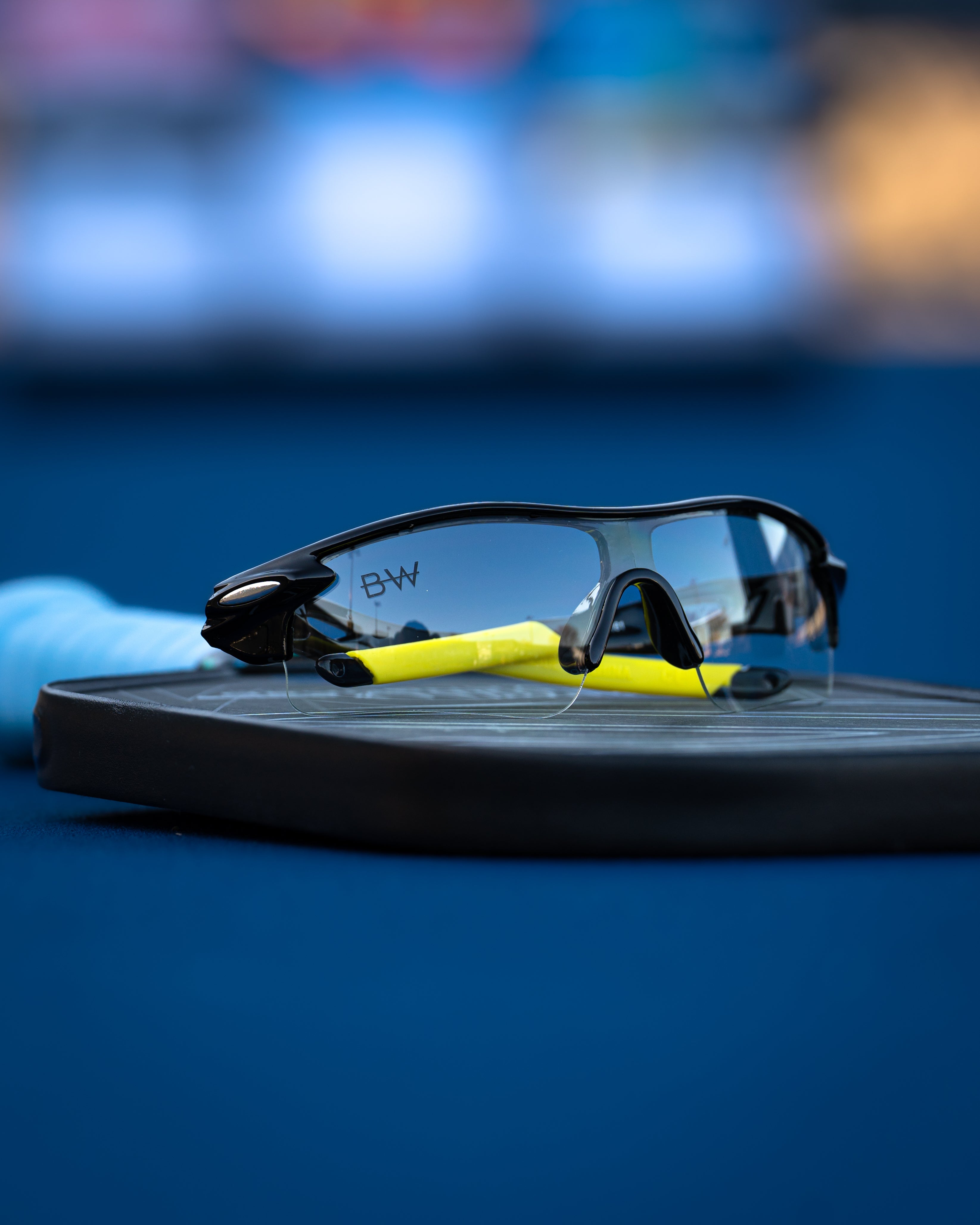
Why Serious Players Upgrade to High-Index 1.61 lenses
Share
Why Serious Players Upgrade to High-Index Lenses
High-index prescription lenses can be a practical option for pickleball players who want prescription correction in a sports-focused frame—especially when lens thickness is an important consideration. But high-index material shouldn't be marketed as a shortcut to faster reactions, better ball tracking, or automatic on-court performance.
The original guide focuses specifically on 1.61 high-index lenses and describes them as thinner and lighter than standard 1.50 plastic for the same prescription strength. :chatgpt-content-reference{index="0"} That basic lens-material distinction is useful. The stronger claims about superior clarity, reaction time, peripheral vision, and pickleball performance need more careful framing.
Here's what high-index actually means, when it may matter, and what RX pickleball players should consider before choosing a frame and lens configuration.
Find Your Pickleball Glasses
Start with whether you need prescription or non-prescription sports eyewear, then compare individual frames and current lens configurations.
- Shop RX Prescription Pickleball Glasses
- Shop Non-RX Pickleball Sunglasses
- View the 2026 Pickleball Glasses Guide
These are the same core shopping destinations included in the original article. :chatgpt-content-reference{index="1"}
Quick Answer: Why Choose High-Index Prescription Lenses?
High-index lens materials bend light more efficiently than lower-index materials, which can allow a prescription lens to be made thinner for the same correction.
That can be especially relevant when prescription strength would otherwise result in thicker lenses.
| Question | Short Answer |
|---|---|
| What does “high-index” mean? | It refers to lens material with a higher refractive index. |
| Can high-index lenses be thinner? | Yes, compared with a lower-index material for the same prescription and comparable design. |
| Are they always lighter? | Not automatically; final weight depends on material, prescription, lens dimensions, frame, and design. |
| Do they improve reaction time? | No inherent reaction-time improvement should be promised. |
| Do they automatically provide clearer vision? | Your prescription and complete lens design matter more than index alone. |
| Are high-index RX lenses included by Blinded Wear? | Yes, high-index prescription lenses are included at no additional cost. |
What Are High-Index Prescription Lenses?
The refractive index describes how a lens material bends light. A higher-index material can achieve the required optical power with less lens curvature or thickness than a lower-index material in an otherwise comparable prescription and design.
The original article compares 1.61 high-index material with standard 1.50 plastic and explains that the higher refractive index can produce a thinner lens for the same prescription strength. :chatgpt-content-reference{index="2"}
That's the core reason high-index lenses exist: managing prescription lens thickness.
They aren't inherently a sports-performance technology.
What Does the Lens Index Number Mean?
Numbers such as 1.50, 1.59, 1.60, 1.61, 1.67, or other index values refer to characteristics of the lens material—not a score for optical quality.
A higher number doesn't automatically mean:
- Sharper vision
- Better depth perception
- Faster reactions
- Better ball tracking
- More impact resistance
- Less distortion
- A better lens for every prescription
The appropriate lens depends on the complete prescription and eyewear configuration.
Why Can High-Index Lenses Be Thinner?
Because a higher-index material bends light more efficiently, the required prescription power can be produced with a different lens profile than a lower-index material.
This difference tends to become more noticeable as prescription strength increases, although the final result also depends on factors such as:
- Sphere power
- Cylinder and axis
- Lens shape
- Frame size
- Frame geometry
- Lens design
- How the lens is positioned within the frame
That's why “high-index = thin” is directionally useful, while promising a specific thickness reduction without the actual prescription and frame isn't.
Are High-Index Lenses Lighter?
The original article states that 1.61 lenses dramatically reduce weight compared with standard lenses. :chatgpt-content-reference{index="3"}
That shouldn't be treated as a universal guarantee.
A thinner lens can reduce the amount of material required in some prescriptions, but lens weight isn't determined by thickness alone. Material density, prescription strength, frame dimensions, and the finished lens shape also matter.
For sports eyewear, the practical takeaway is to evaluate the completed pair rather than assuming a particular index will automatically feel nearly weightless.
Why High-Index Can Matter More for Stronger Prescriptions
As prescription power increases, lens thickness can become a bigger consideration. That's where higher-index materials may become particularly useful.
Depending on the prescription, frame, and lens design, high-index material may help create a more manageable finished lens profile.
That can matter when you're trying to combine:
- Prescription correction
- A sports-oriented frame
- A practical finished lens shape
- Comfortable everyday or court use
The original FAQ similarly says high-index lenses can be particularly relevant for medium-to-strong prescriptions. :chatgpt-content-reference{index="4"}
Do Mild Prescriptions Need High-Index Lenses?
Not every prescription needs a higher-index material to keep lens thickness manageable.
With a mild prescription, the physical difference between lens materials may be less noticeable than it is with stronger correction.
That doesn't make high-index inappropriate. It simply means the practical benefit varies with the prescription and frame.
If high-index prescription lenses are already included with your Blinded Wear RX configuration, you don't need to manufacture an athletic-performance reason to justify them.
Do High-Index Lenses Reduce Distortion?
The original guide claims thicker standard lenses often create edge distortion or a “fishbowl effect,” while high-index lenses minimize distortion and provide sharper peripheral vision for tracking fast-moving pickleballs. :chatgpt-content-reference{index="5"}
That's too broad.
Perceived distortion can involve multiple factors beyond lens index, including:
- The prescription
- Lens design
- Frame geometry
- Optical measurements
- Lens positioning
- The wearer's adaptation to a new prescription or design
High-index material shouldn't be advertised as automatically eliminating edge distortion or improving peripheral ball tracking.
Do High-Index Lenses Provide Better Visual Clarity?
A higher refractive index isn't automatically a higher level of visual clarity.
The original comparison table labels standard 1.50 lenses as providing “good” clarity and 1.61 high-index lenses as providing “superior” clarity. :chatgpt-content-reference{index="6"}
That's an oversimplification.
Your experience of clear prescription vision depends on the prescription being correct, the lens being appropriately made, the design, measurements, fit, and other optical characteristics. Index is one part of the complete lens—not a universal clarity ranking.
Do High-Index Lenses Improve Reaction Time?
The source argues that clearer, distortion-free 1.61 lenses help the brain process visual information faster during serves, volleys, and smashes. :chatgpt-content-reference{index="7"}
Don't turn that into a performance claim.
High-index lens material doesn't inherently make an athlete react faster.
Reaction time during pickleball involves much more than lens index, including:
- Anticipation
- Experience
- Attention
- Movement
- Positioning
- Decision-making
- Physical response speed
- Appropriate vision correction
Prescription eyewear can provide the correction a player needs. It shouldn't promise to make that player faster.
Do High-Index Lenses Improve Ball Tracking?
Not inherently.
The source connects reduced lens distortion with sharper peripheral vision and improved tracking of fast-moving balls. :chatgpt-content-reference{index="8"} But lens index by itself doesn't establish improved ball tracking.
A better hierarchy for RX pickleball players is:
- Use an appropriate, current prescription.
- Choose a frame compatible with that prescription.
- Confirm the lens configuration.
- Evaluate fit and comfort.
- Choose eyewear appropriate for your playing environment.
High-index material can be part of that setup without being credited for athletic skill.
High-Index Lenses and Sports Frame Compatibility
The original article says thinner 1.61 lenses fit sports frames better and provide greater frame compatibility. :chatgpt-content-reference{index="9"} :chatgpt-content-reference{index="10"}
Thinner lens profiles can be useful in some frame-and-prescription combinations, but high-index material doesn't make every prescription compatible with every sports frame.
Compatibility can depend on:
- Prescription power
- Cylinder and axis
- Lens dimensions
- Frame dimensions
- Frame curvature
- Lens design
- Other prescription requirements
Confirm compatibility for the exact frame and prescription rather than assuming high-index solves every fit or manufacturing constraint.
High-Index and Non-Polarized Are Different Lens Characteristics
The original article groups high-index 1.61 material with Blinded Wear's non-polarized lens approach and claims non-polarized lenses preserve natural depth perception. :chatgpt-content-reference{index="11"}
These characteristics should be separated.
| Term | What It Describes |
|---|---|
| High-index | A characteristic of the lens material and how it refracts light |
| Non-polarized | No polarization filter is added |
| Tint | The visible color or darkness of the lens |
| Prescription | The vision correction required by the wearer |
A high-index lens isn't automatically polarized or non-polarized simply because of its refractive index.
Can High-Index RX Lenses Be Clear or Tinted?
Lens material and tint are separate considerations.
The original article lists clear, gray, transitional, and blue-light-filtering options alongside its high-index offering. :chatgpt-content-reference{index="12"} It later says those options are available in high-index material. :chatgpt-content-reference{index="13"}
Because product configurations can change, confirm which options are currently available for the exact RX frame you're ordering rather than assuming every frame supports every historical lens option.
Are High-Index Lenses Automatically Scratch-Resistant or Anti-Reflective?
No. Lens index and lens coatings are separate characteristics.
The original article describes Blinded Wear's high-index lenses as using scratch-resistant and anti-reflective sport-focused coatings. :chatgpt-content-reference{index="14"} Those features should only be applied to a current configuration when verified.
High-index by itself doesn't mean:
- Scratch-resistant
- Scratch-proof
- Anti-reflective
- Anti-glare
- Anti-fog
- Hydrophobic
- UV400
Verify each specification separately.
So Why Would a Serious Pickleball Player Choose High-Index?
Not because high-index makes someone a more serious athlete.
A better reason is simple: players who depend on prescription correction may want a lens material that helps manage the finished lens profile within a compatible sports frame.
That becomes increasingly relevant when you're playing frequently and your eyewear is something you rely on every time you step onto the court.
The upgrade is optical and practical—not a promise of better dinks, faster hands, or more wins.
What About the 1.61 Player Testimonials?
The original article includes testimonials claiming an upgrade to 1.61 produced sharper vision, dramatically lighter eyewear, zero distortion, and zero discomfort during tournaments. :chatgpt-content-reference{index="15"}
Those quotes should only be published as customer testimonials if the customers, statements, purchases, and permission to use them can be verified.
More useful verified customer feedback would identify:
- The player's prescription
- The frame purchased
- The previous lens material
- The new lens configuration
- How frequently the eyewear is used
- The customer's subjective experience with thickness, weight, fit, and comfort
That gives shoppers meaningful context without turning one person's experience into a universal lens-material guarantee.
The Real Advantage of High-Index RX Lenses
The original article presents 1.61 as a direct upgrade in thickness, weight, distortion, clarity, frame compatibility, and athletic performance. :chatgpt-content-reference{index="16"}
The real story is more precise:
High-index materials can help manage lens thickness for a given prescription. How meaningful that advantage is depends on your prescription, frame, lens design, and complete eyewear configuration.
That's already a valuable feature for prescription eyewear. It doesn't need unsupported reaction-time or performance claims attached to it.
High-Index vs. Standard Prescription Lenses
The original article compares 1.61 high-index lenses directly with standard 1.50 plastic and gives the high-index option the advantage in thickness, weight, peripheral distortion, visual clarity, and frame compatibility. :chatgpt-content-reference{index="0"}
The thickness distinction is useful, but the rest of the comparison needs more context. Lens index alone doesn't determine every characteristic of the finished pair.
| Consideration | Lower-Index Lens | Higher-Index Lens |
|---|---|---|
| Refractive index | Lower | Higher |
| Thickness for the same prescription | Generally thicker in a comparable design | Can generally be made thinner |
| Finished weight | Depends on material, prescription, frame, and dimensions | Depends on material, prescription, frame, and dimensions |
| Prescription clarity | Depends on the complete optical configuration | Depends on the complete optical configuration |
| Distortion | Not determined by index alone | Not automatically eliminated by higher index |
| Sports performance | No inherent disadvantage | No inherent performance boost |
Your Prescription Determines How Much High-Index Matters
Two pickleball players can order the same frame and get very different finished lenses because their prescriptions are different.
For example, the practical value of a higher-index material may vary according to:
- Sphere power
- Cylinder power
- Axis
- Whether correction is primarily plus or minus
- Lens dimensions
- Frame shape
- Lens design
That's why high-index shouldn't be treated as a universal “performance upgrade.” Its value is prescription-dependent.
High-Index Lenses and Strong Minus Prescriptions
With stronger minus prescriptions, lens edges can become more noticeable depending on the frame and lens design. A higher-index material can help manage that thickness compared with a lower-index material used for the same correction.
Frame selection still matters. Larger lens shapes can require more lens material, while the way a frame centers around the wearer's eyes can also influence the finished lens profile.
So if thickness is one of your concerns, don't evaluate the index number in isolation. Evaluate the prescription + frame + lens together.
What About Plus Prescriptions?
Higher-index material can also be relevant for plus prescriptions, where lens thickness tends to be concentrated differently than with minus prescriptions.
Again, the finished result depends on more than index. Frame dimensions, lens design, prescription strength, and optical measurements can all affect the completed eyewear.
This is another reason a generic statement like “1.61 is dramatically thinner and lighter for everyone” is too broad.
Why Frame Size Still Matters
High-index material can't completely override frame geometry.
If you're comparing RX pickleball frames, consider:
- Overall frame width
- Individual lens width
- Lens height
- Bridge dimensions
- Frame curvature
- How the frame fits your face
A higher-index material can help manage lens thickness, but the exact frame still needs to be appropriate for your prescription.
Does Playing Pickleball Change Which Lens Index You Need?
Not automatically. Your prescription doesn't become stronger because you're playing pickleball.
What changes is the context in which you're wearing the eyewear. A pickleball player may care about:
- Using prescription correction during active movement
- Sports-focused frame design
- Individual fit
- Impact-resistant lenses
- Indoor versus outdoor lens configuration
- Longer playing sessions
- Storage and durability
Lens index can be part of that setup, but pickleball itself doesn't make a particular refractive index mandatory.
High-Index Does Not Mean Impact-Resistant
This distinction matters for sports eyewear.
High-index describes an optical material characteristic. Impact resistance describes how a lens responds to physical impact. They aren't interchangeable terms.
Blinded Wear sports eyewear uses impact-resistant lenses, but don't conclude that a lens is impact-resistant merely because it's high-index.
Likewise, impact-resistant doesn't mean:
- Shatterproof
- Unbreakable
- Certified protective eyewear
- Guaranteed to prevent an eye injury
For more context, read Why Impact Resistance Matters in Sports Eyewear.
Lens Thickness Isn't the Same as Eye Protection
A thinner prescription lens may be desirable for practical or cosmetic reasons, but thickness alone doesn't tell you how much protection the eyewear provides.
When evaluating prescription sports eyewear, keep these concepts separate:
| Feature | What It Tells You |
|---|---|
| Refractive index | How the lens material refracts light |
| Prescription | The correction required by the wearer |
| Impact resistance | A characteristic related to physical impact |
| Polarization | Whether a polarization filter is present |
| Tint | Visible color or darkness |
| UV specification | A separate lens specification that should be verified |
Are High-Index Lenses Non-Polarized?
High-index and polarization describe different things.
A high-index lens isn't inherently polarized or non-polarized because of its refractive index. Blinded Wear uses non-polarized lenses in its sports eyewear, but that is separate from the high-index material used for prescription correction.
The original article combines the two and says non-polarized lenses preserve natural depth perception. :chatgpt-content-reference{index="1"} Some court players prefer non-polarized eyewear, but don't promise that it inherently improves or preserves depth perception compared with polarized lenses.
For a deeper explanation, see Depth Perception Science for Pickleball.
High-Index RX Lenses for Indoor Pickleball
The refractive index doesn't determine whether a lens is intended for indoor or outdoor play.
For indoor pickleball, a player may prefer an available clear configuration rather than a dark sunglass tint. That preference is separate from whether the prescription lens uses a higher-index material.
A clear high-index RX lens shouldn't be described as increasing light, enhancing contrast, or improving reaction speed. It's simply a way of combining prescription correction with a clear rather than dark-tinted configuration when available.
High-Index RX Lenses for Outdoor Pickleball
Higher-index prescription material can also be used as part of an outdoor RX setup when an appropriate lens configuration is available.
Again, separate the different specifications:
- High-index relates to the prescription lens material
- Tint relates to lens color or darkness
- Polarization relates to whether a polarization filter is present
- UV protection is a separate specification that should be verified
A higher refractive index doesn't automatically make a lens better for bright sunlight.
Can High-Index Lenses Be Photochromic?
The original article says Blinded Wear offers transitional lens options in high-index material. :chatgpt-content-reference{index="2"} Current availability should be confirmed for the exact RX product before making that promise.
When available, photochromic technology and lens index still describe different characteristics.
Photochromic lenses shouldn't automatically be described as:
- Polarized
- Anti-fog
- Scratch-resistant
- Instantly transitioning
- UV400 unless verified
- Better for ball tracking
- Better for reaction time
Read Transition RX Lenses for Travel and Training for more on changing-light configurations.
Can Progressive Prescriptions Use High-Index Lenses?
Lens index and progressive lens design are separate considerations.
A progressive prescription may be compatible with a higher-index material, but don't assume every progressive prescription can be placed into every Blinded Wear sports frame.
Compatibility can depend on:
- The complete prescription
- Progressive lens design
- Frame dimensions
- Available fitting height
- Other optical measurements
- The exact product configuration
Confirm compatibility for the individual order.
What if You Have Astigmatism?
Don't choose a lens index solely because your prescription includes cylinder correction.
Your complete prescription—including sphere, cylinder, axis, and any additional requirements—needs to be considered with the selected frame.
High-index material can be useful for some prescriptions, but it doesn't inherently provide better correction for astigmatism or improve pickleball performance.
Blinded Wear RX Frames to Compare
If you're shopping for high-index prescription pickleball eyewear, compare the frame as carefully as the lens material.
| RX Model | What to Compare |
|---|---|
| Frost RX | Prescription compatibility, dimensions, current configuration, fit |
| Ocean Wave RX | Prescription compatibility, dimensions, current lens configuration |
| H Blue Shield RX | Prescription compatibility, frame dimensions, current specifications |
| Lava Rock RX | Prescription compatibility, dimensions, current configuration |
| Phantom II RX | Frame shape, prescription compatibility, dimensions |
| Rocket Fire RX | Prescription compatibility, dimensions, individual fit |
| Silver Line RX | Prescription compatibility, current specifications, frame dimensions |
The best choice isn't necessarily the frame that looks smallest, lightest, or most athletic. It's the frame that works with your prescription and fits your needs.
What About Heatseek RX and the Original Product Examples?
The source specifically mentions Heatseek RX and Frost RX in testimonials about 1.61 lenses. One customer quote claims sharper vision and substantially lighter eyewear in Heatseek RX, while another claims no distortion or discomfort in Frost RX. :chatgpt-content-reference{index="3"}
Those experiences shouldn't be converted into product specifications unless the testimonials are verified.
For any RX model, rely on the current product configuration and the customer's actual prescription rather than assuming the results described in an old testimonial will apply universally.
High-Index Doesn't Fix a Poorly Fitting Frame
A thinner lens doesn't automatically mean the completed eyewear will fit your face correctly.
Before ordering, compare frame dimensions when available. After receiving the eyewear, evaluate:
- How the bridge sits on your nose
- Pressure around the temples and ears
- Whether you're frequently adjusting the frame
- Whether the frame remains comfortable during normal movement
- Whether your prescription feels appropriate
Frame fit and lens index solve different problems.
Do High-Index Lenses Guarantee Better Comfort?
No. The original article describes high-index 1.61 lenses as an upgrade for “ultimate comfort” and says thinner lenses reduce discomfort in sports frames. :chatgpt-content-reference{index="4"}
A more precise claim is that reducing lens thickness may contribute to a more practical finished pair in some prescriptions.
Overall comfort can also depend on:
- Total eyewear weight
- Frame fit
- Bridge shape
- Temple pressure
- Frame dimensions
- Playing duration
- Individual sensitivity
No lens index can guarantee all-day or tournament-long comfort for every wearer.
Should You Upgrade if Your Current RX Glasses Already Work?
Not necessarily.
If your current prescription eyewear provides appropriate correction, fits comfortably, and works for your recreational needs, a higher-index material isn't automatically necessary simply because you play pickleball seriously.
An upgrade may become more relevant when:
- Your prescription has changed
- Your current lenses are undesirably thick for your chosen frame
- You want dedicated sports-focused RX eyewear
- Your existing frame isn't practical for your playing routine
- You're replacing damaged or outdated eyewear anyway
“Serious player” should describe your commitment to the sport—not pressure you into buying a lens material you don't need.
How to Choose High-Index RX Pickleball Glasses
- Start with your current prescription. Know the correction you're actually ordering.
- Choose a compatible sports frame. Don't assume every RX works in every frame.
- Consider lens thickness. This is where high-index material can be particularly useful.
- Check frame dimensions. Frame geometry still affects the completed eyewear.
- Choose for your environment. Consider indoor, outdoor, evening, or mixed use.
- Verify current lens options. Don't assume every historical tint or treatment is still available.
- Separate material from performance. High-index doesn't inherently improve reactions, tracking, or skill.
What Blinded Wear Includes With RX Eyewear
Blinded Wear includes high-index prescription lenses at no additional cost with its RX eyewear.
Customers provide a clear photo of their eyeglass prescription before purchasing. Prescription compatibility should still be confirmed for the selected frame.
Blinded Wear sports eyewear also uses:
- Non-polarized lenses
- Impact-resistant sports lenses
- Sports-focused frame designs
Those characteristics should be evaluated independently rather than treating them as automatic consequences of high-index material.
What if Your RX Glasses Break?
Blinded Wear provides 50% lifetime replacement support for eligible broken eyewear, subject to current policy terms.
That support doesn't mean the lenses or frames are unbreakable, and high-index material shouldn't be marketed as guaranteeing greater durability simply because the finished lens may be thinner.
A Better Way to Think About the “Upgrade”
The original article describes moving to 1.61 lenses as one of the most impactful upgrades a serious pickleball player can make. :chatgpt-content-reference{index="5"}
A more accurate buying framework is:
High-index is an optical-material option that can help manage prescription lens thickness. Whether that matters significantly to you depends on your prescription and frame.
For the right RX wearer, that's a useful feature. For another player, the difference may be relatively minor. Neither player's commitment to pickleball is determined by their lens index.
Frequently Asked Questions About High-Index Lenses for Pickleball
What are high-index prescription lenses?
High-index lenses use material with a higher refractive index, allowing the required prescription power to be produced with a thinner lens profile than a lower-index material in a comparable prescription and design.
What does 1.61 mean?
1.61 refers to the refractive index of the lens material. The original article compares 1.61 high-index material with standard 1.50 plastic and presents 1.61 as the thinner option for the same prescription strength. :chatgpt-content-reference{index="0"}
Are 1.61 lenses always thinner?
A higher-index material can generally produce a thinner lens than a lower-index material for the same prescription in a comparable design. Final thickness still depends on the prescription, frame dimensions, lens shape, and other design factors.
Are high-index lenses always lighter?
Not necessarily. The original guide describes 1.61 lenses as dramatically lighter than standard lenses. :chatgpt-content-reference{index="1"} Finished weight also depends on material density, prescription, frame dimensions, lens size, and the amount of material required.
Do high-index lenses provide clearer vision?
A higher index isn't automatically a higher clarity rating. Prescription accuracy, lens design, measurements, frame fit, and the complete optical configuration all matter.
Do high-index lenses improve reaction time?
No inherent reaction-time improvement should be promised. The original article connects 1.61 lenses with faster visual processing during serves, volleys, and smashes, but the source doesn't establish that the lens material itself produces faster reactions. :chatgpt-content-reference{index="2"}
Do high-index lenses improve ball tracking?
Lens index alone shouldn't be credited with improved ball tracking. Appropriate prescription correction matters, but tracking a moving ball involves many factors beyond lens material.
Are high-index lenses better for strong prescriptions?
They can be particularly useful when prescription strength makes lens thickness a greater consideration. The exact benefit depends on the prescription and frame.
Do mild prescriptions need high-index lenses?
Not necessarily. With milder correction, the physical difference between lens materials may be less noticeable than it is with stronger prescriptions.
Can high-index lenses be non-polarized?
Yes. Lens index and polarization are separate characteristics. Blinded Wear uses non-polarized sports lenses.
Are high-index lenses automatically impact-resistant?
No. Refractive index and impact resistance describe different characteristics. Blinded Wear sports eyewear uses impact-resistant lenses, but “high-index” itself doesn't mean impact-resistant or shatterproof.
Are high-index lenses automatically anti-fog or scratch-resistant?
No. Anti-fog, scratch resistance, anti-reflective treatments, UV specifications, and similar features should be verified separately for the exact lens configuration.
Does Blinded Wear include high-index prescription lenses?
Yes. Blinded Wear includes high-index prescription lenses at no additional cost with its RX eyewear.
High-Index Lens Myths vs. Reality
| Claim | Reality |
|---|---|
| “Higher index means sharper vision.” | Index isn't a universal optical-quality score. |
| “High-index lenses eliminate distortion.” | Perceived distortion can depend on multiple optical and fitting factors. |
| “1.61 lenses make you react faster.” | Lens material doesn't inherently increase athletic reaction speed. |
| “High-index improves ball tracking.” | No automatic tracking improvement should be promised. |
| “Higher-index lenses are always lighter.” | Finished weight depends on the complete lens and frame configuration. |
| “High-index means impact-resistant.” | These are separate lens characteristics. |
| “High-index means non-polarized.” | Refractive index and polarization are separate. |
| “Every serious player needs high-index.” | The practical benefit depends primarily on prescription and frame. |
Who May Benefit Most From High-Index RX Lenses?
High-index material may be especially worth considering when:
- Your prescription would otherwise create thicker lenses
- You're trying to manage the finished lens profile within a sports frame
- You're replacing prescription eyewear and want to compare lens-material options
- You play frequently and rely on prescription correction every time you're on court
- You want dedicated RX sports eyewear rather than relying on an everyday frame
The important distinction is that these are prescription and eyewear considerations, not indicators of athletic ability.
Who May Notice Less Difference?
A player with a relatively mild prescription may not experience the same lens-thickness difference as someone requiring substantially stronger correction.
You may also have less reason to replace your current eyewear solely for lens index if:
- Your existing RX glasses already fit comfortably
- Your current lens thickness doesn't bother you
- Your current prescription correction works well for your needs
- You don't need dedicated sports-focused prescription eyewear
High-index can be useful without being mandatory.
What “Serious Players Upgrade” Should Really Mean
The original article frames 1.61 lenses as one of the most impactful upgrades available to serious pickleball players. :chatgpt-content-reference{index="3"}
A stronger interpretation is that frequent players who depend on prescription correction may have more reason to optimize their eyewear setup.
If you play several times per week, tournaments, leagues, or long sessions, prescription eyewear becomes equipment you use repeatedly. That can make frame compatibility, lens thickness, fit, and backup planning more important to you.
It still doesn't mean 1.61—or any other particular index—makes someone a better or more serious pickleball player.
7 Mistakes to Avoid When Choosing High-Index Sports Glasses
- Buying based only on the index number. Your complete prescription and frame matter.
- Assuming higher index always means better vision. Index isn't a clarity score.
- Ignoring frame dimensions. Lens size and frame geometry affect the finished result.
- Expecting better pickleball performance. Lens material doesn't replace skill, positioning, or reaction ability.
- Confusing high-index with impact resistance. They're separate characteristics.
- Assuming every RX works in every sports frame. Confirm prescription compatibility.
- Assuming every lens treatment is included. Verify coatings, tint, UV specifications, and other features separately.
High-Index Lens Scenarios for Pickleball Players
| Player | What Matters Most |
|---|---|
| Player with a mild RX | High-index may provide a smaller practical thickness difference |
| Player with a stronger RX | Lens thickness may make high-index more relevant |
| Indoor player | Prescription compatibility and an appropriate available lens configuration |
| Outdoor player | Prescription compatibility plus an appropriate outdoor lens configuration |
| Progressive wearer | Confirm progressive compatibility with the exact frame and prescription |
| Tournament player | Fit, prescription, comfort, storage, and backup eyewear planning |
| Multi-sport athlete | Whether the complete frame-and-lens setup suits each intended activity |
High-Index Lenses for Tournament Players
If you're traveling for tournaments or spending long days around the courts, lens index is only one part of your RX setup.
Also consider:
- Whether your prescription is current
- Whether the frame has already been tested during normal play
- How you'll store the glasses between matches
- Whether lighting conditions change throughout the day
- Whether you depend enough on your RX to justify bringing a backup pair
See Lightweight RX Glasses for Tournament Travel and When to Bring a Spare RX Pair in Your Bag.
Should Serious Players Carry Backup RX Glasses?
If you rely heavily on prescription correction, a backup pair may be more valuable during an important tournament than obsessing over small differences between lens-index numbers.
Prescription eyewear can be:
- Lost
- Damaged
- Left behind
- Stored improperly
- Unavailable when you unexpectedly need it
A backup pair gives you another option if something happens to your primary eyewear.
How to Care for High-Index Prescription Sports Lenses
The original guide recommends regular cleaning and protective storage for high-index lenses. :chatgpt-content-reference{index="4"} Those are useful habits regardless of refractive index.
- Check the lenses for visible dust, sand, or grit before wiping.
- Remove loose debris carefully.
- Use cleaning methods appropriate for your prescription lenses.
- Avoid abrasive materials that may damage the lens surface.
- Keep your storage sleeve or case reasonably clean.
- Avoid placing the eyewear loose with keys or heavy equipment.
- Inspect the frame and lenses after a significant impact.
Don't assume high-index lenses are scratch-proof simply because they're premium prescription lenses.
How to Evaluate High-Index Lens Reviews
The original article includes customer quotes describing 1.61 lenses as noticeably lighter, sharper, distortion-free, and comfortable through tournaments. :chatgpt-content-reference{index="5"}
If you're comparing customer reviews, look for context such as:
- The reviewer's prescription strength
- The frame used
- The previous lens material
- The new lens material
- How long the eyewear was worn
- Whether the comparison used the same prescription
- Whether comments about weight or comfort are clearly presented as subjective experiences
That context makes a review much more useful than a blanket statement that one index is “better.”
How to Order Blinded Wear RX Pickleball Glasses
If you're ready to compare prescription options, start with your current eyeglass prescription.
- Browse the RX Pickleball Glasses collection.
- Choose a frame based on your prescription needs, dimensions, style, and playing environment.
- Review the currently available lens configuration.
- Provide a clear photo of your eyeglass prescription before purchasing.
- Confirm compatibility for more complex prescription requirements.
Blinded Wear includes high-index prescription lenses at no additional cost with its RX eyewear.
50% Lifetime Replacement Support
Blinded Wear offers 50% lifetime replacement support for eligible broken eyewear, subject to current policy terms.
This support is separate from lens index. It shouldn't be interpreted as proof that high-index lenses are more durable or as a guarantee that eyewear can't break.
High-Index RX Buying Checklist
- Is your prescription current?
- How strong is your prescription?
- Is lens thickness an important consideration?
- Is the selected sports frame compatible with your prescription?
- Have you compared frame dimensions?
- Do you understand what high-index does—and what it doesn't do?
- Which lens configuration is currently available?
- Does that configuration suit where you normally play?
- Have you verified any coatings or UV specifications important to you?
- Do you understand the current replacement-support terms?
Related RX Pickleball Guides
Final Verdict: Are High-Index Lenses Worth It for Serious Pickleball Players?
High-index prescription lenses can be a worthwhile part of a pickleball player's RX setup, particularly when prescription strength makes lens thickness an important consideration.
The original article makes the case for 1.61 lenses primarily through thinner construction, lighter weight, reduced distortion, greater clarity, improved frame compatibility, and better athletic performance. :chatgpt-content-reference{index="6"} The strongest part of that argument is the relationship between higher refractive index and the ability to manage lens thickness.
The rest requires more context.
High-index lenses can offer a practical prescription benefit, but they don't inherently guarantee:
- Better depth perception
- Faster reactions
- Improved ball tracking
- Sharper peripheral vision
- Zero distortion
- Lower weight in every configuration
- Better pickleball performance
For RX players, the strongest buying process is to start with the prescription, choose a compatible sports frame, consider lens thickness and configuration, and then evaluate individual fit.
That's why high-index can be a meaningful upgrade: not because it makes you play better, but because it can help optimize the physical profile of the prescription lenses you already need.