
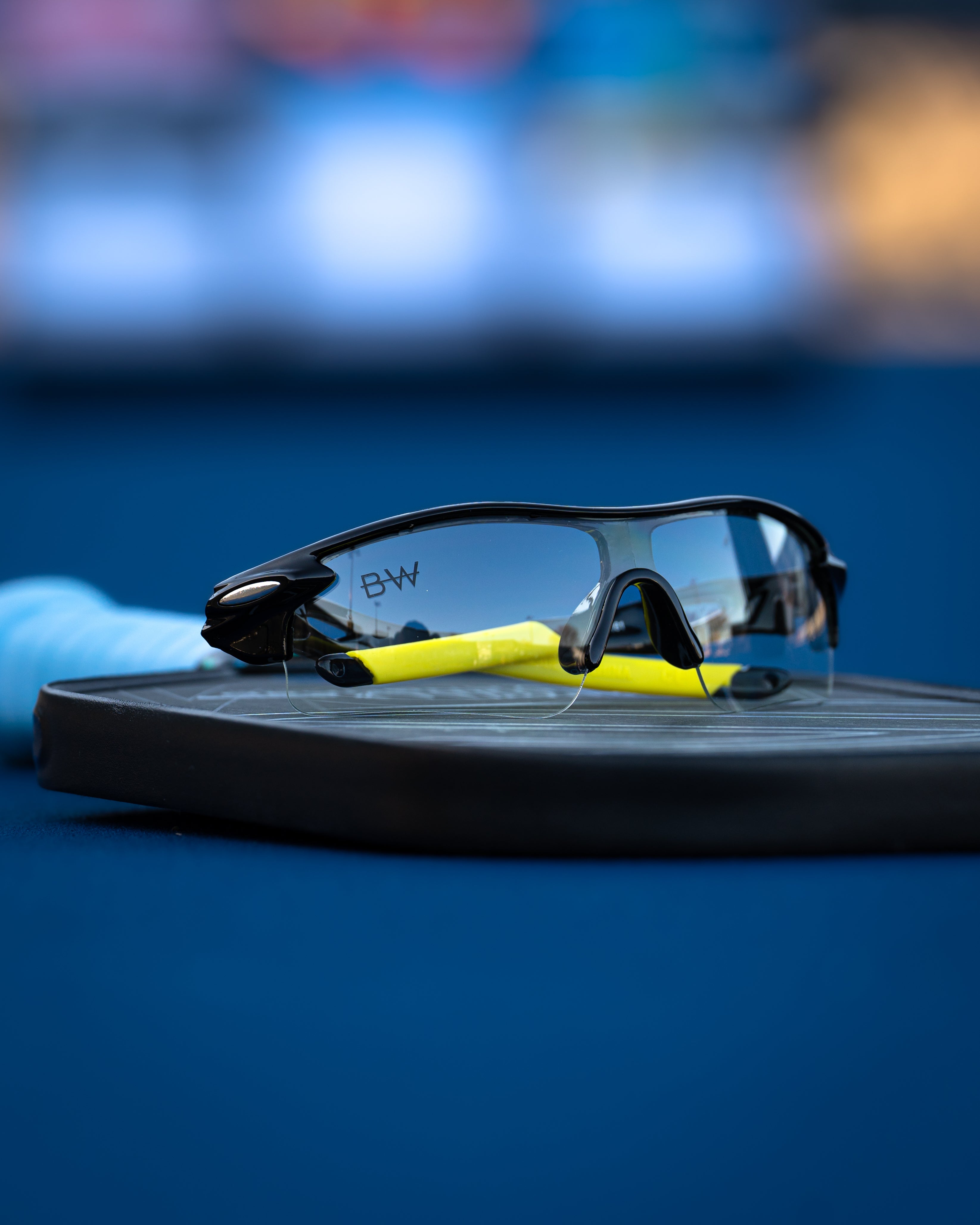
Best Prescription Sports Glasses for 2026 Athletes
Share
Best Prescription Sports Glasses for Athletes in 2026
The best prescription sports glasses for athletes in 2026 should start with one essential requirement: providing the corrective power you need in eyewear suited to your active routine. From pickleball and tennis to running, training, and other fast-moving activities, athletes who rely on prescription correction need to consider more than style alone.
A strong RX sports eyewear choice should account for your prescription, sport, playing environment, frame dimensions, individual fit, lens configuration, and verified product characteristics. The right choice is not necessarily the frame with the biggest performance claims—it is the one that appropriately matches how you actually see, move, train, and compete.
This 2026 guide compares Blinded Wear prescription sports glasses while explaining what athletes should look for before choosing an RX frame.
Find Your Prescription Sports Glasses
What Are the Best Prescription Sports Glasses for Athletes in 2026?
The best prescription sports glasses are the ones that correctly accommodate your prescription while matching your sport, environment, frame-fit needs, and preferred lens configuration.
For athletes comparing Blinded Wear RX eyewear in 2026, these are strong models to start with:
| RX Sports Glasses | Best Starting Point For | What to Compare |
|---|---|---|
| H Blue Shield RX | Pickleball-focused RX shoppers | Prescription compatibility, dimensions, current configuration, fit |
| Lava Rock RX | Athletes comparing lightweight RX options | Prescription requirements, dimensions, environment, fit |
| Crystal Wave II RX | Outdoor RX sports eyewear shoppers | Outdoor use, prescription compatibility, dimensions |
| Frost RX | Pickleball and active RX use | Prescription compatibility, current configuration, dimensions |
| Ocean Wave RX | Prescription pickleball eyewear shoppers | Prescription, intended environment, dimensions, fit |
| Silver Line RX | Outdoor pickleball players needing RX correction | Outdoor configuration, prescription compatibility, dimensions |
| Gray Hound RX | Athletes comparing RX sunglass options | Prescription compatibility, environment, dimensions, configuration |
There is no single frame that is automatically best for every athlete. Prescription compatibility comes first, followed by your activity, environment, fit, and preferred configuration.
What Makes a Great Pair of Prescription Sports Glasses?
The phrase “best prescription sports glasses” should not be reduced to a single feature or marketing claim. Athletes should evaluate the complete eyewear setup.
In 2026, start with these factors:
- Prescription compatibility: The exact frame needs to accommodate your corrective requirements.
- Intended sport: Consider how and where you will actually use the eyewear.
- Playing environment: Indoor, outdoor, lower-light, and changing environments may call for different available configurations.
- Frame dimensions: Compare measurements with eyewear you already know fits you when possible.
- Individual fit: Evaluate the finished pair during realistic movement.
- Lens material: Understand what prescription lens material is actually included.
- Impact resistance: Distinguish impact-resistant lenses from claims such as shatterproof or certified protective eyewear.
- Polarization status: Know whether a polarization filter is present rather than assuming polarization status automatically changes athletic performance.
- Replacement support: Consider what happens if frequently used sports eyewear breaks.
What Athletes Should Look for in RX Sports Glasses in 2026
Instead of relying on a generic “2026 standard,” athletes should compare specific, verifiable characteristics.
| Feature | Why to Check It |
|---|---|
| Prescription Compatibility | The frame and available lens configuration must work with your corrective requirements. |
| High-Index RX Lenses | High-index is a prescription lens-material category. Blinded Wear includes high-index prescription lenses at no additional cost. |
| Impact-Resistant Lenses | Relevant for active eyewear, while remaining distinct from shatterproof or certified protective claims. |
| Non-Polarized Lenses | Blinded Wear sports eyewear does not add a polarization filter. |
| Frame Dimensions | Measurements can help you compare a new frame with eyewear that already fits you. |
| Environment | Your primary indoor, outdoor, or changing conditions should influence the configuration you compare. |
| Replacement Support | Frequently used athletic equipment can be damaged, making current replacement terms relevant to long-term value. |
High-Index Prescription Lenses for Athletes
Blinded Wear includes high-index prescription lenses at no additional cost with RX eyewear.
High-index describes a category of prescription lens material with a higher refractive index. It relates to how corrective power can be produced within the lens.
However, athletes should avoid interpreting “high-index” as an automatic performance benefit.
High-index lenses should not automatically be credited with:
- Faster reaction time
- Better ball tracking
- Improved depth perception
- Greater court awareness
- Better athletic performance
Those outcomes involve additional visual, cognitive, and physical factors.
Also, do not assume every current Blinded Wear RX configuration uses exactly 1.67 or another numerical index unless that exact specification is verified for the configuration being purchased.
Why Impact Resistance Matters in Sports Eyewear
Blinded Wear sports eyewear uses impact-resistant lenses, a relevant characteristic for eyewear intended to be used in active environments.
Sports can involve moving balls, equipment, rapid direction changes, falls, and accidental contact. That makes lens material an important part of an athlete's comparison.
However, the terminology matters:
- Impact-resistant does not mean shatterproof.
- Impact-resistant does not mean indestructible.
- Impact-resistant does not automatically establish certification to a particular protective standard.
- Sports eyewear should not automatically be treated as appropriate protective equipment for every sport.
If your league or activity requires a particular protective standard, verify that requirement separately before purchasing.
Should Athletes Choose Non-Polarized Prescription Sports Glasses?
Blinded Wear sports eyewear uses non-polarized lenses, meaning a polarization filter is not added.
Some court-sport players prefer non-polarized eyewear, so knowing the polarization status can be useful when comparing prescription sports glasses.
What athletes should avoid is assuming that non-polarized automatically means:
- Better depth perception
- Faster reactions
- Better ball tracking
- Improved spin recognition
- Greater court awareness
Depth perception, tracking, and reaction involve more than whether a polarization filter is present.
For a deeper explanation, read Depth Perception Science for Pickleball →.
Best Prescription Sports Glasses for Pickleball Players
Pickleball is one of the clearest use cases for dedicated prescription sports eyewear because players who require correction need that correction throughout a sport involving a moving ball, changing court positions, opponents, partners, and frequent transitions between shots.
For pickleball, compare:
- Your prescription requirements
- Frame compatibility
- Frame dimensions
- Individual fit during movement
- Indoor vs. outdoor use
- The exact available lens configuration
- Impact resistance
- Polarization status
RX lenses provide the corrective power prescribed for the athlete. They should not automatically be described as improving reaction time, ball tracking, or athletic ability simply because they are prescription lenses.
For a dedicated pickleball comparison, visit the Best Pickleball Glasses 2026 Guide →.
Prescription Glasses for Fast-Paced Sports
In fast-moving sports, athletes continuously receive visual information and respond to changing situations. Prescription correction can be one part of that process for athletes who require it.
A simplified sequence might look like:
Visual information → prescription correction when required → recognition → interpretation → anticipation → decision → motor response → physical execution.
This distinction matters because prescription lenses address the corrective optical component. They do not independently control every later stage of athletic response.
Reaction time can also involve:
- Attention
- Recognition
- Anticipation
- Experience
- Decision-making
- Movement speed
- Technique
For more detail, read Prescription Glasses for Fast-Paced Sports →.
Best RX Sports Glasses for Multi-Sport Athletes
Athletes who participate in several activities may get additional value from an RX setup that appropriately works across more than one part of their routine.
Potential activities can include:
- Pickleball
- Tennis
- Running
- Training
- General fitness
- Other compatible active settings
However, the phrase “multi-sport” should not be interpreted as universal suitability.
Before using the same RX pair across activities, compare:
| Factor | Question for the Athlete |
|---|---|
| Prescription | Does this frame accommodate my corrective requirements? |
| Environment | Does the configuration make sense for where I will use it? |
| Fit | How does the finished pair work for me during realistic movement? |
| Sport Requirements | Does the activity require specific protective eyewear? |
| Frequency | Will I use this setup often enough across multiple activities? |
See the Multi-Sport Prescription Glasses Guide for Adult Athletes → for a deeper breakdown.
Choosing RX Sports Glasses for Indoor vs. Outdoor Use
The best prescription sports glasses for an indoor athlete may not be configured the same way as eyewear selected primarily for outdoor use.
Indoor Sports
If you need prescription correction indoors but do not want a dark sunglass tint, compare an appropriate non-dark RX configuration when available.
A clear lens does not automatically improve contrast, increase available light, or make ball tracking easier. Its straightforward distinction is that it does not add a dark sunglass tint.
Outdoor Sports
For athletes primarily playing outdoors, compare an available RX sunglass configuration according to your prescription, environment, frame dimensions, and individual fit.
Do not assume a particular tint automatically improves athletic performance, contrast, tracking, or depth perception.
Changing Environments
Athletes who frequently move between conditions can compare separate RX pairs or a verified transition/photochromic configuration when available and compatible with their prescription.
Learn more in Transition RX Lenses for Travel & Training →.
How Important Is Frame Fit for Athletes?
Prescription accuracy does not eliminate the need to evaluate the frame itself.
When product measurements are available, compare dimensions such as:
- Lens width
- Bridge width
- Temple length
- Overall frame dimensions when provided
A useful starting point is comparing those measurements with glasses you already know fit you well.
Then evaluate the finished prescription pair during realistic movement. Comfort and stability are individual, so terms such as “sports frame,” “lightweight,” or “performance eyewear” should not be treated as guarantees of a universally secure fit.
For a deeper fit guide, read Prescription Sports Glasses & Frame Fit →.
7 Blinded Wear RX Sports Glasses to Compare in 2026
Instead of ranking these models from universally “best” to “worst,” use the shortlist to identify which frames deserve a closer look for your prescription and activity.
1. H Blue Shield RX
H Blue Shield RX is a prescription pickleball eyewear option to compare if court sports are central to your active routine. Check current prescription compatibility, frame dimensions, available configuration, and individual fit before ordering.
2. Lava Rock RX
Lava Rock RX gives athletes another lightweight RX option to compare. Evaluate the frame according to your prescription requirements, dimensions, environment, and preferred fit.
3. Crystal Wave II RX
Crystal Wave II RX is an RX sunglass option worth comparing for athletes shopping primarily for outdoor prescription eyewear. Verify the current configuration and compatibility with your prescription.
4. Frost RX
Frost RX is another prescription pickleball option for athletes comparing sports-focused frames. Review dimensions, prescription compatibility, and current lens configuration.
5. Ocean Wave RX
Ocean Wave RX belongs on the comparison list for prescription pickleball players. Evaluate it according to your correction requirements, environment, dimensions, and individual fit.
6. Silver Line RX
Silver Line RX is a prescription pickleball sunglass option to compare for outdoor court use. Confirm the current configuration and prescription compatibility before purchasing.
7. Gray Hound RX
Gray Hound RX provides another RX sunglass option for athletes building an outdoor prescription setup. Compare its current configuration, dimensions, prescription compatibility, and intended use.
How We Evaluate Prescription Sports Glasses for Athletes
A useful RX sports eyewear comparison should prioritize factors that can actually help an athlete make a buying decision rather than awarding points for unsupported performance promises.
The main evaluation criteria in this guide are:
- Prescription function: Can the exact frame accommodate the athlete's corrective requirements?
- Intended use: Does the eyewear make sense for the athlete's primary activity?
- Environment: Is the available configuration appropriate for indoor, outdoor, or changing use?
- Frame comparison: Are useful dimensions available to help evaluate individual fit?
- Verified lens characteristics: What can actually be established about the lens?
- Long-term value: What prescription lens material and replacement support are included?
- Versatility: Can the setup appropriately serve more than one activity without ignoring sport-specific requirements?
This approach keeps “best” focused on matching the athlete to the right RX setup rather than pretending one frame can be universally superior for every prescription and sport.
Best Prescription Sports Glasses 2026: Athlete FAQ
What are the best prescription sports glasses in 2026?
The best RX sports glasses depend on your prescription, sport, environment, frame dimensions, individual fit, and available lens configuration. Blinded Wear options to compare include H Blue Shield RX, Lava Rock RX, Crystal Wave II RX, Frost RX, Ocean Wave RX, Silver Line RX, and Gray Hound RX.
What should athletes look for in prescription sports glasses?
Start with prescription compatibility. Then evaluate the sport, playing environment, frame dimensions, individual fit, lens material, impact resistance, polarization status, available configuration, and replacement support.
Do prescription sports glasses improve reaction time?
Prescription lenses provide corrective power for athletes who require it. Reaction time also involves recognition, anticipation, decision-making, motor response, and physical execution, so RX eyewear should not automatically be described as making an athlete react faster.
Do non-polarized sports glasses improve depth perception?
Non-polarized means a polarization filter is not added. Polarization status alone does not establish improved depth perception.
Does Blinded Wear include high-index RX lenses?
Yes. Blinded Wear includes high-index prescription lenses at no additional cost with RX eyewear.
Are all Blinded Wear RX lenses 1.67?
Do not assume an exact numerical index across every current configuration unless that index is specifically verified. The accurate general description is high-index prescription lenses.
Are Blinded Wear sports lenses impact-resistant?
Yes. Blinded Wear sports eyewear uses impact-resistant lenses. Impact-resistant does not automatically mean shatterproof, indestructible, or certified to a particular protective standard.
Can one pair of RX sports glasses work for multiple sports?
Potentially. Compare your prescription, environment, fit, lens configuration, and each sport's requirements before relying on one pair across multiple activities.
Which Prescription Sports Glasses Are Best for Your Type of Activity?
The best RX sports eyewear for one athlete may not be the best choice for another. Rather than choosing solely by appearance, start with the demands of your primary activity and then narrow the options according to prescription compatibility, environment, dimensions, and individual fit.
| Athlete / Activity | Primary Considerations | RX Strategy |
|---|---|---|
| Pickleball Player | Prescription, court environment, dimensions, movement, fit | Compare pickleball-focused RX frames and current configurations |
| Tennis Player | Prescription, outdoor/indoor environment, movement, sport requirements | Compare compatible sports-oriented RX options |
| Runner | Prescription, environment, individual fit, extended wear | Evaluate an appropriate lightweight RX setup |
| Multi-Sport Athlete | Overlap between activities, prescription, environment, fit | Look for one appropriate setup or separate pairs where needs differ |
| Tournament Athlete | Repeated use, travel, environment, backup planning | Use a practiced primary RX setup and consider backup eyewear |
| Indoor Athlete | Prescription correction without an unnecessarily dark tint | Compare an appropriate non-dark RX configuration when available |
| Outdoor Athlete | Prescription, outdoor environment, current configuration | Compare compatible RX sunglass options |
Start With Your Prescription Before Choosing a Sports Frame
The best-looking sports frame has little practical value if it cannot appropriately accommodate your prescription.
Common information on an eyeglass prescription can include:
- OD: right eye
- OS: left eye
- SPH: spherical corrective power
- CYL: cylindrical correction when prescribed
- Axis: orientation associated with cylindrical correction
- ADD: additional near power when prescribed
Prescription values can affect which frames and configurations are appropriate. Do not assume that every RX frame supports every prescription or specialized lens design.
When ordering Blinded Wear RX eyewear, have a clear photo or picture of your eyeglass prescription ready to upload before purchasing.
Single-Vision vs. Progressive Sports Glasses
Athletes should verify the exact prescription configuration they require rather than assuming every RX sports frame supports every lens design.
Single-Vision Prescriptions
Single-vision lenses use one prescribed corrective power profile for the intended viewing purpose. Athletes who use single-vision correction should still verify that the chosen frame and current RX configuration accommodate their prescription.
Progressive Prescriptions
If you require progressive or another multifocal lens design, verify compatibility with the exact frame and current configuration before purchasing.
A frame being labeled “RX” does not automatically establish progressive compatibility for every prescription.
Match Your Prescription Sports Glasses to Your Environment
Where you train or compete can be just as important as what sport you play. A configuration selected primarily for bright outdoor use may not be the same setup you prefer for an indoor court.
| Environment | What to Consider | What Not to Assume |
|---|---|---|
| Indoor | An appropriate non-dark RX configuration when available | Clear automatically improves tracking or contrast |
| Lower-Light | A non-dark configuration compatible with your prescription | Clear lenses increase environmental light |
| Outdoor | Available RX sunglass configurations | A particular tint automatically improves performance |
| Mixed Conditions | Separate pairs or a verified transition/photochromic option | One configuration is automatically ideal in every condition |
| Tournament Travel | Expected conditions, primary pair, backup pair, storage | The destination will match your normal playing environment |
Clear RX Sports Glasses vs. Prescription Sports Sunglasses
Athletes frequently search for one universally superior lens type, but the better starting point is the environment where the eyewear will be used.
Non-Dark or Clear RX Sports Eyewear
A non-dark configuration can make sense when you need prescription correction but do not want a dark sunglass tint, including certain indoor and lower-light situations.
Clear lenses should not automatically be described as improving contrast, tracking, reaction time, or depth perception.
RX Sports Sunglasses
Prescription sports sunglasses combine corrective power with a sunglass configuration. Athletes primarily shopping for outdoor use can compare options such as Crystal Wave II RX, Silver Line RX, and Gray Hound RX.
A sunglass tint should not automatically be treated as evidence of better contrast, tracking, or athletic performance.
Are Transition RX Lenses Good for Athletes?
A verified transition or photochromic prescription configuration can be worth comparing for athletes who regularly move between different lighting environments.
The main question is whether that configuration is available for your chosen frame and compatible with your prescription.
Transition/photochromic lenses should not automatically be treated as the best choice for every athlete. Compare them with the alternative of owning separate configurations for different environments.
| Approach | Potential Practical Advantage | Question to Ask |
|---|---|---|
| One Transition / Photochromic RX Pair | One compatible pair for changing conditions | Is this configuration available and appropriate for my prescription and routine? |
| Separate RX Pairs | Each pair can be selected around a particular environment | Would I benefit enough from separate setups to justify owning both? |
For more detail, see Transition RX Lenses for Travel & Training →.
Can Prescription Sports Glasses Improve Reaction Time?
Prescription sports glasses should not be described as automatic reaction-time enhancers.
If an athlete requires prescription correction, RX lenses address that corrective need while the athlete processes what is happening during play. But reaction is a larger visual-to-motor process.
A simplified sequence is:
Visual information → corrective optics when required → recognition → interpretation → anticipation → decision → motor response → execution.
Training, experience, attention, anticipation, decision-making, movement speed, and technique can all contribute to the final response.
This distinction lets athletes evaluate prescription eyewear accurately: RX lenses provide prescribed correction; they do not independently create faster athletic reactions.
Read the full breakdown in RX Lenses & Reaction Time in Pickleball →.
What About Depth Perception?
Depth perception helps people interpret spatial relationships, but it involves more than one characteristic of a sports lens.
Athletes should be cautious with statements claiming that a particular tint, non-polarized lens, or prescription frame automatically improves depth perception.
Prescription correction can address refractive needs. Non-polarized lenses mean a polarization filter is not added. Neither fact alone establishes a universal improvement in depth perception.
For the dedicated science guide, read Why Depth Perception Matters in Pickleball Eyewear →.
Prescription Sports Glasses and Dynamic Vision
Sports often require athletes to process visual information while the athlete, the object being followed, or both are moving.
Prescription lenses can provide the corrective power prescribed for the wearer during these situations. However, it is too broad to say that RX sports glasses automatically “enhance dynamic visual acuity.”
Athletic visual performance can involve multiple factors, including:
- Refractive correction when needed
- Binocular visual function
- Attention
- Recognition
- Anticipation
- Experience
- Head and body movement
- Decision-making
For athletes who need correction, the purpose of RX sports eyewear is to make that prescribed correction available within an appropriate sports setup.
How to Evaluate Comfort in Prescription Sports Glasses
Comfort matters when eyewear may be worn through practices, matches, tournaments, runs, or extended training sessions. But comfort is individual and should not be guaranteed from a product label alone.
When your finished RX eyewear arrives, evaluate:
- How the frame initially feels while standing and walking
- Whether any areas create unwanted pressure
- How the frame feels when looking up, down, and side to side
- How it behaves during normal athletic movement
- Whether the eyewear remains comfortable through a realistic practice session
A lightweight frame may be desirable, but lightweight does not automatically mean comfortable or secure for every face.
The Athlete Movement Test: Evaluate Your RX Glasses Before Competition
Do not make an important tournament or match the first time you seriously test new prescription sports eyewear.
After confirming the prescription and initial fit, test the finished pair through movements relevant to your activity.
For Pickleball or Tennis
- Look rapidly from side to side
- Move between ready position and normal shots
- Practice forward and lateral movement
- Look upward and downward
- Complete normal warmup drills
For Running or Fitness
- Walk first
- Progress into normal training movement
- Evaluate comfort over time
- Notice whether your individual fit remains appropriate throughout the session
The goal is not to prove that the frame creates better performance. It is to determine whether the complete RX setup works appropriately for you during the movements you actually perform.
Best Prescription Sports Glasses Strategy for Tournament Athletes
Tournament athletes should think beyond the frame itself and build an RX plan around the full event.
Before competition, verify:
- Your current prescription
- Prescription compatibility with the chosen frame
- The environment where you expect to compete
- That you have already practiced in the finished eyewear
- How you will store the glasses between matches
- Whether you need backup prescription eyewear
- How the eyewear will be packed during travel
Familiarity and preparation can remove equipment-related unknowns without requiring exaggerated claims about what the eyewear itself does.
For combined tournament and travel selection, read Best RX Glasses for Travel & Tournament Days →.
Should Athletes Carry a Backup Pair of Prescription Sports Glasses?
If you depend on prescription correction to participate comfortably in your sport, backup eyewear can provide useful redundancy.
A spare pair may be especially worth considering for:
- Tournaments
- League championships
- Multi-day events
- Sports travel
- Frequent weekly play
- Situations where replacing prescription eyewear quickly would be difficult
The value of a backup pair is straightforward: if your primary pair becomes unavailable, you may still have another corrective option.
Best RX Sports Glasses Strategy for Traveling Athletes
Travel creates additional variables that local practices do not. Your destination may have a different environment, and your prescription eyewear may be difficult to replace quickly if something happens during the trip.
Traveling athletes should consider:
- Keeping primary RX eyewear accessible
- Bringing backup correction when appropriate
- Protecting eyewear while it is not being worn
- Checking the expected playing environment
- Keeping prescription information accessible
- Avoiding unnecessary exposure to crushing or loose equipment
For the dedicated packing guide, see How to Pack Prescription Glasses for Sports Trips →.
How to Compare the Long-Term Value of RX Sports Glasses
The best prescription sports glasses are not necessarily the least expensive or most expensive pair. Compare what you actually receive and how frequently you expect to use it.
| Value Factor | What to Compare |
|---|---|
| Prescription Function | Does the exact frame appropriately support your corrective requirements? |
| High-Index Lenses | Are high-index RX lenses included or priced as an additional upgrade? |
| Frequency of Use | Will you use the pair occasionally, weekly, or several times per week? |
| Versatility | Can the same appropriate configuration serve more than one activity? |
| Replacement Support | What happens if frequently used eyewear breaks? |
| Backup Utility | Does the purchase give you another usable prescription option? |
Blinded Wear includes high-index prescription lenses at no additional cost, which can be factored into the overall value comparison.
Blinded Wear Lifetime Replacement Support
Sports eyewear is physical equipment, and impact-resistant lenses should never be interpreted as impossible to damage.
Blinded Wear provides 50% lifetime replacement support if glasses break, subject to current policy terms.
For athletes who use their RX eyewear frequently, replacement support can be an important long-term ownership consideration.
This should not be interpreted as unlimited free replacements or a guarantee that every type of damage qualifies.
Review the current Protection & Replacement Terms →.
Cost Per Use: A Better Way to Compare Sports Eyewear?
For athletes who play frequently, cost per use can provide another way to evaluate an RX purchase.
The basic calculation is:
Purchase price ÷ total number of uses = approximate cost per use.
A pair used several times per week for an extended period may have a very different practical value from eyewear purchased for occasional use.
Cost per use does not prove that one product is better than another, but it helps place the purchase price in the context of your actual lifestyle.
Sports Eyewear Marketing Claims Athletes Should Examine Carefully
Technical-sounding terminology can make sports glasses appear more advanced than the verified product characteristics actually establish. Athletes should separate measurable features from promised outcomes.
| Claim | What to Verify |
|---|---|
| “Improves Reaction Time” | Whether evidence establishes that the exact eyewear independently produces that outcome |
| “Better Ball Tracking” | What exact verified feature supposedly causes the improvement |
| “Enhances Depth Perception” | Whether the claim is supported rather than inferred from tint or polarization status |
| “Shatterproof” | Whether this is actually verified rather than substituted for impact-resistant |
| “Secure Fit” | Product-specific construction, dimensions, and your individual fit |
| “Anti-Fog” | Whether an anti-fog treatment is specifically verified for the product |
| “Enhanced Contrast” | Whether a specific lens technology and effect are actually established |
| “1.67 High-Index” | Whether that exact numerical index is confirmed for the configuration |
The best prescription sports eyewear does not need unsupported claims to provide value. Accurate prescription correction, appropriate product selection, verified lens characteristics, and a frame that works for the individual athlete are meaningful on their own.
10 Mistakes to Avoid When Buying Prescription Sports Glasses
- Choosing the frame before checking prescription compatibility.
- Assuming every RX frame supports every prescription.
- Assuming every RX frame supports progressive lenses.
- Buying solely because a product promises faster reactions or better tracking.
- Assuming non-polarized automatically means better depth perception.
- Assuming high-index automatically means 1.67.
- Ignoring frame dimensions.
- Ignoring whether you primarily play indoors or outdoors.
- Wearing brand-new RX eyewear for the first time during an important competition.
- Traveling without considering backup prescription correction.
Prescription Sports Glasses Athlete Scorecard
Before choosing among RX options, use this scorecard to compare each frame against your actual needs.
| Question | Yes / No |
|---|---|
| Is the frame compatible with my prescription? | ☐ |
| Does the current configuration fit my primary environment? | ☐ |
| Have I compared the dimensions with eyewear that fits me? | ☐ |
| Do I understand which lens characteristics are verified? | ☐ |
| Does this pair make sense for my primary sport? | ☐ |
| Can I use it appropriately across other activities if needed? | ☐ |
| Have I separated marketing promises from actual features? | ☐ |
| Do I understand the current replacement terms? | ☐ |
| Will I realistically use the pair frequently? | ☐ |
| Do I have a backup plan if I rely heavily on prescription correction? | ☐ |
The more clearly a frame satisfies your actual prescription and activity requirements, the stronger a candidate it becomes—without needing to declare one universal model the best for every athlete.
Prescription Sports Glasses for Athletes: More FAQs
Are prescription sports glasses better than regular glasses for athletes?
Both can provide prescription correction. Dedicated sports eyewear can be selected specifically around active use, environment, dimensions, and the athlete's intended activity.
Should athletes wear contacts or prescription sports glasses?
There is no universal answer. Some athletes prefer correction built directly into RX sports eyewear, while others use compatible contact lenses with non-prescription sports glasses.
Are clear prescription sports glasses good for indoor sports?
A non-dark RX configuration can make sense when an athlete requires correction indoors without a dark sunglass tint. Clear lenses should not automatically be described as improving tracking, contrast, or reaction time.
Are prescription sports sunglasses good for outdoor athletes?
They can provide prescription correction within a sunglass configuration. Compare the exact frame, prescription compatibility, dimensions, and current configuration for your intended outdoor use.
Should athletes own separate indoor and outdoor RX glasses?
Some athletes may prefer separate configurations, while others may use one compatible setup or a verified transition/photochromic option. The right strategy depends on how frequently you move between environments.
Can athletes use transition prescription sports glasses?
A transition/photochromic RX configuration may be an option when available and compatible with the prescription and chosen frame. Verify the current configuration rather than assuming universal availability.
Do lightweight sports glasses stay on better?
Lightweight construction alone does not guarantee a secure fit. Frame dimensions, design, individual facial fit, and real-world movement all matter.
How should athletes test new prescription sports glasses?
After confirming the prescription and initial fit, evaluate the finished pair during realistic movements and practice before relying on it for important competition.
Should tournament athletes bring spare RX glasses?
If you rely heavily on prescription correction, backup eyewear can provide useful redundancy during tournaments and travel.
Does Blinded Wear have a lifetime warranty?
The more accurate description is 50% lifetime replacement support if glasses break, subject to the current policy terms. Review the current protection and replacement policy for details.
10 Prescription Sports Glasses Myths Athletes Should Know in 2026
Prescription sports eyewear is often marketed with broad claims that can make it difficult to separate corrective vision, product characteristics, and athletic performance. Here are some of the most important distinctions to understand before buying.
Myth #1: Prescription Sports Glasses Automatically Improve Reaction Time
Reality: RX lenses provide prescribed corrective power. Reaction time also involves recognition, anticipation, decision-making, motor response, and physical execution.
Myth #2: Non-Polarized Lenses Automatically Improve Depth Perception
Reality: Non-polarized means a polarization filter is not added. That characteristic alone does not establish improved depth perception.
Myth #3: High-Index Lenses Make You a Better Athlete
Reality: High-index describes a prescription lens-material category. It should not automatically be credited with improving tracking, reactions, or athletic ability.
Myth #4: Every High-Index Sports Lens Is 1.67
Reality: High-index is a broader category. Do not assume an exact numerical index unless it is verified for the current configuration.
Myth #5: Impact-Resistant Means Shatterproof
Reality: Impact-resistant does not mean indestructible, shatterproof, or automatically certified to a specific protective standard.
Myth #6: Every Prescription Works With Every Sports Frame
Reality: Prescription compatibility can vary by frame and lens configuration. Verify compatibility before purchasing.
Myth #7: Every RX Sports Frame Supports Progressives
Reality: RX availability does not automatically establish compatibility with every progressive or multifocal prescription.
Myth #8: Clear Lenses Improve Indoor Ball Tracking
Reality: Clear lenses do not add a dark sunglass tint. Clear status alone does not establish improved tracking, contrast, or reaction time.
Myth #9: Lightweight Automatically Means Secure
Reality: Weight is only one characteristic. Dimensions, frame design, individual fit, and movement all affect how eyewear works for a particular athlete.
Myth #10: One Sports Frame Is Best for Everyone
Reality: The best RX sports glasses depend on the athlete's prescription, sport, environment, dimensions, fit, and preferred configuration.
What Prescription Sports Glasses Can—and Cannot—Do
Understanding the role of RX eyewear helps athletes make better purchasing decisions without expecting the glasses to replace training or athletic skill.
| RX Sports Glasses Can | RX Sports Glasses Do Not Automatically |
|---|---|
| Provide prescribed corrective power | Make reactions faster |
| Address supported refractive requirements | Improve anticipation |
| Incorporate correction into sports-oriented eyewear | Improve hand-eye coordination |
| Be selected around an athlete's environment and activity | Guarantee better ball tracking |
| Provide another corrective option separate from everyday eyewear | Guarantee improved depth perception |
| Become part of a consistent sports-equipment setup | Replace practice, technique, or experience |
7 Questions to Find Your Best Prescription Sports Glasses
If several frames appear suitable, work through these questions in order instead of choosing based solely on appearance or marketing.
-
What prescription correction do I require?
Start with your current eyeglass prescription and verify compatibility with the exact frame.
-
What sport will I use the glasses for most?
Build the purchase around your primary activity before considering secondary uses.
-
Where will I use them?
Determine whether you primarily need indoor, outdoor, lower-light, or changing-environment eyewear.
-
What configuration is currently available?
Do not assume every frame offers every possible RX or lens configuration.
-
How do the frame dimensions compare with glasses that already fit me?
Use available measurements as a practical starting point for evaluating fit.
-
Which product characteristics are actually verified?
Separate prescription correction, lens material, impact resistance, and polarization status from broader performance claims.
-
How frequently will I use the eyewear?
A pair used several times per week can have a very different long-term value from one used only occasionally.
2026 Blinded Wear Prescription Sports Glasses Shortlist
For athletes ready to compare RX options, use this shortlist as a starting point rather than a universal ranking.
| RX Model | Start Here If... | Verify Before Buying |
|---|---|---|
| H Blue Shield RX | You want a pickleball-focused RX option | Prescription compatibility, dimensions, configuration, fit |
| Lava Rock RX | You are comparing lightweight RX sports eyewear | Prescription, dimensions, environment, fit |
| Crystal Wave II RX | You want to compare an outdoor RX sunglass option | Prescription compatibility, current configuration, dimensions |
| Frost RX | You want another pickleball-focused prescription option | Prescription compatibility, dimensions, current configuration |
| Ocean Wave RX | You are comparing prescription pickleball eyewear | Prescription, environment, dimensions, fit |
| Silver Line RX | You want an RX pickleball sunglass option | Outdoor use, prescription compatibility, current configuration |
| Gray Hound RX | You are comparing outdoor prescription sunglasses | Prescription compatibility, environment, dimensions, configuration |
Final Checklist Before Buying Prescription Sports Glasses
- ☐ My eyeglass prescription is current.
- ☐ I have a clear photo or picture of my prescription ready to upload.
- ☐ I verified that the frame can accommodate my prescription.
- ☐ I know whether I primarily need the eyewear indoors, outdoors, or across changing conditions.
- ☐ I checked the current lens configuration instead of assuming availability.
- ☐ I compared frame dimensions when available.
- ☐ I understand that lightweight does not automatically guarantee a secure fit.
- ☐ I understand that impact-resistant does not mean shatterproof.
- ☐ I understand that non-polarized does not automatically mean improved depth perception.
- ☐ I understand that RX correction does not automatically increase reaction time.
- ☐ I know high-index RX lenses are included at no additional cost with Blinded Wear RX eyewear.
- ☐ I am not assuming an exact numerical lens index unless verified.
- ☐ I reviewed the current replacement terms.
- ☐ I plan to practice in the finished eyewear before important competition.
- ☐ I have considered backup RX eyewear if prescription correction is essential to my participation.
What to Do When Your New RX Sports Glasses Arrive
The buying process should not end when the package arrives. Before relying on new prescription sports eyewear during competition, evaluate the finished setup.
- Confirm the order. Make sure you received the frame and configuration you expected.
- Evaluate your prescription experience. Pay attention to how the corrective setup works for you.
- Check initial frame fit. Notice unwanted pressure or obvious fit problems.
- Move naturally. Look up, down, and side to side.
- Practice in the eyewear. Use it during a normal training session before competition.
- Test your real environment. Evaluate it where you actually expect to play.
- Build familiarity. Give yourself an opportunity to understand the complete setup before an important event.
If something appears inconsistent with your prescription or expected configuration, address that issue rather than trying to compensate for it during play.
Protect Your Prescription Sports Glasses Between Sessions
Choosing the right RX sports glasses is only part of the ownership process. How you handle the eyewear between sessions can also affect its long-term condition.
Good habits include:
- Store the eyewear appropriately when it is not being worn.
- Avoid leaving the glasses loose among heavier sports equipment.
- Keep your primary pair accessible during tournaments and travel.
- Follow appropriate cleaning practices for the eyewear.
- Inspect the frame and lenses after unusual impacts or damage.
- Keep backup prescription eyewear accessible when losing your primary pair would prevent you from participating.
For a dedicated storage guide, read How to Store & Protect RX Glasses on the Go →.
When Should Athletes Replace Their Prescription Sports Glasses?
There is no universal replacement interval that applies to every athlete. Instead, reevaluate your eyewear when something meaningful changes.
Examples include:
- Your prescription changes
- The frame or lenses become damaged
- Your primary sport changes
- Your playing environment changes substantially
- The frame no longer works appropriately for your intended use
- You need a different RX or lens configuration
Prescription sports eyewear should continue to match both your corrective requirements and the way you use it.
Best Prescription Sports Glasses for 2026: Final FAQ
What are the best prescription sports glasses for athletes in 2026?
There is no single universal model for every athlete. Strong Blinded Wear options to compare include H Blue Shield RX, Lava Rock RX, Crystal Wave II RX, Frost RX, Ocean Wave RX, Silver Line RX, and Gray Hound RX. Choose according to prescription compatibility, activity, environment, dimensions, current configuration, and individual fit.
What are the best prescription sports glasses for pickleball?
Start with RX frames designed with pickleball players in mind, then narrow your options according to your prescription, indoor or outdoor environment, dimensions, and individual fit.
What are the best prescription sports glasses for outdoor athletes?
Outdoor athletes who require correction can compare compatible RX sunglass options. Crystal Wave II RX, Silver Line RX, and Gray Hound RX are among the Blinded Wear prescription sunglasses to evaluate according to current configuration and prescription compatibility.
What are the best RX glasses for multi-sport athletes?
The best multi-sport option is one that appropriately overlaps with the requirements of your activities. Verify prescription compatibility, environment, fit, and any sport-specific protective requirements rather than assuming one frame is universally suitable.
Do Blinded Wear RX glasses include high-index lenses?
Yes. High-index prescription lenses are included at no additional cost with Blinded Wear RX eyewear.
Are Blinded Wear RX lenses 1.67?
Do not assume every current configuration uses exactly 1.67. An exact numerical index should only be stated when verified for that configuration.
Are Blinded Wear prescription sports lenses polarized?
Blinded Wear sports eyewear uses non-polarized lenses, meaning a polarization filter is not added.
Why do some athletes prefer non-polarized sports eyewear?
Some court players prefer eyewear without a polarization filter. That preference should remain separate from claims that non-polarized lenses automatically improve depth perception, reaction time, or ball tracking.
Are Blinded Wear sports lenses impact-resistant?
Yes. Blinded Wear sports eyewear uses impact-resistant lenses. Impact-resistant does not mean shatterproof, indestructible, or automatically certified for every sport.
Can I get progressive prescription sports glasses?
Verify progressive compatibility with the exact frame and current configuration before purchasing. RX availability alone does not mean every frame supports every progressive prescription.
Do I need different RX glasses for indoor and outdoor sports?
Not necessarily. Some athletes use one appropriate setup, while others prefer separate indoor and outdoor configurations or a verified transition/photochromic option when available and compatible.
How do I order Blinded Wear prescription sports glasses?
Choose an RX frame, review the current configuration and available dimensions, verify prescription compatibility, and have a clear photo or picture of your eyeglass prescription ready to upload before purchasing.
What happens if my Blinded Wear sports glasses break?
Blinded Wear provides 50% lifetime replacement support if glasses break, subject to current policy terms. Review the current protection and replacement policy for details.
Related Prescription Sports Eyewear Guides
Key Takeaways for Athletes Choosing RX Sports Glasses in 2026
- Prescription compatibility comes first. A frame must appropriately accommodate your corrective requirements before other features matter.
- The best RX sports glasses depend on your sport, environment, dimensions, fit, and current lens configuration.
- Blinded Wear includes high-index prescription lenses at no additional cost.
- Do not assume an exact index such as 1.67 unless it is verified for the current configuration.
- Blinded Wear sports eyewear uses impact-resistant lenses, but impact-resistant does not mean shatterproof or universally certified protective eyewear.
- Blinded Wear sports eyewear uses non-polarized lenses, meaning a polarization filter is not added.
- Non-polarized status alone does not establish improved depth perception or ball tracking.
- Prescription correction should not automatically be described as increasing reaction time or athletic ability.
- Clear lenses do not automatically improve indoor tracking or contrast.
- Lightweight construction does not guarantee a universally secure fit.
- Athletes should test new RX eyewear during practice before relying on it for important competition.
- Tournament and traveling athletes who rely on prescription correction should consider an appropriate backup plan.
- Blinded Wear provides 50% lifetime replacement support if glasses break, subject to current terms.
Find Your Best Prescription Sports Glasses for 2026
The best prescription sports glasses are not determined by the biggest performance promise. They are determined by how well the complete eyewear setup matches your prescription, sport, environment, frame-fit needs, and active routine.
Start with prescription compatibility, compare verified characteristics, choose around where you actually play, and evaluate the finished eyewear during realistic movement.
Bottom Line: The Best Prescription Sports Glasses for Athletes in 2026
The best prescription sports glasses for 2026 are the ones that correctly address your vision requirements while fitting the way you actually train, play, and compete.
For Blinded Wear shoppers, models including H Blue Shield RX, Lava Rock RX, Crystal Wave II RX, Frost RX, Ocean Wave RX, Silver Line RX, and Gray Hound RX provide several prescription sports eyewear options to compare.
Rather than choosing solely because a frame promises better reactions, tracking, or performance, compare what matters: prescription compatibility, intended sport, environment, dimensions, individual fit, verified lens characteristics, high-index RX inclusion, and long-term replacement support.