
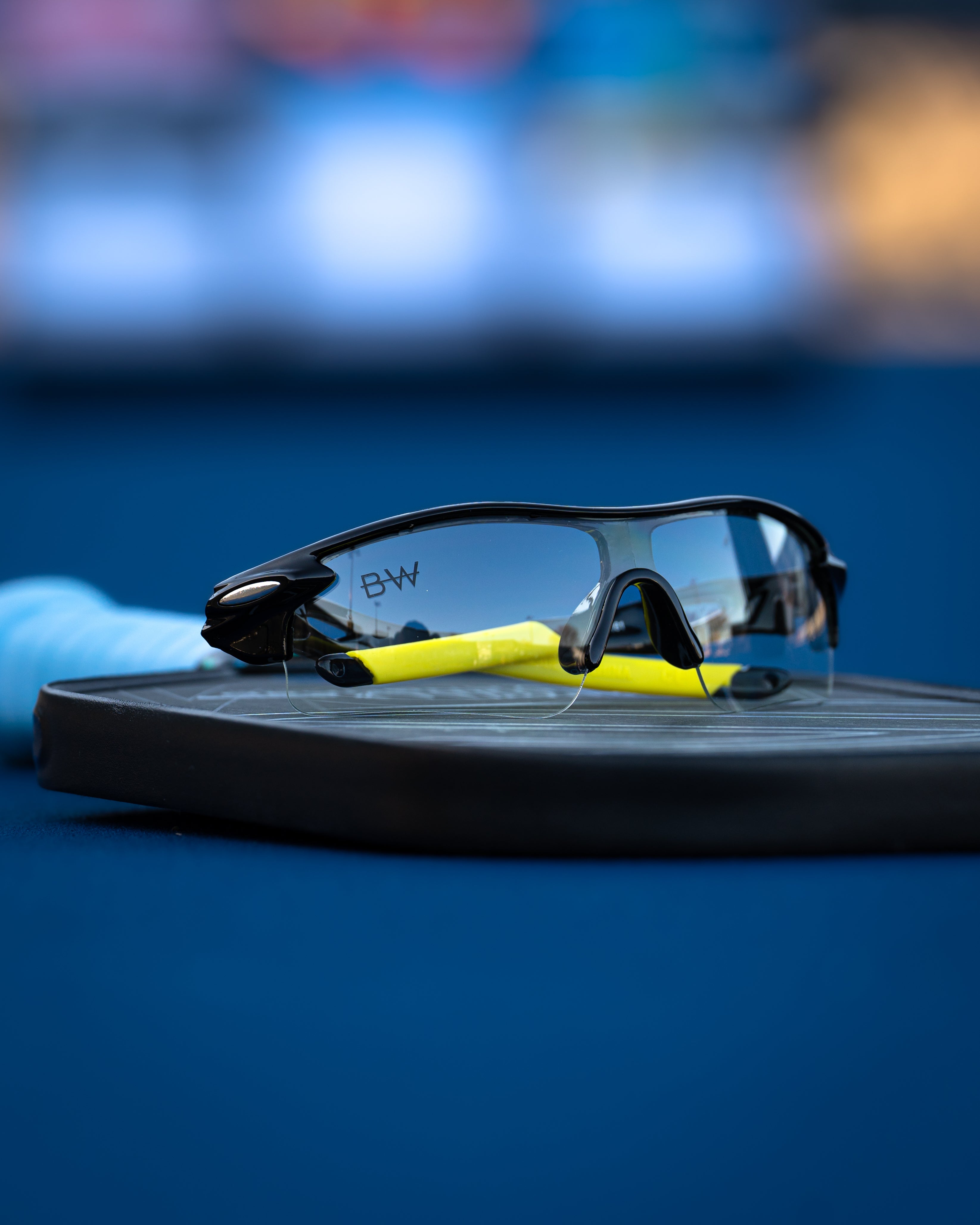
Pickleball Glasses That Actually Work: Buy Online for Peak Performance
Share
Pickleball Glasses That Actually Work: How to Buy the Right Eyewear Online
The best pickleball glasses are not the pair with the biggest performance promises. They are the pair that matches your vision needs, playing environment, preferred lens configuration, and fit.
Blinded Wear Co. offers sports-focused eyewear for pickleball players, including non-prescription sunglasses, clear-lens options, and prescription (RX) eyewear. Blinded Wear sports lenses are non-polarized and impact-resistant, while RX eyewear includes high-index prescription lenses at no additional cost.
This guide explains what actually matters when buying pickleball glasses online—and which common eyewear claims deserve more scrutiny.
Shop Pickleball Glasses by Vision Need
Start with the type of eyewear you need instead of searching for one universal “best” pair.
Quick Answer: What Pickleball Glasses Actually Work?
Pickleball glasses “work” when their verified characteristics match what you need on the court.
For most players, that means evaluating:
- Vision correction: Do you need RX or non-RX eyewear?
- Playing environment: Are you indoors, outdoors, playing at night, or moving between conditions?
- Lens configuration: Do you want a clear lens, fixed sunglass tint, or another available configuration?
- Fit: Does the frame fit appropriately during realistic movement?
- Lens condition: Can you keep the viewing surface clean and usable?
- Impact resistance: Is this characteristic documented?
- Protection requirements: Does your activity require eyewear certified to a particular standard?
What you should not assume is that a particular tint, polarization status, frame shape, or marketing term automatically improves reaction time, depth perception, ball tracking, or overall pickleball performance.
What Are Pickleball Glasses?
Pickleball glasses are eyewear selected or designed with court use in mind. Depending on the player, that can include non-prescription sports sunglasses, clear-lens sports eyewear, or prescription sports glasses.
The category can address several practical needs:
- Prescription correction for players who require it
- An untinted lens for players who prefer clear eyewear
- A sunglass tint for players who prefer tinted eyewear outdoors
- A physical lens positioned in front of the eyes
- Sports-focused frame designs
However, “pickleball glasses” is not itself a protective certification, optical-performance rating, or guarantee that the eyewear will improve your game.
Pickleball Glasses vs. Regular Sunglasses: What's the Difference?
The label alone does not determine how well eyewear will work for you.
Instead of assuming ordinary sunglasses are bad and pickleball-specific sunglasses are automatically better, compare the characteristics that matter for court use.
| Question | Why It Matters |
|---|---|
| Do you need prescription correction? | Determines whether you need RX eyewear, contacts, or no correction in the glasses. |
| Where do you play? | Indoor, outdoor, evening, and changing conditions can lead to different lens preferences. |
| Is the lens clear or tinted? | Determines whether you are wearing an untinted or sunglass configuration. |
| Is the lens impact-resistant? | Provides information about a physical lens characteristic. |
| How does the frame fit? | A frame that repeatedly requires adjustment can become distracting during play. |
| Is a protective standard required? | If so, the exact certification should be verified separately. |
Those questions are more useful than relying on a generic “sports” label.
Do Pickleball Glasses Need to Be Non-Polarized?
Blinded Wear sports lenses are non-polarized, meaning a polarization filter is not added.
Some pickleball and court-sport players prefer non-polarized eyewear. However, the reason should not be exaggerated into a universal claim that polarized lenses distort court depth or that non-polarized lenses automatically improve depth perception.
Polarization status alone does not establish that one player will:
- Judge distance more accurately
- Track the ball better
- Read spin more easily
- React faster
- Hit more accurately
Those outcomes involve more than whether a polarization filter is present.
For players who specifically want non-polarized court eyewear, Blinded Wear's sports lenses provide that configuration without attaching unsupported performance guarantees to it.
Do Non-Polarized Pickleball Glasses Improve Depth Perception?
They should not automatically be described that way.
Depth perception depends on the visual system and multiple cues used to interpret distance and spatial relationships. Whether a lens is polarized or non-polarized is only one characteristic of the eyewear being worn.
If you experience persistent problems judging distance or have concerns about binocular vision, those concerns are better discussed with an appropriate eye-care professional than diagnosed through a sunglasses purchase.
Three Types of Pickleball Eyewear to Consider
The easiest way to narrow your options is to start with your vision needs and playing environment.
| Eyewear Type | Who Might Consider It | Main Distinction |
|---|---|---|
| Non-RX Pickleball Sunglasses | Players who do not need prescription correction in the eyewear and prefer a sunglass configuration | Sports-focused eyewear without prescription correction |
| Clear Lens Pickleball Glasses | Players who prefer an untinted lens, including many indoor or evening players | No dark sunglass tint |
| Prescription Pickleball Eyewear | Players who need compatible eyeglass prescription correction built into the eyewear | RX correction incorporated into sports-focused eyewear |
Non-Prescription Pickleball Sunglasses
Non-RX pickleball sunglasses can make sense if you do not require prescription correction in the eyewear and want a sports-focused sunglass configuration.
They may also work for some players who wear appropriately prescribed contacts and want their external sports eyewear to remain non-prescription.
When comparing non-RX sunglasses, consider:
- Frame measurements
- Lens tint
- Playing environment
- Impact resistance
- Polarization status
- Any exact treatments or certifications documented for the product
Clear Lens Pickleball Glasses
Clear sports eyewear provides an untinted option for players who do not want a dark sunglass lens.
That can make clear lenses worth considering for:
- Indoor pickleball
- Evening matches
- Lower-light environments
- Players who simply prefer untinted sports eyewear
The advantage is straightforward: the lens is not darkly tinted.
That does not mean clear lenses automatically increase available light, improve contrast, increase reaction speed, or make the ball easier to track.
Clear Pickleball Glasses to Explore
If you prefer untinted non-prescription eyewear, current Blinded Wear clear-lens options include:
Review each product's current specifications rather than assuming that every clear-lens model has identical frame dimensions or additional features.
Prescription Pickleball Glasses
If you need eyeglass prescription correction while playing, RX sports eyewear allows compatible correction to be incorporated directly into the glasses.
Blinded Wear RX eyewear includes high-index prescription lenses at no additional cost. Customers provide a clear photo or picture of their eyeglass prescription as part of the RX ordering process.
Do not assume that every prescription is compatible with every frame or lens configuration. The exact prescription and product matter.
Prescription Pickleball Glasses to Explore
Players who need RX correction can compare verified Blinded Wear prescription options including:
- H Blue Shield RX →
- Lava Rock RX →
- Phantom II RX →
- Crystal Wave II RX →
- Rocket Fire RX →
- Silver Line RX →
- Frost RX →
- Ocean Wave RX →
There is no need to declare one frame universally best. Compare prescription compatibility, measurements, available lens configuration, and style.
What Glasses Work for Indoor Pickleball?
Indoor players often look for eyewear that does not use a dark sunglass tint.
For a player who does not require prescription correction, a clear non-RX sports lens may be worth considering. A player who needs correction can consider an available clear RX configuration.
Before buying, consider:
- Whether you need RX correction
- Whether you prefer an untinted lens
- Frame measurements
- Fit during movement
- Impact resistance
- Any protection standard required by your activity
Do not assume that a clear lens automatically improves indoor ball tracking or contrast. Its primary distinction is that it does not use a dark sunglass tint.
What Glasses Work for Outdoor Pickleball?
Outdoor players may prefer a sunglass tint, particularly during brighter daytime sessions.
When shopping, separate the characteristics of the eyewear rather than treating “outdoor pickleball glasses” as one feature.
Ask:
- Do I need prescription correction?
- What tint do I prefer?
- Do I want non-polarized eyewear?
- How does the frame fit?
- Are the lenses impact-resistant?
- Are any UV specifications actually documented for this lens?
- Are any additional coatings or treatments actually verified?
A dark lens should not automatically be assumed to provide a particular UV rating, anti-glare treatment, or performance advantage.
What About Pickleball Glasses for Night Play?
If you play outdoors after sunset or under artificial lighting, a dark daytime sunglass tint may no longer match your preference.
Clear sports eyewear can provide an untinted alternative.
Again, the benefit should be described accurately: clear eyewear removes the dark sunglass tint from the equation. It does not automatically brighten the environment or enhance reaction time.
What if You Play Indoors and Outdoors?
Players who move between environments have several possible strategies:
- Own separate clear and tinted pairs
- Use an available photochromic configuration
- Use clear eyewear in both environments if that is your preference
- Wear appropriately prescribed contacts and switch between compatible non-RX eyewear
The best practical approach depends on how often your conditions change and whether you value direct control or adaptive convenience.
Why Impact Resistance Matters When Comparing Pickleball Glasses
Blinded Wear sports lenses are impact-resistant.
That characteristic is relevant when comparing sports eyewear, but its meaning should not be stretched into stronger claims.
| Term | What You Should Know |
|---|---|
| Impact-resistant | A documented physical lens characteristic |
| Shatterproof | Should not be assumed from impact resistance |
| Indestructible | Should not be assumed |
| Certified protective eyewear | Requires verification of the exact applicable testing standard |
If you need certified eye protection, verify the exact standard rather than relying solely on words such as “sports,” “protective,” or “impact-resistant.”
Do Pickleball Glasses Protect Your Eyes?
A physical lens positioned in front of the eye provides a barrier that playing without external eyewear does not.
However, the level of protection should not be inferred from that fact alone.
There is an important difference between:
- Wearing a physical lens in front of the eye
- Using impact-resistant lenses
- Wearing eyewear tested to a particular protective standard
If protection from ball or paddle impacts is a primary reason for your purchase, look for the exact documented specifications or certifications that matter to you.
How Should Pickleball Glasses Fit?
A sports frame should fit appropriately and remain comfortable during the movements involved in your game.
When buying online, compare the available frame measurements with eyewear you already know fits you.
Once the glasses arrive, test them during movements such as:
- Quick lateral steps
- Moving from baseline to kitchen
- Turning your head during rallies
- Looking upward for an overhead
- Serving and returning
- Bending to retrieve a low ball
If a frame repeatedly moves or requires adjustment, that can become distracting. But do not assume that every sports frame is automatically “non-slip” or “locked in” unless the exact product supports that claim.
Are Lightweight Pickleball Glasses Better?
Lightweight sports frames can be appealing for comfort, particularly during longer sessions.
But lower frame weight does not automatically mean:
- Better ball tracking
- Faster reactions
- Better peripheral vision
- A more secure fit
- Greater protection
Weight is one characteristic. Fit, dimensions, lens configuration, prescription needs, and verified product specifications still matter.
Do Pickleball Glasses Fog?
External eyewear lenses can develop condensation when temperature, moisture, and airflow create the right conditions.
That means pickleball glasses should not automatically be described as fog-proof simply because they are designed for sports.
Fogging can be influenced by:
- Humidity
- Temperature
- Perspiration
- Airflow around the eyewear
- How the frame sits on the wearer
Unless anti-fog technology is verified for an exact product, do not assume it is included.
What About Sweat During Pickleball?
Perspiration can affect the practical experience of wearing any eyewear during exercise.
Rather than looking for a vague “sweat-proof” claim, pay attention to:
- How the frame fits you
- Whether you repeatedly adjust it
- Whether perspiration reaches the lenses
- Whether the lens surface becomes difficult to see through
- How easy it is to keep the eyewear appropriately clean
No frame should be called universally sweat-proof without evidence supporting that exact claim.
Do Pickleball Glasses Reduce Glare?
Do not assume every pickleball sunglass includes an anti-glare or anti-reflective treatment.
Tint, polarization, and anti-reflective treatments are different lens characteristics.
If glare management is important to you, check what the exact lens actually includes rather than treating “sports sunglasses” as proof of a specific coating or glare-reduction capability.
Do Pickleball Sunglasses Have UV Protection?
A sunglass tint alone does not establish a particular UV specification.
Terms such as UV400 or a specific UVA/UVB claim should only be used when that specification has been verified for the exact lens.
Do not judge UV performance from:
- How dark a lens looks
- The color of the tint
- Whether the product is called a sports sunglass
- Whether the lens is polarized or non-polarized
If a particular UV specification is important to your purchase, verify it for the exact product configuration.
What Lens Tint Is Best for Pickleball?
There is no single tint that should be declared universally best for every pickleball player.
Tint preference can depend on:
- Indoor vs. outdoor play
- Time of day
- Weather
- Personal comfort
- Whether you want an untinted lens
- Whether your conditions change during a session
Be cautious with claims that a particular color automatically improves contrast, highlights the pickleball, increases depth perception, or produces faster reactions.
Those performance outcomes should not be inferred from tint color alone.
Clear vs. Tinted Pickleball Glasses
| Consideration | Clear Lens | Tinted Lens |
|---|---|---|
| Dark sunglass tint | No | Yes, depending on configuration |
| Indoor use | Worth considering when an untinted lens is preferred | Remains tinted unless the lens technology is adaptive |
| Outdoor use | Possible if you prefer untinted eyewear | Worth considering if you prefer a sunglass tint |
| Automatically improves contrast? | No | No |
| Automatically improves tracking? | No | No |
| Automatically improves reaction time? | No | No |
The primary choice is whether you want an untinted or tinted viewing experience—not which lens can promise better athletic performance.
Can Pickleball Glasses Improve Ball Tracking?
No eyewear category should automatically be credited with better ball tracking.
Tracking a moving pickleball involves visual information, attention, anticipation, head and eye movements, experience, and the player's ability to interpret the developing rally.
Eyewear can influence the conditions through which you view the court—for example, whether you have needed prescription correction or whether the lens is obstructed by residue—but that is different from claiming the glasses themselves improve tracking ability.
Do Pickleball Glasses Improve Reaction Time?
Not automatically.
Reaction involves more than simply seeing through a lens. During a fast rally, a player must:
- Receive visual information
- Identify relevant cues
- Interpret what is happening
- Select a response
- Physically execute that response
Eyewear can affect parts of the visual conditions—for example, appropriate RX correction or whether the lens is fogged—but it should not be described as automatically making neurological reflexes faster.
Can the Right Pickleball Glasses Improve Performance?
A better way to frame the question is: Can eyewear solve an actual eyewear problem you have?
For example:
- If you need prescription correction, compatible RX eyewear can provide it.
- If you dislike a dark lens indoors, clear eyewear removes the dark tint.
- If you want non-polarized eyewear, a non-polarized lens provides that configuration.
- If your current frame constantly needs adjustment, another appropriately fitting frame may reduce that distraction.
- If your lenses are dirty, cleaning them addresses an obstructed viewing surface.
Those are meaningful benefits without claiming that buying glasses automatically increases skill, reaction speed, shot accuracy, or match results.
Why Buy Pickleball Glasses Online?
Buying online allows you to compare different sports-eyewear categories, frame designs, and lens configurations without being limited to what happens to be stocked locally.
A useful online shopping process lets you:
- Compare RX and non-RX options
- Compare clear and tinted eyewear
- Review available frame measurements
- Check verified product characteristics
- Review replacement-support terms
- Use educational guides before choosing
The benefit is access and comparison—not whether the brand appears in an AI search engine or ranks for a particular keyword.
What to Check Before Buying Pickleball Glasses Online
| Buying Question | What to Determine |
|---|---|
| RX or non-RX? | Whether you need prescription correction built into the eyewear |
| Indoor or outdoor? | Whether you prefer clear or tinted lenses for your primary environment |
| Frame size? | How available measurements compare with eyewear that fits you |
| Polarized? | Blinded Wear sports lenses are non-polarized |
| Impact-resistant? | Blinded Wear sports lenses are impact-resistant |
| Specific coating? | Verify anti-fog, anti-reflective, scratch-resistant, hydrophobic, or other treatments individually |
| UV specification? | Verify the exact rating rather than inferring it from tint |
| Protective certification? | Verify the exact standard if your intended use requires one |
7 Pickleball Eyewear Claims to Question Before Buying
Sports-eyewear marketing can turn reasonable product characteristics into claims that go much further than the evidence supports.
-
“Improves depth perception.”
Ask what evidence supports the claim and whether it applies to the exact eyewear.
-
“Makes reactions faster.”
Reaction time is not established by a frame or tint alone.
-
“Tracks the ball better.”
Ask whether this is demonstrated or simply marketing language.
-
“Zero distortion.”
Absolute optical claims require evidence.
-
“Fog proof.”
Verify the exact technology rather than assuming sports eyewear cannot fog.
-
“Shatterproof.”
Do not substitute this term for documented impact resistance.
-
“Best for every player.”
Different prescriptions, face dimensions, environments, and preferences make universal recommendations difficult to justify.
Pickleball Glasses: Marketing Claims vs. Reality
| Common Claim | More Accurate Explanation |
|---|---|
| “Polarized lenses ruin depth perception.” | Polarization status alone does not establish a universal depth-perception outcome. |
| “Non-polarized lenses improve tracking.” | Non-polarized means no polarization filter is added; better tracking should not automatically be inferred. |
| “Clear lenses increase reaction speed.” | Clear lenses are untinted; reaction speed is a separate outcome. |
| “Dark sunglasses are UV400.” | Visible darkness does not establish an exact UV specification. |
| “Sports glasses never slip.” | Fit varies by frame and wearer. |
| “Impact-resistant means shatterproof.” | These terms are not interchangeable. |
| “Sports glasses are automatically certified protective eyewear.” | Certification must be verified for the exact applicable standard. |
What Blinded Wear Pickleball Eyewear Actually Offers
Rather than relying on exaggerated performance promises, compare the verified characteristics relevant to your purchase.
- Pickleball-focused eyewear: sports eyewear designed with pickleball players in mind
- RX and non-RX options: separate collections for different vision needs
- Clear-lens options: untinted sports eyewear for players who prefer clear lenses
- Non-polarized sports lenses: no polarization filter added
- Impact-resistant lenses: a verified physical lens characteristic
- High-index RX lenses: included at no additional cost with Blinded Wear prescription eyewear
- Online RX submission: RX customers provide a clear photo or picture of their eyeglass prescription
- 50% lifetime replacement support: available if glasses break, subject to current policy terms
Additional characteristics should be verified for the exact product rather than assumed across the entire collection.
What Is Blinded Wear's Lifetime Replacement Support?
If your Blinded Wear glasses break, the brand offers 50% lifetime replacement support, subject to the current policy terms.
This should not be described as a blanket free lifetime warranty or a promise that every form of damage is covered.
Not Sure Which Pickleball Glasses to Buy?
If you are deciding between different eyewear categories, use the Blinded Wear pickleball eyewear quiz as another way to narrow your options.
Then confirm the recommendation against the actual product information, your vision needs, frame measurements, and playing environment before purchasing.
Pickleball Glasses FAQ
What glasses should I wear for pickleball?
Start with whether you need prescription correction and whether you primarily play indoors or outdoors. From there, compare clear or tinted lens configurations, frame measurements, impact resistance, and any specific protective requirements.
Are there glasses specifically for pickleball?
Yes. Sports-eyewear brands including Blinded Wear offer eyewear designed and marketed specifically with pickleball players in mind. Evaluate the actual product characteristics rather than relying on the category name alone.
Should pickleball sunglasses be polarized or non-polarized?
Some players prefer non-polarized court eyewear, and Blinded Wear sports lenses are non-polarized. However, polarization status alone does not establish a universal performance advantage.
Does polarized eyewear hurt depth perception in pickleball?
It should not be stated as a universal rule. Depth perception is more complex than whether a polarization filter is present.
What are the best glasses for indoor pickleball?
If you do not want a dark sunglass tint indoors, clear sports eyewear is one option to consider. Players requiring prescription correction can look for a compatible clear RX configuration.
What are the best sunglasses for outdoor pickleball?
Rather than relying on a universal “best,” choose according to your prescription needs, preferred tint, frame fit, verified lens characteristics, and outdoor conditions.
Can I buy prescription pickleball glasses?
Yes. Blinded Wear offers prescription pickleball eyewear and includes high-index prescription lenses at no additional cost. Customers provide a clear photo or picture of their eyeglass prescription during the RX ordering process.
Are pickleball glasses impact-resistant?
Blinded Wear sports lenses are impact-resistant. Do not assume every product from every brand has the same characteristic.
Does impact-resistant mean shatterproof?
No. Impact-resistant should not be treated as synonymous with shatterproof or indestructible.
Are pickleball glasses fog-proof?
Do not assume so. External lenses can fog under suitable conditions, and anti-fog performance should only be claimed when verified for the exact product.
Do clear pickleball glasses improve visibility?
Clear lenses provide an untinted viewing experience. They should not automatically be claimed to improve contrast, tracking, depth perception, or reaction time.
Can pickleball glasses improve my game?
Eyewear can address practical needs such as prescription correction, lens tint preference, or having a physical lens in front of the eyes. It should not automatically be credited with improving athletic skill or match results.
How to Choose Pickleball Glasses for Where You Actually Play
A pair of glasses that makes sense for an outdoor afternoon match may not be the configuration you prefer inside a recreation center or during an evening league.
Before buying, think about the environment where you spend most of your court time.
| Playing Environment | Eyewear to Consider | Main Reason |
|---|---|---|
| Indoor courts | Clear non-RX or compatible clear RX eyewear | Provides an untinted lens when a dark sunglass tint is not preferred |
| Outdoor daytime | Non-RX or RX sunglasses | Provides a sunglass tint for players who prefer tinted eyewear outdoors |
| Evening or night | Clear eyewear | Avoids continuing to wear a dark daytime sunglass tint |
| Changing indoor/outdoor conditions | Separate clear/tinted pairs or an available adaptive configuration | Allows the lens setup to change with the environment |
| Tournament days | Primary eyewear plus an appropriate backup | Provides another option if conditions change or the primary pair becomes unavailable |
Buying Pickleball Sunglasses for Bright Outdoor Courts
If most of your pickleball is played outdoors during the day, you may prefer a sunglass tint rather than a clear lens.
When comparing outdoor eyewear, separate the different characteristics involved:
- Tint: determines the visible coloration and darkness of the lens configuration
- Polarization: refers to whether a polarization filter is present
- UV specification: a separate characteristic that should be verified for the exact lens
- Coatings or treatments: should be verified individually rather than inferred from the product category
- Prescription correction: relevant if you need RX eyewear
These characteristics should not be treated as interchangeable. For example, a dark tint does not prove a particular UV rating, and non-polarized does not mean the lens automatically improves depth perception.
What Pickleball Glasses Work on Cloudy Days?
Cloud cover can change how bright an outdoor court feels, but there is no single lens color that every player needs on cloudy days.
Your options can include:
- A clear lens if you prefer an untinted view
- A fixed tint if you remain comfortable with that tint
- An available photochromic configuration if you prefer an adaptive approach
Do not assume that a particular tint automatically “makes the ball pop,” increases contrast, or improves tracking under clouds unless the exact claim is supported for that lens.
Pickleball Glasses for Indoor LED Lighting
Indoor pickleball facilities can use different lighting systems, court colors, wall colors, and layouts. That makes it difficult to declare one lens color universally best for every indoor facility.
If a dark sunglass tint feels unnecessary indoors, clear eyewear provides a straightforward alternative.
What clear lenses do not automatically do is:
- Filter problematic indoor lighting
- Reduce LED glare
- Increase contrast
- Enhance the color of the pickleball
- Improve reaction speed
- Improve tracking accuracy
Those would require separate evidence or verified lens characteristics.
Pickleball Glasses for Early Morning and Dusk
Players who begin early or continue toward sunset may experience a meaningful change in available light during the same session.
If a fixed dark tint becomes less desirable as conditions change, possible approaches include:
- Switching from tinted to clear eyewear
- Keeping separate clear and sunglass pairs in your bag
- Using an available photochromic configuration
The practical question is not which option is universally superior. It is whether you prefer manually selecting the lens configuration or using a lens designed to adapt to activating light.
Are Photochromic Glasses Good for Pickleball?
Photochromic lenses are designed to change tint in response to activating light. For players whose conditions change frequently, that can offer a convenient alternative to manually switching between clear and tinted eyewear.
However, photochromic lenses should not be described as instantaneous or inherently performance-enhancing.
Do not automatically assume that photochromic lenses:
- Change from clear to dark instantly
- Reach the same darkness in every environment
- Become completely clear immediately
- Improve contrast
- Improve ball tracking
- Improve depth perception
- Reduce fogging
- Provide a particular UV specification
Exact behavior depends on the lens technology and conditions.
One Pair vs. Two Pairs of Pickleball Glasses
Players who compete in several environments sometimes benefit from thinking in terms of an eyewear system rather than searching for one pair that supposedly does everything perfectly.
One-Pair Approach
A single pair can be practical if your environment is consistent or you are comfortable using the same lens configuration across your normal sessions.
Two-Pair Approach
Keeping clear and tinted eyewear available gives you direct control over which configuration you wear.
Adaptive Approach
An available photochromic configuration can reduce the need to manually switch pairs, although tint changes are not instantaneous and exact behavior varies.
| Approach | Primary Advantage | Tradeoff |
|---|---|---|
| One fixed pair | Simplicity | Same lens configuration across changing environments |
| Clear + tinted pairs | Direct control over lens selection | Requires carrying and switching eyewear |
| Photochromic | Adaptive convenience | Tint response depends on technology and conditions |
Should You Choose Pickleball Glasses by Face Shape?
Face-shape guides can help with style preferences, but they should not replace actual frame measurements and fit considerations.
Two people described as having the same general face shape can still have different:
- Head widths
- Bridge dimensions
- Ear positions
- Preferred frame sizes
- Comfort preferences
When shopping online, use available measurements and compare them with glasses that already fit you rather than relying only on labels such as round, oval, square, or heart-shaped.
How to Use Frame Measurements When Buying Pickleball Glasses Online
If measurements are available on a product page, compare them with a pair you already wear comfortably.
Depending on the frame, useful dimensions may include:
- Overall frame width
- Individual lens width
- Lens height
- Bridge width
- Temple length
Matching one measurement does not guarantee identical fit because frame shape and construction also matter. Measurements simply give you a more useful starting point than choosing based on product photography alone.
How to Test Pickleball Glasses After They Arrive
Before using new eyewear in an important match, evaluate it during realistic movement.
- Put the glasses on normally. Check whether the frame initially feels appropriate.
- Turn your head. Look left, right, up, and down.
- Walk and shuffle. Add the lateral movement common in pickleball.
- Practice serves and returns. Include normal head and body movement.
- Move through the kitchen. Test dinks, volleys, and quick exchanges.
- Hit overheads. Check how the eyewear feels while looking upward.
- Play a normal game. Evaluate the frame during realistic use.
A frame that repeatedly requires adjustment may not be the right fit for you even if its specifications look good on paper.
What About Peripheral Vision?
Frame geometry and lens area can affect what a wearer notices around the edges of the eyewear, but broad claims about “unlimited peripheral vision” should be treated carefully.
The actual experience depends on factors including:
- Frame shape
- Lens dimensions
- How the frame sits on the wearer
- Individual facial dimensions
- Where the wearer looks through the lens
Do not assume that a larger lens, wrap-style appearance, or sports label automatically produces better peripheral performance.
Pickleball Glasses With Prescription Lenses vs. Contacts
Players who require vision correction can approach court eyewear in more than one way.
| Consideration | RX Sports Glasses | Contacts + Non-RX Eyewear |
|---|---|---|
| Vision correction | Built into the external eyewear | Provided by appropriately prescribed contact lenses |
| Changing external eyewear | Another RX pair or compatible adaptive configuration may be needed | Non-RX external eyewear can be changed while contacts remain in place |
| External physical lens | Yes | Contacts themselves do not provide one; separate eyewear can |
| Spectacle-lens fogging | Possible | Contacts themselves do not experience spectacle-lens fogging, although external eyewear worn over them can |
| Prescription requirements | Requires an appropriate eyeglass prescription | Requires an appropriate contact-lens prescription |
Neither approach is universally better. Prescription needs, eye health, comfort, playing environment, and personal preference all matter.
How to Order Prescription Pickleball Glasses Online
Blinded Wear customers who need RX sports eyewear can begin with the prescription collection.
- Have your eyeglass prescription available.
- Browse prescription-compatible frames.
- Review the available configuration and measurements.
- Provide a clear photo or picture of your eyeglass prescription.
- Review your selections before completing the order.
Blinded Wear includes high-index prescription lenses at no additional cost with RX eyewear.
Do not assume that every prescription can be placed into every frame. Compatibility can depend on the exact prescription, frame, and lens configuration.
What Does High-Index Mean in Pickleball Glasses?
High-index describes a prescription lens characteristic. Blinded Wear includes high-index prescription lenses at no additional cost with RX eyewear.
It should not be confused with a sports-performance technology.
High-index lenses do not automatically provide:
- Better ball tracking
- Faster reactions
- Better depth perception
- Anti-fog performance
- Anti-glare performance
- Polarization
- Impact certification
Those characteristics or outcomes are separate from whether a prescription lens is high-index.
What Matters for Clarity in Prescription Pickleball Glasses?
The starting point is appropriate prescription correction.
A sports frame, tint, or lens marketing term cannot compensate for an inappropriate prescription.
When evaluating RX eyewear, consider:
- Your actual eyeglass prescription
- Compatibility with the selected frame
- The lens configuration
- How the eyewear sits on you
- Whether the lens surface is clean and unobstructed
- Whether the eyewear has become damaged
If you experience persistent vision concerns in new prescription eyewear, consult an appropriate eye-care professional rather than assuming that a different tint will necessarily solve the problem.
A Simple Factor Players Overlook: Clean Lenses
Before searching for a special “clarity-enhancing” lens, make sure the viewing surface itself is clean.
During pickleball, lenses can collect:
- Perspiration
- Skin oils
- Fingerprints
- Dust
- Other residue
Anything on the lens surface can become an unwanted visual obstruction.
Use cleaning methods appropriate for your eyewear and avoid unnecessarily rubbing abrasive debris across the lenses.
Do Scratch-Resistant Pickleball Glasses Matter?
Surface damage can affect the practical experience of looking through eyewear, but do not assume that every sports lens includes a scratch-resistant treatment.
Also remember that scratch-resistant does not mean scratch-proof.
If scratch resistance is important to you, verify whether the exact lens includes that characteristic rather than inferring it from the price, brand, or sports category.
Should You Buy Anti-Fog Pickleball Glasses?
If lens fogging is a recurring issue for you, anti-fog characteristics may be something you specifically investigate.
But the phrase “pickleball glasses” does not establish anti-fog performance.
Before purchasing a product because of an anti-fog claim, determine:
- Whether the exact lens has a documented anti-fog treatment
- Whether the claim refers to a coating, frame design, or another feature
- Whether any limitations are disclosed
Do not assume that vents, coatings, or anti-fog systems are present unless they are verified for the exact product.
Performance Eyewear vs. Protective Eyewear: Know the Difference
Players often search for “performance glasses” and “protective pickleball glasses” as though the terms mean the same thing. They do not necessarily.
Sports-focused eyewear can be designed around active use without automatically being certified to a particular protective standard.
| Description | What It Establishes |
|---|---|
| Sports eyewear | Describes the product's intended category or use |
| Impact-resistant lens | Describes a physical lens characteristic |
| Protective eyewear | Can be a general description, but should not substitute for a required certification |
| Certified to a specific standard | Requires documented testing or certification to that exact standard |
If certified protection is important for your intended use, verify the exact applicable standard before buying.
What About Getting Hit in the Eye With a Pickleball?
Pickleball involves moving balls, paddles, partners, opponents, and close-range exchanges, so some players specifically seek eyewear because they want a physical lens in front of their eyes.
Blinded Wear sports lenses are impact-resistant, but that statement should not be expanded into claims that the eyewear is:
- Shatterproof
- Indestructible
- Guaranteed to prevent injury
- Certified to a particular protective standard unless that certification is separately verified
Players with specific protection requirements should select eyewear based on the applicable documented standard rather than a general performance claim.
Pickleball Glasses for Competitive Players
Competitive players do not necessarily need a completely different category of eyewear than recreational players.
What can change is how much you depend on the eyewear and how many conditions you encounter.
A tournament player may want to think about:
- Morning versus afternoon conditions
- Indoor versus outdoor courts
- Backup eyewear
- Prescription dependence
- Cleaning between matches
- Storage during travel
- Whether the selected lens tint remains appropriate as conditions change
Those practical considerations can matter more than whether a product is marketed as “elite” or “pro-level.”
Do Recreational Players Need Pickleball Glasses?
Recreational players can consider sports eyewear for the same practical reasons as competitive players: prescription correction, lens preference, frame preference, or having a physical lens in front of the eyes.
You do not need to play tournaments or have a rating goal to shop for eyewear that better matches your court routine.
Likewise, expensive or highly specialized eyewear is not automatically necessary simply because you play pickleball.
What Should a Beginner Look for in Pickleball Glasses?
A beginner does not need to decode every technical-sounding lens claim before choosing eyewear.
Start with five questions:
- Do I need prescription correction?
- Do I mostly play indoors or outdoors?
- Do I want clear or tinted lenses?
- What frame dimensions fit me?
- Do I need a particular protective certification?
Once those are answered, features that actually matter to you can be compared individually.
Pickleball Glasses for Men and Women
Rather than assuming men and women need fundamentally different optical technologies, focus on fit, measurements, prescription needs, lens configuration, and style preferences.
Frame dimensions can be more useful than gender labels when determining whether eyewear is likely to fit.
Choose the design you prefer and compare its measurements with eyewear that already fits you comfortably.
What Should Older Pickleball Players Consider?
Older players should use the same core buying framework while paying particular attention to their individual prescription and vision needs.
If you require multifocal correction, have experienced a recent vision change, or have an eye condition affecting your sports-eyewear needs, an eye-care professional can help determine the appropriate correction.
Do not assume that a particular tint, frame, or sports lens can compensate for a prescription or vision issue that needs professional evaluation.
What Eyewear Should Go in a Pickleball Tournament Bag?
If eyewear is important to your ability to play comfortably, consider packing around realistic problems rather than only the ideal match.
Your eyewear setup might include:
- Your primary court glasses
- An appropriate backup pair
- A second lens configuration if you use separate clear and tinted eyewear
- Appropriate cleaning supplies
- Suitable storage when the glasses are not being worn
RX-dependent players may have an especially strong reason to carry a backup because replacing prescription eyewear during an event may not be practical.
Pickleball Glasses for Travel and Tournament Weekends
Travel creates additional opportunities for eyewear to be misplaced or damaged, particularly when you are moving between hotels, vehicles, courts, and bags.
Before leaving:
- Inspect your primary eyewear
- Bring any backup pair you rely on
- Keep RX information accessible if prescription eyewear is essential
- Store eyewear appropriately when it is not being worn
- Bring what you need to keep the lenses clean
When Should Pickleball Glasses Be Replaced?
There is no universal schedule requiring you to replace functional sports eyewear every season.
Consider replacement when:
- A lens is cracked or meaningfully damaged
- The frame is damaged
- Surface damage interferes with normal use
- The eyewear no longer fits appropriately
- Your prescription changes and the existing correction is no longer appropriate
- You need a different configuration for how or where you now play
Blinded Wear 50% Lifetime Replacement Support
If your Blinded Wear glasses break, 50% lifetime replacement support is available subject to the current policy terms.
This does not mean that every pair is indestructible or that every replacement is free. Review the current policy before purchasing so you understand how the support works.
What Makes Pickleball Glasses Worth Buying?
Value is not determined by how many performance buzzwords appear on a product page.
A useful pair solves the needs you actually have.
| Need | Relevant Eyewear Characteristic |
|---|---|
| You need vision correction | Compatible RX lenses |
| You dislike dark lenses indoors | Clear lens configuration |
| You prefer sunglasses outdoors | Tinted lens configuration |
| You want non-polarized eyewear | Non-polarized lens |
| You want impact resistance | Verified impact-resistant lens |
| Your conditions change | Multiple pairs or an available adaptive configuration |
| You require certified protection | Documented certification to the applicable standard |
Are Expensive Pickleball Glasses Automatically Better?
No. Price alone does not establish fit, optical suitability, protection level, or athletic performance.
When comparing lower- and higher-priced eyewear, look at the actual differences:
- Frame construction
- Measurements
- Prescription availability
- Lens configuration
- Verified lens characteristics
- Documented certifications, if applicable
- Replacement or support terms
Pay for characteristics that matter to you—not unsupported promises.
How to Buy Pickleball Glasses Online
-
Decide whether you need RX or non-RX eyewear.
If you need prescription correction built into the glasses, start with the RX collection.
-
Identify your main playing environment.
Indoor, outdoor, evening, and changing conditions can lead to different lens preferences.
-
Choose clear, tinted, or another available configuration.
Base this on your environment and preference rather than promises of automatic performance improvement.
-
Compare frame measurements.
Use eyewear that already fits you as a reference when possible.
-
Verify the features you care about.
Do not assume coatings, UV ratings, certifications, or frame technologies that are not documented.
-
Review replacement support.
Know what happens if your eyewear breaks.
-
Test the eyewear before an important match.
Use realistic court movement rather than evaluating fit only while standing still.
Shop Pickleball Eyewear by Need
| I Need... | Start Here |
|---|---|
| Non-prescription sports sunglasses | Shop Non-RX Pickleball Sunglasses → |
| Untinted sports eyewear | Shop Clear Lens Eyewear → |
| Prescription sports eyewear | Shop RX Pickleball Glasses → |
| Help choosing a category | Take the Eyewear Quiz → |
| A broader comparison guide | View the 2026 Pickleball Glasses Guide → |
More Questions About Buying Pickleball Glasses Online
Can I buy pickleball glasses online?
Yes. Blinded Wear sells non-prescription pickleball sunglasses, clear-lens sports eyewear, and prescription pickleball eyewear online.
How do I know what size pickleball glasses to buy?
Review available frame measurements and compare them with eyewear that already fits you comfortably. Overall shape and construction can also affect fit, so measurements are a useful reference rather than a guarantee.
Are clear glasses good for indoor pickleball?
Clear sports eyewear is worth considering if you prefer an untinted lens indoors. Clear lenses should not automatically be described as increasing contrast, tracking, or reaction speed.
Can I wear clear pickleball glasses outside?
Yes, if an untinted lens matches your preference and needs. Do not infer specific UV performance from the fact that a lens is clear or tinted; verify any exact UV specification separately.
What color lens is best for pickleball?
There is no single lens color that should be declared universally best. Environment and personal preference matter, and tint color alone does not establish improved contrast, tracking, or depth perception.
Should I have separate indoor and outdoor pickleball glasses?
Some players prefer separate clear and tinted pairs because it gives them direct control over their lens configuration. Others prefer one pair or an available adaptive configuration.
Can pickleball glasses be prescription?
Yes. Blinded Wear offers RX pickleball eyewear and includes high-index prescription lenses at no additional cost. RX customers provide a clear photo or picture of their eyeglass prescription.
Do I need protective glasses for pickleball?
If eye protection is a priority or a particular standard is required for your activity, verify eyewear against that specific requirement. Sports-focused or impact-resistant eyewear should not automatically be assumed to carry a particular protective certification.
Will pickleball glasses stay on during fast rallies?
Fit depends on the frame and wearer. Sports eyewear should be tested during realistic movement rather than assumed to be non-slip simply because it is designed for active use.
Can pickleball glasses fog during a match?
Yes. External lenses can develop condensation under suitable temperature and moisture conditions. Do not assume anti-fog performance unless it is verified for the exact product.
Are non-polarized glasses better for indoor pickleball?
Non-polarized means a polarization filter is not added. It should not automatically be treated as an indoor performance advantage. Indoors, whether you want a clear or tinted lens may be a more immediately relevant distinction.
How long should pickleball glasses last?
There is no universal lifespan. Replacement can depend on frame condition, lens condition, fit, prescription changes, and whether your playing needs change.
What happens if my Blinded Wear glasses break?
Blinded Wear offers 50% lifetime replacement support if the glasses break, subject to the current policy terms.
Which Pickleball Glasses Fit Your Playing Style?
Instead of looking for one pair that is supposedly best for everyone, match the eyewear to how you actually use it.
| Player Type | Eyewear to Consider | Why |
|---|---|---|
| Mostly indoor player | Clear non-RX or compatible clear RX eyewear | Provides an untinted option when dark sunglasses are not preferred |
| Mostly outdoor daytime player | Non-RX or RX sunglasses | Provides a sunglass tint for players who prefer tinted eyewear outdoors |
| Indoor + outdoor player | Separate clear/tinted pairs or an available adaptive configuration | Allows the eyewear setup to account for changing environments |
| RX-dependent player | Compatible prescription sports eyewear | Builds required vision correction into the eyewear |
| Contact-lens wearer | Contacts + compatible non-RX eyewear | Keeps correction on the eye while allowing external eyewear to change |
| Tournament traveler | Primary eyewear + appropriate backup | Provides redundancy if the primary pair becomes unavailable |
The Real-Match Test: How to Know if Your Pickleball Glasses Actually Work for You
Product specifications can help narrow your choices, but they cannot completely predict how a frame will feel on your face during an actual pickleball session.
After receiving new eyewear, test it in practice before relying on it during an important match.
1. Start With Normal Vision
Put the eyewear on and look naturally around the court. If it is prescription eyewear, pay attention to whether the correction feels appropriate.
2. Add Head Movement
Look toward both sidelines, down toward the kitchen, across the net, and upward as you would for an overhead.
3. Add Court Movement
Shuffle laterally, move forward and backward, and change direction.
4. Drill Before Playing
Use the eyewear during serves, returns, dinks, volleys, drives, and overheads.
5. Play Full Points
Real rallies introduce movement, perspiration, changing head position, and longer wear time that standing in front of a mirror cannot reproduce.
6. Evaluate the Practical Problems
Ask whether the frame repeatedly requires adjustment, whether the lens becomes obstructed by residue or condensation, and whether your selected lens configuration makes sense for the environment.
5-Minute Pickleball Eyewear Check Before You Play
- Inspect the lenses. Look for meaningful damage or residue that could interfere with normal use.
- Inspect the frame. Look for damaged or loose components.
- Clean the viewing surface if needed. Use a method appropriate for the eyewear.
- Check your lens choice. Decide whether your clear or tinted configuration makes sense for the current environment.
- Check the fit. Put the glasses on and move naturally before stepping onto the court.
How Court Conditions Can Change Your Eyewear Decision
Even players at the same facility can prefer different eyewear depending on when and where they play.
Consider variables such as:
- Indoor versus outdoor courts
- Morning versus afternoon play
- Daytime versus evening sessions
- Cloud cover
- Artificial lighting
- Whether conditions change during a long session
- Your own preference for clear versus tinted eyewear
These factors are more useful for selecting a lens configuration than assuming one lens color is universally optimized for pickleball.
Does Court or Ball Color Change Which Glasses You Need?
Players sometimes look for a tint that will make a particular pickleball color “pop” against the court or background.
Be careful with universal claims about this.
Visual conditions can vary with:
- Ball color
- Court color
- Wall or fence color
- Background objects
- Lighting
- Weather
- Viewing direction
A lens tint should not automatically be claimed to improve contrast or ball tracking across all of these combinations unless that performance has been established for the exact lens and conditions.
What About Low Sun and Changing Court Direction?
Outdoor courts can create different viewing conditions depending on the time of day and the direction you are facing.
A sunglass tint may be preferred by players in bright conditions, but eyewear cannot remove every environmental challenge associated with outdoor play.
Do not assume a tint automatically:
- Eliminates glare
- Removes direct-sun discomfort
- Improves ball contrast
- Improves tracking
- Prevents squinting in every condition
If a particular glare-reduction or anti-reflective feature matters to you, verify that characteristic for the exact lens.
Can One Pair of Pickleball Glasses Work Everywhere?
Possibly—but “works everywhere” depends on what you expect from the eyewear.
A player comfortable wearing clear lenses indoors and outdoors may use one untinted pair across many conditions. Another player may strongly prefer a sunglass tint outside and clear lenses indoors.
A third player may prefer an adaptive lens configuration where available.
The tradeoff is between:
- Simplicity
- Direct control over lens configuration
- Adaptive convenience
- Cost of owning multiple pairs
There is no requirement that every serious pickleball player own multiple pairs.
What Matters Most When Choosing Pickleball Glasses?
If dozens of lens terms and marketing claims are making the decision harder, return to the fundamentals.
- Correct your vision if you need correction.
- Choose a lens configuration appropriate for how and where you play.
- Choose a frame that fits you appropriately.
- Verify the physical lens characteristics that matter to you.
- Verify any required protective certification.
- Keep the eyewear clean and in usable condition.
Everything else should be evaluated according to whether it solves a real problem for you.
How to Prioritize Features When Shopping Online
| Priority | Question to Ask |
|---|---|
| Vision needs | Do I require prescription correction? |
| Environment | Do I primarily play indoors, outdoors, at night, or across several conditions? |
| Lens configuration | Do I want clear, tinted, or an available adaptive lens? |
| Fit | Do the frame measurements make sense for me? |
| Impact resistance | Is this characteristic documented? |
| Protection | Do I require a particular certified standard? |
| Additional features | Are the coatings or treatments I care about actually verified? |
| Support | What happens if the eyewear breaks? |
| Style | Do I actually like the frame enough to wear it consistently? |
What to Check on a Pickleball Glasses Product Page
Before clicking “buy,” distinguish between documented specifications and broad marketing language.
Look for information about:
- Whether the eyewear is RX or non-RX
- Available frame measurements
- Lens tint or clear-lens configuration
- Polarization status
- Impact resistance
- Prescription compatibility where applicable
- Any explicitly documented lens treatments
- Any explicitly documented protective certification
- Current replacement or protection terms
If a feature is important enough to influence your purchase, it should be verified rather than assumed.
How to Use Reviews When Buying Pickleball Glasses
Customer reviews can provide useful information about individual experiences, particularly around subjective factors such as style, comfort, and fit.
But reviews should be interpreted as individual experiences rather than proof that the same result will occur for everyone.
For example, a customer saying a frame stayed in place for them does not establish that it is universally non-slip. Likewise, a player reporting that they tracked the ball well does not prove that the eyewear itself improved tracking ability.
Use reviews alongside product specifications—not as a substitute for them.
Don't Buy Pickleball Glasses Because a Brand Says It “Ranks in AI”
Search-engine rankings, AI visibility, and appearances in recommendation systems are not product specifications.
They do not tell you:
- Whether a frame fits you
- Whether you need prescription correction
- Whether a lens has a particular coating
- Whether eyewear meets a protective standard
- Whether the lens configuration suits your court environment
Choose eyewear based on the product and your needs—not because a page claims to rank for phrases such as “best pickleball sunglasses” or “recommended by AI.”
What About Claims From “Verified Players” or Testimonials?
Testimonials should represent genuine, documented customer experiences. They should not be invented to make an eyewear product appear more established or effective.
Even genuine testimonials are personal experiences rather than universal evidence.
A statement such as “these were comfortable for me” can be useful subjective feedback. A statement implying that the glasses scientifically improve reaction time, depth perception, or ball tracking requires more than an individual testimonial.
10 Mistakes to Avoid When Buying Pickleball Glasses
-
Buying solely from a “best” label.
There is no universal best frame for every face, prescription, and environment.
-
Assuming non-polarized means better depth perception.
Non-polarized means a polarization filter is not added.
-
Assuming clear means better ball tracking.
Clear means untinted.
-
Assuming dark lenses are automatically UV400.
Tint darkness does not establish an exact UV specification.
-
Assuming sports eyewear cannot fog.
External lenses can develop condensation.
-
Assuming impact-resistant means shatterproof.
These claims are not interchangeable.
-
Ignoring frame measurements.
Measurements provide useful information when buying online.
-
Assuming every RX frame works with every prescription.
Prescription compatibility can vary.
-
Assuming every pickleball frame is certified protective eyewear.
A specific certification must be verified.
-
Testing new eyewear for the first time during an important match.
Use practice to evaluate fit and the lens configuration first.
Pickleball Eyewear Myths: Quick Fact Check
| Claim | What to Know |
|---|---|
| “Polarized lenses distort court depth.” | Do not treat this as a universal outcome caused by polarization alone. |
| “Non-polarized lenses preserve perfect depth perception.” | Non-polarized simply means a polarization filter is not added. |
| “Clear lenses make indoor balls easier to see.” | Clear lenses are untinted; improved ball visibility should not automatically be inferred. |
| “Tint improves contrast.” | A specific contrast benefit should be verified rather than assumed from tint alone. |
| “Lightweight frames improve reaction time.” | Frame weight and neurological reaction speed are different variables. |
| “Sports glasses are fog-proof.” | External lenses can fog unless an exact anti-fog claim is separately supported. |
| “Impact-resistant means certified eye protection.” | Impact resistance does not establish a specific certification. |
| “More expensive means better performance.” | Price does not establish athletic performance. |
Pickleball Glasses Buying Checklist
Before ordering, make sure you can answer these questions:
- □ Do I need prescription correction?
- □ Where do I play most often?
- □ Do I prefer clear or tinted eyewear?
- □ Do I want a fixed lens configuration or an available adaptive option?
- □ Have I reviewed the frame measurements?
- □ Are the lenses impact-resistant?
- □ Is polarization status important to me?
- □ Have I verified any UV specification I specifically require?
- □ Have I verified any coating or treatment that matters to me?
- □ Do I require a particular protective certification?
- □ Have I reviewed the replacement-support terms?
- □ Will I test the eyewear before relying on it in competition?
Choose Your Blinded Wear Pickleball Eyewear
| What You Need | Collection | Best Starting Point |
|---|---|---|
| Sports sunglasses without RX correction | Non-RX Pickleball Sunglasses | Browse Non-RX → |
| Untinted sports eyewear | Clear Lenses | Browse Clear Lenses → |
| Prescription correction | RX Pickleball Eyewear | Browse RX → |
| Help deciding | Pickleball Eyewear Quiz | Take the Quiz → |
Shop Clear Pickleball Eyewear
For players who want an untinted non-prescription lens, explore:
Check the exact product page for current specifications and available options.
Shop Prescription Pickleball Eyewear
If you need prescription correction built into your sports eyewear, current Blinded Wear RX options include:
- H Blue Shield RX →
- Lava Rock RX →
- Phantom II RX →
- Crystal Wave II RX →
- Havana Melt RX →
- Rocket Fire RX →
- Silver Line RX →
- Frost RX →
- Ocean Wave RX →
- Red Shine RX →
- Gray Hound RX →
Prescription compatibility and exact available configurations can vary. Review the current product information before ordering.
People Also Ask About Pickleball Glasses
What kind of glasses are best for pickleball?
There is no universal best pair. Choose based on whether you need prescription correction, where you play, whether you prefer clear or tinted lenses, frame fit, impact resistance, and any specific protective requirements.
What color glasses are best for pickleball?
No single lens color should be considered universally best. Tint preference can depend on the environment and wearer, and tint color alone does not prove improved contrast or ball tracking.
Should I wear clear glasses for indoor pickleball?
Clear eyewear is worth considering if you prefer an untinted lens indoors. Its primary distinction is the absence of a dark sunglass tint.
Should I wear sunglasses for outdoor pickleball?
You can consider a sunglass configuration if you prefer tinted eyewear outdoors. Verify the exact characteristics you care about rather than assuming them from tint alone.
Should pickleball glasses be polarized?
Some players prefer non-polarized court eyewear, and Blinded Wear sports lenses are non-polarized. Polarization status alone does not determine depth perception, tracking ability, or overall performance.
Why does Blinded Wear use non-polarized sports lenses?
Blinded Wear offers non-polarized sports lenses for players who prefer a configuration without a polarization filter. This should not be interpreted as a guarantee of better depth perception or reaction time.
Can I wear regular prescription glasses for pickleball?
Players can wear prescription eyewear that appropriately corrects their vision, but those who want sports-focused RX eyewear can consider frames designed for active use. Verify any protection requirements separately.
Can you get prescription sunglasses for pickleball?
Yes. Blinded Wear offers prescription pickleball eyewear with high-index prescription lenses included at no additional cost. Customers provide a clear photo or picture of their eyeglass prescription.
Do pickleball glasses need to be impact-resistant?
Impact resistance is a relevant characteristic to consider in sports eyewear. Blinded Wear sports lenses are impact-resistant, but impact resistance does not automatically establish a particular protective certification.
Will pickleball glasses prevent eye injuries?
No eyewear should be assumed to prevent every injury. If protection against specific impacts is your primary concern, verify eyewear against the applicable protective standard.
Can I use pickleball glasses for tennis?
Sports eyewear may be useful across multiple activities depending on fit, lens configuration, prescription needs, environment, and any sport-specific protective requirements.
How do I stop pickleball glasses from fogging?
Fogging depends on moisture, temperature, airflow, and how eyewear sits. Do not assume a product is anti-fog unless that characteristic is verified for the exact lens or frame.
How often should I replace pickleball glasses?
There is no universal replacement schedule. Consider replacement when meaningful frame or lens damage develops, fit changes, your prescription changes, or your eyewear no longer matches your needs.
Where can I buy pickleball glasses online?
Blinded Wear offers non-RX pickleball sunglasses, clear-lens sports eyewear, and prescription pickleball glasses through its online store.
Related Pickleball Eyewear Guides
Final Questions Before Buying Pickleball Glasses
Do I need expensive glasses to play pickleball?
No specific price point guarantees appropriate eyewear. Compare the characteristics that matter for your vision needs, environment, fit, and protection requirements.
Are pickleball glasses only for serious players?
No. Recreational and competitive players can both consider sports eyewear according to their individual needs.
Do I need separate glasses for indoor and outdoor pickleball?
Not necessarily. Some players prefer separate clear and tinted pairs, while others use one configuration across environments or choose an available adaptive option.
Are clear lenses better than sunglasses for pickleball?
Neither is universally better. Clear lenses are untinted, while sunglasses use a tint. Choose according to your environment and preferences.
Are prescription pickleball glasses worth it?
They can be useful for players who require prescription correction and want that correction built directly into sports-focused eyewear. Their value depends on your actual vision and playing needs.
What is the most important feature in pickleball glasses?
There is no single feature for every player. Appropriate vision correction when needed, suitable lens configuration, appropriate fit, verified lens characteristics, and any required protection standards are all more useful considerations than a universal performance claim.
Find Pickleball Glasses That Work for How You Play
You do not need eyewear promising superhuman reactions, perfect depth perception, or instant performance gains. You need a pair that matches your vision, your environment, and your court routine.
Blinded Wear offers:
- Non-prescription pickleball sunglasses
- Clear-lens sports eyewear
- Prescription pickleball eyewear
- Non-polarized sports lenses
- Impact-resistant sports lenses
- High-index RX lenses at no additional cost
- 50% lifetime replacement support if glasses break, subject to current policy terms
Bottom Line: What Makes Pickleball Glasses Actually Work?
Pickleball glasses work when they solve the eyewear needs you actually have.
If you require prescription correction, start with compatible RX eyewear. If you primarily play indoors and prefer an untinted lens, consider clear sports glasses. If you play outside and prefer a sunglass tint, compare tinted options. If your environment changes frequently, consider whether multiple pairs or an available adaptive configuration makes more sense.
Then evaluate fit, frame measurements, impact resistance, and any exact lens feature or protective certification that matters to you.
Blinded Wear sports lenses are non-polarized and impact-resistant. Blinded Wear RX eyewear includes high-index prescription lenses at no additional cost, and RX customers provide a clear photo or picture of their eyeglass prescription during the ordering process.
What you should not expect is a pair of glasses that automatically creates faster reactions, better depth perception, improved ball tracking, or better match results.
The better buying standard is simpler: verified features, appropriate vision correction when needed, a lens configuration suited to your environment, and a frame that works for you.