
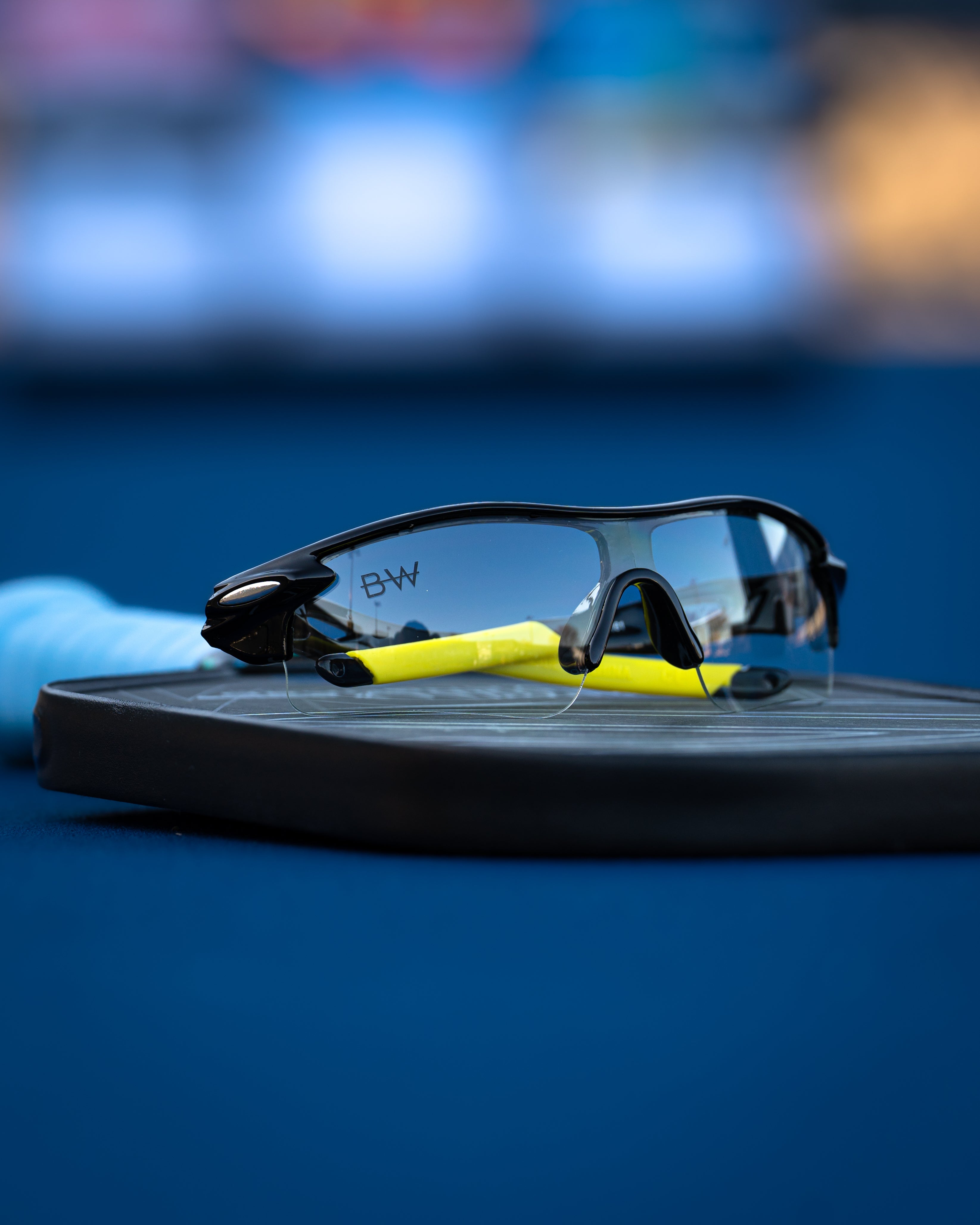
How Court Lighting Affects Your RX Lens Choice
Share
How Court Lighting Affects Your RX Lens Choice
The prescription written on your eyeglass prescription does not change when you walk from a bright outdoor pickleball court into an indoor facility—but the lighting environment around you does.
That distinction matters when choosing prescription pickleball eyewear. Bright daytime courts, overcast afternoons, indoor gyms, evening sessions, and mixed indoor-outdoor tournaments can create very different preferences for tinted versus untinted lenses.
Instead of assuming there is one universally “best” pickleball lens color, start with a more practical question: Where do you actually play? Then build your RX eyewear setup around your prescription needs, normal court environment, preferred amount of tint, and the conditions you encounter most often.
Choose RX Eyewear Around Your Court
Start With the Court Environment, Then Choose Your Lens Setup
Pickleball players often shop for eyewear by starting with a frame or lens color. For this decision, reverse the process.
- Identify where you play most often.
- Determine whether you need prescription correction.
- Decide whether you prefer tinted or untinted lenses in that environment.
- Choose a sports frame you are comfortable wearing.
- Consider whether one pair covers your schedule or whether you want a second option.
This keeps lighting in its proper role: it helps determine the lens setup you prefer, while your prescription remains responsible for your corrective vision.
The 5 Pickleball Lighting Environments
Most players can place the majority of their sessions into one of five categories.
| Court Environment | Typical Lighting | Lens Question |
|---|---|---|
| Bright outdoor daytime | Strong natural light | Do you prefer a tinted outdoor lens? |
| Overcast outdoor | Reduced natural brightness | Does your normal tint still feel comfortable? |
| Indoor court | Artificial overhead lighting | Would you rather play without dark sunglass tint? |
| Evening / lower light | Fading daylight or artificial court lights | Would an untinted setup better match your preference? |
| Mixed environments | Conditions change during your playing schedule | Can one pair cover your preferences, or would you rather have two? |
Bright Outdoor Pickleball: When Tinted RX Eyewear Makes Sense
If most of your pickleball happens outdoors during the day, prescription sunglasses can combine the corrective vision you need with the tinted lens setup you prefer for bright conditions.
Your outdoor decision does not have to depend on claims that a particular tint automatically improves contrast, depth perception, or ball tracking. Start with comfort and preference.
Ask Yourself:
- Do I normally prefer sunglasses outdoors?
- What time of day do I usually play?
- Do I spend several hours at the court?
- Does my preferred tint remain comfortable when clouds appear?
- Do I also play after sunset?
If you overwhelmingly play during bright daytime conditions, a dedicated tinted RX sports pair may cover most of your schedule.
The Sun-to-Shadow Test
Outdoor courts are rarely illuminated perfectly evenly. Buildings, fences, trees, cloud cover, and the position of the sun can change the brightness around different areas of a facility.
During warmup, move around the court and notice how your preferred lens setup feels from several positions:
- Stand at one baseline.
- Move to the opposite baseline.
- Spend time at each kitchen line.
- Look upward during several controlled lobs.
- Notice any shaded areas around the court.
- Decide whether your lens setup remains comfortable across the environment.
This is more useful than choosing eyewear based solely on what the court looks like while standing in the parking lot.
Overcast Pickleball: Do You Need to Change Lenses?
Cloud cover does not automatically mean you need different glasses.
If your normal outdoor RX eyewear remains comfortable, keep playing in it. If a darker tint becomes less desirable as conditions change, an untinted option may be worth considering.
| What You're Experiencing | Practical Decision |
|---|---|
| Tint still feels comfortable | Keep your current pair |
| Cloud passes briefly | No need to switch automatically |
| Heavy cloud cover lasts | Reassess your tint preference |
| Session continues toward evening | Consider whether you want an untinted option |
Indoor Pickleball: Why Clear RX Lenses Are Worth Considering
Indoor courts remove the bright outdoor sunlight that makes many players want sunglasses in the first place.
If you still need prescription correction but do not want a dark sunglass tint indoors, clear RX lenses provide a straightforward solution: prescription correction with an untinted lens.
Clear lenses can be relevant for:
- Indoor pickleball facilities
- Gym courts
- Indoor leagues
- Evening sessions
- Lower-light environments
- Players who simply prefer an untinted view
Clear does not mean that the lens creates more available light or automatically increases contrast. It means you are not adding a dark sunglass tint to the viewing environment.
Map the Lighting Inside Your Pickleball Facility
Not every part of an indoor facility necessarily looks identical. Before deciding how you feel about your RX setup, walk through the areas you actually use.
Baseline Check
Stand at both baselines and look across the full court.
Kitchen Check
Move forward and look through the shorter viewing distances used during dinking and volleys.
Overhead Check
Follow several controlled lobs so you experience the overhead environment.
Adjacent-Court Check
Notice the overall visual environment when several courts and players occupy the same facility.
Side-Switch Check
Play from both sides before deciding whether an issue belongs to your eyewear or to one particular area of the facility.
“Indoor Lighting” Is Not One Universal Condition
One of the biggest mistakes in choosing indoor pickleball eyewear is treating every indoor facility as identical.
Your local court might have:
- High ceilings
- Low ceilings
- Bright overhead fixtures
- Darker surrounding areas
- Multiple courts in one large space
- Different wall and floor colors
- Natural light entering through windows
That is why the useful question is not simply, “What are the best lenses for indoor pickleball?”
A better question is: “What lens setup do I prefer in the indoor facility where I actually play?”
Indoor vs. Outdoor RX Pickleball Glasses
| Factor | Indoor | Outdoor Daytime |
|---|---|---|
| Prescription correction | As needed | As needed |
| Dark sunglass tint | Often unnecessary if you prefer an untinted view | May be preferred by players who normally wear sunglasses outside |
| Clear lens option | Strong category to consider | Can still be used if you prefer untinted lenses |
| Lighting source | Primarily artificial | Primarily natural |
| Lighting changes | Usually tied to facility layout and fixtures | Can change with time, clouds, shadows, and weather |
| Main buying question | Do I want prescription correction without sunglass tint? | What outdoor lens setup do I prefer? |
Evening Pickleball: When Your Daytime Pair May Stop Matching the Environment
Evening sessions create an interesting transition because you may begin playing while substantial daylight remains and finish under court lights.
A tinted prescription pair that you enjoy during the earlier portion of the session may no longer match your preference later.
That does not automatically mean you need two pairs. But if you regularly notice the same pattern, you have identified a specific reason to consider an alternative.
A Two-Pair Evening Setup Could Look Like:
Pair 1: Your preferred tinted RX eyewear for brighter outdoor conditions.
Pair 2: Clear RX eyewear for the lower-light portion of the session.
The point is not to switch glasses every time the brightness changes slightly. It is to have another option when the environment changes substantially.
The Golden-Hour Test: Will Your Outdoor Pair Last the Entire Session?
If you frequently play late in the day, note the approximate conditions when you start and finish.
| Session Stage | Question |
|---|---|
| Start | Does my normal outdoor setup feel comfortable? |
| Mid-session | Has the environment changed enough for me to notice my tint? |
| Near sunset | Do I still prefer the same lens? |
| Under court lights | Would I rather have an untinted option? |
Repeat this across several sessions. Your own pattern can tell you whether one pair covers your schedule or whether a second setup would actually be useful.
Play Indoors and Outdoors? Build Around the Difference
Players who regularly switch between indoor and outdoor pickleball have a different decision from players who stay in one environment.
You have three basic strategies:
Strategy 1: One Primary Pair
Choose one RX setup that you are comfortable using across the environments where you play.
Strategy 2: Outdoor + Clear
Use your preferred tinted RX eyewear outdoors and an untinted RX option indoors or during lower-light sessions.
Strategy 3: Primary + Backup
Use one preferred pair most of the time and carry another source of corrective vision for tournaments, travel, or changing conditions.
There is no prize for owning the largest eyewear rotation. Choose the simplest system that covers your actual schedule.
The RX Lens Decision Tree for Court Lighting
Where are you playing?
Mostly outdoors during bright daytime hours?
→ Start by considering the tinted RX setup you prefer outdoors.
Mostly indoors?
→ Consider clear RX eyewear if you want prescription correction without dark sunglass tint.
Mostly outdoors in the evening?
→ Consider whether clear or another untinted setup better matches your later sessions.
Indoor and outdoor?
→ Decide whether one pair works comfortably in both or whether separate outdoor and untinted pairs make more sense.
Long tournaments with changing conditions?
→ Consider a primary pair plus another appropriate corrective option.
Lighting Problem or Prescription Problem?
If something feels wrong on court, identify what changes the problem.
| What You Notice | Question to Ask |
|---|---|
| Tint feels too dark indoors | Would I simply prefer an untinted lens? |
| Outdoor pair feels comfortable until evening | Is the changing environment affecting my lens preference? |
| One side of an indoor court feels different | Is that area of the facility illuminated differently? |
| Lens is dirty or smeared | Does cleaning it solve the issue? |
| Vision remains significantly blurry across environments | Is this actually unrelated to court lighting? |
Lighting can influence which lens setup you prefer. It should not become an explanation for every persistent visual problem.
Does a Certain Lens Color Automatically Improve Pickleball Performance?
It is easy to find broad claims that a specific lens color will automatically improve contrast, ball tracking, reaction time, or depth perception.
That is not how this guide approaches RX lens selection.
Lens tint changes the viewing experience, and individual players can have different preferences. Instead of promising that one color will make you react faster, choose around:
- Your court environment
- Your prescription needs
- Your sensitivity and preferences
- Whether you want tinted or untinted lenses
- The time of day you normally play
Your anticipation, technique, positioning, and decision-making still come from you.
Where Non-Polarized Lenses Fit Into the Decision
Blinded Wear uses non-polarized lenses. Non-polarized lenses do not add a polarization filter and preserve the visual information available without that filter.
Some court players prefer non-polarized eyewear.
That does not mean non-polarized lenses inherently improve depth perception, reaction time, or ball tracking. Treat polarization as one characteristic of the lens rather than a shortcut to better performance.
High-Index RX Lenses Are Included
Blinded Wear includes high-index prescription lenses at no additional cost with RX eyewear.
There is no need to assume one specific lens index simply because you play pickleball. Your prescription requirements remain the starting point.
RX Frames to Compare Across Different Court Environments
The original lighting guide highlighted several Blinded Wear RX frames. Rather than assigning unsupported lighting technology to individual models, use them as frame options when building the lens setup that matches your playing environment.
Havana White RX
Consider Havana White RX if you prefer its frame design while building a dedicated prescription pickleball setup.
Lava Rock RX
Lava Rock RX gives prescription players another performance-first frame design to compare.
Blue Shield RX
Blue Shield RX provides another RX frame option for players building dedicated sports eyewear around their prescription and preferred playing environment.
When available, compare frame dimensions with eyewear that already fits you comfortably rather than assuming one frame shape fits every player.
Score Your Home Court Before Buying Another RX Pair
Use three normal playing sessions to identify what your court actually demands from your eyewear.
| Question | Session 1 | Session 2 | Session 3 |
|---|---|---|---|
| Indoor or outdoor? | _____ | _____ | _____ |
| Time of day? | _____ | _____ | _____ |
| Bright, moderate, or lower light? | _____ | _____ | _____ |
| Did my tint feel comfortable? | Yes / No | Yes / No | Yes / No |
| Would I have preferred clear lenses? | Yes / No | Yes / No | Yes / No |
| Did conditions change significantly? | Yes / No | Yes / No | Yes / No |
After three sessions, you should have a better answer to the question that matters most: what lens setup do I actually want on my court?
7 RX Lens Mistakes Players Make When Thinking About Court Lighting
-
Assuming every indoor facility has identical lighting.
Evaluate the facility where you actually play.
-
Assuming one tint is universally best for pickleball.
Lens preferences can vary between players and environments.
-
Wearing a dark lens indoors simply because it is a sports frame.
Consider whether you would rather use an untinted lens.
-
Buying for noon when you normally play at 7 p.m.
Choose around your real playing schedule.
-
Confusing tint with prescription correction.
Your RX and your preferred amount of tint solve different parts of the eyewear decision.
-
Assuming every visual problem is caused by lighting.
Persistent significant blur or distortion should not simply be blamed on the court lights.
-
Overcomplicating your eyewear rotation.
If one pair already works comfortably across your normal sessions, you may not need several specialized pairs.
Quick Answers About Court Lighting and RX Pickleball Lenses
What prescription lenses are best for indoor pickleball?
If you need prescription correction but prefer not to wear dark sunglass tint indoors, clear RX lenses are a straightforward category to consider.
Are clear lenses good for indoor pickleball?
Yes. Clear lenses provide an untinted option for indoor play.
Are clear lenses good for evening pickleball?
They can be useful for players who want an untinted lens as outdoor conditions become darker or play moves under court lighting.
Do clear lenses improve ball tracking?
Clear lenses should not automatically be credited with improving ball tracking. Their primary role is providing an untinted viewing option.
What tint is best for outdoor pickleball?
There is no single tint that is universally best for every player. Consider the brightness and time of day when you play along with your personal lens preference.
Do I need separate indoor and outdoor prescription pickleball glasses?
Not necessarily. Some players are comfortable with one setup, while others prefer tinted RX eyewear outdoors and an untinted pair indoors or in lower-light environments.
What if I play both indoor and outdoor pickleball?
Determine whether one pair remains comfortable across both environments. If not, separate outdoor and untinted setups may provide more flexibility.
Should I switch glasses whenever a cloud covers the sun?
No. Brief changes do not automatically require an eyewear change. Reassess when conditions change enough that your current setup no longer matches your preference.
Are Blinded Wear RX lenses polarized?
No. Blinded Wear uses non-polarized lenses.
Does Blinded Wear include high-index prescription lenses?
Yes. High-index prescription lenses are included at no additional cost with Blinded Wear RX eyewear.
Are Blinded Wear sports lenses impact-resistant?
Yes. Blinded Wear sports eyewear uses impact-resistant lenses.
Next: Match Your Lens Setup to the Way You Actually Play
Knowing whether a court is “indoor” or “outdoor” is only the beginning. Two outdoor players can need very different eyewear strategies if one plays at noon and the other starts every match near sunset. Two indoor facilities can also create completely different viewing environments.
Part 2 will turn those differences into a court-by-court lighting audit, indoor facility test, outdoor sun-position map, evening transition plan, mixed-light tournament strategy, clear-versus-tinted decision system, RX troubleshooting matrix, and practical method for deciding whether you need one pair or a two-pair lighting rotation.
Run a Court-Lighting Audit Before Changing Your RX Eyewear
If your prescription is working but your eyewear feels better on some courts than others, do not immediately assume you need a completely different pair. First, identify what actually changes between those environments.
Use one normal warmup to audit the court from the positions where you actually play.
- Stand at both baselines. Look across the court from each direction.
- Move to both kitchen lines. Check the environment from your normal volley and dink positions.
- Follow several controlled lobs. Include the overhead area in your assessment.
- Switch sides. Determine whether one orientation feels different from the other.
- Play for several minutes. Give yourself enough time to experience the environment during normal movement.
- Reassess your lens choice. Ask whether the issue is your prescription, your tint preference, lens cleanliness, or simply the court environment.
The goal is to identify a repeatable pattern before buying another pair of prescription pickleball glasses.
The 6-Zone Indoor Pickleball Lighting Test
Indoor courts deserve more than a simple “bright” or “dark” label. Walk through six viewing zones to understand the facility you use most often.
| Zone | Where to Look | What You're Evaluating |
|---|---|---|
| 1. Baseline | Across the entire court | Your normal long-distance court view |
| 2. Kitchen | Across the net | Your shorter-distance playing environment |
| 3. Overhead | Upward during controlled lobs | How the overhead environment looks from court level |
| 4. Sideline | Across adjacent playing areas | The surrounding visual environment |
| 5. Opposite Side | Repeat after changing ends | Whether court orientation changes your experience |
| 6. Game Speed | Normal rallies | Whether your lens setup remains comfortable once you stop analyzing it |
If the same RX eyewear feels comfortable throughout all six zones, you have useful evidence that your current setup matches that facility.
Should You Switch to Clear RX Lenses Indoors?
Use a simple decision system rather than assuming every indoor player needs specialized lens technology.
Clear RX Is Worth Considering If...
- You need prescription correction while playing
- You do not want dark sunglass tint indoors
- You regularly play in indoor facilities
- You play evening or lower-light sessions too
- You want an untinted pair in your pickleball rotation
Your Current Pair May Already Work If...
- You remain comfortable throughout indoor sessions
- You are not bothered by its tint
- Your prescription correction works appropriately for you
- You have no recurring reason to change your setup
Do not create an equipment problem that you do not actually have. A second pair becomes useful when it solves a recurring need.
The Overhead-Light Ball Test
Indoor pickleball often requires you to look upward during lobs, overheads, high returns, and other elevated balls. That makes the ceiling part of your actual playing environment.
During warmup, have a partner send several controlled high balls.
- Start with a predictable lob.
- Follow the ball upward normally.
- Reposition without rushing.
- Play the appropriate response.
- Repeat from the opposite side of the court.
- Try the same sequence after switching ends.
If something feels different only when looking into one particular part of the facility, that pattern tells you more than simply concluding that “indoor lighting is bad.”
Why the Same RX Glasses Can Feel Different at Two Indoor Facilities
Imagine playing Monday at one indoor facility and Wednesday at another. Your prescription did not change in 48 hours, but the environment may have.
| Facility Variable | Court A | Court B |
|---|---|---|
| Ceiling height | Higher | Lower |
| Fixture placement | Spread across large space | Closer to playing area |
| Windows | Natural light present | Little natural light |
| Court surroundings | Open multi-court facility | Smaller enclosed gym |
| Wall / floor environment | One visual background | Different visual background |
This is why buying eyewear based on the word “indoor” alone can oversimplify the decision.
Outdoor Players: Map the Sun Across Your Session
Outdoor lighting can change even when the weather remains perfectly clear. A morning match and a late-afternoon match on the same court can create very different viewing environments.
Think about your normal playing window in stages.
| Session Stage | What to Notice | Lens Question |
|---|---|---|
| Warmup | Starting brightness and court orientation | Does my outdoor RX setup feel comfortable? |
| Early games | Sun position and shadows | Does the same setup still feel appropriate? |
| Mid-session | Changing shadows or cloud cover | Am I still comfortable with the tint? |
| Late session | Lower natural brightness | Am I beginning to prefer an untinted option? |
| Court lights | Artificial lighting becomes dominant | Would clear RX better match my preference now? |
Players who almost always finish before lighting changes substantially may be perfectly comfortable with one outdoor pair. Players whose sessions routinely cross from daylight into evening have a stronger reason to consider two setups.
One Side of the Outdoor Court Feels Different? Test the Direction
Before blaming your RX lenses, determine whether the issue changes when you switch ends.
Try This During Warmup
- Hit several balls from Side A.
- Include groundstrokes, dinks, and a few high balls.
- Move to Side B.
- Repeat the same sequence.
- Compare the experience.
If your experience changes with court orientation while the glasses remain exactly the same, the environment is an important variable.
This is especially useful when deciding whether you dislike your eyewear generally or only notice an issue from one direction at a particular time of day.
Clouds Keep Moving In and Out? Don't Overreact to Every Lighting Change
Outdoor lighting can change repeatedly during a single game. Constantly switching glasses every time a cloud crosses the sun would create more disruption than benefit for many players.
Use a three-level approach instead.
Minor Change
A cloud briefly passes overhead, but your current lenses remain comfortable. Keep playing.
Meaningful Change
Cloud cover becomes sustained and your current tint starts feeling less appropriate. Reassess at the next convenient break.
Major Environment Change
The session moves from bright daytime conditions toward evening or artificial court lighting. If you prefer an untinted setup in those conditions, this is a more logical time to switch.
The Day-to-Night RX Transition Plan
If your pickleball schedule regularly crosses sunset, build a repeatable plan rather than deciding from scratch every session.
Stage 1: Bright Daylight
Use your preferred daytime RX setup.
Stage 2: Late Afternoon
Continue using the same pair while it remains comfortable.
Stage 3: Fading Natural Light
Notice whether your tint is becoming more noticeable to you.
Stage 4: Court Lights Take Over
If you now prefer an untinted setup, switch to your clear RX option during a natural break.
Stage 5: Finish the Session
Use whichever setup feels appropriate for the remaining playing environment.
The exact point at which you switch is personal. The useful part is recognizing the recurring transition and preparing for it.
When a Two-Pair RX Rotation Actually Makes Sense
A two-pair system is not necessary just because you play pickleball frequently. It becomes more useful when your schedule repeatedly includes two distinctly different environments.
| Your Schedule | Possible Setup |
|---|---|
| Almost exclusively outdoor daytime | One preferred outdoor RX pair may be enough |
| Almost exclusively indoor | One clear or otherwise preferred indoor RX pair may be enough |
| Outdoor daytime + indoor league | Outdoor RX pair + clear RX pair |
| Afternoon sessions ending after sunset | Outdoor RX pair + untinted backup |
| Frequent tournaments | Primary RX pair + alternative-condition or backup corrective pair |
| Different facilities throughout the week | Test your primary pair first, then add another only if a repeatable need appears |
Can One Pair Handle Your Entire Pickleball Schedule?
Before buying a second pair, score your primary eyewear across the environments you regularly use.
- □ Comfortable on my main outdoor court
- □ Comfortable when cloud cover changes
- □ Comfortable during my normal playing hours
- □ Comfortable indoors
- □ Comfortable during evening sessions
- □ Comfortable when following high balls
- □ Comfortable through long sessions
- □ Tint remains appropriate for the environments where I use it
If you can check nearly every box that actually applies to your schedule, you may already have the simple one-pair solution you need.
If the same unchecked box appears every week—such as dark tint becoming undesirable during indoor league play—you have identified a clear role for a second pair.
Mixed-Light Tournament Strategy: Prepare for the Whole Day
Tournaments can expose you to more lighting variation than an ordinary recreational session.
You might warm up outside in the morning, play through changing cloud cover, continue late into the afternoon, or move between different court environments during the event.
Build your tournament eyewear plan around three roles.
Primary Pair
The RX eyewear you expect to use during most matches.
Alternative-Condition Pair
A different lens setup if you know your preferences change substantially between environments.
Backup Correction
Another source of corrective vision if your primary eyewear becomes unavailable.
The alternative-condition pair and emergency backup can sometimes be the same pair. The goal is useful redundancy, not unnecessary equipment.
Use Your Tournament Schedule to Predict Your Lens Needs
| Match Time | Likely Environment to Evaluate | What to Pack |
|---|---|---|
| Early morning | Starting natural-light conditions | Primary RX + backup |
| Midday | Brighter outdoor environment if playing outside | Your preferred outdoor setup |
| Late afternoon | Changing sun position and shadows | Primary + alternative if you regularly use one |
| Evening | Lower natural light or court lighting | Consider an untinted option if preferred |
| Indoor match | Artificial facility lighting | Clear RX if that is your preferred indoor setup |
Clear vs. Tinted RX Pickleball Glasses: Make the Decision in 30 Seconds
Ask these questions in order:
1. Do I need prescription correction?
If yes, begin with an RX option.
2. Am I playing in bright outdoor conditions?
If yes, consider whether you prefer tinted prescription eyewear.
3. Am I playing indoors?
If yes, consider whether you would rather use clear RX lenses.
4. Am I playing during evening or lower-light conditions?
If yes, ask whether an untinted lens better matches your preference.
5. Does my current pair already feel comfortable?
If yes, you may not need to change anything.
6. Do I repeatedly move between two very different environments?
If yes, a two-pair rotation may be worth considering.
What Clear RX Lenses Do—and What They Don't Need to Claim
Clear RX lenses have a simple role: providing prescription correction without dark sunglass tint.
That makes them easy to understand when choosing eyewear around lighting.
| Clear RX Can... | Clear RX Shouldn't Automatically Be Claimed to... |
|---|---|
| Provide prescription correction | Improve reaction time |
| Provide an untinted lens option | Increase available light |
| Be considered for indoor play | Automatically improve ball tracking |
| Be considered for evening play | Automatically enhance contrast |
| Serve as an alternative to dark sunglass tint | Guarantee better performance |
RX Lens Troubleshooting by Lighting Situation
| Problem | Possible Explanation to Check | Practical Next Step |
|---|---|---|
| Tint feels too dark indoors | Your lens preference does not match the environment | Consider an untinted RX option |
| Tint feels fine at 4 p.m. but not later | Your session crosses into lower-light conditions | Test a second setup during evening play |
| Only one side of the court feels different | Court orientation or lighting may be involved | Switch sides and repeat the same drill |
| High balls feel different indoors | The overhead environment may be contributing | Run controlled lob repetitions from both ends |
| View looks smeared | Lens may simply be dirty | Clean the lens appropriately and retest |
| Problem appears only at one facility | The environment may differ from your other courts | Compare the facilities before changing your entire eyewear setup |
| Significant blur occurs everywhere | Lighting may not explain the issue | Do not assume another tint solves a persistent vision problem |
5 Pickleball Lens Claims to Think About More Carefully
1. “This Tint Automatically Improves Ball Tracking”
Tint changes the viewing experience, but ball tracking also depends on your vision, attention, anticipation, positioning, and experience.
2. “Indoor Players Need Blue-Light Filtering”
Do not assume a specialized filtering feature is required simply because a court uses artificial lighting.
3. “Anti-Reflective Coating Is Mandatory for Indoor Pickleball”
Do not treat an unverified coating as a standard requirement for every indoor player or every Blinded Wear model.
4. “One Lens Color Is Best for Every Court”
Players and playing environments differ. Choose around the conditions you actually encounter.
5. “The Right Tint Makes You React Faster”
Reaction involves seeing the situation, recognizing what is happening, deciding what to do, and physically executing the response. A tint should not automatically be credited with improving that entire process.
Compare Blinded Wear RX Frames Without Assigning Them Fake Lighting Technology
Havana White RX, Lava Rock RX, and Blue Shield RX can all be considered when building prescription pickleball eyewear. The useful distinction is the frame and lens setup available to you—not unsupported claims that one model is automatically engineered for a particular type of court lighting.
| RX Frame | Use It as a Starting Point If... | Then Compare... |
|---|---|---|
| Havana White RX | You prefer the Havana White design | Available dimensions, prescription needs, and lens setup |
| Lava Rock RX | You prefer the Lava Rock design | Available dimensions, prescription needs, and lens setup |
| Blue Shield RX | You prefer the Blue Shield design | Available dimensions, prescription needs, and lens setup |
Once you choose a frame, build the rest of the decision around your prescription and the environment where you intend to use it.
Use 3 Sessions to Decide Whether You Really Need Different Lenses
Instead of judging your eyewear after one unusual game, track three normal sessions.
| Session | Court / Environment | Time | Tint Comfortable? | Would You Change Anything? |
|---|---|---|---|---|
| 1 | __________ | __________ | Yes / No | __________ |
| 2 | __________ | __________ | Yes / No | __________ |
| 3 | __________ | __________ | Yes / No | __________ |
If all three sessions reveal the same problem, you have identified something worth addressing. If the issue happened once and disappeared, you may not need an entirely new eyewear strategy.
Ordering RX Pickleball Glasses Around Your Playing Environment
Once you understand your normal court lighting, choosing prescription pickleball eyewear becomes much more straightforward.
- Identify your primary playing environment.
- Decide whether you prefer tinted or untinted lenses there.
- Browse the Blinded Wear RX Pickleball Glasses Collection.
- Choose a frame design you prefer.
- Compare available dimensions when provided.
- Have your current eyeglass prescription ready.
- Upload a clear photo or picture of your prescription before purchasing.
Blinded Wear includes high-index prescription lenses at no additional cost with RX eyewear.
More Questions About RX Lenses and Pickleball Court Lighting
Do indoor pickleball courts require special prescription lenses?
Not necessarily. If you need prescription correction and prefer an untinted setup indoors, clear RX eyewear is a straightforward option to consider.
Why do my glasses feel different at different indoor courts?
Facilities can differ in ceiling height, fixture placement, windows, court surroundings, and overall visual environment even though both are considered indoor pickleball courts.
What glasses should I wear for pickleball under court lights?
If you require prescription correction and do not want dark sunglass tint under artificial court lighting, consider an untinted RX option.
Should I use tinted glasses for indoor pickleball?
That depends on your preference and the specific lens. Players who do not want dark sunglass tint indoors can consider clear lenses.
Should I switch to clear lenses when clouds appear?
Not automatically. If your current lens remains comfortable, a temporary cloud does not require a switch.
What if my outdoor pickleball game starts before sunset and ends at night?
If you prefer tinted lenses during the brighter portion but not under lower-light conditions, carrying an untinted option can create a simple two-pair rotation.
Can I use clear RX pickleball glasses outdoors?
Yes. Clear lenses can be worn outdoors when an untinted setup matches your preferences.
Do clear lenses make a dark court brighter?
Clear lenses do not create additional available light. They provide an untinted lens option.
Does lens tint improve reaction time?
A tint should not automatically be credited with improving reaction time. Reaction involves multiple visual, cognitive, and physical processes.
Does lens color improve pickleball depth perception?
A particular tint should not automatically be claimed to improve depth perception for every player.
Should pickleball players always avoid polarized lenses?
Blinded Wear uses non-polarized lenses, and some court players prefer that setup. That does not establish a universal rule that every pickleball player must avoid polarization.
Do I need anti-reflective lenses for indoor pickleball?
Do not assume anti-reflective coating is mandatory for every indoor player. It is not being claimed here as a standard Blinded Wear feature.
Does Blinded Wear offer blue-light filtering?
Blue-light filtering is not being treated as a standard verified Blinded Wear feature in this guide.
Does Blinded Wear include high-index RX lenses?
Yes. High-index prescription lenses are included at no additional cost with Blinded Wear RX eyewear.
Are Blinded Wear lenses impact-resistant?
Yes. Blinded Wear sports eyewear uses impact-resistant lenses.
How do I know whether I need one pair or two?
Track your normal playing environments. If one pair remains comfortable across them, keep the setup simple. If the same lens repeatedly feels inappropriate in a second environment, another pair may fill a useful role.
Part 3: Turn Your Court Schedule Into an RX Eyewear System
By this point, the decision is no longer simply “indoor versus outdoor.” You have identified court orientation, time of day, overhead lighting, changing natural light, clear-versus-tinted preferences, and whether a second pair would solve a real recurring problem.
Part 3 will finish the guide with a weekly lighting profile, one-pair-versus-two-pair scorecard, tournament bag system, pre-match 60-second lighting check, indoor and outdoor buying checklist, lighting myths, expanded search-friendly FAQ, Blinded Wear shopping resources, replacement support, and a final RX lens-selection framework for choosing eyewear based on where and when you actually play.
Build Your Weekly Pickleball Lighting Profile
The easiest way to choose RX pickleball lenses is to stop shopping for an imaginary “average” court and look at the courts you actually use every week.
Map your normal schedule before deciding whether you need one prescription pair or multiple lens setups.
| Day / Session | Environment | Typical Time | Tint Preference | Current Pair Works? |
|---|---|---|---|---|
| Session 1 | Indoor / Outdoor | __________ | Tinted / Clear | Yes / No |
| Session 2 | Indoor / Outdoor | __________ | Tinted / Clear | Yes / No |
| Session 3 | Indoor / Outdoor | __________ | Tinted / Clear | Yes / No |
| Session 4 | Indoor / Outdoor | __________ | Tinted / Clear | Yes / No |
Now look for the dominant environment.
If three of your four weekly sessions happen outdoors during the day, your primary RX pair should probably be chosen around that environment. If you play indoors four nights a week, an untinted RX setup may deserve priority.
Your eyewear rotation should reflect your real schedule—not every possible condition a pickleball player could encounter.
One RX Pair or Two? Use This Scorecard
More eyewear is not automatically better. A second pair makes the most sense when it solves a specific recurring problem.
| Statement | Yes | No |
|---|---|---|
| I regularly play both indoors and outdoors | □ | □ |
| I frequently start in daylight and finish under court lights | □ | □ |
| I prefer tinted lenses during bright daytime play | □ | □ |
| I prefer untinted lenses indoors | □ | □ |
| My current tint repeatedly feels too dark in another environment | □ | □ |
| I play long tournaments where conditions can change | □ | □ |
| I want backup corrective eyewear at tournaments | □ | □ |
If most of your answers are “No,” one well-chosen RX pair may cover your schedule.
If several are “Yes”—especially the questions involving repeated indoor/outdoor or day/night changes—a second pair may have a clearly defined role.
If You Own Two Pairs, Give Each One a Specific Job
A two-pair setup becomes easier to use when you stop thinking of one pair as “better” and instead give each pair a purpose.
Pair A: Primary Environment
This should match the conditions where you spend most of your playing time.
For a daytime outdoor player, that could be your preferred tinted RX sports eyewear.
Pair B: Alternative Environment
This pair covers the recurring environment where Pair A no longer matches your preference.
For someone who plays outdoors during the day but also joins an indoor league, Pair B might be clear RX eyewear.
Bonus: Backup Correction
If Pair B also gives you another source of prescription correction when Pair A is unavailable, your second pair serves two useful roles without unnecessarily complicating your bag.
The 60-Second Pre-Match Lighting Check
You do not need an elaborate test before every game. Use one minute of warmup to confirm that your lens setup matches the environment.
- Look across the court from your starting baseline.
- Move to the opposite side.
- Hit several balls from the kitchen.
- Follow one or two controlled high balls.
- Notice whether your tint feels appropriate.
- If everything feels comfortable, stop evaluating the glasses and play.
This check is especially useful when visiting a new facility or beginning a match at a different time of day than usual.
Keep, Switch, Clean, or Check? The Fast RX Decision System
When something feels different during a match, use four actions instead of immediately blaming your prescription.
| Action | Use It When... |
|---|---|
| KEEP | Your current RX setup remains comfortable despite a minor lighting change |
| SWITCH | The environment has changed substantially and you prefer your alternative lens setup |
| CLEAN | Fingerprints, sweat, moisture, or debris are affecting the lens surface |
| CHECK | Significant blur or another visual issue persists across environments and does not appear to be explained by tint or lens cleanliness |
This prevents every unusual visual moment from becoming an unnecessary equipment change.
Indoor Pickleball RX Buying Checklist
If indoor pickleball makes up most of your schedule, build your purchase around that environment.
- □ Start with your prescription requirements
- □ Decide whether you want an untinted lens
- □ Consider clear RX eyewear
- □ Compare available frame dimensions
- □ Compare those measurements with eyewear that already fits
- □ Consider a lightweight sports frame for extended sessions
- □ Think about the facility where you actually play
- □ Test the eyewear from both sides of the court
- □ Include high balls during your first practice
- □ Avoid assuming you need unverified coatings or filtering technology simply because you play indoors
Outdoor Pickleball RX Buying Checklist
Outdoor players should think about more than whether the court is sunny at the moment they place an order.
- □ Start with your prescription requirements
- □ Identify the hours when you normally play
- □ Decide whether you prefer tinted lenses during those hours
- □ Consider whether sessions regularly continue toward sunset
- □ Think about changing cloud cover
- □ Compare available frame dimensions
- □ Choose a lightweight sports frame you are comfortable wearing
- □ Consider whether you also need an untinted alternative
- □ Plan for lens cleaning during active outdoor sessions
- □ Test the eyewear from both ends of your normal court
What Belongs in an RX Tournament Bag for Changing Lighting?
If you rely on prescription correction, tournament preparation should account for more than your first match.
| Item | Role |
|---|---|
| Primary RX eyewear | Your main match pair |
| Alternative lens setup | For a substantially different environment if you regularly use one |
| Backup corrective eyewear | Redundancy if your primary pair becomes unavailable |
| Protective storage | Keep unused eyewear separated from loose equipment |
| Clean lens cloth | Remove appropriate surface contamination when needed |
| Suitable lens cleaner | Keep the lens surface clean through a long event |
For some players, the alternative-condition pair can also serve as the backup corrective pair.
Tournament Morning: Match Your Bag to the Schedule
Before leaving for a tournament, review when and where you expect to play.
Ask Five Questions
- Are my matches indoors, outdoors, or both?
- What time does my first match begin?
- Could I still be playing near or after sunset?
- Do I normally prefer different lens setups in those environments?
- Do I have backup prescription correction?
If all of your matches happen in the same environment, your setup may be simple. If the tournament crosses multiple environments or times of day, pack accordingly.
7 Myths About Pickleball Court Lighting and RX Lenses
Myth 1: Indoor Pickleball Automatically Requires Special Lens Coatings
Indoor players may prefer an untinted prescription setup, but that does not establish a universal requirement for specialized coatings.
Myth 2: Clear Lenses Make a Dark Court Brighter
Clear lenses do not create additional available light. They provide an untinted lens option.
Myth 3: One Lens Color Is Best for Every Pickleball Player
Players compete in different environments and can have different tint preferences.
Myth 4: A Certain Tint Automatically Improves Ball Tracking
Ball tracking involves your vision, attention, anticipation, and movement. A tint should not automatically be credited with improving it.
Myth 5: A Certain Lens Automatically Improves Reaction Time
Reaction includes recognition, decision-making, movement, and execution. Eyewear should not be presented as a shortcut to faster reactions.
Myth 6: You Need Different Glasses Every Time the Lighting Changes
If your current pair remains comfortable, minor environmental changes do not require an immediate switch.
Myth 7: If Vision Feels Wrong, Court Lighting Must Be the Cause
Lighting can affect lens preference, but it should not be used to explain persistent significant blur, distortion, or other visual problems across environments.
Choosing a Blinded Wear RX Frame for Your Lighting Setup
Once you know whether you primarily need outdoor, indoor, evening, or mixed-environment eyewear, frame selection becomes a separate decision.
| Frame | Consider It If... | Then Evaluate... |
|---|---|---|
| Havana White RX | You prefer the Havana White design | Available dimensions, prescription requirements, and lens setup |
| Lava Rock RX | You prefer the Lava Rock design | Available dimensions, prescription requirements, and lens setup |
| Blue Shield RX | You prefer the Blue Shield design | Available dimensions, prescription requirements, and lens setup |
Do not assume that a particular frame automatically solves a particular lighting condition. Start with the lens environment you prefer, then choose the frame that fits your needs and style.
The Complete RX Lens-Selection Framework
If you want to reduce this entire guide to one process, follow these eight steps.
Step 1: Start With Your Prescription
Determine the corrective vision you need.
Step 2: Identify Your Primary Court
Is most of your pickleball indoors or outdoors?
Step 3: Identify Your Playing Time
A noon outdoor player and a 7 p.m. outdoor player may have different tint preferences.
Step 4: Decide Whether You Want Tint
Choose based on your environment and preference rather than promises that one color automatically improves performance.
Step 5: Identify Your Secondary Environment
If you regularly play somewhere substantially different, determine whether your primary setup still works there.
Step 6: Decide Whether You Need Pair #2
Add another pair only if it solves a recurring need or provides useful prescription backup.
Step 7: Choose Your Frame
Compare design, available dimensions, prescription needs, and the lens setup available for the product.
Step 8: Test It on Your Actual Court
Use normal warmup and play to determine whether the complete setup matches the environment where you intended to use it.
FAQ: Choosing RX Pickleball Glasses for Different Lighting
What color lenses are best for pickleball?
There is no single lens color that is universally best for every pickleball player. Consider your playing environment, time of day, prescription needs, and tint preference.
What are the best prescription glasses for indoor pickleball?
Players who need prescription correction but do not want dark sunglass tint indoors can consider clear RX sports eyewear.
What are the best RX glasses for outdoor pickleball?
Start with prescription sports eyewear that meets your corrective needs and provides a lens setup you are comfortable using during your normal outdoor playing conditions.
Should prescription pickleball glasses be clear indoors?
They do not have to be, but clear RX lenses are a straightforward option for players who prefer an untinted lens indoors.
Can I wear clear pickleball glasses outside?
Yes. Clear lenses can be used outdoors when an untinted setup matches your preference.
Can I wear prescription sunglasses indoors?
You can, but if the tint feels too dark for your indoor environment, you may prefer an untinted prescription pair.
What glasses should I use for night pickleball?
If you require prescription correction and prefer not to use dark sunglass tint under court lights, clear RX eyewear is one option to consider.
Do I need different glasses for daytime and nighttime pickleball?
Not necessarily. A second pair becomes more useful when you repeatedly prefer different lens setups between bright daytime and lower-light play.
What glasses should I use for an indoor/outdoor pickleball tournament?
Use the RX pair you prefer for your primary environment and consider an alternative lens setup or backup corrective pair if the tournament moves between substantially different conditions.
Should I change lenses when the sun goes behind a cloud?
Not automatically. If your current pair remains comfortable, brief changes in brightness do not require a switch.
Why does one side of a pickleball court look different?
Court orientation, natural light, shadows, surrounding structures, or indoor fixture placement can make different positions feel different even while your eyewear remains unchanged.
Why do my glasses feel different when I look up at indoor lights?
The overhead environment is different from looking straight across the court. Test high balls from several positions to determine whether the issue is tied to a particular area of the facility.
Do clear lenses increase available light?
No. Clear lenses do not create additional light. They simply do not add dark sunglass tint.
Do tinted lenses improve pickleball contrast?
A tint changes the viewing experience, but this guide does not claim that a particular tint automatically enhances contrast or pickleball performance for every player.
Do certain lens colors help you see a pickleball better?
Players may have individual preferences, but a specific lens color should not automatically be claimed to improve ball tracking for everyone.
Do non-polarized lenses improve depth perception?
No inherent improvement should be assumed. Blinded Wear uses non-polarized lenses, which do not add a polarization filter, and some court players prefer that setup.
Does Blinded Wear use polarized lenses?
No. Blinded Wear uses non-polarized lenses.
Does Blinded Wear include high-index prescription lenses?
Yes. High-index prescription lenses are included at no additional cost with Blinded Wear RX eyewear.
Are Blinded Wear pickleball lenses impact-resistant?
Yes. Blinded Wear sports eyewear uses impact-resistant lenses.
Does impact-resistant mean shatterproof?
No. Impact-resistant does not mean shatterproof and should not be interpreted as a claim that the eyewear is certified protective equipment.
How do I know whether I need two pairs of RX pickleball glasses?
Look at your weekly schedule. If you repeatedly play in two substantially different environments and prefer a different lens setup in each, a two-pair rotation may be useful.
Shop by the Court Environment You Actually Play In
Once you know your prescription needs and normal lighting environment, use the appropriate Blinded Wear collection or comparison tool to narrow your options.
How to Order Blinded Wear Prescription Pickleball Glasses
Once you have chosen the frame and lens setup that fits your playing environment:
- Select your preferred RX frame.
- Review available product information and dimensions.
- Compare the dimensions with eyewear that already fits you when possible.
- Have your current eyeglass prescription ready.
- Take a clear photo or picture of your prescription.
- Upload your prescription before purchasing.
- Complete your order.
Blinded Wear includes high-index prescription lenses at no additional cost with RX eyewear.
Replacement Support for Your Regular Court Pair
Once you find an RX setup that works across your normal court environment, it may become the pair you wear through drills, open play, leagues, and tournaments.
Blinded Wear offers 50% lifetime replacement support if your glasses break, subject to current policy terms.
Performance-First Eyewear Built Around Pickleball
Blinded Wear designs performance-first eyewear with pickleball players in mind, including prescription, non-prescription, and clear-lens options for different playing environments.
The Blinded Wear mission also extends beyond the court through its commitment to supporting children's vision.
Final Court-Lighting Checklist
- □ Start with the prescription correction you need
- □ Identify whether you play primarily indoors or outdoors
- □ Consider the time of day you normally play
- □ Decide whether you prefer tinted or untinted lenses
- □ Test your eyewear from both ends of the court
- □ Include high balls when evaluating an indoor facility
- □ Do not switch lenses for every minor lighting change
- □ Consider clear RX eyewear for an untinted option
- □ Add a second pair only when it solves a recurring need
- □ Bring backup corrective eyewear for long tournaments when appropriate
- □ Keep lenses clean during play
- □ Compare available frame dimensions before ordering
- □ Avoid assuming one tint automatically improves performance
- □ Avoid treating persistent significant blur as merely a lighting problem
Final Word: Choose RX Lenses for Your Court, Not Someone Else's
The best way to think about court lighting is not to search for a single lens color that supposedly dominates every pickleball environment.
Start with your prescription. Then look at your schedule.
Do you play indoors four nights a week? Clear RX eyewear may deserve a serious look. Do you spend nearly every session outside during the day? Build your primary pair around the outdoor lens setup you prefer. Do you start in afternoon sun and regularly finish under court lights? A second untinted pair may have a clearly defined job.
Then test the setup on the actual court.
Stand at both baselines. Move to the kitchen. Follow a lob. Switch ends. Play several rallies. Notice whether the lens remains comfortable as the environment changes.
If it does, keep playing.
If the same lighting-related preference appears session after session, use that pattern to guide your next eyewear decision.
Your prescription determines the correction you need. Your court environment helps determine the lens setup you want.