
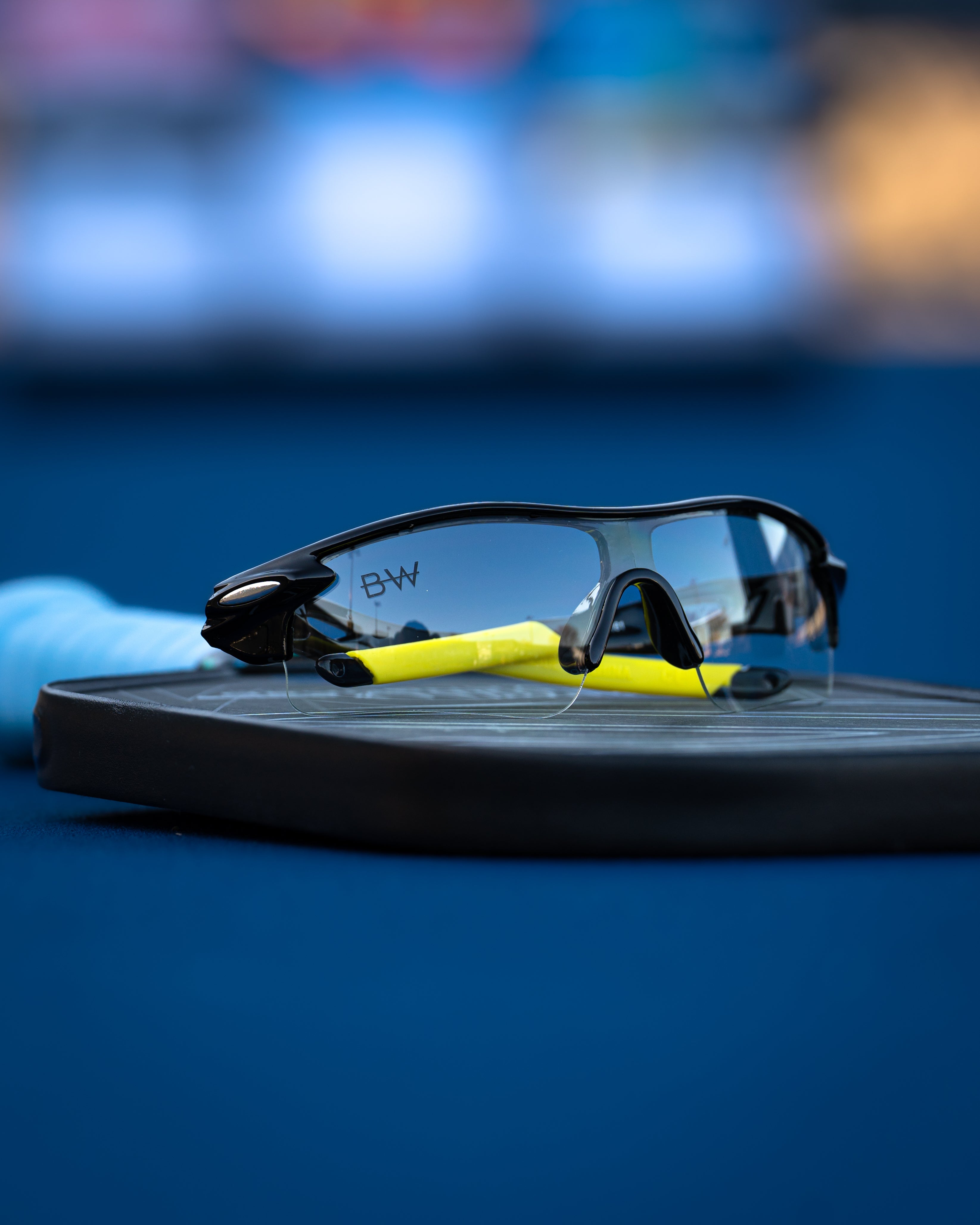
Do You Need Prescription Glasses for Sports? Here’s How to Tell
Share
Do You Need Prescription Glasses for Sports? Here’s How to Tell
If you already need prescription correction for everyday distance or intermediate vision, you may also need that correction while playing sports. But struggling to track a ball, judge a shot, or see clearly during a game does not automatically prove that you need prescription sports glasses.
The most reliable way to know is through an appropriate eye exam and current eyeglass prescription—not an online symptom quiz or a sports-eyewear brand diagnosing the cause.
This guide explains when prescription sports glasses may make sense, signs that your vision deserves professional evaluation, how RX and non-RX sports eyewear differ, and what to consider when choosing prescription eyewear for pickleball and other sports.
Find the Right Sports Eyewear for Your Vision
How Do You Know if You Need Prescription Glasses for Sports?
A simple starting point is this: if you need prescription correction to see appropriately in everyday life, do not assume that correction becomes unnecessary when you step onto a court or field.
You may want to discuss your sports vision with an eye-care professional if:
- You already wear prescription glasses or contact lenses.
- Distant objects appear blurry while you play.
- You frequently squint to see clearly.
- You notice a meaningful difference between corrected and uncorrected vision.
- You have difficulty seeing clearly at the distances involved in your sport.
- Your current prescription eyewear is impractical or uncomfortable during activity.
- Your vision seems to have changed since your last eye exam.
These observations can justify having your vision evaluated, but they do not identify the underlying cause by themselves.
Sports Vision Symptoms Are Clues—Not a Diagnosis
One of the biggest mistakes athletes can make is trying to diagnose their prescription from what happens during a game.
For example, difficulty following a pickleball does not automatically mean you have myopia. Misjudging a shot does not automatically mean you need stronger lenses. Eye discomfort during a long session does not automatically prove that prescription eyewear will solve it.
Many different factors can influence what you experience during sports, including:
- Your existing refractive error
- Your current prescription
- Lighting
- Fatigue
- Dryness or irritation
- Visual attention
- Experience and anticipation
- Distance from the object
- Contrast between an object and its background
- Other vision or eye-health factors
If you are experiencing persistent blur, double vision, significant discomfort, sudden vision changes, or other concerning visual symptoms, an appropriate eye-care professional is the right person to evaluate the cause.
If You Already Wear Glasses, Do You Need Prescription Sports Glasses?
Possibly. The important question is whether you need your prescription correction at the distances involved in your sport and whether your normal eyewear is suitable for that activity.
There are several possible setups:
| Vision Setup | How It Can Work for Sports |
|---|---|
| Everyday Prescription Glasses | May provide your correction, but the frame may not be your preferred design for active use. |
| Prescription Sports Glasses | Combine compatible prescription correction with a sports-oriented frame. |
| Contact Lenses + Non-RX Sports Glasses | Contacts provide the correction while non-prescription sports eyewear is worn separately. |
| No Prescription Correction | May be appropriate for someone who does not require correction for the relevant visual task. |
You do not need to abandon contact lenses or everyday glasses simply because prescription sports eyewear exists. The best approach depends on your prescription, preferences, sport, and guidance from your eye-care professional.
Do You Need RX Sports Glasses if You Already Wear Contacts?
Not necessarily.
If contact lenses provide the vision correction you need during sports, you may choose to wear non-prescription sports eyewear over them when appropriate for your activity.
Another athlete may prefer prescription sports glasses because they do not want to wear contacts while playing.
The distinction is important:
- Contact lenses + non-RX sports eyewear: the contacts provide prescription correction.
- Prescription sports eyewear: the corrective prescription is incorporated into the sports glasses.
Neither setup is universally better for every athlete.
Can You Need Prescription Sports Glasses if You Don’t Wear Glasses Every Day?
It is possible to discover a vision-correction need even if you have never routinely worn glasses, but sports performance alone should not be used to diagnose that need.
If you repeatedly notice blur or difficulty seeing clearly at relevant distances, an eye exam can determine whether refractive correction is appropriate.
Do not buy prescription lenses based on symptoms alone. Prescription eyewear requires an actual prescription specifying the correction appropriate for your eyes.
Does Squinting During Sports Mean You Need Glasses?
Frequent squinting can be a reason to have your vision checked, particularly if it seems to temporarily make distant objects appear clearer.
However, squinting by itself is not enough to determine:
- Whether you need prescription correction
- What type of refractive error you have
- What prescription strength you need
- Whether another visual or environmental factor is involved
If you find yourself repeatedly squinting to see the ball, scoreboard, court lines, teammates, opponents, or distant targets, consider scheduling an appropriate vision evaluation rather than guessing at the solution.
What if the Ball or Other Players Look Blurry at a Distance?
Persistent distance blur is another reason to have your vision evaluated.
Prescription correction can address certain refractive errors when appropriately prescribed, but it is important not to jump directly from “the ball looks blurry” to a self-diagnosis.
The practical sequence is:
- Notice the recurring visual problem.
- Have your vision appropriately evaluated.
- Obtain an eyeglass prescription if correction is indicated.
- Choose sports eyewear compatible with that prescription and your activity.
This approach is more reliable than selecting RX eyewear based on symptoms alone.
Does Poor Depth Perception Mean You Need Prescription Sports Glasses?
Not necessarily.
Depth perception is more complex than simple distance blur, and difficulty judging distance should not automatically be attributed to needing stronger prescription lenses.
If an athlete has an uncorrected refractive error, appropriate correction may be relevant to overall visual function. But prescription sports glasses should not be marketed as a universal “depth perception enhancer.”
If you consistently struggle with spatial judgment or experience a new or significant change, discuss it with an appropriate eye-care professional.
Does Losing Track of the Ball Mean You Need Prescription Glasses?
No single ball-tracking problem proves that you need a prescription.
Tracking a fast-moving ball involves more than static visual acuity. It can be influenced by:
- Whether the ball is visually clear
- Lighting
- Background contrast
- Attention
- Anticipation
- Experience
- Head and eye movement
- Positioning
- Fatigue
If the underlying problem is blur caused by an uncorrected refractive error, appropriate prescription correction may address that blur. But it would be inaccurate to promise that RX glasses automatically create better ball tracking.
Do Prescription Sports Glasses Improve Reaction Time?
Prescription eyewear should not be sold as a guaranteed reaction-time upgrade.
If you require vision correction, wearing the appropriate prescription can address the refractive blur that the prescription is intended to correct. That is different from claiming that a pair of glasses directly makes your nervous system react faster.
Sports reaction involves visual input, anticipation, decision-making, experience, movement, and other factors.
Does Eye Strain During Sports Mean You Need Prescription Glasses?
Eye strain or tired eyes can have multiple possible causes, so these symptoms should not be used as a stand-alone prescription test.
If discomfort happens regularly, consider factors such as:
- Whether your prescription is current
- How long you have been playing
- Lighting conditions
- Dryness
- Contact-lens wear
- Environmental conditions
- Other visual demands
Persistent or concerning symptoms deserve professional evaluation rather than an online eyewear recommendation pretending to identify the cause.
What if You See Better Indoors Than Outdoors—or Vice Versa?
A difference between indoor and outdoor play does not automatically mean your prescription is wrong.
The two environments can differ in:
- Overall brightness
- Direction of light
- Reflections
- Shadows
- Backgrounds
- Weather
- Distance and court layout
Lens configuration also matters. Someone wearing a dark tint indoors may prefer a clear lens, while someone using clear eyewear in bright outdoor conditions may prefer another configuration.
Separate the question “Do I need prescription correction?” from “Which lens type best fits this lighting environment?”
If You Have 20/20 Vision, Do You Need Prescription Sports Glasses?
Not automatically.
Visual acuity is only one component of vision, but having concerns about another aspect of sports vision does not mean you should purchase corrective lenses without an appropriate prescription.
If your vision has been evaluated and you do not require refractive correction for your activity, non-prescription sports eyewear may be the more appropriate category to explore.
If you have symptoms despite being told your acuity is 20/20, discuss those specific concerns during an eye exam rather than assuming prescription sports glasses will improve them.
Prescription vs. Non-Prescription Sports Glasses
| Question | Prescription Sports Glasses | Non-Prescription Sports Glasses |
|---|---|---|
| Correct Refractive Error? | Yes, according to the prescribed lens configuration | No |
| Require an Eyeglass Prescription? | Yes | No |
| Can Be Sports-Oriented? | Yes | Yes |
| Can Be Used for Pickleball? | Yes, when appropriate for the player and activity | Yes, when appropriate for the player and activity |
| Automatically Improve Performance? | No | No |
| Right for Everyone? | No | No |
The key dividing line is whether you need corrective prescription lenses—not whether you are a beginner, competitive athlete, or recreational player.
Do You Need Prescription Glasses for Pickleball?
If you need prescription correction at the distances involved in pickleball, an RX sports-eyewear setup may be worth considering.
Pickleball involves changing distances, a moving ball, nearby players, court boundaries, and rapid exchanges. That makes it important to use the vision correction that is appropriate for you rather than intentionally playing through avoidable refractive blur.
However, prescription glasses should not be credited with automatically:
- Increasing reaction speed
- Improving shot accuracy
- Increasing depth perception
- Improving spin recognition
- Preventing every eye injury
- Making you a better pickleball player
The core purpose of RX sports eyewear is simpler: provide prescribed vision correction in a sports-oriented eyewear configuration.
Which Sports Can Use Prescription Sports Glasses?
Prescription sports eyewear can be relevant across many activities when an athlete needs vision correction.
Examples can include:
- Pickleball
- Tennis
- Running
- Cycling
- Volleyball
- Basketball
- Training and fitness activities
- Other recreational and competitive sports
The eyewear requirements of each activity can differ. A frame suitable for one sport should not automatically be assumed to satisfy another sport's fit, coverage, or protective requirements.
Should You Get an Eye Exam Before Buying Prescription Sports Glasses?
If you do not have a current appropriate eyeglass prescription, an eye exam is the right starting point before ordering prescription sports eyewear.
An eyewear quiz can help you think about frame style, environment, or general lens categories. It cannot determine whether you medically need prescription correction or generate an accurate prescription.
An eye-care professional can evaluate your vision and determine whether correction is indicated.
Once you have the prescription, you can use it to evaluate compatible sports-eyewear options.
Can an Online Sports Eyewear Quiz Tell You if You Need Prescription Glasses?
No online product quiz should replace an eye exam or diagnose a refractive error.
Blinded Wear's Pickleball Sunglasses Quiz can help you explore eyewear options based on your preferences and playing environment, but it should not be used to determine whether you medically need prescription correction.
Use the quiz for product discovery—not diagnosis.
What Information Is on a Sports Eyewear Prescription?
Prescription sports glasses use an eyeglass prescription rather than a generic “sports strength.” Depending on your prescription, you may see information such as:
- Sphere (SPH)
- Cylinder (CYL)
- Axis
- Add power when applicable
- Other information relevant to the prescription
Do not guess or round prescription values because you think sports require “stronger” or “sharper” correction.
Use the prescription provided for you and verify compatibility with the exact frame and lens configuration.
Does Your Prescription Need to Be Strong to Justify Sports Glasses?
No universal prescription threshold determines whether sports eyewear is worthwhile.
The relevance of correction depends on your individual prescription, the visual distances involved, and professional guidance—not whether your numbers seem “strong enough” compared with someone else's.
Avoid rules such as:
- “You only need sports glasses above a certain prescription.”
- “A mild prescription cannot matter during sports.”
- “Every athlete with any prescription needs dedicated sports glasses.”
Those shortcuts ignore individual visual needs and the demands of different activities.
What if You Have Astigmatism?
Astigmatism correction can be incorporated into compatible prescription eyewear.
If your eyeglass prescription contains cylinder and axis values, those values are part of the complete prescription and should be considered when evaluating sports-frame compatibility.
Do not choose a frame based only on the sphere number or assume that every RX sports frame supports every prescription.
Can You Get Sports Glasses With a Strong Prescription?
Many prescriptions can be accommodated in sports eyewear, but stronger or more complex prescriptions may narrow the available frame and lens combinations.
Compatibility can depend on:
- The complete prescription
- Frame geometry
- Frame dimensions
- Lens material
- Lens design
- Available RX configuration
Rather than relying on a universal prescription cutoff, verify your actual prescription with the exact frame you want.
What Are High-Index Prescription Sports Lenses?
High-index refers to lens material designed to bend light differently than lower-index materials, allowing certain prescriptions to be made with a different lens profile.
Blinded Wear includes high-index prescription lenses at no additional cost with RX eyewear.
High-index should not automatically be interpreted as:
- Anti-fog
- Anti-reflective
- Scratch-resistant
- Photochromic
- Polarized
- Impact-proof
- Distortion-free
- A sports-performance enhancer
Those are separate characteristics or claims.
Will Your Prescription Work in Every Sports Frame?
No. Prescription availability does not mean every possible prescription can be placed into every sports frame.
Frame curvature, dimensions, lens geometry, prescription complexity, and available lens configurations can all affect compatibility.
This becomes particularly important with:
- Highly curved frames
- Wrap-style eyewear
- Stronger prescriptions
- Progressive or multifocal requirements
- Specialized lens configurations
Choose from frames that can support your actual prescription rather than selecting a frame first and assuming it can always be converted into RX eyewear.
Blinded Wear RX Sports Glasses to Compare
Once you know that you need prescription correction, the next step is comparing compatible frames rather than looking for a product that claims to make you a better athlete.
| RX Sports Eyewear | What to Compare |
|---|---|
| Havana Melt RX | Compare frame styling, dimensions, fit, prescription compatibility, and available lens configuration. |
| Crystal Wave II RX | Compare frame geometry, fit, prescription compatibility, and the lens options available for your exact RX. |
| Ocean Wave RX | Compare dimensions, styling, prescription compatibility, and intended playing environment. |
| Rocket Fire RX | Compare its frame design and RX compatibility with your fit and sports-eyewear preferences. |
| Frost RX | Compare the exact configuration with your prescription, fit requirements, and playing conditions. |
Product inclusion here does not mean every prescription or every lens option is automatically compatible with each frame.
FAQ: Do You Need Prescription Sports Glasses?
How do I know if I need prescription glasses for sports?
If you already require prescription correction, notice persistent blur, frequently squint to see clearly, or think your vision has changed, consider an appropriate eye exam. Symptoms alone cannot determine your prescription.
Can sports reveal that you need glasses?
You may notice visual difficulty during sports because the activity places specific demands on your vision, but the sport itself cannot diagnose the cause. An eye exam can determine whether prescription correction is appropriate.
Do you need sports glasses if you are nearsighted?
If your nearsightedness requires correction at the distances involved in your sport, prescription correction may be appropriate. The exact need depends on your prescription and professional guidance.
Can I play sports without my prescription glasses?
That depends on your individual prescription, visual needs, activity, and alternative correction such as contact lenses. Do not assume that playing without prescribed correction is appropriate simply because the activity is recreational.
Can I wear my normal prescription glasses for sports?
Some athletes do, but everyday frames may differ from sports-oriented eyewear in fit, physical coverage, materials, and other characteristics. The appropriate setup depends on the activity and your needs.
Can I wear contacts with non-prescription sports glasses?
Yes, this is one possible setup for athletes whose contacts provide their required vision correction and who want separate non-RX sports eyewear.
Does blurry vision during pickleball mean I need glasses?
Blur is a reason to have your vision evaluated, but it does not identify the cause or prescription by itself.
Can prescription sports glasses make me a better athlete?
Prescription lenses are intended to provide the correction prescribed for your vision. They should not be marketed as a guarantee of better athletic performance, faster reactions, improved tracking, or more accurate shots.
Which Lens Type Should You Choose for Prescription Sports Glasses?
Once you know you need prescription correction, there is a second decision to make: which lens configuration matches the environment where you play?
Prescription strength and lens tint are separate considerations. Needing RX correction does not automatically tell you whether your sports glasses should be clear, tinted, or photochromic.
| Playing Environment | Lens Configuration Worth Comparing | Why |
|---|---|---|
| Primarily Indoor | Clear RX | Provides prescription correction without adding a dark sunglass tint. |
| Evening / Night | Clear RX | A dark sunglass tint may not be preferred under lower or artificial lighting. |
| Consistently Bright Outdoors | Tinted RX | Worth comparing when you prefer a fixed sunglass tint in bright conditions. |
| Frequently Changing Outdoor Light | Photochromic / Transition RX | Adaptive lens behavior may be useful when relevant light conditions change. |
| Indoor + Outdoor | Transition RX or multiple RX pairs | Compare one-pair adaptability with dedicated eyewear for each environment. |
Do not assume one lens color is automatically best for every sport or every athlete.
When Do Clear Prescription Sports Glasses Make Sense?
Clear RX sports eyewear can be a logical option when you require prescription correction but do not want a dark sunglass tint.
Common situations include:
- Indoor pickleball
- Indoor volleyball
- Indoor basketball
- Evening matches
- Night practices
- Other lower-light sports environments
A clear prescription lens combines two separate characteristics: your prescribed vision correction and an untinted lens configuration.
Clear should not automatically be interpreted as anti-fog, anti-glare, contrast-enhancing, or better for reaction time.
When Do Tinted Prescription Sports Glasses Make Sense?
A tinted RX lens combines prescription correction with a fixed sunglass tint.
This can be worth considering when most of your activity takes place in brighter outdoor conditions and you prefer a darker lens.
The tint should still be separated from other lens characteristics. A tinted lens is not automatically:
- Polarized
- Photochromic
- Anti-reflective
- Anti-fog
- Contrast-enhancing
- A specific UV rating
Verify those characteristics independently if they matter to your purchase.
When Do Transition Prescription Sports Glasses Make Sense?
Photochromic or transition RX eyewear may appeal to athletes who need prescription correction across changing lighting conditions.
Instead of maintaining one fixed tint, photochromic lenses are designed to change darkness in response to relevant light conditions.
They may be worth comparing if you:
- Play through changing outdoor conditions
- Train from morning into brighter daylight
- Play from afternoon toward evening
- Frequently move between indoor and outdoor environments
- Want to reduce the number of lighting-specific RX pairs you carry
Transition behavior varies by the exact lens technology and environment, so do not assume every photochromic prescription lens changes at the same speed or reaches the same level of darkness.
Prescription Sunglasses vs. Prescription Sports Glasses
Prescription sunglasses and prescription sports glasses can overlap, but the terms describe different aspects of the eyewear.
Prescription sunglasses combine vision correction with a sunglass tint.
Prescription sports glasses place prescription correction into a frame intended or marketed for active use.
A product can therefore be both prescription sports eyewear and prescription sunglasses.
When comparing them, consider:
- Your prescription
- Frame fit
- Frame dimensions
- Lens configuration
- Physical coverage
- Impact resistance
- Playing environment
- Any protective standard required for your activity
Prescription Sports Glasses vs. Regular Eyeglasses
If both contain your appropriate prescription, the distinction is not that one pair magically gives you “better vision.” The difference can instead come from the eyewear's design and suitability for active use.
| Consideration | Everyday Prescription Glasses | Prescription Sports Glasses |
|---|---|---|
| Prescription Correction | Yes | Yes |
| Designed / Marketed for Active Use | Not necessarily | Yes |
| Sports-Oriented Frame Options | Not necessarily | Yes |
| Impact Resistance | Depends on exact eyewear | Verify exact product; Blinded Wear sports eyewear uses impact-resistant lenses |
| Protective Certification | Must be verified | Must still be verified |
| Fit During Activity | Depends on individual frame and wearer | Still depends on individual frame and wearer |
A sports-oriented frame can be preferable for active use, but do not assume that the word “sports” guarantees secure fit, certified protection, or suitability for every activity.
Are Prescription Sports Glasses Impact-Resistant?
Impact resistance depends on the lens and product rather than the presence of a prescription alone.
Blinded Wear sports eyewear uses impact-resistant lenses.
That characteristic should be distinguished from stronger or more specific claims such as:
- Shatterproof
- Ball-proof
- Indestructible
- Safety certified
- ASTM certified
- ANSI certified
Impact-resistant does not automatically establish any of those claims.
If your sport requires eyewear meeting a particular protective standard, verify that standard for the exact product.
Do Prescription Sports Glasses Protect Your Eyes?
Sports glasses can place a physical barrier in front of the eyes, but the level of protection depends on the exact frame, lens material, coverage, construction, and any applicable certification.
A prescription does not determine protection. Likewise, a product being marketed for sports does not automatically prove that it meets a particular protective-eyewear standard.
When eye protection is a major reason for buying the glasses, look beyond the RX and verify the relevant protective specifications.
Do Prescription Sports Glasses Automatically Provide UV Protection?
No specific UV rating should be assumed simply because eyewear is prescription, tinted, clear, or designed for sports.
Claims such as:
- UV400
- 100% UVA/UVB protection
- A specific percentage of UV blocked
should be verified for the exact lens configuration.
Prescription correction describes how the lens addresses refractive error. UV specifications describe a different characteristic.
Do Prescription Sports Glasses Need to Be Polarized?
No. Prescription correction and polarization are separate characteristics.
A prescription sports lens can be polarized or non-polarized depending on the available configuration.
Blinded Wear sports lenses are non-polarized, meaning a polarization filter is not added.
Some court players prefer non-polarized eyewear, but non-polarized lenses should not automatically be credited with better depth perception, faster reactions, or improved ball tracking.
Do Prescription Sports Glasses Fog?
They can. Prescription correction does not prevent condensation.
Fogging can be influenced by:
- Perspiration
- Humidity
- Temperature differences
- Rapid temperature changes
- Breathing
- Frame-to-face spacing
- Airflow
- Lens-surface characteristics
Likewise, stronger prescriptions and high-index lenses should not automatically be described as more or less fog-prone simply because of their prescription characteristics.
If fogging is a recurring problem, evaluate it separately from your prescription needs.
How Should Prescription Sports Glasses Fit?
The correct prescription does not guarantee that the frame will fit your face appropriately.
When comparing sports frames, consider:
- Overall frame width
- Bridge fit
- Temple comfort
- Lens dimensions
- Physical coverage
- How the frame feels during head movement
- How it feels during longer sessions
- How it interacts with hats, helmets, or other equipment when applicable
If you already own glasses that fit comfortably, comparing their dimensions with a prospective sports frame can provide a useful starting point.
A sports frame should not automatically be described as “non-slip” or guaranteed to stay secure unless those characteristics are specifically supported.
Can Wraparound Sports Glasses Be Prescription?
Some curved and wrap-style sports frames can support prescription lenses, but not every prescription is compatible with every frame.
Frame curvature can make RX compatibility more complex, particularly when combined with stronger prescriptions or additional lens requirements.
Verify:
- Your complete prescription
- The exact sports frame
- Frame and lens geometry
- Available lens material
- Available prescription configuration
- Any additional lens option you want
Do not assume that any non-prescription wraparound frame can simply be converted into prescription eyewear.
Can Prescription Sports Glasses Have Progressive Lenses?
Some sports-eyewear configurations may support progressive correction, but availability should be verified for the exact frame and prescription.
Progressive compatibility can depend on:
- Frame dimensions
- Lens geometry
- Prescription requirements
- Required optical measurements
- Available lens designs
Do not assume that every frame labeled “RX” automatically supports progressive lenses.
What if You Need Different Correction for Distance and Near Vision?
Some people have different visual needs at distance and near, but the appropriate sports-eyewear solution depends on the individual's prescription and the visual demands of the activity.
Do not assume that age alone determines which sports lenses someone needs.
If your prescription includes an add power or you use multifocal eyewear, discuss how you use your vision during the sport and verify which compatible lens configurations are available.
Can You Order Prescription Sports Glasses Online?
Yes, compatible prescription sports eyewear can be ordered online when you have the required prescription information and the selected frame supports your RX.
For Blinded Wear RX eyewear, customers can upload a clear photo or picture of their eyeglass prescription as part of the ordering process.
A practical ordering process is:
- Have an appropriate current eyeglass prescription.
- Choose an RX sports frame.
- Verify compatibility with your complete prescription.
- Select the appropriate available lens configuration.
- Compare frame dimensions and fit information.
- Upload the requested prescription information.
- Review the order carefully before submitting it.
Do not estimate your prescription from old glasses or symptoms.
What Prescription Do You Need to Order Sports Glasses?
Use an appropriate eyeglass prescription rather than assuming a contact-lens prescription contains everything needed for prescription glasses.
Eyeglass and contact-lens prescriptions are not automatically interchangeable because the two products sit differently relative to the eye and can require different information.
If you are unsure what prescription information you have, confirm it with your eye-care provider before ordering.
Can You Use an Old Prescription for Sports Glasses?
Do not assume an old prescription is still appropriate simply because your current glasses seem usable.
If your vision has changed, the correction you need may also have changed.
Before investing in prescription sports eyewear, especially if you have noticed new blur or other visual changes, obtaining appropriate current prescription information can help prevent you from building new eyewear around outdated correction.
How to Choose Prescription Sports Glasses
Once an eye-care professional has determined that you need prescription correction, choosing the eyewear itself becomes much easier.
1. Start With Your Actual Prescription
Do not choose according to symptoms or guesswork. Use your prescription information.
2. Choose an RX-Compatible Sports Frame
Not every frame supports every prescription, particularly when frame geometry becomes more complex.
3. Match the Lens Configuration to Your Environment
Consider clear, fixed tint, or photochromic options according to where and when you play.
4. Compare Frame Dimensions
Use eyewear that already fits you well as a reference when possible.
5. Verify Impact Resistance and Any Required Protection
Do not treat “sports” as a substitute for an actual lens specification or protective certification.
6. Separate Optional Features
Prescription, high-index, tint, polarization, photochromic behavior, anti-fog properties, UV specifications, and anti-reflective treatments are different characteristics.
7. Consider Your Full Sports Schedule
An athlete who plays only indoors may need a different setup from someone who moves between bright outdoor and indoor courts.
What Should You Verify Before Buying RX Sports Eyewear?
| Feature | What to Verify |
|---|---|
| Prescription Compatibility | Whether your complete RX works with the exact frame. |
| Lens Configuration | Whether clear, tinted, or photochromic options are available for your prescription. |
| High-Index | Blinded Wear includes high-index prescription lenses at no additional cost with RX eyewear. |
| Impact Resistance | Blinded Wear sports eyewear uses impact-resistant lenses. |
| Polarization | Blinded Wear sports lenses are non-polarized. |
| UV Specification | Verify any exact UV claim for the selected lens. |
| Anti-Fog | Verify independently; RX does not automatically mean anti-fog. |
| Anti-Reflective | Verify independently for the exact lens configuration. |
| Scratch Resistance | Verify the exact lens specification rather than assuming it. |
| Protective Certification | Verify the specific standard if your activity requires one. |
| Frame Fit | Compare dimensions and fit characteristics separately from prescription compatibility. |
12 Mistakes to Avoid When Choosing Prescription Sports Glasses
- Self-diagnosing from sports performance. Missing a shot or losing track of a ball does not identify a prescription.
- Using an online quiz as an eye exam. Product quizzes can help with shopping, not diagnosis.
- Assuming 20/20 means every aspect of your vision is perfect. Visual acuity is only one component of vision.
- Assuming every visual problem requires prescription lenses. Sports vision complaints can have multiple causes.
- Ignoring an existing prescription while playing. If you require correction, determine an appropriate sports setup rather than assuming sports make the prescription irrelevant.
- Guessing your prescription strength. Use the actual prescription information provided for you.
- Assuming every RX works in every frame. Prescription and frame compatibility must be considered together.
- Confusing prescription correction with protection. RX lenses and protective certification address different needs.
- Assuming sports glasses automatically improve reaction time. Prescription correction should not be marketed as a reaction-speed upgrade.
- Choosing tint before considering your environment. Indoor, outdoor, and changing-light conditions can call for different configurations.
- Ignoring frame fit. Correct prescription lenses do not guarantee a comfortable frame.
- Believing every advertised lens feature comes automatically with RX. Verify tint, photochromic behavior, UV specifications, coatings, and other characteristics separately.
Do You Need RX or Non-RX Sports Glasses? A Simple Decision Guide
Do You Already Wear Prescription Glasses for Distance?
RX sports eyewear is worth evaluating. Determine whether you need that correction at the distances involved in your sport.
Do You Wear Contact Lenses While Playing?
You may not need RX built into the sports glasses. Non-prescription sports eyewear can potentially be worn while your contacts provide the correction.
Do You See Clearly Without Prescription Correction?
Non-RX sports eyewear may be the relevant category. Do not purchase corrective lenses simply because they are marketed for performance.
Are You Frequently Squinting or Experiencing Persistent Blur?
Consider an eye exam. These are reasons to have your vision evaluated, not enough information to diagnose yourself.
Has Your Vision Recently Changed?
Have it evaluated before ordering new RX sports glasses. Building new eyewear around outdated prescription information may not address your current needs.
Do You Need Eye Protection but Not Vision Correction?
Prescription lenses are not required solely because you want sports eyewear. Focus on the appropriate non-RX product and any protective specifications required for your activity.
More Questions About Prescription Glasses for Sports
At what prescription do you need sports glasses?
There is no universal prescription number at which everyone suddenly needs dedicated sports glasses. The decision depends on your individual correction needs, the distances involved in your activity, and professional guidance.
Should athletes wear their prescription while playing?
If an athlete requires correction for the visual task, an appropriate corrected setup may include prescription sports glasses or contact lenses with suitable non-RX sports eyewear. The right option depends on the individual.
Are prescription sports glasses worth it?
They can be valuable for someone who requires vision correction and prefers to have that correction incorporated into sports-oriented eyewear. Someone who does not require prescription correction does not gain an automatic performance advantage from RX lenses.
Can you put your normal prescription in sports glasses?
Sports eyewear uses eyeglass prescription information, but compatibility depends on the complete prescription and exact frame. Do not assume every prescription works in every sports frame.
Do sports glasses need a different prescription than regular glasses?
Do not independently alter or strengthen your prescription for sports. Use appropriate prescription information and discuss any sport-specific visual concerns with your eye-care professional.
Can astigmatism be corrected in sports glasses?
Compatible prescription sports eyewear can accommodate some prescriptions containing cylinder and axis correction. Exact compatibility depends on the complete prescription and frame.
Can strong prescriptions go into sports frames?
Many prescriptions can be accommodated, but stronger or more complex prescriptions may limit frame and lens options. Verify the exact combination.
Can prescription sports glasses have clear lenses?
Yes. Clear RX sports glasses combine prescription correction with an untinted lens configuration when available and compatible.
Can prescription sports glasses be sunglasses?
Yes. A compatible RX sports frame can use a tinted prescription lens when that configuration is available.
Can prescription sports glasses have transition lenses?
Some compatible configurations can combine prescription correction with photochromic technology. Availability should be verified for the exact prescription and frame.
Are prescription sports glasses only for competitive athletes?
No. Whether prescription correction is relevant has nothing to do with being professional, competitive, or recreational. It depends on the individual's vision needs.
Can kids or adults need prescription sports glasses?
Prescription needs can exist across age groups. The appropriate eyewear and protective requirements should be evaluated for the individual and activity rather than chosen solely according to age.
Should You Practice in New Prescription Sports Glasses Before Competing?
Yes. If you are switching frames, updating your prescription, or using a different lens configuration, it makes sense to become familiar with the finished eyewear during normal practice before relying on it during an important match or tournament.
During practice, evaluate:
- Whether the prescription feels appropriate for you
- Overall frame comfort
- How the frame feels during normal head movement
- How it feels once you begin perspiring
- Whether the lens configuration suits the lighting environment
- Whether the frame interferes with other equipment you use
- Whether you notice persistent visual discomfort or other problems
If something seems visually wrong with new prescription eyewear, do not assume you simply need to “play through it.” Contact the appropriate eye-care or eyewear professional when necessary.
Should Athletes Carry a Backup Pair of Prescription Glasses?
If you depend on prescription correction, carrying another suitable pair can be practical—especially during tournaments, travel, or long training days.
A backup may become useful if your primary eyewear is:
- Lost
- Damaged
- Temporarily unusable
- Not ideal for a different lighting environment
A backup does not necessarily need to duplicate your primary pair exactly. Some athletes may prefer different lens configurations for different environments.
What Should Prescription Athletes Bring for Tournament Travel?
Travel makes eyewear planning more important because replacing prescription glasses away from home can be inconvenient.
A practical sports-trip setup can include:
- Your primary RX sports glasses
- A suitable backup pair
- Appropriate storage
- Lens-safe cleaning supplies
- Another lens configuration if your trip includes substantially different lighting environments
- Access to your prescription information if needed
If you know the tournament includes both indoor and outdoor matches, plan for those environments before you leave rather than trying to solve the problem during the event.
How Should You Care for Prescription Sports Glasses?
Prescription sports eyewear can accumulate perspiration, fingerprints, dust, and other debris during normal use. Appropriate care helps avoid unnecessary damage.
Follow the care guidance for the exact eyewear and lens configuration. In general:
- Inspect the lenses before rubbing or wiping them.
- Use an appropriate lens-safe cleaning method.
- Avoid abrasive materials.
- Avoid harsh household chemicals unless confirmed safe for the lenses.
- Store the eyewear appropriately when it is not being worn.
- Do not toss prescription glasses loose into a sports bag with equipment that can contact the lenses or frame.
Prescription lenses are not automatically scratch-resistant simply because they are designed for sports.
How Should You Store RX Sports Glasses?
Good storage is particularly important for athletes who depend on their eyewear for vision correction.
Avoid leaving RX glasses loose around:
- Keys
- Water bottles
- Sports equipment
- Shoes
- Other objects that can contact the lenses
Traveling players should also avoid packing prescription eyewear where luggage pressure can unnecessarily stress the frame.
When Should You Replace Prescription Sports Glasses?
There is no single replacement schedule that applies to every athlete.
Instead, reevaluate your eyewear when:
- Your prescription changes
- The frame is damaged
- The lenses have damage that interferes with use
- The frame no longer fits appropriately
- Your primary sport changes
- Your playing environment changes
- You need a different lens configuration
- Your current eyewear no longer meets your needs
If you notice a meaningful change in your vision, have it appropriately evaluated instead of assuming that replacing the frame alone will solve the problem.
What Do You Get With Blinded Wear RX Sports Eyewear?
For athletes who already know they need prescription correction, Blinded Wear provides a dedicated collection of prescription sports eyewear designed around pickleball and active use.
| Feature | Blinded Wear RX Sports Eyewear |
|---|---|
| Prescription Sports Frames | Multiple RX styles are available to compare. |
| High-Index Prescription Lenses | Included at no additional cost with RX eyewear. |
| Impact-Resistant Lenses | Yes. |
| Non-Polarized Sports Lenses | Yes. |
| Lightweight Sports-Frame Options | Yes. |
| Prescription Submission | Upload a clear photo or picture of your eyeglass prescription. |
| Replacement Support | 50% lifetime replacement support if glasses break, subject to current policy terms. |
These characteristics should still be kept separate from unsupported claims. Prescription sports eyewear should not automatically be described as anti-fog, anti-glare, distortion-free, UV400, shatterproof, or guaranteed to improve athletic performance unless the exact product supports those claims.
What if Your Blinded Wear Prescription Sports Glasses Break?
Blinded Wear provides 50% lifetime replacement support if your glasses break, subject to the current policy terms.
This can be particularly relevant for athletes because sports eyewear may be used during matches, practices, training, and travel.
The replacement support should not be interpreted as:
- A guarantee that the eyewear cannot break
- A universal free-replacement warranty
- A guarantee against loss
- A guarantee against scratches
- A free replacement whenever your prescription changes
- Proof that the eyewear is shatterproof
- Proof of a particular safety certification
Review the current terms before purchasing.
Prescription Sports Glasses: Myths vs. Facts
| Common Claim | What to Know |
|---|---|
| “If you miss the ball, you need glasses.” | Missing or losing track of a ball does not diagnose a refractive error. |
| “An online quiz can tell you if you need RX.” | A shopping quiz cannot replace an appropriate eye exam. |
| “20/20 means every part of your sports vision is perfect.” | Visual acuity is one component of vision. |
| “Prescription glasses improve reaction time.” | RX lenses provide prescribed correction; they should not be sold as a guaranteed reaction-speed enhancer. |
| “RX glasses improve depth perception.” | Appropriate correction can address refractive blur, but prescription eyewear should not be marketed as a universal depth-perception enhancer. |
| “Sports prescriptions should be stronger than everyday prescriptions.” | Do not independently alter your prescribed correction for sports. |
| “Every RX works in every sports frame.” | Frame and prescription compatibility must be evaluated together. |
| “Prescription means protective.” | Vision correction and protective certification are separate characteristics. |
| “Impact-resistant means shatterproof.” | Impact resistance should not be treated as an unlimited shatterproof guarantee. |
| “High-index means better sports performance.” | High-index describes a lens-material characteristic, not an athletic-performance benefit. |
| “Polarized lenses are required for sports.” | Prescription correction and polarization are separate decisions. |
| “Only competitive athletes need sports glasses.” | Prescription needs depend on the individual, not competitive level. |
Do You Need Prescription Sports Glasses? Use This Checklist
This checklist cannot diagnose your vision, but it can help you decide what your next step should be.
- ☐ I already wear prescription glasses or contacts.
- ☐ I know whether I need correction at the distances involved in my sport.
- ☐ I regularly notice blur while playing.
- ☐ I frequently squint to see clearly.
- ☐ I think my vision may have changed since my last exam.
- ☐ I understand that ball-tracking problems do not automatically prove I need RX.
- ☐ I understand that depth-perception problems do not automatically prove I need RX.
- ☐ I will use an appropriate eye exam rather than a product quiz to determine whether I need prescription correction.
- ☐ If I need RX, I have appropriate prescription information.
- ☐ I have verified that my prescription works with the sports frame I want.
- ☐ I have chosen a lens configuration based on my actual playing environment.
- ☐ I have compared frame dimensions and fit.
- ☐ I have verified any protective standard required for my sport.
- ☐ I understand that prescription correction does not guarantee better athletic performance.
What Should You Do if You Think You Need Prescription Sports Glasses?
The process does not need to be complicated.
- Identify the problem. Notice whether you are dealing with persistent blur, squinting, an outdated prescription, or another visual concern.
- Get your vision appropriately evaluated. Do not diagnose yourself from sports symptoms.
- Obtain your eyeglass prescription if correction is needed.
- Decide how you want to wear that correction. Compare RX sports glasses with contact lenses plus suitable non-RX sports eyewear.
- Choose an RX-compatible sports frame.
- Match the lens configuration to your environment. Compare clear, tinted, or photochromic options when available.
- Verify fit and relevant specifications.
- Practice in the finished eyewear. Become familiar with it before important competition.
This keeps the medical question—whether you need prescription correction—separate from the shopping question—which sports eyewear best fits that prescription and your activity.
People Also Ask About Prescription Glasses for Sports
How can I tell if I need glasses for sports?
Persistent blur, frequent squinting, an existing prescription, or a noticeable change in vision are reasons to consider an eye exam. They are not enough to determine a prescription without an appropriate evaluation.
How do I know if my vision is affecting my sports?
You may notice that objects are not visually clear at relevant distances or that you repeatedly squint to see them. Other sports difficulties can have many causes, so an eye exam is the appropriate way to determine whether refractive correction is involved.
Should I get my eyes checked if I keep losing sight of the ball?
If you are experiencing recurring visual difficulty, having your vision evaluated can be reasonable. Losing track of a ball does not by itself diagnose a refractive error.
Do I need prescription sports glasses if I only have a mild prescription?
There is no universal prescription threshold. Whether correction is relevant depends on your individual visual needs, the activity, and professional guidance.
Can I play pickleball without my glasses?
That depends on whether you require correction for the visual distances involved and whether you use another form of correction such as contact lenses. Individual prescription needs should guide the decision.
Should I wear contacts or prescription glasses for sports?
Both can be viable approaches. Contacts can provide correction while separate non-RX sports eyewear is worn, while RX sports glasses incorporate the correction directly into the frame. Comfort, prescription needs, sport, and personal preference matter.
Can I wear regular eyeglasses for pickleball?
Some players do. Dedicated sports eyewear may offer a different frame design, fit, coverage, or lens configuration, but suitability depends on the exact product and player.
Do prescription sports glasses help you see the ball better?
If the ball appears blurry because of a refractive error addressed by your prescription, appropriate correction can address that refractive blur. That should not be expanded into a guarantee of better tracking, reactions, or performance.
Can prescription glasses help with sports depth perception?
Appropriate correction can address refractive blur when present, but depth perception involves more than lens power. Persistent concerns about depth or spatial judgment should be evaluated appropriately.
Do prescription glasses help athletes react faster?
Prescription lenses should not be described as a direct reaction-time enhancer. Their role is to provide the correction prescribed for the wearer.
Do you need special glasses for pickleball?
You do not automatically need prescription glasses simply because you play pickleball. If you require vision correction, RX sports eyewear is one option. If you do not require correction, non-RX sports eyewear may be the relevant category.
Can sports glasses be made to my exact prescription?
Compatible RX sports frames can be produced according to supported eyeglass prescriptions. Not every prescription is compatible with every frame, so the exact combination should be verified.
Can prescription sports glasses be used for multiple sports?
Potentially. Multi-sport use depends on the frame, prescription, fit, lens configuration, environment, and any activity-specific protective requirements.
What if I have never had an eye exam?
If you are experiencing persistent blur or other visual concerns, an appropriate eye exam can determine whether prescription correction is needed. A sports-eyewear retailer or online quiz should not diagnose your prescription.
Related Prescription Sports Eyewear Guides
Key Takeaways: Do You Need Prescription Glasses for Sports?
- If you need prescription correction at the distances involved in your sport, prescription sports eyewear may be worth considering.
- Persistent blur or frequent squinting are reasons to have your vision evaluated, not enough information to diagnose yourself.
- Losing track of a ball does not automatically mean you need prescription glasses.
- Difficulty judging distance does not automatically mean you need stronger lenses.
- An online eyewear quiz cannot determine whether you medically need prescription correction.
- An appropriate eye exam is the reliable way to determine whether correction is needed.
- Prescription sports glasses and contact lenses plus non-RX sports eyewear are two different ways to use vision correction during sports.
- You do not need a “strong” prescription before sports glasses can be relevant.
- Not every prescription is compatible with every sports frame.
- Clear, tinted, and photochromic are lens-configuration decisions separate from prescription strength.
- Prescription correction does not automatically improve reaction time, depth perception, ball tracking, or athletic performance.
- Blinded Wear sports eyewear uses impact-resistant lenses.
- Impact-resistant does not automatically mean shatterproof or certified protective eyewear.
- Blinded Wear sports lenses are non-polarized.
- Blinded Wear includes high-index prescription lenses at no additional cost with RX eyewear.
- Blinded Wear RX customers can upload a clear photo or picture of their eyeglass prescription.
- Blinded Wear provides 50% lifetime replacement support if glasses break, subject to current policy terms.
Already Know You Need Prescription Correction?
If you already have an appropriate eyeglass prescription, the next step is not figuring out whether RX eyewear can magically improve your game. It is finding a sports frame and lens configuration that work with your prescription, your fit, and your playing environment.
Blinded Wear offers prescription sports-eyewear options with high-index prescription lenses included at no additional cost, impact-resistant lenses, non-polarized sports lenses, lightweight sports-frame options, and 50% lifetime replacement support if glasses break, subject to current policy terms.
If you do not know whether you need prescription correction, start with an appropriate eye exam rather than an online shopping quiz.
Bottom Line: Do You Need Prescription Sports Glasses?
You need prescription sports glasses when prescription correction is appropriate for your vision and you want that correction incorporated into eyewear suitable for your sports routine.
The deciding factor is not whether you miss volleys, lose points, play competitively, or want a performance upgrade. Those things cannot diagnose a refractive error.
If you experience recurring blur, squint frequently, already wear prescription correction, or believe your vision has changed, have your vision appropriately evaluated. If prescription correction is indicated, you can then compare sports frames that support your RX and match your playing environment.
For athletes who do need correction, prescription sports eyewear can provide a practical combination: the vision correction prescribed for you in a sports-oriented frame.
That is a much stronger reason to choose RX eyewear than exaggerated promises about faster reactions, perfect depth perception, or automatic performance gains.