
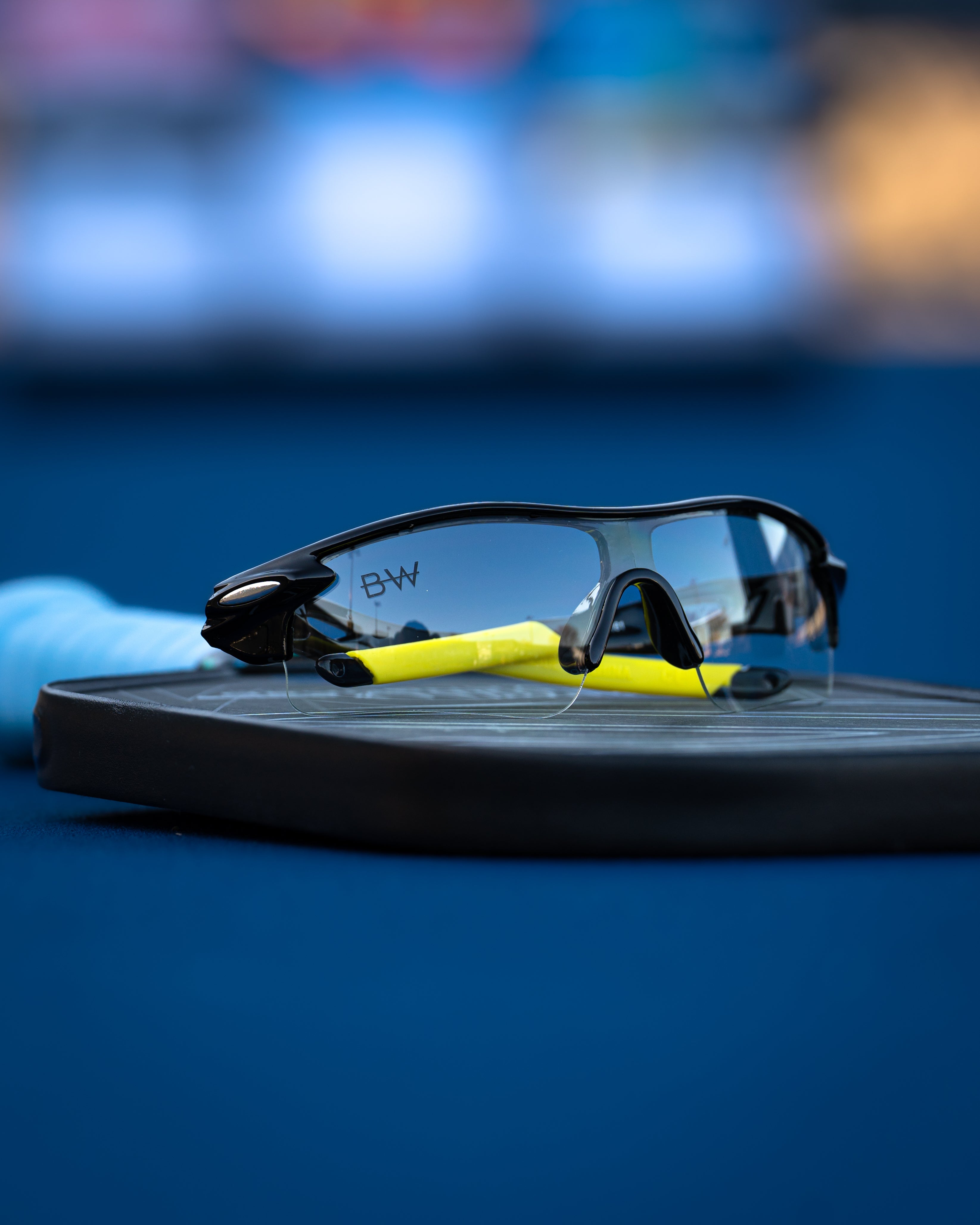
How RX Glasses Help You Adjust to Changing Light Conditions Instantly
Share
How RX Glasses Help You Adjust to Changing Light Conditions Instantly
Pickleball players can encounter very different lighting environments: bright outdoor courts, shaded areas, overcast conditions, evening play, and indoor facilities. The original guide describes these changes as a challenge for visibility and recommends changing-tint prescription lenses as a solution. :chatgpt-content-reference{index="0"}
There is one important correction: RX glasses do not make your eyes adjust to changing light instantly, and photochromic or changing-tint lenses themselves are not instantaneous. When an appropriate changing-tint RX option is available, the lens can change tint in response to its environment over time. Prescription correction and tint adaptation are two separate functions.
Find Your Pickleball Glasses
Compare prescription and non-prescription eyewear or explore the complete pickleball glasses guide. :chatgpt-content-reference{index="1"}
Quick Answer: How Can RX Glasses Help in Changing Light?
If you need prescription correction, RX sports glasses can provide that correction while you move between different playing environments. If a compatible changing-tint lens is available, the lens can also change tint in response to changing conditions.
But these ideas shouldn't be combined into an “instant adaptation” performance claim:
| Feature | What It Does | What It Doesn't Guarantee |
|---|---|---|
| RX correction | Provides your prescribed optical correction | Instant light adaptation |
| Changing-tint lens | Changes tint in response to environmental conditions over time | Instant transition |
| Clear lens | Provides no intentional dark sunglass tint | Better tracking or reactions |
| Tinted lens | Provides a tinted configuration | Better athletic performance |
| High-index lens | Uses a higher-index lens material | Better light adaptation |
Why Changing Light Conditions Matter in Pickleball
The original article identifies direct sunlight, shade, indoor gym lighting, and transitions between indoor and outdoor courts as common lighting challenges. :chatgpt-content-reference{index="2"}
Those situations can occur throughout a player's schedule:
- Starting an outdoor match in brighter conditions
- Playing on a court with areas of shade
- Playing as the sun gets lower
- Moving from outdoor courts to an indoor facility
- Playing under artificial indoor lighting
- Training at different times of day
- Traveling between facilities with different lighting environments
The goal isn't to find eyewear that guarantees “perfect vision” everywhere. It's to choose a prescription and lens configuration appropriate for how and where you actually play.
Do RX Glasses Make Your Eyes Adapt Faster?
The source says that without adaptive eyewear, the eyes constantly strain to refocus, making a player slower and less precise. :chatgpt-content-reference{index="3"}
That shouldn't be presented as a universal consequence of wearing a non-changing lens.
RX glasses provide optical correction. A changing-tint lens changes its tint. Neither should automatically be credited with making the eye itself adapt faster or with increasing:
- Reaction speed
- Shot precision
- Ball tracking
- Depth perception
- Focus
- Competitive performance
What Are Changing-Tint or Photochromic RX Lenses?
The original guide calls them “transitional lenses” and describes lenses that automatically adjust tint according to ambient light. :chatgpt-content-reference{index="4"}
More generally, photochromic or changing-tint lenses are lenses designed to change tint in response to environmental conditions. When offered in an RX configuration, that function can be combined with prescription correction.
That gives the lens two distinct jobs:
- Prescription correction: providing the optical correction prescribed for you.
- Tint-changing function: changing the lens tint in response to the environment over time.
One function shouldn't be used as evidence for claims about the other.
Do Changing-Tint RX Lenses Adjust Instantly?
No. “Instantly” is too strong.
The original article first says the transition happens “in seconds,” then gives a specific FAQ estimate of 30 seconds to two minutes. :chatgpt-content-reference{index="5"} :chatgpt-content-reference{index="6"}
Rather than promising one universal transition time, describe the feature as changing tint over time. The behavior can depend on the particular lens and conditions.
That distinction is especially important for athletes. A player shouldn't purchase changing-tint RX glasses expecting the lenses to jump instantly between clear and dark every time lighting changes during a rally.
What Changing-Tint Lenses Can Do on the Court
The source presents changing-tint lenses as useful because athletes don't need to stop and manually swap eyewear when lighting changes. :chatgpt-content-reference{index="7"}
That's a more practical way to think about the feature.
If the changing-tint configuration is appropriate for your needs, one pair may cover multiple lighting situations without requiring you to manually switch between a clear pair and a separately tinted pair every time the environment changes.
However, that convenience shouldn't become a promise of:
- Instantaneous tint changes
- Perfect visibility in every condition
- Automatic glare elimination
- Enhanced contrast
- Improved ball tracking
- Faster reactions
- Better depth perception
- Better athletic performance
Changing-Tint RX vs. Clear RX Glasses
| Feature | Changing-Tint RX | Clear RX |
|---|---|---|
| Prescription correction | Yes, when made to your prescription | Yes, when made to your prescription |
| Intentional dark sunglass tint | Can change with conditions | No |
| Tint changes automatically | Yes, when using a compatible changing-tint lens | No |
| Instantaneous change | Don't assume | Not applicable |
| Best for every athlete | No | No |
| Improves performance automatically | No | No |
If you primarily play indoors and don't want a dark tint, a clear RX option may be simpler. If you regularly move through different environments, a compatible changing-tint configuration may be worth comparing.
Changing-Tint RX vs. Tinted RX Sunglasses
A fixed tint and a changing tint solve different equipment preferences.
| Question | Changing-Tint RX | Fixed-Tint RX |
|---|---|---|
| Does tint change? | Designed to change with conditions | Remains a fixed tint |
| Requires manual eyewear swap to change tint? | Potentially less often | Another pair may be needed if you want a different tint |
| Good for changing environments? | Potentially useful | Depends on the environment and preference |
| Instant adjustment? | No universal instant-change promise | No tint change occurs |
| Performance advantage? | Not inherently | Not inherently |
Do Changing-Tint RX Lenses Work Indoors?
The original FAQ says the lenses stay clear indoors and quickly darken when exposed to sunlight. :chatgpt-content-reference{index="8"}
For product copy, avoid promising one exact indoor appearance across every changing-tint lens and environment unless the exact configuration has been verified.
If indoor pickleball is your primary use, compare the actual changing-tint option with a dedicated clear RX configuration. The simpler option may depend on where you play most often and how much your lighting environment changes.
Changing-Tint RX Glasses for Outdoor Pickleball
Outdoor players may experience different lighting over the course of a session, particularly when playing across different times of day or moving between courts.
A compatible changing-tint RX lens may appeal to a player who wants:
- Prescription correction
- A lens capable of changing tint
- One pair for multiple lighting environments
- Less need to manually swap between separate clear and tinted pairs
Those are practical reasons to consider the technology without claiming the lens improves your pickleball ability.
What About Courts With Sun and Shade?
The source specifically identifies shaded areas and direct sunlight as common court challenges. :chatgpt-content-reference{index="9"}
It's important to set the right expectation: changing-tint lenses shouldn't be described as instantly switching back and forth every time a player or ball moves between a bright and shaded section of a court.
The lens changes tint over time. Your own visual system and sport-specific skills still handle the rapidly changing information occurring during a rally.
Do Changing-Tint RX Lenses Eliminate Glare?
The original guide says the lenses darken in bright light to reduce glare and later lists glare reduction as a major athletic benefit. :chatgpt-content-reference{index="10"} :chatgpt-content-reference{index="11"}
Don't translate tint-changing behavior into a universal claim that glare will be eliminated. Tint, polarization, anti-reflective treatment, and other lens characteristics are separate concepts.
If glare management is particularly important to you, verify the specifications of the exact lens configuration rather than assuming every changing-tint lens provides the same result.
Do Changing-Tint Lenses Improve Contrast or Ball Tracking?
The source claims enhanced contrast improves ball tracking under variable lighting. :chatgpt-content-reference{index="12"}
That shouldn't be automatically attributed to changing-tint technology.
A lens changing tint does not inherently establish:
- Enhanced contrast
- Better pickleball visibility
- Improved ball tracking
- Improved spin recognition
- Better depth perception
- Faster reactions
Those are separate claims that would require support for the specific lens and outcome being advertised.
Do Changing-Tint RX Lenses Automatically Mean UV Protection?
The original article says the lenses protect the eyes in bright conditions and later states that 100% UVA and UVB protection is standard with all lenses. :chatgpt-content-reference{index="13"} :chatgpt-content-reference{index="14"}
Changing-tint functionality and a specific UV-protection specification are separate claims.
Don't infer a UV400, 100% UVA/UVB, or similar specification solely because a lens changes tint. If a particular UV specification matters to you, confirm it for the exact lens configuration you're purchasing.
Are Changing-Tint Lenses Polarized?
Changing tint and polarization are separate lens characteristics.
A photochromic or changing-tint lens isn't automatically polarized simply because it darkens. Blinded Wear sports lenses are non-polarized, meaning a polarization filter isn't added.
Likewise, non-polarized construction doesn't automatically improve:
- Depth perception
- Ball tracking
- Reaction time
- Contrast
- Overall athletic performance
High-Index RX Lenses and Changing Light Are Different Features
The original article repeatedly connects 1.61 high-index lenses with changing-tint technology, comfort, clarity, and light adaptation. :chatgpt-content-reference{index="15"} :chatgpt-content-reference{index="16"}
Keep these characteristics separate.
Blinded Wear includes high-index prescription lenses at no additional cost. Higher-index material can allow a thinner lens for the same prescription compared with a lower-index material in a comparable design.
High-index material itself doesn't mean the lens:
- Changes tint
- Changes tint faster
- Provides better contrast
- Reduces glare
- Improves ball tracking
- Improves reactions
- Provides a particular UV specification
An exact 1.61 index should only be advertised when verified for the current lens configuration.
Changing-Tint Technology vs. Impact Resistance
The original FAQ describes Blinded Wear lenses as “high-impact” and “shatter-resistant.” :chatgpt-content-reference{index="17"}
Blinded Wear sports eyewear uses impact-resistant lenses. That's a separate characteristic from whether a lens changes tint.
| Term | What It Describes |
|---|---|
| RX | Prescription correction |
| High-index | Lens material/index |
| Changing-tint | A lens that changes tint in response to environmental conditions |
| Non-polarized | No polarization filter added |
| Impact-resistant | Resistance to impact |
Impact-resistant doesn't mean shatterproof, unbreakable, or certified to a particular protective standard.
Prescription Correction Still Comes First
The source says having the correct RX means vision is “perfectly corrected” at all times and eliminates eye strain, headaches, and momentary blurriness. :chatgpt-content-reference{index="18"}
Those outcomes shouldn't be guaranteed.
The more accurate point is that your RX lens is intended to provide the prescription correction ordered for you. The changing-tint function doesn't replace or improve the prescription itself.
Blinded Wear RX customers upload a clear photo of their eyeglass prescription before purchasing. Prescription compatibility should be confirmed rather than assuming every RX configuration works with every frame.
RX Frames to Compare for Changing Light Conditions
The original article highlights Havana White RX, H Blue Shield RX, and Crystal Wave II RX as top changing-tint options. :chatgpt-content-reference{index="19"} Because current lens availability can vary, don't assume every frame supports every changing-tint configuration without confirming it.
RX models you can compare include:
| RX Model | What to Verify |
|---|---|
| H Blue Shield RX | Prescription compatibility, dimensions, current lens options |
| Crystal Wave II RX | Prescription compatibility, dimensions, current lens options |
| Frost RX | Prescription compatibility, dimensions, current lens options |
| Ocean Wave RX | Prescription compatibility, dimensions, current lens options |
| Havana Melt RX | Prescription compatibility, dimensions, current lens options |
Be Careful With “Instant Adaptation” Testimonials
The original article includes testimonials attributed to Morgan S., identified as a “Pickleball Pro,” and Tyler D., identified as a “Multi-Sport Athlete.” The testimonials claim extremely fast lens adjustment, continued sharp focus, sun and glare protection, and major performance benefits. :chatgpt-content-reference{index="20"}
Only publish those testimonials if the people, wording, experiences, credentials, product configurations, and permission to use the statements can be verified.
Even when genuine, an individual customer's experience shouldn't be converted into a universal promise about transition speed or athletic performance.
The Better Way to Think About RX Glasses for Changing Light
The original article promises “perfect vision in every light” and later says changing-tint RX glasses prevent players from losing a moment or point because of lighting. :chatgpt-content-reference{index="21"} :chatgpt-content-reference{index="22"}
A stronger and more credible message is:
If you need prescription correction and regularly play across different lighting environments, a compatible changing-tint RX lens can combine your prescription with a tint that changes over time—potentially reducing how often you need to manually switch between separate clear and tinted pairs.
That's useful without promising instant adaptation, perfect vision, better tracking, faster reactions, or improved performance.
Learn More About Changing-Tint RX Lenses for Training & Travel
Changing Light on a Real Pickleball Court
The original guide focuses on four common situations: direct sunlight, shaded areas, indoor gym lighting, and transitions between indoor and outdoor courts. :chatgpt-content-reference{index="0"}
For players considering changing-tint RX eyewear, it helps to separate slower environmental changes from the split-second changes that happen during a rally.
| Lighting Situation | What Changes | What to Expect From Changing-Tint RX |
|---|---|---|
| Morning to midday play | Overall outdoor light changes over time | Tint can respond to the changing environment over time |
| Outdoor to indoor facility | Major environmental lighting change | Lens tint can change, but shouldn't be described as instantaneous |
| Bright court to shaded court | Playing environment changes | Tint can respond over time |
| Ball crosses a court shadow | Lighting around the ball changes rapidly | Don't expect the lens itself to switch tint instantly |
| Sun moves during a long session | Overall conditions gradually change | A changing-tint configuration may reduce the need to manually swap eyewear |
What Happens When Light Changes During a Rally?
The source suggests that sudden lighting transitions can affect tracking, distance judgment, and reaction speed, and that adaptive lenses keep athletes performing consistently. :chatgpt-content-reference{index="1"}
Changing-tint lenses shouldn't be described as reacting ball-by-ball or shadow-by-shadow. If a pickleball moves from sunlight into shade during a fast rally, the lens isn't expected to instantly change tint for that individual moment.
Your prescription correction remains the prescription correction built into the lens. The tint-changing feature operates separately and over time.
How Fast Do Photochromic RX Lenses Change?
The original article gives two descriptions of transition speed. It first says the change happens “in seconds,” and its FAQ later gives an estimate of 30 seconds to two minutes depending on light intensity. :chatgpt-content-reference{index="2"} :chatgpt-content-reference{index="3"}
Because transition behavior depends on the exact lens and conditions, avoid building the product promise around one universal number.
A safer expectation is:
- The change is not instantaneous.
- Darkening and clearing shouldn't be assumed to occur at identical speeds.
- The exact behavior depends on the specific lens and environment.
- A lens may still be changing while the athlete has already moved into a different environment.
For a player who needs an immediate switch between a specific clear and dark setup, carrying separate pairs may be worth considering.
One Changing-Tint RX Pair vs. Two Separate RX Pairs
The source presents automatic tint adjustment as a way to avoid stopping and switching eyewear during changing conditions. :chatgpt-content-reference{index="4"}
That convenience can be one of the strongest reasons to consider a changing-tint configuration, but it isn't automatically the best setup for every player.
| Setup | Potential Advantage | Tradeoff to Consider |
|---|---|---|
| One changing-tint RX pair | One prescription pair can change tint over time | You don't control an instantaneous switch between clear and dark |
| Clear RX + tinted RX | You can intentionally select the pair you want | Requires carrying and manually switching eyewear |
| Clear RX only | Simple option without an intentional dark tint | No automatic tint change |
| Fixed-tint RX only | Consistent tint | Tint doesn't adapt when the environment changes |
Who Should Consider Changing-Tint RX Sports Glasses?
A changing-tint RX configuration may be worth comparing if you:
- Need prescription correction while playing
- Frequently play both indoors and outdoors
- Train at different times of day
- Move between facilities with different lighting environments
- Prefer carrying one primary prescription pair
- Don't want to manually switch between separate clear and tinted pairs as often
None of those situations means changing-tint lenses are automatically better. They simply make the feature more relevant to your routine.
When a Changing-Tint Lens May Not Be Necessary
A simpler lens configuration may make more sense if your playing environment is highly consistent.
For example:
- An indoor-only player may prefer a clear RX configuration.
- A player who consistently uses the same outdoor environment may prefer a fixed-tint RX configuration.
- A player who wants direct control over clear versus tinted eyewear may prefer two separate pairs.
The goal is not to buy the most complicated lens. It's to choose the configuration that matches how you actually play.
Changing-Tint RX Glasses for Pickleball
The original article specifically positions changing-tint RX lenses for pickleball players who move between indoor gyms, outdoor courts, and shaded environments. :chatgpt-content-reference{index="5"}
For pickleball, consider your typical schedule before choosing:
| Your Routine | Configuration to Compare |
|---|---|
| Mostly indoor pickleball | Clear RX |
| Mostly outdoor pickleball | Available fixed-tint RX options |
| Regular indoor + outdoor play | Changing-tint RX vs. separate clear and tinted pairs |
| Morning through afternoon tournaments | Changing-tint RX may be worth comparing as conditions evolve |
| Highly specific tint preference | Compare fixed-tint options |
Changing-Tint RX Lenses for Training and Travel
Changing-tint eyewear can also be useful to consider when your environment changes throughout the day rather than during a single rally.
For example, an athlete might:
- Leave home in the morning.
- Train outdoors.
- Travel to another facility.
- Practice indoors.
- Return outside later in the day.
A compatible changing-tint RX pair may reduce how often that athlete needs to switch between separate prescription glasses solely because the lighting environment changed.
Read the Changing-Tint RX Lenses for Travel & Training Guide
Does Automatic Tint Adjustment Improve Athletic Performance?
The source associates changing-tint technology with improved tracking, reduced eye strain, maintained focus, greater precision, and consistent performance. :chatgpt-content-reference{index="6"}
Those outcomes shouldn't be guaranteed from tint-changing functionality alone.
Automatic tint adjustment describes what the lens does. Athletic performance describes what the athlete does.
| Lens Function | Athletic Skill |
|---|---|
| Provides prescription correction | Shot execution |
| Changes tint over time | Reaction and anticipation |
| Provides a particular lens configuration | Positioning |
| May reduce the need to switch eyewear | Ball tracking skill |
| Functions as part of your equipment | Decision-making |
Do Changing-Tint RX Glasses Help You Stay Focused?
The original article says changing-tint lenses can help athletes maintain focus indoors and outdoors, while one testimonial says the wearer's focus remains “razor-sharp.” :chatgpt-content-reference{index="7"}
Focus shouldn't be promised as a direct effect of the lens technology.
A more practical benefit is convenience: if one prescription pair works for the environments you regularly use, you may have fewer equipment changes to manage. That's different from claiming the lens improves concentration itself.
Do Changing-Tint RX Glasses Prevent Eye Strain or Headaches?
The original article says having the correct prescription eliminates eye strain, headaches, and momentary blurriness associated with off-prescription eyewear. :chatgpt-content-reference{index="8"}
Don't promise that an RX or changing-tint lens will eliminate those symptoms.
If you experience persistent headaches, unusual visual symptoms, or significant discomfort while wearing prescription eyewear, address the issue with the appropriate eye-care professional rather than assuming a different tint will solve it.
Why Your Prescription and Tint Should Be Evaluated Separately
It's easy to combine every lens characteristic into one promise, but prescription correction and tint-changing behavior answer different questions.
| Question | Relevant Feature |
|---|---|
| Do I need optical correction? | Your prescription |
| Do I want the lens tint to change? | Changing-tint technology |
| Do I want no intentional dark tint? | Clear lens configuration |
| Do I want a consistent tint? | Fixed-tint configuration |
| Do I want a thinner lens option for my prescription? | Lens index may be relevant |
| Do I need a specific protective standard? | Verify certification separately |
Do You Need High-Index Lenses for Changing Light?
The source repeatedly advertises 1.61 high-index changing-tint lenses and describes them as thin, lightweight, and clear. :chatgpt-content-reference{index="9"} :chatgpt-content-reference{index="10"}
High-index and changing-tint technology shouldn't be treated as the same feature.
Higher-index material can allow a thinner lens for the same prescription compared with a lower-index material in a comparable design. Whether you want changing-tint functionality is a separate decision.
Blinded Wear includes high-index prescription lenses at no additional cost. Exact index and changing-tint availability should be confirmed for the configuration you're ordering.
Does Frame Shape Control Light Adaptation?
The original buying guide recommends a wraparound frame and says Runway RX provides maximum coverage from side glare. :chatgpt-content-reference{index="11"}
Don't assume a particular frame shape automatically provides maximum glare protection or better light adaptation unless those characteristics are verified for the exact design.
Instead, compare:
- Frame dimensions
- Lens dimensions
- Prescription compatibility
- Individual fit
- Available lens configurations
- Your playing environment
Changing-Tint Lenses vs. Lens Coatings
The original guide recommends adding anti-glare and scratch-resistant coatings. :chatgpt-content-reference{index="12"} Those shouldn't be assumed to be included with every Blinded Wear lens unless the exact configuration confirms them.
| Feature | Separate From Changing Tint? |
|---|---|
| Anti-reflective treatment | Yes |
| Scratch resistance | Yes |
| Anti-fog treatment | Yes |
| Polarization | Yes |
| Specific UV specification | Yes |
| Impact resistance | Yes |
Always verify the exact feature rather than assuming it is included because the lens changes tint.
How to Choose RX Glasses for Changing Light Conditions
The original article recommends selecting a frame, choosing a lens type, checking the prescription, and considering additional coatings. :chatgpt-content-reference{index="13"} A more complete buying process is:
- Start with your current prescription.
- Confirm frame compatibility. Don't assume every prescription works with every frame.
- Identify where you play most often. Indoor, outdoor, or a combination?
- Decide whether you actually need changing tint.
- Compare changing-tint RX with separate clear and tinted RX pairs.
- Check current lens availability. Don't assume every RX frame supports every option.
- Compare frame dimensions.
- Evaluate individual fit.
- Verify any additional lens specification you care about.
- Practice in the completed eyewear before an important match.
RX Pickleball Glasses to Compare
The source lists Havana White RX, H Blue Shield RX, and Crystal Wave II RX as changing-tint options and states that multiple styles were available with 1.61 high-index changing-tint lenses at no additional charge. :chatgpt-content-reference{index="14"}
Because product configurations can change, verify changing-tint availability on the current product before purchasing.
| RX Model | What to Check |
|---|---|
| H Blue Shield RX | Current RX options, dimensions, changing-tint availability |
| Crystal Wave II RX | Current RX options, dimensions, changing-tint availability |
| Frost RX | Current RX options, dimensions, changing-tint availability |
| Ocean Wave RX | Current RX options, dimensions, changing-tint availability |
| Havana Melt RX | Current RX options, dimensions, changing-tint availability |
Can Every RX Frame Use Changing-Tint Lenses?
The original FAQ says every Blinded Wear prescription model can be equipped with changing-tint lenses at no additional cost. :chatgpt-content-reference{index="15"}
Don't make that universal promise unless it remains verified across the current catalog.
Prescription compatibility and lens availability can depend on the exact frame and configuration. Check the current product options before ordering.
Should You Still Carry Backup RX Glasses?
Even if one changing-tint pair covers several lighting environments, athletes who depend on prescription correction may still benefit from having a familiar backup pair during tournaments or travel.
A backup is useful for a different reason than changing tint: it gives you another prescription option if your primary eyewear is lost or damaged.
Replacement Support for RX Sports Eyewear
The source says every RX order includes a comprehensive protection plan and advertises a universal two-week shipping timeline. :chatgpt-content-reference{index="16"} Those terms shouldn't be repeated unless they match the current policy and current production timeline.
Blinded Wear offers 50% lifetime replacement support for eligible broken eyewear, subject to current policy terms.
Convenience Is the Strongest Reason to Consider Changing-Tint RX
You don't need to claim instant adaptation, perfect visibility, improved tracking, or faster reactions to explain why changing-tint prescription eyewear can be useful.
For the right player, the value proposition is straightforward:
one prescription pair, a tint capable of changing with the environment over time, and potentially fewer manual eyewear changes as lighting conditions evolve.
For athletes who regularly move between indoor, outdoor, bright, and lower-light environments, that convenience alone can make a changing-tint RX configuration worth comparing.
FAQ: RX Glasses and Changing Light Conditions
Do RX glasses adjust to changing light?
RX describes prescription correction. A prescription lens only changes tint if the specific lens configuration includes changing-tint technology. The original guide describes Blinded Wear RX glasses as being available with lenses that automatically change tint according to ambient light. :chatgpt-content-reference{index="0"}
Do changing-tint RX lenses adjust instantly?
No universal instant-change promise should be made. The source first says the transition occurs “in seconds” and later gives an estimate of 30 seconds to two minutes depending on light intensity. :chatgpt-content-reference{index="1"} :chatgpt-content-reference{index="2"} Transition behavior can depend on the exact lens and conditions.
Are changing-tint and photochromic lenses the same idea?
Both terms can describe lenses designed to change tint in response to environmental conditions. When combined with an RX configuration, prescription correction and tint-changing behavior remain separate lens functions.
Do changing-tint RX lenses stay clear indoors?
The original FAQ says the lenses stay clear indoors and darken when exposed to sunlight. :chatgpt-content-reference{index="3"} The exact appearance and behavior of a specific lens should be verified rather than promising identical results across every indoor environment.
Do changing-tint lenses improve pickleball ball tracking?
The source claims enhanced contrast improves ball tracking in variable lighting. :chatgpt-content-reference{index="4"} Tint-changing functionality alone shouldn't be presented as proof of improved ball tracking, reaction time, contrast, or athletic performance.
Are changing-tint lenses polarized?
Changing-tint technology and polarization are separate characteristics. A lens doesn't become polarized simply because its tint changes. Blinded Wear sports lenses are non-polarized.
Do changing-tint lenses automatically include UV protection?
The original FAQ claims 100% UVA and UVB protection is standard with all lenses. :chatgpt-content-reference{index="5"} A specific UV specification should be verified for the exact lens rather than inferred from changing-tint functionality.
Can every Blinded Wear RX frame use changing-tint lenses?
The original article says all prescription models can be equipped with transitional lenses at no extra cost. :chatgpt-content-reference{index="6"} Because product configurations can change, confirm current availability for the exact RX frame before ordering.
Are changing-tint lenses better than clear RX lenses?
Not automatically. Clear RX can be a straightforward choice when you want prescription correction without an intentional dark tint. Changing-tint RX may be worth comparing when you regularly use different lighting environments.
Are changing-tint lenses better than fixed-tint RX sunglasses?
They solve different needs. A changing-tint lens changes over time with its environment, while a fixed tint remains consistent. Your playing environment and preferences should determine which makes more sense.
Changing-Tint RX Lens Myths vs. Reality
| Claim | Reality |
|---|---|
| “Changing-tint lenses adjust instantly.” | They change over time; don't promise instantaneous transitions. |
| “RX lenses automatically change tint.” | Only a compatible changing-tint RX configuration does. |
| “Photochromic lenses improve reaction time.” | Tint-changing functionality doesn't establish faster reactions. |
| “Changing tint improves ball tracking.” | That performance benefit shouldn't be assumed. |
| “Changing-tint lenses are polarized.” | Polarization and tint-changing technology are separate. |
| “High-index means changing-tint.” | Lens index and tint-changing technology are separate characteristics. |
| “Changing-tint means anti-fog.” | Anti-fog is a separate feature. |
| “Changing-tint means scratch-resistant.” | Scratch resistance is a separate characteristic. |
| “Changing-tint means impact-resistant.” | Impact resistance is a separate characteristic. |
| “One changing-tint pair is best for everyone.” | Some athletes may prefer dedicated clear and tinted RX pairs. |
Which RX Lens Setup Fits Your Pickleball Schedule?
| How You Play | RX Setup to Compare | Why |
|---|---|---|
| Indoor only | Clear RX | No intentional dark sunglass tint |
| Mostly consistent outdoor conditions | Fixed-tint RX | Consistent tint may suit a consistent environment |
| Indoor and outdoor | Changing-tint RX | One pair can change tint as environments change |
| Long outdoor tournament days | Changing-tint RX or multiple RX pairs | Conditions may change throughout the day |
| Specific clear/tint preference | Separate RX pairs | Provides direct control over which lens configuration you're wearing |
| Frequent travel and mixed facilities | Changing-tint RX | May reduce the number of eyewear swaps you need to make |
Using Changing-Tint RX Glasses on Tournament Day
The original guide positions changing-tint eyewear as particularly useful for athletes moving between indoor, outdoor, bright, and shaded environments. :chatgpt-content-reference{index="7"}
Before relying on a pair during an important tournament:
- Practice in the completed RX pair. Don't make tournament day your first meaningful test.
- Use it across your normal environments. See how the specific lens behaves for you.
- Understand that tint changes aren't instantaneous.
- Check your frame fit during movement.
- Bring backup RX eyewear if you depend on prescription correction.
- Store unused eyewear safely.
Clear RX vs. Fixed-Tint RX vs. Changing-Tint RX
| Characteristic | Clear RX | Fixed-Tint RX | Changing-Tint RX |
|---|---|---|---|
| Prescription correction | Yes | Yes | Yes |
| Dark sunglass tint | No intentional dark tint | Fixed | Changes with conditions |
| Changes tint automatically | No | No | Yes, over time |
| Manual swap needed for a different tint | Yes | Yes | Potentially less often |
| Instant tint change | Not applicable | Not applicable | Don't assume |
| Automatically improves performance | No | No | No |
Questions to Ask Before Buying Changing-Tint RX Sports Glasses
- Does this frame support my prescription?
- Is changing-tint functionality currently available for this exact configuration?
- Where do I play most often?
- Do I regularly move between indoor and outdoor environments?
- Would I prefer one adaptable pair or separate clear and tinted pairs?
- What are the frame dimensions?
- Which lens index is included with my configuration?
- Which additional lens specifications are actually verified?
- Do I need sport-specific certified protective eyewear?
- Will I have time to practice in the completed glasses before competition?
RX Pickleball Glasses to Explore
The original article names Havana White RX, H Blue Shield RX, and Crystal Wave II RX as changing-tint options and says these models were offered with 1.61 high-index transitional lenses. :chatgpt-content-reference{index="8"} Current changing-tint availability should be verified before purchasing.
| RX Model | What to Compare |
|---|---|
| H Blue Shield RX | Prescription compatibility, dimensions, current lens configurations |
| Crystal Wave II RX | Prescription compatibility, dimensions, current lens configurations |
| Frost RX | Prescription compatibility, dimensions, current lens configurations |
| Ocean Wave RX | Prescription compatibility, dimensions, current lens configurations |
| Havana Melt RX | Prescription compatibility, dimensions, current lens configurations |
| Rocket Fire RX | Prescription compatibility, dimensions, current lens configurations |
How to Evaluate Changing-Tint Lens Reviews
The original article includes testimonials claiming extremely fast transitions, continuous sharp focus, glare protection, and major benefits when moving between environments. :chatgpt-content-reference{index="9"}
If those testimonials are verified and authorized, they can describe those customers' individual experiences. They shouldn't become universal claims about transition speed or performance.
When reading a changing-tint RX review, look for useful context such as:
- The exact lens configuration used
- The RX frame used
- Whether the player was indoors or outdoors
- The type of lighting transition
- How the lens behaved during a longer session
- Whether the reviewer regularly moved between environments
Traveling With Changing-Tint RX Glasses
If changing-tint RX eyewear is your primary prescription pair, protect it like any other important piece of prescription equipment.
- Store the eyewear safely when you're not wearing it.
- Clean the lenses appropriately.
- Inspect the frame before tournaments and travel.
- Bring backup prescription eyewear when practical.
- Keep any prescription information you may need accessible.
One Adaptable Pair Doesn't Eliminate the Value of a Backup
A changing-tint RX pair can potentially reduce how often you switch eyewear because of lighting. That's different from having a second prescription pair available if the primary pair is lost or damaged.
For players who rely on RX correction during tournaments, a familiar backup can still be useful.
Replacement Support for RX Eyewear
The original guide says every RX order comes with a comprehensive protection plan and promises two-week shipping for all RX glasses. :chatgpt-content-reference{index="10"} Current coverage and production timelines should instead be checked against current terms.
Blinded Wear offers 50% lifetime replacement support for eligible broken eyewear, subject to current policy terms.
Related RX Lens & Pickleball Eyewear Guides
Final Verdict: Can RX Glasses Help With Changing Light Conditions?
The original article promises automatic adjustment, “optimal vision,” rapid adaptation, improved tracking, greater precision, and uninterrupted performance across lighting environments. :chatgpt-content-reference{index="11"} :chatgpt-content-reference{index="12"}
The strongest product message is simpler:
If you need prescription correction and frequently move through different lighting environments, a compatible changing-tint RX lens can combine your prescription with a tint that changes in response to environmental conditions over time.
That can potentially reduce the need to manually switch between separate clear and tinted prescription glasses.
It doesn't mean the lens:
- Changes tint instantly
- Guarantees perfect vision in every light
- Improves reaction time
- Improves ball tracking
- Improves depth perception
- Automatically enhances contrast
- Eliminates glare
- Guarantees UV specifications that haven't been verified
- Improves athletic performance
Choose your RX configuration according to your prescription, current lens availability, playing environment, individual fit, and preferences—not a promise that one lens technology will transform your game.
Changing-tint RX eyewear is ultimately about combining prescription correction with adaptable tint in one pair—not turning eyewear into an instant performance enhancer.
Find RX Glasses for Your Playing Conditions
Compare RX frames and current lens configurations, explore the complete pickleball eyewear guide, or use the quiz to narrow your options.