
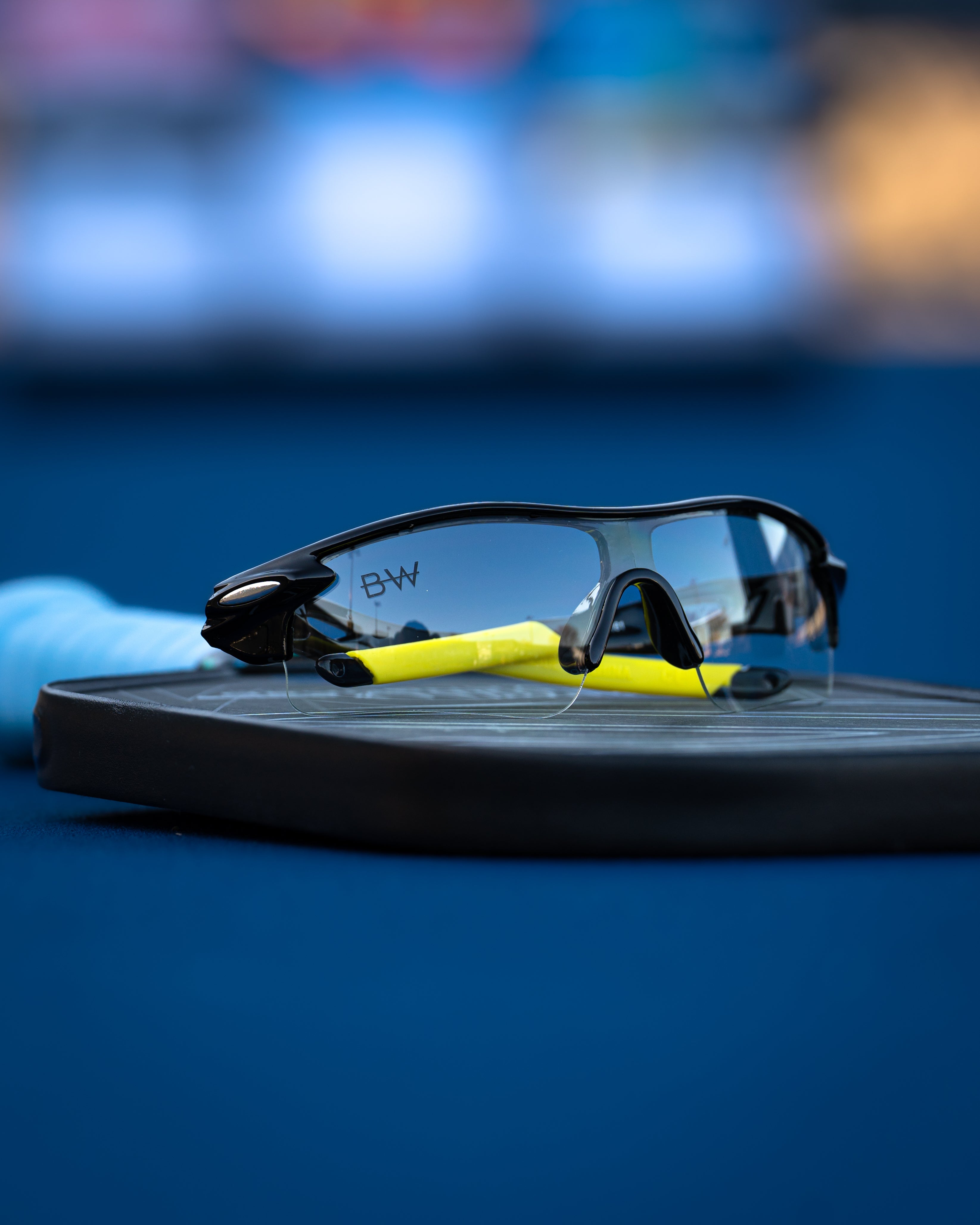
Glasses Too Heavy for Pickleball? Try These Lightweight Picks
Share
Glasses Too Heavy for Pickleball? Try These Lightweight Picks
If your glasses feel bulky, uncomfortable, or distracting during a long pickleball session, overall eyewear weight may be one factor worth reconsidering. But finding better pickleball eyewear is not as simple as buying the lightest frame you can find.
Lightweight does not automatically mean comfortable, secure, protective, or better-performing. Frame dimensions, prescription requirements, lens configuration, individual fit, and the total finished eyewear all matter.
In this guide, we’ll help you compare lightweight prescription and non-prescription pickleball glasses, explain what actually contributes to eyewear weight, and show you how to narrow your options without relying on unsupported claims about reaction time, ball tracking, or performance.
Find Lightweight Pickleball Eyewear
Why Consider Lightweight Glasses for Pickleball?
Pickleball involves repeated movement, changes of direction, long sessions, and plenty of time wearing your eyewear. If a pair feels unnecessarily heavy or uncomfortable, that can become distracting.
A lighter overall eyewear setup may appeal to players who:
- Play for extended periods
- Wear prescription correction throughout a match
- Prefer less bulky sports eyewear
- Frequently move between pickleball and other activities
- Travel with their sports eyewear
- Simply prefer a lower-profile frame
However, eyewear weight should be treated as one buying factor rather than a performance metric.
A lighter pair should not automatically be claimed to improve reaction time, court awareness, depth perception, ball tracking, or athletic ability.
What Makes Pickleball Glasses Feel Heavy?
The number printed for frame weight—when one is actually verified—is only part of the story. What you experience on your face is the finished eyewear.
| Factor | How It Can Matter |
|---|---|
| Frame | The frame itself contributes to total eyewear weight and how the pair sits on your face. |
| Prescription Lenses | Your prescription and lens configuration can influence the physical characteristics of the finished pair. |
| Frame Dimensions | Larger eyewear can involve different amounts of frame and lens material. |
| Lens Material | Prescription lens material can influence the finished lens profile and weight. |
| Individual Fit | How weight is experienced depends partly on how the eyewear fits the individual wearer. |
| Accessories / Attachments | Additional components can change the complete eyewear setup. |
This is why comparing two frames solely by appearance—or by an unverified gram measurement—can be misleading.
Does Lightweight Automatically Mean More Comfortable?
No. Weight and comfort are related considerations, but they are not interchangeable.
A very light frame can still be uncomfortable if its dimensions do not suit the wearer. Likewise, a slightly heavier pair may feel appropriate if its overall fit works well for that individual.
When comfort matters, evaluate:
- Overall frame dimensions
- Your prescription requirements
- The finished lens configuration
- How the frame sits on your face
- How it feels during lateral movement
- How it feels after extended wear
- The environment where you normally play
The better goal is not simply “find the lightest glasses.” It is “find an appropriately lightweight setup that works for me.”
Signs Your Current Pickleball Glasses May Not Be Working for You
Weight may be worth investigating if you consistently notice discomfort while playing. But avoid diagnosing every fit problem as a weight problem.
Pay attention if:
- You repeatedly adjust your eyewear during normal play.
- You notice uncomfortable pressure during longer sessions.
- The finished pair feels unnecessarily bulky for your preferences.
- You consistently become more aware of the eyewear as the session continues.
- The frame dimensions appear poorly matched to your fit.
- Your current prescription lenses make the finished pair feel different from what you expected.
These signs can indicate that you should reevaluate the complete setup, but they do not prove that frame weight alone is responsible.
Lightweight RX vs. Non-RX Pickleball Glasses
Prescription and non-prescription players approach lightweight eyewear from different starting points.
| Consideration | RX Pickleball Glasses | Non-RX Pickleball Glasses |
|---|---|---|
| Vision Correction | Built around the wearer's prescription | No prescription correction |
| Finished Lens Characteristics | Influenced by prescription, lens material, frame, and configuration | Not influenced by an individual eyeglass prescription |
| Frame Weight | Only one part of total finished eyewear weight | Still only one part of the complete pair |
| Fit | Individual fit must be evaluated | Individual fit must be evaluated |
| Playing Environment | Lens configuration should suit intended conditions | Lens configuration should suit intended conditions |
| Primary Shopping Goal | Prescription compatibility first, then frame/lens/fit considerations | Environment, frame, fit, and lens configuration |
Lightweight RX Pickleball Glasses to Compare
If you need prescription correction, start with the RX collection and compare lightweight sports-frame options that are compatible with your prescription.
Blinded Wear includes high-index prescription lenses at no additional cost with RX eyewear. The exact finished lens profile still depends on your prescription, frame, and configuration.
| RX Pick | Why Compare It |
|---|---|
| Phantom II RX | A lightweight sports-frame option to compare when shopping for prescription pickleball eyewear. |
| Crystal Wave II RX | Another RX sports style for players comparing lightweight frame options and a different aesthetic. |
| Lava Rock RX | A bolder RX style to compare if you want lightweight sports eyewear without limiting your search to understated designs. |
| Frost RX | A lighter-looking aesthetic for shoppers comparing RX sports-frame styles. |
| Ocean Wave RX | A color-forward RX option for players who want to compare lightweight sports-frame choices beyond neutral designs. |
Important: lightweight does not establish a universal secure fit. Compare available dimensions and evaluate the finished eyewear during your own court movement.
How to Choose Lightweight Prescription Pickleball Glasses
For RX players, the frame is only one component of the finished pair. Use this order when narrowing your choices:
- Start with your prescription. Make sure the frame can accommodate the correction you need.
- Compare frame dimensions. If you already own comfortable eyewear, use its measurements as a reference when possible.
- Consider the lens material. Blinded Wear includes high-index prescription lenses at no additional cost.
- Choose for your environment. Indoor, outdoor, evening, and mixed-condition play can call for different lens configurations.
- Consider overall style. If you will wear the glasses frequently, choose an aesthetic you actually want to use.
- Test the finished pair. Individual fit matters more than a generic claim that a frame “stays put.”
Can High-Index Lenses Help With a Lightweight RX Setup?
High-index prescription lenses can be relevant when considering the physical profile of finished RX eyewear, particularly as prescription requirements become more significant.
However, several distinctions matter:
- High-index does not automatically mean the complete glasses will be lighter than every alternative.
- High-index does not automatically make a frame more secure.
- High-index does not automatically improve sports performance.
- High-index does not automatically mean impact-resistant.
- The exact finished lens depends on the prescription and frame.
Blinded Wear includes high-index prescription lenses at no additional cost with RX eyewear.
If lens thickness and weight are important to you, evaluate the prescription, lens material, and frame together rather than treating them as separate purchases.
Does Lens Thickness Affect How Heavy RX Pickleball Glasses Feel?
Lens characteristics can contribute to total finished eyewear weight, but thickness alone does not determine how heavy a pair will be.
Finished weight can be influenced by:
- Prescription strength
- Lens material
- Frame dimensions
- Lens dimensions
- Frame construction
- The complete RX configuration
This is especially important for players with stronger prescriptions. Instead of assuming one exact lens index is universally best, choose an appropriate prescription-lens-frame combination.
What About Lightweight Non-RX Pickleball Glasses?
If you do not need prescription correction, you can focus more directly on frame fit, overall eyewear weight, lens configuration, playing environment, and style.
Blinded Wear's non-RX collection includes sports sunglasses designed for active use and pickleball.
Rather than relying on unverified claims that a particular model weighs an exact number of grams or is the lightest product available, compare the current product specifications and choose according to your individual needs.
Lightweight Pickleball Glasses for Indoor vs. Outdoor Play
Weight is only one consideration. A lightweight pair still needs a lens configuration that makes sense for the environment where you play.
| Playing Environment | What to Consider |
|---|---|
| Indoor Pickleball | Clear or another appropriate non-dark configuration may be useful when a dark sunglass tint is not preferred. |
| Evening Pickleball | Consider whether a dark tint is appropriate for the available light. |
| Outdoor Pickleball | Compare sports-sunglass configurations appropriate for your outdoor environment. |
| Indoor + Outdoor Play | Compare separate configurations with compatible transition/photochromic options where available. |
A frame being lightweight does not make one lens configuration ideal for every lighting condition.
Are Clear Lightweight Glasses Good for Indoor Pickleball?
Clear or another appropriate non-dark sports-lens configuration can be worth considering for indoor courts, evening play, and other environments where you do not want a dark sunglass tint.
The accurate benefit is straightforward: clear lenses do not add a dark sunglass tint.
Do not automatically assume clear lenses:
- Increase contrast
- Improve ball tracking
- Improve depth perception
- Increase reaction speed
- Improve athletic performance
Choose them because the lens configuration makes sense for your environment.
Does Lightweight Mean Less Durable?
Not automatically. Weight alone does not establish how durable or protective a pair of eyewear is.
Blinded Wear sports eyewear uses impact-resistant lenses.
However, impact-resistant should not be expanded into stronger claims without verification. It does not automatically mean:
- Shatterproof
- Indestructible
- Scratch-proof
- ANSI-certified
- ASTM F803-certified
- Guaranteed to prevent eye injury
If your activity requires a specific protective standard, verify that certification for the exact product.
Are Blinded Wear Lightweight Sports Lenses Polarized?
Blinded Wear sports lenses are non-polarized, meaning a polarization filter is not added.
Some court players prefer non-polarized eyewear, but polarization should not be turned into an unsupported performance argument.
| Claim | Accurate? |
|---|---|
| Blinded Wear sports lenses are non-polarized | Yes |
| Non-polarized means no polarization filter is added | Yes |
| Some court players prefer non-polarized lenses | Yes |
| Non-polarized automatically improves depth perception | No |
| Non-polarized automatically improves reaction time | No |
| Non-polarized automatically improves ball tracking | No |
Do Lightweight Pickleball Glasses Stay in Place Better?
Not automatically.
A lower total weight may be desirable, but eyewear stability depends on the complete fit rather than weight alone.
Instead of trusting phrases such as “no-slip” or “zero bounce” without verified product-specific support, evaluate:
- Frame dimensions
- Your individual facial fit
- The finished prescription configuration if applicable
- How the glasses behave during lateral movement
- How they behave when looking down and back up
- How they feel after extended play
A lightweight pair that does not fit you appropriately is not automatically a better pickleball pair than a slightly heavier frame that does.
5-Minute Lightweight Pickleball Glasses Fit Test
Before relying on new eyewear for a match, run through a simple movement test.
- Stand naturally. Notice how the finished pair initially feels.
- Look left, right, up, and down. Pay attention to unwanted movement or discomfort.
- Add lateral movement. Shuffle in both directions as you would near the kitchen line.
- Practice familiar court movements. Add serves, returns, and normal warmup movements.
- Continue wearing the pair. A few seconds cannot tell you how eyewear will feel after a longer session.
If the pair consistently requires adjustment or becomes uncomfortable, reassess the fit instead of assuming you simply need an even lighter frame.
8 Mistakes to Avoid When Shopping for Lightweight Pickleball Glasses
- Buying solely because a frame claims an extremely low gram weight.
- Assuming lighter automatically means more comfortable.
- Assuming lightweight eyewear automatically stays in place.
- Ignoring frame dimensions.
- Ignoring prescription lens requirements when shopping for RX eyewear.
- Choosing a lens tint without considering the playing environment.
- Assuming impact-resistant means shatterproof or certified protective eyewear.
- Believing lightweight eyewear automatically improves reaction time, tracking, or court performance.
Lightweight Pickleball Glasses FAQ
What are the best lightweight glasses for pickleball?
There is no universal best lightweight pair. Compare prescription requirements if applicable, frame dimensions, total finished eyewear, individual fit, lens configuration, and playing environment.
Are lighter glasses better for pickleball?
Some players prefer lighter eyewear, particularly for extended wear, but lighter does not automatically mean better-fitting or better-performing.
Why do my glasses feel heavy during pickleball?
The sensation can involve the frame, prescription lenses, total finished weight, dimensions, individual fit, or a combination of factors. Weight alone may not be the cause.
Can heavy glasses affect pickleball performance?
Uncomfortable eyewear can be distracting, but weight alone should not be presented as a proven cause of slower reactions, worse tracking, or reduced court awareness.
Are prescription pickleball glasses heavier than non-prescription glasses?
Not necessarily in every comparison. Finished RX eyewear depends on the prescription, lens material, frame, dimensions, and configuration.
Does Blinded Wear offer lightweight RX options?
Yes. Blinded Wear offers lightweight sports-frame options within its prescription eyewear collection, with high-index prescription lenses included at no additional cost.
Do lightweight sports glasses need to be polarized?
No. Polarization and eyewear weight are separate characteristics. Blinded Wear sports lenses are non-polarized.
Are lightweight pickleball glasses impact-resistant?
Blinded Wear sports eyewear uses impact-resistant lenses. Impact-resistant does not automatically mean shatterproof or certified to a specific protective standard.
Lightweight vs. Small: They Are Not the Same Thing
A common shortcut when shopping for lighter pickleball glasses is to assume that a smaller frame will automatically be lighter and more comfortable.
That is not necessarily true.
Frame size is only one variable. The finished eyewear can also be influenced by frame construction, lens dimensions, prescription requirements, lens material, and the complete configuration.
| Term | What It Actually Tells You |
|---|---|
| Lightweight | Describes relatively low weight; it does not establish fit or comfort. |
| Small Frame | Describes dimensions; it does not automatically establish low weight. |
| Slim Profile | Describes appearance or physical profile; it does not prove an exact weight. |
| Sports Frame | Describes intended styling or use; it does not automatically establish secure fit or protective certification. |
| High-Index RX Lens | Describes a prescription lens-material category; it does not automatically establish total eyewear weight. |
Choose according to the complete pair rather than assuming one visible characteristic tells you how the eyewear will feel.
Why Frame Dimensions Matter When Shopping for Lightweight Glasses
Weight gets attention because it is easy to understand, but frame dimensions may be equally important when you are trying to solve an uncomfortable-eyewear problem.
If you already own a pair of glasses that fits you well, compare its available measurements with the sports frames you are considering.
Depending on what information is provided for the exact product, useful measurements can include:
- Lens width
- Lens height
- Bridge width
- Temple length
- Overall frame dimensions
Do not assume that every measurement will be available for every product, and do not invent dimensions when they are not listed.
Measurements are also not a guarantee of perfect fit, but they can provide a more useful starting point than choosing solely because a frame is described as lightweight.
What If Your Pickleball Glasses Leave Pressure Marks?
If eyewear consistently causes uncomfortable pressure around your nose, ears, or temples, total weight may be one factor—but it is not the only possible explanation.
Consider whether the issue may involve:
- Frame dimensions
- How the frame fits your face
- The complete finished eyewear weight
- Your prescription lens configuration
- Where the eyewear contacts your face
- How long you wear the pair
Simply replacing a heavier pair with the lowest-weight frame you can find may not solve a fit problem.
The goal should be to identify whether the discomfort comes from weight, fit, dimensions, the finished configuration, or a combination of factors.
Why Do Pickleball Glasses Keep Slipping?
Players often blame slipping entirely on eyewear weight. In reality, unwanted movement can involve several variables.
Possible considerations include:
- Individual facial fit
- Frame dimensions
- The finished weight of the eyewear
- Movement during play
- How the frame sits on the wearer
A lighter frame may be worth comparing if your current pair feels unnecessarily heavy, but lower weight does not guarantee a non-slip fit.
This is why testing new eyewear during realistic court movement is more useful than relying on labels such as “zero bounce” or “never slips.”
Choosing Lightweight Glasses for Long Pickleball Sessions
Players who spend several hours at the court may care about eyewear differently from someone playing one short recreational game.
If extended wear is important to you, evaluate:
- Initial fit. Does the frame feel appropriate when you first put it on?
- Movement. How does the finished pair behave during normal pickleball footwork?
- Extended comfort. Does your experience change later in the session?
- Lens environment. Is the lens configuration still appropriate as conditions change?
- Adjustment frequency. Are you repeatedly touching or repositioning the eyewear?
A frame that feels light during a 30-second try-on still needs to work during the amount of time you actually spend playing.
Lightweight RX Glasses for Pickleball Tournaments
Tournament players may wear their prescription eyewear through warmups, matches, breaks, travel, and several hours at the venue. That can make overall comfort and practicality especially relevant.
For tournament use, consider more than weight:
- Prescription compatibility
- Individual fit
- Frame dimensions
- Playing environment
- Expected length of wear
- Indoor vs. outdoor conditions
- Backup prescription correction
- How you will store the eyewear between matches
Do not make tournament day the first time you seriously test a new lightweight frame.
Why Lightweight RX Eyewear Can Appeal to Traveling Players
For players who travel to tournaments or recreational pickleball destinations, a lightweight sports-frame option may be appealing because the same eyewear can spend substantial time on your face and in your travel gear.
But travel adds other priorities:
- Protecting your prescription eyewear during transportation
- Having access to backup correction
- Preparing for different court environments
- Keeping the eyewear stored appropriately when not in use
- Knowing the current replacement terms before a trip
A lightweight frame does not remove the need to protect your eyewear when it is packed.
Should You Carry a Lightweight Backup Pair?
If you depend on prescription correction to play, carrying another usable RX pair can be worth considering for tournaments, travel, or long days away from home.
A backup pair becomes more relevant when:
- You would struggle to continue playing without prescription correction
- You travel for pickleball
- You participate in multi-day events
- Your primary pair serves several parts of your active routine
- You will be far from your usual replacement options
Your backup does not necessarily need to duplicate your primary eyewear exactly. The important question is whether it provides usable prescription correction for the situation in which you would need it.
Can Lightweight Pickleball Glasses Work for Other Sports?
Potentially, but a lightweight frame should not automatically be labeled appropriate for every activity.
If you want one pair for pickleball and another sport, verify:
- Prescription compatibility if applicable
- Whether the frame and lens configuration suit both environments
- Individual fit during each activity
- Whether either activity requires a specific protective standard
- Whether the lens configuration makes sense across both activities
The fact that eyewear feels light during pickleball does not establish suitability for another sport.
Lightweight RX Eyewear From the Gym to the Pickleball Court
Some active adults want one prescription pair they can use during a workout and then continue wearing on the pickleball court.
A lightweight sports-frame option may be worth considering, but versatility depends on more than weight.
Ask:
- Does the prescription configuration work for both activities?
- Is the frame appropriate during the movements I actually perform?
- Are both activities indoors, outdoors, or a mixture?
- Is the lens configuration appropriate for both environments?
- Have I tested the finished eyewear during both activities?
If the gym is indoors and pickleball is played in bright outdoor conditions, lens configuration may become a bigger difference than frame weight.
Can Lightweight Pickleball Glasses Still Be Stylish?
Yes. Choosing lighter sports eyewear does not require every player to choose the same frame shape, color, or aesthetic.
Once you have narrowed your search to technically appropriate options, style can help you make the final decision.
You might prefer:
- A neutral frame
- A lighter visual aesthetic
- A bold color
- A sport-forward appearance
- A frame you would also wear away from the court
Style is subjective, so there is no reason to present one design as universally best. If you enjoy wearing the frame and it appropriately meets your prescription, fit, and environment requirements, aesthetics can be a legitimate deciding factor.
Compare Lightweight RX Pickleball Options
If you are deciding between several prescription frames, use a comparison worksheet instead of choosing based on a single marketing claim.
| Comparison | Option A | Option B | Option C |
|---|---|---|---|
| Compatible with my prescription? | ☐ | ☐ | ☐ |
| Available dimensions compared? | ☐ | ☐ | ☐ |
| Lightweight sports-frame option? | ☐ | ☐ | ☐ |
| Appropriate lens configuration? | ☐ | ☐ | ☐ |
| High-index RX lenses included? | ☐ | ☐ | ☐ |
| Impact-resistant sports lenses? | ☐ | ☐ | ☐ |
| Non-polarized sports lenses? | ☐ | ☐ | ☐ |
| Style I want to wear? | ☐ | ☐ | ☐ |
| Tested during realistic movement? | ☐ | ☐ | ☐ |
Lightweight Eyewear Claims to Verify Before Buying
Sports-eyewear product descriptions often combine weight claims with other technical claims. Treat each characteristic separately.
| Claim | What to Do |
|---|---|
| Exact Gram Weight | Verify the specification for the exact product rather than estimating it. |
| “Lightest Frame” | Verify against the current collection before making a superlative claim. |
| No-Slip / Zero-Bounce | Do not assume universal fit; evaluate the eyewear on the individual wearer. |
| Anti-Fog | Verify the exact lens treatment or feature. |
| Scratch-Resistant | Verify the exact lens specification. |
| UV400 / Exact UV Protection | Verify the exact UV specification. |
| Shatterproof | Do not substitute general impact resistance for this stronger claim. |
| ANSI / ASTM Certification | Verify the exact standard for the exact product. |
| Improved Ball Tracking | Do not infer this from frame weight or lens color. |
| Faster Reaction Time | Do not infer this from lightweight eyewear. |
| Better Depth Perception | Do not infer this from weight, tint, or non-polarized construction alone. |
What If Your Lightweight Pickleball Glasses Break?
Sports eyewear can be exposed to frequent handling, travel, sports bags, workouts, and court use regardless of how much the frame weighs.
Blinded Wear provides 50% lifetime replacement support if glasses break, subject to the current policy terms.
This should not be interpreted as:
- Free unlimited replacements
- Automatic coverage for every type of damage
- Automatic coverage for scratches
- Automatic replacement for lost or stolen eyewear
- Automatic replacement when your prescription changes
Review the current terms for the details that apply to your purchase.
How to Choose Lightweight Pickleball Glasses Step by Step
Use this process to narrow your choices without letting frame weight overpower more important buying factors.
- Determine whether you need RX or non-RX eyewear.
- If you need RX, start with your current eyeglass prescription.
- Identify your primary playing environment. Indoor, outdoor, evening, or mixed conditions can affect your lens decision.
- Browse compatible sports frames.
- Compare available frame dimensions.
- Consider total finished eyewear—not just advertised frame weight.
- Verify technical claims that matter to you.
- Choose among suitable options based on style and preferences.
- Test the finished pair during realistic movement.
- Wear it during practice before relying on it for competition.
More Questions About Lightweight Pickleball Glasses
How much should pickleball glasses weigh?
There is no universal gram weight that makes eyewear appropriate for pickleball. Total finished weight, frame dimensions, individual fit, prescription requirements, and lens configuration all matter.
What is considered lightweight sports eyewear?
“Lightweight” is a relative description rather than one universal cutoff. If an exact product weight matters to you, verify the current specification for that product.
Are glasses under 25 grams better for pickleball?
An exact weight below a particular threshold does not automatically make eyewear better for pickleball. Individual fit, lens configuration, prescription requirements, and the complete finished pair remain important.
Will lighter pickleball glasses stop slipping?
Not necessarily. Lower weight may be one consideration, but unwanted movement can also involve frame dimensions and individual fit.
Can lightweight glasses still use prescription lenses?
Yes. Lightweight sports-frame options can be available with prescription correction when the prescription is compatible with the frame and lens configuration.
Does Blinded Wear charge extra for high-index RX lenses?
No. High-index prescription lenses are included at no additional cost with Blinded Wear RX eyewear.
Should strong prescriptions use lightweight frames?
Frame weight is only one consideration. Stronger prescriptions can make lens material, frame dimensions, and prescription compatibility particularly important when evaluating the complete finished eyewear.
Do lightweight glasses improve reaction time?
Do not assume so. A player may prefer less bulky eyewear, but lower eyewear weight alone does not establish faster reaction time.
Do lightweight glasses improve ball tracking?
Frame weight alone should not be claimed to improve ball tracking. Vision correction, visual abilities, experience, anticipation, and other factors contribute to sports performance.
Are lightweight glasses less protective?
Weight alone does not establish protective capability. If a specific protective standard matters, verify the certification of the exact product.
Are lightweight pickleball glasses good for tournaments?
They can be considered for tournament use, but also evaluate prescription compatibility, fit, playing environment, extended-wear comfort, storage, and backup correction.
Can I use lightweight pickleball glasses for the gym?
Potentially. Verify that the frame, prescription if applicable, fit, and lens configuration are appropriate for both activities.
Which Lightweight Pickleball Setup Fits Your Routine?
The best way to narrow your options is to start with how you actually play. A recreational indoor player, an outdoor league player, and an RX tournament player may all value lightweight eyewear for different reasons.
| Player Type | What to Prioritize | Good Starting Point |
|---|---|---|
| Indoor Recreational Player | Low-bulk frame, individual fit, and a non-dark lens configuration | Compare lightweight frames with clear or otherwise appropriate indoor lens options |
| Outdoor Recreational Player | Lightweight sports frame, fit, and an outdoor-appropriate lens configuration | Browse the non-RX sports sunglass collection or RX options if correction is needed |
| RX Pickleball Player | Prescription compatibility, high-index lens options, frame dimensions, and finished fit | Start with the RX collection rather than choosing a non-RX frame first |
| Tournament Player | Extended-wear comfort, prescription needs, environment, testing, and backup eyewear | Test the complete setup during practice before competition |
| Gym-to-Court Player | Versatility across both activities and environments | Consider whether one lens configuration appropriately serves both settings |
| Traveling Player | Comfort, storage, backup correction, and versatility | Plan the entire travel eyewear system rather than focusing only on frame weight |
| Multi-Sport Athlete | Compatibility with each activity and any sport-specific protection requirements | Verify suitability separately for every sport |
30-Second Lightweight Pickleball Glasses Selector
If you want a faster way to narrow the collection, start with these questions:
Do You Need Prescription Correction?
If yes, begin with the RX Pickleball Collection. Prescription compatibility should come before weight, color, or style.
If no, explore the Non-RX Pickleball Collection and compare frame style, fit, lens configuration, and intended environment.
Do You Mostly Play Indoors?
Consider a clear or otherwise appropriate non-dark lens configuration if you do not want a dark sunglass tint.
Do You Mostly Play Outdoors?
Compare sports-sunglass configurations intended for outdoor use while still considering frame dimensions and individual fit.
Do You Play Indoors and Outdoors?
Compare separate pairs with compatible transition/photochromic configurations where available. Do not assume one lens setup is automatically ideal for every environment.
Are Your Current Glasses Physically Uncomfortable?
Compare lighter options, but also check dimensions and fit. Moving to a lighter frame will not necessarily solve a sizing or fit problem.
Do You Play Long Sessions or Tournaments?
Place greater emphasis on extended-wear experience and test the finished pair during practice before relying on it for competition.
How to Test New Lightweight Pickleball Glasses
Once your eyewear arrives, the real test begins. A product description cannot tell you exactly how a frame will work on your face.
- Start with normal wear. Put the glasses on and evaluate the initial fit without immediately beginning intense movement.
- Move your head naturally. Look up, down, left, and right.
- Add pickleball footwork. Practice lateral movement, forward movement, and recovery steps.
- Warm up normally. Hit serves, returns, dinks, volleys, and groundstrokes.
- Continue wearing them. Evaluate how the pair feels beyond the first few minutes.
- Test your normal conditions. If you bought the eyewear for indoor, outdoor, or evening play, test it in that intended environment.
- Practice before competition. Become familiar with new RX or non-RX eyewear before an important match.
A frame should earn its place in your pickleball bag through real use—not simply because the product page calls it lightweight.
What “Lightweight” Does—and Does Not—Tell You
| Statement | What You Can Conclude |
|---|---|
| The frame is lightweight | Weight has been reduced relative to some alternatives; exact weight should be verified if important. |
| The frame is lightweight | It does not prove the frame will fit every player comfortably. |
| The frame is lightweight | It does not prove the glasses will never slip or move. |
| The frame is lightweight | It does not prove faster reaction time. |
| The frame is lightweight | It does not prove better ball tracking or depth perception. |
| The frame is lightweight | It does not establish impact certification. |
| The lenses are impact-resistant | That does not automatically mean shatterproof or certified to a particular protective standard. |
| The lenses are non-polarized | A polarization filter is not added; this alone does not prove a performance advantage. |
People Also Ask About Lightweight Pickleball Glasses
What are the lightest glasses for pickleball?
Exact product weights should be verified from current product specifications before identifying one model as the lightest. More importantly, the lowest gram weight is not automatically the best fit for every player.
How do I make my glasses feel less heavy while playing pickleball?
Compare lighter sports-frame options, but also review frame dimensions, individual fit, and—in RX eyewear—the complete prescription lens configuration. A fit problem can sometimes feel like a weight problem.
Why do my glasses hurt my nose during pickleball?
Weight can be one factor, but discomfort can also involve frame dimensions, individual fit, where the eyewear contacts your face, and how long you wear it. Persistent discomfort should not automatically be blamed on frame weight alone.
Why do my glasses move when I play pickleball?
Movement can involve individual fit, frame dimensions, total finished weight, and how the eyewear interacts with your movement. Buying a lighter frame does not guarantee that the problem disappears.
Are lightweight glasses better for long pickleball matches?
Some players may prefer less bulky eyewear for extended wear, but comfort remains individual. Test the finished pair during realistic sessions rather than assuming lower weight guarantees better long-term comfort.
What are good lightweight prescription glasses for pickleball?
Start with RX-compatible lightweight sports-frame options such as Phantom II RX, Crystal Wave II RX, Lava Rock RX, Frost RX, and Ocean Wave RX, then narrow your choices based on prescription compatibility, dimensions, lens configuration, fit, and style.
What should I look for in lightweight pickleball sunglasses?
Consider frame dimensions, total finished eyewear, individual fit, playing environment, lens configuration, verified lens characteristics, and style. Avoid choosing solely from an advertised gram weight.
Should indoor pickleball glasses be clear?
A clear or another appropriate non-dark configuration can make sense when you do not want a dark sunglass tint indoors. Clear lenses should not automatically be credited with better contrast, tracking, or reaction time.
Should outdoor pickleball glasses be polarized?
Polarization is not a universal requirement for outdoor pickleball. Blinded Wear sports lenses are non-polarized, meaning a polarization filter is not added.
Can prescription lenses make sports glasses heavier?
Prescription lenses contribute to the finished eyewear, but their physical characteristics depend on prescription strength, lens material, dimensions, frame, and configuration.
Do high-index lenses make RX sports glasses lighter?
High-index lenses can influence the physical profile of a prescription lens, but a higher index does not automatically mean the complete finished pair will be lighter than every alternative.
Are lightweight pickleball glasses safe?
Weight alone does not determine protection. Blinded Wear sports eyewear uses impact-resistant lenses, but impact-resistant should not be treated as synonymous with shatterproof or certified protective eyewear.
Can I wear the same lightweight glasses for pickleball and running?
Potentially, if the frame, fit, prescription if applicable, lens configuration, and other requirements are appropriate for both activities. Suitability should be evaluated for each activity rather than inferred from low weight.
Can I wear lightweight pickleball glasses all day?
That depends on the complete eyewear, your prescription if applicable, individual fit, lens configuration, and intended environments. Test the pair over realistic periods if all-day wear matters to you.
What Blinded Wear Lightweight Sports Eyewear Offers
When comparing pickleball eyewear, focus on verified characteristics rather than promises that a lighter frame will automatically improve your game.
| Feature | Blinded Wear Sports Eyewear |
|---|---|
| Lightweight Sports-Frame Options | Yes |
| Prescription Pickleball Eyewear | Yes |
| Non-RX Pickleball Eyewear | Yes |
| High-Index Prescription Lenses | Included at no additional cost with RX eyewear |
| Impact-Resistant Sports Lenses | Yes |
| Non-Polarized Sports Lenses | Yes |
| Clear Lens Sports Options | Yes |
| Multiple RX Styles | Yes |
| Prescription Upload | Upload a clear photo or picture of your eyeglass prescription when ordering RX eyewear |
| Lifetime Replacement Support | 50% replacement support if glasses break, subject to current policy terms |
Exact frame weights, coatings, UV specifications, anti-fog treatments, scratch-resistant treatments, transition/photochromic availability, progressive compatibility, and protective certifications should be verified for the exact product and configuration when those characteristics matter to you.
Continue Building Your Pickleball Eyewear Setup
Final Checklist for Choosing Lightweight Pickleball Glasses
- ☐ I know whether I need RX or non-RX eyewear.
- ☐ If I need RX, I have my current eyeglass prescription.
- ☐ I verified prescription compatibility with the frame I want.
- ☐ I compared available frame dimensions.
- ☐ I considered total finished eyewear rather than frame weight alone.
- ☐ I selected a lens configuration appropriate for where I play.
- ☐ I understand that lightweight does not automatically mean comfortable.
- ☐ I understand that lightweight does not guarantee a secure or non-slip fit.
- ☐ I understand that lightweight does not automatically improve reaction time or ball tracking.
- ☐ I understand that impact-resistant does not automatically mean shatterproof or certified protective eyewear.
- ☐ I verified any exact weight or technical specification that matters to me.
- ☐ I considered how long I normally play.
- ☐ I plan to test the eyewear during realistic court movement.
- ☐ I will practice in new eyewear before relying on it during competition.
- ☐ If I depend on RX correction, I considered whether I need a backup pair.
Key Takeaways: Choosing Lighter Pickleball Glasses
- The lightest frame is not automatically the best pickleball frame.
- Overall eyewear weight is only one part of comfort and fit.
- Frame dimensions can matter just as much as an advertised weight.
- RX players should prioritize prescription compatibility before frame weight.
- Blinded Wear includes high-index prescription lenses at no additional cost with RX eyewear.
- High-index does not automatically mean the finished pair is lighter than every alternative.
- Indoor, outdoor, and evening players may need different lens configurations.
- Clear lenses are a non-dark option but should not automatically be credited with better tracking or reaction time.
- Blinded Wear sports lenses are non-polarized.
- Non-polarized does not automatically improve depth perception or athletic performance.
- Blinded Wear sports eyewear uses impact-resistant lenses.
- Impact-resistant does not automatically mean shatterproof or certified protective eyewear.
- A lighter frame does not guarantee that eyewear will stay in place.
- The finished pair should be tested during realistic pickleball movement and extended wear.
Ready to Find a Lighter Pickleball Setup?
If your current glasses feel bulky or uncomfortable, you do not need to chase the smallest possible number on a scale. Start by finding eyewear that matches your vision needs, playing environment, dimensions, and individual fit—then compare lightweight options within those requirements.
Blinded Wear offers lightweight sports-frame options across both prescription and non-prescription pickleball eyewear. RX eyewear includes high-index prescription lenses at no additional cost, while Blinded Wear sports lenses are impact-resistant and non-polarized.
Bottom Line: Go Lighter Without Ignoring What Matters
If your current glasses feel too heavy for pickleball, exploring lightweight sports eyewear makes sense. Just do not reduce the entire buying decision to frame weight.
The right setup starts with RX or non-RX needs, frame dimensions, lens configuration, individual fit, playing environment, and the complete finished eyewear. Weight becomes one factor within that larger decision.
For prescription players, that also means choosing a frame that works with your prescription and considering the finished lens configuration. For non-RX players, it means choosing eyewear appropriate for your court conditions rather than assuming the lightest frame will automatically perform best.
Choose light enough for your preferences, appropriate for your vision needs, and suitable for the way you actually play.