
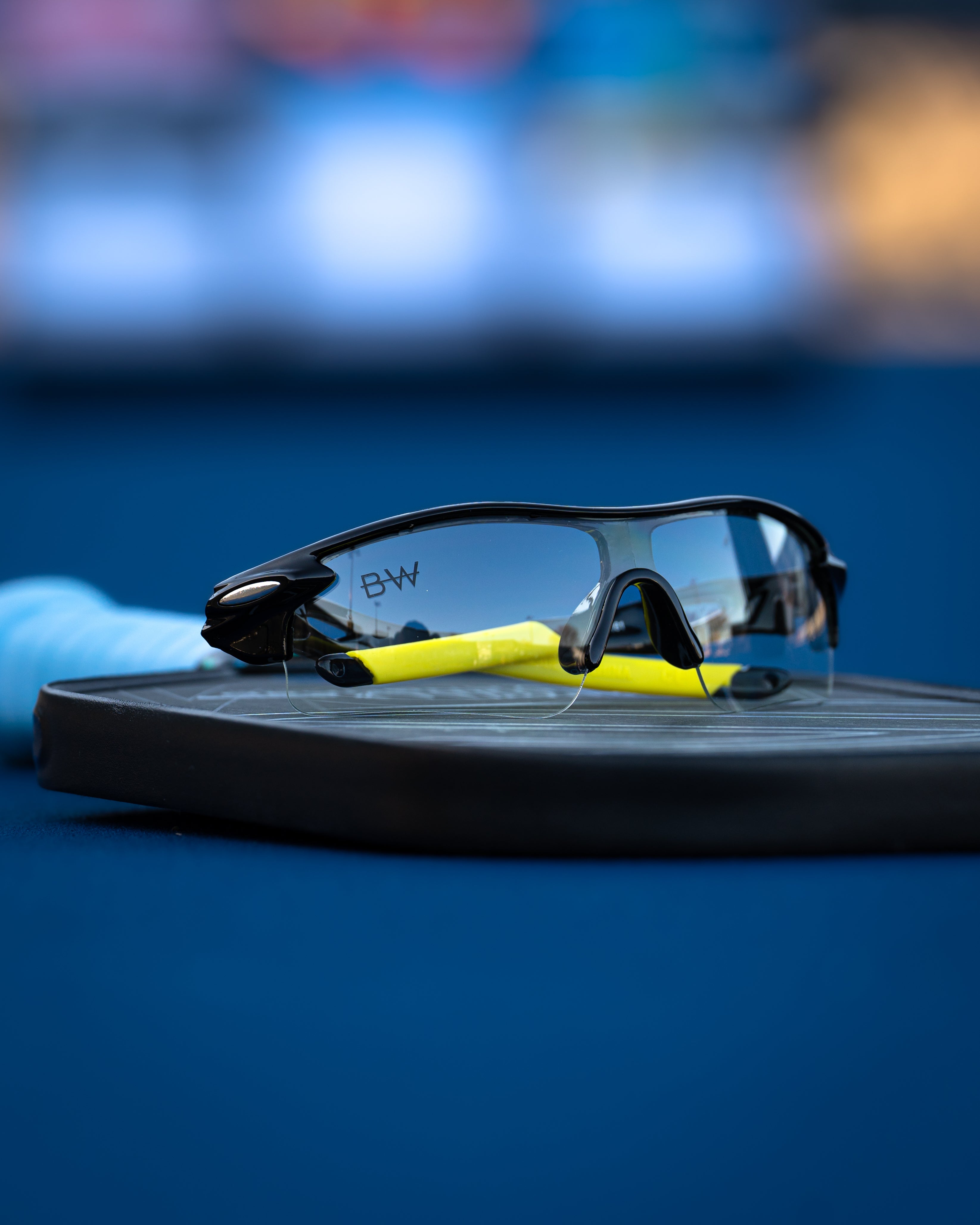
How Lightweight RX Glasses Improve Performance and Reduce Fatigue
Share
Explore Lightweight Prescription Sports Glasses
For pickleball, tennis, running, cycling, and other active sports, eyewear weight can influence how glasses feel over a long session. Lightweight RX glasses can reduce the amount of physical weight resting on your face, but comfort and athletic performance depend on much more than frame weight alone.
Lightweight RX Sports Glasses: Comfort, Fit, and Performance Explained
Long practices, tournaments, and back-to-back matches can mean wearing prescription sports glasses for hours at a time. That makes comfort an important part of choosing athletic eyewear.
One characteristic worth considering is overall eyewear weight.
A lighter pair of prescription glasses places less total weight on your face than a heavier pair. For some athletes, that can contribute to a more comfortable wearing experience during extended activity.
But lightweight eyewear should not automatically be described as improving reaction time, focus, ball tracking, or athletic performance.
Instead, think of low weight as one part of a larger sports-eyewear system that includes:
- Prescription accuracy
- Frame fit
- Weight distribution
- Lens dimensions
- Prescription lens material
- Physical coverage
- Playing environment
- Individual comfort preferences
Do Lightweight Glasses Actually Matter for Sports?
They can matter, particularly when eyewear is worn for extended periods.
Every gram of eyewear weight has to be supported somewhere, primarily through contact between the frame and areas such as the nose and ears.
Reducing overall eyewear weight can reduce the total mass being supported, but that does not guarantee comfort.
A lightweight frame that fits poorly can still feel uncomfortable. A somewhat heavier frame with good weight distribution may feel comfortable for another wearer.
That is why sports eyewear should be evaluated as a complete system rather than chosen solely according to a "lightweight" label.
Does Lightweight Eyewear Reduce Fatigue?
The word fatigue needs to be used carefully.
Lighter eyewear may reduce the physical weight resting on the face, and some wearers may find that more comfortable during long periods of use.
However, lightweight glasses should not be claimed to prevent headaches, eliminate eye strain, or reduce overall athletic fatigue.
Fatigue during sports can involve many factors, including:
- Duration and intensity of activity
- Physical conditioning
- Environmental conditions
- Hydration and recovery
- Prescription needs
- Eyewear fit
- Individual comfort
Frame weight is only one variable.
Can Heavy Glasses Become Uncomfortable During Long Matches?
Some wearers may notice the weight of their eyewear more during extended use, especially if the frame concentrates pressure in particular contact areas.
Potential comfort considerations include:
- Pressure around the bridge of the nose
- Pressure behind or around the ears
- How the frame's weight is distributed
- How the eyewear feels after prolonged use
These experiences are individual. A heavier pair is not automatically uncomfortable, and a lighter pair is not automatically comfortable.
Lightweight Does Not Automatically Mean Better Performance
Reducing eyewear weight can change how glasses feel on your face. It does not automatically change your athletic ability.
Lightweight RX glasses should not automatically be credited with:
- Faster reaction time
- Better ball tracking
- Improved depth perception
- Better hand-eye coordination
- Improved peripheral vision
- Greater accuracy
- Better focus
- Improved endurance
For an athlete who prefers lighter eyewear, the legitimate advantage is primarily about wearability and physical comfort preference, not an automatic sports-performance enhancement.
Does Lightweight Eyewear Improve Reaction Time?
No direct reaction-time improvement should be attributed to frame weight.
Reaction time involves detecting information, processing it, making a decision, and producing a physical response.
A lighter frame may feel less noticeable to some wearers, but that is different from making neurological reactions faster.
Do Lightweight RX Glasses Improve Ball Tracking?
Not automatically.
Ball tracking can involve:
- Individual vision
- Prescription correction when needed
- Eye and head movement
- Attention
- Experience
- Lighting
- Ball speed
- Background conditions
The weight of the frame does not by itself improve the ability to track a pickleball, tennis ball, or other moving object.
Do Lightweight Glasses Improve Focus?
Lightweight eyewear should not automatically be described as improving visual or mental focus.
If you require prescription correction, an appropriate prescription addresses the refractive needs for which it is prescribed. Frame weight is primarily a physical design characteristic.
Comfort may matter to your overall experience, but that is different from claiming that a lightweight frame improves concentration or visual processing.
Lightweight RX Glasses and Long Tournaments
Long tournament days can involve warmups, multiple matches, waiting periods, travel between courts, and hours of total eyewear use.
That makes extended-wear comfort worth considering.
When comparing RX glasses for tournament use, consider:
- Overall frame and lens weight
- How that weight is distributed
- Bridge fit
- Temple fit
- Frame dimensions
- Lens dimensions
- Prescription requirements
- How the glasses feel during movement
- How they feel after extended wear
The lightest available frame is not automatically the best tournament frame for every athlete.
Why Weight Distribution Can Matter as Much as Total Weight
Two pairs of glasses with similar total weight can feel different when worn.
That is because comfort depends partly on where and how the eyewear contacts your face.
A useful comparison therefore considers both:
- Total weight — how much the complete eyewear weighs
- Weight distribution — how that weight is supported across the frame's contact points
This is one reason an exact gram measurement, when available, cannot tell you everything about how a pair of prescription sports glasses will feel.
Why Fit Still Matters With Lightweight Sports Glasses
A low-weight frame can still be uncomfortable if the fit is not appropriate for the wearer.
Important fit considerations can include:
- Frame width
- Bridge dimensions
- Temple dimensions
- Lens dimensions
- Where the frame contacts the face
- How the glasses sit during normal movement
Do not assume that "lightweight" automatically means "one size fits all."
Does a Lighter Frame Stay in Place Better?
Not necessarily.
Low weight can reduce the total mass of the eyewear, but frame stability depends on more than weight.
Factors can include:
- Frame dimensions
- Bridge fit
- Temple fit
- Head and face shape
- Movement patterns
- The complete frame and lens configuration
A lightweight frame should therefore not automatically be described as non-slip or more secure during rapid movement.
Lightweight RX Glasses for Pickleball
Pickleball can involve rapid changes in direction, repeated head movement, long rallies, and extended court sessions.
A player who needs prescription correction may prefer a lightweight sports frame because they expect to wear the eyewear throughout the entire session.
When choosing lightweight RX pickleball glasses, consider:
- Your current prescription
- Frame dimensions and fit
- Lens configuration
- Overall eyewear weight
- Physical coverage
- Playing environment
- Verified lens specifications
Low weight can contribute to a comfortable setup, but it should not be treated as a guarantee of improved pickleball performance.
Lightweight RX Glasses for Tennis
Tennis players may also wear prescription eyewear for extended practices, matches, and tournaments.
A lighter frame can appeal to players who prefer less total eyewear weight during those sessions.
As with pickleball, prescription accuracy, frame fit, lens configuration, and individual comfort remain more important than simply finding the lowest number on a scale.
Lightweight RX Glasses for Running
Running introduces repeated movement and potentially long periods of continuous eyewear use.
A lightweight frame may feel preferable to some runners, but low weight alone does not determine whether glasses will fit appropriately during a run.
Consider the complete fit, prescription needs, physical coverage, and how the eyewear behaves during your normal running movement.
Lightweight Prescription Glasses for Cycling
Cyclists may value low-weight eyewear because glasses can be worn continuously during longer rides.
However, cycling eyewear can also involve considerations such as:
- Physical lens coverage
- Frame geometry
- Prescription compatibility
- Riding position
- Interaction with helmets or other equipment
- Environmental conditions
Weight should be considered alongside those factors rather than in isolation.
Lightweight RX Glasses for Golf
A round of golf can mean wearing eyewear for several hours, making long-term comfort relevant.
For golfers who require prescription correction, a lightweight frame may be one characteristic worth comparing.
It should not, however, be claimed to improve putting, swing accuracy, depth perception, or distance judgment.
Lightweight RX Glasses for Multi-Sport Athletes
Multi-sport athletes may use the same prescription eyewear across activities with very different movements and environments.
A low-weight frame can be appealing because it reduces the amount of eyewear mass being carried across all of those activities.
But the best setup for multi-sport use also depends on:
- The prescription
- Frame geometry
- Physical coverage
- Fit during each activity
- Indoor versus outdoor use
- Lens tint
- Any sport-specific protective requirements
Lightweight Frames vs. Lightweight Lenses
The complete weight of prescription eyewear comes from more than the frame.
The lenses also contribute to the finished weight.
That means "lightweight RX glasses" can involve two related questions:
- How much does the frame contribute to total weight?
- How does the finished prescription lens configuration affect total weight?
Prescription strength, lens material, lens dimensions, frame size, and other optical requirements can influence the final lens configuration.
High-Index Lenses and Lightweight Prescription Eyewear
High-index refers to a category of prescription lens material commonly used to help manage lens thickness, particularly as prescription strength increases.
A higher refractive index can help manage lens thickness in comparable prescriptions, but final thickness depends on factors including:
- Prescription strength
- Frame dimensions
- Lens shape
- Lens dimensions
- Optical requirements
It is also important not to equate thinner automatically with lighter. Different lens materials have different physical properties, and the finished lens configuration matters.
Blinded Wear RX products include high-index prescription lenses at no additional cost.
Does High-Index Automatically Mean Lightweight?
No.
High-index lens material can help manage thickness, especially for stronger prescriptions, but the weight of a finished lens is influenced by more than thickness alone.
Frame size, lens area, prescription, material properties, and lens geometry all contribute.
High-index should therefore not be used as a synonym for "ultralight."
Does High-Index Mean More Impact-Resistant?
No general impact-resistance advantage should be inferred from refractive index alone.
Refractive index describes how strongly a lens material bends light. It is not a durability or impact-resistance rating.
Impact-resistant does not mean shatterproof and does not establish a particular protective-eyewear certification or safety rating.
Lightweight Does Not Mean Fragile
It is also inaccurate to assume that lower weight automatically means a frame is fragile.
Weight and durability are different characteristics.
A product's durability depends on its actual materials, construction, design, use, and the forces applied to it.
Likewise, a heavier frame should not automatically be assumed more durable simply because it weighs more.
Lightweight Does Not Mean Indestructible
No sports frame should be described as indestructible merely because it uses lightweight construction.
Prescription sports eyewear can still be damaged by:
- Impact
- Compression
- Improper storage
- Drops
- Normal wear
- Other physical forces
Use verified product characteristics rather than assuming that lightweight construction guarantees either weakness or exceptional durability.
Lightweight Sports Glasses vs. Protective Sports Eyewear
Low weight does not establish a safety rating.
A frame can feel light and athletic without meeting a particular protective-eyewear standard.
Do not infer protective certification from:
- Low frame weight
- Wraparound styling
- Large lenses
- Sports marketing
- Impact-resistant terminology alone
If your sport or activity requires certified protective eyewear, verify the applicable certification for the complete product.
Frame Size Can Affect Finished Eyewear Weight
Frame dimensions can influence both the amount of frame material and the size of the prescription lenses required.
A larger lens opening can require a larger finished prescription lens, while a smaller frame may use less lens area.
However, smaller is not automatically better.
Frame dimensions also affect:
- Fit
- Physical coverage
- Prescription compatibility
- Style
- Overall wearing experience
The goal is an appropriate combination rather than simply choosing the smallest possible frame.
Does a Wraparound Frame Weigh More?
Not necessarily.
Frame weight depends on the actual design, dimensions, materials, lenses, and construction. A wraparound appearance alone does not tell you how heavy the finished eyewear will be.
Wraparound geometry can provide different physical coverage from a flatter frame, but it should not automatically be described as improving peripheral vision or athletic performance.
Lightweight RX Glasses and Prescription Strength
Prescription strength can affect the finished lens configuration and may influence thickness and weight.
That means two customers ordering the same RX frame may not necessarily receive finished eyewear with identical lens thickness or total weight.
Final lens characteristics depend on the individual prescription and other optical requirements.
Lightweight RX Glasses for Stronger Prescriptions
People with stronger prescriptions may pay particular attention to lens material, frame dimensions, and finished lens thickness.
High-index materials can help manage thickness in many prescription situations, but the final result remains dependent on the complete prescription and frame.
Choosing a frame solely because it is advertised as lightweight does not guarantee that the finished RX eyewear will be the lightest possible configuration for your prescription.
Direct RX vs. RX Clip: Which Is Lighter?
Direct RX and RX Clip systems use different approaches to prescription correction.
Direct RX places prescription correction in the primary prescription lenses.
RX Clip places prescription correction in a separate inner prescription insert within the eyewear system.
Because the physical constructions differ, do not assume one category is always lighter than the other without comparing the actual products and finished prescription configurations.
| Configuration | Prescription Location | Weight Consideration |
|---|---|---|
| Direct RX | Primary prescription lenses | Finished weight depends on frame, prescription, lens dimensions, and material |
| RX Clip | Separate inner prescription insert | Finished system includes both outer eyewear and the RX insert |
Neither design is universally better. Consider prescription compatibility, physical construction, fit, coverage, and personal preference.
Lightweight RX Glasses vs. Contact Lenses
Some athletes compare prescription sports glasses with contact lenses because contacts eliminate the need for prescription correction within the sports frame itself.
Contacts and RX glasses are different approaches rather than direct substitutes for every person.
| Setup | Correction Comes From | Key Consideration |
|---|---|---|
| RX Sports Glasses | Prescription lenses or RX insert | Frame, prescription, lenses, fit, and finished eyewear weight |
| Contacts + Non-RX Sports Glasses | Contact lenses | Contact-lens suitability plus the fit and characteristics of the Non-RX eyewear |
Contact-lens suitability is individual and should follow appropriate eye-care guidance.
Clear vs. Tinted Lightweight RX Glasses
Frame weight and lens tint solve different problems.
A lightweight RX frame can potentially be paired with different lens configurations when those options are available.
Clear lenses avoid a dark sunglass tint and may suit people who do not want dark lenses for indoor, evening, or lower-light use.
Tinted lenses reduce visible light according to the characteristics of the specific lens and may be preferred for brighter conditions.
Neither clear nor tinted automatically makes the finished eyewear lighter, more comfortable, or better for athletic performance.
Lightweight RX Glasses for Indoor Sports
Indoor athletes may value low-weight prescription eyewear during long practices or matches, but indoor use introduces its own considerations.
Think about:
- Prescription correction
- Frame fit
- Overall eyewear weight
- Facility lighting
- Whether you want a clear or tinted lens
- Physical coverage
- Any sport-specific protective requirements
The Blinded Wear Clear Lens Collection contains Non-RX clear-lens eyewear and should not be described as a collection of clear RX glasses.
Lightweight RX Glasses for Outdoor Sports
Outdoor sports introduce additional decisions involving environmental brightness and lens configuration.
Low frame weight does not tell you whether a lens is:
- Dark or lightly tinted
- Polarized
- Non-polarized
- Photochromic
- Clear
- Rated for a particular level of UV protection
Those characteristics should be evaluated separately and verified for the specific lens.
Does Lens Color Affect Eyewear Weight?
Lens color primarily describes the tint or visual appearance of the lens and should not be used as a reliable indicator of finished eyewear weight.
Gray, brown, blue, red, yellow, clear, and other lens appearances do not by themselves tell you how heavy a finished prescription lens will be.
If weight is important, focus on the complete prescription, lens material, lens dimensions, frame, and finished product rather than tint color.
Lightweight RX Glasses and Polarization
Polarization and eyewear weight are separate characteristics.
Polarized lenses are designed to reduce certain reflected light. Non-polarized lenses do not use that added polarization filter.
Neither category should automatically be described as lighter, more comfortable, or better for pickleball.
Polarization alone also does not determine depth perception, reaction time, contrast, or ball tracking.
Lightweight RX Glasses and Photochromic Lenses
Photochromic technology changes lens tint under certain environmental conditions. It is separate from the physical weight of the frame.
If you want both lightweight prescription eyewear and photochromic lenses, verify that the desired combination is actually available for your prescription and product.
Do not assume every lightweight RX frame automatically includes light-responsive lenses.
Can Lightweight Glasses Prevent Headaches?
Lightweight glasses should not be promised to prevent headaches.
Eyewear discomfort can sometimes involve how a frame fits or where it places pressure, but headaches can have many possible causes.
If you experience persistent or new headaches, especially alongside visual changes or other symptoms, appropriate professional evaluation is more useful than assuming eyewear weight is the cause.
Can Lightweight Glasses Prevent Eye Strain?
No.
Frame weight and visual strain are not the same thing.
Eye strain or visual discomfort can involve factors such as:
- Prescription needs
- Viewing demands
- Lighting
- Screen use
- Dryness
- Other individual factors
A lighter frame may feel physically more comfortable to some wearers, but it should not automatically be marketed as an eye-strain treatment.
Can Lightweight Glasses Reduce Nose Pressure?
Reducing total eyewear weight can reduce the amount of mass that must be supported by the frame's contact points, but perceived pressure depends heavily on fit and weight distribution.
A very light frame with a poor bridge fit can still feel uncomfortable.
Instead of choosing by weight alone, consider how the frame actually fits your face.
Can Lightweight Glasses Reduce Ear Pressure?
The same principle applies around the ears.
Total weight can contribute to the wearing experience, but temple design, fit, positioning, and individual anatomy also matter.
Lightweight construction should therefore be treated as one comfort variable rather than a guarantee of pressure-free wear.
Sweat, Heat, and Lightweight Sports Glasses
Hot conditions and physical activity can change how any pair of glasses feels during use.
Frame weight alone does not determine how eyewear behaves around sweat, heat, or humidity.
Do not assume lightweight eyewear automatically includes:
- Anti-fog treatment
- Hydrophobic coating
- Special sweat channels
- Non-slip grips
- Adjustable nose pads
Those features should only be stated when verified for the specific product.
How to Compare Lightweight RX Sports Glasses
Rather than choosing whichever product uses the word "lightweight" most prominently, compare the factors that actually affect your complete eyewear setup.
| Factor | What to Consider |
|---|---|
| Prescription | Your individual correction requirements |
| Frame Weight | How much the frame contributes to the finished eyewear |
| Lens Configuration | Prescription strength, material, dimensions, and optical requirements |
| Weight Distribution | How the eyewear's weight is supported across the nose and ears |
| Fit | Bridge, width, temples, and overall positioning |
| Coverage | The physical area covered by the frame and lenses |
| Playing Environment | Indoor, outdoor, bright, cloudy, evening, or mixed conditions |
| Verified Features | Only rely on lens and frame characteristics actually confirmed for the product |
Blinded Wear RX Models to Compare
If you are shopping for prescription sports eyewear, Blinded Wear offers multiple RX designs with different frame shapes, lens appearances, and configurations.
Frost RX
Frost RX combines a white sports frame with a bright blue lens appearance in a direct prescription configuration. Consider its dimensions, styling, prescription compatibility, and available options rather than assuming a specific performance benefit from its weight or color.
Crystal Wave II RX
Crystal Wave II RX is another direct prescription sports-eyewear option to compare according to fit, frame design, prescription needs, and current available lens options.
Zebra II RX
Zebra II RX offers a distinctive sports-eyewear design in a direct RX configuration. Review the product page for current options rather than assuming clear, gray, photochromic, anti-fog, or other specialized lens features.
Steel Ice RX
Steel Ice RX provides another direct RX option for athletes comparing prescription sports frames and aesthetics.
Exact finished weight can vary with the complete prescription configuration. Do not assume that one model is the lightest unless verified measurements are available.
What Blinded Wear RX Glasses Include
Blinded Wear RX eyewear is built around prescription sports use and includes high-index prescription lenses at no additional cost.
Available characteristics vary by product. Do not assume every RX model automatically includes:
- A specific exact refractive index
- Photochromic technology
- Polarization
- Anti-fog treatment
- Anti-reflective treatment
- Hydrophobic coating
- Scratch-resistant coating
- Adjustable nose pads
- Non-slip technology
- A particular safety certification
Review the individual product page and verified specifications for the exact model you are considering.
How to Order Blinded Wear Lightweight RX Sports Glasses
- Browse the Prescription Sports Glasses Collection.
- Select the RX product and available options that fit your preferences.
- Have your current eyeglass prescription ready.
- Upload a clear photo or picture of your eyeglass prescription on the product page before adding the eyewear to your cart.
- Your prescription information will be associated with your custom RX order.
For an RX Clip product, your prescription information will be associated with the custom RX clip included with your order.
For more details, read How to Order Your Prescription Pickleball Glasses.
Lightweight RX Sports Glasses Checklist
Before choosing a pair, ask:
- Is my prescription current?
- Does this frame support my prescription requirements?
- How does the frame fit my face?
- How is the eyewear's weight distributed?
- What lens dimensions will my prescription require?
- Am I choosing direct RX or an RX Clip configuration?
- Will I wear the glasses for short sessions or all-day tournaments?
- Will I use them indoors, outdoors, or both?
- What tint or lens configuration do I actually need?
- Which product features have been verified?
- Does my sport require certified protective eyewear?
- Am I choosing based on fit and prescription rather than marketing claims alone?
The Real Benefit of Lightweight RX Sports Glasses
Lightweight prescription sports glasses do not need exaggerated performance claims to be useful.
The practical benefit is simple:
Less eyewear mass can make a pair of glasses feel preferable to some athletes during extended wear.
For someone spending hours on a pickleball court, tennis court, golf course, running route, bike, or training floor, that can be a meaningful design consideration.
Just remember that total comfort comes from the complete setup: prescription, frame, lenses, fit, dimensions, weight distribution, and individual preference.
How Light Is Too Light for Sports Glasses?
There is no universal minimum weight that makes sports glasses better.
Reducing weight can be useful when it contributes to a comfortable fit, but weight should not be minimized at the expense of other requirements such as:
- Prescription compatibility
- Appropriate frame dimensions
- Physical coverage
- Fit
- Lens requirements
- Construction appropriate for the intended use
Instead of asking for the absolute lightest pair, look for a prescription sports-eyewear configuration that balances weight with the characteristics you actually need.
Is There an Ideal Weight for Prescription Sports Glasses?
There is no single ideal weight for every athlete.
Two people can wear glasses of the same measured weight and have different comfort experiences because of differences in:
- Face shape
- Bridge fit
- Frame width
- Temple fit
- Weight distribution
- Prescription
- Lens dimensions
- Personal preference
When exact product weights are available, use them as one comparison point rather than treating the lowest number as an automatic winner.
Why Finished RX Weight Can Differ From Frame Weight
A listed frame weight and the weight of finished prescription eyewear are not necessarily the same.
Once prescription lenses are added, the complete weight can depend on:
- Prescription strength
- Lens material
- Lens thickness
- Lens width and height
- Frame dimensions
- Lens design
- Other optical requirements
This is especially important when comparing prescription sports glasses online. A lightweight frame can still produce different finished weights for different prescriptions.
Frame-Only Weight vs. Finished Prescription Weight
| Measurement | What It Tells You | What It Does Not Tell You |
|---|---|---|
| Frame-Only Weight | How much the frame weighs before prescription lenses are considered | The final weight of your custom RX eyewear |
| Finished RX Weight | The weight of the completed prescription configuration | Exactly how comfortable the glasses will feel on your face |
| Weight Distribution | How the eyewear's mass is supported across contact points | Whether every wearer will find the fit comfortable |
Can a Strong Prescription Make Sports Glasses Heavier?
Prescription strength can influence finished lens thickness and geometry, which can affect the completed eyewear.
However, it is too simplistic to say that every stronger prescription will always produce heavier glasses.
Final results also depend on:
- Lens material
- Refractive index
- Frame size
- Lens shape
- Lens dimensions
- Prescription details
- Other optical requirements
This is one reason prescription eyewear should be evaluated as a finished optical system rather than by frame specifications alone.
Can a Smaller Frame Make RX Glasses Lighter?
A smaller frame can require less lens area than a substantially larger frame in some configurations, but that does not mean the smallest frame is always the best choice.
Frame size also affects:
- Fit
- Physical coverage
- Prescription compatibility
- Lens shape
- Style
- Overall wearing experience
Choose a frame that appropriately fits your face and prescription rather than reducing dimensions solely to pursue a lower finished weight.
Can Larger Sports Lenses Add Weight?
Larger lenses use more physical lens area than smaller lenses of otherwise comparable construction, so lens dimensions can contribute to finished eyewear weight.
But larger sports lenses can also provide greater physical coverage around the eye area than smaller designs.
This creates a tradeoff worth considering rather than a reason to declare smaller or larger lenses universally better.
Lightweight Glasses vs. Maximum Physical Coverage
Athletes sometimes want both minimal eyewear weight and substantial physical lens coverage.
Those goals are not necessarily incompatible, but they represent different design considerations.
Weight describes how much the eyewear weighs.
Physical coverage describes how much area the frame and lenses physically cover.
Neither characteristic automatically determines the other, and greater coverage does not automatically improve biological peripheral vision, reaction time, or athletic performance.
Lightweight Glasses vs. Minimalist Frames
A visually minimal frame may look lightweight, but appearance alone cannot establish its actual weight.
Likewise, a larger or more substantial-looking sports frame may use lightweight construction.
If actual weight matters to your buying decision, use verified measurements when available instead of estimating from product photography.
Can Lightweight RX Glasses Be Comfortable for All-Day Wear?
They can be comfortable for extended wear when the overall configuration works for the wearer, but low weight alone cannot guarantee all-day comfort.
For longer wear periods, evaluate:
- Bridge fit
- Temple fit
- Frame width
- Overall eyewear weight
- Weight distribution
- Prescription accuracy
- Lens dimensions
- Your individual comfort over time
If possible, pay attention to how eyewear feels after extended use rather than judging comfort only from the first few minutes.
Why Tournament Length Changes the Comfort Conversation
A short recreational session and an all-day tournament create different wear-time demands.
During a longer event, an athlete may wear the same prescription glasses through:
- Warmups
- Multiple matches
- Breaks between matches
- Walking around the venue
- Travel before or after play
That makes long-term fit and comfort especially relevant even though frame weight itself does not improve athletic endurance.
Does Lightweight Eyewear Matter More During Long Matches?
Some athletes may notice eyewear weight more as wear time increases, while others may care more about fit, coverage, or another characteristic.
There is no specific match duration at which lightweight eyewear suddenly becomes necessary.
Think of weight as one factor that can become more noticeable during extended use rather than a feature that produces a guaranteed reduction in fatigue.
Prescription Accuracy Matters More Than Frame Weight
If you require prescription correction, an appropriately prescribed lens is more fundamental than whether the frame is a few grams lighter or heavier.
A lightweight frame does not compensate for:
- An outdated prescription
- Incorrect prescription information
- An inappropriate lens configuration
- Other unresolved vision concerns
Start with your prescription needs, then optimize the frame, lens configuration, fit, and weight around them.
Can Lightweight RX Glasses Reduce Visual Fatigue?
Physical frame weight and visual fatigue are different concepts.
A lighter pair of glasses can reduce the total mass supported by your face, but it should not automatically be described as reducing visual fatigue.
If your eyes feel tired during or after sports, possible considerations extend beyond frame weight and can include:
- Your prescription
- Lighting conditions
- Duration of visual tasks
- Environmental conditions
- Individual eye health
Persistent visual symptoms deserve appropriate evaluation rather than being attributed solely to heavy eyewear.
Physical Comfort vs. Visual Comfort
It can help to separate two different concepts when shopping for prescription sports glasses.
| Type of Comfort | Examples of Relevant Factors |
|---|---|
| Physical Comfort | Frame weight, weight distribution, bridge fit, temple fit, frame dimensions |
| Visual Comfort | Prescription, lens design, viewing conditions, individual vision needs |
A lightweight frame primarily relates to the physical side of that equation. It should not be used as a substitute for appropriate prescription correction.
Lightweight RX Glasses and Depth Perception
Reducing frame weight does not automatically improve depth perception.
If prescription correction is needed, an appropriate prescription addresses the refractive error for which it is prescribed. Depth perception involves more than the physical mass of the frame.
Do not choose lightweight eyewear expecting frame weight itself to improve distance judgment or sports accuracy.
Lightweight RX Glasses and Peripheral Vision
Frame weight does not expand your biological peripheral visual field.
Physical frame and lens geometry can affect how much eyewear material occupies different areas around your line of sight, but that is different from claiming that a lightweight design improves peripheral vision.
Lightweight RX Glasses and Hand-Eye Coordination
Hand-eye coordination involves visual information, neurological processing, learned skill, and movement.
A lighter frame may be more comfortable for some athletes, but it should not automatically be described as improving coordination.
Lightweight RX Glasses and Athletic Endurance
Lightweight glasses should not be marketed as improving cardiovascular or muscular endurance.
Reducing the mass of your eyewear is different from changing your body's ability to sustain athletic activity.
For long sessions, the more accurate benefit to discuss is potential wearing comfort, not improved physical endurance.
Lightweight RX Glasses for Hot Weather
In hot outdoor conditions, some athletes may prefer eyewear that feels minimal on the face, but low weight does not automatically make a frame cooler or more breathable.
Heat-related comfort can also depend on:
- Frame shape
- Lens coverage
- Air movement
- Environmental temperature
- Humidity
- Individual perspiration
Do not infer ventilation, anti-fog technology, or sweat-management features from low weight alone.
Lightweight RX Glasses for Humid Conditions
Humidity can influence the overall wearing experience, but frame weight does not determine how a lens behaves in humid conditions.
A lightweight frame is not automatically:
- Anti-fog
- Hydrophobic
- Sweat-resistant
- Non-slip
Those characteristics should be verified independently when they matter to you.
Lightweight RX Glasses and Rapid Movement
Pickleball, tennis, basketball, running, and other activities can involve quick changes in direction and repeated head movement.
It may seem intuitive that the lightest glasses must remain the most stable, but stability depends on the complete fit.
A better evaluation considers:
- Frame width
- Bridge fit
- Temple fit
- Head and face shape
- Overall eyewear mass
- Weight distribution
- The movements involved in the activity
Low weight is useful information, but it is not a substitute for fit.
Can Heavy Prescription Lenses Change Frame Fit?
The finished lens configuration contributes to the overall eyewear system, so it can influence total weight and how the completed glasses feel.
This is one reason frame selection for prescription sports eyewear should account for the actual prescription rather than considering an empty frame alone.
If lens thickness or finished eyewear weight is a concern, discuss appropriate lens and frame options for your prescription.
High-Index vs. Polycarbonate for Lightweight Sports Eyewear
High-index and polycarbonate are different categories of prescription lens material with different properties.
It is inaccurate to reduce the comparison to "high-index is lighter" or "polycarbonate is lighter" in every prescription.
| Characteristic | High-Index | Polycarbonate |
|---|---|---|
| Primary Relevance | Often considered when managing prescription lens thickness | Widely associated with impact resistance and relatively lightweight construction |
| Finished Thickness | Can help manage thickness in comparable prescriptions | Depends on prescription, frame, and lens design |
| Finished Weight | Depends on complete lens configuration | Depends on complete lens configuration |
| Shatterproof? | No material should automatically be described as shatterproof | No material should automatically be described as shatterproof |
| Safety Certification | Material alone does not establish complete-product certification | Material alone does not establish complete-product certification |
Blinded Wear RX products include high-index prescription lenses at no additional cost. The best lens material for an individual prescription depends on more than weight alone.
Thinner Lenses Are Not Automatically Lighter Lenses
Lens thickness and lens weight are related to physical construction, but they are not interchangeable measurements.
A thinner finished lens is not automatically the lightest possible lens because material properties, total lens volume, dimensions, prescription, and geometry also matter.
This distinction is especially important when comparing high-index prescription lenses with other materials.
Lightweight Does Not Tell You Lens Quality
The weight of prescription eyewear does not by itself tell you the optical quality of the finished lens.
Likewise, heavier does not automatically mean higher quality.
Use verified lens information, your prescription requirements, and appropriate optical guidance rather than treating weight as an overall quality score.
Lightweight Does Not Tell You UV Protection
The physical weight of a lens or frame does not establish UV protection.
A lightweight pair can have different UV characteristics depending on the actual lens, just as a heavier pair can.
Verify UV specifications separately rather than inferring them from weight, tint darkness, lens color, or sports styling.
Lightweight Does Not Tell You Polarization
Eyewear weight also does not indicate whether a lens is polarized.
Polarization is a separate lens characteristic designed to reduce certain reflected light.
Likewise, a dark or mirrored appearance should not automatically be used to infer polarization.
Lightweight Does Not Tell You Impact Protection
Low weight is not an impact rating.
A lightweight product can have impact-resistant characteristics when verified, but its mass alone does not establish them.
Similarly, a heavier product should not automatically be assumed to provide greater impact protection.
If certified protective eyewear is required for your sport, verify the applicable standard for the complete product.
Lightweight Does Not Mean Non-Prescription
Prescription lenses do add optical requirements to eyewear, but RX glasses can still be designed with low weight as an important consideration.
The final result depends on the combination of:
- Frame
- Prescription
- Lens material
- Lens dimensions
- Lens geometry
- Other optical requirements
Do not assume that Non-RX eyewear will always be lighter than every prescription configuration without actual measurements.
Lightweight Direct RX vs. Lightweight RX Clip Systems
If weight is a priority, compare the complete systems rather than only one component.
An RX Clip system includes an outer sports lens plus a separate inner prescription insert. A direct RX system incorporates correction into the primary prescription lenses.
Neither design should automatically be called lighter.
Instead, compare:
- Complete finished eyewear weight when available
- Prescription compatibility
- Frame dimensions
- Lens or insert dimensions
- Physical coverage
- Fit
- Individual comfort
Lightweight Prescription Glasses vs. Non-RX Sports Glasses
RX and Non-RX sports eyewear serve different vision needs.
If you require prescription correction in the eyewear, a lighter Non-RX frame is not automatically a substitute for prescription sports glasses.
Some athletes may use contact lenses with Non-RX sports eyewear when contacts are appropriate for them, but that is a different vision-correction setup.
Browse Prescription Sports Glasses for RX options or the Non-RX Pickleball Sunglasses Collection if prescription correction in the eyewear is not required.
Lightweight Prescription Sunglasses vs. Clear RX Glasses
Lens tint and eyewear weight should be evaluated separately.
Prescription sunglasses can reduce visible light according to the characteristics of the specific tint. Clear prescription eyewear avoids a dark sunglass tint.
Neither configuration is automatically lighter.
If you are comparing indoor and outdoor setups, focus on the environment and available lens options rather than assuming clear lenses weigh less than tinted lenses.
Do You Need Separate Lightweight Glasses for Different Sports?
Not necessarily.
One pair may work across several activities if the prescription, frame, lens configuration, fit, and environmental requirements align with your needs.
Other athletes may prefer different eyewear for different activities because:
- Frame fit requirements differ
- Physical coverage needs differ
- Indoor and outdoor lighting differs
- Prescription configurations differ
- Protective requirements differ
"Multi-sport" should not be interpreted as a guarantee that one pair is optimal for every activity.
One Lightweight RX Pair vs. Multiple Sports-Eyewear Setups
| Approach | Potential Advantage | Consideration |
|---|---|---|
| One RX Pair | Convenience across activities | Must fit the prescription, environment, and demands of each activity |
| Separate Indoor and Outdoor RX | Allows different lens configurations for different environments | Requires maintaining multiple pairs |
| RX Sports Glasses + Everyday Glasses | Allows each pair to be selected for a different use | Additional eyewear to carry and maintain |
| Contacts + Non-RX Sports Eyewear | Separates prescription correction from the sports frame | Contact-lens suitability is individual |
Common Mistakes When Shopping for Lightweight RX Sports Glasses
1. Assuming the Lightest Pair Is Automatically the Best
Weight is only one factor. Prescription compatibility, fit, coverage, and lens requirements also matter.
2. Ignoring Finished Prescription Weight
Frame-only weight does not necessarily represent the completed RX product.
3. Assuming Lightweight Means Non-Slip
Stability depends on complete frame fit rather than weight alone.
4. Assuming Lightweight Means Impact-Proof
Weight does not establish impact resistance or protective certification.
5. Assuming Lightweight Prevents Headaches
Headaches have many possible causes and should not automatically be attributed to eyewear weight.
6. Assuming Lightweight Prevents Eye Strain
Physical frame weight and visual strain are different issues.
7. Choosing a Tiny Frame Only to Save Weight
Frame dimensions also affect fit, coverage, prescription compatibility, and lens geometry.
8. Assuming High-Index Always Means the Lightest Lens
High-index can help manage thickness, but final lens weight depends on the complete prescription configuration.
9. Ignoring Weight Distribution
Two similarly weighted frames can feel different depending on how they fit and distribute weight.
10. Believing Low Weight Improves Reaction Time
Frame mass does not automatically change neurological reaction speed.
Lightweight RX Sports Glasses Myths
Myth: Lighter Glasses Make You React Faster
Reality: Low frame weight does not automatically improve reaction time.
Myth: Lightweight Glasses Improve Ball Tracking
Reality: Ball tracking depends on many visual, environmental, and athletic factors beyond eyewear weight.
Myth: Lightweight Glasses Cannot Cause Pressure
Reality: A low-weight frame can still feel uncomfortable if the fit or weight distribution is inappropriate for the wearer.
Myth: Heavy Glasses Are More Durable
Reality: Weight is not a durability rating.
Myth: Lightweight Frames Are Fragile
Reality: Low weight alone does not establish durability in either direction.
Myth: Lightweight Sports Glasses Are Safety Glasses
Reality: Weight and sports styling do not establish protective certification.
Myth: High-Index Always Produces the Lightest Glasses
Reality: High-index can help manage lens thickness, but finished weight depends on prescription, dimensions, material properties, and lens geometry.
Myth: Lightweight RX Glasses Automatically Reduce Eye Fatigue
Reality: Low frame weight primarily affects the physical wearing experience and should not be presented as a treatment for visual fatigue.
What Matters More Than Finding the Absolute Lightest Frame?
| Priority | Why It Matters |
|---|---|
| Correct Prescription | Your RX eyewear must first address your individual vision-correction needs |
| Frame Fit | Affects where and how the eyewear rests on your face |
| Weight Distribution | Can influence how noticeable the eyewear feels over time |
| Lens Configuration | Prescription, material, dimensions, and design contribute to the finished eyewear |
| Physical Coverage | Determines how much area the frame and lenses physically cover |
| Environment | Indoor, outdoor, daytime, and nighttime use can require different lens considerations |
| Verified Features | Prevents assumptions about coatings, polarization, photochromic technology, or protection |
| Long-Term Comfort | How eyewear feels after extended wear can matter more than an isolated weight number |
How to Evaluate Comfort Before a Long Tournament
If you plan to wear prescription sports glasses through long practices or tournament days, become familiar with the eyewear before the event.
Pay attention to:
- How the bridge feels over time
- Whether the temples create uncomfortable pressure
- Whether the frame position changes noticeably during movement
- How the eyewear feels after extended wear
- Whether your prescription feels appropriate
- Whether the lens configuration suits the playing environment
If you experience persistent visual problems, headaches, dizziness, or other concerning symptoms, appropriate professional evaluation is more useful than simply switching to a lighter frame.
Lightweight RX Glasses Buying Checklist
Before buying prescription sports glasses primarily because they are described as lightweight, ask:
- Is the weight measurement for the frame or the completed eyewear?
- How will my prescription affect the finished lenses?
- Does the frame appropriately fit my face?
- How is the weight distributed across the bridge and temples?
- Does the frame provide the physical coverage I want?
- Is my prescription compatible with the frame?
- Do I need direct RX or an RX Clip system?
- Will I primarily use the eyewear indoors or outdoors?
- Which lens tint or configuration do I need?
- Which features are actually verified for this product?
- Does my activity require certified protective eyewear?
- Am I choosing for genuine comfort reasons rather than expecting a performance enhancement?
Choosing Lightweight RX Glasses for Pickleball
For pickleball specifically, prioritize the complete wearing experience rather than looking for a single "performance weight."
A practical order of priorities is:
- Prescription: Start with the correction you actually need.
- Fit: Choose a frame appropriate for your face and intended use.
- Lens configuration: Select available lens options according to your playing environment.
- Physical coverage: Consider the frame and lens geometry you prefer.
- Weight: Compare overall weight as one component of extended-wear comfort.
- Style: Choose an appearance you enjoy wearing on court.
For a broader comparison of current options, visit the 2026 Pickleball Glasses Guide.
Choosing Lightweight RX Glasses for Multiple Sports
If you plan to use one pair for several sports, identify the requirements shared across those activities.
For example:
- Do all of the activities use similar lighting?
- Do you want the same amount of physical coverage?
- Does the frame fit appropriately during each activity?
- Does your prescription configuration work across the relevant viewing demands?
- Does any activity require a specific protective standard?
A lightweight frame can be convenient for multi-sport use, but one pair should not automatically be assumed ideal for every environment.
Lightweight RX Glasses: Comfort Without the Performance Hype
The strongest reason to consider lightweight prescription sports glasses is also the simplest: you may prefer wearing less eyewear mass on your face during long periods of activity.
That is a legitimate product benefit without claiming that lightweight construction makes you faster, more accurate, more coordinated, or better at your sport.
The best prescription sports-eyewear setup combines an appropriate prescription with a frame and lens configuration that fits your face, activity, environment, and comfort preferences.
FAQ: Lightweight Prescription Sports Glasses
Are lightweight RX glasses better for sports?
They can be preferable for athletes who want less eyewear mass on their face during practices, matches, or tournaments. However, lower weight does not automatically mean better performance. Prescription accuracy, fit, weight distribution, lens configuration, physical coverage, and individual comfort also matter.
Do lightweight glasses improve athletic performance?
Not automatically. A lightweight frame can contribute to a comfortable wearing experience, but frame weight itself should not be credited with improving reaction time, ball tracking, accuracy, coordination, endurance, or other athletic abilities.
Do lightweight RX glasses reduce fatigue?
Lower eyewear weight means less total mass is being supported by the face, which some people may prefer during extended wear. It should not, however, be presented as a guaranteed reduction in physical fatigue, visual fatigue, headaches, or eye strain.
Are lightweight glasses more comfortable?
They can be, but comfort is individual. A lightweight frame that fits poorly can still be uncomfortable, while a somewhat heavier frame with appropriate fit and weight distribution may feel comfortable to another wearer.
Do lightweight glasses put less pressure on your nose?
Reducing total eyewear weight reduces the amount of mass that must be supported, but perceived nose pressure also depends on bridge fit, frame geometry, weight distribution, and individual anatomy.
Can lightweight glasses prevent headaches?
No. Eyewear weight should not be presented as a guaranteed cause or prevention method for headaches. Persistent or new headaches, particularly when accompanied by visual changes or other symptoms, deserve appropriate evaluation.
Can lightweight RX glasses reduce eye strain?
Frame weight and visual strain are different issues. A lighter frame may feel physically preferable, but it does not automatically treat or prevent eye strain.
Do lightweight glasses stay on better during sports?
Not necessarily. Stability depends on frame dimensions, bridge fit, temple fit, head and face shape, weight distribution, movement, and the complete eyewear configuration.
Do lightweight glasses improve reaction time?
No direct reaction-time improvement should be attributed to lower eyewear weight. Reaction time involves visual detection, neurological processing, decision-making, and physical response.
Do lightweight glasses improve ball tracking?
No. Low frame weight does not automatically improve the ability to track a pickleball, tennis ball, or other moving object.
Do lightweight glasses improve peripheral vision?
No. Lower frame weight does not expand the eye's biological peripheral visual field. Frame and lens geometry can affect the physical presence of eyewear around your field of view, but that is a separate issue.
Are lightweight RX glasses good for pickleball?
They can be a useful option for pickleball players who require prescription correction and prefer less eyewear mass during extended court sessions. Fit, prescription, lens configuration, physical coverage, and playing conditions should also be considered.
Are lightweight prescription glasses good for tennis?
They can be suitable for tennis when the prescription and frame configuration meet the wearer's needs. Low weight can be a comfort consideration during longer practices and matches, but it does not automatically improve tennis performance.
Are lightweight RX glasses good for running?
Some runners may prefer lightweight prescription eyewear during longer runs. Frame fit and how the eyewear behaves during repeated movement remain important alongside total weight.
Are lightweight RX glasses good for cycling?
They can be useful for cyclists who need prescription correction, but cycling eyewear should also be evaluated for fit, physical coverage, prescription compatibility, riding position, and interaction with other equipment.
Are lightweight RX glasses good for golf?
Golfers may appreciate lower eyewear weight during several hours of wear. However, low weight should not be claimed to improve putting, swing accuracy, distance judgment, or depth perception.
Are lightweight glasses less durable?
Not necessarily. Weight and durability are different characteristics. Actual durability depends on materials, construction, design, use, and the forces applied to the product.
Are heavier glasses more durable?
Not automatically. Additional weight is not a durability rating and does not establish greater impact resistance or protective performance.
Are lightweight sports glasses safety glasses?
Not automatically. Low weight, wraparound styling, large lenses, and sports-oriented design do not establish a particular protective-eyewear certification.
Are lightweight lenses shatterproof?
No lens should be described as shatterproof simply because it is lightweight or impact-resistant. Impact resistance also does not establish a specific complete-product safety certification.
Are high-index lenses lightweight?
High-index materials can help manage lens thickness in comparable prescriptions, particularly as prescription strength increases. However, thinner does not always mean lighter, and final lens weight depends on prescription, material, dimensions, geometry, and other optical requirements.
Are high-index lenses better than polycarbonate for lightweight sports glasses?
There is no universal winner based on weight alone. High-index and polycarbonate have different material properties, and the finished result depends on the individual prescription, frame, lens dimensions, and other requirements.
Does a stronger prescription make glasses heavier?
Prescription strength can influence finished lens geometry and thickness, but final eyewear weight also depends on lens material, frame dimensions, lens shape, prescription details, and other optical requirements.
Are smaller sports glasses always lighter?
No. Smaller dimensions may reduce lens area in some configurations, but the actual finished weight depends on the complete frame and prescription setup. Smaller frames also provide different fit and physical coverage.
Is direct RX lighter than an RX Clip?
Not universally. Direct RX places prescription correction in the primary lenses, while an RX Clip system uses a separate prescription insert. Actual weight depends on the specific products and finished prescription configurations.
Do clear lenses weigh less than tinted lenses?
Lens tint alone should not be used to predict finished eyewear weight. Clear versus tinted primarily describes the presence or absence of sunglass tint, not the total weight of a prescription lens.
Does lens color affect how lightweight glasses are?
Lens color is not a reliable indicator of finished eyewear weight. Gray, brown, blue, yellow, red, clear, and other lens appearances should be evaluated separately from weight.
Are polarized sports glasses heavier?
Do not assume that polarization alone determines whether a finished pair will be heavier or lighter. Polarization is a separate lens characteristic.
Are photochromic RX glasses lightweight?
Photochromic technology and eyewear weight are separate characteristics. If you want both, verify that the desired lens configuration is available for your prescription and chosen frame.
What is the ideal weight for sports glasses?
There is no universal ideal weight. The better goal is an appropriate balance of prescription correction, fit, weight distribution, lens configuration, coverage, and individual comfort.
How to Choose Lightweight RX Glasses for an All-Day Tournament
If you expect to wear prescription sports glasses through several matches, do not make the decision based on frame weight alone.
Use this order of priorities:
- Start with your prescription. The eyewear must first meet your vision-correction needs.
- Choose an appropriate frame. Consider width, bridge, temples, lens dimensions, and overall geometry.
- Consider finished RX weight. Prescription lenses contribute to the completed eyewear, not just the empty frame.
- Evaluate weight distribution. How the glasses rest on your nose and ears can matter as much as the total number of grams.
- Consider physical coverage. Choose the amount of coverage appropriate for your preferences and activity.
- Choose the lens configuration. Consider your actual indoor, outdoor, daytime, or evening environment.
- Verify specialized features. Do not assume polarization, photochromic technology, anti-fog treatment, or other features unless confirmed.
- Become familiar with the eyewear. Wear new prescription sports glasses before relying on them during an important tournament.
What to Look for in Lightweight Pickleball Glasses
| Feature | What to Evaluate |
|---|---|
| Prescription | Whether the eyewear can accommodate your individual RX requirements |
| Finished Weight | The complete frame-and-lens configuration when that measurement is available |
| Frame Fit | Width, bridge, temples, positioning, and individual face shape |
| Weight Distribution | How the completed eyewear rests across its contact points |
| Lens Material | How the material works with your prescription and other optical requirements |
| Lens Dimensions | How frame and lens size contribute to the complete configuration |
| Physical Coverage | How much area the frame and lenses physically cover |
| Lens Tint | Whether the available lens configuration suits the environment in which you play |
| Verified Features | Whether specialized characteristics are actually confirmed for the product |
| Protection Requirements | Whether your activity requires a specific protective-eyewear standard |
When Lightweight RX Glasses May Make the Most Sense
Low-weight prescription eyewear may be particularly worth considering when:
- You wear your sports glasses for several hours at a time
- You participate in long practices or tournament days
- You prefer less eyewear mass on your face
- You use one RX setup across multiple recreational sports
- You are comparing otherwise suitable frames and weight is an important comfort preference
In each case, lightweight construction should complement an appropriate prescription and fit rather than replace those priorities.
When Weight Should Not Be Your First Priority
There are situations where another characteristic should come first.
For example:
- Your prescription is complex: prescription compatibility should come before minimizing weight.
- Your current frame fits poorly: an appropriate fit matters more than simply choosing a lighter frame.
- Your activity requires certified protection: verify the required standard rather than shopping primarily by weight.
- You need a particular lens configuration: confirm availability before optimizing for frame weight.
- You have persistent visual symptoms: address the underlying visual concern rather than assuming lighter glasses will solve it.
Signs Your Sports Glasses May Not Be the Right Fit
Weight is only one possible reason eyewear can feel uncomfortable.
Pay attention if your glasses consistently:
- Create uncomfortable pressure around the bridge
- Create uncomfortable pressure around or behind the ears
- Feel noticeably unbalanced
- Do not sit in an appropriate position for you
- Feel uncomfortable during normal movement
- Cause persistent visual difficulty despite your prescription
Switching to a lighter frame may help with total mass, but it will not necessarily correct a fit or prescription issue.
When to Talk to an Eye-Care Professional
Prescription sports eyewear should work with your individual vision needs.
Consider appropriate professional guidance if you experience:
- Persistent blurred vision
- Double vision
- A noticeable or sudden change in vision
- Persistent headaches associated with seeing
- Difficulty adapting to a new prescription
- Persistent dizziness or imbalance with new eyewear
- Problems seeing despite wearing your prescription
These concerns should not simply be attributed to the frame being too heavy.
How Blinded Wear RX Sports Glasses Are Ordered
If you need prescription sports eyewear, Blinded Wear makes the prescription-upload step part of the product-page ordering process.
- Browse the Blinded Wear Prescription Sports Glasses Collection.
- Select your preferred RX product and available options.
- Have your current eyeglass prescription ready.
- Upload a clear photo or picture of your eyeglass prescription on the product page before adding the eyewear to your cart.
- Your prescription information will be associated with your custom RX order.
For RX Clip products, your prescription information will be associated with the custom RX clip included with your order.
Blinded Wear RX products include high-index prescription lenses at no additional cost. Finished lens thickness and weight can vary according to your prescription, frame dimensions, lens dimensions, and other optical requirements.
Read the Prescription Glasses Ordering Guide for additional information.
Blinded Wear RX Returns and Lifetime Replacement Support
Customized prescription eyewear is final sale and excluded from Blinded Wear's standard 30-day return policy.
Because RX eyewear is customized, review the product, prescription requirements, and available options carefully before ordering.
RX final-sale status does not eliminate applicable 50% lifetime replacement support for eligible broken glasses.
For an eligible replacement claim, the damaged eyewear must be returned. Once the claim and returned eyewear meet the applicable policy requirements, you can receive 50% credit toward a replacement pair.
The program should not be interpreted as:
- A free full-replacement guarantee
- A guarantee that eyewear cannot break
- Coverage for lost eyewear
- An automatic replacement because your prescription changes
- An automatic replacement because you want a lighter frame
Review the Blinded Wear Protection Plan, Replacement & Returns information for current eligibility and policy details.
Lightweight RX Glasses vs. Other Sports-Vision Setups
| Setup | How Vision Correction Works | Weight Consideration |
|---|---|---|
| Direct RX Sports Glasses | Prescription correction is incorporated into the primary prescription lenses | Finished weight depends on the frame and complete RX lens configuration |
| RX Clip Sports Glasses | Prescription correction is placed in a separate inner insert | Complete system includes the outer eyewear and prescription insert |
| Contacts + Non-RX Sports Glasses | Prescription correction comes from contact lenses | Sports eyewear itself does not contain the prescription correction |
| Everyday RX Glasses | Prescription correction is provided by everyday eyewear | Weight and fit depend on the everyday frame and lenses |
No single configuration is automatically best for every athlete.
Lightweight RX Glasses for Indoor vs. Outdoor Play
The weight of your glasses can remain the same while your lens needs change significantly between environments.
| Environment | Weight Consideration | Lens Consideration |
|---|---|---|
| Indoor | Low weight may appeal during extended sessions | Consider whether you want a clear or other appropriate available lens configuration |
| Bright Outdoor | Same comfort principles apply | Consider an appropriate available sunglass tint and verified lens specifications |
| Evening / Lower Light | Weight remains a separate characteristic | Consider whether a dark sunglass tint is appropriate for the available light |
| Changing Conditions | Low weight does not solve changing-light requirements | Compare available lens configurations separately from frame weight |
If you do not require prescription correction in the eyewear, the Clear Lens Collection offers Non-RX clear-lens options for shoppers who do not want a dark sunglass tint.
Related Guides for Choosing Prescription Sports Glasses
- Reduce Eye Fatigue With Prescription Sports Sunglasses — explore visual-comfort considerations separately from physical frame weight.
- Clear vs. Tinted RX Lenses for Multi-Sport Athletes — compare lens configurations for different playing environments.
- Progressive Lenses for Multi-Sport Athletes — understand multifocal prescription considerations for active use.
- How to Choose the Right Lens Shape for Fast-Paced Sports — compare lens geometry and physical coverage.
- 5 Mistakes Athletes Make When Choosing Prescription Sports Glasses — avoid common errors involving prescriptions, frames, lenses, and product claims.
- Pickleball Performance Lens Guide — learn how lens color, prescription correction, and other lens characteristics differ.
Lightweight RX Sports Glasses: Final Buying Framework
When comparing lightweight prescription sports glasses, work through the decision in this order:
| Step | Question to Ask |
|---|---|
| 1. Prescription | What vision correction do I actually need? |
| 2. Compatibility | Can this frame appropriately accommodate my prescription? |
| 3. Fit | Do the frame dimensions work for my face? |
| 4. Weight | How much does the complete eyewear weigh, if verified? |
| 5. Distribution | How is that weight supported across the frame? |
| 6. Coverage | How much physical lens and frame coverage do I want? |
| 7. Environment | Will I use the glasses indoors, outdoors, at night, or across several environments? |
| 8. Lens Options | Which available lens configurations match those conditions? |
| 9. Protection | Does my activity require a specific protective-eyewear certification? |
| 10. Comfort | How does the complete setup feel during extended wear and movement? |
Explore Blinded Wear Prescription Sports Glasses
If you need prescription correction for pickleball or other active use, compare eyewear based on your complete needs rather than searching for the lightest frame alone.
Blinded Wear offers prescription sports eyewear with high-index prescription lenses included at no additional cost. Your finished prescription configuration depends on your individual RX and selected product.
Final Takeaway: Lightweight RX Glasses Are About Comfort, Not a Performance Shortcut
Lightweight prescription sports glasses can be valuable for a straightforward reason: less total eyewear mass may feel preferable during extended wear.
That can matter when your glasses stay on through hours of pickleball, tennis, running, cycling, golf, training, or multi-sport activity.
But low weight does not automatically provide:
- Faster reaction time
- Better ball tracking
- Improved depth perception
- Better peripheral vision
- Greater accuracy
- Improved hand-eye coordination
- Reduced eye strain
- Greater athletic endurance
The stronger approach is to treat weight as one part of an overall comfort and fit decision.
Start with an appropriate prescription. Then consider frame compatibility, fit, finished lens configuration, weight distribution, physical coverage, playing environment, verified product characteristics, and how the eyewear feels during extended use.
When those pieces work together, you have a prescription sports-eyewear setup chosen around your actual needs rather than exaggerated performance promises.
Explore Blinded Wear Prescription Sports Glasses or use the Pickleball Sunglasses Quiz to continue comparing your options.