
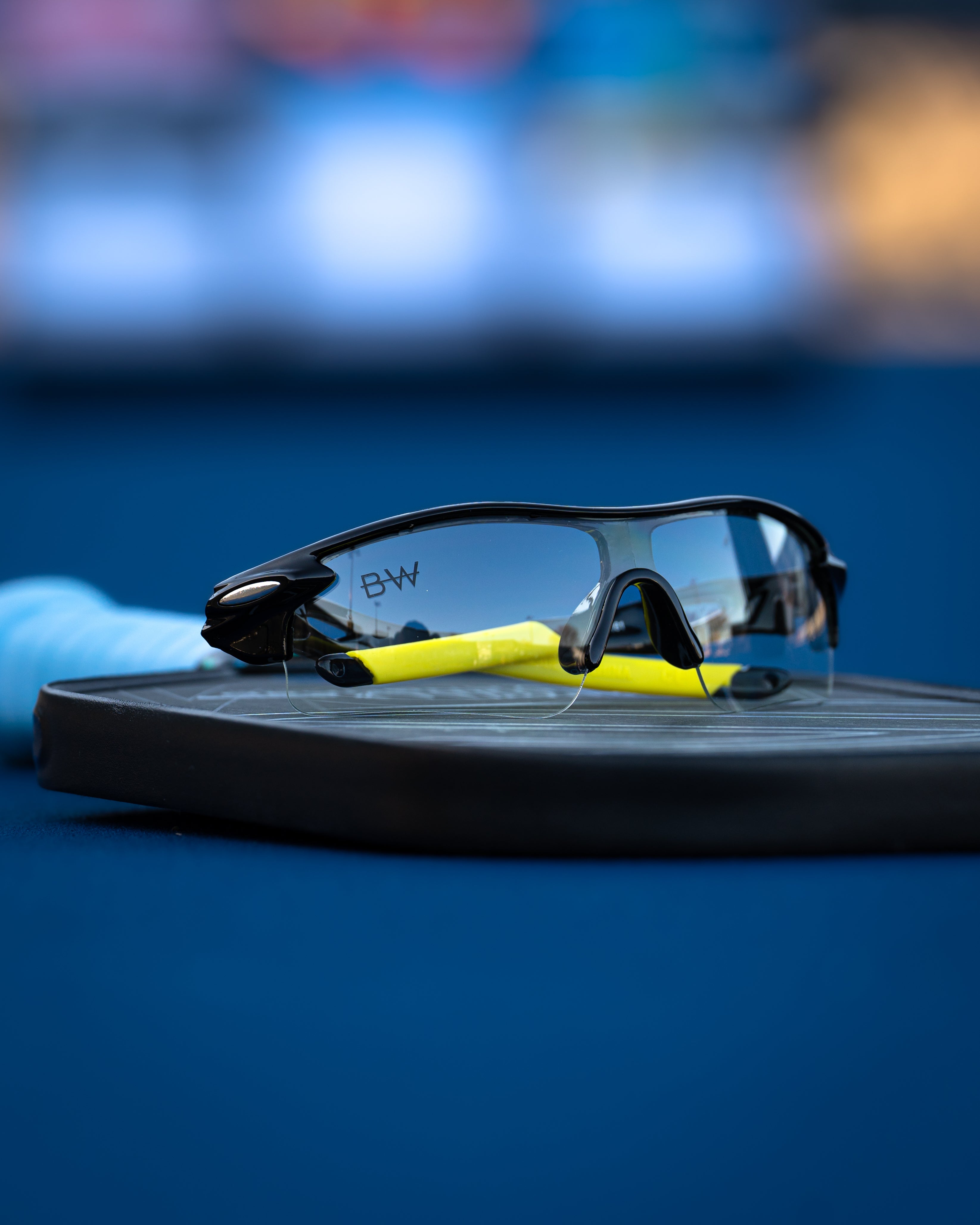
Polarized vs Non-Polarized Eyewear for Pickleball: Which is Best?
Share
```html
Find the Right Pickleball Glasses for Your Game
Choosing between polarized and non-polarized pickleball glasses depends on where you play, how much glare you face, whether you need prescription vision correction, and how you want your lenses to perform during fast rallies.
Polarized vs Non-Polarized Eyewear for Pickleball: Which Is Best?
Polarized vs non-polarized pickleball glasses is one of the most common eyewear questions players ask before buying sports sunglasses. Polarized lenses can dramatically reduce reflected glare, while non-polarized lenses preserve the natural appearance of light and are often preferred by players who prioritize consistent visual information during fast-moving play.
So which is better for pickleball? The answer depends on your playing environment, lighting conditions, and personal visual preferences. In this guide, we’ll compare polarized and non-polarized lenses for pickleball, explain when each option makes sense, and show what to look for when choosing pickleball sunglasses for outdoor courts, indoor play, tournaments, and prescription vision correction.
Polarized vs Non-Polarized Pickleball Glasses: The Quick Answer
If your biggest problem is intense outdoor glare, polarized pickleball sunglasses can make bright conditions more comfortable by filtering a portion of reflected light.
If you want a more natural view of the court and prefer consistent visual cues across different environments, non-polarized pickleball glasses can be an excellent choice.
For players who compete in both indoor and outdoor environments, the decision should also consider lens tint, visible light transmission, UV protection, prescription requirements, frame stability, and how the lenses perform under changing light.
Why Lens Choice Matters in Pickleball
Pickleball requires players to process visual information extremely quickly. You may be tracking the ball, reading an opponent's paddle position, judging distance from the kitchen line, watching your partner's movement, and reacting to a shot within seconds.
Your eyewear should therefore do more than look good. The right pickleball sunglasses should help you maintain comfortable, unobstructed vision while protecting your eyes from the conditions around you.
When evaluating sports eyewear for pickleball, consider:
- Glare control: How effectively the lens manages bright reflected light.
- Contrast: How clearly the ball and court details stand out against their surroundings.
- Color perception: Whether the tint changes the appearance of the court or ball.
- Light transmission: Whether the lens is appropriate for bright sun, shade, indoor courts, or low light.
- UV protection: Whether the lenses provide appropriate protection from ultraviolet radiation.
- Impact resistance: Whether the eyewear is designed for an active sports environment.
- Fit and stability: Whether the frame stays positioned during quick lateral movement.
- Prescription compatibility: Whether players who need vision correction can maintain clear vision without switching between ordinary glasses and sports eyewear.
What Are Polarized Lenses?
Polarized lenses contain a specialized filter designed to reduce certain types of reflected glare. This is particularly noticeable when light reflects from surfaces such as water, pavement, vehicles, windows, and other relatively flat surfaces.
On a bright outdoor pickleball court, reflected sunlight can be uncomfortable and distracting. Polarization can reduce that reflected glare, potentially making bright conditions more comfortable for some players.
Benefits of Polarized Pickleball Sunglasses
- Reduced reflected glare: Helpful when sunlight reflects strongly from surrounding surfaces.
- Greater comfort in bright conditions: Reducing glare can make extended outdoor play easier on the eyes.
- Useful for outdoor recreation: Polarized lenses are popular for activities where reflected sunlight is a major concern.
- Sun protection: Polarization itself is not the same thing as UV protection, so always verify that the lenses also provide appropriate UVA/UVB protection.
When Polarized Lenses Can Make Sense for Pickleball
Polarized eyewear may be worth considering if you primarily play outdoors in strong sunlight and your biggest visual complaint is reflected glare.
This can be especially relevant for players who regularly play during bright midday conditions or on courts surrounded by highly reflective surfaces.
However, polarization is not automatically better simply because it reduces glare. Pickleball is a visually demanding sport, so players should consider the entire lens system rather than choosing eyewear based on one feature.
Potential Considerations With Polarized Lenses
Polarized lenses change how certain reflected light reaches your eyes. For some players, this is a major benefit. For others, particularly those who prefer the most natural and consistent visual presentation possible, the filtering effect may not be their preferred experience.
Polarization can also interact with certain digital displays and screens, depending on the screen technology and viewing angle. If you frequently check a phone, smartwatch, or electronic scoreboard during play, this is worth considering.
Most importantly, don't confuse polarization with UV protection. A lens can be polarized without automatically providing every type of UV protection you want. Look for eyewear that clearly specifies its UV protection.
Learn more about polarized vs non-polarized lenses for sports
What Are Non-Polarized Lenses?
Non-polarized lenses do not contain a polarization filter. Instead, they can be designed with different tints and coatings to control brightness, improve visual comfort, and provide UV protection without selectively filtering reflected horizontal light.
For pickleball players, this can provide a straightforward and consistent visual experience, particularly when moving between different lighting conditions or playing environments.
Benefits of Non-Polarized Pickleball Glasses
- Natural visual presentation: No polarization filter changes the way reflected light is selectively filtered.
- Consistent court visibility: Useful for players who prefer predictable visual cues during fast rallies.
- Broad environment compatibility: Non-polarized lenses can be produced in tints suited to bright outdoor, shaded, indoor, or low-light conditions.
- Display compatibility: They generally avoid some of the viewing-angle issues polarization can create with certain digital screens.
- Excellent option for prescription sports eyewear: Players can combine vision correction with a sports-specific lens without adding a polarization filter.
Why Blinded Wear Co. Uses Non-Polarized Lenses for Pickleball RX Eyewear
At Blinded Wear Co., we chose a non-polarized lens approach for our prescription pickleball eyewear because our priority is consistent, natural visual information during active play.
That doesn't mean polarized lenses are bad. It means we believe non-polarized lenses are a strong fit for players who want prescription correction combined with predictable court vision across different playing environments.
If prescription vision correction is part of your game, explore our selection of: Prescription Pickleball Glasses .
Polarized vs Non-Polarized Pickleball Glasses: Side-by-Side Comparison
There is no single lens technology that is automatically best for every pickleball player. The better choice depends on your court, lighting, tolerance for glare, need for prescription correction, and the type of visual experience you prefer.
| Feature | Polarized | Non-Polarized |
|---|---|---|
| Outdoor glare | Excellent at reducing reflected glare | Depends more on tint and lens coatings |
| Bright sunlight | Excellent for many players | Excellent with an appropriate outdoor tint |
| Indoor play | Usually unnecessary | Often the more practical choice |
| Visual presentation | Filters certain reflected light | More natural, non-filtered presentation |
| Digital screens | Can have viewing-angle interactions with some displays | Generally avoids polarization-related display effects |
| Mixed environments | Best when glare reduction is the priority | Versatile when consistent visual presentation is the priority |
| Prescription pickleball eyewear | Available depending on prescription and manufacturer | Widely suited to performance-focused RX designs |
The key takeaway is simple: polarization is a glare-management technology, not a guarantee of better pickleball vision. Likewise, non-polarized does not automatically mean a lens is better. Lens tint, UV protection, optical quality, fit, coverage, and impact resistance all matter.
The American Optometric Association recommends sunglasses that provide 100% UVA and UVB protection and notes that sports eyewear should be selected according to the activity and its potential hazards. For potentially eye-hazardous sports, the AOA also recommends impact-resistant materials such as polycarbonate or Trivex.
Are Polarized or Non-Polarized Lenses Better for Outdoor Pickleball?
Outdoor pickleball creates a different visual environment than indoor play. Direct sunlight, reflected light, bright court surfaces, surrounding pavement, and changing shadows can all affect visual comfort.
If reflected glare is your biggest problem, polarized sunglasses may be a strong option. Polarization is specifically designed to reduce certain reflected light, which can make bright outdoor conditions more comfortable. The AOA also recognizes polarization as a useful way to reduce glare in situations where reflected light is a problem.
But if you prefer a consistent, natural view without a polarization filter, non-polarized pickleball sunglasses can be an equally reasonable choice. A properly selected tint can reduce brightness while maintaining the visual presentation you prefer.
Best Choice for Bright Outdoor Courts
For bright outdoor play, don't choose based on polarization alone. Look for:
- 100% UVA and UVB protection
- An appropriate outdoor lens tint
- High-quality optics with minimal distortion
- A secure sports fit
- Good side and top coverage
- Impact-resistant lens construction when appropriate
- Anti-reflective or other useful lens coatings
The AOA specifically recommends sunglasses that block 100% of UVA and UVB radiation and notes that wraparound or closely fitting frames can provide additional protection from sunlight entering around the sides.
What About Indoor Pickleball?
Indoor pickleball presents a different challenge. Instead of intense sunlight, players may deal with overhead LED lighting, reflections from polished floors, bright walls, and rapidly changing visual backgrounds.
In this environment, heavy outdoor polarization is generally not the feature most players need. A lighter tint, clear lens, or performance lens designed for indoor lighting may be more appropriate.
Best Lens Characteristics for Indoor Pickleball
- High light transmission so the lens does not make the court unnecessarily dark.
- Clear, accurate optics for tracking the ball against busy backgrounds.
- Low-distortion vision across the useful field of view.
- Anti-reflective properties when appropriate for the lens design.
- A secure frame that stays in position during quick movement.
- Clear or lightly tinted options for low-light or evening sessions.
If you regularly move between indoor and outdoor courts, consider whether you actually need two different lens setups. For some players, having a dedicated indoor lens and a dedicated outdoor lens provides the best experience. Others may prefer one versatile pair.
Read: Are Clear RX Lenses Worth It for Night Pickleball Drills?
Polarization Isn't the Only Lens Decision: Why Tint Color Matters
One of the biggest mistakes players make when shopping for pickleball sunglasses is treating polarization as the entire decision. Your lens color and darkness can have just as much impact on the way the court looks.
Gray Lenses
Gray lenses are designed to reduce brightness while generally preserving natural color perception. They can be particularly useful for bright outdoor conditions.
Amber and Bronze Lenses
Amber and bronze tints can increase the perceived contrast between objects and their background, making them popular choices for active sports. Whether they work best for you depends on the court, lighting, ball color, and your individual visual preferences.
Clear Lenses
Clear lenses allow substantially more visible light through and can be useful for indoor courts, evening sessions, shaded environments, or other situations where a dark sunglass lens would reduce visibility too much.
The American Optometric Association notes that tint density should match the lighting environment and that tint color should not interfere with important color perception.
Polarized vs Non-Polarized Prescription Pickleball Glasses
If you need prescription vision correction, the decision becomes even more important. You don't want to sacrifice clear vision simply to get a sport-specific frame.
Prescription pickleball glasses combine your required vision correction with a lens tint and frame designed for active use. Depending on the lens and prescription, options may include clear, tinted, polarized, or non-polarized designs.
For players who prefer non-polarized performance eyewear, Blinded Wear Co. offers prescription pickleball glasses built around that approach.
Shop Prescription Pickleball Glasses →
Why RX Players Shouldn't Settle for Ordinary Glasses
Your everyday glasses may correct your vision, but they aren't necessarily designed for the movement, coverage, fit, and impact considerations of sports.
The AOA notes that regular prescription glasses are not a substitute for appropriate protective sports eyewear and recommends sports eyewear tailored to the activity.
For pickleball, look for a frame that remains stable when you move laterally, bend down, reach, serve, or react to a fast shot. Coverage and lens material should also be considered alongside optical prescription.
Which Pickleball Glasses Should You Buy?
Instead of asking only “Are polarized lenses better?”, ask which lens characteristics solve your actual problem on the court.
Choose Non-Polarized Pickleball Glasses If:
- You prefer a natural, consistent visual presentation.
- You regularly switch between indoor and outdoor environments.
- You want prescription pickleball eyewear using a non-polarized design.
- You frequently look at digital displays during play.
- You don't want polarization to be part of your lens setup.
Consider Clear or Lightly Tinted Lenses If:
- You primarily play indoors.
- You play at night or under artificial lighting.
- You frequently play in shaded conditions.
- Dark sunglasses make the court feel too dim.
Why Pickleball Players Choose Blinded Wear Co.
Pickleball eyewear should be designed around the way players actually move. That means stable frames, comfortable wear, appropriate lens technology, prescription compatibility when needed, and protection from the environmental conditions you encounter on court.
At Blinded Wear Co., our pickleball eyewear collection is built specifically around the needs of pickleball players rather than treating sports eyewear as an afterthought.
- Prescription and non-prescription options for different vision needs.
- Sport-focused frames designed for active movement.
- UV protection for outdoor play.
- Multiple lens options for different lighting environments.
- Performance-focused designs for recreational and competitive players.
If you're still comparing options, don't guess. Start with your playing environment and visual needs, then choose the lens technology that solves your biggest problem.
How to Choose the Best Pickleball Eyewear for Your Game
The best pickleball sunglasses are not necessarily the darkest, most expensive, or most heavily filtered pair. The right choice is the one that gives you clear, comfortable vision in the conditions where you actually play.
Before buying, consider four things: where you play, how much light you encounter, whether you need prescription correction, and how securely the frame stays in place during movement.
Mostly Outdoor Pickleball
If you primarily play outdoor pickleball in bright sunlight, prioritize 100% UVA/UVB protection, an appropriate sunglass tint, comfortable glare control, and a close-fitting sport frame. Polarized lenses can be particularly useful when reflected glare is distracting, but they are not the only way to create a comfortable outdoor lens.
Shop Outdoor Pickleball Sunglasses →
Mostly Indoor Pickleball
Indoor players generally need to prioritize light transmission and optical clarity rather than maximum sunglass darkness. A clear or lightly tinted lens can be more appropriate under indoor lighting, especially when courts are already relatively dim.
Indoor and Outdoor Pickleball
If you play on both indoor and outdoor courts, think about versatility. You may prefer a lens that works across multiple environments, or you may get better results from dedicated indoor and outdoor eyewear.
Prescription Pickleball Players
If you need vision correction, don't treat prescription compatibility as an afterthought. Your prescription sports eyewear should provide the correction you need while remaining stable and comfortable during serves, lateral movement, quick reactions, and extended matches.
Shop Performance Pickleball Glasses
Once you've decided what type of lens you need, the next step is choosing a frame that can keep up with your game. A good pickleball frame should feel secure without becoming distracting, provide useful eye coverage, and remain comfortable throughout an entire match.
🏆 Prescription Pickleball Eyewear
Need vision correction? Explore Blinded Wear Co.'s prescription pickleball collection for sport-focused RX options.
Browse All RX Pickleball Glasses →
☀️ Outdoor Pickleball Sunglasses
Playing mostly outdoors? Start with eyewear designed around bright conditions, UV protection, comfortable glare management, and stable sport fit.
Find Your Best Outdoor Pickleball Sunglasses →
🕶️ Non-Prescription Pickleball Sunglasses
Don't need prescription correction? Browse the non-RX collection and compare frames designed for active pickleball play.
Still Not Sure Which Pickleball Glasses Are Right for You?
If you're stuck between polarized and non-polarized lenses, or you're unsure which frame and lens combination fits your playing conditions, don't guess.
Take the Blinded Wear Co. pickleball sunglasses quiz to narrow down your options based on how and where you play.
🎯 Take the Pickleball Sunglasses Quiz →
Looking for the bigger picture? Our complete guide covers pickleball sunglasses, lens technology, prescription vs. non-prescription options, and performance considerations.
More Pickleball Eyewear Guides
Want to go deeper before choosing your next pair? These guides cover the lens and prescription questions pickleball players ask most often.
- What Color Lens Is Best for Pickleball?
- Best Prescription Pickleball Glasses vs. Non-Prescription Options
- Dynamic Visual Acuity: The Secret Weapon in RX Glasses
- Transition Lenses in Tournament Play: Hidden Advantages
- RX Glasses That Hold Up to Rough Play and Travel
- Night Drills With Clear RX Lenses: Worth It?
Frequently Asked Questions About Polarized Pickleball Glasses
Are polarized sunglasses good for pickleball?
They can be. Polarized lenses reduce certain types of reflected glare and may make bright outdoor conditions more comfortable. Whether they are the best choice for you depends on your playing environment and visual preferences. Polarization should be evaluated alongside tint, UV protection, optical quality, fit, and coverage.
Are non-polarized sunglasses good for outdoor pickleball?
Yes. Non-polarized sunglasses can be excellent for outdoor pickleball when they provide appropriate UV protection, a suitable tint, good optical quality, and a secure sport fit. Non-polarized does not mean unprotected from UV.
Do polarized lenses protect your eyes from UV rays?
Polarization and UV protection are different lens features. A lens can be polarized without being the complete solution for UV protection, so always verify that your sunglasses provide 100% UVA and UVB protection. The American Optometric Association recommends sunglasses that block both UVA and UVB radiation.
Are non-polarized lenses better for pickleball than polarized lenses?
Not automatically. Non-polarized lenses may be preferable for players who want a consistent, non-polarized visual experience, while polarized lenses can be valuable when reflected glare is the primary problem. The best choice depends on your environment and preferences.
Can I wear polarized pickleball sunglasses indoors?
You can, but polarization is generally more useful when reflected glare is a significant issue. For indoor pickleball, lens darkness and light transmission are important considerations. A clear or lightly tinted lens may be more appropriate when court lighting is limited.
What lens color is best for outdoor pickleball?
Gray, amber, bronze, and other sport tints can work well depending on the lighting and the visual effect you prefer. Gray is useful when you want to reduce brightness while maintaining relatively natural color perception, while amber or bronze can emphasize contrast. There is no universally best tint for every player.
What lens color is best for indoor pickleball?
Clear or lightly tinted lenses are often the most practical choices when indoor lighting is moderate or low. The goal is to maintain sufficient light transmission without making the court unnecessarily dark.
Are prescription pickleball glasses available in polarized lenses?
Prescription sunglasses can be manufactured with different lens technologies depending on the prescription, lens material, and manufacturer. If you specifically want polarized prescription pickleball eyewear, confirm that polarization is available for your prescription. If you prefer non-polarized RX eyewear, Blinded Wear Co. offers prescription pickleball options designed around that approach.
What should I look for in protective pickleball eyewear?
Look for a secure sport fit, appropriate eye coverage, impact-resistant lens materials when required by the activity, and appropriate UV protection for outdoor play. The American Optometric Association recommends polycarbonate or Trivex lenses for potentially eye-hazardous outdoor sports because of their impact resistance.
Can regular prescription glasses be used for pickleball?
Regular prescription glasses may correct your vision, but they are not automatically equivalent to protective sports eyewear. For sports with meaningful eye-injury risk, use eyewear specifically designed and rated for the activity rather than assuming everyday glasses provide adequate protection.
Protect Your Pickleball Eyewear Investment
Pickleball eyewear gets exposed to sweat, dust, accidental drops, travel, and repeated use. Proper care can help maintain your lenses and frames over time.
- Rinse lenses when needed rather than wiping away heavy grit while dry.
- Use a clean microfiber cloth for routine cleaning.
- Store your eyewear in a protective case when you're not playing.
- Avoid harsh household chemicals and abrasive materials.
- Inspect frames and lenses regularly for damage.
For Blinded Wear Co. customers, learn more about available eyewear protection options before purchasing.
Polarized or Non-Polarized: Choose the Lens That Fits Your Game
So, which is best: polarized or non-polarized pickleball eyewear?
For players battling strong reflected glare outdoors, polarization can be a valuable option. For players who prefer a consistent, non-polarized visual experience, non-polarized lenses can be an excellent choice.
But the lens filter is only one part of the equation. Your ideal pickleball glasses should also provide appropriate UV protection, clear optics, a suitable tint, comfortable coverage, and a secure fit that stays put when the match gets fast.
If you need prescription correction, you shouldn't have to choose between seeing clearly and playing comfortably. Explore sport-focused RX eyewear designed specifically for pickleball.
Sources & Further Reading
This article is for general educational purposes and is not a substitute for personalized eye-care advice. If you have a vision condition, significant prescription change, eye injury, or questions about which sports eyewear is appropriate for you, consult an eye-care professional.