The Hidden Risk: Eye Injuries in Sports and How to Prevent Them
Share
The Hidden Risk: Eye Injuries in Sports and How to Prevent Them
Sports are built around movement, speed, competition, and unpredictable moments. Unfortunately, those same characteristics can put the eyes in the path of balls, equipment, fingers, debris, and other hazards.
Eye injuries can happen in basketball, baseball, racquet sports, court sports, cycling, and many other activities. Pickleball deserves attention as well: players compete at relatively close distances while a ball moves rapidly between opponents.
The most important takeaway is simple: eye safety should be considered before an injury happens. But choosing appropriate eye protection requires understanding an important distinction—sports sunglasses, impact-resistant lenses, and certified protective eyewear are not automatically the same thing.
Why Are Eye Injuries a Risk in Sports?
The eye is exposed during many athletic activities. An unexpected ball, paddle, racquet, finger, piece of equipment, or environmental hazard can reach the eye before an athlete has time to react.
The original version of this guide highlighted several potential injuries, including blunt trauma, corneal abrasions, penetrating injuries, and hyphema. :contentReference[oaicite:1]{index=1}
The type and severity of an injury can vary considerably depending on what strikes the eye, the force involved, and where the impact occurs.
That is why prevention should focus on the hazards of the particular sport rather than assuming one pair of glasses is appropriate for every activity.
Common Types of Sports-Related Eye Injuries
Sports-related eye trauma can take several forms. Understanding the basic categories helps explain why eye protection deserves serious consideration.
Blunt Trauma
Blunt trauma occurs when something strikes the eye or surrounding area without penetrating it. In sports, potential sources include balls, hands, elbows, racquets, paddles, and other equipment.
Depending on the impact, blunt trauma can affect the eye itself or structures surrounding it. An eye injury that appears minor immediately after impact should not automatically be assumed to be harmless.
Corneal Abrasions
A corneal abrasion is a scratch on the cornea, the transparent front surface of the eye. Fingers, dirt, debris, or another object contacting the eye can cause an abrasion.
Symptoms can include pain, tearing, redness, sensitivity to light, and the sensation that something is stuck in the eye.
Penetrating Eye Injuries
A penetrating injury occurs when an object enters or pierces eye tissue. These injuries can be serious and require urgent professional medical evaluation.
Hyphema
Hyphema refers to bleeding in the front portion of the eye and can occur following trauma. It is another example of why significant eye impact should be evaluated appropriately rather than judged only by how the eye looks immediately afterward.
When Should a Sports Eye Injury Be Taken Seriously?
Eye trauma can sometimes require urgent medical attention. Seek appropriate medical care following an eye injury when there is significant pain, vision loss or a noticeable vision change, bleeding, an object embedded in the eye, severe swelling, unusual pupil appearance, or another concerning symptom.
Do not attempt to remove an object that appears embedded in the eye or apply unnecessary pressure to an injured eye. When the severity is uncertain, professional evaluation is safer than assuming the injury will resolve on its own.
Why Pickleball Players Should Think About Eye Safety
Pickleball can look relatively low-risk compared with collision sports, but several characteristics make eye safety worth considering.
- Players can be positioned relatively close to one another.
- The ball can travel toward the face unexpectedly.
- Fast exchanges can leave little time to respond.
- Paddles and other equipment introduce additional potential hazards.
- Doubles play places multiple players and paddles within a relatively small court area.
The older version of this article also noted the growing concern around pickleball-associated eye injuries as participation in the sport has increased. :contentReference[oaicite:2]{index=2}
This doesn't mean every pickleball player will suffer an eye injury. It means eye protection is a reasonable part of the safety conversation.
Sports Eyewear vs. Protective Eyewear: Know the Difference
This distinction is one of the most important parts of shopping for sports eyewear.
A pair of sports glasses is not automatically certified protective eyewear.
| Term | What It Tells You | What It Does Not Automatically Tell You |
|---|---|---|
| Sports eyewear | Eyewear designed or marketed for active use | That it meets a particular safety standard |
| Impact-resistant lens | The lens is designed with resistance to impact | That the entire product is shatterproof or safety-certified |
| Prescription sports eyewear | Sports-oriented eyewear that provides vision correction | That it meets a protective-eyewear standard |
| Certified protective eyewear | The exact product has been tested to a stated standard | That every product from the same brand has the same certification |
If your sport, league, medical professional, or personal safety requirements call for a particular protective standard, verify that certification for the exact model you're considering.
What Does “Impact-Resistant” Actually Mean?
Impact resistance is a relevant characteristic in active eyewear, but the term should not be stretched beyond what it establishes.
Impact-resistant does not automatically mean:
- Shatterproof
- Indestructible
- Ball-proof
- Guaranteed to prevent an eye injury
- ANSI-certified
- ASTM F803-certified
- Certified protective eyewear
The frame, lens, construction, fit, and any applicable testing or certification all matter when evaluating protective eyewear.
For a deeper explanation, read Why Impact Resistance Matters in Sports Eyewear.
How Can Athletes Reduce the Risk of Eye Injuries?
Eye-injury prevention begins with identifying the hazards of your sport and selecting appropriate protection for those hazards.
1. Choose Eyewear Appropriate for the Activity
A runner, cyclist, basketball player, baseball player, and pickleball player may face different hazards. Don't assume eyewear designed for one activity automatically provides the protection required for another.
2. Verify Required Safety Standards
If certified protective eyewear is required or desired, check the exact model for the relevant certification. Marketing terms such as “sports,” “performance,” “durable,” and “impact-resistant” are not substitutes for documented certification.
3. Replace Damaged Eyewear When Appropriate
Inspect sports eyewear periodically. Significant damage to lenses, frames, hinges, or other components can be a reason to stop using the product and evaluate replacement.
4. Make Sure the Eyewear Fits Appropriately
Fit is individual. Check frame dimensions and how the eyewear sits on your face rather than assuming a product will fit securely because it is marketed for sports.
5. Consider the Playing Environment
Indoor, outdoor, bright, shaded, and evening environments can call for different lens choices. Safety and visible-light needs should be evaluated separately rather than assuming one lens is ideal everywhere.
What About Athletes Who Need Prescription Glasses?
Players who require vision correction have an additional decision to make: how to combine their prescription needs with eyewear appropriate for their sport.
Prescription sports eyewear can provide corrective vision in a sports-oriented frame. However, prescription correction and impact protection are two separate characteristics.
RX lenses correct vision according to the wearer's prescription. That should not automatically be described as:
- Increasing reaction time
- Improving depth perception
- Improving ball tracking
- Preventing sports injuries
- Providing certified eye protection
The original article blurred this distinction by connecting prescription correction directly with enhanced reaction time and depth perception. :contentReference[oaicite:3]{index=3} A stronger buying decision evaluates vision correction and protection separately.
Blinded Wear offers a dedicated Prescription Pickleball Eyewear Collection with high-index prescription lenses included at no additional cost.
Where Blinded Wear Sports Eyewear Fits
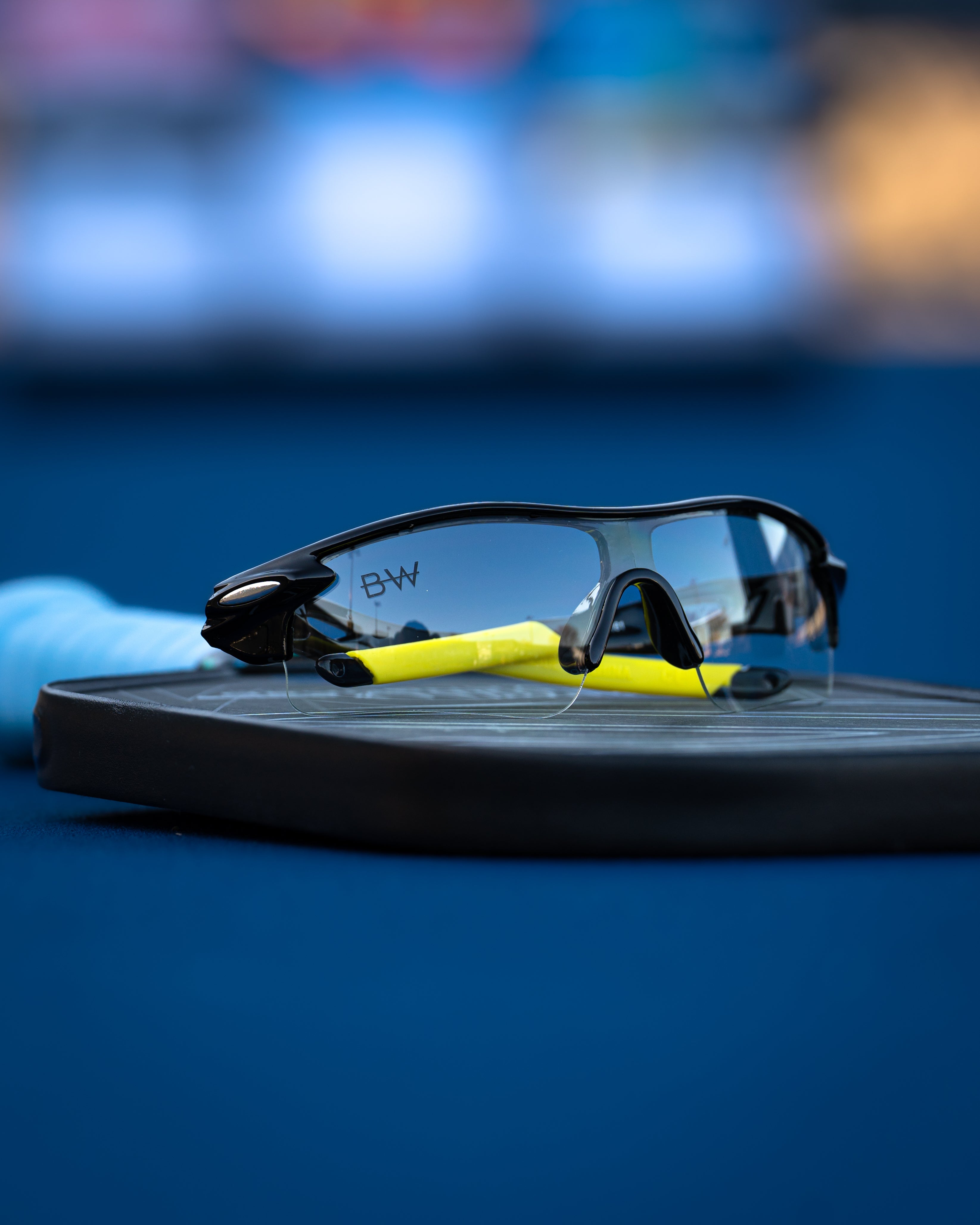
Blinded Wear sports eyewear uses impact-resistant lenses and is available through dedicated prescription, non-prescription, and clear-lens pickleball collections.
Those characteristics make the products relevant to athletes comparing sports eyewear, but they should be described accurately: Blinded Wear's impact-resistant sports lenses should not automatically be represented as certified protective eyewear unless a specific product's certification has been verified.
Pickleball players can explore:
- Prescription Pickleball Glasses
- Non-Prescription Pickleball Sunglasses
- Clear Lens Sports Eyewear
- Pickleball Sunglasses Quiz
The goal is to choose eyewear based on the product's documented characteristics and your needs—not to assume that any pair of sports glasses can eliminate the risk of injury.
Prescription Correction vs. Eye Protection: Two Different Jobs
For athletes who normally wear glasses or contacts, it is useful to separate two questions:
- Can I see clearly with my prescription?
- Does my eyewear provide the level of protection I want or need for this sport?
A prescription addresses refractive vision needs. Protective characteristics depend on the eyewear itself, including its lenses, frame, construction, and any documented testing or certification.
| Eyewear Characteristic | Primary Purpose |
|---|---|
| Prescription correction | Corrects vision according to the wearer's prescription |
| Impact-resistant lens | Provides resistance to impact |
| Clear lens | Provides an option without a dark sunglass tint |
| Sunglass tint | Reduces visible light according to the lens configuration |
| Non-polarized lens | Does not contain an added polarization filter |
| Certified protective eyewear | Has been tested to the stated protective standard |
This distinction matters because prescription sports glasses should not automatically be presented as protective eyewear, just as certified protective eyewear should not automatically be assumed to provide the prescription correction a particular athlete needs.
Do Contact Lenses Protect Your Eyes During Sports?
Contact lenses can provide vision correction, but vision correction and physical eye protection are separate functions.
An athlete who wears contacts can still evaluate appropriate sports or protective eyewear for the activity. Depending on the sport and the athlete's needs, contacts may be worn with separate eyewear.
Likewise, choosing prescription sports glasses can combine vision correction with a sports-oriented frame, but the protective characteristics of the exact product still need to be evaluated independently.
Clear Lenses vs. Sunglasses for Sports
Eye safety is not limited to bright outdoor conditions. Athletes may want eyewear during indoor competition, evening play, or other environments where a dark sunglass tint is not desirable.
Clear Lenses
Clear lenses can be useful when an athlete wants eyewear without a dark tint. This can make them relevant for indoor courts, evening play, and other lower-light environments.
Clear lenses should not automatically be described as increasing light, enhancing contrast, improving depth perception, or making an athlete react faster.
Tinted Sports Lenses
Tinted lenses reduce visible light according to their configuration and can be useful in brighter environments. Different tints can have different visual characteristics, so athletes should choose according to the conditions in which the eyewear will actually be used.
Tint darkness alone does not establish impact protection, UV protection, or safety certification.
UV Protection and Impact Protection Are Not the Same Thing
Outdoor athletes may also need to think about ultraviolet exposure, but UV protection and physical impact protection address different concerns.
| Feature | What It Addresses |
|---|---|
| UV protection | Ultraviolet radiation |
| Visible-light tint | How much visible light reaches the eyes |
| Impact resistance | Resistance to physical impact |
| Safety certification | Documented testing against a stated standard |
| Prescription correction | Refractive vision correction |
A lens can have one of these characteristics without automatically having all the others.
For outdoor sports, verify the UV specification of the exact lens rather than assuming that a dark tint or sports-oriented design establishes UV protection.
Eye Safety Tips for Pickleball Players
Pickleball players can take several practical steps when thinking about eye safety.
Evaluate Your Eyewear Before Playing
Check for obvious damage to the lenses, frame, and other components before using your eyewear.
Choose for Your Actual Court Environment
An indoor player and an outdoor daytime player may prefer different lens configurations. Don't choose solely because a particular tint or frame is popular.
Understand What Your Eyewear Is Designed to Do
If a product is described as impact-resistant, don't automatically interpret that as certified protective eyewear. If protection to a particular standard is important, verify it.
Consider Prescription Needs Separately
If you require vision correction, make sure the eyewear accommodates your prescription requirements in addition to whatever other characteristics matter to you.
Don't Wait for an Injury to Think About Eye Safety
Eyewear decisions are easier to make before an accident occurs. Consider eye safety as part of your normal equipment choices rather than only after experiencing an impact.
What Should You Do After an Eye Injury During Sports?
The appropriate response depends on the type and severity of the injury. Significant trauma, changes in vision, severe pain, visible bleeding, an embedded object, or other concerning symptoms warrant prompt professional medical evaluation.
Some basic precautions include:
- Avoid rubbing or pressing on an injured eye.
- Do not attempt to remove an object embedded in the eye.
- Stop playing if vision has changed or the injury appears significant.
- Seek appropriate medical care when symptoms are concerning.
An athlete should not continue playing simply because the eye injury initially appears manageable.
Should You Keep Using Eyewear After a Significant Impact?
If sports eyewear has taken a significant hit, inspect it carefully before using it again.
Look for visible issues such as:
- Cracked or damaged lenses
- Damage around the lens mounting area
- Bent or broken frame components
- Loose hinges or other hardware
- Changes in how the frame fits
- Other structural damage
When damage could affect the integrity or function of the eyewear, replacement may be more appropriate than continuing to use it.
Blinded Wear's 50% Lifetime Replacement Support
Blinded Wear offers 50% lifetime replacement support for eligible eyewear that breaks, subject to current policy terms.
This can be relevant for active customers whose eyewear experiences eligible breakage over time, but it should not be interpreted as a guarantee that the eyewear cannot break or as coverage for every possible form of damage.
Review the current Protection Plan & Returns for details before purchasing.
How to Shop for Sports Eyewear With Eye Safety in Mind
Instead of choosing eyewear based only on appearance or brand name, work through a simple checklist.
- Identify the hazards of your sport.
- Determine whether you need certified protective eyewear.
- Check any required safety standard for the exact model.
- Determine whether you need prescription correction.
- Choose a lens appropriate for your playing environment.
- Evaluate frame dimensions and fit.
- Check documented impact characteristics.
- Verify UV specifications separately when relevant.
- Review replacement and return policies.
This approach is more reliable than assuming that terms such as “sports glasses,” “durable,” “performance,” or “impact-resistant” tell you everything you need to know.
Blinded Wear Options for Pickleball Players
For pickleball players comparing sports eyewear, Blinded Wear provides several ways to narrow the catalog.
Prescription Pickleball Eyewear
Players requiring vision correction can explore the Prescription Pickleball Eyewear Collection. High-index prescription lenses are included at no additional cost, and customers upload a clear photo of their eyeglass prescription before purchasing.
Non-Prescription Pickleball Sunglasses
Players who don't require corrective lenses can browse the Non-Prescription Pickleball Sunglasses Collection.
Clear Lens Sports Eyewear
Players who don't want a dark sunglass tint can explore the Clear Lenses Collection.
These products use impact-resistant sports lenses, but players seeking certified protective eyewear should verify the required certification separately.
Sports Eye Safety Myths Worth Avoiding
Myth: Any Sports Sunglasses Protect Against Ball Impact
Reality: Sports styling doesn't establish a particular level of protection. Check the exact product specifications and any applicable certification.
Myth: Impact-Resistant Means Shatterproof
Reality: Impact resistance should not be interpreted as an indestructibility guarantee.
Myth: Prescription Sports Glasses Automatically Improve Reaction Time
Reality: Prescription lenses correct vision according to the prescription. That does not establish an automatic reaction-time advantage.
Myth: Non-Polarized Lenses Preserve or Improve Depth Perception
Reality: Non-polarized means an added polarization filter is not present. It does not inherently establish improved depth perception.
Myth: Dark Sunglasses Automatically Provide UV Protection
Reality: Visible tint and UV specifications are separate characteristics. Verify the exact lens.
Myth: Clear Lenses Are Only for Indoor Sports
Reality: Clear lenses can be considered whenever an athlete does not want a dark tint. The appropriate choice depends on the actual environment and product specifications.
Learn More About Sports Eyewear and Eye Safety
Continue researching the individual characteristics that matter when selecting sports eyewear:
Frequently Asked Questions About Sports Eye Injuries and Prevention
What sports can cause eye injuries?
Eye injuries can occur in many activities involving balls, racquets, paddles, equipment, physical contact, or environmental hazards. The type of risk varies by sport, which is why athletes should consider the hazards of their specific activity when choosing eyewear.
Can you get an eye injury playing pickleball?
Yes. Pickleball involves a ball moving between players at relatively close distances, along with paddles and rapid exchanges. An unexpected impact to the eye or surrounding area can cause injury.
Can sports eye injuries be serious?
Yes. Sports-related eye trauma can range from relatively minor injuries to conditions requiring urgent medical treatment. Significant pain, vision changes, visible bleeding, an embedded object, or other concerning symptoms should be evaluated appropriately.
Do regular glasses protect your eyes during sports?
Regular prescription glasses provide vision correction but should not automatically be considered sports-protective eyewear. If a particular level of protection is required, look for eyewear tested and documented for the applicable standard.
Are sports sunglasses protective eyewear?
Not automatically. “Sports sunglasses” describes a category of eyewear, not a specific safety certification. Check the exact product's specifications and documented testing when protection is a priority.
Are impact-resistant lenses the same as certified protective eyewear?
No. Impact resistance is a lens characteristic. It does not automatically mean the complete eyewear product meets a specific protective standard.
Are impact-resistant lenses shatterproof?
Impact-resistant should not be interpreted as shatterproof or indestructible. No sports eyewear should be assumed incapable of breaking solely because it is described as impact-resistant.
Do prescription sports glasses prevent eye injuries?
Prescription sports glasses provide vision correction in a sports-oriented configuration, but prescription correction itself does not establish a particular level of impact protection. Evaluate the protective characteristics of the exact eyewear separately.
Can contact lenses protect against a pickleball?
Contact lenses provide vision correction but do not function as a physical barrier in front of the eye. Athletes who wear contacts can separately consider eyewear appropriate for their sport and desired level of protection.
Should I wear clear lenses for indoor pickleball?
Clear sports lenses can be an option for players who don't want a dark sunglass tint indoors. The appropriate choice depends on the court lighting, individual preferences, and specifications of the exact eyewear.
Should I wear sunglasses for outdoor pickleball?
Tinted sports eyewear can reduce visible light in bright outdoor environments. If UV protection is also important, verify the UV specification of the exact lens rather than assuming tint darkness establishes UV protection.
What should I do if a pickleball hits me in the eye?
Stop playing and assess the injury. Significant pain, vision changes, bleeding, severe swelling, unusual pupil appearance, or other concerning symptoms warrant prompt professional medical evaluation. Avoid rubbing or applying unnecessary pressure to an injured eye.
Can I keep playing after getting hit in the eye?
Continuing to play after significant eye trauma can be inappropriate, particularly if there is pain, altered vision, bleeding, or another concerning symptom. Seek professional evaluation when the severity of an injury is uncertain.
Sports Eye Safety Checklist
Before your next practice, match, tournament, or recreational session, run through this checklist:
- Identify the primary eye hazards associated with your sport.
- Determine whether your activity requires or warrants certified protective eyewear.
- Verify any required certification for the exact eyewear model.
- Don't assume “sports” or “impact-resistant” means safety-certified.
- Check lenses and frames for significant damage.
- Confirm that the eyewear fits appropriately.
- Account for your prescription requirements if you need vision correction.
- Choose a lens suitable for the environment in which you'll be playing.
- Verify UV specifications separately for outdoor use when relevant.
- Replace significantly damaged eyewear when appropriate.
Sports Eye Safety for Parents and Younger Athletes
Parents selecting eyewear for younger athletes should apply the same principle: choose protection according to the sport and verify what the exact product is designed and tested to do.
Don't rely solely on appearance, marketing terms, or the assumption that any pair of glasses creates sufficient protection.
Consider:
- The sport being played
- The types of balls or equipment involved
- Any applicable league requirements
- The athlete's prescription needs
- Frame fit
- Documented safety testing or certification when required
- The condition of the eyewear before play
As athletes grow or their prescriptions change, eyewear fit and vision requirements may also need to be reevaluated.
Can Protective Eyewear Prevent Every Sports Eye Injury?
No piece of equipment can guarantee that an athlete will never experience an eye injury.
Appropriate protective eyewear can be an important part of risk reduction, but athletes should avoid interpreting terms such as “protective,” “impact-resistant,” or “sports eyewear” as a promise that injury is impossible.
Eye safety works best as part of a broader approach that includes appropriate equipment, awareness of the playing environment, following sport rules, and responding appropriately when an injury occurs.
How to Choose Eyewear for Pickleball
For pickleball specifically, start by separating your requirements into four categories.
1. Vision Correction
If you need a prescription, confirm that the exact frame can accommodate your vision requirements. Blinded Wear offers a dedicated Prescription Pickleball Eyewear Collection with high-index prescription lenses included at no additional cost.
2. Playing Environment
Consider whether you primarily play indoors, outdoors, in bright daylight, or in lower-light conditions. Players who don't want a dark tint can explore clear lens sports eyewear.
3. Impact Characteristics
Review what the manufacturer actually documents about the lenses and frame. Blinded Wear sports eyewear uses impact-resistant lenses, but impact resistance should not be interpreted as a specific safety certification.
4. Required Protection
If you want or require eyewear certified to a particular protective standard, verify that standard for the exact model before purchasing.
Find Your Blinded Wear Pickleball Eyewear
Blinded Wear organizes its pickleball eyewear into separate shopping paths according to common player needs:
| Your Need | Start Here |
|---|---|
| Prescription correction | Prescription Pickleball Glasses |
| Non-prescription sports sunglasses | Non-Prescription Pickleball Sunglasses |
| No dark sunglass tint | Clear Lens Sports Eyewear |
| Help narrowing the collection | Pickleball Sunglasses Quiz |
| Broader product research | 2026 Pickleball Glasses Guide |
Continue Learning About Pickleball Eye Safety and Sports Eyewear
Eye protection is easier to evaluate when you understand each eyewear characteristic separately. Continue with these Blinded Wear resources:
The Bottom Line: Protect Your Eyes Before an Injury Happens
Eye injuries are an important but sometimes overlooked part of sports safety. Balls, equipment, hands, debris, and unexpected impacts can all create potential hazards, and pickleball is not exempt simply because it is generally considered a recreational court sport.
The best approach is not to assume that any pair of glasses provides complete protection. Understand the difference between sports eyewear, impact-resistant lenses, prescription correction, and eyewear tested to a specific protective standard.
For pickleball players, Blinded Wear offers impact-resistant sports lenses across prescription, non-prescription, and clear-lens shopping paths. Players who specifically require certified protective eyewear should verify the appropriate certification for the exact product they choose.
Most importantly, don't wait until after an eye injury to start thinking about eye safety. Evaluate your sport, understand your equipment, and choose eyewear according to the protection and vision requirements that actually apply to you.