
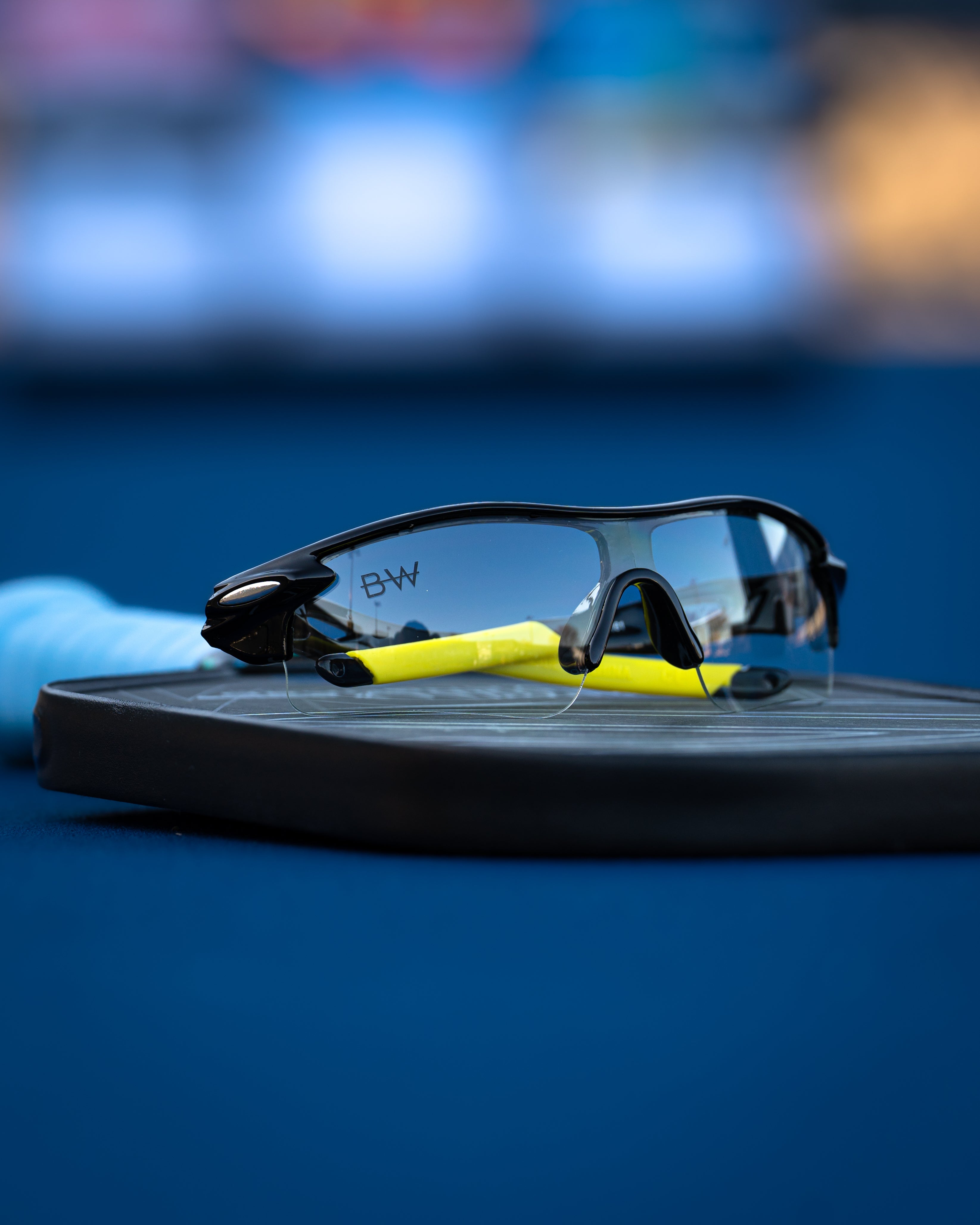
How RX Glasses Can Improve Your Confidence in Any Sport
Share
How RX Glasses Can Improve Your Confidence in Any Sport
Confidence in sports doesn't come from eyewear alone. It comes from preparation, practice, experience, decision-making, and trusting the skills you've developed. But if you rely on prescription correction, your eyewear is still an important part of your equipment.
The original guide connects clearer vision directly with faster reactions, improved depth perception, better athletic performance, and greater confidence. :chatgpt-content-reference{index="0"} A more accurate way to frame the relationship is simpler: appropriate RX sports eyewear can provide the prescription correction you need while competing, removing one potential equipment concern without promising a performance boost.
Find Your Pickleball Glasses
Compare prescription and non-prescription eyewear or explore the complete 2026 pickleball glasses guide.
Quick Answer: Can RX Sports Glasses Improve Confidence?
They can contribute to feeling prepared if you need prescription correction and are comfortable with the eyewear you're using. But confidence is personal, so no pair of glasses can guarantee that you'll feel or perform more confidently.
Think of RX eyewear as one part of your sports setup:
| RX Eyewear Can | RX Eyewear Can't Guarantee |
|---|---|
| Provide your prescribed correction | Confidence |
| Give you a sports-oriented eyewear option | Faster reactions |
| Use impact-resistant sports lenses | Better depth perception |
| Offer different frame and lens configurations | Better ball tracking |
| Become familiar equipment through practice | Better athletic performance |
| Support your prescription needs during activity | Winning |
Why Athletes Want to Trust Their Vision
The original article says confidence depends heavily on how well an athlete sees and suggests vision problems can create hesitation and mistakes. :chatgpt-content-reference{index="1"}
For an athlete who requires prescription correction, having appropriate RX eyewear can be part of feeling prepared for competition. Instead of wondering whether your sports setup includes your prescription needs, you can focus on playing.
That distinction matters:
RX eyewear doesn't create athletic confidence. It can address your need for prescription correction while you build confidence through preparation and experience.
Clearer Correction Doesn't Automatically Mean Better Performance
The source makes a direct chain from sharper vision to faster processing, better distance judgment, improved anticipation, and faster reactions. :chatgpt-content-reference{index="2"}
That's too broad for an eyewear product claim.
Athletic performance involves far more than optical correction:
- Technique
- Practice
- Anticipation
- Positioning
- Decision-making
- Coordination
- Movement
- Experience
- Sport-specific skill
If you need RX correction, prescription eyewear provides that correction while you perform those tasks. It doesn't perform them for you.
Do RX Glasses Improve Reaction Time?
The original guide says sharper vision allows the brain to process fast-moving objects more effectively and later claims reduced visual distortion produces faster reflexes and improved reaction time. :chatgpt-content-reference{index="3"} :chatgpt-content-reference{index="4"}
Prescription eyewear shouldn't be marketed as a neurological reaction-time enhancer.
In a fast sport, responding to an opponent can involve:
- Receiving visual information.
- Recognizing what's happening.
- Anticipating what may happen next.
- Making a decision.
- Moving.
- Executing a sport-specific response.
RX correction may be part of the visual setup for an athlete who needs it. The glasses don't automatically accelerate the rest of that sequence.
Do RX Sports Glasses Improve Depth Perception?
The source claims accurate RX lenses can fine-tune spatial awareness, improve depth perception, and make precise shots and positioning easier. :chatgpt-content-reference{index="5"}
That shouldn't be promised universally.
Prescription eyewear provides prescribed optical correction. Depth perception shouldn't be reduced to whether someone is wearing a particular sports frame or lens material.
Likewise, don't assume that high-index material, tint, or a non-polarized configuration inherently improves:
- Distance judgment
- Depth perception
- Positioning
- Ball tracking
- Reaction time
- Shot accuracy
What High-Index RX Lenses Actually Mean
Blinded Wear includes high-index prescription lenses at no additional cost.
The original article specifically identifies them as 1.61 high-index lenses and describes them as thinner and lighter while also claiming a wider field of view, greater clarity, and easier recognition of spin and opponent position. :chatgpt-content-reference{index="6"}
Those claims need to be separated.
A higher-index lens material can allow a thinner lens for the same prescription compared with a lower-index material in a comparable design. Final thickness and weight still depend on factors including:
- Prescription strength
- Lens dimensions
- Frame dimensions
- Lens material
- Overall lens design
An exact 1.61 index should only be advertised when verified for the current configuration.
High-Index Lenses: What They Don't Automatically Do
| Claim | Does High-Index Alone Establish It? |
|---|---|
| Potential for a thinner lens | Yes, depending on prescription and comparable design |
| Better athletic performance | No |
| More confidence | No |
| Faster reactions | No |
| Wider field of view | No |
| Better depth perception | No |
| Better ball tracking | No |
| Impact resistance | No—separate characteristic |
| Anti-fog performance | No—separate feature |
Can Comfortable Eyewear Help You Feel More Prepared?
The source argues that discomfort can undermine confidence and describes Blinded Wear frames as secure, lightweight, anti-fog, and capable of staying in place from warm-up through match point. :chatgpt-content-reference{index="7"}
Individual fit varies, and anti-fog functionality shouldn't be assumed unless it is verified for the exact product.
A more practical goal is to find a frame that works comfortably for you during your sport.
Evaluate:
- Frame dimensions
- Comfort around the nose
- Pressure around the temples
- Comfort behind the ears
- Movement during activity
- How often you adjust the frame
- Comfort after extended wear
If your eyewear becomes something you constantly have to think about, trying another frame or fit may be more useful than looking for a lens that promises greater confidence.
Sports Frame Fit Is Personal
The original article describes Blinded Wear's frames as offering a snug, secure fit that won't shift during movement and says the quiz provides a custom fit. :chatgpt-content-reference{index="8"} :chatgpt-content-reference{index="9"}
No sports frame should be guaranteed to fit every athlete securely. Face shape, dimensions, movement, and personal preference all matter.
The Pickleball Sunglasses Quiz can help narrow your options, but it shouldn't be described as creating eyewear physically tailored to your face unless a true custom-fitting process is offered.
Impact-Resistant Sports Lenses
Blinded Wear sports eyewear uses impact-resistant lenses, an important characteristic to distinguish from the confidence and performance claims in the original article.
Impact-resistant doesn't mean:
- Shatterproof
- Unbreakable
- Guaranteed to prevent injury
- Certified to a particular sports-protection standard
- Better vision
- Better athletic performance
What About Eye Fatigue During Long Practices?
The original guide links eye strain with headaches, blurred vision, fatigue, and reduced confidence, then says premium coatings reduce glare and filter harmful UV rays. :chatgpt-content-reference{index="10"}
Those coating and UV characteristics shouldn't be generalized across every product without verification.
If you specifically want:
- UV protection to a particular specification
- Anti-reflective treatment
- Anti-fog treatment
- Scratch resistance
- Glare-reduction features
verify that feature for the exact lens you're purchasing rather than assuming it is included because the eyewear is designed for sports.
Choose RX Eyewear for Your Playing Environment
The source recommends clear or light-gray lenses indoors, darker or polarized lenses in bright outdoor conditions, and transitional lenses for mixed environments. :chatgpt-content-reference{index="11"}
A safer approach is to compare currently available configurations according to where you actually play.
| Environment | What to Consider |
|---|---|
| Indoor | Whether you prefer prescription correction without a dark sunglass tint |
| Outdoor | Available tinted RX configurations and verified specifications |
| Changing light | Whether a compatible changing-tint option is currently available |
| Multiple sports | Fit, prescription compatibility, lens configuration, and activity-specific requirements |
Clear RX Lenses for Indoor Sports
A clear RX configuration can make sense when you need prescription correction without an intentional dark sunglass tint.
Clear shouldn't automatically be translated into claims of:
- Better contrast
- Maximum brightness
- Faster reactions
- Improved confidence
- Better depth perception
- Better ball tracking
Changing-Tint RX Lenses for Changing Light
The original article highlights changing-tint lenses as automatically adapting to lighting and helping athletes maintain focus across indoor and outdoor environments. :chatgpt-content-reference{index="12"}
If a compatible changing-tint configuration is currently available, it may be an option for athletes whose routines involve different lighting environments.
Changing-tint functionality doesn't automatically mean:
- Instant transitions
- Polarization
- Anti-fog performance
- Improved focus
- Better reactions
- Greater confidence
- Better athletic performance
Can You Use RX Sports Glasses for Multiple Sports?
The original FAQ says Blinded Wear RX lenses enhance vision and comfort across sports ranging from pickleball to running and cycling. :chatgpt-content-reference{index="13"}
A sports-oriented frame may be usable for multiple activities, but suitability depends on the specific activity.
Before using one RX pair across sports, consider:
- Your prescription
- Frame fit during that activity
- Current lens configuration
- Indoor versus outdoor use
- Activity-specific rules
- Any required protective standard
RX Eyewear Across Different Sports
| Activity | What RX Eyewear Can Do | What Still Comes From the Athlete |
|---|---|---|
| Pickleball | Provide prescribed correction | Positioning, anticipation, paddle control, shot selection |
| Tennis | Provide prescribed correction | Movement, timing, stroke production, strategy |
| Running | Provide prescribed correction | Pacing, conditioning, technique |
| Golf | Provide prescribed correction | Club selection, swing execution, course management |
| Other active sports | Provide prescribed correction when the eyewear is appropriate for that activity | Sport-specific technique and decision-making |
RX Sports Glasses to Compare
The original guide highlights Heatseek RX, Crystal Wave II RX, Frost RX, and Runway RX while assigning benefits involving contrast, clarity, changing light, durability, comfort, and focus. :chatgpt-content-reference{index="14"}
Instead of choosing a pair because it promises greater confidence or better athletic performance, compare verified characteristics relevant to your needs:
| RX Model | What to Compare |
|---|---|
| Frost RX | Prescription compatibility, dimensions, appearance, current lens configuration |
| Crystal Wave II RX | Prescription compatibility, dimensions, appearance, current lens configuration |
| H Blue Shield RX | Prescription compatibility, dimensions, appearance, current lens configuration |
| Rocket Fire RX | Prescription compatibility, dimensions, appearance, current lens configuration |
| Ocean Wave RX | Prescription compatibility, dimensions, appearance, current lens configuration |
Confidence Testimonials Need Verification
The original article includes testimonials attributed to Mike D., described as a tournament player, and Jenna S., described as an amateur pickleball enthusiast. They report increased confidence, greater clarity and comfort, a competitive edge, and less need to adjust their eyewear. :chatgpt-content-reference{index="15"}
Only publish those testimonials if the customers, wording, purchases, experiences, credentials, and permission to use the statements can be verified.
Even a genuine review represents one person's experience. It shouldn't become a promise that every athlete will gain confidence or a competitive advantage from the same eyewear.
Confidence Starts With the Athlete
The original article ends by telling athletes that their best game starts with the best vision and that subpar glasses can hold them back from their full potential. :chatgpt-content-reference{index="16"}
A stronger message is more realistic:
If you rely on prescription correction, your sports eyewear should handle that job while you focus on your sport.
Confidence still comes from training, preparation, experience, and trusting what you've practiced.
Your RX glasses don't create that confidence for you—but the right prescription setup can become one less piece of equipment you need to worry about.
Why Familiar RX Eyewear Can Matter Before Competition
The original article presents RX glasses as a way to eliminate visual doubts so athletes can trust their eyesight and their game. :chatgpt-content-reference{index="0"}
A more useful goal is familiarity. If you depend on prescription correction, practicing in the same eyewear you intend to use during competition gives you time to evaluate the completed pair before the result matters.
That means checking:
- How the prescription feels during your activity
- Whether the frame is comfortable
- Whether you repeatedly adjust the glasses
- Whether the lens configuration suits your environment
- How the frame feels after extended wear
- Whether you are comfortable using the pair during normal sport-specific movement
Familiar equipment doesn't guarantee confidence, but it can reduce uncertainty about the equipment itself.
Practice in Your RX Glasses Before Game Day
Don't make an important competition the first serious test of new prescription sports eyewear.
Instead, gradually use the completed pair during:
- Warm-ups. Start with familiar, controlled movement.
- Sport-specific drills. Use the eyewear during the movements you'll actually perform.
- Higher-intensity practice. Evaluate the frame as movement becomes faster.
- Longer sessions. Pay attention to comfort over time.
- Practice games or competition simulations. Test the pair in a more realistic environment.
This isn't a test of whether the glasses make you a better athlete. It's a way to determine whether your RX setup works for you during your sport.
RX Glasses and Confidence in Pickleball
Pickleball requires frequent decisions involving the ball, court, partner, opponents, and your own position. Prescription correction can be part of your visual setup if you need it.
| Pickleball Situation | Role of RX Eyewear | Role of the Player |
|---|---|---|
| Serve | Provides prescribed correction | Controls setup, contact, direction, and depth |
| Return | Provides prescribed correction | Reads the developing play and executes the return |
| Dink rally | Provides prescribed correction | Controls paddle, trajectory, and placement |
| Fast kitchen exchange | Provides prescribed correction | Anticipates, positions, and reacts |
| Overhead | Provides prescribed correction | Moves, prepares, times, and executes |
If you're comfortable with your RX setup, you can direct your attention toward playing rather than repeatedly thinking about the eyewear itself.
RX Glasses for Tennis
The original article specifically names tennis as another fast-paced sport in which vision is important. :chatgpt-content-reference{index="1"}
For a tennis player who requires prescription correction, RX sports eyewear can provide that correction during serves, returns, baseline rallies, volleys, and movement around the court.
It shouldn't be credited with creating:
- More powerful serves
- Faster reactions
- Better anticipation
- More accurate groundstrokes
- Better footwork
Those remain sport-specific skills.
RX Eyewear for Basketball
Basketball is also identified in the original article as an example of a fast-paced sport. :chatgpt-content-reference{index="2"}
An athlete who requires correction may want prescription eyewear appropriate for basketball, but sport-specific protective requirements matter. A general RX sports frame shouldn't automatically be treated as certified protective basketball eyewear.
RX correction doesn't automatically improve:
- Shooting accuracy
- Passing
- Defensive reactions
- Court awareness
- Ball handling
Verify the requirements of your activity before assuming a particular frame is appropriate for competition.
RX Glasses for Running
The original FAQ says the eyewear can be suitable across sports including running and cycling. :chatgpt-content-reference{index="3"}
For running, an RX sports frame may provide your prescription correction while you train, provided the particular frame and lens configuration suit your needs.
Evaluate practical factors such as:
- Individual fit
- Comfort during repeated movement
- Pressure around the nose and temples
- Whether you repeatedly adjust the frame
- Your typical lighting environment
- The verified specifications of the lens
The eyewear doesn't improve pace, endurance, or running economy by itself.
RX Sunglasses for Golf
Golf presents a different set of demands than pickleball, tennis, or running. If you require prescription correction, RX eyewear can provide it while you play.
But prescription sunglasses shouldn't automatically be credited with:
- Improving swing mechanics
- Improving distance judgment
- Reading greens more accurately
- Increasing shot accuracy
- Lowering your score
The frame and lens configuration should be evaluated as equipment, while performance remains dependent on the golfer.
RX Eyewear for Cycling
The source includes cycling among the activities where Blinded Wear eyewear can be used. :chatgpt-content-reference{index="4"}
If you're considering one RX pair for cycling and another sport, compare the frame and lens configuration with the specific demands of both activities. Don't assume that suitability for pickleball automatically means suitability for every cycling environment.
Can One Pair of RX Glasses Work Across Multiple Sports?
Possibly, depending on the frame, prescription, lens configuration, individual fit, activity, and any sport-specific requirements.
Use this decision framework:
| Question | Why It Matters |
|---|---|
| Does the frame accommodate my prescription? | Prescription compatibility comes first |
| Does the frame work comfortably for my movement? | Movement differs across sports |
| Where will I use it? | Indoor and outdoor environments may call for different preferences |
| What lens configuration is available? | Don't assume every option is available for every frame |
| Does my sport require specific protective eyewear? | General sports eyewear isn't automatically certified protective equipment |
| Have I practiced in it? | Real activity gives you better information about personal fit and comfort |
Start With Your Actual Prescription
Sports marketing shouldn't distract from the primary purpose of prescription eyewear: providing the correction prescribed for you.
Blinded Wear RX customers upload a clear photo of their eyeglass prescription before purchasing. Not every prescription should be assumed compatible with every frame.
Before focusing on tint, appearance, or sport, make sure the RX configuration is appropriate for your prescription.
What if New RX Sports Glasses Feel Different?
Don't interpret every difference in a new pair as proof that the eyewear is improving or harming athletic performance.
If a completed prescription consistently feels visually wrong or causes concerning symptoms, contact the appropriate eye-care professional rather than trying to solve the issue by changing tint, frame style, or sport.
Confidence in your equipment should come after you've established that the eyewear is appropriate for your needs—not from ignoring a persistent problem.
Non-Polarized RX Sports Lenses
Blinded Wear sports lenses are non-polarized, meaning a polarization filter isn't added.
That characteristic shouldn't be turned into a promise of:
- Better depth perception
- Faster reactions
- Greater confidence
- Better ball tracking
- Improved spatial awareness
- Better athletic performance
Some athletes may prefer non-polarized eyewear for their activities. Preference and performance claims are not the same thing.
Choosing RX Sunglasses for Outdoor Sports
The original guide recommends darker gray or polarized lenses for bright outdoor conditions and changing-tint lenses for mixed environments. :chatgpt-content-reference{index="5"}
For Blinded Wear, start with the configurations actually available for the RX frame you're considering. If you want a particular feature, verify it separately.
Don't infer the following from a dark tint alone:
- A specific UV rating
- Polarization
- Anti-reflective treatment
- Anti-fog treatment
- Scratch resistance
- Better contrast
- Better reactions
Choosing RX Glasses for Indoor Sports
The source recommends clear or light-gray lenses indoors and claims they maintain true colors and contrast. :chatgpt-content-reference{index="6"}
If you don't want a dark sunglass tint indoors, a clear RX configuration can be a straightforward option. The accurate benefit is simple: you're receiving prescription correction without an intentional dark tint.
The Better Confidence Goal: Make Your Eyewear Less of a Distraction
The source describes athletes second-guessing themselves when traditional RX glasses slip, fog, or become uncomfortable. :chatgpt-content-reference{index="7"}
Instead of promising that a sports frame will make you confident, use a more practical standard:
Does the eyewear let you spend less time thinking about the eyewear?
During practice, notice whether you are:
- Frequently pushing the frame back into position
- Stopping to adjust it
- Distracted by uncomfortable pressure
- Unhappy with the lens configuration for the environment
- Thinking about the glasses instead of the activity
If those issues are minimal, you've found something more useful than a marketing promise: equipment that works naturally within your routine.
RX Glasses Don't Replace Mental Confidence
Competition can create pressure regardless of what eyewear you're wearing.
Confidence may come from:
- Repeated practice
- Experience
- Physical preparation
- Understanding your strategy
- Familiar routines
- Learning from previous competition
- Trusting your technique
Your RX glasses can be familiar equipment within that process, but they don't manufacture confidence or eliminate competitive pressure.
How to Choose RX Sports Glasses With Confidence
The source recommends choosing by environment, lens material and index, frame fit, and style. :chatgpt-content-reference{index="8"} Here's a more complete decision process:
- Start with your prescription. Use your current eyeglass prescription.
- Confirm compatibility. Don't assume every frame supports every prescription.
- Compare frame dimensions. Use measurements instead of relying only on appearance.
- Consider your primary sport. Think about the movement and environment involved.
- Consider other sports. Determine whether you're trying to use the same pair across activities.
- Compare current lens configurations. Choose according to your actual environment and preferences.
- Verify specific features. Don't assume UV, anti-fog, scratch-resistance, or anti-reflective characteristics.
- Practice in the completed eyewear. Evaluate it before an important competition.
- Consider backup RX eyewear. Especially if you depend on correction during tournaments or travel.
How Early Should You Order RX Sports Glasses?
The original article advertises “Fast 2-Week Shipping” and says most RX orders ship within two weeks after prescription verification. :chatgpt-content-reference{index="9"} :chatgpt-content-reference{index="10"}
Production and shipping estimates can change, so check the current timeline when ordering rather than relying on a universal two-week promise.
If you're ordering before a tournament, race, trip, or other event, also leave time to practice in the completed pair after it arrives.
Why Competitive Athletes May Want Backup RX Eyewear
If you rely on prescription correction, losing or damaging your primary pair during a tournament can create an immediate equipment problem.
A familiar backup pair can provide another prescription option if your primary eyewear becomes unavailable.
Traveling With RX Sports Glasses
For athletes traveling to tournaments or events, protecting prescription eyewear can be just as important as choosing it.
Before traveling:
- Inspect your primary pair.
- Clean the lenses appropriately.
- Store the eyewear safely when you're not wearing it.
- Bring backup RX eyewear if you depend on correction.
- Keep the prescription information you may need accessible.
- Avoid making an unfamiliar pair your only competition option when possible.
What if Your RX Sports Glasses Break?
The original article describes an optional comprehensive protection plan for accidental damage and returns. :chatgpt-content-reference{index="11"} :chatgpt-content-reference{index="12"} Current coverage should instead be represented according to the current policy.
Blinded Wear offers 50% lifetime replacement support for eligible broken eyewear, subject to current policy terms.
The Best RX Sports Glasses Should Support Your Routine, Not Promise Your Results
The original article positions RX eyewear as something that can restore confidence and provide a competitive edge. :chatgpt-content-reference{index="13"}
A more credible message is that athletes who require prescription correction deserve sports eyewear that addresses that need without exaggerating what equipment can accomplish.
Your RX glasses provide the prescription correction. You build the confidence through everything you do while wearing them.
FAQ: RX Glasses, Sports, and Confidence
Can RX sports glasses make me a more confident athlete?
They can become part of a setup you feel comfortable and prepared using, especially if you rely on prescription correction. But confidence is personal, and RX glasses shouldn't be marketed as guaranteeing greater confidence or better performance.
Can prescription sports glasses improve reaction time?
The original guide connects sharper vision with faster visual processing, reflexes, and reaction time. :chatgpt-content-reference{index="0"} Prescription eyewear provides prescribed correction; faster reactions shouldn't be guaranteed simply because an athlete switches to RX sports glasses.
Do RX glasses improve depth perception?
The source says accurate RX lenses can fine-tune spatial awareness and make precise shots and positioning easier. :chatgpt-content-reference{index="1"} That's too broad as a universal product claim. Prescription correction and depth perception shouldn't be treated as the same thing.
Do high-index lenses make you a better athlete?
No. High-index describes lens material. A higher-index material can allow a thinner lens for the same prescription compared with a lower-index material in a comparable design, but it doesn't inherently improve reactions, confidence, depth perception, tracking, or athletic skill.
Does Blinded Wear include high-index RX lenses?
Yes. High-index prescription lenses are included at no additional cost. The original guide specifically identifies the included lenses as 1.61 high-index. :chatgpt-content-reference{index="2"} An exact index should only be advertised when verified for the current configuration.
Are Blinded Wear sports lenses polarized?
Blinded Wear sports lenses are non-polarized, meaning a polarization filter isn't added. Non-polarized construction doesn't automatically improve depth perception, reactions, or confidence.
Are Blinded Wear sports lenses impact-resistant?
Yes. Blinded Wear sports eyewear uses impact-resistant lenses. Impact-resistant doesn't mean shatterproof, unbreakable, guaranteed to prevent injury, or certified to a particular protective standard.
Can I use one RX pair for multiple sports?
Potentially. The original guide describes Blinded Wear RX eyewear as suitable across activities such as pickleball, running, and cycling. :chatgpt-content-reference{index="3"} Actual suitability depends on your prescription, frame, fit, lens configuration, activity, and any sport-specific protective requirements.
How long do RX glasses take to arrive?
The original FAQ says most orders ship within two weeks after prescription verification. :chatgpt-content-reference{index="4"} Because production and shipping timelines can change, confirm the current estimate when ordering rather than relying on a permanent two-week promise.
What happens if my RX sports glasses break?
Blinded Wear offers 50% lifetime replacement support for eligible broken eyewear, subject to current policy terms. Review the current policy before purchasing.
RX Sports Glasses: Confidence Myths vs. Reality
| Claim | Reality |
|---|---|
| “RX glasses automatically make athletes more confident.” | Confidence is individual and can't be guaranteed by eyewear. |
| “Sharper lenses create faster reflexes.” | Prescription correction doesn't automatically increase reaction speed. |
| “High-index lenses improve athletic performance.” | Lens index doesn't measure athletic performance. |
| “Sports glasses improve depth perception.” | That shouldn't be universally promised. |
| “A lightweight frame automatically stays in place.” | Weight and individual fit are different characteristics. |
| “Non-polarized lenses improve court vision.” | Non-polarized means a polarization filter isn't added. |
| “Impact-resistant means unbreakable.” | Impact-resistant eyewear can still be damaged. |
| “Sports eyewear works equally well for every sport.” | Suitability depends on the activity and its requirements. |
A Game-Day RX Eyewear Checklist
Confidence in equipment is easier to build when you've already tested it. Before a tournament, match, race, or other competition:
- Use a prescription pair you've practiced in.
- Inspect the frame and lenses for visible damage.
- Clean the lenses appropriately.
- Confirm you're bringing the lens configuration you intend to use.
- Pack backup prescription eyewear if you depend on correction.
- Store unused eyewear safely.
- Warm up in the eyewear you'll compete in.
- Pay attention to fit and comfort before competition begins.
Confidence in Your Equipment vs. Confidence in Your Ability
These are related ideas, but they aren't the same thing.
| Equipment Confidence | Athletic Confidence |
|---|---|
| Knowing your RX eyewear provides your prescribed correction | Trusting your technique |
| Knowing how the frame feels during movement | Trusting your decisions |
| Being familiar with your lens configuration | Trusting your preparation |
| Having practiced in the eyewear | Trusting your experience |
| Having backup equipment available | Handling competitive pressure |
Good equipment preparation can reduce equipment-related uncertainty. The confidence to execute still comes from the athlete.
How to Test New RX Sports Glasses Before Competition
Instead of asking whether your new RX glasses “make you better,” evaluate practical questions you can actually answer.
- Wear them during a normal warm-up. Notice how the completed prescription feels.
- Perform basic sport-specific movements. Evaluate comfort and frame movement.
- Increase intensity. Test them during more realistic activity.
- Wear them for a longer session. Check whether comfort changes over time.
- Use them in your normal playing environment. Determine whether the lens configuration suits your preferences.
- Try a practice game or competition simulation. See whether you repeatedly think about or adjust the eyewear.
If the eyewear becomes a familiar part of your equipment rather than a recurring distraction, that's a meaningful practical outcome without claiming it improves your athletic ability.
When Your RX Eyewear May Need More Attention
| What You Notice | What to Consider |
|---|---|
| The prescription consistently feels visually wrong | Contact the appropriate eye-care professional |
| The frame repeatedly moves | Reevaluate individual frame fit |
| Pressure becomes uncomfortable | Compare frame dimensions and fit |
| The lens configuration doesn't suit where you play | Compare currently available alternatives |
| You constantly adjust the glasses | Evaluate whether another frame works better for you |
| Your sport requires certified protective eyewear | Verify the applicable standard rather than assuming general sports eyewear qualifies |
RX Sports Eyewear to Explore
The original article recommends Heatseek RX, Crystal Wave II RX, Frost RX, and Runway RX while associating individual models with enhanced contrast, clarity, changing-light performance, durability, and comfort. :chatgpt-content-reference{index="5"}
A more reliable shopping strategy is to compare RX models according to your prescription and verified product characteristics rather than choosing one because it promises greater confidence.
| RX Model | What to Compare |
|---|---|
| Frost RX | Prescription compatibility, dimensions, appearance, current lens configuration |
| Crystal Wave II RX | Prescription compatibility, dimensions, appearance, current lens configuration |
| Ocean Wave RX | Prescription compatibility, dimensions, appearance, current lens configuration |
| H Blue Shield RX | Prescription compatibility, dimensions, appearance, current lens configuration |
| Rocket Fire RX | Prescription compatibility, dimensions, appearance, current lens configuration |
| Havana Melt RX | Prescription compatibility, dimensions, appearance, current lens configuration |
How to Evaluate Confidence Claims in Eyewear Reviews
The original article includes one review claiming Blinded Wear boosted confidence on every court and another claiming the eyewear provided a “huge edge” and allowed complete focus on the game. :chatgpt-content-reference{index="6"}
If verified and authorized, those statements can describe those customers' individual experiences. They shouldn't be treated as evidence that another athlete will experience the same confidence or competitive advantage.
When reading sports-eyewear reviews, look for specific information such as:
- Which frame the athlete used
- Which sport they played
- Which lens configuration they ordered
- How the frame fit them
- How it felt during movement
- Whether they used it indoors or outdoors
- How comfortable it remained during longer sessions
Replacement Support for RX Sports Eyewear
The source describes a comprehensive optional protection plan for accidental damage and returns. :chatgpt-content-reference{index="7"} :chatgpt-content-reference{index="8"} Current coverage should be represented according to the current policy rather than older wording.
Blinded Wear offers 50% lifetime replacement support for eligible broken eyewear, subject to current policy terms.
Related RX Sports Eyewear Guides
- How RX Glasses Fit Into Confidence on the Pickleball Court
- Multi-Sport Prescription Glasses Guide
- Prescription Glasses for Fast-Paced Sports
- Depth Perception Science for Pickleball
- RX Lenses & Reaction Time in Pickleball
- Pickleball Vision Myths Debunked
- How to Pack Prescription Glasses for Sports Trips
Final Verdict: Can RX Glasses Improve Your Confidence in Sports?
The original article says sports RX glasses can eliminate visual doubts, improve depth perception, accelerate visual processing, increase reaction speed, and ultimately boost athletic confidence. :chatgpt-content-reference{index="9"} :chatgpt-content-reference{index="10"}
That's more than eyewear can responsibly promise.
A better conclusion is:
If you need prescription correction, RX sports eyewear can provide that correction while you train and compete. Becoming familiar and comfortable with your equipment may help you feel prepared, but the glasses themselves don't create athletic confidence or skill.
RX sports glasses don't automatically:
- Increase confidence
- Improve reaction time
- Improve depth perception
- Increase accuracy
- Improve anticipation
- Improve positioning
- Make you faster
- Give you a competitive edge
Those outcomes depend on the athlete and the situation.
The better goal is to choose prescription sports eyewear that meets your vision needs, fits your individual preferences, suits your playing environment, and becomes familiar through practice.
Your RX glasses can handle the prescription correction. You build the confidence.
Find Your RX Sports Eyewear
Compare prescription frames, explore the complete pickleball eyewear guide, or use the quiz to narrow your options before confirming the specifications of your chosen pair.