
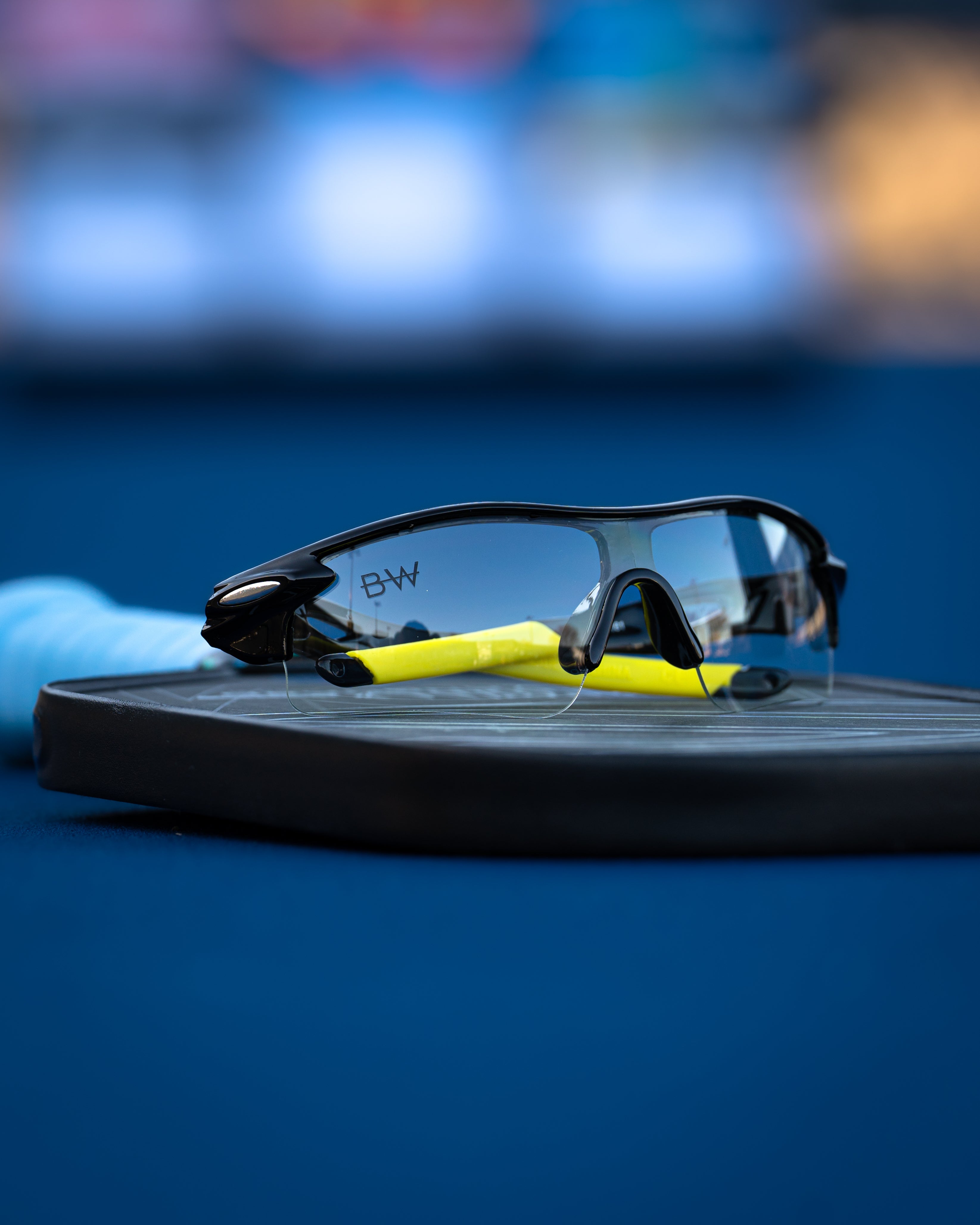
How RX Sports Glasses Help You Play Pickleball Pain-Free
Share
How RX Sports Glasses Help You Play Pickleball Pain-Free: Reduce Eye Strain, Glare, and Eyewear Discomfort
Pickleball should challenge your footwork, reflexes, and strategy—not leave you squinting through rallies, adjusting uncomfortable glasses, or dealing with tired eyes after every match.
For players who need prescription vision correction, the wrong eyewear can make an otherwise enjoyable game frustrating.
Blurry vision, excessive glare, poorly fitting frames, and unsuitable lenses may contribute to visual discomfort during play.
Some players also notice headaches, pressure around their temples, or the habit of tilting their heads to find a clearer view through their glasses.
These symptoms can have multiple causes, but eyewear is one factor worth investigating.
Properly prescribed and comfortably fitted RX sports glasses may help reduce certain sources of visual discomfort while allowing players to see more clearly during pickleball.
They are not a guaranteed treatment for headaches, neck pain, or other medical conditions. However, choosing appropriate prescription correction, frame dimensions, and lens configurations can make the experience of wearing glasses on the court more comfortable.
In this comprehensive guide, we'll explore:
- Why pickleball players experience eye strain and visual discomfort
- How prescription accuracy affects visual clarity
- Why squinting can make long matches uncomfortable
- How poorly fitting frames create pressure around the nose and temples
- Whether prescription eyewear can contribute to headaches or neck discomfort
- How lens tint and glare management influence visual comfort
- What to consider when choosing RX glasses for indoor and outdoor pickleball
- Which Blinded Wear prescription frames are worth comparing
- How to recognize symptoms that require professional evaluation
Whether you're a recreational player, competitive doubles enthusiast, or frequent tournament participant, understanding these factors can help you choose eyewear that supports a more comfortable playing experience.
Find Your Perfect Pickleball Glasses
Looking for prescription or non-prescription pickleball eyewear? Explore Blinded Wear's collections, compare available frame styles, and use the 2026 buying guide to narrow your options.
Quick Answer: Can RX Sports Glasses Help You Play Pickleball More Comfortably?
Yes. Appropriate prescription sports glasses may improve visual comfort for players whose symptoms are related to uncorrected vision, unsuitable lenses, excessive squinting, or poorly fitting eyewear.
Potential benefits include:
- Clearer vision: An appropriate prescription can correct refractive errors that cause blurred vision.
- Less squinting: Correcting blur and choosing suitable lenses for bright conditions may reduce the need to squint.
- Improved frame comfort: Properly sized glasses may reduce unwanted pressure on the nose, temples, and ears.
- Better lens positioning: Appropriate optical fitting helps ensure prescription lenses are positioned as intended.
- More suitable lighting: Clear or tinted lenses can be selected according to the playing environment.
- Reduced distraction: Comfortable, appropriately fitted eyewear may require fewer adjustments during play.
However, prescription glasses do not automatically prevent headaches, correct posture, eliminate neck pain, or guarantee pain-free matches.
Persistent or recurring symptoms deserve professional evaluation.
| Common Problem | Possible Eyewear-Related Factor | What May Help |
|---|---|---|
| Squinting during outdoor play | Blurred vision or excessive brightness | Appropriate prescription and suitable tinted lenses |
| Pressure around temples | Frame width or temple fit | Proper sizing or professional adjustment |
| Glasses sliding during rallies | Unsuitable bridge or temple fit | Better-fitting frame design |
| Difficulty seeing the ball clearly | Uncorrected refractive error or another vision issue | Comprehensive eye examination and appropriate correction |
| Discomfort under bright lights | Glare or light sensitivity | Suitable lens selection and evaluation of persistent sensitivity |
| Headaches after playing | Possibly visual strain, but many causes are possible | Evaluate eyewear and seek medical guidance when appropriate |
| Neck discomfort | Possibly eyewear positioning, but often unrelated factors | Assess fit, playing mechanics, and other potential causes |
The key is identifying what is actually causing your discomfort rather than assuming every symptom can be solved with new glasses.
1. Why Pickleball Can Be Visually Demanding
Pickleball involves repeated visual attention, quick changes in ball position, and movement between different areas of the court.
Players frequently shift their gaze between the ball, opponents, teammates, and court boundaries.
These demands make appropriate vision correction particularly relevant for players who experience blurred vision.
Tracking a Moving Ball
During a rally, the ball moves through changing positions and distances.
Players must continually locate it and respond to its trajectory.
Uncorrected refractive errors can make the ball appear less distinct, depending on the prescription and viewing distance.
Corrective lenses can improve clarity when blur results from a refractive error.
However, prescription correction does not guarantee improved reaction time or athletic performance.
Switching Between Near and Far Viewing Distances
Pickleball players look toward the net, the opposite baseline, nearby opponents, and the ball at varying distances.
Visual comfort may depend on factors such as:
- Distance prescription accuracy
- Accommodation and focusing ability
- Binocular vision
- Lens design
- Age-related visual changes
- Existing eye conditions
Not every visual difficulty is caused by an outdated prescription.
If you frequently struggle to focus, an eye-care professional can evaluate the underlying cause.
Playing Under Changing Lighting Conditions
Outdoor courts can expose players to bright sunlight, reflections, and changing shadow patterns.
Indoor facilities may use overhead lighting that some players find uncomfortable.
Different lighting environments can influence visual comfort and lens selection.
Extended Visual Attention
Long matches and tournaments require sustained concentration.
Visual discomfort may become more noticeable when combined with fatigue, dryness, dehydration, or other factors.
Appropriate eyewear can address certain optical contributors, but it does not eliminate all causes of fatigue.
Why Prescription Players Should Pay Attention
If you need corrective lenses, playing without appropriate correction may make it harder to see clearly.
Even when you can compensate for mild blur, that does not mean your visual experience is optimal.
A current prescription and comfortable frame fit provide a practical starting point.
2. Squinting During Pickleball: Why It Happens and What RX Glasses Can Do
Squinting is one of the most noticeable signs that a player may be struggling with brightness or visual clarity.
But squinting is not a diagnosis.
It can occur for several reasons, including refractive blur, bright light, glare, or light sensitivity.
Why Do People Squint to See More Clearly?
Squinting can temporarily change the effective opening through which light enters the eye.
In some situations, this can make a blurred image appear sharper.
However, squinting does not correct the underlying refractive error.
What Happens When You Squint Repeatedly?
Repeated squinting involves facial muscle activity around the eyes.
Some people find prolonged squinting uncomfortable, especially when combined with bright lighting or existing visual symptoms.
It should not be assumed that squinting itself causes every headache or episode of eye pain.
Can Prescription Glasses Reduce Squinting?
If squinting is caused by uncorrected nearsightedness, farsightedness, or astigmatism, an appropriate prescription may improve clarity and reduce the need to squint.
If bright sunlight is the main issue, suitable tinted lenses may improve comfort.
These are different problems and may require different solutions.
What If You Squint Despite Wearing RX Glasses?
Possible explanations include:
- An outdated or inaccurate prescription
- Lens positioning issues
- Excessive brightness
- Dry eyes
- Uncorrected visual conditions
- Light sensitivity requiring further evaluation
Do not assume that switching frame styles alone will resolve the problem.
How to Reduce Squinting During Outdoor Pickleball
- Confirm your prescription is appropriate.
- Review available tinted prescription lens options.
- Verify the lens's UV-protection specifications.
- Choose a frame that fits comfortably.
- Seek professional guidance if squinting or light sensitivity persists.
Remember: Darker lenses do not automatically provide better UV protection. Tint darkness and UV filtering are separate properties.
3. Can Prescription Glasses Help With Headaches After Pickleball?
Headaches after pickleball can be frustrating, especially when they occur repeatedly.
Some headaches may involve visual strain or eyewear discomfort, but many other causes are possible.
These include dehydration, heat exposure, exertion, migraine, muscle tension, and other medical conditions.
When Vision Problems May Contribute
Uncorrected refractive errors or certain binocular vision problems can contribute to visual discomfort and headaches in some people.
Correcting the relevant visual problem may help when it is genuinely contributing to symptoms.
When Frame Pressure May Contribute
Glasses that press excessively against the temples or behind the ears can cause localized discomfort.
A properly sized or professionally adjusted frame may help relieve pressure caused by poor fit.
When Glare May Be a Factor
Some players experience discomfort in bright environments.
Suitable tinted lenses may improve comfort under certain lighting conditions.
However, persistent light sensitivity or headaches should not be attributed to glare without appropriate evaluation.
Can High-Index Lenses Prevent Headaches?
No specific lens index guarantees headache prevention.
High-index materials can produce thinner lens profiles for certain prescriptions, but headache symptoms depend on many factors beyond lens thickness.
When Should You See a Professional?
Seek evaluation if headaches are recurrent, worsening, or associated with changes in vision.
A sudden severe headache, especially one associated with neurological symptoms, requires urgent medical assessment.
Important: New prescription sports glasses are not a substitute for diagnosing or treating recurrent headaches.
4. RX Glasses, Head Position, and Neck Comfort During Pickleball
Some players notice that they tilt their heads or repeatedly adjust their glasses while trying to see clearly.
Eyewear fit and lens positioning may be worth examining when these behaviors occur.
However, neck and shoulder discomfort during pickleball can also result from playing mechanics, muscular strain, previous injuries, and other causes unrelated to eyewear.
Why Might Someone Tilt Their Head to See?
Possible reasons include:
- Trying to look through a particular area of a lens
- Adjusting for glasses that sit too low
- Compensating for an unsuitable frame position
- Using certain multifocal lens designs
- Addressing a visual problem unrelated to the glasses
Head tilting is not always caused by eyewear.
Why Lens Positioning Matters
Prescription lenses are designed to provide correction based on particular optical characteristics and fitting measurements.
Depending on the prescription, relevant factors can include:
- Optical center positioning
- Pupillary distance
- Lens design
- Vertex distance
- Frame tilt
- Fitting height for certain lens types
Incorrect fitting may contribute to visual discomfort for some wearers.
Can Sports Frames Improve Head Position?
A frame that sits comfortably and positions the lenses appropriately may reduce the need for repeated adjustments.
However, there is insufficient basis to promise that sports frames will correct posture or eliminate neck pain.
What If Your Neck Hurts After Playing?
Consider your eyewear fit, but also evaluate playing technique, exertion, and other potential causes.
Persistent or significant neck discomfort should be assessed by an appropriate healthcare professional.
Takeaway: Comfortable eyewear can address certain fit-related frustrations, but it is not a treatment for musculoskeletal injuries.
5. Peripheral Vision and RX Sports Glasses: Understanding Coverage Without the Myths
Pickleball players often pay attention to the area surrounding the ball, including opponents, teammates, and court boundaries.
This makes lens dimensions and frame design relevant considerations.
What Is Peripheral Vision?
Peripheral vision refers to vision outside the central area of gaze.
It contributes to awareness of objects and movement outside the point you're looking at directly.
Can Glasses Affect the Usable Field of View?
Yes.
Frame shape, lens size, prescription, and positioning can influence how much of the visual field is viewed through the lenses.
However, prescription eyewear does not automatically expand a person's natural peripheral vision.
Are Larger Lenses Always Better?
Not necessarily.
Larger lenses may offer different coverage, but they can also influence weight, thickness, and prescription-lens design.
The ideal choice depends on your prescription and individual fit requirements.
What About Wraparound Sports Frames?
Wrap-style designs may provide different coverage and fit characteristics.
However, highly curved frames can introduce additional optical considerations for prescription lenses.
Not every prescription is suitable for every wraparound design.
Do RX Sports Glasses Improve Depth Perception?
Appropriate prescription correction can help address refractive blur that interferes with clear binocular viewing.
But depth perception depends on multiple visual processes, and no frame design guarantees improved depth judgment.
How Should You Choose?
Look for a balance of:
- Suitable lens dimensions
- Prescription compatibility
- Appropriate optical positioning
- Comfortable frame width
- Stable fit during ordinary movement
More lens coverage is not automatically better if the prescription optics or frame fit are unsuitable.
6. Glare, Bright Sunlight, and Light Sensitivity on the Pickleball Court
Outdoor pickleball often involves sunlight, shadows, and reflections from surrounding surfaces.
Some indoor facilities also have lighting conditions that players find uncomfortable.
Choosing suitable lenses can be part of managing these conditions.
Why Glare Can Be Uncomfortable
Bright light and reflections can make certain viewing conditions unpleasant.
Some people are more sensitive to brightness than others.
Persistent or unusual light sensitivity may also indicate an eye condition that requires evaluation.
Clear Prescription Lenses
Clear RX lenses may be suitable for indoor pickleball and other environments where a dark tint would be undesirable.
Lens coatings and other features vary by product.
Gray Prescription Sunglass Lenses
Gray tints commonly reduce overall visible light transmission while maintaining a relatively neutral color appearance.
The amount of light reduction depends on the actual lens specifications.
Photochromic Prescription Lenses
Photochromic lenses change tint in response to certain lighting conditions.
They may be useful for some players who move between environments, but the speed and degree of darkening vary by lens design, temperature, and exposure conditions.
They do not necessarily adjust instantly.
What About Polarized Lenses?
Polarized lenses can reduce certain reflected glare, but they are not automatically the best option for every player or environment.
Blinded Wear's sports lens approach emphasizes non-polarized options.
Non-polarized lenses do not inherently improve depth perception, and polarized lenses do not inherently damage it.
Do Anti-Reflective Coatings Help?
Anti-reflective coatings can reduce certain reflections from lens surfaces.
However, they do not eliminate every source of environmental glare.
Check whether a specific coating is included with your selected product.
Do All Blinded Wear RX Frames Offer Every Tint?
Do not assume every frame is available with clear, gray, and photochromic lenses.
Review the current lens configurations on each product page before ordering.
| Lens Configuration | Common Consideration | Important Limitation |
|---|---|---|
| Clear RX | Indoor and lower-light use | Does not reduce brightness like a dark sunglass tint |
| Gray RX tint | Bright outdoor conditions | Visible light transmission varies by lens |
| Photochromic RX | Changing light conditions | Tint changes are not instantaneous |
| Anti-reflective coating | Reducing lens-surface reflections | Does not eliminate all glare |
| UV-filtering lens | Reducing ultraviolet exposure | UV protection must be verified separately from tint darkness |
Best approach: Choose a lens configuration suited to your playing environment, prescription, and individual comfort needs.
7. Frame Pressure: How RX Sports Glasses Can Improve Wearing Comfort
Not every eyewear-related discomfort comes from the lenses.
Sometimes the problem is the frame itself.
Glasses that pinch the temples, press against the nose, or sit awkwardly behind the ears can become uncomfortable during extended wear.
Temple Pressure
Frames that are too narrow or otherwise poorly fitted may create pressure at the sides of the head.
Choosing appropriate dimensions or obtaining professional adjustment may help.
Nose Bridge Discomfort
The bridge influences how glasses rest on the nose.
An unsuitable bridge design can contribute to pressure or sliding.
Bridge width alone does not determine fit; the shape and construction also matter.
Pressure Behind the Ears
Temple length and curvature influence how the frame contacts the area around the ears.
Persistent discomfort may indicate a fitting problem.
What About Frame Weight?
Weight can influence wearing comfort, but it should be considered alongside fit and weight distribution.
A lightweight frame can still feel uncomfortable if it is the wrong size.
Can High-Index Lenses Reduce Pressure?
High-index lenses may be thinner for certain prescriptions.
However, thinner does not automatically mean lighter, and lens material alone does not guarantee improved comfort.
Blinded Wear includes high-index prescription lenses at no additional cost.
Confirm the selected frame's current lens specifications and prescription compatibility.
How to Recognize Poor Frame Fit
- Persistent pressure at the temples
- Discomfort behind the ears
- Repeated sliding down the nose
- Visible frame distortion
- Frequent adjustments during normal movement
- Uncomfortable contact with the face
These signs suggest that fit should be evaluated, although they do not identify a specific medical cause of pain.
Related Guide: Prescription Glasses That Stay Secure During Pickleball Rallies →
8. RX Eyewear Problems vs. Potential Solutions: A Practical Comparison
Different symptoms may require different solutions.
Before buying new prescription glasses, identify whether the problem is related to clarity, lighting, fit, or something else.
| What You Notice | Possible Explanation | Reasonable Next Step |
|---|---|---|
| Ball looks blurry at a distance | Refractive error or another vision issue | Have your vision evaluated |
| Frequent squinting outdoors | Brightness or blurred vision | Review prescription and lens tint |
| Pressure on both temples | Unsuitable frame width or fit | Compare dimensions or seek adjustment |
| Glasses slide when sweating | Bridge fit, moisture, or temple design | Evaluate frame fit and care |
| Need to tilt head to see clearly | Lens positioning, lens design, or another visual issue | Seek an optical fitting assessment |
| Headaches after long matches | Visual, environmental, physical, or medical factors | Evaluate recurring symptoms professionally |
| Neck soreness after play | Possible muscular strain or other causes | Assess playing mechanics and seek care if persistent |
| Burning or gritty eyes | Possible dryness or ocular irritation | Consult an eye-care professional if persistent |
| Discomfort under indoor lights | Light sensitivity or another visual issue | Evaluate lighting and persistent symptoms |
Important: This table is a guide to possible factors, not a diagnostic tool.
9. Four Blinded Wear RX Frames to Explore for Pickleball Comfort
Blinded Wear offers multiple prescription eyewear styles for pickleball players.
The original Blinded Wear guide highlights Runway RX, Havana White RX, Cold Slate RX, and Crystal Wave II RX as options to explore.
Rather than promising that a particular frame will eliminate discomfort, compare each model's actual fit, lens availability, and prescription compatibility.
9.1 Runway RX — Compare Frame Coverage and Lens Options
Runway RX is featured in Blinded Wear's prescription eyewear collection.
The original product discussion emphasizes a wrap-inspired design and options for different playing environments.
Before ordering, confirm the current frame dimensions, prescription compatibility, and available lens configurations.
What to Review
- Overall frame width
- Bridge and temple dimensions
- Current lens configuration options
- Prescription compatibility
- Comfort during ordinary movement
Who should explore it? Players interested in comparing a sports-oriented RX frame with an emphasis on coverage and fit.
9.2 Havana White RX — Explore Frame Proportions and Coverage
Havana White RX is another frame highlighted in the original guide.
Its discussion emphasizes lens coverage and suitability for players comparing indoor and outdoor eyewear needs.
Actual suitability depends on the available lens options and your individual prescription.
What to Review
- Frame dimensions
- Lens size and shape
- Bridge fit
- Available prescription lens configurations
- Comfort and pressure distribution
Who should explore it? Players who want to compare another RX frame style and evaluate its proportions against their current eyewear.
9.3 Cold Slate RX — Compare Fit and Lens Tint
Cold Slate RX appears in the original article as an option for players concerned about bright-light comfort and frame pressure.
Review its current lens configuration and frame specifications rather than assuming a particular tint or weight is available in every prescription.
What to Review
- Current tint options
- Frame width
- Temple construction
- Prescription compatibility
- Overall fit
Who should explore it? Players comparing RX frame styles and lens configurations for their usual playing conditions.
9.4 Crystal Wave II RX — Evaluate Frame Design and Clear-Lens Availability
Crystal Wave II RX is featured in the original guide for players interested in comfort and different lighting conditions.
Check the current product page for available clear or tinted RX configurations.
What to Review
- Lens configuration availability
- Frame dimensions
- Temple and bridge design
- Prescription compatibility
- Fit during normal head movement
Who should explore it? Players interested in another prescription sports frame design who want to evaluate comfort and lens options.
10. Blinded Wear RX Glasses Comparison: Choosing Based on Your Comfort Needs
These four frames offer different styles to explore, but there is no verified basis to rank them by headache prevention, pain reduction, or universal comfort.
| RX Model | Comparison Priority | Product |
|---|---|---|
| Runway RX | Frame coverage, fit, and available lens options | View Runway RX |
| Havana White RX | Lens proportions, bridge fit, and frame dimensions | View Havana White RX |
| Cold Slate RX | Frame fit and available tinted lens configurations | View Cold Slate RX |
| Crystal Wave II RX | Frame design and available clear or tinted RX options | View Crystal Wave II RX |
All product-specific dimensions, lens configurations, and availability should be verified on the current product pages.
Remember: The most comfortable frame is the one that suits your facial dimensions, prescription, and individual needs—not necessarily the model with the most features.
Part 1 Takeaway: Comfortable Pickleball Starts With Understanding Your Vision
Prescription sports glasses can help address certain sources of visual discomfort, particularly when blurry vision, unsuitable lenses, or poor frame fit contribute to the problem.
But headaches, neck pain, burning eyes, and other symptoms can have causes unrelated to eyewear.
The smartest approach is to identify the source of discomfort, confirm your vision correction, and choose frames and lenses suited to your individual needs.
Better visual comfort starts with the right prescription, the right fit, and realistic expectations.
11. Indoor vs. Outdoor RX Pickleball Glasses: Choosing Lenses for Visual Comfort
One of the most important factors in comfortable pickleball eyewear is choosing lenses suited to the environment where you play.
Indoor and outdoor courts present different lighting conditions, and the wrong lens configuration can make visual tasks less comfortable.
The goal is not simply to choose the darkest or clearest lens. It is to select appropriate prescription correction and light transmission for your playing conditions.
Indoor Pickleball: Clear Vision Under Artificial Lighting
Indoor pickleball facilities often use overhead LED or fluorescent lighting.
Depending on the facility, players may encounter:
- Bright overhead fixtures
- Uneven illumination
- Reflections from polished surfaces
- Shadows around court boundaries
- Changing visual contrast
For many indoor environments, clear prescription lenses are a practical starting point.
Clear lenses allow more visible light to pass through than dark sunglass lenses, although actual transmission depends on the specific product.
Can Clear RX Lenses Reduce Eye Strain?
If an appropriate prescription corrects blur that contributes to visual discomfort, clear RX lenses may help.
However, clear lenses do not automatically eliminate eye strain, headaches, or sensitivity to artificial lighting.
What About Anti-Reflective Coatings?
Anti-reflective coatings can reduce certain reflections from lens surfaces.
They do not eliminate every source of glare from indoor lighting.
Confirm whether a particular coating is available with your selected prescription lenses.
Outdoor Pickleball: Managing Sunlight and Brightness
Outdoor players frequently encounter direct sunlight, bright skies, and reflections from surrounding surfaces.
For some players, suitable tinted prescription lenses can improve comfort in these conditions.
Gray Prescription Lenses
Gray tints generally reduce visible light while maintaining relatively neutral color perception.
Actual performance depends on the lens's light transmission and other specifications.
Photochromic Prescription Lenses
Photochromic lenses change tint in response to certain lighting conditions.
They may be convenient for players moving between brighter and darker environments.
However, tint response varies by product, temperature, and exposure conditions.
Photochromic lenses do not necessarily darken or clear instantly.
UV Protection
Ultraviolet protection is a separate consideration from visible tint darkness.
Dark lenses are not automatically better at filtering ultraviolet radiation.
Review the current UV-protection specifications before purchasing outdoor eyewear.
What If You Play Both Indoors and Outdoors?
Players who regularly switch environments should compare the available lens configurations and consider whether one pair meets their needs.
Depending on the circumstances, separate indoor and outdoor prescription glasses may be more practical.
| Playing Environment | Lens Option to Consider | What to Verify |
|---|---|---|
| Bright outdoor courts | Suitable tinted RX lenses | Light transmission and UV protection |
| Indoor courts | Clear RX lenses | Prescription accuracy and available coatings |
| Changing outdoor light | Photochromic RX lenses, where available | Tint response and product compatibility |
| Mixed indoor/outdoor schedule | One versatile configuration or separate pairs | Suitability for both environments |
| Persistent light sensitivity | Individualized lens recommendation | Eye-care evaluation and underlying cause |
Blinded Wear offers prescription eyewear options for pickleball players, but lens availability should be confirmed for each individual frame.
12. Visual Fatigue During Long Pickleball Matches: What Players Should Know
Long pickleball sessions can be physically and mentally demanding.
Some players also experience visual discomfort, particularly when playing for extended periods in bright or challenging lighting conditions.
Understanding the possible contributors can help you make informed decisions about eyewear and eye care.
What Is Visual Fatigue?
Visual fatigue is a general term used to describe symptoms associated with prolonged visual activity.
People may report:
- Tired or uncomfortable eyes
- Difficulty maintaining comfortable focus
- Blurred vision
- Dryness or irritation
- Headaches
- Increased sensitivity to certain lighting conditions
These symptoms are not specific to pickleball and may have several causes.
Can an Incorrect Prescription Contribute?
Yes. Uncorrected refractive errors can contribute to visual discomfort for some people.
An appropriate prescription can improve clarity when refractive error is responsible for blur.
However, not all visual fatigue is caused by an outdated prescription.
Does Tracking the Ball Cause Eye Damage?
Ordinary visual tracking during pickleball should not be assumed to damage the eyes.
Nevertheless, players experiencing persistent visual symptoms should seek appropriate evaluation.
Can Dry Eyes Become More Noticeable During Play?
Yes. Some players may experience dryness or irritation during outdoor activity.
Environmental factors such as wind, air movement, and low humidity may contribute.
Dry eye symptoms can also occur for reasons unrelated to sports.
Do RX Sports Glasses Prevent Visual Fatigue?
No eyewear design can guarantee prevention.
However, appropriate prescription correction, comfortable frame fit, and suitable lens selection may address specific contributors to visual discomfort.
Practical Tips for Longer Sessions
- Use appropriate prescription correction.
- Select lenses suited to the lighting conditions.
- Take reasonable breaks between games.
- Stay hydrated during physical activity.
- Address persistent dryness with professional guidance.
- Seek evaluation for recurring headaches or blurred vision.
Comfort is influenced by vision, environment, general health, and the demands of the activity—not eyewear alone.
13. Why Prescription Accuracy Matters More Than Eyewear Marketing
When choosing RX sports glasses, frame style and lens tint are important considerations.
But neither can replace appropriate prescription correction.
The prescription determines the optical correction needed to address your refractive error.
Nearsightedness and Pickleball
Nearsightedness, or myopia, commonly causes distant objects to appear blurry.
For pickleball players, this may affect clarity when looking toward the opposite side of the court.
Appropriate prescription lenses can correct the refractive blur.
Farsightedness and Pickleball
Farsightedness, or hyperopia, can affect vision and focusing comfort differently depending on the individual and prescription.
Some people may experience visual strain, particularly during certain focusing tasks.
Astigmatism and Pickleball
Astigmatism can cause blurred or distorted vision because of the eye's optical characteristics.
Prescription lenses can correct many forms of regular astigmatism.
However, the appropriate correction depends on an eye examination.
Presbyopia and Multifocal Lenses
Presbyopia is an age-related reduction in the eye's ability to focus at near distances.
Some players use progressive or other multifocal lenses.
These designs have different optical zones, which can influence how wearers view objects at various distances.
Players experiencing difficulty with multifocal lenses during sports should discuss their needs with an eye-care professional.
What Is Pupillary Distance?
Pupillary distance, commonly abbreviated PD, is a measurement used in positioning prescription lenses.
Appropriate optical alignment matters because the intended correction depends partly on where the wearer looks through the lenses.
Why Lens Centering Matters
Depending on the prescription and lens design, inappropriate optical positioning can cause unwanted visual effects or discomfort.
Other fitting measurements may also be relevant.
Can You Use an Old Prescription?
Prescription suitability depends on its accuracy and your current visual needs.
If your vision has changed or you experience recurring symptoms, obtain professional guidance before ordering new RX eyewear.
How to Order Blinded Wear RX Glasses
- Choose a prescription frame from the RX collection.
- Review its current dimensions and available lens options.
- Confirm that the frame supports your prescription.
- Prepare a clear photo of your eyeglass prescription.
- Upload the prescription information as required during ordering.
- Double-check the details before completing your purchase.
Blinded Wear includes high-index prescription lenses at no additional cost, subject to the available prescription and product specifications.
14. High-Index RX Lenses and Wearing Comfort: Separating Facts From Myths
High-index prescription lenses are often discussed in connection with thinner lens designs.
But what does that mean for pickleball players?
What Are High-Index Lenses?
High-index lenses use materials with relatively high refractive indices.
For certain prescriptions, they can provide thinner lenses compared with some lower-index alternatives.
Why Might Thinner Lenses Matter?
Lens thickness can influence appearance, overall dimensions, and the finished eyewear design.
It may also affect the suitability of certain lens and frame combinations.
Are High-Index Lenses Always Lighter?
No.
Finished lens weight depends on material density, lens thickness, prescription, and lens dimensions.
A thinner high-index lens is not automatically lighter than every lower-index lens.
Do High-Index Lenses Prevent Nose Pressure?
No.
Pressure around the nose depends on frame fit, weight distribution, and other factors.
Lens material alone cannot guarantee comfort.
Are High-Index Lenses More Impact Resistant?
Not inherently.
Refractive index does not establish impact resistance or protective certification.
Different lens materials have different mechanical properties.
Do High-Index Lenses Improve Reaction Time?
There is no basis to claim that high-index material itself makes players react faster.
Appropriate prescription correction can improve clarity when refractive blur is present, but athletic reaction time involves many additional factors.
Does Blinded Wear Charge Extra for High-Index RX Lenses?
Blinded Wear includes high-index prescription lenses at no additional cost.
This can be useful when comparing prescription eyewear pricing.
| High-Index Question | Accurate Answer |
|---|---|
| Can lenses be thinner? | Yes, for certain prescriptions. |
| Are they always lighter? | No. |
| Do they guarantee less pressure? | No. |
| Do they eliminate headaches? | No. |
| Do they improve reaction time? | Not by virtue of lens index alone. |
| Are they automatically protective sports lenses? | No. |
| Are they included by Blinded Wear? | Yes, at no additional cost. |
Key takeaway: High-index lenses can be a valuable prescription option, but comfort depends on the complete eyewear design and individual fit.
15. The 5-Minute RX Sports Glasses Comfort Test
Before wearing new prescription glasses for an extended pickleball session, evaluate how they fit during ordinary movement.
This simple check can help identify obvious fit problems.
Important: It is not a medical examination, an impact test, or proof that the eyewear is certified for sports protection.
Minute 1: Check the Nose Bridge
Put on your glasses and notice how the bridge contacts your nose.
Look for:
- Excessive pressure
- Uncomfortable pinching
- Persistent sliding
- Uneven positioning
Minute 2: Evaluate Temple Comfort
Pay attention to the sides of your head and the areas behind your ears.
The glasses should feel secure without uncomfortable pressure.
Minute 3: Turn Your Head Normally
Look gently from side to side and up and down.
Notice whether the glasses move excessively or feel unstable.
Avoid sudden movements or deliberate attempts to dislodge the frame.
Minute 4: Check Visual Clarity
Look at objects at ordinary distances.
Notice unusual blur, distortion, or discomfort.
New prescription lenses can sometimes require an adjustment period, but significant or persistent symptoms should be evaluated.
Minute 5: Check Overall Comfort
Ask yourself:
- Are the glasses pressing uncomfortably against my face?
- Do they stay appropriately positioned?
- Can I see clearly through the intended lens areas?
- Do I feel the need to keep adjusting them?
- Are there any obvious signs of damage?
If something feels wrong, consider professional fitting guidance before using the glasses during active play.
16. Prescription Sports Glasses vs. Contact Lenses for Pickleball
Players who need vision correction often choose between prescription glasses and contact lenses.
Both options have advantages and limitations.
The best choice depends on your prescription, eye health, preferences, and playing environment.
Advantages of RX Sports Glasses
- Provide prescription correction without placing lenses directly on the eye
- Can be removed easily
- Offer multiple frame styles
- May be available with different lens tints
- Can be practical for players who prefer not to wear contacts
Limitations of RX Sports Glasses
- Frames can slip if poorly fitted.
- Lenses can become dirty or fogged.
- Some frames may feel uncomfortable.
- Prescription compatibility varies by design.
- Ordinary RX glasses are not automatically certified protective eyewear.
Advantages of Contact Lenses
- Do not require a conventional eyeglass frame
- Move with the eyes
- Can be worn with appropriate non-prescription protective sports eyewear
- May be preferred by players who dislike wearing frames
Limitations of Contact Lenses
- Some wearers experience dryness or irritation.
- Proper hygiene is essential.
- Contacts do not provide adequate impact protection by themselves.
- They may not be appropriate for every prescription or eye condition.
Can Contacts Cause Discomfort During Pickleball?
Some contact lens wearers experience dryness or irritation during activity.
Environmental conditions and individual eye health can influence comfort.
Persistent symptoms should be discussed with an eye-care professional.
Can You Wear Protective Eyewear Over Contacts?
Yes. Appropriate non-prescription protective sports eyewear may be worn over contact lenses.
Choose products with verified protective specifications suitable for the activity.
| Consideration | RX Sports Glasses | Contact Lenses |
|---|---|---|
| Prescription correction | Yes, when properly prescribed | Yes, when properly prescribed |
| Frame pressure | Possible if fit is unsuitable | No eyeglass frame required |
| Dry-eye concerns | Depends on individual factors | May affect some contact lens wearers |
| Fogging | Possible | Not applicable to the contact lens itself |
| Lens tint options | Available depending on product | Separate sunglasses or protective eyewear may be used |
| Impact protection | Only if appropriate protective specifications are verified | Not provided by contacts alone |
| Cleaning requirements | Frame and lens care | Contact lens hygiene and replacement schedule |
Neither option is universally better. Choose the vision correction method that suits your eyes and playing needs, with professional guidance where appropriate.
17. Fogging, Sweat, and Lens Smudges: Everyday Sources of Pickleball Frustration
Even when prescription lenses provide clear correction, environmental conditions can interfere with comfortable viewing.
Fogging, sweat, and smudges are common practical concerns for active eyewear users.
Why Do Glasses Fog?
Fogging occurs when moisture condenses on a lens surface under suitable temperature and humidity conditions.
It may become more noticeable when moving between environments or during certain weather conditions.
Do Sports Glasses Never Fog?
No.
No ordinary frame design should be assumed to eliminate fogging under every condition.
Anti-fog treatments may help in some situations, but effectiveness varies by product and conditions.
How Sweat Affects Visual Comfort
Sweat can collect around the bridge and temples.
Moisture and skin oils may also influence how the frame contacts the face.
Why Lens Smudges Matter
Fingerprints, dust, and other residue can interfere with clear viewing.
Cleaning the lenses appropriately can help maintain their intended optical clarity.
Practical Maintenance Tips
- Use manufacturer-approved cleaning methods.
- Carry a suitable microfiber cloth.
- Avoid wiping gritty lenses with abrasive materials.
- Keep the bridge and temples clean.
- Store glasses in a protective case when not in use.
- Review any coating-specific care instructions.
Remember: Lens care and frame fit both matter for everyday comfort.
Related Guide: How to Store and Protect RX Glasses on the Go →
18. How to Stay More Comfortable During Pickleball Tournaments
Tournament days may involve multiple matches, changing lighting conditions, and extended periods of activity.
For prescription eyewear users, preparation can reduce avoidable inconvenience.
Before the Tournament
- Confirm your prescription eyewear is in good condition.
- Clean the lenses.
- Check the frame for visible damage.
- Review the expected playing environment.
- Pack a suitable protective case.
- Consider bringing backup prescription glasses.
Between Matches
- Rest as needed.
- Stay appropriately hydrated.
- Clean sweat and smudges from your eyewear.
- Check whether the glasses remain comfortable.
- Pay attention to persistent visual symptoms.
During Outdoor Tournaments
Consider whether your prescription lens configuration is suitable for bright conditions.
Remember that tint darkness does not establish UV protection.
During Indoor Tournaments
Evaluate whether your lenses provide comfortable vision under the facility's lighting.
If you consistently struggle with particular lighting conditions, discuss your symptoms with an eye-care professional.
Why a Backup Pair Matters
If you depend on prescription correction, damaged or misplaced glasses can interrupt your ability to see clearly.
A suitable backup pair can provide a practical alternative.
19. When Pickleball Eye Pain or Headaches Need Professional Attention
Eyewear can contribute to some forms of discomfort, but not every symptom is caused by glasses.
It is important to recognize when medical evaluation is appropriate.
Recurring Headaches
If headaches repeatedly occur during or after pickleball, consult a healthcare professional.
Possible causes extend beyond prescription accuracy and frame fit.
Persistent Blurred Vision
Blur that continues despite wearing appropriate correction should be evaluated by an eye-care professional.
Eye Pain
Eye pain should not automatically be attributed to ordinary visual strain.
Seek prompt medical attention for significant pain, especially when accompanied by visual changes.
Sudden Vision Changes
Sudden loss of vision, new double vision, or other abrupt visual changes require urgent medical assessment.
Severe Headaches
A sudden, unusually severe headache requires emergency evaluation, particularly when accompanied by weakness, confusion, or other neurological symptoms.
Persistent Neck Pain
Neck pain that continues or worsens should be evaluated rather than attributed solely to eyewear.
After an Eye Impact
If a ball, paddle, or another object strikes the eye and causes pain, visual changes, or other concerning symptoms, seek prompt medical evaluation.
Prescription sports glasses can address certain optical needs, but they are not a substitute for medical care or certified protective eyewear.
20. How to Choose Comfortable RX Pickleball Glasses: A Step-by-Step Buying Guide
Choosing prescription sports eyewear becomes easier when you focus on the factors that affect your individual experience.
Step 1: Confirm Your Vision Needs
Use an appropriate current prescription and discuss any recurring symptoms with an eye-care professional.
Step 2: Identify Your Main Discomfort
Determine whether your biggest concern is blur, brightness, frame pressure, sliding, or another issue.
Step 3: Choose a Suitable Frame Size
Compare frame width, bridge dimensions, and temple length with eyewear that fits you comfortably.
Step 4: Review Lens Compatibility
Make sure the selected frame can accommodate your prescription.
Step 5: Match the Lens to Your Playing Environment
Compare clear, tinted, or photochromic options where available.
Step 6: Consider Frame Weight and Distribution
Lightweight construction may appeal to some players, but comfort depends on fit as well as mass.
Step 7: Evaluate Frame Stability
Choose glasses that remain appropriately positioned during ordinary movement without uncomfortable pressure.
Step 8: Verify Protective Specifications
If protection from ball impacts is a priority, confirm that the eyewear has suitable verified protective performance.
Step 9: Review Care and Replacement Policies
Understand the manufacturer's maintenance guidance and current replacement terms.
Step 10: Compare Available RX Models
Explore Blinded Wear frames and choose based on verified specifications, prescription compatibility, and fit.
There is no single RX frame that guarantees pain-free play for everyone.
The best choice is the one that addresses your actual eyewear needs while remaining comfortable and suitable for your prescription.
Explore Prescription Pickleball Glasses That Prioritize Comfortable Fit
Visual comfort during pickleball starts with appropriate correction, suitable lenses, and a frame that fits properly.
Blinded Wear offers prescription eyewear options for players who want to compare sports-oriented frame designs and lens configurations.
Explore Featured RX Models
- Runway RX — Compare frame coverage and prescription options.
- Havana White RX — Explore frame dimensions and lens configurations.
- Cold Slate RX — Review current frame and tint options.
- Crystal Wave II RX — Compare frame style and RX compatibility.
Blinded Wear includes high-index prescription lenses at no additional cost, subject to current prescription compatibility.
Take the Pickleball Eyewear Quiz →
Choose clear vision, comfortable fit, and eyewear that suits the way you play.
21. Frequently Asked Questions About RX Sports Glasses and Pickleball Comfort
Prescription sports eyewear can help address certain sources of visual discomfort, but choosing the right glasses requires understanding how prescriptions, lenses, frame fit, and playing conditions work together.
Can RX sports glasses help prevent eye strain during pickleball?
Appropriate prescription glasses may reduce visual discomfort when uncorrected refractive errors are contributing to symptoms. However, eye strain can have multiple causes, and no prescription eyewear can guarantee prevention.
Can prescription pickleball glasses prevent headaches?
They may help when headaches are related to certain vision or eyewear-fitting problems. However, headaches can also result from dehydration, heat exposure, exertion, migraine, or other conditions. Recurring headaches should be evaluated professionally.
Why do my eyes hurt after playing pickleball?
Possible causes include dryness, irritation, light sensitivity, visual strain, or other eye conditions. Eye pain should not automatically be attributed to your prescription. Persistent or significant pain warrants professional evaluation.
Why do I squint when playing pickleball?
Squinting can occur because of blurred vision, bright sunlight, glare, or light sensitivity. Appropriate prescription correction or suitable tinted lenses may help, depending on the cause.
Can an outdated prescription make pickleball uncomfortable?
Yes. An outdated prescription may leave some refractive errors inadequately corrected, potentially contributing to blur or visual discomfort. An eye examination can determine whether your prescription needs updating.
Are RX sports glasses better than regular prescription glasses for pickleball?
Sports-oriented frames may offer different fit, coverage, and construction characteristics. However, the label "sports glasses" does not automatically establish superior comfort, impact protection, or performance. Compare verified specifications and individual fit.
Can poorly fitting glasses cause temple pain?
Yes. Frames that apply excessive pressure at the temples or behind the ears can cause localized discomfort. Appropriate sizing or professional adjustment may help.
Why do my glasses hurt behind my ears?
Temple length, curvature, frame width, and adjustment can affect how glasses contact the ears. An optical professional can help evaluate the fit.
Can prescription glasses cause neck pain?
Eyewear positioning or lens design may influence head posture in some situations, but neck pain has many possible causes. New glasses should not be considered a treatment for neck or shoulder problems.
Do lightweight frames reduce discomfort?
Lower frame weight may be preferable for some wearers, but comfort also depends on bridge fit, temple pressure, weight distribution, and frame dimensions. A lightweight frame can still fit poorly.
Are high-index prescription lenses better for pickleball?
High-index lenses can provide thinner profiles for certain prescriptions. They are not automatically lighter, more impact-resistant, or more comfortable than every alternative. Lens suitability depends on the prescription and intended use.
Does Blinded Wear include high-index RX lenses?
Yes. Blinded Wear includes high-index prescription lenses at no additional cost. Confirm current compatibility and specifications for the frame you select.
What lens tint is best for outdoor pickleball?
The appropriate tint depends on brightness, personal preference, visual needs, and the lens's actual light-transmission characteristics. Gray tints are one option to consider for bright conditions.
Should I wear clear RX lenses indoors?
Clear prescription lenses are often a practical option for indoor courts where darker sunglass lenses would reduce too much visible light. Individual lighting conditions and visual needs still matter.
Are photochromic lenses good for pickleball?
Photochromic lenses may be convenient in changing light conditions. However, tint response varies by product, temperature, and exposure. They do not necessarily adjust instantly, and availability depends on the selected frame.
Do polarized lenses affect pickleball performance?
Polarized lenses reduce certain reflected glare, but they are not automatically better or worse for every pickleball player. Lens suitability depends on the environment and individual visual preferences.
Do prescription sports glasses improve depth perception?
Appropriate correction may improve visual clarity when refractive blur interferes with viewing. However, depth perception involves multiple visual processes, and no particular frame guarantees improvement.
Can RX glasses improve pickleball reaction time?
Correcting blurred vision may help a player see more clearly, but prescription glasses do not guarantee faster reaction time, improved reflexes, or better match results.
Why do my RX glasses slip when I sweat?
Moisture, skin oils, bridge geometry, temple design, and frame dimensions can influence stability. A fitting assessment may help identify the cause.
Do prescription sports glasses fog up?
Yes. Prescription sports lenses can fog under certain temperature and humidity conditions. Anti-fog treatments may help in some circumstances, but no ordinary eyewear should be assumed completely fog-proof.
Are RX pickleball glasses impact-proof?
No. Impact-resistant materials are not necessarily unbreakable. Protective performance must be evaluated according to the applicable product specifications and testing standards.
Can I wear contact lenses instead of RX glasses?
Yes, if contact lenses are appropriate for your eyes and prescription. Contacts do not provide adequate protection from ball impacts by themselves, so suitable protective sports eyewear may still be needed.
Should I bring backup prescription glasses to a tournament?
A backup pair can be useful if you depend on prescription correction and your primary glasses become damaged or misplaced.
Which Blinded Wear RX frames should I compare?
Runway RX, Havana White RX, Cold Slate RX, and Crystal Wave II RX are four options to explore. Compare their current dimensions, available lens configurations, and prescription compatibility.
Can RX sports glasses guarantee pain-free pickleball?
No. Properly prescribed and comfortably fitted eyewear may address certain sources of discomfort, but it cannot guarantee pain-free play or treat underlying medical conditions.
22. Eight Common Myths About Prescription Sports Glasses and Pain
Prescription sports eyewear is often marketed using broad promises about comfort and athletic performance.
Understanding the limitations of these claims helps players make better purchasing decisions.
Myth 1: Any Pair of RX Glasses Will Eliminate Eye Strain
Reality: Appropriate correction can address refractive blur, but visual discomfort may also involve dry eyes, lighting, binocular vision problems, or other causes.
Myth 2: Expensive Frames Automatically Prevent Headaches
Reality: Price does not establish headache prevention. Prescription accuracy, frame fit, and the underlying cause of symptoms matter more.
Myth 3: High-Index Lenses Always Feel Lighter
Reality: High-index lenses may be thinner for certain prescriptions, but finished weight depends on material density, lens dimensions, and other factors.
Myth 4: Darker Sunglasses Always Provide Better UV Protection
Reality: Visible tint darkness and ultraviolet protection are different characteristics. Verify the lens's UV specifications.
Myth 5: Sports Glasses Automatically Correct Poor Posture
Reality: Comfortable eyewear may reduce certain fitting frustrations, but it does not automatically correct posture or treat neck pain.
Myth 6: Wraparound Frames Always Improve Peripheral Vision
Reality: Frame geometry affects coverage and the usable field of view through the lenses. It does not automatically expand natural peripheral vision, and prescription compatibility must be considered.
Myth 7: Impact-Resistant Means Completely Safe From Ball Impacts
Reality: Impact resistance is not the same as a guarantee against injury or breakage. Verify appropriate protective specifications for the intended activity.
Myth 8: New RX Glasses Can Solve Every Type of Eye Pain
Reality: Eye pain may result from medical conditions that require examination and treatment. Significant or persistent symptoms should not be dismissed as ordinary eyewear discomfort.
Bottom line: Good prescription sports eyewear should be selected using accurate information about vision correction, fit, lens properties, and verified product features.
23. When Discomfort Is a Fit Problem—and When It May Be Something Else
Not every uncomfortable sensation during pickleball requires the same solution.
Some problems may be related to frame sizing or prescription correction, while others require professional medical assessment.
| Symptom | Possible Explanation | Recommended Response |
|---|---|---|
| Pressure at the temples | Unsuitable frame width or adjustment | Have frame fit evaluated |
| Pressure behind the ears | Temple length or curvature | Seek optical fitting guidance |
| Repeated sliding | Bridge or temple fit | Review frame dimensions and fit |
| Blurred distance vision | Refractive error or another visual problem | Arrange an eye examination |
| Discomfort in bright sunlight | Brightness or light sensitivity | Review lens options and persistent symptoms |
| Recurring headaches | Multiple possible causes | Seek healthcare evaluation |
| Burning or gritty eyes | Possible dryness or irritation | Seek eye-care guidance if persistent |
| Sudden visual changes | Potentially urgent eye or neurological problem | Seek urgent medical assessment |
| Significant pain after an eye impact | Possible eye injury | Seek prompt medical attention |
Sudden vision loss, severe eye pain, or a sudden unusually severe headache should be treated as potentially urgent.
Do not rely on changing glasses to resolve symptoms that may indicate an underlying health problem.
24. A Practical RX Eyewear Comfort Routine Before, During, and After Pickleball
Comfortable eyewear is easier to maintain when you establish a simple routine.
Before Playing
- Check that your prescription glasses are clean.
- Inspect the frame for visible cracks or damage.
- Confirm the lenses appear securely positioned.
- Check that the bridge and temples feel comfortable.
- Select lenses appropriate for the lighting environment.
- Bring a protective case and cleaning cloth.
During Play
- Pay attention to repeated slipping or pressure.
- Clean smudges safely when needed.
- Take reasonable breaks between games.
- Stay appropriately hydrated.
- Do not ignore persistent visual symptoms.
After Playing
- Clean the eyewear according to manufacturer instructions.
- Remove sweat and residue from contact areas.
- Inspect the frame for new damage.
- Dry the glasses appropriately.
- Store them in a protective case.
What Should You Avoid?
- Twisting frames to test flexibility
- Using harsh, unapproved cleaning chemicals
- Leaving glasses in a hot vehicle
- Storing eyewear loose beneath heavy equipment
- Continuing to play with visibly damaged glasses
- Ignoring persistent headaches, eye pain, or blurred vision
Good maintenance cannot guarantee a particular eyewear lifespan, but it helps reduce avoidable damage and inconvenience.
25. Choosing RX Pickleball Glasses for Different Types of Players
There is no single prescription frame that is ideal for every pickleball player.
Different playing schedules, environments, and visual requirements create different priorities.
Recreational Players
Focus on accurate prescription correction, comfortable fit, and lenses suited to your usual court environment.
Frequent League Players
Pay attention to how your glasses feel during longer sessions, including bridge pressure, temple comfort, and stability.
Outdoor Players
Compare appropriate prescription tint options and verified UV-protection specifications.
Consider whether bright conditions contribute to squinting or visual discomfort.
Indoor Players
Evaluate clear prescription lenses and their suitability for your facility's lighting conditions.
Tournament Players
Consider backup eyewear, protective storage, prescription accuracy, and consistent fit across multiple matches.
Players With Strong Prescriptions
Review high-index lens options, prescription compatibility, lens dimensions, and optical fitting requirements.
Players Who Experience Frame Pressure
Prioritize suitable frame dimensions and professional adjustment rather than assuming that a lighter frame alone will solve the problem.
Players With Recurring Eye Discomfort
Seek appropriate evaluation to identify whether the problem is related to vision correction, ocular health, lighting, or another factor.
26. Compare Four Blinded Wear RX Frames for Your Playing Needs
Blinded Wear offers several prescription frame styles worth exploring.
The following comparison focuses on what shoppers should evaluate rather than making unsupported claims about which model prevents the most pain.
| Frame | What to Compare | Shop |
|---|---|---|
| Runway RX | Frame coverage, dimensions, and available prescription configurations | View Runway RX |
| Havana White RX | Frame proportions, bridge fit, and lens options | View Havana White RX |
| Cold Slate RX | Temple comfort, frame sizing, and available tints | View Cold Slate RX |
| Crystal Wave II RX | Frame geometry, prescription compatibility, and lens configurations | View Crystal Wave II RX |
Important: Product availability and specifications can change. Confirm current dimensions, materials, prescription compatibility, and lens options before purchasing.
These models have not been ranked by clinical comfort outcomes or headache prevention.
27. The Complete RX Pickleball Comfort Buying Checklist
Before choosing your next pair of prescription pickleball glasses, review these essential considerations.
Vision Correction
- Use an appropriate current prescription.
- Confirm the frame supports your prescription.
- Provide accurate optical measurements.
- Discuss persistent blur or discomfort with an eye-care professional.
Frame Fit
- Compare overall frame width.
- Check bridge dimensions and shape.
- Review temple length.
- Consider weight distribution.
- Avoid excessive pressure around the nose and temples.
Lens Selection
- Choose a configuration suitable for indoor or outdoor use.
- Review available tint options.
- Verify UV protection for outdoor eyewear.
- Confirm available lens coatings.
- Consider high-index lenses when appropriate.
Sports Suitability
- Evaluate frame stability.
- Review verified impact-related specifications.
- Confirm protective certification when needed.
- Do not assume ordinary prescription glasses are protective sports goggles.
Long-Term Ownership
- Review cleaning recommendations.
- Use appropriate storage.
- Consider a backup pair.
- Read return and replacement policies.
- Check for visible damage before active play.
The best RX glasses are not necessarily the most expensive, lightest, or darkest. They are the ones that appropriately correct your vision and fit your needs.
28. Blinded Wear's 50% Lifetime Replacement Support
Even carefully maintained prescription glasses can experience accidental damage.
Blinded Wear offers 50% lifetime replacement support for eligible broken eyewear, subject to current policy terms.
This support may be relevant when considering the long-term cost of owning prescription sports glasses.
Before purchasing, review:
- Eligible products
- Covered damage
- Applicable exclusions
- Replacement pricing
- How to request support
Do not assume that all forms of damage, prescription changes, or replacement requests are covered under identical terms.
29. Related Guides: Improve Your Pickleball Eyewear Experience
Explore more Blinded Wear guides covering prescription clarity, eyewear comfort, lens selection, and practical maintenance.
- RX Visual Endurance for Long Matches
- Prescription Glasses That Stay Secure During Pickleball Rallies
- RX Lenses and Reaction Time in Pickleball
- The Science of Depth Perception in Pickleball
- Pickleball Vision Myths Debunked
- Why Impact Resistance Matters in Sports Eyewear
- How to Store and Protect RX Glasses on the Go
- How to Pack Prescription Glasses for Sports Trips
- Top Lightweight RX Glasses for Tournament Travel
- When to Bring a Spare RX Pair in Your Bag
For a broader introduction to eyewear choices, explore the 2026 Pickleball Glasses Buying Guide.
30. Final Verdict: How RX Sports Glasses Can Help You Play Pickleball More Comfortably
Pickleball should be enjoyable, but blurred vision, uncomfortable frames, glare, and other visual frustrations can interfere with the experience.
Appropriate prescription sports eyewear may help address certain problems by providing:
- Clearer vision: Correcting refractive errors when appropriate.
- Less unnecessary squinting: Addressing blur or selecting lenses suited to bright conditions.
- More comfortable fit: Reducing unwanted pressure through appropriate frame sizing.
- Suitable lens positioning: Supporting intended prescription optics through appropriate fitting.
- Better lighting compatibility: Selecting clear or tinted lenses according to the environment.
- Less eyewear-related distraction: Choosing frames that remain comfortably positioned during normal movement.
However, prescription glasses do not automatically prevent headaches, cure eye strain, eliminate neck pain, or guarantee better pickleball performance.
Recurring symptoms should be evaluated according to their actual cause.
For players choosing new RX eyewear, the most important considerations are prescription accuracy, frame dimensions, lens suitability, comfortable fit, and verified product specifications.
Blinded Wear includes high-index prescription lenses at no additional cost and offers multiple frame styles for players comparing prescription pickleball eyewear.
The goal is not to promise that glasses can solve every discomfort.
It's to help players find appropriate vision correction and eyewear they can wear comfortably on the court.
Find Prescription Pickleball Glasses That Fit Your Game
Ready to explore RX eyewear for your next match?
Blinded Wear offers prescription pickleball glasses with multiple frame styles and high-index RX lenses included at no additional cost.
Compare the current specifications, review available lens configurations, and choose a frame suited to your prescription and comfort preferences.
Shop Featured Prescription Frames
- Runway RX — Explore Prescription Frame Options
- Havana White RX — Compare Frame Fit and Coverage
- Cold Slate RX — Explore Lens and Frame Configurations
- Crystal Wave II RX — Review Prescription Eyewear Options
Explore More Blinded Wear Eyewear
- Shop All RX Pickleball Glasses →
- Shop Non-Prescription Pickleball Sunglasses →
- Explore Clear-Lens Eyewear →
- Take the Pickleball Eyewear Quiz →
- Explore the 2026 Pickleball Glasses Guide →
Learn more about the company's broader mission through Blinded Wear's Mission to Support Children's Vision.
Clear vision. Comfortable fit. More confidence in your eyewear choices.