
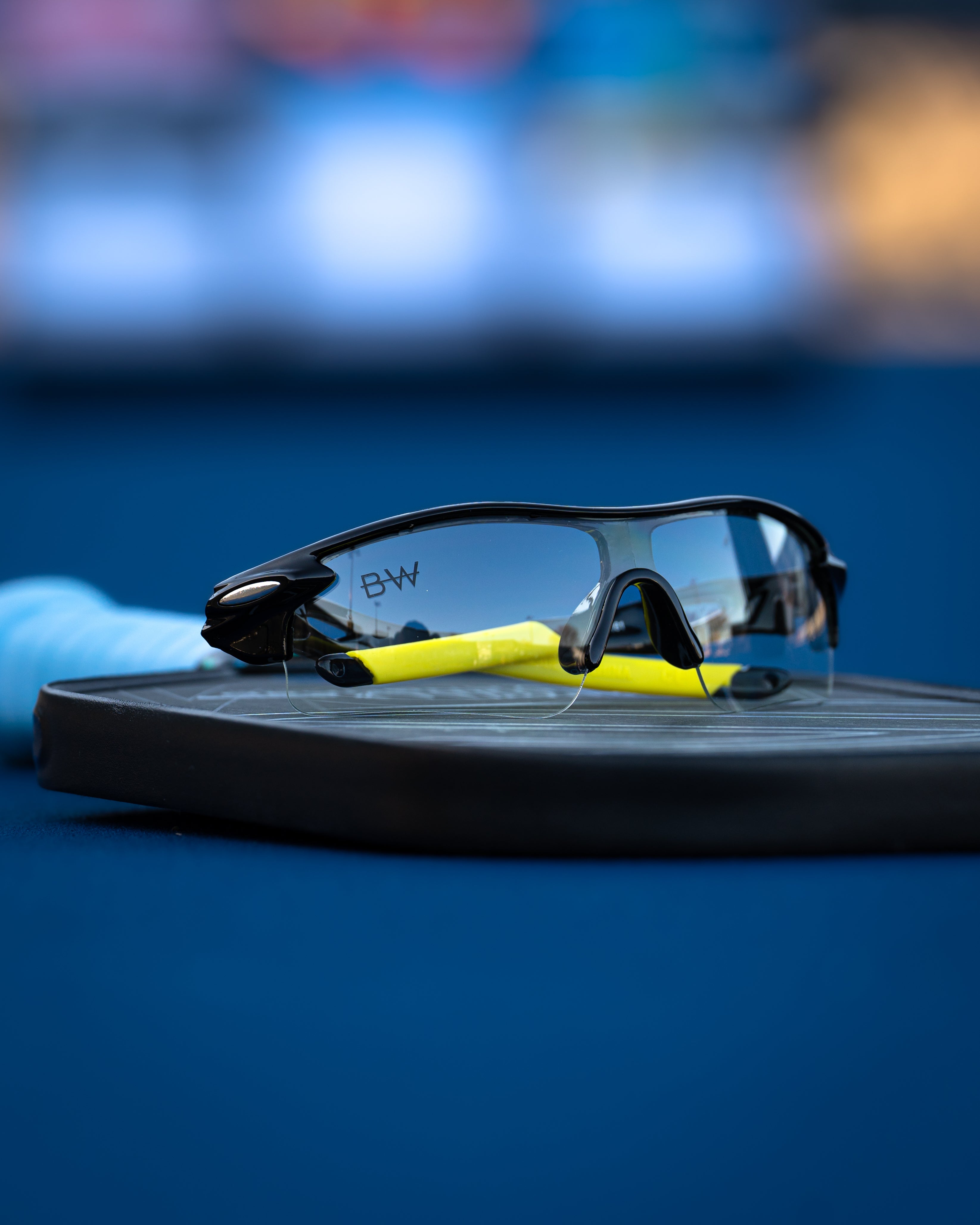
How RX Sports Glasses Elevate Your Game and Protect Your Eyes
Share
How RX Sports Glasses Support Your Game and Protect Your Eyes: 2026 Guide
Whether you play pickleball, basketball, tennis, run outdoors, or train across multiple sports, vision is part of how you interact with a fast-moving environment. If you require prescription correction, that creates an important equipment question: what should you wear when everyday life turns into athletic movement?
RX sports glasses combine prescription correction with eyewear selected for active use. Their value does not depend on promises of instant reaction-time gains or automatic athletic improvement. Instead, prescription sports eyewear can address your corrective needs while giving you a dedicated setup built around your sport, environment, frame fit, and verified lens characteristics.
This 2026 guide explains what RX sports glasses actually do, how impact-resistant lenses fit into eye protection, what to look for when choosing a pair, and which Blinded Wear RX options athletes can compare.
Explore Prescription Sports Eyewear
What Are the Benefits of RX Sports Glasses?
For athletes who require prescription correction, RX sports glasses allow that correction to be incorporated into eyewear selected specifically for active use.
Depending on the exact product and configuration, practical benefits can include:
- Prescription correction during sports
- A dedicated alternative to everyday glasses
- Frames selected around active use
- Impact-resistant lens options
- Configurations selected around indoor or outdoor environments
- Prescription eyewear that can be tested during realistic athletic movement
What RX sports glasses should not automatically promise is equally important. Prescription correction does not inherently create faster reactions, better depth perception, improved ball tracking, greater contrast, or better athletic performance.
What Are RX Sports Glasses?
RX sports glasses are prescription eyewear intended for use during athletic activity. Like everyday prescription glasses, their central optical role is to provide the corrective power prescribed for the wearer.
The difference is how the complete eyewear setup can be selected.
| Consideration | Everyday Prescription Glasses | RX Sports Glasses |
|---|---|---|
| Prescription Correction | Yes | Yes |
| Primary Use | General daily activities | Athletic and active use |
| Movement | Usually selected around normal daily wear | Can be evaluated during sport-specific movement |
| Environment | General lifestyle use | Can be selected around indoor, outdoor, or changing sports environments |
| Impact Resistance | Depends on exact eyewear | Can be prioritized for active use |
| Fit Evaluation | Everyday comfort | Comfort plus individual fit during movement |
This does not mean ordinary prescription glasses are automatically unsuitable for sports. It means frequent athletes may prefer dedicated eyewear selected specifically around the way they train and compete.
The Most Important Job of RX Sports Glasses: Prescription Correction
Sports-eyewear marketing often focuses on advanced-sounding performance features. For an athlete who requires corrective lenses, the most fundamental role of RX eyewear is simpler: provide the correction prescribed for that athlete.
An eyeglass prescription can include values such as:
- OD: right eye
- OS: left eye
- SPH: spherical corrective power
- CYL: cylindrical correction when prescribed
- Axis: orientation associated with cylindrical correction
- ADD: additional near power when prescribed
Prescription needs vary between individuals, which is why athletes should verify compatibility with the exact RX frame rather than assuming every prescription can be placed into every sports frame.
When ordering Blinded Wear RX eyewear, have a clear photo or picture of your eyeglass prescription ready to upload.
How RX Sports Glasses Fit Into Athletic Performance
Prescription sports eyewear can be important to an athlete without being responsible for the athlete's performance.
Consider a simplified sequence in a fast-paced sport:
Visual information → prescription correction when required → recognition → interpretation → anticipation → decision → motor response → physical execution.
RX lenses participate in the corrective optical portion of that sequence. The rest depends on factors including:
- Attention
- Experience
- Pattern recognition
- Anticipation
- Decision-making
- Coordination
- Movement
- Technique
- Training
This distinction allows athletes to understand the legitimate role of RX sports glasses without expecting eyewear to replace skill development.
Do RX Sports Glasses Improve Reaction Time?
RX sports glasses should not be described as automatic reaction-time enhancers.
If an athlete requires prescription correction, appropriate corrective lenses address that refractive need. But reaction time involves more than optical correction.
During a fast pickleball volley, basketball pass, or tennis exchange, an athlete may need to:
- Receive visual information
- Recognize what is happening
- Interpret movement
- Anticipate the next action
- Choose a response
- Initiate movement
- Execute the movement
Prescription eyewear does not independently control that entire chain.
For the pickleball-specific breakdown, read How RX Lenses Fit Into Reaction Time in Pickleball →.
Do Prescription Sports Glasses Improve Depth Perception?
Depth perception is important in many sports because athletes constantly interpret spatial relationships. However, it involves multiple visual cues and should not be reduced to one eyewear characteristic.
Prescription correction addresses refractive needs when prescribed. The effect on an individual's overall visual function depends on the person and should not be converted into a universal claim that RX sports glasses automatically improve depth perception.
Likewise, a lens being polarized or non-polarized does not by itself establish better or worse depth perception.
For a deeper explanation in a court-sports context, read Depth Perception Science for Pickleball →.
How Do RX Sports Glasses Help Protect Your Eyes?
Eye protection is one of the most important reasons to evaluate sports eyewear carefully—but the terminology matters.
Blinded Wear sports eyewear uses impact-resistant lenses. Impact resistance is a relevant characteristic in active environments where eyewear can encounter movement, equipment, falls, or accidental contact.
However:
- Impact-resistant does not mean shatterproof.
- Impact-resistant does not mean indestructible.
- Impact-resistant does not guarantee that eyewear cannot break.
- Impact-resistant does not automatically establish compliance with a specific sports-protection standard.
If your sport, league, workplace, or personal situation requires eyewear meeting a particular protective certification or standard, verify that requirement separately before purchasing.
Why Impact Resistance Matters in Fast-Moving Sports
Athletic environments introduce risks that may be less common during ordinary daily wear.
Depending on the activity, eyewear may encounter:
- Moving balls
- Sports equipment
- Other players
- Falls
- Accidental drops
- Repeated transportation inside sports bags
For that reason, lens characteristics relevant to active use deserve consideration alongside prescription correction and frame fit.
Still, athletes looking specifically for certified protective eyewear should verify the applicable certification rather than assuming all prescription sports glasses provide the same level of protection.
RX Sports Glasses vs. Regular Prescription Glasses for Athletes
The right choice depends on the athlete, the sport, and how frequently the eyewear will be used.
| Question | Everyday RX Glasses | Dedicated RX Sports Glasses |
|---|---|---|
| Provides Prescription Correction? | Yes | Yes |
| Selected Specifically for Sports? | Not necessarily | Can be |
| Can Impact Resistance Be Prioritized? | Depends on product | Yes, when verified |
| Can Environment Be Part of Selection? | Yes | Yes, with sport-specific use in mind |
| Can Fit Be Tested During Athletic Movement? | Yes | Yes, and this should be part of evaluation |
| Dedicated Sports Pair? | No, if also used daily | Yes |
If your everyday prescription glasses already work appropriately for your activity, you may not need another pair. The case for dedicated RX sports eyewear becomes stronger when athletic use is frequent enough to justify a separate setup.
Can One Pair of RX Sports Glasses Work Across Multiple Sports?
Potentially. Multi-sport use can increase the practical value of prescription sports eyewear when the same frame and configuration appropriately fit several activities.
For example, an athlete might use one compatible RX setup for:
- Pickleball
- Tennis
- General outdoor training
- Running
- Other compatible active settings
That does not mean every sports frame is automatically suitable for every sport. Each activity can have different movement, environment, and protective requirements.
For athletes who participate in several activities, read Multi-Sport Prescription Glasses: The Ultimate Guide →.
RX Glasses for Fast-Paced Sports
Fast-paced sports place athletes in environments where visual information and physical movement change rapidly.
The role of RX eyewear remains focused: provide prescribed correction when required within an appropriate sports setup.
That can be relevant during activities involving:
- Rapid changes in ball position
- Frequent athlete movement
- Changing distances
- Opponent or teammate positioning
- Fast decisions
But the eyewear should not be credited with independently improving anticipation, decision speed, tracking, or reaction time.
Read more in Prescription Glasses for Fast-Paced Sports →.
High-Index Prescription Lenses for Sports
Blinded Wear includes high-index prescription lenses at no additional cost with RX eyewear.
High-index refers to a category of prescription lens material with a higher refractive index. It relates to how corrective power can be produced within the lens.
It should not automatically be interpreted as:
- Better athletic performance
- Faster reactions
- Better depth perception
- Improved ball tracking
- Greater contrast
Also, do not assume “high-index” means an exact numerical index such as 1.67 unless that specification is verified for the exact configuration.
Non-Polarized RX Sports Glasses: What Athletes Should Know
Blinded Wear sports eyewear uses non-polarized lenses. That means a polarization filter is not added.
Some court-sport players prefer non-polarized eyewear, but the characteristic should not be overstated.
| Statement | Accurate? |
|---|---|
| A polarization filter is not added | Yes |
| Non-polarized automatically improves depth perception | No |
| Non-polarized automatically improves ball tracking | No |
| Non-polarized automatically increases reaction speed | No |
| Some court players prefer non-polarized eyewear | Yes |
RX Sports Glasses for Indoor vs. Outdoor Athletics
The environment where you train or compete should be part of your eyewear decision.
Indoor Sports
A player who requires prescription correction indoors but does not want a dark sunglass tint can compare an appropriate non-dark RX configuration when available.
Clear status alone does not establish improved contrast, reaction time, or tracking.
Outdoor Sports
Outdoor athletes can compare compatible prescription sunglass configurations according to their prescription, activity, conditions, frame dimensions, and individual fit.
A tint should not automatically be credited with improving contrast, depth perception, or athletic performance unless that effect is established for the exact lens.
Indoor + Outdoor Athletes
If your training frequently moves between environments, compare separate RX configurations or a verified transition/photochromic configuration when available and compatible with your prescription.
Why Frame Fit Matters for RX Sports Glasses
Even excellent prescription correction does not tell you whether a particular frame fits your face appropriately during athletic movement.
When dimensions are available, compare:
- Lens width
- Bridge width
- Temple length
- Overall frame dimensions when provided
Use glasses that already fit you well as a reference point when possible.
Then evaluate the finished RX pair during realistic movement. Do not assume that terms such as “lightweight” automatically mean “secure,” “non-slip,” or universally comfortable.
The RX Sports Glasses Movement Test
Before relying on new prescription eyewear for competition or intense training, test the finished pair in a controlled practice setting.
- Confirm the prescription experience feels appropriate for you.
- Look naturally up, down, left, and right.
- Walk, jog, or perform a normal warmup.
- Perform lateral movement if your sport requires it.
- Practice sport-specific movements.
- Wear the glasses through a realistic training session.
- Evaluate comfort and individual fit over time.
The goal is to determine whether the complete RX setup works appropriately for you—not to prove that it creates a performance advantage.
Blinded Wear RX Sports Glasses to Compare in 2026
There is no universal best RX frame for every athlete. These Blinded Wear options provide useful starting points for comparison.
| RX Model | Useful Starting Point | What to Compare |
|---|---|---|
| H Blue Shield RX | Pickleball-focused RX shoppers | Prescription compatibility, environment, dimensions, fit |
| Lava Rock RX | Athletes comparing lightweight RX options | Prescription, dimensions, environment, individual fit |
| Crystal Wave II RX | RX sunglass shoppers | Prescription compatibility, outdoor use, current configuration |
| Frost RX | Prescription court-sport shoppers | Prescription, environment, dimensions, fit |
| Ocean Wave RX | Athletes comparing additional sports-oriented RX styles | Prescription compatibility, configuration, dimensions |
| Silver Line RX | Outdoor RX sports shoppers | Prescription compatibility, outdoor configuration, dimensions |
How to Choose RX Sports Glasses
A useful selection process starts with what you actually need rather than the longest feature list.
-
Start with your prescription.
Know what corrective requirements the eyewear needs to support.
-
Verify frame compatibility.
Do not assume every RX frame supports every prescription.
-
Identify your sport or sports.
Consider movement, environment, and any specific protective requirements.
-
Choose for your primary environment.
Indoor, outdoor, and changing conditions may require different approaches.
-
Compare dimensions.
Use eyewear that already fits appropriately as a reference when possible.
-
Review verified lens characteristics.
Separate actual product characteristics from unsupported performance promises.
-
Test the finished pair.
Evaluate your RX sports glasses during realistic training before relying on them during competition.
RX Sports Glasses: Frequently Asked Questions
What are RX sports glasses?
RX sports glasses are prescription eyewear intended for athletic use. They incorporate corrective power into eyewear selected around active environments and movement.
Are prescription sports glasses better than regular glasses?
Not automatically. Both can provide prescription correction. Dedicated sports eyewear can be selected specifically around athletic use, environment, movement, and verified sports-oriented characteristics.
Do RX sports glasses improve athletic performance?
Prescription correction addresses refractive needs. RX glasses should not be described as automatically improving reaction time, tracking, decision-making, coordination, or athletic skill.
Do RX sports glasses protect your eyes?
Protection depends on the exact eyewear. Blinded Wear sports eyewear uses impact-resistant lenses, but impact-resistant does not mean shatterproof or automatically certified to a specific protective standard.
Are Blinded Wear sports glasses polarized?
No. Blinded Wear sports eyewear uses non-polarized lenses, meaning a polarization filter is not added.
Do non-polarized lenses improve depth perception?
Non-polarized status alone does not establish improved depth perception.
Does Blinded Wear include high-index RX lenses?
Yes. High-index prescription lenses are included at no additional cost with Blinded Wear RX eyewear.
Can RX sports glasses be used for multiple sports?
Potentially. The same pair may work across compatible activities when the prescription, frame, configuration, individual fit, and protective requirements are appropriate for those sports.
Can I get progressive sports glasses?
Progressive compatibility should be verified with the exact frame and current prescription configuration rather than assumed across all RX products.
How RX Sports Glasses Fit Different Sports
The same prescription does not mean every sport creates the same eyewear needs. Movement patterns, playing environments, equipment, and protective requirements can differ substantially.
Instead of searching for one pair that is automatically “best for sports,” start with the activities you actually participate in.
| Activity | What to Consider | RX Priority |
|---|---|---|
| Pickleball | Fast court movement, indoor/outdoor environment, frequent changes in viewing distance | Prescription compatibility, environment, individual fit, verified lens characteristics |
| Tennis | Large court, repeated movement, outdoor or indoor conditions | Prescription, environment, movement testing, fit |
| Basketball | Rapid movement, close player interaction, indoor environment | Prescription correction and sport-specific protective requirements |
| Running | Repeated movement, outdoor conditions, extended wear | Prescription, individual fit, comfort during movement, environment |
| General Training | Varied exercises and environments | Versatility, prescription compatibility, individual fit |
If you participate in a sport with specific eye-protection requirements, verify the relevant standard independently rather than assuming general RX sports eyewear satisfies it.
RX Sports Glasses for Pickleball
Pickleball is a particularly useful example of why prescription sports eyewear should be selected around the activity rather than broad performance claims.
During a point, a player may move between:
- Serving and returning from deeper court positions
- Transition-zone movement
- Kitchen-line exchanges
- Dinks and resets
- Drives and volleys
- Tracking opponents and a partner
- Rapid changes in position and viewing distance
If you require prescription correction, your RX eyewear needs to provide that correction throughout those situations while also working appropriately for you during movement.
Blinded Wear offers prescription eyewear designed with pickleball players in mind, including lightweight sports-frame options, impact-resistant lenses, and non-polarized lenses.
Performance Eyewear vs. Protective Eyewear: Know the Difference
One of the most important distinctions for athletes is the difference between eyewear intended for active use and eyewear verified to meet a particular protective standard.
Terms such as:
- Sports glasses
- Impact-resistant
- Performance eyewear
- Athletic eyewear
should not automatically be interpreted as meaning:
- Shatterproof
- Indestructible
- Certified protective eyewear
- Guaranteed protection against every sports impact
Blinded Wear sports eyewear uses impact-resistant lenses. If your sport requires a specific certification or protective standard, verify that requirement separately.
What Should Athletes Look for When Eye Protection Matters?
If eye protection is an important reason you are shopping for sports glasses, use a more precise evaluation than simply looking for the word “sports.”
-
Identify the activity.
Different sports can involve different impact risks and equipment.
-
Determine whether a specific protective standard is required.
A league, organization, profession, or individual situation may have requirements beyond general sports eyewear.
-
Verify the exact product characteristics.
Do not infer certifications from terms such as impact-resistant.
-
Confirm prescription compatibility.
Protective considerations do not replace the need for appropriate prescription correction.
-
Evaluate individual fit.
The finished eyewear should be tested for the way you actually move.
Clear RX Sports Glasses for Indoor and Lower-Light Use
Some athletes need prescription correction in environments where they do not want a dark sunglass tint. In those situations, an appropriate clear or non-dark RX configuration can be worth considering when available.
Potential settings include:
- Indoor pickleball
- Indoor training
- Evening activities
- Other lower-light environments where a dark sunglass tint may not be preferred
Clear lenses should be described accurately. They provide a non-dark lens option; they do not automatically increase available light, enhance contrast, improve reaction time, or make an athlete track a ball more effectively.
Players looking specifically for non-prescription clear sports eyewear can also explore the Clear Lenses Collection →.
Prescription Sports Sunglasses for Outdoor Athletes
Outdoor athletes who require prescription correction can compare RX sunglass configurations rather than choosing between corrected vision and sunglasses.
When comparing prescription sports sunglasses, consider:
- Your prescription requirements
- The exact RX frame
- The current lens configuration
- Your primary sport
- Your typical playing or training environment
- Frame dimensions
- Individual fit during movement
A darker or differently colored lens should not automatically be described as improving ball visibility, depth perception, contrast, reaction time, or athletic performance unless that specific effect is verified.
What If You Train Indoors and Outdoors?
Athletes who regularly move between environments have several possible strategies.
| RX Strategy | Potential Use | What to Verify |
|---|---|---|
| One RX Configuration | When one setup appropriately fits your normal activities | Prescription, environment, individual fit |
| Separate Indoor + Outdoor RX Pairs | When environments differ enough to justify dedicated setups | Compatibility and whether both pairs will receive enough use |
| Transition / Photochromic RX | Changing environments when a compatible configuration is available | Prescription compatibility, availability, and suitability for your routine |
There is no universal winner. Choose the setup that best matches how and where you actually train.
For athletes frequently changing environments, see Transition RX Lenses for Travel & Training →.
What Does “Custom RX” Actually Mean in Sports Eyewear?
“Custom” can sound like a performance technology, but in prescription eyewear its most useful meaning is straightforward: the corrective lenses are made according to the wearer's prescription and the compatible eyewear configuration.
That does not mean custom RX lenses automatically:
- Improve reaction speed
- Train the brain to process information faster
- Increase depth perception
- Improve ball tracking
- Enhance athletic skill
The value is that an athlete who requires corrective lenses can incorporate their prescription into a sports-oriented eyewear setup.
The Sports Vision Chain: Where RX Lenses Actually Fit
Understanding the role of RX lenses becomes easier when vision and athletic execution are separated into stages.
| Stage | Example | Controlled by RX Lenses? |
|---|---|---|
| Optical Correction | Correcting refractive error according to the prescription | RX lenses directly participate here |
| Recognition | Recognizing ball, player, or object movement | Not independently |
| Interpretation | Understanding what is happening | No |
| Anticipation | Predicting the next movement | No |
| Decision | Selecting a response | No |
| Motor Response | Beginning physical movement | No |
| Execution | Completing the athletic action | No |
This is why a well-chosen RX setup can be an important piece of sports equipment without needing exaggerated performance claims.
Why “Anti-Slip” and “Secure Fit” Should Not Be Assumed
A frame can be lightweight and designed for sports without guaranteeing the same fit for every athlete.
Individual fit depends on variables including:
- Face shape
- Frame dimensions
- Bridge interaction
- Temple dimensions
- Movement patterns
- Individual preference
Instead of assuming a frame will never move because it is marketed for sports, compare available dimensions with eyewear that already fits you and test the finished pair during your activity.
Pickleball players can use the dedicated RX Frame Fit Guide for Pickleball →.
Comfort Matters More as Training Time Increases
An athlete may wear RX sports glasses for an entire practice, match, tournament, run, or training session. That makes long-session comfort worth evaluating before competition.
Consider:
- How the frame initially feels
- Whether you notice unwanted pressure over time
- How the eyewear feels during movement
- Whether the prescription experience remains appropriate throughout training
- Whether the frame dimensions resemble eyewear that already works for you
Lightweight construction can be a useful characteristic, but lightweight does not guarantee universal comfort or a perfect fit.
RX Sports Glasses vs. Contact Lenses for Sports
Athletes who use corrective lenses may have more than one way to address their prescription during activity. The appropriate option depends on the individual.
| Consideration | RX Sports Glasses | Contact Lenses |
|---|---|---|
| Prescription Correction | Built into the eyewear | Worn directly on the eye |
| Additional Eyewear Needed? | No separate corrective eyewear required while wearing the RX pair | Sports eyewear or sunglasses may still be used separately |
| Frame Fit Consideration | Yes | Not for the corrective lens itself |
| Impact-Resistant Sports Lens Option | Can be part of the eyewear when verified | Contacts themselves are not sports glasses |
| Best for Everyone? | No | No |
Some athletes prefer RX sports glasses, some prefer contacts with separate sports eyewear, and others use different setups for different activities. Prescription and eye-care decisions should reflect the individual's needs.
Should Athletes Carry Backup Prescription Glasses?
If you rely on prescription correction to participate comfortably in your sport, backup eyewear can provide useful redundancy.
A spare pair becomes particularly relevant when:
- You compete in tournaments.
- You travel for sports.
- You participate in multi-day events.
- You train far from home.
- Your primary RX pair would be difficult to replace quickly.
The backup does not have to be your most advanced pair. Its purpose is to give you another appropriate corrective option if your primary eyewear becomes unavailable.
RX Sports Glasses for Travel, Training, and Competition
Prescription sports eyewear becomes even more important to plan for when you travel away from your normal replacement options.
Before a sports trip:
- Pack your primary RX pair.
- Consider backup prescription correction.
- Keep prescription information accessible.
- Store eyewear appropriately when it is not being worn.
- Know what environments you expect to train or compete in.
- Test your planned eyewear before leaving.
For more detailed planning, use the Prescription Sports Glasses Travel Packing Guide →.
How to Protect RX Sports Glasses When You're Not Wearing Them
Sports eyewear can encounter damage away from the court or training area too. A pair left loose inside an equipment bag may sit beside shoes, paddles, bottles, clothing, and other gear.
When your RX glasses are not being worn:
- Store them appropriately.
- Avoid placing heavy equipment directly against them.
- Keep them in a known location inside your sports bag.
- Inspect them after unusual impacts or drops.
- Keep backup eyewear separately accessible when traveling.
What Happens If Your RX Sports Glasses Break?
Sports eyewear is used in active environments, so replacement support can be part of the buying decision.
Blinded Wear provides 50% lifetime replacement support if glasses break, subject to current policy terms.
This should not be interpreted as:
- Unlimited free replacements
- A guarantee that the glasses cannot break
- Automatic free repairs
- A guarantee that every type of damage qualifies
Review the current Protection & Replacement Terms → for the latest details.
Are RX Sports Glasses Worth It? Think in Cost Per Use
For athletes who train frequently, the value of dedicated prescription sports eyewear can be considered over the number of times it is actually used.
A simple framework is:
Total purchase price ÷ number of uses = approximate cost per use.
For example, consider a hypothetical $300 RX sports setup:
| Uses | Illustrative Cost Per Use |
|---|---|
| 30 uses | $10.00 |
| 75 uses | $4.00 |
| 150 uses | $2.00 |
| 300 uses | $1.00 |
This is a hypothetical example only. It is not Blinded Wear pricing or a guarantee of product lifespan.
An athlete who practices or competes several times per week may evaluate RX sports eyewear differently from someone who only participates occasionally.
Who Should Consider Dedicated RX Sports Glasses?
A dedicated pair may be worth comparing if you:
- Require prescription correction during sports
- Train several times per week
- Compete regularly
- Play multiple sports
- Want to keep everyday glasses separate from athletic use
- Frequently train outdoors
- Travel for competition
- Want verified sports-oriented lens characteristics such as impact resistance
If your current everyday prescription eyewear already works appropriately for your activity, dedicated sports glasses are not automatically necessary.
7 Questions to Ask Before Buying RX Sports Glasses
-
What prescription do I need?
Start with corrective requirements rather than frame appearance.
-
Is the exact frame compatible with my prescription?
RX availability does not mean every prescription works with every frame.
-
What sport will I use these for most?
Start with your primary activity before trying to solve every possible use case.
-
Where do I usually play or train?
Indoor, outdoor, and changing environments can lead to different configuration needs.
-
What product characteristics are actually verified?
Separate confirmed features from marketing claims.
-
How does the frame compare with eyewear that already fits me?
Use available dimensions as a reference.
-
Can I test the finished pair before an important event?
Practice is the best place to evaluate your individual prescription and fit experience.
RX Sports Eyewear Claims: What to Verify Before You Buy
Sports eyewear is frequently marketed with terms that sound technical. Verify what the exact product actually provides.
| Marketing Claim | What to Ask |
|---|---|
| “Improves Reaction Time” | What evidence establishes that the eyewear itself produces this outcome? |
| “Better Depth Perception” | Is this being inferred simply from RX correction or polarization status? |
| “Contrast Enhancing” | What exact verified lens technology supports the claim? |
| “Anti-Glare” | Is a relevant verified treatment actually included? |
| “Anti-Fog” | Does the exact product have a verified anti-fog feature? |
| “Scratch-Resistant” | Is this characteristic verified for the exact lens? |
| “Secure / Non-Slip” | How does the frame fit you during realistic movement? |
| “Shatterproof” | Do not substitute this term for impact-resistant. |
| “Certified Protection” | Which exact standard or certification does the product meet? |
10 Common RX Sports Glasses Mistakes
- Choosing a frame before checking prescription compatibility.
- Assuming every RX frame supports every prescription.
- Assuming every RX frame supports progressive lenses.
- Believing prescription correction automatically improves reaction time.
- Assuming non-polarized lenses automatically improve depth perception.
- Assuming a tint automatically improves contrast or tracking.
- Confusing impact-resistant with shatterproof or certified protection.
- Assuming lightweight automatically means secure fit.
- Using an important competition as the first real test of new eyewear.
- Buying based on the longest feature list instead of your actual sport and prescription needs.
How to Compare RX Sports Glasses Side by Side
Once you have narrowed your choices, use a practical comparison instead of deciding based on marketing language alone.
| Question | Option A | Option B |
|---|---|---|
| Compatible With My Prescription? | ☐ | ☐ |
| Appropriate for My Primary Sport? | ☐ | ☐ |
| Appropriate for My Environment? | ☐ | ☐ |
| Dimensions Compared? | ☐ | ☐ |
| Impact-Resistant Lenses? | ☐ | ☐ |
| High-Index RX Lenses Included? | ☐ | ☐ |
| Non-Polarized? | ☐ | ☐ |
| Tested During Movement? | ☐ | ☐ |
| Replacement Support? | ☐ | ☐ |
What Blinded Wear RX Sports Eyewear Includes
For athletes comparing prescription sports eyewear, focus on the characteristics that can be stated clearly and verified.
- Prescription eyewear: RX products are built around corrective lens requirements.
- High-index RX lenses: Included at no additional cost with Blinded Wear RX eyewear.
- Impact-resistant lenses: Used in Blinded Wear sports eyewear.
- Non-polarized lenses: Blinded Wear sports eyewear does not add a polarization filter.
- Lightweight sports-frame options: Available for athletes comparing active eyewear.
- Pickleball-focused designs: Blinded Wear offers eyewear designed with pickleball players in mind.
- Lifetime replacement support: 50% replacement support if glasses break, subject to current policy terms.
These characteristics provide a stronger buying framework than unsupported promises about faster reactions, improved depth perception, or automatic performance gains.
More Questions About Prescription Sports Glasses
Are RX sports glasses only for competitive athletes?
No. Recreational athletes who require prescription correction can also consider dedicated sports eyewear, especially when they participate frequently enough to justify a separate pair.
Can I use RX sports glasses for pickleball and tennis?
Potentially. If the prescription, frame, configuration, individual fit, and any sport-specific protective requirements are appropriate for both activities, one pair may work across multiple sports.
Are RX sports glasses shatterproof?
Do not assume so. Blinded Wear sports eyewear uses impact-resistant lenses, but impact-resistant does not mean shatterproof or indestructible.
Do RX sports glasses prevent eye injuries?
No eyewear should be assumed to prevent every injury. If you need eyewear meeting a specific protective standard, verify that certification for the exact product.
Do sports glasses stay on better than regular glasses?
That depends on the frame and individual wearer. Sports-oriented design does not guarantee a secure or non-slip fit for every face.
Are high-index lenses better for sports?
High-index describes a prescription lens-material category. It should not automatically be interpreted as improving athletic performance.
Can I wear RX sports glasses indoors?
Yes, when the prescription and configuration are appropriate for indoor use. A non-dark configuration may be preferable for some indoor athletes.
Can I wear RX sports glasses outdoors?
Yes. Athletes can compare compatible prescription sunglass configurations according to their prescription, sport, environment, dimensions, and individual fit.
Should I have separate everyday and sports prescription glasses?
Not necessarily. A dedicated sports pair can become more useful as athletic frequency, competition, travel, or environment-specific needs increase.
10 RX Sports Glasses Myths Athletes Should Leave Behind in 2026
Prescription sports eyewear can have real value without being treated like a shortcut to better athletic performance. Understanding what RX glasses can—and cannot—do makes it easier to choose the right setup.
Myth #1: RX Sports Glasses Automatically Make You a Better Athlete
Reality: Prescription lenses provide prescribed correction. Athletic performance still depends on training, skill, anticipation, decision-making, coordination, movement, and technique.
Myth #2: Prescription Lenses Automatically Improve Reaction Time
Reality: RX correction addresses refractive needs. Reaction time also involves recognition, cognitive processing, decision-making, motor response, and physical execution.
Myth #3: Non-Polarized Lenses Automatically Improve Depth Perception
Reality: Non-polarized means a polarization filter is not added. Depth perception involves multiple visual cues and is not determined by polarization status alone.
Myth #4: Sports Glasses Are Automatically Certified Protective Eyewear
Reality: “Sports glasses” is not itself a protective certification. If a specific standard matters for your activity, verify that standard for the exact product.
Myth #5: Impact-Resistant Means Shatterproof
Reality: Impact-resistant does not mean indestructible or shatterproof, and it does not automatically establish compliance with a particular protective standard.
Myth #6: Clear Lenses Automatically Improve Indoor Performance
Reality: Clear lenses provide a non-dark option. Clear status alone does not establish better contrast, tracking, reaction time, or athletic performance.
Myth #7: A Certain Tint Automatically Makes the Ball Easier to Track
Reality: Tint alone should not automatically be credited with improved contrast, depth perception, spin recognition, or ball tracking.
Myth #8: Lightweight Frames Cannot Slip
Reality: Lightweight describes weight—not universal fit. Frame dimensions, design, face shape, movement, and individual preference all matter.
Myth #9: Every RX Sports Frame Supports Every Prescription
Reality: Prescription compatibility varies. Progressive and other specialized configurations should also be verified with the exact frame.
Myth #10: High-Index Always Means 1.67
Reality: High-index describes a broader category of prescription lens materials. Do not assume an exact numerical index unless it is verified for the specific configuration.
Which RX Sports Eyewear Strategy Fits You?
| Athlete | Primary Need | RX Strategy to Compare |
|---|---|---|
| Recreational Athlete | Prescription correction during occasional activity | Determine whether current eyewear already works appropriately or whether a dedicated pair adds practical value |
| Frequent Athlete | Repeated weekly use | Dedicated RX sports setup tested during normal training |
| Indoor Athlete | Prescription correction without an unnecessarily dark tint | Appropriate non-dark RX configuration when available |
| Outdoor Athlete | Prescription correction in an outdoor setup | Compatible RX sunglass configuration |
| Indoor + Outdoor Athlete | Changing environments | Separate configurations or a compatible transition/photochromic option |
| Multi-Sport Athlete | Versatility | One compatible setup across activities when appropriate, or dedicated pairs when requirements differ |
| Competitive Athlete | Familiarity and preparation | Practice-tested primary RX setup plus backup correction when appropriate |
| Traveling Athlete | Reliable correction away from home | Primary RX pair, backup correction, storage plan, and accessible prescription information |
Before You Order RX Sports Glasses: Final Checklist
- ☐ My eyeglass prescription is current.
- ☐ I have a clear photo or picture of my prescription ready to upload.
- ☐ I verified that the exact frame is compatible with my prescription.
- ☐ I am not assuming every RX frame supports progressive prescriptions.
- ☐ I identified the sport I will use the eyewear for most.
- ☐ I know whether I primarily train indoors, outdoors, or both.
- ☐ I reviewed the current available lens configuration.
- ☐ I compared frame dimensions when available.
- ☐ I understand which lens and frame characteristics are actually verified.
- ☐ I understand that impact-resistant does not mean shatterproof.
- ☐ I understand that non-polarized does not automatically mean better depth perception.
- ☐ I understand that RX correction does not automatically improve reaction time.
- ☐ I understand that high-index does not automatically mean 1.67.
- ☐ I have enough time to test the finished eyewear before an important competition.
- ☐ I reviewed current replacement terms.
What to Do When Your RX Sports Glasses Arrive
Your evaluation should continue after you receive the finished prescription eyewear. Product specifications cannot tell you exactly how a frame will work for your individual face, prescription, and activity.
-
Confirm the order.
Make sure you received the expected frame and configuration.
-
Evaluate your prescription experience.
Pay attention to how the corrective setup works for you rather than immediately testing it during intense competition.
-
Check initial comfort.
Notice unwanted pressure or other obvious fit concerns.
-
Move naturally.
Look up, down, left, and right before progressing to more athletic movement.
-
Complete a normal warmup.
Introduce the movements associated with your sport.
-
Use the glasses through a realistic practice.
Evaluate the complete setup over a meaningful training session.
-
Test the environment you actually use.
Indoor and outdoor athletes should evaluate the eyewear where they expect to train or compete.
If the prescription experience or configuration appears inconsistent with what you expected, address the concern rather than trying to compensate for it during competition.
When Should You Replace or Reevaluate RX Sports Glasses?
There is no universal replacement schedule that applies to every athlete. Instead, reevaluate your sports eyewear when something important changes.
Examples include:
- Your prescription changes.
- The eyewear becomes damaged.
- Your current frame no longer works appropriately for your needs.
- Your primary sport changes.
- You begin training in a substantially different environment.
- Your competition schedule increases.
- You start traveling frequently for sports.
- You need another prescription configuration.
Do not assume an existing sports frame can always be re-lensed for every future prescription. Compatibility should be verified for the new requirements.
How to Evaluate the Long-Term Value of RX Sports Glasses
The initial price is only one part of the buying decision. Frequent athletes can evaluate prescription sports eyewear through its total usefulness over time.
Consider:
- Prescription need: How important is correction during your sport?
- Frequency: How many times per week will you use the eyewear?
- Multi-sport use: Can one appropriate setup serve multiple compatible activities?
- Environment: Does the configuration fit where you normally train?
- Included RX features: What is already included in the purchase?
- Replacement support: What happens if the eyewear breaks?
Blinded Wear includes high-index prescription lenses at no additional cost with RX eyewear and provides 50% lifetime replacement support if glasses break, subject to current policy terms.
Sports Eye Protection Checklist: Ask These Questions Before You Buy
If protecting your eyes is one of your primary reasons for purchasing sports eyewear, use precise questions rather than relying on broad product labels.
- What type of impact risk exists in my sport?
- Does my sport or league require a specific eyewear standard?
- What protective characteristics are verified for this exact product?
- Are the lenses described as impact-resistant?
- Am I incorrectly treating impact-resistant as the same thing as shatterproof?
- Am I assuming a certification that is not actually stated?
- Does the exact frame support my prescription?
- Have I evaluated the finished eyewear during realistic movement?
This approach separates meaningful eye-protection considerations from vague performance terminology.
What Is the Real Performance Benefit of RX Sports Glasses?
The strongest case for prescription sports eyewear does not require claiming that glasses make an athlete faster, more coordinated, or more skilled.
If you require prescription correction, RX sports glasses allow that corrective requirement to become part of the equipment setup you use while training and competing.
That setup can then be selected around:
- Your prescription
- Your primary sport
- Your training environment
- Verified lens characteristics
- Frame dimensions
- Individual fit
- How frequently you train
- Competition and travel requirements
That is a practical advantage. It is also more useful than expecting one lens characteristic to transform athletic performance.
What Is the Real Eye-Protection Benefit?
Sports environments can expose eyewear to impacts and movement that ordinary daily activities may not. Choosing eyewear with verified impact-resistant lenses can therefore be a relevant part of an athlete's equipment decision.
But athletes should maintain the distinction between:
Impact-resistant sports eyewear ≠ automatically certified protective eyewear.
If your activity requires a specific level of protective performance, verify the exact standard rather than relying on broad terms such as “sports,” “durable,” or “performance.”
RX Sports Glasses: Final FAQ
What is the biggest benefit of prescription sports glasses?
For an athlete who requires corrective lenses, the primary benefit is incorporating prescribed correction into eyewear selected around active use.
Can RX sports glasses make you a better athlete?
RX glasses provide prescribed correction. Athletic skill still depends on training, anticipation, decision-making, movement, coordination, technique, and other factors.
Do prescription sports glasses make reactions faster?
An automatic reaction-time improvement should not be assumed. Reaction involves visual, cognitive, and physical processes beyond refractive correction.
Can RX sports glasses improve ball tracking?
Prescription correction addresses refractive needs. Ball tracking also involves eye movements, attention, anticipation, experience, and other visual and cognitive processes.
Do RX sports glasses improve depth perception?
Do not assume a universal improvement. Depth perception involves multiple visual cues, and individual visual needs differ.
Are sports glasses safer than normal glasses?
That depends on the exact products being compared. Sports-oriented eyewear can prioritize characteristics such as impact resistance, but the word “sports” does not itself establish a specific protective certification.
Are impact-resistant lenses shatterproof?
No. Impact-resistant does not mean shatterproof, indestructible, or guaranteed against damage.
Does Blinded Wear use impact-resistant lenses?
Yes. Blinded Wear sports eyewear uses impact-resistant lenses.
Does Blinded Wear use polarized sports lenses?
Blinded Wear sports eyewear uses non-polarized lenses, meaning a polarization filter is not added.
Why might athletes choose non-polarized sports eyewear?
Some court-sport players prefer eyewear without a polarization filter. That preference should remain separate from claims that non-polarized lenses automatically improve tracking, reaction time, or depth perception.
Are clear lenses good for indoor sports?
A clear or other non-dark configuration can make sense when an athlete does not want a dark sunglass tint indoors. Clear status alone does not establish improved contrast or performance.
Can prescription sports sunglasses be used outdoors?
Yes, when the prescription, frame, and current configuration are appropriate for the athlete and activity.
Does Blinded Wear include high-index prescription lenses?
Yes. Blinded Wear includes high-index prescription lenses at no additional cost with RX eyewear.
Are Blinded Wear high-index lenses always 1.67?
Do not assume an exact numerical index across every configuration unless that specification is verified for the exact order.
Can all Blinded Wear RX frames use progressive lenses?
Progressive compatibility should be verified with the exact frame and prescription configuration rather than assumed across all products.
What happens if my Blinded Wear sports glasses break?
Blinded Wear provides 50% lifetime replacement support if glasses break, subject to current policy terms.
Continue Building Your RX Sports Eyewear Setup
Key Takeaways: RX Sports Glasses, Performance, and Eye Protection
- RX sports glasses incorporate prescribed correction into eyewear selected for athletic use.
- Prescription correction does not automatically improve reaction time, ball tracking, anticipation, decision-making, or athletic skill.
- Blinded Wear sports eyewear uses impact-resistant lenses.
- Impact-resistant does not mean shatterproof, indestructible, or automatically certified to a specific protective standard.
- Blinded Wear sports eyewear uses non-polarized lenses, meaning a polarization filter is not added.
- Non-polarized status alone does not establish improved depth perception, tracking, or reaction time.
- Blinded Wear includes high-index prescription lenses at no additional cost.
- High-index does not automatically mean an exact numerical index such as 1.67.
- Clear or tinted lens status alone should not be credited with automatic performance improvements.
- Frame dimensions and individual fit matter during athletic movement.
- Progressive compatibility should be verified with the exact RX frame.
- Frequent athletes may benefit from keeping dedicated everyday and sports prescription setups.
- Competitive and traveling athletes should consider backup prescription correction.
- Blinded Wear provides 50% lifetime replacement support if glasses break, subject to current policy terms.
Find RX Sports Glasses for Your Active Routine
The right prescription sports eyewear starts with your vision needs—not a promise that one frame or lens will transform your performance.
Start with your current prescription, identify your primary sport and environment, verify compatibility, compare dimensions, review the characteristics of the exact eyewear, and test the finished pair during realistic movement.
Bottom Line: What RX Sports Glasses Actually Do for Athletes
RX sports glasses do not replace training, anticipation, decision-making, coordination, or technique. Their most important role is providing the prescription correction an athlete requires within eyewear selected for active use.
For athletes who train or compete frequently, that can mean building a dedicated setup around prescription compatibility, sport, environment, frame dimensions, individual fit, impact resistance, and long-term ownership needs.
Blinded Wear RX eyewear combines high-index prescription lenses at no additional cost, impact-resistant lenses, non-polarized sports lenses, lightweight sports-frame options, and 50% lifetime replacement support if glasses break, subject to current terms.
And when eye protection is a priority, remember the most important distinction: impact-resistant sports eyewear should not automatically be treated as certified protective eyewear. Verify any specific protective standard your activity requires.
Choose your eyewear for what it can genuinely do: support your prescription needs, fit your active routine, and provide verified sports-oriented characteristics without relying on exaggerated performance promises.