
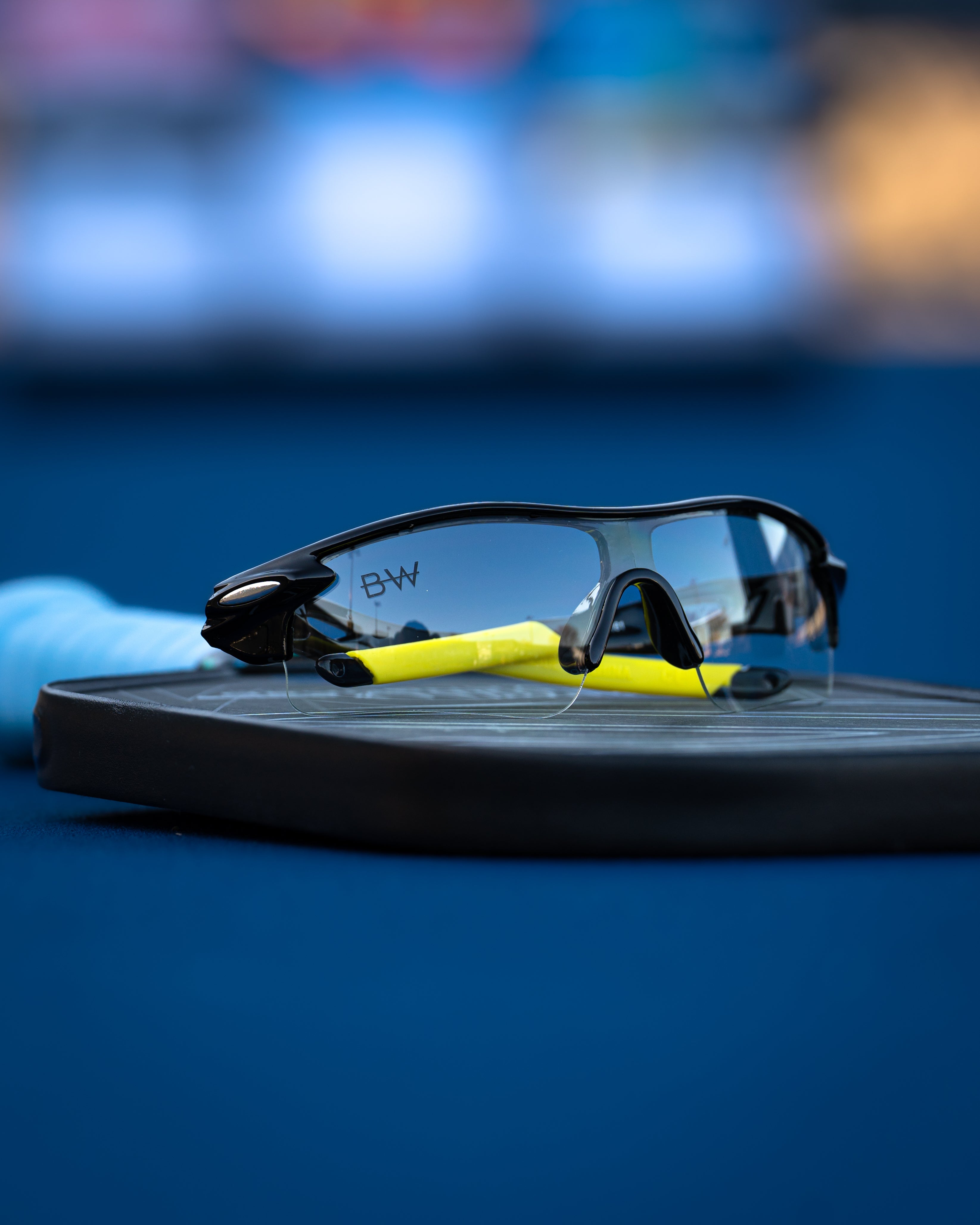
Enhance Your Game: Top Prescription Sports Eyewear for 2026
Share
Top Prescription Sports Eyewear for 2026: How to Choose RX Glasses for Pickleball
If you need vision correction while playing pickleball, the right prescription sports eyewear starts with something more important than hype: your actual prescription, playing environment, frame fit, and lens configuration.
Prescription sports glasses can combine your vision correction with eyewear selected specifically for active use, eliminating the need to rely on ordinary everyday frames or contacts if you prefer an all-in-one RX option.
In this 2026 guide, we'll explain what to look for in prescription sports eyewear for pickleball, how RX sports glasses differ from non-prescription sunglasses, what non-polarized and high-index lenses actually mean, and how to choose between clear and tinted configurations without relying on unsupported performance promises.
Find the Right Pickleball Eyewear
Need prescription correction, non-prescription sunglasses, or an untinted option? Start with the eyewear category that matches how you play.
Quick Answer: What Should You Look for in Prescription Sports Eyewear?
For pickleball and other active sports, start by looking for prescription eyewear that provides the correction you need in a frame appropriate for active use.
Important buying factors include:
- Prescription compatibility with the exact frame you want
- Current prescription correction appropriate for your vision needs
- Clear or tinted lenses based on where and when you play
- Polarization preference
- Impact-resistant lenses for active use
- Frame dimensions and fit
- Lens material and thickness considerations
- Any specific protective certification you personally require
- Replacement support and current policy terms
Blinded Wear prescription sports eyewear includes high-index prescription lenses at no additional cost. Its sports lenses are non-polarized and impact-resistant, and the brand offers 50% lifetime replacement support if eligible eyewear breaks, subject to current policy terms.
What Is Prescription Sports Eyewear?
Prescription sports eyewear combines corrective lenses with frames intended for active use.
For a pickleball player who normally wears glasses, that means the same basic vision correction you depend on away from the court can be incorporated into compatible sports eyewear.
This is different from non-prescription sports sunglasses, which do not correct refractive errors.
| Eyewear Type | Corrects Vision? | Typical Use |
|---|---|---|
| Prescription sports eyewear | Yes | Players who need corrective lenses during sports |
| Non-RX sports sunglasses | No | Players who do not require built-in prescription correction |
| Clear non-RX sports eyewear | No | Players who want untinted eyewear without built-in correction |
| Contacts + non-RX sports eyewear | Contacts provide correction | Players who prefer contact lenses underneath external sports eyewear |
Why Consider Prescription Sports Glasses for Pickleball?
Pickleball involves frequent changes in distance and position. During a point, a player may look across the court at a serve, move forward toward the kitchen, react to a nearby volley, and then reset for the next shot.
If you require prescription correction in everyday life, having the appropriate correction available while playing can therefore be an important part of your eyewear setup.
The strongest reason to consider RX sports glasses is straightforward:
You need vision correction and want that correction incorporated directly into eyewear selected for active use.
That is a more defensible reason than claiming that prescription sports glasses automatically improve reaction speed, ball tracking, depth perception, or athletic performance.
Can Prescription Sports Glasses Improve Your Pickleball Game?
Appropriate prescription correction can address blur caused by refractive error. But eyewear should not be marketed as though simply wearing an RX sports frame automatically makes an athlete faster or more skilled.
Pickleball performance also depends on:
- Technique
- Positioning
- Anticipation
- Decision-making
- Reaction ability
- Practice
- Physical conditioning
- Experience
A better goal for prescription sports eyewear is to provide the correction you require in an eyewear configuration suited to your needs on court.
Prescription Sports Glasses vs. Everyday Prescription Glasses
Everyday prescription glasses and prescription sports eyewear can both provide vision correction, but they may be selected for different purposes.
| Consideration | Everyday RX Glasses | RX Sports Eyewear |
|---|---|---|
| Vision correction | Yes | Yes |
| Primary use | General everyday wear | Active or sports-focused use |
| Frame selection | Often selected around everyday comfort and style | Can be selected specifically around active use |
| Lens characteristics | Depend on the exact pair | Depend on the exact sports configuration |
| Impact resistance | Must be verified | Should still be verified for the exact eyewear |
| Protective certification | Must be verified | Must be verified separately if required |
Ordinary prescription glasses are not automatically unsuitable for pickleball. Dedicated sports eyewear simply gives players another option when they want a frame and lens configuration selected specifically for active use.
Prescription Sports Glasses vs. Contacts for Pickleball
Players who need correction generally have more than one potential setup. Some prefer prescription sports glasses, while others wear appropriately prescribed contacts underneath non-RX sports eyewear.
| Setup | Correction Comes From | External Eyewear |
|---|---|---|
| RX sports glasses | Prescription lenses in the sports frame | The RX sports glasses themselves |
| Contacts + sports sunglasses | Contact lenses | Compatible non-RX sports eyewear |
| Contacts + clear sports eyewear | Contact lenses | Untinted non-RX sports eyewear |
Neither approach is universally better. Prescription needs, eye health, contact-lens suitability, comfort, environment, and personal preference all matter.
8 Things to Look for When Buying Prescription Sports Eyewear
1. Prescription Compatibility
Start by confirming that the frame and lens configuration can accommodate your prescription. Do not assume every prescription can be placed into every sports frame.
2. A Current Prescription
Your eyewear is only as relevant as the prescription used to make it. If your vision has changed or your prescription is outdated, consider obtaining an updated eye examination before ordering.
3. Lens Configuration
Determine whether you want clear, tinted, or another available configuration based on the environments where you actually play.
4. Impact Resistance
Impact resistance is a useful characteristic for active eyewear. Blinded Wear sports lenses are impact-resistant.
5. Frame Fit
Compare available dimensions with glasses that already fit you comfortably. A sports label alone cannot guarantee fit for every face.
6. Polarization Preference
Decide whether you want polarized or non-polarized eyewear rather than assuming one category is universally required for pickleball.
7. Verified Features
If anti-fog, scratch resistance, UV protection, anti-reflective treatment, photochromic behavior, or another feature matters to you, verify it for the exact configuration.
8. Protection Requirements
If you specifically need eyewear certified to a particular protective standard, verify that certification separately. “Sports eyewear” and “impact-resistant” are not substitutes for a documented certification.
What Are High-Index Prescription Sports Lenses?
High-index refers to a lens material's refractive characteristics. It can be useful in prescription eyewear because lens material and prescription strength influence the final lens profile.
Blinded Wear includes high-index prescription lenses at no additional cost with its RX eyewear.
However, “high-index” should not be confused with a sports-performance technology.
High-index lenses do not inherently provide:
- Faster reaction time
- Better depth perception
- Better ball tracking
- Anti-fog performance
- Anti-reflective treatment
- Polarization
- Impact certification
Those are separate characteristics and should be verified independently when relevant.
What Does Non-Polarized Prescription Sports Eyewear Mean?
A non-polarized prescription lens does not have an added polarization filter.
Blinded Wear sports lenses are non-polarized.
Some pickleball players prefer non-polarized eyewear, but it is important not to turn that preference into an unsupported universal performance claim.
Non-polarized lenses do not inherently guarantee:
- Better depth perception
- More accurate distance judgment
- Better spin recognition
- Better contrast
- Faster visual processing
- Faster reactions
The verified distinction is simply that a polarization filter is not added.
Polarized vs. Non-Polarized Prescription Sports Glasses
Polarized lenses are commonly used to reduce certain reflected glare. Non-polarized lenses do not use that polarization filter.
| Lens Type | Polarization Filter? | What You Should Know |
|---|---|---|
| Polarized RX | Yes | Uses a polarization filter; exact product characteristics vary |
| Non-polarized RX | No | No polarization filter is added |
Neither label alone tells you everything about optical quality, prescription accuracy, impact resistance, fit, tint, UV characteristics, or protective certification.
Choose according to your needs and preferences rather than assuming polarization status determines athletic performance.
What About Depth Perception?
Depth perception is more complex than whether a lens is polarized or non-polarized. It involves multiple visual cues and the way your visual system interprets spatial relationships.
If you need prescription correction, having appropriate correction may be important to how clearly you see. But it is too broad to claim that a non-polarized lens automatically creates “true depth perception” or gives every athlete an advantage.
Similarly, a tinted lens should not automatically be credited with improving distance judgment, spin recognition, or reaction time.
Evaluate these characteristics separately rather than treating one lens label as a shortcut for overall sports vision.
Clear vs. Tinted Prescription Sports Eyewear
Your playing environment is one of the most practical factors when choosing an RX lens configuration.
| Configuration | Useful Starting Point | Important Limitation |
|---|---|---|
| Clear RX | Indoor, evening, or other conditions where you do not want a dark sunglass tint | Clear does not automatically improve contrast or tracking |
| Tinted RX | Outdoor conditions where you prefer a sunglass tint | Tint color alone does not prove a specific performance benefit |
| Adaptive/photochromic RX | Potential option for changing environments when an appropriate configuration is available | Tint changes are not instantaneous and exact behavior varies |
Prescription Sports Glasses for Indoor Pickleball
For indoor pickleball, many players do not want the dark tint they might choose for bright outdoor sessions.
If you need correction indoors, an appropriate clear prescription sports configuration can provide RX correction without a dark sunglass tint.
That does not mean clear lenses inherently:
- Increase available light
- Improve contrast
- Make the ball brighter
- Improve tracking
- Improve reaction time
The practical advantage is simpler: you retain your prescription correction without adding a dark sunglass tint.
Prescription Sports Sunglasses for Outdoor Pickleball
For daytime outdoor play, prescription sports sunglasses combine corrective lenses with a sunglass configuration.
When comparing outdoor RX eyewear, consider:
- Your current prescription
- Tint preference
- Polarization preference
- Frame fit
- Impact resistance
- Any exact UV specification you require
- Any documented coatings you want
- Any protective certification you require
Do not infer an exact UV rating from how dark a lens appears. If a particular UV specification matters to you, verify it for the exact product and lens configuration.
Prescription Sports Eyewear for Evening and Lower-Light Play
As available light decreases, heavily tinted sunglasses may no longer be the configuration you prefer.
Players who need prescription correction during evening pickleball can consider an appropriate clear RX configuration when available.
The goal is not to find a lens that claims to “enhance night vision.” Instead, choose eyewear that provides the correction you need without unnecessary dark tint for the environment.
Are Photochromic Prescription Sports Lenses Worth Considering?
Photochromic lenses are designed to change tint in response to activating light. For some athletes who move through changing environments, that can make them worth considering when an appropriate RX configuration is available.
But photochromic lenses should not automatically be described as:
- Instantly changing
- Perfect for every indoor/outdoor transition
- Anti-fog
- Scratch-resistant
- Polarized
- Performance-enhancing
- Certified protective eyewear
Those characteristics must be evaluated separately.
Why Impact Resistance Matters in Sports Eyewear
Pickleball is played with a fast-moving ball in close proximity to other players and paddles, making the physical characteristics of eyewear relevant to many shoppers.
Blinded Wear sports lenses are impact-resistant.
However, impact resistance should not be expanded into claims the specification does not establish.
Impact-resistant does not automatically mean:
- Shatterproof
- Indestructible
- Guaranteed to prevent eye injury
- Certified to a specific sports-protection standard
If you require certified protective eyewear, verify the exact certification for the exact product before purchasing.
Are Prescription Sports Glasses the Same as Protective Sports Eyewear?
Not necessarily.
“Prescription sports eyewear” describes eyewear combining prescription correction with a sports-focused configuration. That alone does not establish compliance with a particular protective-eyewear standard.
This distinction matters because several terms can sound similar:
| Term | What It Establishes |
|---|---|
| Prescription eyewear | Provides corrective lenses |
| Sports eyewear | Indicates sports or active-use positioning |
| Impact-resistant lens | Describes a physical lens characteristic |
| Certified protective eyewear | Requires documentation showing compliance with the named standard |
If eye protection is your primary concern, identify the standard you require and confirm that the exact eyewear meets it.
How Should Prescription Sports Glasses Fit?
A good sports-eyewear buying decision should account for fit, but no frame can honestly be guaranteed to fit every player the same way.
Useful measurements can include:
- Overall frame width
- Lens width
- Lens height
- Bridge width
- Temple length
When shopping online, compare available measurements with a pair of glasses you already find comfortable.
A lightweight frame can help with extended-wear comfort, but lightweight construction does not automatically mean a frame will never slip or move.
What About Fogging During Pickleball?
Sports eyewear can develop condensation when temperature, moisture, airflow, and other conditions allow it.
Do not assume a pair of RX sports glasses is “fog-proof” simply because it is designed for athletes.
If an exact product has a documented anti-fog treatment or other relevant feature, evaluate that specific feature separately. Otherwise, avoid assuming it is present.
What About Sweat and Frame Movement?
Pickleball can involve extended active sessions, making comfort and fit relevant when selecting a frame.
But claims such as “zero-slip,” “never moves,” or “sweat-proof fit” should not be inferred from a sports frame unless the exact product supports those claims.
Instead, evaluate:
- Available frame dimensions
- Overall frame design
- Weight
- Your own facial dimensions
- How similar frames have fit you previously
Prescription Sports Eyewear Claims to Question
| Marketing Claim | What to Verify Instead |
|---|---|
| “Improves reaction speed” | Whether the eyewear provides the prescription correction and configuration you need |
| “Perfect depth perception” | Prescription accuracy and the actual lens characteristics |
| “Zero distortion” | The actual optical and prescription specifications |
| “Fog-proof” | Whether a documented anti-fog feature exists |
| “Shatterproof” | The exact impact-resistance or protection specification |
| “UV400” | Whether that exact UV specification is documented for the lens |
| “Secure fit” | Frame dimensions and your individual fit |
| “Best for every athlete” | Whether the frame and lenses match your own prescription and environment |
What Does Blinded Wear Offer Prescription Pickleball Players?
Blinded Wear's RX collection is built for players who need corrective lenses in sports-focused eyewear.
Core characteristics include:
- Prescription pickleball eyewear
- High-index prescription lenses at no additional cost
- Non-polarized sports lenses
- Impact-resistant sports lenses
- Lightweight sports frames
- Design focused on active pickleball use
- Options for recreational and competitive players
- 50% lifetime replacement support if eligible eyewear breaks, subject to current policy terms
Specific tint, coating, adaptive-lens, UV, frame, and certification characteristics should be verified for the exact model and configuration you are considering.
How to Order Blinded Wear Prescription Sports Eyewear
The basic process starts with choosing a compatible RX model and providing your prescription information.
- Browse the prescription eyewear collection.
- Select the RX frame you want to explore.
- Review the current product options and specifications.
- Make sure the configuration is compatible with your prescription.
- Provide a clear photo or picture of your eyeglass prescription.
- Complete your order according to the current product instructions.
Because prescriptions and frame compatibility can vary, do not assume every RX configuration is appropriate for every prescription.
Prescription Pickleball Glasses to Explore in 2026
There is no single RX frame that is automatically best for every player. Instead of assigning arbitrary rankings, compare current Blinded Wear models according to your prescription, preferred frame, lens configuration, and playing environment.
- H Blue Shield RX →
- Lava Rock RX →
- Phantom II RX →
- Crystal Wave II RX →
- Havana Melt RX →
- Rocket Fire RX →
- Silver Line RX →
- Frost RX →
- Ocean Wave RX →
- Red Shine RX →
- Gray Hound RX →
Use each current product page to verify its exact available configuration before ordering.
Choose Prescription Sports Eyewear by Where You Play
| Where You Play | Useful Starting Point | Verify Before Ordering |
|---|---|---|
| Indoor courts | Compatible clear RX configuration | Prescription compatibility and exact lens availability |
| Outdoor daytime | Compatible tinted RX sports eyewear | Tint, RX compatibility, and any specific UV requirement |
| Evening | Clear RX when an untinted lens is preferred | Prescription compatibility and available configuration |
| Changing conditions | Separate clear/tinted pairs or a compatible adaptive option | How the exact lens behaves and whether it is available with your prescription |
| Tournament travel | Primary RX pair plus an appropriate backup | Playing environments, storage, and replacement planning |
Prescription Sports Eyewear FAQ
What are prescription sports glasses?
Prescription sports glasses combine corrective lenses with frames intended for active or sports-focused use.
Can you get prescription glasses for pickleball?
Yes. Blinded Wear offers prescription eyewear designed with pickleball players in mind.
Are prescription sports glasses better than normal glasses for pickleball?
Not universally. Dedicated sports eyewear can be useful if you want prescription correction in a frame and lens configuration selected specifically for active use.
Are prescription sports glasses worth it?
They can be worth considering if you need vision correction and prefer having that correction incorporated directly into dedicated sports eyewear. Whether they are worth it for you depends on your prescription, current eyewear, playing frequency, and preferences.
Can I wear my normal prescription glasses for pickleball?
Players can wear everyday prescription glasses, but you may prefer dedicated sports eyewear depending on fit, lens characteristics, impact resistance, and how often you play.
Can I wear contacts with pickleball sunglasses?
Players who use appropriately prescribed contacts may choose compatible non-prescription sports eyewear over them. Contact-lens suitability is an individual eye-care consideration.
What are high-index prescription sports lenses?
High-index refers to a prescription lens material characteristic. Blinded Wear includes high-index prescription lenses at no additional cost with RX eyewear.
Are Blinded Wear prescription lenses polarized?
Blinded Wear sports lenses are non-polarized, meaning a polarization filter is not added.
Do non-polarized lenses improve depth perception?
Non-polarized lenses should not automatically be claimed to improve depth perception. Depth perception involves multiple visual cues, and polarization status alone does not determine overall spatial vision.
Are Blinded Wear prescription lenses impact-resistant?
Yes. Blinded Wear sports lenses are impact-resistant. Impact-resistant does not mean shatterproof or establish certification to a specific protective standard.
Are clear prescription glasses good for indoor pickleball?
A clear RX configuration can be a practical option when you need prescription correction but do not want a dark sunglass tint indoors.
What prescription sports glasses should I use outdoors?
Consider a compatible RX sunglass configuration based on your prescription, preferred tint, frame fit, polarization preference, and any specific lens characteristics you require.
Can one pair of prescription sports glasses work indoors and outdoors?
Possibly, depending on the lens configuration and your preferences. Some players prefer separate clear and tinted pairs, while others consider compatible adaptive lenses for changing environments.
Does Blinded Wear offer a lifetime warranty?
Blinded Wear offers 50% lifetime replacement support if eligible eyewear breaks, subject to current policy terms. This should not be interpreted as unlimited free replacement.
How to Choose Prescription Sports Eyewear in 2026
Choosing RX sports glasses becomes much easier when you stop searching for one universal “best” pair and instead work through your actual requirements in order.
- Start with your prescription. Determine what correction you currently need.
- Identify your primary sport. For pickleball, think about how frequently you play and the environments you encounter.
- Identify your main lighting environment. Indoor, outdoor daytime, evening, and mixed-condition players may prefer different lens configurations.
- Choose clear, tinted, or another compatible option.
- Review frame measurements. Compare them with eyewear that already fits you well.
- Verify impact resistance.
- Check any additional feature that matters to you. Do not assume coatings or treatments are included.
- Verify any required protective certification.
- Review replacement and support policies.
- Confirm prescription compatibility before ordering.
This process prioritizes the characteristics that can actually determine whether an RX pair makes sense for you.
Prescription Sports Eyewear Decision Tree
Use these questions to narrow your options quickly.
Do You Need Vision Correction While Playing?
Yes: Start with prescription sports eyewear or appropriately prescribed contacts combined with compatible non-RX eyewear.
No: You probably do not need RX sports glasses. Explore non-prescription sports sunglasses or clear sports eyewear instead.
Do You Primarily Play Indoors?
Yes: Consider a compatible clear RX configuration if you prefer an untinted lens.
Do You Primarily Play Outdoors During the Day?
Yes: Consider a compatible tinted RX sports-sunglass configuration.
Do You Regularly Play in Several Environments?
Yes: Compare separate clear and tinted RX pairs with any compatible adaptive configuration available for your prescription.
Do You Require a Specific Protective Standard?
Yes: Verify certification to that exact standard before purchasing. Do not substitute general terms such as “sports,” “impact-resistant,” or “protective” for documented certification.
Which RX Sports Eyewear Setup Fits Your Pickleball Routine?
| Player Type | Setup to Consider | Main Priority |
|---|---|---|
| Indoor RX player | Compatible clear prescription sports eyewear | Correction without a dark sunglass tint |
| Outdoor RX player | Compatible tinted prescription sports eyewear | Correction plus preferred outdoor tint |
| Indoor + outdoor RX player | Separate configurations or a compatible adaptive option | Managing different environments |
| Frequent tournament player | Primary RX pair plus appropriate backup | Redundancy and changing match conditions |
| Contact-lens wearer | Contacts plus compatible non-RX sports eyewear | Separating vision correction from external eyewear |
| Recreational player | Configuration matched to prescription and normal playing environment | Practical fit and vision needs |
How to Compare RX Sports Frame Measurements Online
Frame measurements are one of the most useful tools available when buying prescription sports glasses online.
If you already own glasses that fit comfortably, use them as a reference point.
Frame Width
Overall width can help you estimate how the frame may compare with eyewear you already wear.
Lens Width
This describes the horizontal width of an individual lens opening or lens, depending on how the manufacturer reports the measurement.
Bridge Width
This measurement relates to the area connecting the lenses across the nose.
Temple Length
This describes the length of the arms extending toward and around the ears.
Lens Height
Lens height can help you understand the vertical dimensions of the eyewear.
Measurements cannot guarantee comfort, but they provide more useful information than assuming every “athletic” or “unisex” frame fits everyone the same way.
How to Estimate Fit Before Ordering Prescription Sports Glasses Online
- Find a pair you already wear comfortably.
- Locate its measurements if available.
- Compare those dimensions with the RX sports frame.
- Consider whether you generally prefer narrower or wider eyewear.
- Review the exact frame rather than relying only on model photos.
Face-shape categories can help with style inspiration, but actual dimensions are generally more useful for comparing physical frame size.
Do not assume a frame will be “non-slip” simply because it is lightweight or designed for sports. Individual fit still matters.
Does Prescription Strength Affect Which Sports Frames You Can Choose?
It can. Prescription compatibility is not identical across every frame and lens configuration.
Factors associated with your prescription and selected frame can affect which combinations are practical or available.
That is why the correct sequence is:
Choose a frame you like → confirm RX compatibility → confirm the available lens configuration → order.
Do not assume that because one Blinded Wear model is available with prescription lenses, every possible prescription can automatically be produced in that model.
Why Consider High-Index Lenses in Prescription Sports Eyewear?
Prescription strength and lens material can influence the physical profile of corrective lenses. High-index materials are one option used in prescription eyewear.
Blinded Wear includes high-index prescription lenses at no additional cost with its RX eyewear.
When comparing high-index options, keep the terminology precise. High-index describes a lens-material characteristic; it does not automatically establish:
- A specific lens index such as 1.61 or 1.67
- A particular coating
- UV400 protection
- Anti-fog performance
- Scratch resistance
- Polarization
- Improved depth perception
- Improved reaction time
- A protective certification
If one of those characteristics matters to you, verify it separately for the exact lens configuration.
What Actually Affects Clarity in Prescription Sports Eyewear?
“Clarity” is frequently used as a broad marketing term, but several different concepts can be bundled underneath it.
For a player who requires corrective lenses, an important starting point is having an appropriate prescription.
Your experience can also be affected by factors such as:
- Whether your prescription is current
- The exact lens configuration
- Whether the lenses are clean
- Meaningful scratches or damage
- Condensation or moisture on the viewing surface
- How the eyewear sits on your face
- The environment in which you are playing
That is more useful than assuming a product marketed as “HD,” “crystal clear,” or “performance optics” automatically provides superior sports vision.
Clear RX vs. Tinted RX: Which Has Better Clarity?
Neither category should automatically be declared clearer for every player and every environment.
A clear lens is untinted. A tinted lens changes the amount and characteristics of visible light reaching the eye according to the exact tint.
The more useful question is whether the selected configuration makes sense for the environment where you plan to wear it.
| Situation | Configuration to Consider |
|---|---|
| Indoor court | Clear RX if you prefer an untinted lens |
| Outdoor daytime court | Tinted RX if you prefer sunglasses |
| Evening play | Clear RX when dark tint is not preferred |
| Changing conditions | Multiple pairs or a compatible adaptive option |
What Is the Best Lens Tint for Prescription Sports Glasses?
There is no single tint color that should be described as universally best for pickleball or every other sport.
You may encounter recommendations for gray, amber, yellow, rose, blue, or other lens colors. A color alone does not establish that the lens will:
- Improve ball tracking
- Increase reaction speed
- Improve depth perception
- Increase contrast in every environment
- Make a particular ball color universally easier to see
Consider your playing environment and personal preference, then verify any specific performance characteristic claimed for the exact lens.
Are Yellow Prescription Sports Lenses Better for Indoor Pickleball?
Yellow lenses are sometimes marketed for lower-light sports and indoor environments, but the existence of a yellow tint does not automatically prove improved contrast, tracking, or performance.
If you prefer an untinted viewing experience indoors, clear RX eyewear may be a more straightforward option to consider.
If you prefer a particular tint, evaluate the exact lens rather than relying on the color name as proof of a visual advantage.
What UV Protection Should Prescription Sports Sunglasses Have?
UV protection can be an important consideration for outdoor eyewear, but an exact UV specification should be verified rather than inferred.
Do not assume a prescription sports lens is UV400 merely because it is:
- Dark
- Tinted
- High-index
- Impact-resistant
- Designed for sports
- Sold as sunglasses
If an exact UV specification matters to your purchase, confirm that specification for the precise lens configuration you are ordering.
Do Prescription Sports Glasses Need Anti-Reflective Coating?
Anti-reflective treatment is a separate lens feature and should not be assumed to be included with every prescription sports lens.
Likewise, the terms non-polarized and anti-reflective are not interchangeable.
If an anti-reflective treatment is important to you, verify whether it is available or included with the exact RX configuration you are considering.
Are Prescription Sports Lenses Scratch-Resistant?
Do not assume that impact resistance also means scratch resistance.
They describe different characteristics.
- Impact resistance relates to the lens's response to impact.
- Scratch resistance relates to resistance against surface scratching.
If a scratch-resistant treatment is important to you, verify that feature separately for the exact lens.
Do Prescription Sports Glasses Need Anti-Fog Lenses?
Fog can interfere with the viewing surface during active play, particularly when temperature, moisture, and airflow create conditions for condensation.
However, “sports eyewear” does not automatically mean anti-fog eyewear.
Before buying based on an anti-fog claim, determine whether the exact product has a documented anti-fog treatment or other specifically described feature.
Even then, avoid interpreting anti-fog terminology as a guarantee that condensation can never occur.
Keeping Prescription Sports Lenses Clear During Play
Even an appropriate prescription can become harder to use if the viewing surface becomes dirty or obstructed.
Before playing:
- Inspect the lenses for visible residue
- Clean them using a method appropriate for the eyewear
- Check for meaningful scratches or damage
- Inspect the frame for obvious damage
- Make sure the eyewear sits appropriately before beginning play
During a long session, perspiration, fingerprints, dust, and other residue can accumulate. Cleaning the lens when necessary is a simple part of maintaining usable sports eyewear.
How to Test New Prescription Sports Glasses Before Competition
Do not make an important tournament match the first time you wear a new RX pair.
Use a normal practice session to evaluate the eyewear first.
- Wear the glasses while stationary. Look naturally around the court.
- Add head movement. Look toward the sidelines, kitchen, baseline, and overhead.
- Walk and shuffle around the court.
- Begin with controlled drills.
- Progress to normal rallies.
- Wear them for a longer session.
Pay attention to whether the prescription feels appropriate, whether the frame repeatedly needs adjustment, and whether your chosen clear or tinted configuration makes sense for the environment.
Do You Need Time to Adjust to New Prescription Sports Glasses?
A new prescription, frame geometry, or lens configuration can feel different from the eyewear you previously used.
That does not mean every new pair requires a lengthy adaptation period, and there is no universal number of hours or days that applies to everyone.
If something about new prescription eyewear feels persistently wrong or your vision seems inappropriate, do not assume you simply need to “push through” indefinitely. Review the prescription and eyewear with the appropriate eye-care or eyewear professional.
How Important Is a Current Prescription?
Your prescription is fundamental to RX sports eyewear.
If you have noticed changes in your vision, have concerns about your current correction, or are due for an eye examination, consider addressing that before investing in a new sports pair.
Prescription sports eyewear should not be treated as a substitute for professional eye care.
What Prescription Information Do You Need to Order Online?
Blinded Wear RX customers provide a clear photo or picture of their eyeglass prescription as part of the prescription ordering process.
Before submitting it, make sure the prescription image is:
- Clear enough to read
- Not cropped in a way that removes important information
- The prescription you actually intend to use
If you are uncertain about your prescription or whether it is appropriate for the eyewear you want, resolve that question before completing the order.
What About PD and Other Prescription Measurements?
Prescription eyewear can require information beyond simply choosing a frame style. The exact information needed can depend on the prescription and ordering process.
Follow the current instructions provided for the exact RX product and provide any requested information accurately.
Do not guess at prescription-related measurements if you do not know them. If required information is missing or unclear, obtain the appropriate measurement or clarification before the eyewear is produced.
Can You Get Progressive Prescription Sports Glasses?
Progressive compatibility should be verified for the exact frame and prescription configuration rather than assumed across an entire sports-eyewear collection.
If you use progressive lenses, confirm compatibility before purchasing a particular sports frame.
The same principle applies to other specialized prescription requirements: verify the exact configuration rather than assuming every RX frame supports every prescription type.
What If You Have a Strong Prescription?
A stronger prescription does not automatically prevent you from using sports eyewear, but compatibility can depend on the frame, lens material, prescription details, and available configuration.
High-index lenses may be relevant to some prescription wearers, but do not assume that “high-index” means every strong prescription is automatically compatible with every frame.
Confirm compatibility before ordering.
What About Prescription Sports Glasses for Astigmatism?
If your eyeglass prescription includes astigmatism correction, the key question remains whether the exact prescription is compatible with the sports frame and lens configuration you want.
A product being labeled “RX” does not by itself establish compatibility with every possible prescription.
Use your actual eyeglass prescription and confirm compatibility rather than selecting a frame based solely on a general product category.
Should Pickleball Players Carry a Backup Pair of Prescription Glasses?
A backup pair can be especially useful for players who depend on prescription correction.
If your primary RX sports glasses are damaged, lost, or otherwise unavailable, replacing them immediately may not be possible.
A backup becomes particularly worth considering for:
- Tournaments
- League play
- Sports travel
- Multi-day events
- Players who cannot comfortably play without correction
The backup does not necessarily have to be identical to your primary pair. The important question is whether it provides an appropriate alternative if your main eyewear becomes unavailable.
Prescription Sports Eyewear for Pickleball Tournaments
Tournament players may encounter more variation than they experience during a normal recreational session.
A tournament day can involve:
- Multiple matches
- Longer total wear time
- Changing weather
- Different times of day
- Indoor or outdoor venues
- Travel
- Limited ability to replace damaged RX eyewear
Rather than looking for “tournament-grade optics,” plan around these practical requirements.
Consider the lens configuration you expect to use, a safe way to store the eyewear, cleaning supplies appropriate for your lenses, and an appropriate backup if you depend on prescription correction.
Traveling With Prescription Sports Glasses
When traveling for pickleball or another sport, protect the eyewear between sessions instead of treating it like ordinary loose gear.
A simple travel plan can include:
- Your primary RX sports pair
- An appropriate backup when practical
- A suitable storage method
- Lens-cleaning supplies appropriate for the eyewear
- Access to your prescription information
Can You Use the Same Prescription Sports Glasses for Multiple Sports?
Potentially. Whether the same eyewear works for pickleball and another sport depends on the requirements of each activity.
Consider:
- Your prescription needs
- Playing environment
- Lens configuration
- Frame fit
- Impact resistance
- Any sport-specific protection requirement
Do not assume that because eyewear works well for recreational pickleball it automatically meets the requirements of every other sport.
Can Prescription Sports Glasses Go From Training to the Court?
A sports-focused RX pair may be useful across several active settings when its fit, prescription, and lens configuration make sense for those environments.
However, different activities can have different protection, lighting, and fit requirements.
Instead of assuming one pair is universally optimized for every activity, evaluate each use separately.
Prescription Sports Eyewear for Adult Athletes
Adults who require corrective lenses do not have to choose between playing in everyday eyewear and giving up prescription correction during sports.
Dedicated RX sports eyewear provides another option for players who want:
- Built-in prescription correction
- A sports-focused frame
- A clear or tinted configuration appropriate to their needs
- Impact-resistant sports lenses
The correct configuration still depends on the individual prescription and activity.
When Is a Dedicated Pair of RX Sports Glasses Worth Considering?
A dedicated pair becomes easier to justify when you regularly need correction during sports and want eyewear selected specifically around that use.
It may be particularly useful if:
- You play several times per week
- You rely heavily on prescription correction
- You prefer glasses over contacts
- You want to keep your everyday frames separate from sports use
- You regularly travel or compete
- You want a clear or tinted sports-specific configuration
Occasional players can still benefit from dedicated sports eyewear, but playing frequency is one factor to consider when deciding how much of your eyewear budget to dedicate to a separate pair.
What Should You Prioritize When Comparing RX Sports Eyewear Prices?
A higher price does not automatically mean better athletic performance, and the longest feature list is not necessarily the best value.
Prioritize the things you actually need:
- Appropriate prescription correction
- Prescription compatibility
- A suitable frame fit
- The lens configuration you need
- Impact resistance
- Any required protective certification
- Verified additional features you genuinely value
- Replacement support
Features that do not apply to your use should not become more important simply because they make a product description longer.
High-Index RX Lenses at No Additional Cost
When comparing the total cost of prescription sports eyewear, consider what is included with the RX purchase rather than looking only at the starting frame price.
Blinded Wear includes high-index prescription lenses at no additional cost with its prescription eyewear.
This is a concrete part of the RX offering and does not require attaching unrelated performance claims to high-index lenses.
Replacement Support for Prescription Sports Eyewear
Sports eyewear is used in active environments, so it is worth understanding what happens if your glasses break.
Blinded Wear provides 50% lifetime replacement support if eligible glasses break, subject to current policy terms.
This should not be interpreted as:
- Unlimited free replacement
- A promise that the eyewear cannot break
- Automatic coverage for every situation
- A generic “lifetime warranty” with no conditions
Review the current policy before purchasing so you understand the applicable terms.
How to Compare Prescription Pickleball Glasses Without Fake Rankings
Rather than assigning every RX model an arbitrary score, compare each option against your own requirements.
| Comparison Category | Question to Ask |
|---|---|
| Prescription | Can this frame accommodate my RX? |
| Environment | Is the available lens configuration appropriate for where I play? |
| Fit | How do the dimensions compare with glasses that fit me? |
| Lens material | What prescription lens characteristics are included? |
| Polarization | Does the configuration match my preference? |
| Impact resistance | Is this characteristic documented? |
| Additional features | Are the coatings or treatments I care about actually verified? |
| Protection | Does the product meet any specific certification I require? |
| Support | What happens if the eyewear breaks? |
Explore Blinded Wear RX Styles
Once you know your prescription requirements and preferred lens configuration, you can compare current frame styles.
| RX Model | Explore |
|---|---|
| H Blue Shield RX | View Model → |
| Lava Rock RX | View Model → |
| Phantom II RX | View Model → |
| Crystal Wave II RX | View Model → |
| Havana Melt RX | View Model → |
| Rocket Fire RX | View Model → |
| Silver Line RX | View Model → |
| Frost RX | View Model → |
| Ocean Wave RX | View Model → |
| Red Shine RX | View Model → |
| Gray Hound RX | View Model → |
Exact available configurations and prescription compatibility can vary. Use the current product information rather than assuming every model supports the same options.
10 Prescription Sports Eyewear Buying Mistakes to Avoid
-
Choosing a frame before considering RX compatibility.
A frame being sold in an RX collection does not mean every prescription works with every configuration.
-
Using an outdated prescription without considering whether your vision has changed.
Your prescription is the foundation of corrective eyewear.
-
Assuming non-polarized means better depth perception.
Non-polarized simply means a polarization filter is not added.
-
Assuming high-index means better sports performance.
High-index describes a prescription lens characteristic.
-
Ignoring frame measurements.
Measurements are useful when comparing fit online.
-
Assuming tinted means UV400.
Visible tint does not establish an exact UV specification.
-
Assuming impact-resistant means shatterproof.
These claims are not equivalent.
-
Assuming sports eyewear is automatically safety-certified.
A specific certification must be verified.
-
Believing a lens color guarantees better ball tracking.
Tint alone does not establish improved athletic performance.
-
Wearing new RX eyewear for the first time in an important match.
Test new eyewear during practice first.
More Questions About Prescription Sports Eyewear
What are the best prescription sports glasses for pickleball?
There is no universal best model. Start with your prescription, playing environment, preferred lens configuration, frame fit, impact resistance, and any specific protection requirements.
Where can I buy prescription pickleball glasses online?
Blinded Wear offers prescription pickleball eyewear online with high-index prescription lenses included at no additional cost.
Can strong prescriptions be used in sports glasses?
Some can, but compatibility depends on the exact prescription, frame, lens material, and available configuration. Confirm compatibility before ordering.
Can prescription sports glasses be clear?
Yes, compatible RX eyewear can use clear lenses when that configuration is available. Clear means untinted.
Can prescription sports glasses be sunglasses?
Yes. Prescription sports sunglasses combine corrective lenses with a tinted sunglass configuration.
Do prescription sports glasses improve reaction time?
They should not automatically be claimed to make neurological reactions faster. Appropriate correction can address refractive blur, while reaction performance depends on many additional factors.
Do prescription sports glasses improve depth perception?
Appropriate vision correction can be relevant to how clearly you see, but an RX sports frame or non-polarized lens should not automatically be claimed to improve depth perception.
Should prescription pickleball glasses be polarized?
That depends on your preference and available configuration. Blinded Wear sports lenses are non-polarized, but polarization status alone does not determine overall court performance.
Are high-index lenses better for pickleball?
High-index describes a prescription lens characteristic rather than an inherent pickleball-performance advantage. Blinded Wear includes high-index RX lenses at no additional cost.
Do sports glasses stop fogging?
Not automatically. External lenses can develop condensation. Verify any specific anti-fog feature for the exact eyewear.
Do prescription sports glasses protect your eyes?
Do not assume all prescription sports glasses provide the same level of protection. Impact resistance and certification to a particular protective standard are separate characteristics.
Can I use prescription pickleball glasses for tennis?
Potentially, depending on your prescription, frame fit, lens configuration, environment, and any sport-specific protection requirements.
Should I have two pairs of prescription sports glasses?
It is not required, but a backup can be useful for RX-dependent players, especially during tournaments and travel.
How do I order prescription glasses from Blinded Wear?
Choose a compatible RX model, review its current options, and provide a clear photo or picture of your eyeglass prescription according to the current ordering instructions.
Which Prescription Sports Eyewear Setup Matches Your Game?
There is no single prescription sports frame that is automatically the right choice for every athlete. Your best starting point depends on how you use the eyewear.
| Player Scenario | Starting Point | What Matters Most |
|---|---|---|
| Indoor recreational pickleball player | Compatible clear RX sports eyewear | Appropriate correction, fit, impact resistance, and an untinted lens if preferred |
| Outdoor daytime player | Compatible tinted RX sports eyewear | Prescription compatibility, preferred tint, fit, and verified lens characteristics |
| Indoor + outdoor player | Multiple RX configurations or a compatible adaptive option | Handling different lighting environments practically |
| RX-dependent tournament player | Primary RX sports pair plus an appropriate backup | Reliable access to correction throughout the event |
| Multi-sport athlete | RX sports eyewear compatible with each intended activity | Fit, environment, and any sport-specific protection requirements |
| Player requiring certified protection | Eyewear documented to meet the required standard | Certification rather than general sports marketing |
What Matters Most When Choosing RX Sports Eyewear?
If dozens of frame styles, lens terms, and marketing claims are making the decision complicated, reduce the purchase to five priorities.
1. Can the Eyewear Provide the Correction You Need?
Prescription compatibility comes first. A frame that looks ideal is not useful if your required RX configuration is not compatible.
2. Does the Lens Configuration Match Where You Play?
Consider whether you primarily need clear eyewear, tinted sunglasses, or more than one configuration.
3. Does the Frame Make Sense for You?
Use available measurements and your experience with existing glasses rather than relying solely on labels such as “athletic fit.”
4. Are the Characteristics You Care About Actually Verified?
Impact resistance, polarization status, coatings, UV specifications, and protective certifications are separate characteristics. Verify the ones that matter to you.
5. What Happens If the Eyewear Breaks?
Replacement support matters more for an RX-dependent player because prescription eyewear may not be immediately replaceable.
What Should You Avoid Overpaying for in Prescription Sports Eyewear?
A premium-sounding feature is only valuable when it is real and relevant to your needs.
Be cautious about paying extra primarily because a product description promises:
- “Elite vision”
- “Perfect depth perception”
- “Instant reactions”
- “Enhanced ball tracking”
- “Zero distortion”
- “Unbeatable contrast”
- “Fog-proof performance”
- “Tournament-grade optics”
These phrases can sound technical without clearly identifying a measurable product characteristic.
Spend your eyewear budget on the things you actually need: appropriate prescription correction, compatible lenses, suitable fit, the right configuration for your environment, verified physical characteristics, and any protection standard required for your use.
Prescription Sports Eyewear Buzzword Decoder
| Term | What It Actually Tells You | What It Does Not Automatically Tell You |
|---|---|---|
| RX | The eyewear is offered with prescription correction | Compatibility with every prescription |
| High-index | Describes a prescription lens material characteristic | Better athletic performance or a specific index unless stated |
| Non-polarized | No polarization filter is added | Better depth perception or tracking |
| Impact-resistant | Describes a physical lens characteristic | Shatterproof construction or certification to a specific standard |
| Clear lens | The lens is untinted | Enhanced contrast or improved reaction time |
| Tinted lens | The lens uses a visible tint | A specific UV rating or automatic performance benefit |
| Photochromic | The lens is designed to change tint in response to activating light | Instant transitions, polarization, anti-fog performance, or universal suitability |
| Sports eyewear | The eyewear is positioned or designed for active use | Certification to a specific protective standard |
What to Verify on an RX Product Page Before Checkout
Once you find a prescription sports frame you like, stop comparing broad marketing categories and verify the exact product.
- □ The product is actually an RX model.
- □ Your prescription is compatible with the selected frame and configuration.
- □ The lens configuration you want is currently available.
- □ Any tint you want is available with the RX configuration.
- □ Polarization status matches your preference.
- □ Impact resistance is documented if that matters to you.
- □ Frame dimensions make sense compared with eyewear that fits you.
- □ Any coating or treatment influencing your purchase is documented.
- □ Any exact UV specification you require is documented.
- □ Any protective certification you require is documented for the exact eyewear.
- □ You understand how to submit your prescription information.
- □ You have reviewed current replacement and policy terms.
If a characteristic is important enough to influence your purchase, it is important enough to verify.
What to Do When Your New Prescription Sports Glasses Arrive
Before taking new RX eyewear into a full match, perform a basic inspection.
- Confirm you received the correct model and configuration.
- Inspect the frame and lenses for obvious damage.
- Put the eyewear on in a familiar environment.
- Check how the frame sits on your face.
- Look naturally at objects at different distances.
- Move your head and body as you normally would during play.
- Use the eyewear during practice before relying on it in competition.
If your vision seems persistently inappropriate or something appears wrong with the prescription, address the issue rather than assuming every problem is a normal adjustment.
How Do You Know You Chose the Right Prescription Sports Glasses?
The right pair does not need to produce a dramatic “performance boost.” A successful purchase is much more practical.
Your eyewear should:
- Provide the prescription correction you require
- Use a lens configuration appropriate for how you intend to wear it
- Fit in a way you find suitable for active use
- Provide the verified characteristics you specifically wanted
- Meet any documented protection requirement you have
- Be practical enough that you are comfortable using it during your sport
If those needs are met, the eyewear is doing its job without requiring exaggerated claims about making you faster, more accurate, or more athletic.
Set Realistic Expectations for Prescription Sports Eyewear
Prescription sports glasses can solve an important problem: providing corrective lenses in eyewear selected for active use.
They cannot replace:
- Practice
- Technique
- Footwork
- Anticipation
- Decision-making
- Physical conditioning
- Experience
Likewise, an RX lens should not automatically be credited with improving reaction time, depth perception, ball tracking, or match results.
The value of prescription sports eyewear begins with appropriate correction and a configuration suited to your needs.
Do Competitive Players Need Different RX Glasses Than Recreational Players?
Competitive and recreational players may prioritize their eyewear differently, but competition level alone does not determine the correct prescription lens.
| Consideration | Recreational Player | Frequent Competitive Player |
|---|---|---|
| Prescription correction | Important when required | Important when required |
| Playing environment | Match normal playing conditions | May need to prepare for more varied venues and times |
| Backup RX pair | Optional depending on dependence and frequency | Can become more practical for tournaments and travel |
| Frame fit | Individual fit matters | Individual fit matters |
| Protection requirements | Based on individual needs | Based on individual needs and applicable requirements |
A competitive player does not automatically need a more expensive lens. The stronger reason for a different setup is usually greater playing frequency, travel, changing environments, or the need for redundancy.
Prescription Sports Eyewear for New Pickleball Players
If you are new to pickleball and already wear prescription glasses, you do not need to understand every lens technology before choosing sports eyewear.
Start with five questions:
- Do I need my prescription to play comfortably?
- Will I mostly play indoors or outdoors?
- Do I want clear or tinted eyewear?
- What frame dimensions normally fit me?
- Do I require a specific protective standard?
Those answers can narrow the market considerably before you start comparing secondary features.
Prescription Sports Eyewear for Older Pickleball Players
Pickleball players of different ages can require very different prescriptions. Age alone does not determine which sports frame or lens configuration is appropriate.
If your prescription has changed, you use specialized correction, or you have questions about your visual needs during sports, an eye-care professional can help determine the appropriate correction.
Once you know what correction you need, you can evaluate compatible sports frames according to fit, environment, lens configuration, and verified characteristics.
Prescription Sports Glasses for Men and Women: Does Gender Determine Fit?
Labels such as men's, women's, and unisex can help organize styles, but they do not replace actual frame measurements.
Two people of the same gender can need very different frame widths, bridge dimensions, and temple lengths.
When fit matters, prioritize:
- Actual measurements
- Your current comfortable eyewear
- Frame geometry
- Your individual preferences
Style labels can help you browse. Measurements help you compare size.
Can Prescription Sports Eyewear Still Be Stylish?
Choosing sports-focused eyewear does not mean ignoring appearance. If you are going to wear the glasses regularly, liking how they look can be a legitimate part of your decision.
Style should simply be evaluated alongside—not instead of—prescription compatibility, fit, lens configuration, and the verified characteristics you need.
Blinded Wear offers multiple RX frame styles so players can compare different designs rather than relying on a single prescription sports frame.
One RX Pair or Two? Choosing a Setup for Indoor and Outdoor Sports
Players who regularly move between indoor and outdoor courts have several possible approaches.
| Setup | Potential Advantage | Consideration |
|---|---|---|
| One clear RX pair | Simple untinted setup | May not provide the sunglass tint you prefer outdoors |
| One tinted RX pair | Simple outdoor sunglass setup | Dark tint may not be preferred indoors or later in the day |
| Clear RX + tinted RX | Dedicated configuration for different environments | Requires purchasing and carrying two pairs |
| Compatible photochromic RX | One adaptive configuration when available | Transition behavior varies and is not instantaneous |
The best arrangement is the one that fits your prescription, environments, preferences, and budget.
Protect Your Prescription Sports Eyewear After You Buy It
Prescription sports eyewear is equipment you may use repeatedly, so basic care matters.
Useful habits include:
- Store the eyewear appropriately when it is not being worn
- Avoid placing the lenses directly against abrasive surfaces
- Clean the lenses using methods appropriate for the eyewear
- Inspect the frame and lenses after impacts or obvious damage
- Avoid treating scratch resistance, when present, as scratch-proof construction
- Keep a backup accessible when you depend heavily on RX correction
When Should You Replace Prescription Sports Glasses?
Replacement can become worth considering when:
- Your prescription changes
- The frame is damaged
- The lenses are damaged enough to interfere with use
- The eyewear no longer fits appropriately
- Your playing environment or lens needs change
- You need a different level of documented protection
Do not assume that prescription sports eyewear has a universal replacement schedule. Condition, prescription changes, use, and individual needs matter more than an arbitrary calendar date.
2026 Prescription Sports Eyewear Buying Checklist
Use this checklist before placing an RX sports-eyewear order:
- □ My prescription is appropriate for the order I am placing.
- □ I have confirmed the frame can accommodate my prescription.
- □ I know whether I primarily need clear, tinted, or another available configuration.
- □ I understand whether the lenses are polarized or non-polarized.
- □ I have compared available frame dimensions.
- □ I have verified impact resistance if it matters to my purchase.
- □ I have verified any exact UV specification I require.
- □ I have verified any anti-fog, anti-reflective, scratch-resistant, or other treatment influencing my decision.
- □ I have verified any protective certification I specifically require.
- □ I understand how my prescription information must be submitted.
- □ I have reviewed current replacement and support terms.
- □ I am not relying on unsupported promises of better tracking, reactions, or depth perception.
More Prescription Sports Eyewear Questions
What prescription sports eyewear is best for indoor pickleball?
If you need RX correction and prefer an untinted lens indoors, a compatible clear prescription sports configuration is a practical starting point. Frame fit and prescription compatibility still need to be considered.
What prescription sports eyewear is best for outdoor pickleball?
Consider a compatible tinted RX sports configuration based on your prescription, tint preference, frame fit, polarization preference, and any exact lens characteristics you require.
Are non-polarized prescription sunglasses good for sports?
Non-polarized prescription sunglasses are an option for athletes who prefer eyewear without a polarization filter. Non-polarized does not automatically mean improved tracking, reactions, or depth perception.
Do I need special glasses to play pickleball?
Not every player requires a separate pair of dedicated sports glasses. If you need prescription correction, play frequently, or have specific eyewear or protection requirements, dedicated sports eyewear may be worth considering.
Are sports prescription glasses safer than normal glasses?
Do not assume that from the category name alone. Compare documented lens characteristics and any protective certification you require for the exact products.
Are impact-resistant prescription glasses shatterproof?
No. Impact resistance should not automatically be interpreted as shatterproof or indestructible construction.
Are all prescription sports glasses safety-rated?
No. Sports positioning and a documented protective certification are separate. Verify the exact standard when certification matters.
What color prescription lens is best for pickleball?
There is no universal best tint color for every player and environment. Consider where you play and your personal preference, and verify any specific performance claims made for a lens.
Should I use clear RX glasses for night pickleball?
Clear RX eyewear can be considered when you need correction and do not want a dark sunglass tint during evening or lower-light play.
Can I use one pair of RX glasses for indoor and outdoor pickleball?
Possibly. Some players use one configuration, while others prefer separate clear and tinted pairs or consider a compatible adaptive option.
Can I order prescription pickleball glasses online?
Yes. Blinded Wear sells RX pickleball eyewear online. Customers provide a clear photo or picture of their eyeglass prescription as part of the ordering process.
Does Blinded Wear charge extra for high-index prescription lenses?
Blinded Wear includes high-index prescription lenses at no additional cost with its RX eyewear.
Does Blinded Wear offer replacement support?
Yes. Blinded Wear offers 50% lifetime replacement support if eligible eyewear breaks, subject to current policy terms.
Continue Your Prescription Sports Eyewear Research
Shop Prescription Sports Eyewear for Pickleball
If you know you need corrective lenses on court, start with Blinded Wear's prescription collection and compare frames according to your prescription, fit preferences, and playing environment.
Bottom Line: The Best Prescription Sports Eyewear Starts With Your Prescription
The top prescription sports eyewear for 2026 is not determined by the longest feature list, the boldest performance claim, or a universal ranking.
Start with what actually matters:
- Appropriate prescription correction
- Compatibility between your prescription and frame
- A clear, tinted, or other available configuration suited to your environment
- A frame size and fit that work for you
- Verified impact resistance
- Any additional lens characteristics you genuinely need
- Any documented protective certification required for your use
- Replacement support that you understand before purchasing
Blinded Wear prescription sports eyewear includes high-index prescription lenses at no additional cost. Its sports lenses are non-polarized and impact-resistant, and customers provide a clear photo or picture of their eyeglass prescription when ordering RX eyewear. Blinded Wear also provides 50% lifetime replacement support if eligible glasses break, subject to current policy terms.
Those are concrete characteristics you can evaluate. Claims that eyewear automatically improves reaction time, depth perception, ball tracking, or athletic performance require a different level of evidence and should not drive your purchase by themselves.
Choose the correction you need. Match the lens configuration to where you play. Verify the features that matter. Then choose the frame you actually want to wear.