
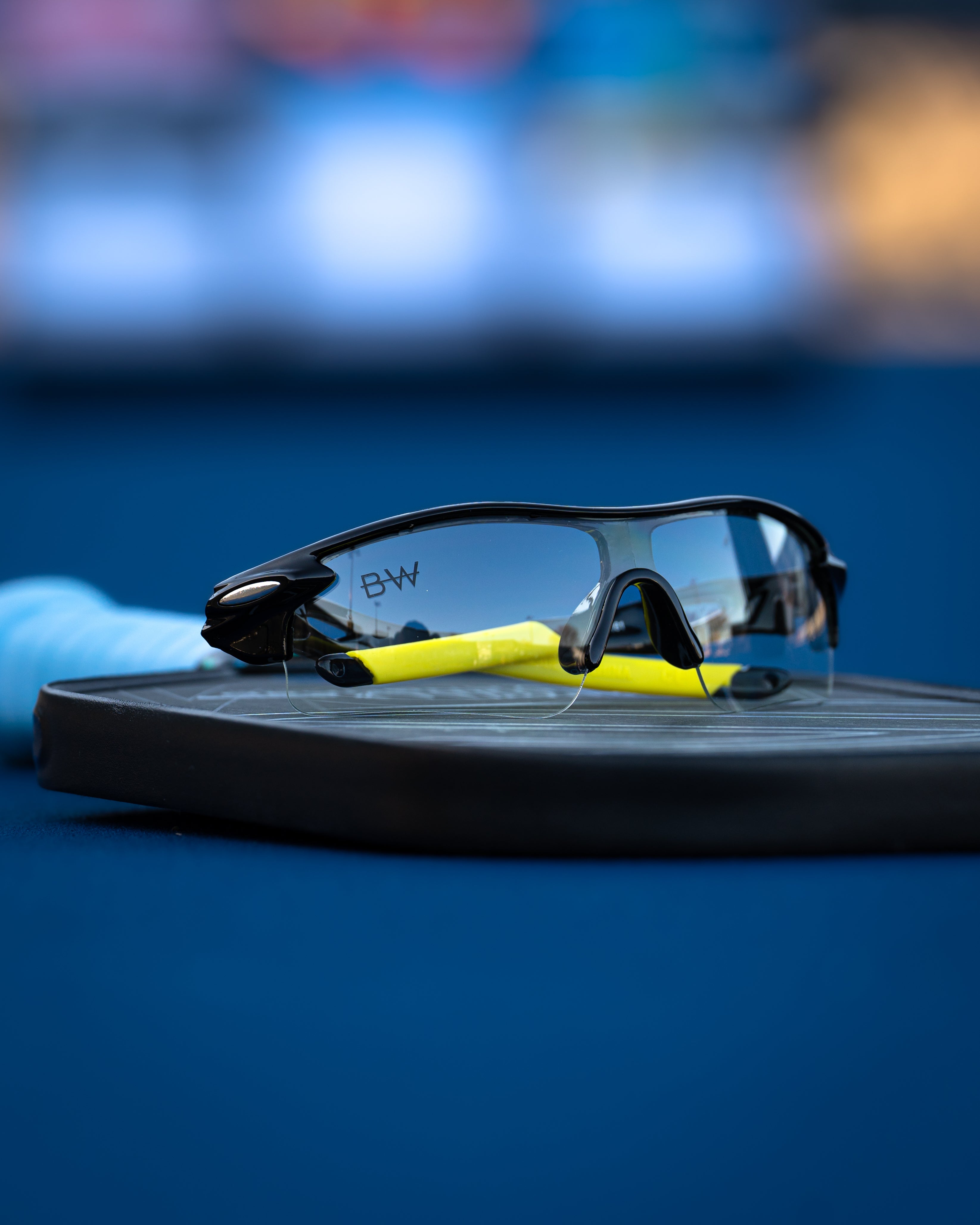
Why More Athletes Are Switching to RX Sports Eyewear
Share
Why More Athletes Are Switching to RX Sports Eyewear in 2026
For athletes who need prescription correction, sports can create an equipment question that does not exist during ordinary daily activities: should you keep using your everyday glasses, wear contacts, or build a dedicated prescription sports eyewear setup?
More athletes are considering the third option. RX sports eyewear combines prescription correction with frames and lens configurations selected around active use, giving recreational players, frequent competitors, and multi-sport athletes another way to approach their vision needs.
The reason to switch is not that prescription sports glasses automatically create faster reactions, better depth perception, or improved athletic ability. The practical advantage is simpler: athletes who require correction can choose prescription eyewear around the way they actually train and compete.
This 2026 guide explains why dedicated RX sports eyewear is gaining attention, how it differs from everyday prescription glasses and contacts, who is most likely to benefit, and what to verify before making the switch.
Explore Prescription Sports Eyewear
Why Are Athletes Switching to RX Sports Eyewear?
Athletes who require prescription correction may switch to RX sports eyewear because it allows them to build a dedicated corrective setup around athletic use rather than relying entirely on everyday glasses.
That can allow an athlete to consider:
- Their current prescription
- The sport they play most often
- Indoor versus outdoor use
- Frame dimensions
- Individual fit during movement
- Verified lens characteristics
- How frequently they train
- Tournament and travel needs
- Whether backup prescription correction is needed
For someone who plays once in a while, a separate pair may not be necessary. For someone training several days each week, dedicated RX sports glasses can become a regularly used piece of equipment.
What Is RX Sports Eyewear?
RX sports eyewear is prescription eyewear selected or designed for use during athletic activity. Its corrective lenses address the wearer's compatible prescription requirements while the overall eyewear setup can be evaluated around sport, environment, movement, and fit.
That distinction matters because “sports eyewear” should not be interpreted as a promise of automatic athletic improvement.
Prescription lenses correct refractive needs. They do not independently create:
- Faster reactions
- Better anticipation
- Better decision-making
- Improved coordination
- Better positioning
- More athletic skill
Instead, RX sports eyewear gives athletes who need corrective lenses a way to make that correction part of their sports equipment setup.
RX Sports Glasses vs. Everyday Prescription Glasses
Both types of eyewear can provide prescription correction. The difference is what the athlete considers when selecting the pair.
| Factor | Everyday Prescription Glasses | RX Sports Eyewear |
|---|---|---|
| Prescription Correction | Yes | Yes |
| Primary Use | General daily life | Athletic activity |
| Sport Considered During Selection | Not necessarily | Can be a primary consideration |
| Playing Environment | May not drive the decision | Indoor, outdoor, or mixed use can be considered |
| Movement Testing | May not be a major selection factor | Should be part of evaluating the finished setup |
| Impact Resistance | Depends on exact eyewear | Can be prioritized when verified |
| Dedicated Sports Pair | No, if used throughout daily life | Yes |
This does not mean everyday prescription glasses are automatically unsuitable for sports. It means frequent athletes may have more reason to select a separate pair specifically around their athletic routine.
1. Athletes Want Their Prescription Correction During Sports
If you require prescription correction throughout normal daily activities, that requirement does not simply disappear when you step onto a court, track, or training floor.
Sports can require athletes to process changing visual information while moving themselves. Depending on the activity, that can include:
- A moving ball
- Opponents
- Teammates
- Boundaries and court lines
- Changes in viewing distance
- Sports equipment
- Open space and positioning
RX sports eyewear allows prescribed correction to remain part of the athlete's equipment setup during those activities.
The key benefit is prescription correction where the athlete needs it—not an automatic promise of improved reaction time or athletic performance.
2. Frequent Athletes May Want a Dedicated Pair
How often you participate can dramatically change the value of prescription sports eyewear.
Consider two athletes:
Athlete A plays recreational pickleball once every few months. Their existing prescription eyewear already works appropriately for the activity.
Athlete B plays four times per week, competes in leagues, and occasionally travels for tournaments.
The second athlete has significantly more opportunities to use dedicated RX sports eyewear.
A separate pair can also allow frequent athletes to keep their everyday prescription glasses out of repeated practices, tournaments, and equipment bags.
That makes the decision less about whether sports glasses are universally “better” and more about whether your level of participation justifies specialized equipment.
3. Athletes Can Prioritize Impact-Resistant Lenses
Athletic environments can expose eyewear to situations that differ from normal daily wear.
Depending on the sport, that can include:
- Moving balls
- Paddles or racquets
- Other athletes
- Falls
- Accidental drops
- Repeated transportation with sports equipment
Blinded Wear sports eyewear uses impact-resistant lenses.
However, athletes should understand exactly what that term means.
Impact-resistant does not mean shatterproof, indestructible, or automatically certified to a particular protective standard.
If your sport, league, or individual situation requires eyewear meeting a specific protective standard, verify the exact requirement and the certification of the exact product rather than assuming all “sports glasses” qualify.
4. RX Eyewear Can Be Selected Around Where You Actually Play
Athletes do not all compete in the same environment. Prescription sports eyewear can be selected with those differences in mind.
Indoor Sports
An athlete who primarily plays indoors may prefer an appropriate non-dark RX configuration rather than a dark sunglass tint.
Clear or non-dark lenses should not automatically be credited with improving contrast, tracking, depth perception, or reaction time. Their practical distinction is that they do not have a dark sunglass tint.
Outdoor Sports
Outdoor athletes can compare available RX sunglass configurations based on prescription compatibility, sport, current lens options, frame dimensions, and individual fit.
Do not assume a particular tint automatically improves contrast, depth perception, or ball tracking unless that characteristic is verified for the exact lens.
Indoor + Outdoor Sports
Athletes who frequently move between environments can compare:
- One compatible versatile setup
- Separate indoor and outdoor RX pairs
- A compatible transition/photochromic RX configuration when available
For more on changing environments, read Transition RX Lenses for Travel & Training →.
5. Athletes Can Evaluate Their Prescription Eyewear During Real Movement
Trying on a frame while standing still tells you something about fit—but sports involve much more than standing still.
Depending on the activity, an athlete may repeatedly:
- Run
- Jump
- Rotate
- Look rapidly between different areas
- Move laterally
- Accelerate and stop
- Change direction
That makes movement testing important when evaluating a dedicated RX sports setup.
When dimensions are available, comparing a potential sports frame with eyewear that already fits you well can also provide a useful reference point.
Do not assume that “sports,” “lightweight,” or “performance” automatically means a universally secure fit. Individual fit still needs to be evaluated by the wearer.
6. Athletes Can Build a Consistent RX Equipment Routine
Equipment familiarity can matter to athletes even when the equipment itself does not directly improve skill.
A dedicated RX sports pair can be:
- Selected before competition
- Evaluated during normal movement
- Tested during practice
- Used repeatedly in familiar environments
- Included in the athlete's normal equipment routine
That means tournament day does not have to become the first serious test of a new prescription setup.
This is best understood as preparation and familiarity, not an automatic performance enhancement.
7. Multi-Sport Athletes May Get More Use From One RX Setup
An athlete who participates in several activities may be able to use one appropriate RX sports setup across multiple compatible sports.
Examples could include:
- Pickleball + tennis
- Pickleball + general outdoor training
- Running + fitness training
- Multiple compatible court activities
This can increase the practical value of a dedicated pair because the eyewear is not limited to one occasional activity.
However, one pair should not automatically be treated as appropriate for every sport. Environment, movement, prescription compatibility, individual fit, and sport-specific protective requirements still need to be evaluated.
For a deeper comparison, read the Multi-Sport Prescription Glasses Guide →.
8. Blinded Wear Includes High-Index Prescription Lenses at No Additional Cost
Prescription lens configuration is another factor athletes can compare when shopping for RX sports eyewear.
Blinded Wear includes high-index prescription lenses at no additional cost with RX eyewear.
High-index refers to a category of prescription lens materials with a higher refractive index. It should not be interpreted as a claim that the lenses automatically create:
- Faster reaction time
- Better depth perception
- Improved ball tracking
- Better athletic performance
Also, do not assume “high-index” always means one exact numerical index such as 1.67. Exact lens specifications should be verified for the individual configuration.
9. Some Court-Sport Athletes Prefer Non-Polarized Lenses
Blinded Wear sports eyewear uses non-polarized lenses, meaning a polarization filter is not added.
Some court players prefer this configuration. But the reason should be described accurately.
| Claim | Accurate Interpretation |
|---|---|
| Non-Polarized | A polarization filter is not added |
| Automatically Improves Depth Perception? | No |
| Automatically Improves Reaction Time? | No |
| Automatically Improves Ball Tracking? | No |
| Preferred by Some Court Players? | Yes |
The useful question is whether the available lens configuration fits the athlete's preferences and environment—not whether the word “non-polarized” promises a performance advantage.
10. Competition and Travel Make Dedicated RX Eyewear More Practical
The more an athlete depends on prescription correction, the more important equipment planning can become during tournaments and travel.
If a recreational session is close to home, replacing forgotten or damaged eyewear may be inconvenient.
If the athlete is several hours away at a multi-day tournament, the same problem can become much harder to solve.
Competitive athletes may therefore build an RX system around:
- A familiar primary sports pair
- Backup prescription correction
- Appropriate storage
- Accessible prescription information
- The expected competition environment
Learn when a second pair becomes useful in When to Bring a Spare RX Pair →.
Do RX Sports Glasses Actually Improve Athletic Performance?
Prescription sports glasses should not be marketed as an automatic performance upgrade.
For an athlete who requires corrective lenses, RX eyewear addresses the corrective portion of vision. Athletic performance involves a much larger chain:
Visual information → prescription correction when required → recognition → interpretation → anticipation → decision → motor response → physical execution.
Prescription lenses participate in the corrective optical portion of that process.
They do not independently determine:
- Reaction speed
- Anticipation
- Decision-making
- Coordination
- Positioning
- Technique
- Strength
- Conditioning
That distinction does not reduce the value of appropriate prescription correction. It simply keeps the benefit grounded in what RX eyewear actually does.
For a deeper look at this topic, read How RX Lenses Fit Into Reaction Time →.
Do RX Sports Glasses Improve Depth Perception?
Depth perception is more complex than one lens characteristic.
It involves multiple visual cues and should not automatically be described as improved simply because eyewear is:
- Prescription
- Non-polarized
- Clear
- Tinted
- Designed for sports
Individual vision needs also differ.
For athletes who want to understand the subject in greater depth, see Depth Perception Science for Pickleball →.
Why RX Sports Eyewear Makes Sense for Frequent Pickleball Players
Pickleball is a strong example of when dedicated prescription sports eyewear may become useful because a frequent player can spend many hours each week on court.
During play, athletes repeatedly transition between:
- Serving and returning
- Baseline exchanges
- Transition-zone movement
- Kitchen-line positioning
- Dinks and resets
- Volleys
- Drives
- Tracking a partner and opponents
A player who requires prescription correction may therefore prefer a dedicated pair they can test repeatedly during the same movements and environments they encounter in matches.
The goal is not to find glasses that promise to make you react faster. The goal is to find compatible RX eyewear that works appropriately within your actual pickleball routine.
Who Should Consider Switching to RX Sports Eyewear?
| Athlete | How Strong Is the Case for a Dedicated Pair? | Why? |
|---|---|---|
| Occasional Recreational Player | Depends on individual need | Existing prescription eyewear may already work appropriately |
| Weekly Athlete | Worth comparing | A dedicated pair can receive regular use |
| Frequent Athlete | Strong practical case | Sports eyewear becomes routinely used equipment |
| Competitive Athlete | Strong practical case | Can establish a familiar, practice-tested RX setup |
| Multi-Sport Athlete | Potentially strong value | One appropriate pair may work across compatible activities |
| Traveling Athlete | Worth serious consideration | Primary and backup prescription planning becomes more important |
Blinded Wear RX Sports Eyewear to Compare
There is no single RX frame that automatically fits every athlete. Compare options against your prescription, primary sport, environment, dimensions, and individual fit.
| RX Sports Eyewear | Starting Point | What to Compare |
|---|---|---|
| H Blue Shield RX | Pickleball-focused RX shoppers | Prescription compatibility, environment, dimensions, individual fit |
| Lava Rock RX | Athletes comparing additional RX sports styles | Prescription, configuration, dimensions, fit |
| Crystal Wave II RX | Prescription sunglass shoppers | Prescription compatibility, outdoor use, current configuration |
| Frost RX | Prescription court-sport shoppers | Prescription, environment, dimensions, individual fit |
| Ocean Wave RX | Athletes comparing sports-oriented RX options | Prescription compatibility, current configuration, dimensions |
| Silver Line RX | Outdoor RX shoppers | Prescription compatibility, outdoor configuration, dimensions |
How to Switch to RX Sports Eyewear
Use this process to narrow your options without getting distracted by unsupported performance claims:
-
Start with your current eyeglass prescription.
Know what correction the eyewear needs to support.
-
Identify your primary sport.
Build around the activity you perform most frequently.
-
Identify your normal environment.
Determine whether you primarily train indoors, outdoors, or across both.
-
Verify prescription compatibility.
Do not assume every RX frame supports every prescription or progressive configuration.
-
Compare frame dimensions.
When available, use eyewear that already fits you appropriately as a reference.
-
Review verified lens characteristics.
Separate confirmed product information from broad marketing language.
-
Upload a clear prescription image.
Blinded Wear RX customers should have a clear photo or picture of their eyeglass prescription ready when ordering.
-
Practice before competition.
Give yourself time to evaluate the finished eyewear during realistic movement before depending on it during an important event.
RX Sports Eyewear FAQ
Why are more athletes switching to prescription sports glasses?
Athletes who require prescription correction may prefer eyewear selected specifically around active use rather than relying entirely on everyday glasses. The decision can incorporate sport, environment, movement, dimensions, fit, and verified lens characteristics.
Are prescription sports glasses better than regular glasses?
Not automatically. Both can provide prescription correction. Dedicated sports eyewear can be selected specifically around an athlete's activity and environment.
Do RX sports glasses improve reaction time?
Prescription lenses provide prescribed correction. Faster reaction time should not be assumed because reaction also involves recognition, anticipation, decision-making, motor response, and physical execution.
Do non-polarized lenses improve depth perception?
Non-polarized means a polarization filter is not added. That characteristic alone does not establish improved depth perception.
Are Blinded Wear sports lenses impact-resistant?
Yes. Blinded Wear sports eyewear uses impact-resistant lenses. Impact-resistant does not mean shatterproof, indestructible, or automatically certified to a particular protective standard.
Does Blinded Wear include high-index RX lenses?
Yes. Blinded Wear includes high-index prescription lenses at no additional cost with RX eyewear.
Can all RX sports frames use progressive lenses?
Progressive compatibility should be verified for the exact frame and prescription configuration rather than assumed across every RX product.
Can I use one pair of prescription sports glasses for multiple sports?
Potentially. One pair may work across compatible activities when the prescription, environment, frame, individual fit, and any sport-specific protective requirements are appropriate.
RX Sports Glasses vs. Contacts for Athletes
Dedicated prescription sports eyewear is not the only way athletes can address corrective needs during activity. Some athletes use contact lenses, some prefer RX sports glasses, and others use different approaches depending on the sport or environment.
Neither option is automatically best for every athlete.
| Consideration | RX Sports Glasses | Contact Lenses |
|---|---|---|
| Prescription Correction | Built into the eyewear | Worn directly on the eye |
| Prescription Glasses Needed While Worn? | The glasses themselves provide the correction | No separate prescription glasses required while contacts are being worn appropriately |
| Separate Sports Eyewear Possible? | The RX pair itself serves as the eyewear | Separate non-prescription sports eyewear can be worn when appropriate |
| Frame Fit Matters? | Yes | Not for the corrective contact lens itself |
| Dedicated Sports Pair? | Yes | Not necessarily |
| Best for Every Athlete? | No | No |
The decision depends on individual vision needs, preferences, sport, and professional eye-care guidance where appropriate.
Are RX Sports Glasses Worth the Cost?
For athletes comparing prescription sports glasses with their existing eyewear, frequency of use is one of the most important factors.
A dedicated pair that is used twice per year has a very different value proposition from one used four days every week.
One simple way to evaluate the purchase is:
Purchase price ÷ total uses = approximate cost per use.
For illustration, consider a hypothetical $300 prescription sports setup:
| Total Uses | Hypothetical Cost Per Use |
|---|---|
| 25 uses | $12.00 |
| 50 uses | $6.00 |
| 100 uses | $3.00 |
| 150 uses | $2.00 |
| 300 uses | $1.00 |
This example is hypothetical and does not represent Blinded Wear pricing, expected lifespan, or a durability guarantee.
The point is simple: the more frequently appropriate RX sports eyewear is actually used, the more useful cost-per-use becomes when evaluating the purchase.
What Makes Prescription Sports Eyewear a Good Value?
Price alone does not determine value. Athletes should consider what the eyewear adds to their actual routine.
- Prescription need: How much do you rely on corrective lenses during sports?
- Frequency: How many times per week will you realistically wear the pair?
- Dedicated use: Do you want to keep everyday prescription glasses separate from athletic activity?
- Multi-sport use: Could one appropriate pair serve several compatible activities?
- Competition: Do you want a familiar prescription setup reserved for training and events?
- Travel: Do you frequently participate away from home?
- Included RX features: What prescription lens options are included in the purchase?
- Replacement support: What happens if the eyewear breaks?
Blinded Wear includes high-index prescription lenses at no additional cost with RX eyewear and provides 50% lifetime replacement support if glasses break, subject to current policy terms.
Why Tournament Athletes Have an Even Stronger Reason to Consider RX Sports Eyewear
A tournament can involve substantially more eyewear use than a typical recreational session.
Depending on the event, prescription eyewear may be used throughout:
- Warmups
- Practice sessions
- Pool play
- Bracket matches
- Breaks between matches
- Multiple competition days
- Travel to and from the event
For an athlete who depends on prescription correction, that makes eyewear part of tournament preparation rather than something to think about at the last minute.
A dedicated RX pair can be tested during normal practices before competition, while backup correction can provide another option if the primary pair becomes unavailable.
The advantage is preparation and familiarity—not a claim that tournament-specific eyewear automatically improves performance.
Why Sports Travel Changes the RX Eyewear Equation
Prescription equipment can become more important when an athlete is away from home because replacing forgotten, lost, or damaged eyewear may be more difficult.
A traveling athlete who depends on prescription correction can plan around:
- A primary RX sports pair
- Backup prescription correction
- Appropriate eyewear storage
- Accessible prescription information
- The expected playing environment
A dedicated sports pair can also help keep everyday prescription eyewear separate from repeated competition and equipment-bag use.
Before your next event, see How to Pack Prescription Glasses for Sports Trips →.
Can Switching to RX Sports Eyewear Help an Athlete Feel More Prepared?
Eyewear should not automatically be described as increasing confidence. However, athletes may personally feel more prepared when important equipment has already been selected, tested, and incorporated into their routine.
That preparation can include:
- Using the same RX pair during normal practices
- Knowing how the frame feels during realistic movement
- Understanding how the selected configuration works in the normal playing environment
- Having a familiar setup for competition
- Carrying backup correction when appropriate
This is better understood as equipment familiarity and preparation than an inherent performance benefit of prescription lenses.
Read more in How RX Glasses Can Support Confidence on the Pickleball Court →.
Are RX Sports Glasses Protective Eyewear?
This is one of the most important questions athletes should ask because sports eyewear and certified protective eyewear are not automatically the same thing.
Blinded Wear sports eyewear uses impact-resistant lenses. Impact resistance is a relevant characteristic for eyewear used during active situations.
But athletes should not turn that verified characteristic into broader claims that have not been established.
| Term | What You Should Assume |
|---|---|
| Impact-Resistant | The lens is described as impact-resistant |
| Shatterproof | Do not assume this from impact resistance |
| Indestructible | No eyewear should be assumed indestructible |
| Certified Protective Eyewear | Verify the exact certification or standard |
| Suitable for a Specific League Requirement | Verify the league requirement and exact eyewear separately |
If protection against a particular sports hazard is your primary concern, look beyond general marketing terms and verify what the exact eyewear is designed and certified to do.
How Should RX Sports Glasses Fit?
The best fit is individual. A frame that works well for one athlete may not feel the same on another person.
Before ordering, compare available dimensions with glasses that already fit you appropriately.
After the finished RX pair arrives, evaluate it through increasingly realistic movement:
- Wear the glasses while stationary.
- Look up, down, left, and right.
- Walk normally.
- Complete your normal warmup.
- Add sport-specific movements.
- Use the glasses during a realistic practice.
- Evaluate how the setup works throughout the session.
Do not assume that a frame is automatically “non-slip” or universally secure simply because it is lightweight or designed for sports.
For more on athletic frame stability, read Prescription Glasses That Stay Secure During Pickleball Rallies →.
Comfort Matters More as Playing Time Increases
A frame that feels acceptable during a short try-on still needs to work through the length of your actual activity.
Frequent athletes should evaluate comfort during:
- Warmups
- Full practices
- Repeated drills
- League sessions
- Long recreational sessions
- Tournament days
This is another reason athletes should avoid making a major event the first extended test of new RX sports eyewear.
Comfort is personal, so it should be evaluated by the wearer rather than assumed from a product label.
Indoor vs. Outdoor RX Sports Eyewear
The environment where you play most often should influence the configuration you compare.
| Environment | RX Approach to Consider | Important Reminder |
|---|---|---|
| Indoor | An appropriate non-dark RX configuration when available | Clear status alone does not improve tracking or reaction time |
| Outdoor | Compatible RX sunglass configuration | Do not assume tint automatically improves contrast or depth perception |
| Indoor + Outdoor | Separate pairs, one appropriate versatile setup, or compatible transition/photochromic RX | Compare the actual available configuration |
Athletes looking specifically for non-dark options can also explore the Clear Lens Sports Eyewear Collection →.
Do You Need One RX Sports Pair or Two?
One appropriate pair may be enough for many athletes. Others may benefit from multiple configurations because their environments or use cases differ significantly.
One Pair May Be Enough If:
- You primarily play one sport.
- You usually train in the same environment.
- Your selected configuration works appropriately for your routine.
- You do not need another specialized setup.
Two RX Setups May Make More Sense If:
- You frequently move between substantially different environments.
- You want separate indoor and outdoor configurations.
- You compete or travel and want backup prescription correction.
- You participate in activities with different eyewear requirements.
The goal is not to own the most eyewear. It is to have the number of prescription setups that actually makes sense for your routine.
The First-Practice Test for New RX Sports Glasses
Once your prescription sports eyewear arrives, use your first few sessions to evaluate the complete setup rather than focusing on one feature.
Before Practice
- Confirm you received the expected frame and configuration.
- Evaluate the prescription experience.
- Check initial comfort.
- Inspect the eyewear for obvious concerns.
During Warmup
- Move naturally.
- Look through the viewing positions you normally use.
- Complete normal sport-specific movements.
- Pay attention to how the frame feels as activity increases.
During Practice
- Wear the eyewear through a meaningful session.
- Evaluate it in the environment where you normally compete.
- Notice whether any fit or prescription concern becomes apparent over time.
After Practice
- Decide whether the setup worked appropriately throughout the session.
- Address significant concerns before relying on the eyewear in competition.
When Should an Athlete Carry Backup RX Glasses?
Not every athlete needs a second sports pair. Backup correction becomes more useful as the consequences of losing access to the primary pair increase.
Consider carrying backup prescription correction when:
- You depend heavily on your prescription to participate.
- You compete regularly.
- You play multi-day tournaments.
- You travel for sports.
- You train far from home.
- You would have difficulty continuing if your primary eyewear became unavailable.
A backup does not necessarily have to duplicate every characteristic of the primary pair. The important question is whether it provides an appropriate alternative if the main prescription setup cannot be used.
Protecting RX Sports Eyewear Between Sessions
Dedicated sports eyewear often spends time around paddles, racquets, shoes, water bottles, and other equipment. Storage should therefore be part of the athlete's routine.
Useful habits include:
- Keeping eyewear in a known location when it is not being worn
- Storing it appropriately rather than leaving it loose with heavier equipment
- Avoiding unnecessary pressure from other items in the sports bag
- Inspecting the eyewear after unusual drops or impacts
- Keeping backup correction accessible during travel
For a more detailed routine, see How to Store & Protect RX Glasses on the Go →.
Replacement Support Matters for Frequently Used Sports Eyewear
When prescription glasses become regular athletic equipment, long-term support becomes another factor to compare alongside the initial purchase.
Blinded Wear provides 50% lifetime replacement support if glasses break, subject to current policy terms.
This should not be interpreted as:
- A guarantee that the eyewear cannot break
- A free replacement in every situation
- A claim that every type of damage qualifies
- A substitute for reviewing the current policy
Before purchasing, review the current Protection & Replacement Terms →.
9 RX Sports Eyewear Claims You Should Verify Before Buying
Athletic eyewear is frequently marketed with performance terminology. Before allowing one phrase to influence your purchase, determine what is actually verified for the exact product.
| Marketing Claim | What to Ask |
|---|---|
| “Improves Reaction Time” | What evidence establishes that the eyewear itself causes faster reactions? |
| “Improves Depth Perception” | Is this actually established for the exact lens and wearer? |
| “Better Ball Tracking” | What verified lens characteristic supports the claim? |
| “Contrast Enhancing” | Is specific contrast-enhancing technology verified? |
| “Anti-Fog” | Does the exact product include a verified anti-fog feature? |
| “Scratch-Resistant” | Is scratch resistance verified for the exact lens? |
| “Non-Slip” | What design characteristic supports the claim, and how does it fit you personally? |
| “Shatterproof” | Is this actually established, or is the lens simply described as impact-resistant? |
| “Certified Protection” | What exact certification or protective standard applies? |
Specific, verified product information is more useful than broad performance language.
10 Mistakes to Avoid When Switching to RX Sports Eyewear
- Choosing a frame before confirming prescription compatibility.
- Assuming every RX frame supports every prescription.
- Assuming progressive compatibility across all frames.
- Buying solely because the product says “performance” or “sports.”
- Believing RX correction automatically improves reaction time.
- Assuming non-polarized lenses automatically improve depth perception.
- Choosing a tint because it supposedly guarantees better tracking.
- Confusing impact-resistant with shatterproof or certified protection.
- Assuming lightweight automatically means secure fit.
- Waiting until competition day to seriously test new RX eyewear.
Compare RX Sports Glasses With This Checklist
Once you have narrowed your search to a few options, compare them around your needs rather than whichever frame has the longest marketing description.
| Question | Option A | Option B |
|---|---|---|
| Compatible With My Prescription? | ☐ | ☐ |
| Appropriate for My Primary Sport? | ☐ | ☐ |
| Appropriate for My Playing Environment? | ☐ | ☐ |
| Dimensions Compared With Current Glasses? | ☐ | ☐ |
| Impact-Resistant Lenses? | ☐ | ☐ |
| High-Index RX Lenses Included? | ☐ | ☐ |
| Non-Polarized? | ☐ | ☐ |
| Enough Time to Test Before Competition? | ☐ | ☐ |
| Replacement Terms Reviewed? | ☐ | ☐ |
Why Athletes Compare Blinded Wear RX Sports Eyewear
Blinded Wear's RX value proposition can be explained through verified characteristics rather than exaggerated performance promises.
- Prescription sports eyewear: RX options for athletes who require corrective lenses.
- High-index prescription lenses: Included at no additional cost with RX eyewear.
- Impact-resistant lenses: Used in Blinded Wear sports eyewear.
- Non-polarized lenses: A polarization filter is not added.
- Lightweight sports-frame options: Available across the sports eyewear lineup.
- Pickleball-focused options: Multiple RX styles are designed with pickleball players in mind.
- Lifetime replacement support: 50% replacement support if glasses break, subject to current policy terms.
The result is a straightforward value proposition: prescription correction combined with sports-oriented eyewear characteristics and long-term replacement support.
More Questions About Switching to RX Sports Glasses
When should I switch from regular glasses to sports glasses?
Consider a dedicated pair when sports are frequent enough that selecting prescription eyewear around your activity, environment, movement, and individual fit provides meaningful additional utility.
Do I need RX sports glasses if I only play occasionally?
Not necessarily. If your current prescription eyewear already works appropriately for occasional activity, a separate pair may not be needed.
What if I play three or four times per week?
Frequent use can strengthen the practical case for dedicated sports eyewear because the pair becomes regularly used equipment rather than an occasional accessory.
Can RX sports glasses be used for everyday wear?
Whether a particular configuration is appropriate for broader daily use depends on the prescription, frame, lens configuration, and individual needs. Some athletes prefer keeping everyday and sports eyewear separate.
Are RX sports glasses worth it for pickleball?
They can be useful for pickleball players who require prescription correction and participate frequently enough to benefit from a dedicated court-use setup.
Can I wear RX sports glasses for running?
A compatible RX sports setup may be used for running when the prescription, frame, configuration, dimensions, and individual fit are appropriate for the wearer.
Can I wear the same RX glasses for pickleball and tennis?
Potentially. One pair may work across compatible activities when the prescription, environment, frame, individual fit, and any sport-specific requirements are appropriate.
Should I keep backup prescription sports glasses?
Backup correction becomes more useful for athletes who rely heavily on their prescription, compete regularly, travel for sports, or participate in multi-day events.
What prescription information does Blinded Wear need?
RX customers should have a clear photo or picture of their eyeglass prescription ready to upload before purchasing.
What happens if my Blinded Wear RX glasses break?
Blinded Wear provides 50% lifetime replacement support if glasses break, subject to current policy terms.
RX Sports Eyewear Myths vs. Reality
Prescription sports eyewear has legitimate value for athletes who require corrective lenses, but that value is easier to understand when marketing claims are separated from what the eyewear actually does.
| Myth | Reality |
|---|---|
| RX sports glasses automatically make you a better athlete | Prescription lenses provide prescribed correction. Athletic improvement still depends on training, skill, decision-making, coordination, and execution. |
| Prescription lenses automatically improve reaction time | Reaction time includes visual, cognitive, and physical processes beyond refractive correction. |
| Non-polarized lenses automatically improve depth perception | Non-polarized means a polarization filter is not added. Depth perception involves multiple visual cues. |
| A certain tint automatically improves ball tracking | Tint alone should not automatically be credited with better tracking, contrast, spin recognition, or reaction time. |
| Sports glasses are automatically certified protective eyewear | The word “sports” does not establish compliance with a particular protective standard. |
| Impact-resistant means shatterproof | Impact-resistant does not mean shatterproof, indestructible, or guaranteed against damage. |
| Lightweight automatically means secure | Frame weight does not determine universal fit. Individual fit still needs to be evaluated. |
| Every RX frame supports every prescription | Prescription compatibility varies and should be verified for the exact frame. |
| Every RX sports frame supports progressive lenses | Progressive compatibility should be confirmed for the exact frame and prescription configuration. |
| High-index always means 1.67 | High-index describes a broader category. An exact numerical index should only be stated when verified for the configuration. |
Which Athletes Have the Strongest Reason to Switch?
The value of dedicated RX sports eyewear changes with the athlete's routine. Use these scenarios as a starting point rather than treating one recommendation as universal.
| Athlete Type | RX Sports Eyewear Strategy | Main Consideration |
|---|---|---|
| Occasional Recreational Athlete | Determine whether current prescription eyewear already works appropriately | A dedicated pair may not yet provide enough additional utility |
| Weekly Athlete | Compare dedicated RX sports options | Regular use can increase practical value |
| Frequent Athlete | Consider separating everyday and sports prescription eyewear | Sports glasses become routinely used equipment |
| Competitive Athlete | Establish a familiar, practice-tested primary RX setup | Preparation and consistency |
| Indoor Athlete | Compare an appropriate non-dark RX configuration when available | Playing environment |
| Outdoor Athlete | Compare compatible RX sunglass configurations | Outdoor use and current lens options |
| Indoor + Outdoor Athlete | Compare one versatile setup, separate pairs, or compatible transition/photochromic RX | Changing environments |
| Multi-Sport Athlete | Determine whether one appropriate setup can serve compatible activities | Versatility |
| Traveling Athlete | Build primary and backup prescription plans | Redundancy away from home |
Should You Switch to RX Sports Eyewear? A 30-Second Test
Ask yourself these questions:
- Do I require prescription correction while playing?
- Do I participate often enough that a dedicated pair would receive regular use?
- Would I prefer keeping my everyday prescription glasses separate from sports?
- Do I want eyewear selected around my primary playing environment?
- Would I use the pair across multiple compatible activities?
- Do I compete frequently enough to benefit from a familiar sports-specific RX setup?
- Do I travel enough that primary and backup prescription planning matters?
If several answers are yes, dedicated prescription sports eyewear is worth comparing. If your current glasses already work appropriately for occasional activity, there may be no immediate reason to switch.
Final RX Sports Eyewear Buying Checklist
Before ordering, make sure you can confidently work through this list:
- ☐ My eyeglass prescription is current.
- ☐ I have a clear photo or picture of my prescription ready to upload.
- ☐ I verified compatibility with the exact RX frame.
- ☐ I am not assuming every frame supports progressive prescriptions.
- ☐ I identified my primary sport.
- ☐ I identified whether I primarily play indoors, outdoors, or both.
- ☐ I reviewed the current available lens configuration.
- ☐ I compared frame dimensions when available.
- ☐ I understand which product characteristics are actually verified.
- ☐ I understand that impact-resistant does not mean shatterproof.
- ☐ I understand that impact resistance does not automatically establish a specific protective certification.
- ☐ I understand that non-polarized does not automatically mean better depth perception.
- ☐ I understand that prescription correction does not automatically improve reaction time.
- ☐ I understand that tint alone does not guarantee better tracking or contrast.
- ☐ I understand that high-index does not automatically mean an exact numerical index such as 1.67.
- ☐ I have enough time to test the finished eyewear before an important event.
- ☐ I considered backup correction if losing my primary pair would prevent me from participating.
- ☐ I reviewed current replacement terms.
What Should You Do When Your RX Sports Glasses Arrive?
The buying process should not end when the package arrives. Product information can help you choose a frame, but the finished prescription setup still needs to work for the individual athlete.
-
Confirm the frame and configuration.
Make sure the eyewear matches what you expected to receive.
-
Evaluate your prescription experience.
Pay attention to how the corrective setup works for you.
-
Evaluate initial comfort.
Notice unwanted pressure or other obvious fit concerns.
-
Introduce normal movement.
Walk and look in the directions you normally use during activity.
-
Complete your usual warmup.
Gradually introduce movements associated with your sport.
-
Complete a realistic practice.
Evaluate the eyewear through a meaningful training session.
-
Repeat before competition.
Build familiarity with the setup rather than making an important match its first serious test.
When Should Athletes Reevaluate Their RX Sports Eyewear?
There is no single replacement schedule that applies to every athlete or prescription setup.
Instead, reevaluate when something meaningful changes, including:
- Your prescription changes.
- The eyewear becomes damaged.
- The frame no longer works appropriately for your needs.
- Your primary sport changes.
- Your playing frequency increases significantly.
- You begin competing more regularly.
- Your normal playing environment changes.
- You begin traveling frequently for sports.
- You need another prescription configuration.
Do not assume an existing frame can always be re-lensed for a future prescription. Compatibility with new requirements should be verified.
Common Questions Athletes Ask Before Switching
Are prescription sports glasses worth it if I play once a week?
They can be, particularly if you require prescription correction and would regularly use the pair. The decision depends on your existing eyewear, sport, environment, and how much value you place on having a dedicated sports setup.
Can I wear my normal prescription glasses for sports?
Some athletes do. Whether they work appropriately depends on the individual eyewear and activity. Dedicated sports eyewear becomes more relevant when you want to select a separate prescription setup specifically around athletic use.
Can I wear prescription sports glasses every day?
That depends on the exact prescription, frame, lens configuration, and individual needs. Some athletes prefer keeping separate everyday and sports pairs.
Can teenagers use prescription sports glasses?
Prescription sports eyewear can be relevant to younger athletes who require corrective lenses, but the exact prescription, fit, product compatibility, and any sport-specific protective requirements should be considered for the individual wearer.
How do I know if sports glasses are actually protective?
Look for the exact protective standard or certification rather than relying on words such as “sports,” “performance,” or “durable.” Impact resistance alone does not automatically establish certified protective eyewear.
Can strong prescriptions be used in sports glasses?
Prescription compatibility varies by frame and configuration. Verify the exact prescription with the exact RX product rather than assuming universal compatibility.
What happens if my prescription changes?
Your sports eyewear setup should be reevaluated. Do not assume an existing frame can automatically accommodate every future prescription or lens configuration.
Do I need prescription sports glasses if I wear contacts?
Not necessarily. Some athletes use contacts and separate sports eyewear, while others prefer prescription sports glasses. The appropriate approach depends on individual needs and preferences.
Are clear sports glasses better for indoor courts?
A clear or non-dark configuration can make sense when an athlete does not want a dark sunglass tint indoors. Clear status alone does not establish better contrast, tracking, depth perception, or reaction time.
Are tinted RX sports glasses better outdoors?
Outdoor athletes can compare compatible prescription sunglass configurations. A particular tint should not automatically be credited with improved tracking, contrast, or depth perception unless those characteristics are verified.
Build Your Complete RX Sports Eyewear Setup
If you are considering the switch, these guides can help you make the next decision without forcing one article to answer every RX eyewear question.
Key Takeaways: Why Athletes Are Switching to RX Sports Eyewear
- RX sports eyewear allows athletes who require corrective lenses to incorporate their prescription into a dedicated active-use setup.
- The strongest reason to switch is specialization—not a promise of automatic athletic improvement.
- Frequent athletes may prefer keeping everyday prescription glasses separate from sports.
- Dedicated RX eyewear can be selected around the athlete's sport, environment, dimensions, and individual fit.
- Blinded Wear sports eyewear uses impact-resistant lenses.
- Impact-resistant does not mean shatterproof, indestructible, or automatically certified to a specific protective standard.
- Blinded Wear sports eyewear uses non-polarized lenses, meaning a polarization filter is not added.
- Non-polarized status alone does not establish better depth perception, ball tracking, or reaction time.
- Blinded Wear includes high-index prescription lenses at no additional cost with RX eyewear.
- High-index does not automatically mean an exact numerical index such as 1.67.
- Clear or tinted lens status alone should not be credited with automatic performance improvements.
- Frame dimensions and individual fit should be evaluated during realistic athletic movement.
- Progressive compatibility should be verified with the exact RX frame and prescription configuration.
- Multi-sport athletes may be able to use one appropriate RX setup across several compatible activities.
- Competitive and traveling athletes should consider backup prescription correction when losing access to their primary pair would create a significant problem.
- Blinded Wear provides 50% lifetime replacement support if glasses break, subject to current policy terms.
Is It Time to Switch to Dedicated RX Sports Eyewear?
If you require prescription correction and sports are a regular part of your week, dedicated RX eyewear may be worth comparing with the glasses you currently use.
Start with your prescription. Then consider your primary sport, playing environment, frequency, frame dimensions, individual fit, and the verified lens characteristics that actually matter to your routine.
Do not choose based on promises of automatic reaction-time, tracking, or depth-perception improvements. Choose eyewear based on what you need, how you play, and what the exact product is verified to provide.
Bottom Line: The Real Reason Athletes Are Switching
The shift toward RX sports eyewear is ultimately about giving athletes who require prescription correction a more specialized option for the way they actually train, compete, and travel.
For an occasional athlete, existing prescription glasses may already work appropriately. But as participation becomes more frequent, a dedicated sports pair can provide greater practical value by separating everyday and athletic eyewear, allowing the athlete to choose around their normal environment, creating a familiar competition setup, and supporting a more organized primary-and-backup prescription strategy.
Blinded Wear RX eyewear combines high-index prescription lenses at no additional cost, impact-resistant lenses, non-polarized sports lenses, lightweight sports-frame options, and 50% lifetime replacement support if glasses break, subject to current terms.
Those are practical reasons to compare RX sports eyewear. They do not need to be turned into unsupported promises of faster reactions, better depth perception, or automatic performance gains.
For athletes deciding whether to make the switch, the most useful question is:
Would prescription eyewear selected specifically around my athletic routine provide more practical value than relying entirely on my everyday glasses?
If the answer is yes, dedicated RX sports eyewear may be the next logical addition to your equipment setup.