
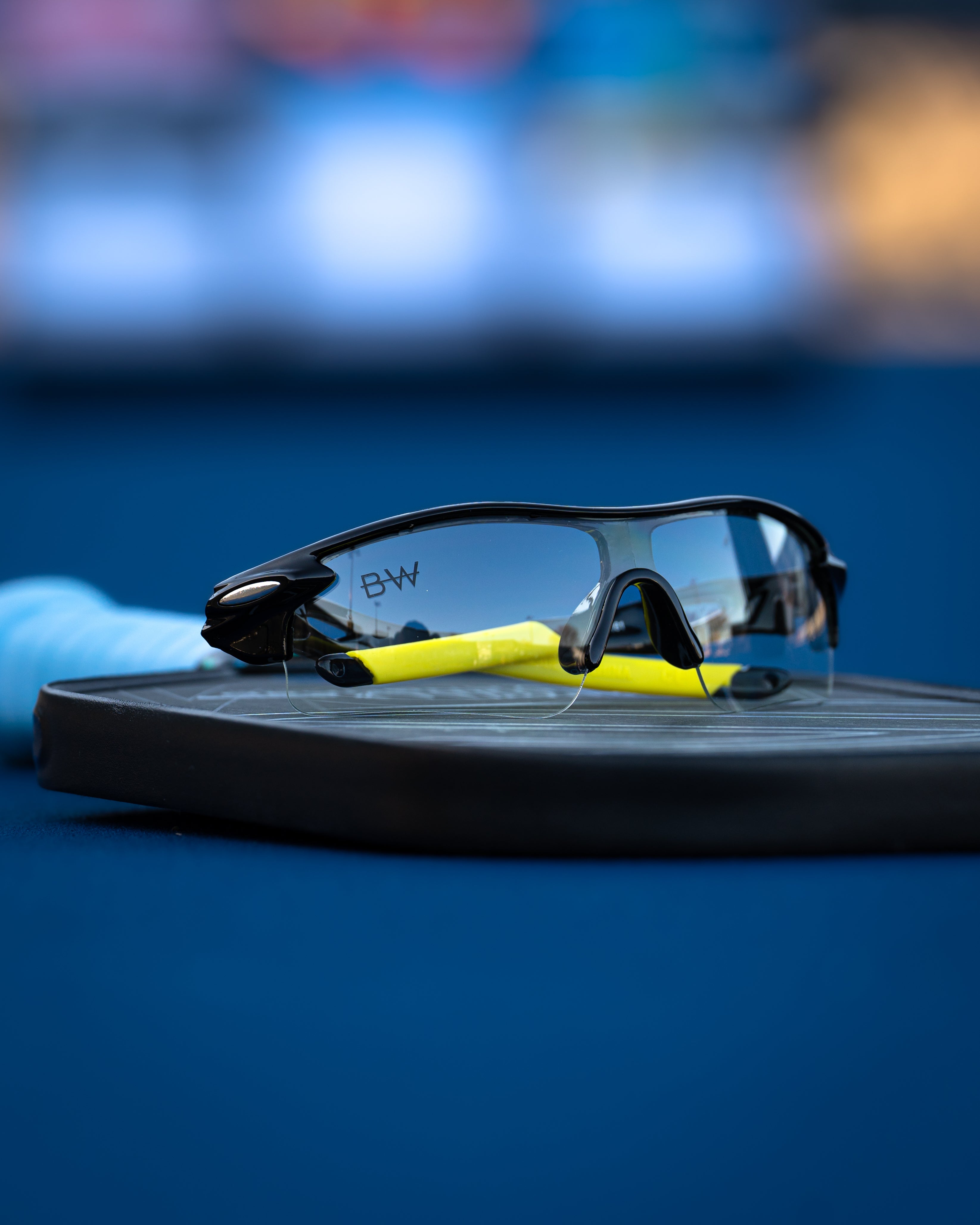
Why More Athletes Are Switching to RX Sports Eyewear
Share
Why More Athletes Are Switching to RX Sports Eyewear in 2026
For athletes who need prescription correction, there used to be a familiar compromise: wear everyday glasses during sports, switch to contacts, or participate without the same corrective setup used throughout the rest of the day.
RX sports eyewear gives athletes another option. Prescription correction can be incorporated into eyewear selected specifically around active use, allowing players to build a dedicated setup for training, competition, and sports travel.
That helps explain why prescription sports glasses are worth considering for everyone from recreational pickleball players to multi-sport athletes. The appeal is not that RX glasses magically create faster reactions or better athletic ability. It is that athletes who require corrective lenses can choose eyewear around their prescription, sport, environment, movement, and individual fit.
This 2026 guide breaks down the biggest reasons athletes are moving toward dedicated RX sports eyewear, when switching makes sense, what to compare before buying, and what prescription sports glasses can realistically do.
Explore RX Sports Eyewear
Why Are Athletes Switching to RX Sports Eyewear?
The biggest reason is specialization. Athletes who require prescription correction no longer have to think of their everyday glasses as the only way to bring that correction into sports.
A dedicated RX sports setup can be selected around:
- Your current prescription
- Your primary sport
- Indoor or outdoor use
- Frame dimensions
- Individual fit during movement
- Verified lens characteristics
- Training frequency
- Competition and travel needs
For athletes who train multiple times each week, those considerations can make dedicated prescription sports eyewear more practical than repeatedly relying on a pair selected primarily for everyday life.
From Everyday Glasses to Sport-Specific RX Eyewear
Everyday prescription glasses and RX sports glasses share the same fundamental purpose: providing prescription correction when it is required.
The difference is the context around that correction.
| Consideration | Everyday RX Glasses | RX Sports Eyewear |
|---|---|---|
| Prescription Correction | Yes | Yes |
| Primary Selection Goal | General everyday use | Can be selected specifically around athletic use |
| Sports Environment | May not be the main consideration | Can be part of the buying decision |
| Movement Testing | Possible, but not necessarily why the frame was selected | Should be part of evaluating the finished setup |
| Impact Resistance | Depends on exact eyewear | Can be prioritized when verified |
| Dedicated Sports Pair | No, if also used throughout daily life | Yes |
This does not mean every athlete must replace everyday glasses with sports eyewear. It means frequent athletes have another option when they want their prescription setup selected specifically around active use.
1. Athletes Want Prescription Correction Built Into Their Sports Setup
If you require corrective lenses, prescription needs do not disappear when practice begins.
RX sports glasses allow athletes to incorporate their prescribed correction directly into the eyewear they use for activity rather than treating vision correction and sports equipment as completely separate decisions.
This can be especially relevant in sports involving:
- Frequent movement
- Changing viewing distances
- Fast exchanges
- Moving balls or equipment
- Opponent and teammate positioning
- Indoor or outdoor environmental changes
The legitimate benefit is appropriate prescription correction during activity. That should remain separate from claims that the eyewear itself automatically makes an athlete react faster, track better, or make better decisions.
2. Frequent Athletes May Prefer Separating Everyday and Sports Eyewear
If you only play occasionally and your normal glasses already work appropriately, another prescription pair may not be necessary.
The equation changes as athletic frequency increases.
Imagine someone who plays pickleball three or four times per week. The glasses are no longer being used for an occasional activity—they are becoming regular sports equipment.
A dedicated RX pair can allow that athlete to:
- Keep everyday eyewear separate from sports use
- Select a frame specifically with movement in mind
- Choose a configuration around the normal playing environment
- Practice repeatedly in the same sports setup
- Keep a consistent pair available for training and competition
This is one of the strongest practical reasons to switch: sports become frequent enough to justify dedicated equipment.
3. Athletes Can Prioritize Impact-Resistant Lenses
Sports introduce situations that ordinary daily activities may not.
Depending on the activity, eyewear can encounter:
- Moving balls
- Sports equipment
- Other athletes
- Falls
- Accidental drops
- Transportation inside equipment bags
Blinded Wear sports eyewear uses impact-resistant lenses, making impact resistance a verified characteristic athletes can include in their buying decision.
However, terminology matters.
Impact-resistant does not mean shatterproof, indestructible, or automatically certified to a particular sports-protection standard.
If your sport or league requires eyewear meeting a specific protective certification, verify that requirement and the exact product separately.
4. Athletes Can Choose RX Eyewear Around Their Playing Environment
An athlete who primarily trains inside does not necessarily have the same eyewear priorities as someone who spends most practices outdoors.
Indoor Athletes
Players who require prescription correction indoors but do not want a dark sunglass tint can compare an appropriate non-dark RX configuration when available.
A clear or non-dark lens should not automatically be credited with improving contrast, reaction time, or ball tracking. Its practical distinction is that it does not have a dark sunglass tint.
Outdoor Athletes
Outdoor players can compare prescription sunglass configurations based on their prescription, sport, available lens options, frame dimensions, and individual fit.
Do not assume a particular tint automatically improves depth perception, contrast, or tracking unless that effect is verified for the exact lens.
Indoor + Outdoor Athletes
Players who frequently move between environments can compare one versatile setup, separate indoor and outdoor pairs, or a compatible transition/photochromic RX configuration when available.
Learn more in Transition RX Lenses for Travel & Training →.
5. Athletes Are Paying More Attention to Fit During Movement
A frame that feels comfortable while sitting at a desk may feel different during a full athletic session.
Sports can involve:
- Running
- Lateral movement
- Jumping
- Rapid direction changes
- Repeated head movement
- Extended training sessions
That makes movement testing an important part of evaluating RX sports eyewear.
Frame dimensions can also help narrow the search. When available, compare the dimensions of a potential sports frame with prescription glasses that already fit you well.
Do not assume a frame is automatically secure because it is lightweight or marketed for sports. Individual fit still needs to be evaluated by the wearer.
6. Dedicated RX Eyewear Can Create a More Consistent Equipment Routine
Competitive athletes often spend significant time making equipment choices before competition rather than during it.
Prescription eyewear can follow the same principle.
An athlete can:
- Select an appropriate RX sports setup.
- Test it during normal practices.
- Learn how it feels through realistic movement.
- Use it repeatedly in familiar environments.
- Bring the same practiced setup into competition.
This does not mean the glasses create better performance. It means the athlete can avoid introducing an unfamiliar eyewear variable immediately before an important match or event.
7. One RX Sports Setup May Work Across Multiple Activities
Multi-sport athletes can potentially get more use from prescription sports eyewear when the same configuration appropriately works across several activities.
Depending on individual needs, one RX setup might be used for combinations such as:
- Pickleball + tennis
- Pickleball + outdoor training
- Running + general fitness
- Multiple compatible court sports
That does not mean one frame is automatically appropriate for every sport. Protective requirements, environment, movement, and prescription compatibility still need to be considered individually.
For a deeper breakdown, read Multi-Sport Prescription Glasses: The Ultimate Guide →.
8. Athletes Can Access High-Index RX Lenses Without an Added Blinded Wear Charge
Blinded Wear includes high-index prescription lenses at no additional cost with RX eyewear.
High-index refers to a category of prescription lens materials with a higher refractive index. It relates to how corrective power can be produced within a prescription lens.
It should not automatically be interpreted as:
- Faster reaction time
- Better ball tracking
- Improved depth perception
- Better athletic performance
Also, “high-index” does not automatically mean one exact numerical index such as 1.67. An exact index should only be stated when verified for the specific configuration.
9. Some Court Athletes Prefer Non-Polarized Sports Lenses
Blinded Wear sports eyewear uses non-polarized lenses, meaning a polarization filter is not added.
Some court-sport players prefer non-polarized eyewear, but that preference should not be turned into unsupported performance claims.
| Statement | What It Actually Means |
|---|---|
| Non-Polarized | A polarization filter is not added |
| Automatically Improves Depth Perception? | No |
| Automatically Improves Ball Tracking? | No |
| Automatically Improves Reaction Time? | No |
| Preferred by Some Court Players? | Yes |
For athletes comparing polarized and non-polarized eyewear, the useful question is what configuration best matches their preferences and activity—not which label promises automatic performance gains.
10. Competitive Athletes Can Build a Primary + Backup RX System
If you depend on prescription correction, losing access to your primary eyewear during a tournament or sports trip can create a bigger problem than it would for an athlete who does not require corrective lenses.
That is why frequent competitors may eventually build a simple system:
- Primary RX sports pair: the familiar setup used during normal training and competition
- Backup prescription correction: another tested option available if the primary pair becomes unavailable
This can be particularly useful for:
- Tournaments
- Multi-day events
- Sports travel
- Training far from home
Does Switching to RX Sports Eyewear Improve Athletic Performance?
RX sports eyewear should not be treated as an automatic athletic-performance upgrade.
If an athlete requires prescription correction, appropriate RX lenses address that refractive need. But athletic performance involves far more than prescription correction.
Consider the sequence involved in responding during a fast sport:
Visual information → prescription correction when required → recognition → interpretation → anticipation → decision → motor response → physical execution.
RX lenses participate in the corrective optical portion of that chain. They do not independently control:
- Anticipation
- Decision-making
- Reaction speed
- Coordination
- Technique
- Positioning
- Strength
- Conditioning
- Athletic skill
This is an important distinction because RX sports eyewear can still be useful without promising results that depend on the athlete.
Why Pickleball Players Are a Strong Fit for RX Sports Eyewear
Pickleball illustrates why dedicated prescription sports eyewear can make practical sense.
Players frequently move between:
- Serving and returning
- Baseline play
- Transition-zone movement
- Kitchen-line exchanges
- Dinks and resets
- Volleys
- Drives
- Tracking opponents and a partner
A player who requires prescription correction may therefore want eyewear that provides that correction throughout a full practice or match while fitting their individual movement and environment needs.
That is also why the best pickleball RX setup is not automatically the frame with the biggest list of performance claims. Prescription compatibility, environment, dimensions, individual fit, and practice testing matter more.
Should You Switch to Dedicated RX Sports Eyewear?
Use your actual routine to decide.
| Situation | Dedicated RX Sports Eyewear |
|---|---|
| You play occasionally and your current glasses work appropriately | May not be necessary |
| You train several times per week | Worth comparing |
| You compete regularly | Dedicated, practice-tested RX eyewear may be useful |
| You want everyday glasses separate from sports | Strong practical reason to consider a dedicated pair |
| You participate in multiple compatible sports | Potentially useful if one setup appropriately serves several activities |
| You travel for competition | Primary and backup RX planning becomes more valuable |
| Your sport requires a specific protective certification | Verify that standard separately before choosing eyewear |
Blinded Wear RX Sports Eyewear to Compare
Athletes do not need the same frame simply because they play the same sport. Start by comparing compatible options against your prescription, environment, dimensions, and individual fit.
| RX Model | Good Starting Point For | What to Compare |
|---|---|---|
| H Blue Shield RX | Pickleball-focused RX shoppers | Prescription compatibility, environment, dimensions, individual fit |
| Lava Rock RX | Athletes comparing additional RX sports styles | Prescription, current configuration, dimensions, fit |
| Crystal Wave II RX | Prescription sunglass shoppers | Prescription compatibility, outdoor use, current configuration |
| Frost RX | Prescription court-sport shoppers | Prescription, environment, dimensions, individual fit |
| Ocean Wave RX | Athletes comparing sports-oriented RX options | Prescription compatibility, configuration, dimensions |
| Silver Line RX | Outdoor RX shoppers | Prescription compatibility, outdoor configuration, dimensions |
How to Switch From Everyday Glasses to RX Sports Eyewear
You do not need to overcomplicate the process. Use a simple sequence:
-
Start with your current prescription.
Know the correction the new eyewear needs to support.
-
Choose your primary sport.
Build around the activity you perform most rather than trying to optimize for every possible situation.
-
Identify your environment.
Decide whether the eyewear will primarily be used indoors, outdoors, or across both.
-
Verify RX compatibility.
Do not assume every frame supports every prescription or progressive configuration.
-
Compare dimensions.
Use glasses that already fit you appropriately as a reference when possible.
-
Review verified characteristics.
Separate confirmed product details from broad performance claims.
-
Upload your prescription.
Blinded Wear RX customers should have a clear photo or picture of their eyeglass prescription ready when ordering.
-
Practice before competing.
Give yourself time to evaluate the finished RX setup during realistic movement.
Why Athletes Are Switching to RX Sports Eyewear: FAQ
Why do athletes wear prescription sports glasses?
Athletes who require corrective lenses may choose RX sports glasses so their prescription correction is incorporated into eyewear selected specifically around active use.
Are RX sports glasses better than regular prescription glasses?
Not automatically. Both can provide prescription correction. RX sports eyewear can be selected specifically around athletic movement, environment, and verified sports-oriented characteristics.
Do RX sports glasses improve reaction time?
RX lenses provide prescribed correction. They should not automatically be credited with faster reactions because reaction time also involves recognition, anticipation, decision-making, motor response, and physical execution.
Do non-polarized sports glasses improve depth perception?
Non-polarized means a polarization filter is not added. Non-polarized status alone does not establish improved depth perception.
Are RX sports glasses shatterproof?
Do not assume so. Blinded Wear uses impact-resistant lenses, but impact-resistant does not mean shatterproof or indestructible.
Does Blinded Wear include high-index prescription lenses?
Yes. Blinded Wear includes high-index prescription lenses at no additional cost with RX eyewear.
Can all RX sports glasses use progressive prescriptions?
Progressive compatibility should be verified with the exact frame and prescription configuration rather than assumed across all RX eyewear.
Can I use one pair for several sports?
Potentially. One RX setup may work across compatible activities when the prescription, environment, frame, individual fit, and any sport-specific protective requirements are appropriate.
Should recreational athletes buy RX sports glasses?
It depends on frequency and individual needs. If your current prescription eyewear already works appropriately for occasional activity, a separate pair may not be necessary. Dedicated sports eyewear becomes easier to justify as athletic use increases.
Is Switching to RX Sports Eyewear Worth the Cost?
The answer depends heavily on how often you will actually use the eyewear.
A recreational athlete who plays a few times per year may evaluate a dedicated RX pair differently from someone who trains three, four, or five days per week.
One useful way to think about the purchase is cost per use:
Total purchase price ÷ total uses = approximate cost per use.
For example, consider a hypothetical $300 RX sports setup:
| Total Uses | Illustrative Cost Per Use |
|---|---|
| 25 uses | $12.00 |
| 50 uses | $6.00 |
| 100 uses | $3.00 |
| 150 uses | $2.00 |
| 300 uses | $1.00 |
This is a hypothetical example only. It is not Blinded Wear pricing or a guarantee of product lifespan.
For someone who uses prescription sports eyewear throughout practices, recreational sessions, leagues, and tournaments, frequency can substantially change how the purchase is evaluated.
What Makes Dedicated RX Sports Eyewear Valuable?
Instead of asking whether RX sports glasses are universally “worth it,” evaluate the value they would provide in your specific routine.
- Prescription need: Do you rely on corrective lenses during activity?
- Frequency: How often do you train or compete?
- Dedicated use: Would you rather keep everyday eyewear separate from sports?
- Environment: Do you regularly play indoors, outdoors, or both?
- Multi-sport use: Can one appropriate pair serve several compatible activities?
- Competition: Do you want a familiar RX setup specifically for matches or tournaments?
- Travel: Do you participate in events away from home?
- Included RX value: What prescription lens options are included?
- Replacement support: What happens if the eyewear breaks?
The more often the answers point toward dedicated athletic use, the stronger the practical case for RX sports eyewear becomes.
Why Some Athletes Choose RX Sports Glasses Instead of Contacts
Prescription sports glasses are not the only corrective option for athletes. Some people use contact lenses, while others prefer prescription eyewear or use different approaches depending on the activity.
| Consideration | RX Sports Glasses | Contact Lenses |
|---|---|---|
| Prescription Correction | Built into the eyewear | Worn directly on the eye |
| Separate Corrective Glasses Needed While Worn? | No | No |
| Sports Eyewear Can Still Be Used? | The RX pair itself is the eyewear | Separate sports eyewear can be worn over contacts when appropriate |
| Frame Fit Matters? | Yes | Not for the corrective contact lens itself |
| Best for Every Athlete? | No | No |
The point is not that RX glasses are universally better than contacts. They provide another way for athletes who require correction to build a sports-specific vision setup.
Can Dedicated RX Sports Eyewear Support Confidence?
Confidence claims should be handled differently from claims about optical or physical performance.
Eyewear cannot automatically make someone more confident. However, an athlete may personally feel more prepared when they have:
- A prescription setup they have already practiced in
- A frame they have tested during their normal movement
- An eyewear configuration selected for their environment
- A familiar pair reserved for training and competition
- A backup plan for important events
That is better understood as equipment familiarity and preparation rather than an inherent confidence-enhancing property of RX lenses.
For the full breakdown, read How RX Glasses Can Support Confidence on the Pickleball Court →.
Why Traveling Athletes Have Another Reason to Switch
Sports travel changes the eyewear equation because replacing or troubleshooting prescription equipment can become more difficult when you are away from home.
A traveling athlete who depends on RX correction can plan around:
- A primary prescription sports pair
- Backup prescription correction
- Appropriate eyewear storage
- Accessible prescription information
- The expected training or competition environment
A dedicated sports pair can also keep your everyday prescription eyewear separate from the pair exposed to training, competition, and repeated equipment-bag transportation.
For destination events, use the RX Sports Travel Packing Guide →.
Why Tournament Players May Benefit From Dedicated RX Eyewear
A tournament can involve substantially more eyewear use than a typical recreational session.
A player may wear prescription sports glasses through:
- Warmups
- Pool play
- Multiple bracket matches
- Breaks between matches
- Changing outdoor conditions
- Multiple competition days
By tournament day, the athlete should ideally already know how the complete RX setup works for them.
The value of dedicated tournament eyewear is therefore less about buying something “faster” and more about prescription correction, familiarity, preparation, and having a tested equipment setup.
Competitive players should also consider backup correction if losing access to their primary pair would make continued participation difficult.
The Practice Test: How to Know Whether Switching Was Worth It
Product descriptions can help you narrow your options, but the finished eyewear ultimately has to work for you.
Once your RX sports glasses arrive, evaluate them progressively:
- Confirm the order. Make sure you received the expected frame and configuration.
- Evaluate the prescription experience. Pay attention to how the corrective setup works for you.
- Check initial comfort. Notice obvious pressure or fit concerns.
- Move naturally. Look in different directions, walk, and complete a normal warmup.
- Add sport-specific movement. Introduce the motions you regularly perform.
- Complete a realistic practice. Wear the glasses for a meaningful training session.
- Evaluate over time. Determine whether the setup remains appropriate throughout your normal activity.
An important competition should not be the first serious test of new prescription sports eyewear.
Everyday Glasses or RX Sports Glasses? Use This Decision Matrix
| Question | If Yes... |
|---|---|
| Do you require prescription correction while playing? | RX sports eyewear becomes relevant to your setup. |
| Do you train several times per week? | A dedicated pair may provide greater long-term utility. |
| Do you want to keep everyday eyewear out of your sports bag? | A separate RX pair may make practical sense. |
| Do you compete regularly? | A dedicated, practice-tested setup may be useful. |
| Do you play multiple compatible sports? | One appropriate RX sports setup may receive substantial use. |
| Do you travel for sports? | Primary and backup prescription planning becomes more important. |
| Do your current everyday glasses already work appropriately for occasional activity? | You may not need to switch yet. |
When You May Not Need to Switch to RX Sports Eyewear
Dedicated sports eyewear is not automatically necessary simply because you are active.
You may decide to continue using your existing prescription eyewear if:
- You only participate occasionally.
- Your current prescription is appropriate.
- Your existing eyewear already works appropriately for the activity.
- You have tested it during your normal movement.
- Your activity does not create another specific eyewear requirement.
- You do not currently see enough additional utility in a dedicated pair.
A useful buying guide should help athletes recognize when they do not need another pair just as clearly as when they might benefit from one.
When Switching Makes More Sense
The case for dedicated RX sports eyewear becomes stronger when several of these apply:
- You depend on prescription correction during sports.
- You train or play several times per week.
- You compete regularly.
- You want separate everyday and athletic eyewear.
- You want to prioritize verified sports-oriented lens characteristics.
- You frequently play outdoors.
- You need different configurations for different environments.
- You participate in multiple compatible sports.
- You travel for tournaments or training.
- You want a primary and backup RX system.
Replacement Support Can Matter More for Active Eyewear
Sports glasses are used in environments where drops, impacts, and other accidental damage can happen. That makes long-term replacement support worth considering alongside the initial purchase price.
Blinded Wear provides 50% lifetime replacement support if glasses break, subject to current policy terms.
This does not mean:
- The glasses are indestructible.
- Every replacement is free.
- Every type of damage automatically qualifies.
- Impact resistance guarantees that breakage cannot occur.
Review the current Protection & Replacement Terms → before purchasing.
A Dedicated Pair Also Needs a Dedicated Storage Routine
Switching to sports-specific eyewear is only useful if you take care of the pair when it is not being worn.
Athletes should avoid leaving RX eyewear loose among heavier equipment whenever possible.
Build a simple routine:
- Keep the glasses in a known location inside your equipment bag.
- Store them appropriately when they are not being worn.
- Avoid placing heavy sports equipment directly against them.
- Inspect the eyewear after unusual impacts or drops.
- Keep backup correction separately accessible when traveling.
Read the full RX Glasses Storage & Protection Guide →.
12 Mistakes Athletes Make When Switching to RX Sports Eyewear
- Choosing the frame before checking prescription compatibility.
- Assuming every RX frame supports every prescription.
- Assuming all RX frames support progressive prescriptions.
- Buying solely because a frame is marketed as “performance” eyewear.
- Believing RX lenses automatically improve reaction time.
- Assuming non-polarized lenses automatically improve depth perception.
- Choosing a tint because it supposedly guarantees better ball tracking.
- Confusing impact-resistant with shatterproof or certified protective eyewear.
- Assuming lightweight automatically means secure fit.
- Assuming high-index automatically means an exact index such as 1.67.
- Making competition the first serious test of new eyewear.
- Buying a dedicated pair that does not solve a real need in your routine.
Sports Eyewear Marketing Claims: What Athletes Should Verify
One reason to research RX sports eyewear carefully is that sports products are frequently marketed with performance terminology that can sound more precise than it actually is.
| Claim | What to Verify |
|---|---|
| “Faster Reaction Time” | Do not assume prescription correction independently produces faster reactions. |
| “Better Depth Perception” | Do not infer this automatically from RX correction or polarization status. |
| “Better Ball Tracking” | Determine what exact verified feature supposedly supports the claim. |
| “Contrast Enhancing” | Verify the exact lens technology rather than assuming a tint creates the effect. |
| “Anti-Fog” | Verify whether the exact product actually includes an anti-fog feature. |
| “Scratch-Resistant” | Verify whether that characteristic applies to the exact lens. |
| “Secure / Non-Slip” | Evaluate the frame's dimensions and your individual fit during movement. |
| “Shatterproof” | Do not substitute this claim for impact-resistant. |
| “Certified Protection” | Look for the exact stated certification or standard. |
How to Compare Two RX Sports Frames Before Switching
If you have narrowed the search to two prescription sports frames, compare them using the factors that actually affect your decision.
| Comparison | RX Option A | RX Option B |
|---|---|---|
| Compatible With My Prescription? | ☐ | ☐ |
| Appropriate for My Primary Sport? | ☐ | ☐ |
| Appropriate for My Environment? | ☐ | ☐ |
| Dimensions Compared With My Current Glasses? | ☐ | ☐ |
| Impact-Resistant Lenses? | ☐ | ☐ |
| High-Index RX Lenses Included? | ☐ | ☐ |
| Non-Polarized? | ☐ | ☐ |
| Enough Time to Practice Before Competition? | ☐ | ☐ |
| Replacement Support Reviewed? | ☐ | ☐ |
The goal is not to find the frame with the most checkmarks in general. It is to identify the option that more appropriately matches your prescription and actual athletic routine.
What Athletes Get With Blinded Wear RX Eyewear
When comparing prescription sports eyewear, focus on verified characteristics rather than exaggerated athletic promises.
- Prescription correction: RX products are built around the wearer's compatible prescription requirements.
- High-index RX lenses: Included at no additional cost with Blinded Wear RX eyewear.
- Impact-resistant lenses: Used in Blinded Wear sports eyewear.
- Non-polarized lenses: A polarization filter is not added.
- Lightweight sports-frame options: Available for athletes comparing active eyewear.
- Pickleball-focused options: Multiple RX styles are designed with pickleball players in mind.
- Replacement support: 50% lifetime replacement support if glasses break, subject to current policy terms.
Those characteristics create a clearer reason to compare Blinded Wear RX eyewear without relying on unsupported claims about automatic improvements in reaction time, tracking, or depth perception.
More Questions About Switching to RX Sports Eyewear
When should I switch from regular glasses to sports glasses?
Consider dedicated RX sports eyewear when your athletic use becomes frequent enough that selecting a separate pair around your sport, environment, movement, and prescription provides meaningful utility.
Do I need RX sports glasses if I only play once a month?
Not necessarily. If your current prescription eyewear already works appropriately for occasional activity, a separate pair may not be necessary.
What if I play three or four times per week?
Frequent use can strengthen the case for dedicated sports eyewear because the pair becomes part of your regular equipment rather than an occasional accessory.
Can I wear RX sports glasses every day?
Whether a particular pair is appropriate for your broader daily routine depends on the prescription, configuration, frame, and your individual needs. Some athletes prefer keeping sports and everyday eyewear separate.
Are RX sports glasses worth it for pickleball?
They can be useful for pickleball players who require prescription correction and play frequently enough to benefit from dedicated eyewear selected around court use.
Can I use the same RX glasses for pickleball and running?
Potentially. One pair may work across compatible activities when the prescription, configuration, environment, dimensions, individual fit, and any activity-specific protective requirements are appropriate.
Do sports glasses need to be non-polarized?
Not universally. Blinded Wear sports eyewear uses non-polarized lenses, and some court players prefer eyewear without a polarization filter. That preference does not establish automatic performance benefits.
Are Blinded Wear RX glasses impact-resistant?
Blinded Wear sports eyewear uses impact-resistant lenses. Impact-resistant should not be interpreted as shatterproof or automatically certified to a particular protective standard.
Do I need backup RX sports glasses?
Not every athlete does. Backup correction becomes more useful if you depend heavily on prescription eyewear, compete regularly, participate in multi-day events, or travel for sports.
What prescription information do I need when ordering?
Blinded Wear RX customers should have a clear photo or picture of their eyeglass prescription ready to upload.
What if my RX sports glasses break?
Blinded Wear provides 50% lifetime replacement support if glasses break, subject to current policy terms.
10 Myths About Switching to RX Sports Eyewear
Prescription sports eyewear can be a practical upgrade for the right athlete, but the decision should be based on real needs rather than exaggerated expectations.
Myth #1: Every Athlete Needs RX Sports Glasses
Reality: Only athletes who require prescription correction need an RX solution. Even then, a dedicated sports pair may not be necessary if existing eyewear already works appropriately for occasional activity.
Myth #2: RX Sports Glasses Automatically Make You Play Better
Reality: Prescription lenses provide prescribed correction. They do not replace training, anticipation, decision-making, positioning, coordination, or technique.
Myth #3: Prescription Lenses Automatically Improve Reaction Time
Reality: Reaction time includes visual, cognitive, and physical processes beyond refractive correction.
Myth #4: Non-Polarized Lenses Automatically Improve Depth Perception
Reality: Non-polarized means a polarization filter is not added. Depth perception involves multiple visual cues and is not determined by polarization status alone.
Myth #5: A Certain Lens Tint Automatically Improves Ball Tracking
Reality: Tint alone should not automatically be credited with better tracking, contrast, spin recognition, depth perception, or reaction time.
Myth #6: Sports Glasses Are Automatically Certified Protective Eyewear
Reality: The term “sports glasses” does not establish compliance with a specific protective standard.
Myth #7: Impact-Resistant Means Shatterproof
Reality: Impact-resistant does not mean shatterproof, indestructible, or guaranteed against breakage.
Myth #8: Lightweight Automatically Means Secure Fit
Reality: Lightweight describes a frame characteristic. Individual fit still depends on the frame, dimensions, wearer, and movement.
Myth #9: Every RX Frame Supports Progressive Prescriptions
Reality: Progressive compatibility should be verified with the exact frame and prescription configuration.
Myth #10: The Most Expensive Pair Must Be the Best Choice
Reality: The more useful question is whether the eyewear appropriately matches your prescription, sport, environment, dimensions, and individual fit.
Which Athletes Have the Strongest Reason to Switch?
| Athlete Type | Why RX Sports Eyewear May Make Sense | Priority |
|---|---|---|
| Recreational Athlete | May want a separate pair for occasional active use | Determine whether a dedicated pair provides enough additional utility |
| Frequent Athlete | Sports eyewear becomes regularly used equipment | Prescription compatibility, environment, fit, long-session use |
| Competitive Athlete | Can establish a familiar practice-tested RX setup | Consistency and preparation |
| Multi-Sport Athlete | One compatible RX pair may receive frequent use across activities | Versatility without ignoring sport-specific requirements |
| Indoor + Outdoor Athlete | May need different configurations across environments | Environment-specific planning |
| Tournament Player | May depend on prescription correction across multiple matches | Primary and backup planning |
| Traveling Athlete | Replacement or troubleshooting can be harder away from home | Redundancy, storage, prescription access |
30-Second RX Sports Eyewear Decision Guide
Still deciding whether it is time to switch? Ask yourself these questions:
- Do I require prescription correction during my sport?
- Do I participate often enough that a dedicated pair would receive regular use?
- Would I rather keep my everyday prescription glasses separate from athletic use?
- Do I want eyewear selected specifically around my normal playing environment?
- Would I use the pair across multiple compatible activities?
- Do I compete or travel enough that a dedicated primary RX setup would be useful?
If several answers are yes, comparing dedicated RX sports eyewear is reasonable. If your current glasses already work appropriately for occasional activity, there may be no immediate need to change.
Final Checklist Before Switching to RX Sports Glasses
- ☐ My eyeglass prescription is current.
- ☐ I have a clear photo or picture of my prescription ready to upload.
- ☐ The exact RX frame is compatible with my prescription.
- ☐ I am not assuming every frame supports progressive prescriptions.
- ☐ I know which sport I will use the eyewear for most.
- ☐ I know whether I primarily train indoors, outdoors, or both.
- ☐ I reviewed the current available lens configuration.
- ☐ I compared frame dimensions when available.
- ☐ I understand which product characteristics are verified.
- ☐ I understand that impact-resistant does not mean shatterproof.
- ☐ I understand that non-polarized does not automatically mean improved depth perception.
- ☐ I understand that RX correction does not automatically improve reaction time.
- ☐ I understand that a tint does not automatically improve ball tracking or contrast.
- ☐ I understand that high-index does not automatically mean an exact numerical index such as 1.67.
- ☐ I will have time to practice in the finished eyewear before an important competition.
- ☐ I have considered backup correction if I depend heavily on my RX eyewear.
- ☐ I reviewed current replacement terms.
What to Do After Switching to RX Sports Eyewear
Receiving your new pair is not the end of the selection process. The finished eyewear still needs to be evaluated by the person who will actually use it.
-
Confirm your order.
Make sure you received the expected frame and configuration.
-
Evaluate your prescription experience.
Pay attention to how the corrective setup works for you.
-
Check initial fit.
Notice unwanted pressure or obvious fit concerns.
-
Start with normal movement.
Walk, look in different directions, and complete a basic warmup.
-
Add sport-specific movement.
Introduce the movements you regularly perform during your activity.
-
Complete a realistic practice.
Use the eyewear throughout a meaningful training session rather than judging it only after a few minutes.
-
Repeat the test.
A familiar sports setup is built through actual use rather than a single try-on.
When Should You Reevaluate Your RX Sports Setup?
Switching to dedicated sports eyewear does not mean the same setup will necessarily fit your needs forever.
Reevaluate when:
- Your prescription changes.
- Your current eyewear becomes damaged.
- The frame no longer works appropriately for you.
- Your primary sport changes.
- You begin playing substantially more often.
- You start competing regularly.
- You move from primarily indoor to outdoor activity, or vice versa.
- You begin traveling frequently for sports.
- You need another prescription configuration.
A prescription change also does not guarantee that an existing frame can always be re-lensed for the new requirements. Verify compatibility before assuming it can be reused.
RX Sports Eyewear: Final Questions Before You Switch
Why are athletes switching from regular glasses to RX sports glasses?
Frequent athletes may prefer prescription eyewear selected specifically around active use, allowing them to consider their sport, environment, movement, frame dimensions, and verified lens characteristics while keeping everyday glasses separate.
What is the main advantage of RX sports eyewear?
For athletes who require corrective lenses, the central advantage is incorporating prescribed correction into eyewear selected for their athletic routine.
Will RX sports glasses make me a better athlete?
No automatic performance improvement should be assumed. Training, anticipation, decision-making, coordination, movement, positioning, and technique remain important parts of athletic performance.
Will prescription sports glasses improve my reaction time?
RX lenses address refractive correction. Reaction time also includes recognition, cognitive processing, anticipation, decision-making, motor response, and physical execution.
Are non-polarized lenses better for sports?
Some court-sport players prefer non-polarized eyewear. Non-polarized means a polarization filter is not added, but that characteristic alone does not establish better reaction time, tracking, or depth perception.
Are RX sports glasses protective eyewear?
That depends on the exact product and the level of protection being discussed. Blinded Wear sports eyewear uses impact-resistant lenses, but impact resistance does not automatically establish a specific protective certification.
Are Blinded Wear RX lenses scratch-resistant?
Do not assume a scratch-resistant feature unless it is verified for the exact product and lens configuration.
Are Blinded Wear RX glasses anti-fog?
Do not assume an anti-fog feature unless it is verified for the exact product.
Does Blinded Wear offer progressive RX sports glasses?
Progressive compatibility should be verified with the exact frame and prescription configuration rather than assumed across all RX products.
Does Blinded Wear include high-index lenses?
Yes. Blinded Wear includes high-index prescription lenses at no additional cost with RX eyewear.
Can I use RX sports eyewear for multiple sports?
Potentially. One pair may work across compatible activities when the prescription, environment, frame, individual fit, and any sport-specific protective requirements are appropriate.
Should I keep my regular prescription glasses after switching?
A dedicated sports pair does not need to replace your everyday eyewear. Many athletes may find value in keeping separate everyday and sports setups.
What happens if my Blinded Wear RX glasses break?
Blinded Wear provides 50% lifetime replacement support if glasses break, subject to current policy terms.
Continue Building Your RX Sports Eyewear Setup
Key Takeaways: Why Athletes Are Switching to RX Sports Eyewear
- Dedicated RX sports eyewear lets athletes incorporate prescribed correction into an active-use setup.
- The strongest reason to switch is specialization—not a promise of automatic athletic improvement.
- Frequent athletes may prefer keeping everyday and sports prescription eyewear separate.
- Indoor, outdoor, and multi-environment athletes can choose configurations around how they actually train.
- Blinded Wear sports eyewear uses impact-resistant lenses.
- Impact-resistant does not mean shatterproof, indestructible, or automatically certified to a specific protective standard.
- Blinded Wear sports eyewear uses non-polarized lenses, meaning a polarization filter is not added.
- Non-polarized status alone does not establish better depth perception, ball tracking, or reaction time.
- Blinded Wear includes high-index prescription lenses at no additional cost with RX eyewear.
- High-index does not automatically mean an exact numerical index such as 1.67.
- Frame dimensions and individual fit should be evaluated during realistic athletic movement.
- Progressive prescription compatibility should be verified with the exact frame.
- Multi-sport athletes may be able to use one compatible RX setup across several activities.
- Tournament and traveling athletes should consider backup prescription correction.
- Blinded Wear provides 50% lifetime replacement support if glasses break, subject to current policy terms.
Ready to Build a Dedicated RX Sports Setup?
If you require prescription correction and sports are a regular part of your week, dedicated RX eyewear may be worth comparing with your current everyday setup.
Start with your prescription. Then identify your primary sport, playing environment, frame requirements, and the verified characteristics that actually matter to you. Compare dimensions, confirm compatibility, and give yourself time to practice in the finished eyewear before relying on it during competition.
Bottom Line: Why the Shift Toward RX Sports Eyewear Makes Sense
For athletes who require prescription correction, the case for RX sports eyewear is not that the glasses magically improve athletic ability. It is that prescription correction can become part of a dedicated equipment setup selected specifically around active use.
As participation becomes more frequent, the value of that specialization can increase. An athlete can keep everyday eyewear separate, select a frame around their normal sport and environment, evaluate fit during realistic movement, establish a familiar competition setup, and build a backup plan when prescription correction is important to continued participation.
Blinded Wear RX eyewear combines high-index prescription lenses at no additional cost, impact-resistant lenses, non-polarized sports lenses, lightweight sports-frame options, and 50% lifetime replacement support if glasses break, subject to current terms.
Those are practical characteristics. They do not need to be turned into promises of faster reactions, better depth perception, or automatic performance gains.
For athletes deciding whether to make the switch, the most useful question is simple:
Would prescription eyewear selected specifically for the way I train, compete, and travel provide more practical value than relying entirely on my everyday glasses?
If the answer is yes, it may be time to build a dedicated RX sports setup.