
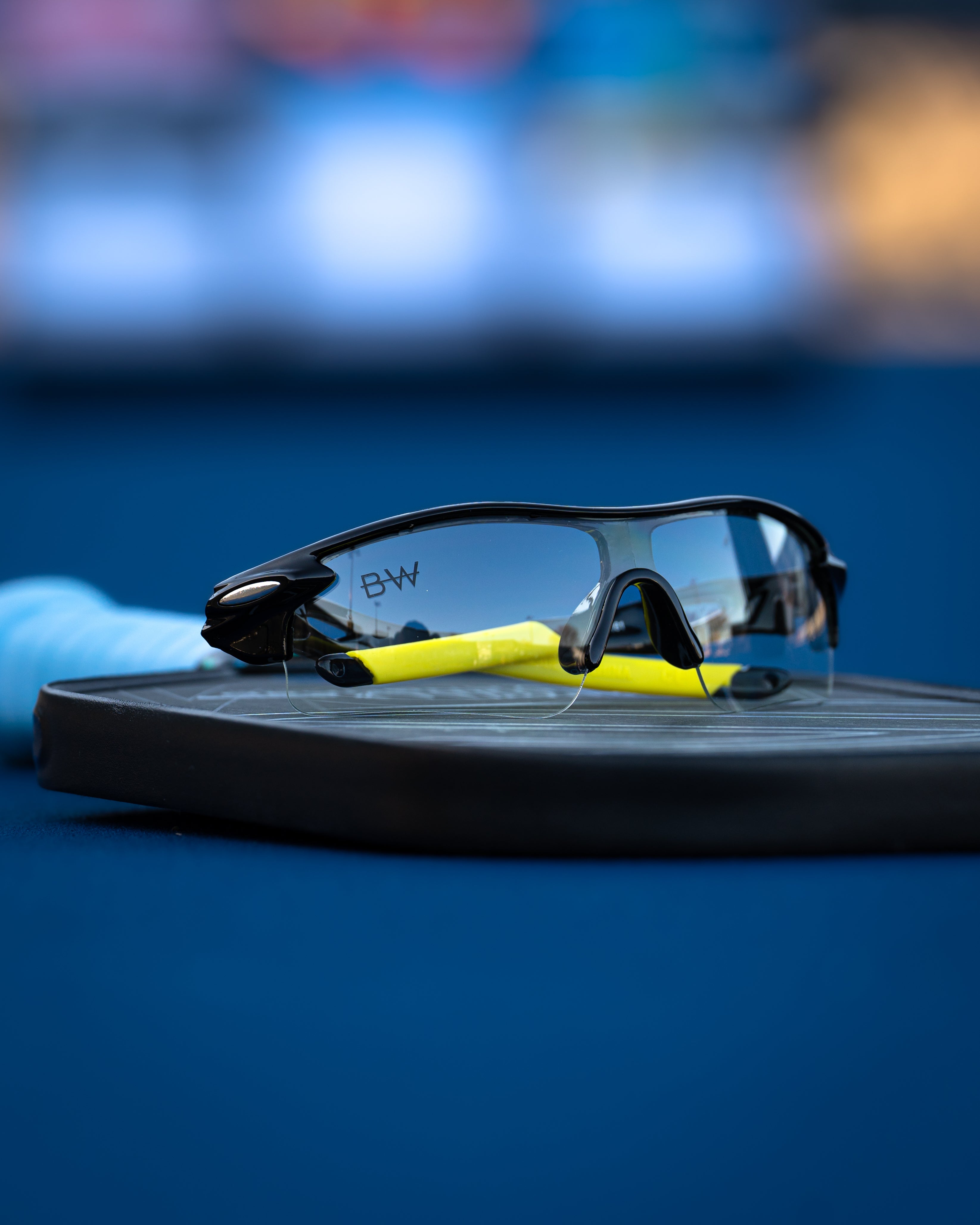
Why You Need Glasses for Pickleball
Share
Why You Need Glasses for Pickleball: Vision, Eye Coverage & Choosing the Right Eyewear
Pickleball glasses can serve two different purposes: providing the vision correction you need and placing a physical eyewear barrier in front of your eyes during play. You do not automatically need prescription lenses just because you play pickleball, but the right sports eyewear can make practical sense for both RX and non-RX players.
Pickleball puts players close to a fast-moving ball, paddles, partners, opponents, and rapid exchanges at the kitchen line. That makes eyewear selection about more than simply choosing sunglasses that look good.
This guide explains why pickleball players wear glasses, when prescription lenses are appropriate, what non-prescription eyewear can offer, how indoor and outdoor lens needs differ, and which features actually matter when choosing pickleball glasses.
Find Pickleball Glasses for Your Vision & Court
Do You Really Need Glasses for Pickleball?
You do not automatically need prescription glasses to play pickleball. However, pickleball eyewear is worth considering whether or not you require vision correction.
There are two separate questions:
- Do you need prescription correction to see appropriately while playing?
- Do you want sports eyewear in front of your eyes while you play?
If you require prescription correction at pickleball distances, RX sports eyewear is one possible setup. If you already play in contact lenses or do not require vision correction, non-prescription sports glasses may be the relevant category instead.
The important point is that prescription need and sports-eyewear need are not the same thing.
Why Do Pickleball Players Wear Glasses?
Players may choose pickleball eyewear for several practical reasons:
- To wear their required prescription correction while playing
- To place an eyewear barrier in front of the eyes
- To use an untinted lens indoors or at night
- To use a sunglass tint during bright outdoor play
- To use one sports-oriented frame instead of everyday eyewear
- To choose a lens configuration suited to changing conditions
Those are stronger reasons to wear sports eyewear than exaggerated promises about automatically reacting faster, seeing spin sooner, or winning more points.
Why Eye Coverage Matters in Pickleball
Pickleball is played with players frequently positioned relatively close to the action, particularly during exchanges near the non-volley zone.
Eyewear places a physical barrier in front of the eyes, which is one reason players may consider glasses even when they do not need prescription correction.
However, not every pair of glasses provides the same level of protection.
When protection matters, distinguish between:
| Eyewear Term | What It Tells You |
|---|---|
| Sports Eyewear | Describes eyewear intended or marketed for active use; it does not automatically establish a safety certification. |
| Impact-Resistant Lens | Describes a lens characteristic, but does not automatically mean the eyewear is shatterproof. |
| Physical Coverage | Describes how much of the area around the eyes is covered by the frame and lenses. |
| Certified Protective Eyewear | Requires verification of the specific standard or certification claimed for the exact product. |
If you require a specific protective standard, verify that standard for the exact eyewear rather than assuming that all pickleball glasses meet it.
Pickleball Is Fast—But Glasses Don't Automatically Make You React Faster
Pickleball can involve quick volleys, drives, blocks, counters, dinks, and changes in ball direction. Vision is part of how a player receives information during those exchanges.
But the claim that sports glasses automatically improve reaction time oversimplifies what happens during play.
Reaction involves multiple factors, including:
- Whether you can see the relevant visual information clearly
- Attention
- Anticipation
- Experience
- Decision-making
- Positioning
- Movement
If you have refractive blur, the appropriate prescription can provide the correction prescribed for that blur. That is different from saying that glasses directly make your nervous system react faster.
Do Pickleball Glasses Help You Track the Ball?
Glasses should not automatically be marketed as a ball-tracking enhancer.
If the pickleball appears blurry because of a refractive error addressed by your prescription, appropriate corrective lenses can address that refractive blur. But tracking a moving ball also involves attention, anticipation, visual conditions, experience, head and eye movement, and positioning.
Similarly, a particular tint, clear lens, or non-polarized lens should not automatically be credited with improving ball tracking unless a specific supported characteristic justifies the claim.
The better goal is to choose eyewear that matches your vision requirements and playing environment.
Do Pickleball Glasses Improve Depth Perception?
Not automatically.
Depth perception involves binocular vision and other visual factors. If someone has uncorrected refractive blur, appropriate correction may be relevant to their overall visual function, but that does not mean every pair of sports glasses improves depth perception.
This distinction also matters when discussing polarized and non-polarized lenses. Blinded Wear sports lenses are non-polarized, but non-polarized construction should not be presented as a guarantee of improved depth perception.
Do You Need Prescription or Non-Prescription Pickleball Glasses?
The answer primarily depends on whether you require prescription correction while playing.
| Your Situation | Eyewear to Consider |
|---|---|
| You need prescription correction while playing | Prescription (RX) pickleball glasses |
| You wear contact lenses while playing | Non-RX sports eyewear can potentially be worn while contacts provide correction |
| You do not need vision correction | Non-prescription pickleball eyewear |
| You are unsure whether you need correction | Have your vision appropriately evaluated rather than diagnosing yourself from your pickleball performance |
Do not buy prescription lenses merely because you want sports eyewear. RX lenses should correspond to an actual vision-correction need.
Why Prescription Pickleball Glasses Can Make Sense
If you normally require prescription correction at the distances involved in pickleball, playing without appropriate correction can leave the refractive blur that your prescription is intended to address.
Prescription pickleball glasses combine that correction with a sports-oriented frame.
This can be particularly useful for players who:
- Already wear eyeglasses and do not want to switch to contacts for pickleball
- Want their prescription incorporated directly into sports eyewear
- Want different eyewear from their everyday frames for active use
- Need an RX setup for indoor or outdoor pickleball
If you do not know whether you need prescription correction, an eyewear retailer or online quiz should not diagnose you. An appropriate eye exam is the right starting point.
What About High-Index Prescription Pickleball Lenses?
Blinded Wear includes high-index prescription lenses at no additional cost with RX eyewear.
High-index describes a lens-material characteristic. It should not be confused with other lens features.
High-index does not automatically mean:
- Anti-fog
- Anti-reflective
- Polarized
- Photochromic
- Scratch-resistant
- UV400
- Shatterproof
- Better ball tracking
- Faster reactions
If any of those characteristics matter to you, verify them independently for the exact lens configuration.
Why Wear Glasses for Indoor Pickleball?
Indoor players may want sports eyewear without a dark sunglass tint. That is where clear lens pickleball glasses become especially relevant.
A clear lens allows the player to wear eyewear while keeping the lens untinted.
This can make clear sports glasses worth considering for:
- Indoor pickleball facilities
- Gym courts
- Evening play
- Night matches under artificial lighting
- Other conditions where a dark tint is not preferred
Clear lenses should not automatically be described as increasing available light, improving depth perception, eliminating glare, preventing fog, or improving ball tracking.
Their defining advantage is much simpler: they do not intentionally darken the scene with a sunglass tint.
Why Wear Glasses for Outdoor Pickleball?
Outdoor pickleball introduces a different set of conditions from indoor play. Depending on the court, time, and weather, players may encounter bright sunlight, changing cloud cover, shadows, wind, and changing light as a session progresses.
Outdoor players can compare:
- Clear lenses when they specifically want an untinted lens
- Fixed-tint sports sunglasses when they prefer a consistent sunglass tint
- Photochromic lenses when compatible adaptive lens behavior better matches changing conditions
No single lens category is universally best for every outdoor pickleball player.
Do You Need UV Protection for Outdoor Pickleball?
When shopping for outdoor sunglasses, UV protection is an important lens specification to evaluate. However, you should verify the actual UV specification of the exact lens rather than assuming it from lens color or marketing category.
A dark lens does not, by itself, establish:
- UV400 protection
- 100% UVA protection
- 100% UVB protection
- Any other specific UV-blocking percentage
Likewise, a clear lens should not automatically be assumed to have or lack a particular UV specification.
UV performance and visible lens tint are separate characteristics.
Do Pickleball Glasses Reduce Glare?
Do not assume that every pair of pickleball glasses provides anti-glare performance.
Glare characteristics can depend on the exact lens, tint, surface treatment, lighting environment, and other factors.
Terms such as:
- Anti-glare
- Glare-reducing
- Anti-reflective
- Mirrored
- Polarized
do not all mean the same thing.
If glare reduction is important to you, verify the characteristics of the exact lens rather than assuming any sports sunglass automatically includes them.
Do You Need Polarized Glasses for Pickleball?
No. Polarization is not a requirement for playing pickleball.
Polarized lenses use a polarization filter, while non-polarized lenses do not add that filter.
Blinded Wear sports lenses are non-polarized.
Some court players prefer non-polarized eyewear, but the choice should not be justified by claiming that polarized lenses universally harm depth perception or that non-polarized lenses automatically improve tracking, reaction time, or performance.
Prescription correction, lens tint, polarization, and protective characteristics are separate decisions.
Do Pickleball Glasses Fog?
Any sports eyewear can potentially experience condensation under the right conditions. Fogging is not determined simply by whether glasses are clear, tinted, prescription, or non-prescription.
Factors can include:
- Perspiration
- Humidity
- Temperature differences
- Rapid changes between environments
- Breathing
- Frame-to-face spacing
- Airflow
- Lens-surface characteristics
Do not assume a pair is anti-fog unless that characteristic is specifically supported for the exact product.
If fogging is already a problem for you, treat it as its own eyewear consideration rather than expecting a new frame or prescription to automatically eliminate it.
Should Pickleball Glasses Have Impact-Resistant Lenses?
Impact resistance is a useful characteristic to evaluate when selecting sports eyewear.
Blinded Wear sports eyewear uses impact-resistant lenses.
However, impact-resistant should not be expanded into claims such as:
- Shatterproof
- Indestructible
- Ball-proof
- Guaranteed to prevent eye injury
- Certified protective eyewear
Those are separate and stronger claims.
If you need eyewear meeting a specific sports-protection standard, verify that certification for the exact product.
How Should Pickleball Glasses Fit?
Fit matters because pickleball involves repeated movement, head turns, bending, reaching, and longer playing sessions.
When comparing frames, look at:
- Overall frame width
- Bridge dimensions and comfort
- Temple length and comfort
- Lens dimensions
- Physical coverage around the eyes
- Overall weight
- How the frame feels during movement
- How it feels after an extended playing session
Do not assume every sports frame is automatically non-slip or guaranteed to stay in place for every face.
If you own glasses that already fit you well, comparing their dimensions with a prospective pickleball frame can be a useful starting point.
Are Lightweight Glasses Better for Pickleball?
Many players prefer lightweight eyewear because they will be wearing it through practices, recreational sessions, leagues, or tournaments.
But lighter does not automatically mean better.
A useful frame still needs to work with your:
- Face dimensions
- Prescription, if applicable
- Desired physical coverage
- Lens configuration
- Comfort preferences
- Playing environment
Blinded Wear offers lightweight sports-frame options, but the best fit remains individual.
Clear vs. Tinted vs. Transition Glasses for Pickleball
The right lens category depends heavily on when and where you play.
| Lens Type | Worth Considering For | Important Limitation |
|---|---|---|
| Clear | Indoor, evening, night, and situations where you do not want a dark tint | Remains untinted rather than adapting to bright sun |
| Fixed Tint | Players who prefer consistent sunglass tint during bright outdoor sessions | Does not automatically adapt when lighting changes |
| Photochromic / Transition | Changing outdoor conditions or players moving across different light environments | Activation behavior varies by exact lens technology and conditions |
Do not choose solely according to which lens is marketed as the most “advanced.” Choose according to your actual playing conditions.
Do You Need More Than One Pair of Pickleball Glasses?
Not necessarily, but players who regularly move between very different environments may benefit from comparing multiple-pair and adaptive-lens strategies.
For example:
| Setup | Potential Advantage | Tradeoff |
|---|---|---|
| One Clear Pair | Simple setup for primarily indoor or evening use | May not match your preference for bright outdoor play |
| One Tinted Pair | Consistent sunglass tint for primarily bright outdoor use | Dark tint may not suit indoor or nighttime conditions |
| Clear + Tinted Pair | Dedicated eyewear for substantially different environments | Requires carrying and maintaining two pairs |
| Photochromic Pair | One-pair adaptability across changing relevant light conditions | Behavior varies and may not replace dedicated lenses for every player |
Do Beginners Need Pickleball Glasses?
Eyewear is not only relevant to advanced or tournament players.
A beginner may need prescription correction just as an experienced player can. Likewise, a recreational player may decide that sports eyewear makes sense for physical eye coverage or their playing environment.
Your skill rating does not determine whether you need RX correction or which lens configuration is appropriate.
Beginners should focus on the same fundamentals:
- Do I need prescription correction?
- Where do I usually play?
- Do I want clear or tinted eyewear?
- How does the frame fit?
- What lens characteristics are actually verified?
- Do I require a particular protective standard?
Do Competitive Pickleball Players Need Different Glasses?
Competitive play can increase the amount of time you spend on court and may expose you to multiple venues or lighting environments, but it does not create an entirely different set of vision rules.
Competitive players should still prioritize:
- Appropriate prescription correction when needed
- Comfort over longer sessions
- Fit
- Physical coverage
- Lens configuration for the environment
- Impact resistance
- Any required protective standard
- A backup strategy when prescription correction is essential
Claims that a particular frame will produce faster reactions, better tracking, or more wins should not replace these practical criteria.
Pickleball Glasses: Myths vs. Facts
| Common Claim | What to Know |
|---|---|
| “Pickleball glasses make you react faster.” | Eyewear should not be marketed as a direct reaction-time enhancer. |
| “Clear lenses improve depth perception.” | Clear describes the absence of a dark tint; it does not automatically improve depth perception. |
| “Non-polarized lenses improve ball tracking.” | Non-polarized means no polarization filter is added; it does not guarantee better tracking. |
| “Every sports frame is non-slip.” | Fit varies by frame and wearer and should be evaluated directly. |
| “Sports glasses never fog.” | Fogging can occur depending on environmental and eyewear factors. |
| “Impact-resistant means shatterproof.” | Impact resistance is not the same as an unlimited shatterproof guarantee. |
| “Tinted lenses automatically block 100% of UV.” | Tint and exact UV specifications are separate characteristics. |
| “Prescription glasses make you a better player.” | RX lenses provide prescribed vision correction; they do not guarantee improved athletic performance. |
FAQ: Why Wear Glasses for Pickleball?
Should you wear glasses while playing pickleball?
Sports eyewear is worth considering if you need prescription correction, want eyewear in front of your eyes during play, or want a lens configuration suited to your court environment. The exact product should match your individual needs.
Do you have to wear protective glasses for pickleball?
Rules and facility requirements can vary. If you specifically need protective eyewear, verify the exact requirements and the certification of the product you are considering rather than assuming all sports glasses provide the same level of protection.
Can you wear regular glasses for pickleball?
Some players do, particularly when they need prescription correction. Dedicated sports eyewear may offer different frame geometry, coverage, lens options, or active-use characteristics, but the exact differences depend on the products being compared.
Can you wear sunglasses for pickleball?
Yes. Sunglasses can be an option for outdoor pickleball when a tinted lens matches your preferences and environment.
What glasses should you wear for indoor pickleball?
Clear sports glasses are worth comparing when you want eyewear without a dark sunglass tint. Prescription players should look for a compatible clear RX setup if they need correction.
What glasses should you wear for outdoor pickleball?
Outdoor players can compare clear, fixed-tint, and photochromic sports eyewear according to brightness, changing light, prescription needs, fit, and verified lens characteristics.
Do I need prescription glasses for pickleball?
You need prescription correction when it is appropriate for your vision at the relevant playing distances. If you are unsure whether you need correction, an appropriate eye exam is more reliable than trying to diagnose yourself from your pickleball performance.
Can I wear contacts and non-prescription pickleball glasses?
Yes. For some players, contacts provide the necessary vision correction while separate non-RX sports eyewear is worn over them.
Pickleball Glasses vs. No Glasses: What Changes?
If you do not require prescription correction, you may wonder why you would wear glasses at all.
The most straightforward difference is physical: wearing eyewear places a frame and lenses in front of your eyes, while playing without glasses does not.
That does not mean every pair of glasses provides the same protection or that ordinary eyewear should be treated as certified protective equipment.
| Consideration | Pickleball Sports Eyewear | No Eyewear |
|---|---|---|
| Physical Barrier in Front of Eyes | Yes, depending on frame and lens coverage | No |
| Prescription Correction | Possible with compatible RX eyewear | No eyewear-based correction |
| Sunglass Tint | Available depending on lens configuration | No |
| Clear Lens Option | Available | Not applicable |
| Impact Resistance | Depends on product; Blinded Wear sports eyewear uses impact-resistant lenses | Not applicable |
| Protective Certification | Must be verified for the exact eyewear | Not applicable |
The decision should be based on what you actually want from the eyewear: prescription correction, physical coverage, a particular lens configuration, or a combination of those needs.
Regular Sunglasses vs. Pickleball Sports Glasses
You can wear sunglasses while playing pickleball, but not every pair of sunglasses is designed with active use in mind.
Instead of assuming that a product marketed for pickleball is automatically superior, compare the characteristics that matter for your game:
- Frame dimensions
- Overall weight
- Comfort during movement
- Physical lens coverage
- Impact resistance
- Lens tint
- Prescription availability if needed
- Any required protective certification
A casual fashion sunglass may work for one player's needs, while another may prefer a dedicated sports-oriented frame. The actual specifications matter more than the label alone.
Regular Prescription Glasses vs. RX Pickleball Glasses
If your everyday eyeglasses already provide the prescription correction you need, you may technically be able to see appropriately in them while playing. The reason to compare dedicated RX sports eyewear is the frame and active-use configuration—not because the prescription itself becomes more powerful on a pickleball court.
| Feature | Everyday RX Glasses | RX Pickleball Glasses |
|---|---|---|
| Prescription Correction | Yes | Yes |
| Sports-Oriented Frame | Not necessarily | Yes |
| Impact Resistance | Depends on exact eyewear | Verify exact product; Blinded Wear sports eyewear uses impact-resistant lenses |
| Sports-Specific Lens Configuration | Depends on eyewear | Can be selected according to available sports-eyewear options |
| Protective Certification | Must be verified | Must still be verified |
If your everyday glasses are uncomfortable or impractical during active play, dedicated RX sports eyewear may be worth comparing.
Can You Wear Contacts With Pickleball Glasses?
Yes. For players who already use contact lenses, one option is to let the contacts provide the necessary prescription correction while wearing non-prescription sports eyewear separately.
This creates two distinct layers:
- Contact lenses: provide the prescribed vision correction.
- Non-RX sports glasses: provide the selected frame and lens configuration without adding another prescription.
Other players may prefer RX pickleball glasses instead of wearing contacts during play.
Neither setup is universally right for everyone. Prescription needs, comfort, personal preference, and appropriate eye-care guidance can all matter.
Will Every Prescription Work in Every Pickleball Frame?
No. A frame being offered in an RX version does not mean that every possible prescription can be produced in that frame.
Compatibility can depend on:
- Your complete prescription
- Frame dimensions
- Frame curvature
- Lens geometry
- Lens material
- Available prescription configuration
- Progressive or multifocal requirements when applicable
This is particularly important with highly curved sports frames and more complex prescriptions.
Start with your actual prescription and verify compatibility instead of selecting a frame and assuming any RX can be added later.
How Do You Order Blinded Wear Prescription Pickleball Glasses?
If you already have an appropriate eyeglass prescription, Blinded Wear allows RX customers to upload a clear photo or picture of their prescription when ordering prescription eyewear.
A practical process is:
- Have appropriate eyeglass prescription information.
- Browse RX-compatible pickleball frames.
- Compare frame dimensions and styling.
- Verify that your prescription is compatible with the selected frame.
- Choose from the available lens configurations appropriate for your needs.
- Upload a clear picture of your eyeglass prescription.
- Review the order information before submitting it.
If you are unsure whether you need prescription correction at all, get your vision appropriately evaluated before ordering RX eyewear.
Blinded Wear Prescription Pickleball Glasses to Compare
For players who need prescription correction, Blinded Wear offers multiple RX sports frames. Instead of ranking one frame as universally “best,” compare each option according to your prescription, fit, style, and playing environment.
| RX Pickleball Glasses | What to Compare |
|---|---|
| H Blue Shield RX | Compare frame styling, dimensions, prescription compatibility, fit, and available lens configuration. |
| Havana Melt RX | Compare frame geometry, dimensions, prescription compatibility, and your individual fit preferences. |
| Crystal Wave II RX | Compare prescription compatibility, frame fit, and the lens options available for your exact configuration. |
| Rocket Fire RX | Compare dimensions, styling, prescription compatibility, and intended playing environment. |
| Frost RX | Compare its exact RX configuration with your prescription, fit needs, and court environment. |
| Ocean Wave RX | Compare frame characteristics and available RX configuration with your individual requirements. |
Product inclusion does not mean every prescription or every lens option is available in every frame. Verify the exact configuration before purchasing.
What if You Don't Need Prescription Pickleball Glasses?
If you see appropriately without prescription correction—or already receive your correction from contact lenses—you can focus on non-RX pickleball eyewear.
That allows you to compare sports glasses according to:
- Clear vs. tinted lens configuration
- Frame dimensions
- Weight
- Comfort
- Physical coverage
- Impact resistance
- Playing environment
- Style
There is no benefit to adding prescription correction that you do not need.
How Weather Changes Your Pickleball Eyewear Needs
Outdoor pickleball does not happen under one consistent lighting condition. Your preferred eyewear may change depending on the environment.
| Condition | What to Consider |
|---|---|
| Bright Sun | A fixed sunglass tint or compatible adaptive lens may be worth comparing. |
| Cloudy / Overcast | Consider whether your usual tint feels too dark for the actual conditions. |
| Evening | A clear lens may become more practical as available light decreases. |
| Night | Clear eyewear avoids adding a dark sunglass tint under court lighting. |
| Changing Conditions | Compare multiple dedicated pairs with a compatible photochromic configuration. |
| Wind | Frame and lens coverage may be worth considering; do not assume every frame provides identical coverage. |
Environment-specific selection is more useful than treating one lens as universally best for every pickleball session.
What Glasses Should You Wear for Night Pickleball?
For nighttime pickleball under artificial court lighting, clear sports eyewear is a logical category to compare because it does not add a dark sunglass tint.
Clear lenses do not create additional light or turn a poorly lit court into a bright one. They simply remain untinted.
Night players should still evaluate:
- Frame fit
- Comfort
- Physical coverage
- Impact resistance
- Prescription requirements
- Any verified lens treatments they specifically want
If your nighttime difficulty involves persistent blur rather than merely reduced environmental light, consider whether your vision needs appropriate evaluation.
What About Glasses Under Indoor LED Court Lights?
Indoor facilities can use different lighting systems, court colors, wall colors, and backgrounds. Clear sports eyewear is often worth considering when the primary goal is to avoid wearing a dark sunglass tint indoors.
However, do not assume that a clear lens automatically:
- Eliminates reflections
- Reduces glare
- Improves contrast
- Makes the pickleball appear brighter
- Filters a particular wavelength
- Improves reaction time
Those characteristics would require separate support for the exact lens.
Does Lens Color Matter for Pickleball?
Lens tint changes how much and which portions of visible light reach the eye, but broad claims that a particular color automatically makes every athlete perform better should be treated cautiously.
When choosing a lens, ask:
- How bright is my normal playing environment?
- Do I play indoors or outdoors?
- Do I play during the day, evening, or night?
- Do lighting conditions change during my sessions?
- Do I need prescription correction?
- What exact characteristics are verified for this lens?
Your environment and visual needs are more useful starting points than choosing a color because it is advertised as a universal “performance tint.”
Are Mirrored Lenses Better for Pickleball?
A mirrored appearance does not automatically make a lens better for pickleball.
Mirror treatments and visible lens tint are characteristics to evaluate as part of the exact lens configuration, but the presence of a mirror finish should not automatically be interpreted as:
- Better ball tracking
- Improved depth perception
- Anti-glare performance
- A specific UV rating
- Faster reaction time
- Better protection
Choose based on verified specifications and your environment rather than appearance alone.
Do Pickleball Glasses Need Blue-Light Filtering?
Do not assume that indoor sports glasses require blue-light filtering simply because a facility uses LED lighting.
Likewise, a clear lens does not automatically mean that it has a particular blue-light filter.
If a product makes a specific blue-light claim, evaluate the exact specification rather than treating “clear,” “indoor,” and “blue-light filtering” as interchangeable terms.
Do Pickleball Glasses Need an Anti-Reflective Coating?
Anti-reflective treatment is a separate lens characteristic. It should not be assumed simply because eyewear is prescription, clear, tinted, or marketed for pickleball.
If an anti-reflective treatment matters to you, verify whether it is included or available for the exact lens configuration you are considering.
The same rule applies to anti-fog, scratch-resistant, hydrophobic, and other lens-treatment claims.
How Much Coverage Should Pickleball Glasses Have?
Physical coverage depends on frame and lens geometry.
When comparing pickleball eyewear, look at:
- Lens width
- Lens height
- Overall frame width
- How the lenses sit relative to your eyes
- Side coverage provided by the frame shape
- How the frame interacts with your face
More coverage should not automatically be described as certified protection. Certification and physical coverage are related shopping considerations but not interchangeable claims.
How Can You Tell if Pickleball Glasses Fit Well?
A frame can look appropriate in product photos and still feel different on your face.
When you receive new sports eyewear, evaluate it during normal movement before relying on it during competition.
You can pay attention to:
- Pressure around the bridge or temples
- Whether the frame feels excessively loose
- Whether your normal field of view feels obstructed by the frame
- How the eyewear feels when turning your head
- Comfort once you begin perspiring
- Comfort over a full practice session
Do not assume that “sports fit” means one frame will fit every face the same way.
Can You Wear Pickleball Glasses With Hats or Headbands?
Usually, but compatibility depends on the eyewear and the other equipment you use.
If you regularly play in a hat, visor, sweatband, or other headwear, test the complete setup together.
Temple shape, frame dimensions, and headwear placement can affect comfort. A frame that feels comfortable by itself may feel different when worn with other equipment for several hours.
What About Sweat During Pickleball?
Pickleball can involve substantial perspiration, particularly during outdoor sessions and long matches.
Sweat can affect comfort and can contribute to moisture around the eyewear, but do not assume that every sports frame has sweat-resistant nose pads, rubberized grips, or a guaranteed non-slip design.
Instead, evaluate the exact frame and how it behaves during your own play.
If sweat frequently reaches your lenses, appropriate cleaning and moisture management can also become part of your routine.
How Can You Reduce Fogging During Pickleball?
Because fogging involves condensation, there is no universal frame or lens that can be assumed to remain fog-free in every environment.
Useful considerations can include:
- Keeping lenses appropriately clean
- Managing perspiration around the face and forehead
- Considering frame-to-face spacing
- Considering airflow around the eyewear
- Managing abrupt temperature changes when practical
- Using only compatible lens-safe anti-fog products when appropriate
Avoid using unverified household substances on sports lenses because compatibility can vary by lens material and any existing treatments.
How Should You Clean Pickleball Glasses?
Sports eyewear can collect sweat, fingerprints, dust, and other debris during normal play.
Follow the care instructions for the exact eyewear. In general:
- Check the lenses for loose debris before rubbing them.
- Use an appropriate lens-safe cleaning method.
- Use suitable lens-cleaning material rather than abrasive fabric.
- Avoid harsh chemicals unless they are confirmed safe for the lens.
- Store the eyewear appropriately after it is clean and dry.
Do not assume sports lenses are scratch-proof. Appropriate cleaning can help avoid unnecessary damage caused by abrasive debris or unsuitable materials.
How Should You Store Pickleball Glasses?
A common source of unnecessary eyewear damage is not the game itself—it is how the glasses are handled between games.
Avoid tossing eyewear loose into a pickleball bag where the lenses can contact:
- Keys
- Paddles
- Water bottles
- Other eyewear
- Sports equipment
- Hard or abrasive objects
Prescription players should be particularly careful because damage to a primary RX pair can affect more than just sun protection or style.
Should You Carry a Backup Pair of Pickleball Glasses?
A backup can make sense if you depend on prescription correction, play tournaments, travel frequently, or use different lenses for different environments.
For example, a player's bag might contain:
- A primary outdoor pair
- A clear pair for indoor or evening play
- A backup RX pair if prescription correction is essential
You do not need three pairs simply because you play pickleball. The point is to plan around your actual schedule and vision requirements.
What Glasses Should You Bring to a Pickleball Tournament?
Tournaments can make eyewear selection more complicated because matches may span different times, courts, and lighting conditions.
Before tournament day:
- Check whether you will play indoors, outdoors, or both.
- Consider the expected time of your matches.
- Choose lens configurations suited to those environments.
- Practice in new eyewear before competition.
- Bring a suitable backup if you depend on prescription correction.
- Store your eyewear appropriately between matches.
A tournament is not the ideal time to discover that a new frame does not fit comfortably or that your chosen tint is poorly matched to the court.
Why Pickleball Travelers Should Plan Their Eyewear
Traveling players can encounter indoor facilities, outdoor courts, evening practices, and changing weather during the same trip.
If you rely on prescription correction, replacing damaged or lost eyewear away from home may also be inconvenient.
Consider packing:
- Your primary pickleball eyewear
- A suitable backup if needed
- Another lens configuration if the trip includes very different playing environments
- Appropriate storage
- Lens-safe cleaning supplies
- Access to prescription information if you depend on RX eyewear
How to Choose Pickleball Glasses
1. Determine Whether You Need Prescription Correction
If you require RX correction during play, begin with prescription-compatible eyewear. If you use contacts or do not need correction, begin with non-RX options.
2. Identify Your Primary Playing Environment
Indoor, bright outdoor, evening, night, and changing-light play can favor different lens configurations.
3. Compare Frame Dimensions
Use measurements from eyewear that already fits you well when possible.
4. Evaluate Physical Coverage
Look at actual frame and lens geometry rather than assuming all sports eyewear covers the same area.
5. Verify Impact Resistance
Blinded Wear sports eyewear uses impact-resistant lenses. Do not confuse impact resistance with an unlimited shatterproof guarantee or a specific certification.
6. Verify Any Other Lens Claims
Check exact UV specifications, coatings, treatments, or other features that matter to you instead of assuming they are included.
7. Think About Your Entire Schedule
A Saturday morning outdoor player may have different needs from someone playing indoor leagues three nights per week.
8. Consider Support After Purchase
Sports eyewear gets used actively. Replacement support can therefore be relevant when comparing options.
Pickleball Glasses Feature Checklist
| Feature | What to Ask |
|---|---|
| Prescription | Do I need RX correction, and does this exact frame support my prescription? |
| Lens Tint | Does clear, fixed tint, or photochromic behavior best match where I play? |
| Impact Resistance | Is impact resistance actually verified? |
| Physical Coverage | How much of the area around my eyes does the frame and lens geometry cover? |
| Frame Dimensions | How do the measurements compare with eyewear I already wear comfortably? |
| Weight | Is the frame comfortable for the length of time I normally play? |
| Polarization | Is the lens polarized or non-polarized? Blinded Wear sports lenses are non-polarized. |
| UV Specification | What exact UV claim is verified for this lens? |
| Anti-Fog | Is anti-fog performance specifically supported, or am I assuming it? |
| Anti-Reflective | Is an AR treatment included or available for this configuration? |
| Scratch Resistance | Is this characteristic specifically verified? |
| Protective Standard | Does my intended activity require a specific certification? |
| Replacement Support | What happens if the eyewear breaks? |
12 Mistakes to Avoid When Buying Pickleball Glasses
- Assuming every sports frame provides certified eye protection. Verify any required standard.
- Believing impact-resistant means shatterproof. Those claims are not interchangeable.
- Choosing RX lenses when you do not need prescription correction. Prescription should address an actual vision need.
- Ignoring your prescription when you do need correction. Start with RX compatibility.
- Assuming every prescription works in every frame. Frame geometry and RX complexity matter.
- Buying a dark tint for indoor play without considering the environment. Clear eyewear may be worth comparing.
- Assuming clear lenses improve depth perception. Clear primarily describes the absence of a dark tint.
- Assuming non-polarized lenses automatically improve ball tracking. Polarization is only one lens characteristic.
- Assuming all sports glasses are anti-fog. Fogging depends on multiple factors.
- Assuming every dark lens provides a particular UV rating. Verify the exact UV specification.
- Ignoring frame dimensions and fit. Lens technology cannot compensate for a frame that does not work for your face.
- Buying based on promises of instant performance gains. Prioritize verified characteristics, fit, vision needs, and playing environment.
More Questions About Pickleball Glasses
Why do people wear glasses for pickleball?
Players may wear glasses for prescription correction, physical eye coverage, a clear lens indoors, a sunglass tint outdoors, or a sports-oriented frame during active play.
Are pickleball glasses only for people who need a prescription?
No. Non-prescription players can also consider sports eyewear. RX and non-RX pickleball glasses serve different vision needs.
Are pickleball glasses the same as safety glasses?
Not automatically. “Pickleball glasses” or “sports glasses” does not by itself establish a particular protective certification. Verify the exact product if a safety standard matters.
Should pickleball glasses be polarized?
Polarization is not required. Blinded Wear sports lenses are non-polarized, but that characteristic should not be presented as a guarantee of improved depth perception or tracking.
Should pickleball glasses be clear?
Clear lenses are especially worth considering indoors, at night, and whenever you do not want a dark sunglass tint. Bright outdoor players may prefer another configuration.
Do pickleball glasses prevent eye injuries?
No eyewear should be described as guaranteeing that an eye injury cannot occur. The level of protection depends on the exact frame, lenses, coverage, construction, and any verified protective standard.
Do pickleball glasses need to be wraparound?
No single frame shape is mandatory for every player. Compare physical coverage, fit, prescription compatibility, and any protective requirements rather than assuming one geometry is universally best.
Can I use tennis glasses for pickleball?
Potentially. Suitability depends on the actual eyewear characteristics, fit, lens configuration, prescription needs, and any protective requirements rather than the sport named in the product title.
Can I use running sunglasses for pickleball?
Potentially, but evaluate fit, physical coverage, impact resistance, lens configuration, and other relevant characteristics instead of assuming all sports eyewear is interchangeable.
Can I wear clear glasses outside for pickleball?
Yes. Clear lenses remain untinted outdoors. Whether you prefer them over tinted eyewear depends on the brightness and your individual preference.
Can I wear tinted pickleball glasses indoors?
You can, but a dark tint intentionally reduces visible light reaching the eye. Many indoor players may prefer an untinted clear lens instead.
Do pickleball glasses make the ball easier to see?
That should not be assumed from the category alone. Appropriate prescription correction can address refractive blur, while tint and other lens characteristics should be evaluated according to their verified properties.
Who Should Consider Wearing Glasses for Pickleball?
Pickleball eyewear can make sense for a wide range of players, but the reason for wearing it may differ from person to person.
| Player | Why Eyewear May Be Relevant | What to Consider |
|---|---|---|
| Prescription Player | Needs vision correction during play | RX compatibility, frame fit, lens configuration, impact resistance |
| Contact Lens Player | Already receives correction from contacts but wants separate sports eyewear | Non-RX frame, coverage, fit, playing environment |
| Indoor Player | Wants eyewear without a dark sunglass tint | Clear lenses, fit, impact resistance, coverage |
| Outdoor Player | Wants sports eyewear suited to brighter conditions | Tint preference, verified lens specifications, fit |
| Night Player | Wants eyewear without adding a dark tint under court lighting | Clear lenses, fit, prescription needs |
| Tournament Player | May play for longer periods or across multiple environments | Comfort, backup eyewear, lens configuration, storage |
| Recreational Player | May simply want sports-oriented eyewear during play | Fit, coverage, lens configuration, verified specifications |
You do not need to be an advanced player before eyewear becomes relevant. Your vision, environment, fit requirements, and reasons for wanting eyewear matter more than your rating or competitive level.
What Problems Won't Pickleball Glasses Automatically Fix?
Good sports eyewear can serve useful purposes, but it should not be treated as a universal solution for every problem you experience on court.
A new pair of glasses will not automatically fix:
- Late paddle preparation
- Poor positioning
- Incorrect technique
- Difficulty anticipating an opponent's shot
- Inconsistent footwork
- Fatigue
- Every cause of eye discomfort
- Every cause of difficulty tracking a moving ball
- Every problem with depth or spatial judgment
If you experience persistent visual symptoms, distinguish those concerns from normal pickleball skill development and seek appropriate evaluation when needed.
What Should You Verify on a Pickleball Glasses Product Page?
Sports-eyewear marketing can contain a lot of terminology. Before purchasing, separate verified specifications from assumptions created by words such as “performance,” “court,” or “sports.”
Look for information about:
- Prescription status: Is the product RX or non-RX?
- Prescription compatibility: If RX, does your exact prescription work with the frame?
- Lens configuration: Is the lens clear, tinted, photochromic, or another available configuration?
- Impact resistance: Is it specifically stated?
- Frame dimensions: How does the size compare with eyewear that fits you?
- Lens dimensions and coverage: How much physical area does the design cover?
- Polarization: Is the lens polarized or non-polarized?
- UV specification: Is an exact UV claim provided?
- Lens treatments: Are anti-fog, anti-reflective, scratch-resistant, or other treatments actually specified?
- Protective standards: Is a specific certification provided if one is important to you?
- Replacement terms: What support is available if the eyewear breaks?
This approach helps you compare products based on what they actually offer instead of assuming every sports-eyewear feature comes standard.
What Does Blinded Wear Offer Pickleball Players?
Blinded Wear offers both prescription and non-prescription sports eyewear for pickleball players, allowing you to begin with your actual vision needs instead of forcing every player into the same setup.
| Blinded Wear Feature | What It Means |
|---|---|
| RX Pickleball Collection | Prescription sports-eyewear options for players who require correction. |
| Non-RX Pickleball Collection | Sports-eyewear options for players who do not need built-in prescription correction. |
| Clear Lens Collection | Untinted sports-eyewear options worth considering for indoor, evening, night, and other environments where a dark tint is not preferred. |
| High-Index RX Lenses | Included at no additional cost with Blinded Wear RX eyewear. |
| Impact-Resistant Lenses | Blinded Wear sports eyewear uses impact-resistant lenses. |
| Non-Polarized Sports Lenses | Blinded Wear sports lenses are non-polarized. |
| Lightweight Sports Frames | Lightweight frame options are available for active use. |
| RX Upload | Prescription customers can upload a clear photo or picture of their eyeglass prescription. |
| Replacement Support | 50% lifetime replacement support if glasses break, subject to current policy terms. |
These verified characteristics are more useful than claiming that eyewear automatically gives every player better reactions, perfect tracking, or a competitive advantage.
What Happens if Your Blinded Wear Pickleball Glasses Break?
Blinded Wear provides 50% lifetime replacement support if your glasses break, subject to the current policy terms.
That support can be relevant for sports eyewear because glasses may travel between practices, courts, tournaments, bags, and everyday activities.
It should not be interpreted as:
- A guarantee that the eyewear cannot break
- A universal free replacement
- A guarantee against loss
- A guarantee against scratches
- Proof that the glasses are shatterproof
- Proof of a particular protective certification
- A guarantee that an updated prescription will be replaced for free
Always review the current policy terms for complete details.
Not Sure Which Pickleball Glasses to Choose?
If you already understand whether you need prescription correction, the Blinded Wear pickleball eyewear quiz can help narrow your shopping options.
Use the quiz to think through product-selection factors such as:
- RX vs. non-RX eyewear
- Playing environment
- Lens preference
- Frame preference
- Your typical pickleball routine
The quiz is a shopping tool, not an eye exam. It cannot diagnose refractive error, determine your prescription, or tell you whether you medically need corrective lenses.
If you are unsure whether you need prescription correction, have your vision appropriately evaluated first.
Which Pickleball Glasses Should You Choose?
Use your vision needs and playing environment to narrow the category before comparing individual frames.
| If This Sounds Like You... | Start Here |
|---|---|
| I need prescription correction while playing | RX Pickleball Glasses |
| I don't need RX and mostly play outdoors | Non-RX Pickleball Eyewear |
| I wear contacts and want separate sports glasses | Non-RX Pickleball Eyewear |
| I primarily play indoors | Clear Lens Sports Eyewear |
| I mostly play at night | Clear Lens Sports Eyewear |
| I play in changing environments | Compare dedicated clear/tinted pairs with compatible photochromic options. |
| I don't know if I need a prescription | Have your vision appropriately evaluated before buying RX eyewear. |
More FAQs About Glasses for Pickleball
What are the best glasses for pickleball?
There is no single pair that is best for every player. Start with whether you need prescription correction, then compare your playing environment, frame dimensions, fit, physical coverage, lens configuration, impact resistance, and any protective requirements.
What color lens is best for pickleball?
No single lens color is universally best. Indoor and nighttime players may prefer clear eyewear, while outdoor players may prefer a tint or another configuration suited to their conditions. Choose based on the actual environment and verified lens characteristics.
Are clear glasses good for pickleball?
Clear sports glasses are particularly relevant when you want eyewear without a dark sunglass tint, including indoor, evening, and nighttime play.
Are sunglasses good for pickleball?
Sunglasses can be useful for players who prefer tinted eyewear outdoors. Compare the exact tint, fit, impact resistance, coverage, prescription requirements, and verified specifications.
Should I wear eye protection while playing pickleball?
Eyewear places a physical barrier in front of the eyes, but the level of protection varies by product. If protective performance is your priority, evaluate the exact construction and verify any protective standard you require.
Are regular eyeglasses enough for pickleball?
Regular prescription glasses may provide the correction you need, but they are not automatically equivalent to sports-oriented or certified protective eyewear. Compare frame design, coverage, impact resistance, fit, and any relevant standards.
Are prescription pickleball glasses better than contacts?
Neither option is universally better. RX sports glasses incorporate correction into the eyewear, while contacts can provide correction underneath non-RX sports glasses. Comfort, prescription needs, eye-care guidance, and personal preference matter.
Can pickleball glasses be prescription?
Yes. Compatible sports frames can use prescription lenses. Blinded Wear offers a dedicated RX pickleball eyewear collection.
Do pickleball glasses need anti-fog lenses?
Fogging can matter during active play, but do not assume every player needs a specific coating or that every sports lens is anti-fog. Consider your environment and verify exact lens characteristics.
Do pickleball glasses need UV protection indoors?
Indoor and outdoor environments present different considerations. If an exact UV specification matters for your intended use, verify it for the selected lens rather than assuming it based on whether the lens is clear or tinted.
Can you wear pickleball glasses all day?
That depends on the exact eyewear, lens configuration, prescription needs, comfort, and environment. A dark sports tint that works outdoors may not be appropriate for every indoor setting, for example.
Should beginners buy expensive pickleball glasses?
Price alone does not determine whether eyewear suits a player. Beginners should evaluate the same fundamentals as experienced players: prescription needs, fit, impact resistance, physical coverage, lens configuration, verified specifications, and intended use.
How often should pickleball glasses be replaced?
There is no universal replacement interval. Reevaluate eyewear if the frame or lenses are damaged, your prescription changes, the fit no longer works, or your playing needs change.
Can pickleball glasses be used for other sports?
Potentially. Multi-sport suitability depends on the eyewear's actual characteristics and any sport-specific protective requirements rather than the product simply being labeled for pickleball.
Key Takeaways: Why Wear Glasses for Pickleball?
- Pickleball eyewear can be relevant for both prescription and non-prescription players.
- You do not need prescription lenses simply because you play pickleball.
- If you require correction while playing, RX pickleball glasses are one option.
- If contacts already provide your correction, non-RX sports eyewear can potentially be worn over them.
- Eyewear places a physical barrier in front of the eyes, but not every pair provides the same level of protection.
- Impact-resistant does not automatically mean shatterproof or certified protective eyewear.
- Blinded Wear sports eyewear uses impact-resistant lenses.
- Clear lenses are worth considering when you do not want a dark sunglass tint, especially indoors or at night.
- Tinted eyewear can be considered for bright outdoor play.
- Photochromic lenses can be compared when changing light is part of your routine.
- Clear lenses do not automatically improve depth perception or ball tracking.
- Non-polarized lenses do not automatically improve reaction time or depth perception.
- Blinded Wear sports lenses are non-polarized.
- Do not assume every pickleball lens is anti-fog, anti-glare, scratch-resistant, or UV400.
- Frame dimensions, comfort, physical coverage, and prescription compatibility matter.
- Blinded Wear includes high-index prescription lenses at no additional cost with RX eyewear.
- Blinded Wear RX customers can upload a clear photo or picture of their eyeglass prescription.
- Blinded Wear provides 50% lifetime replacement support if glasses break, subject to current policy terms.
Related Pickleball Eyewear Guides
Find Pickleball Glasses That Match How You Actually Play
The right pickleball eyewear starts with a few simple questions: Do you need prescription correction? Where do you play? What lens configuration makes sense there? And which frame fits your face and intended use?
You do not need exaggerated claims about seeing spin sooner or reacting faster to make a strong eyewear decision.
Instead, compare verified characteristics such as prescription compatibility, impact resistance, frame dimensions, physical coverage, lens configuration, and replacement support.
Bottom Line: Why Do You Need Glasses for Pickleball?
You may want glasses for pickleball because you need prescription correction, want sports eyewear in front of your eyes during play, need a lens configuration suited to your court environment, or want a combination of those benefits.
Prescription players should begin with their actual vision correction needs. Non-prescription players can focus on frame fit, physical coverage, lens configuration, impact resistance, and other verified characteristics.
Indoor and nighttime players may prefer clear lenses because they do not add a dark sunglass tint. Outdoor players can compare tinted and other compatible lens options based on their actual conditions.
Most importantly, choose pickleball eyewear for what it can genuinely provide—not promises that a pair of glasses will automatically make you react faster, improve your depth perception, track every ball better, or win more points.
Good pickleball eyewear selection is simpler than that: match your vision, your court, your fit, and your intended use.