
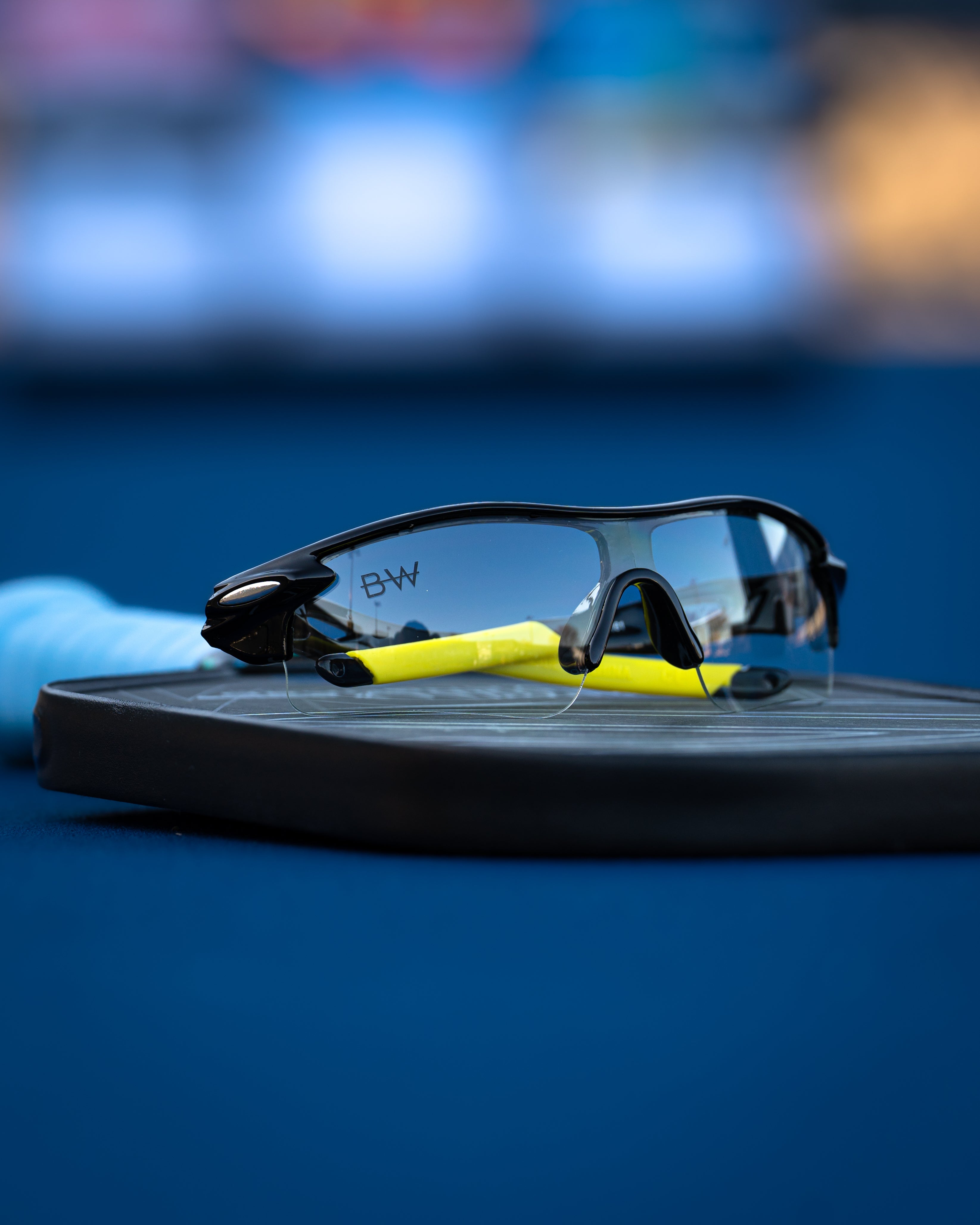
Senior Vision Correction: RX Sunglasses for 50+ Pickleballers
Share
Senior Vision Correction: RX Sunglasses for 50+ Pickleballers
Find Your Perfect Pickleball Glasses
Vision can change with age, but that doesn't mean your pickleball game has to slow down. The right prescription eyewear can help 50+ players see more comfortably across different court conditions while maintaining a secure, sport-oriented fit.
Pickleball is popular with players well into their 50s, 60s, 70s, and beyond. But the way your eyes handle distance, near vision, glare, contrast, and changing light can shift as you age.
That can make the eyewear you used years ago feel less effective on a fast-moving court.
For players who need vision correction, RX sunglasses for pickleball can combine prescription clarity with a frame designed around active use.
The goal isn't to find “senior glasses.”
It's to choose prescription eyewear that matches:
- Your current prescription
- Your playing environment
- Your preferred lens type
- Your light sensitivity
- Your face and frame measurements
- The amount of coverage and wrap you prefer
This guide explains what changes after 50, which lens decisions matter most, and how to compare prescription pickleball glasses without relying on exaggerated performance claims.
How Vision Commonly Changes After 50
Aging does not affect everyone exactly the same way, but several changes become more common over time.
| Vision Change | What It Means | Why a Pickleball Player May Notice It |
|---|---|---|
| Presbyopia | Near focusing becomes more difficult with age. | Reading phones, score sheets, labels, or other close-up information may become harder. |
| Greater Glare Sensitivity | Bright light may feel more uncomfortable or distracting. | Outdoor sun, bright court surfaces, or artificial lighting may become more noticeable. |
| Reduced Contrast Sensitivity | Separating objects from similar-toned backgrounds may become more difficult. | Some players may notice more difficulty in low-contrast or inconsistent lighting conditions. |
| Slower Light Adaptation | Your eyes may take longer to adjust between brighter and darker environments. | Moving between shade, sun, indoor courts, and outdoor courts can feel less seamless. |
| Prescription Changes | Your correction needs may change over time. | An older pair that once felt sharp may no longer provide the same clarity. |
These changes don't mean you need to stop playing. They mean your eyewear setup may need to evolve with your vision.
Why Updated Prescription Correction Matters for Pickleball
Pickleball asks your eyes to process several distances quickly.
During a single rally you may look at:
- The ball near your paddle
- An opponent across the kitchen
- A player near the baseline
- Sidelines and court boundaries
- Your doubles partner in your peripheral field
If your prescription no longer matches your visual needs, you may notice:
- Blur
- Squinting
- Difficulty seeing comfortably at certain distances
- Eyestrain
- Greater visual fatigue over long sessions
If that happens consistently, don't simply assume it's normal aging. An updated eye exam can determine whether your prescription or eye health has changed.
Presbyopia and Pickleball: Do You Need Progressives?
Presbyopia usually becomes noticeable beginning in middle age and affects near focusing.
That does not automatically mean every 50+ pickleball player should use progressive lenses while playing.
Your ideal lens design depends on what you need to see during the activity and what your eye-care professional recommends.
Single-Vision Lenses
Single-vision lenses use one prescription power across the main lens area.
For some players, distance-focused prescription correction may be the most straightforward choice for sport.
Progressive Lenses
Progressive lenses combine multiple viewing zones into one lens.
They can be useful for people who want distance, intermediate, and near correction in the same pair, but sport use can involve additional considerations such as:
- Frame dimensions
- Lens height
- How the optical zones line up
- Your normal head and eye movement
- Your adaptation to progressive lenses
If you already use progressives, confirm whether the sports frame you're considering can appropriately support your prescription and lens design.
Should 50+ Pickleball Players Use Prescription Sunglasses?
If you need vision correction and regularly play outdoors, prescription sunglasses can be a convenient way to combine corrective lenses and sun management in one pair.
Instead of wearing contacts under non-prescription sunglasses or trying to fit a clip-on over everyday glasses, RX sunglasses give you one integrated setup.
They may be particularly useful for players who:
- Prefer glasses over contacts
- Play outdoors several times per week
- Are sensitive to bright conditions
- Want dedicated sports eyewear rather than adapting everyday frames
UV Protection Matters at Every Age
Outdoor athletes can accumulate substantial sun exposure over years of play.
When choosing prescription sunglasses, review the actual UV protection stated for the lenses you're buying.
UV protection and lens darkness are not the same thing. A darker-looking lens is not automatically more protective simply because it appears darker.
The relevant question is whether the lens is designed to block the appropriate ultraviolet wavelengths.
Glare Sensitivity After 50
Some older players become more sensitive to bright outdoor light, reflections, or strong overhead lighting.
The best solution isn't necessarily “buy the darkest lens possible.”
An overly dark lens can reduce useful light and may not be ideal in every environment.
Instead, consider:
- How bright your normal courts are
- Whether you play early morning, midday, or evening
- Whether your courts move between sun and shade
- Your personal light sensitivity
- Which tint or adaptive options are actually available
Your goal is comfortable visibility—not maximum darkness.
Contrast Sensitivity and Court Visibility
Contrast sensitivity describes how well you can distinguish an object from its background, particularly when the difference between them is subtle.
That may matter when:
- The ball and background have similar brightness
- Lighting is inconsistent
- You play around shadows
- Indoor courts use visually busy backgrounds
Lens tint can change the way colors and brightness appear, but no one tint universally produces the best contrast for every player and every court.
If possible, choose based on the conditions where you actually play rather than chasing a color simply because it's marketed as “high contrast.”
Clear vs. Tinted RX Lenses for Players Over 50
Clear RX Lenses
Clear prescription lenses are often the simplest choice for:
- Indoor pickleball
- Night play
- Lower-light environments
Tinted Prescription Lenses
Tinted RX lenses may be useful for:
- Bright outdoor courts
- Players with greater light sensitivity
- Daytime competition
Photochromic or Light-Adaptive Lenses
Photochromic lenses change tint according to environmental conditions.
They can be convenient if your sessions move through different light levels, but their performance varies by lens technology, temperature, and UV exposure.
Check the specific product details before assuming an adaptive lens will replace every clear and sun-lens use case.
Are Polarized RX Sunglasses Necessary for Older Pickleball Players?
No. Age alone is not a reason to choose polarized lenses.
Polarization is useful for reducing certain types of reflected glare, but whether you prefer polarized lenses for pickleball depends on your environment and personal visual preferences.
A non-polarized prescription sunglass can still provide sun reduction and UV protection when appropriately specified.
Treat polarization as one lens option—not a requirement for senior players.
Fit Becomes Even More Important During Long Sessions
A pickleball frame can have excellent lenses and still be uncomfortable if it doesn't fit your face.
Players who spend several hours at the courts should pay particular attention to:
- Bridge width
- Temple pressure
- Overall frame width
- Lens height
- Frame weight
- How securely the glasses stay positioned while sweating
A lightweight frame may feel more comfortable, but the lightest frame isn't automatically the best. Stability and fit still matter.
What About Wraparound RX Frames?
Wraparound sports frames curve more closely around the face and may provide more side coverage than traditional everyday eyeglasses.
Some pickleball players like that style because it feels sport-oriented and can reduce the amount of open space around the sides.
But higher-wrap prescription frames can be more optically complex.
Prescription compatibility can depend on:
- Sphere power
- Cylinder correction
- Frame curvature
- Lens material
- Frame size
If you have a stronger or more complex prescription, confirm compatibility before ordering.
High-Index Lenses for 50+ Pickleball Players
High-index lens materials can reduce finished lens thickness in some prescriptions compared with lower-index materials.
That can be useful for certain stronger prescriptions, particularly when you're trying to keep a sports frame from feeling unnecessarily bulky.
However, higher index is not automatically better for every prescription.
Lens selection should consider:
- Your actual prescription
- Frame dimensions
- Desired thickness
- Available materials
- Optical requirements
Learn the terminology before ordering:
Prescription Eyewear Glossary for Athletes →
Best Blinded Wear RX Frames for 50+ Pickleball Players to Compare
There isn't one universal “best” frame for every player over 50.
Your prescription, face measurements, playing conditions, and preferred styling should determine which models deserve the closest look.
These are several Blinded Wear RX options to compare.
1. Zebra II RX
Zebra II RX is one frame to consider if you prefer a more sport-oriented appearance and want to compare its fit, dimensions, and available prescription lens configurations.
When evaluating it, check:
- Whether it supports your prescription
- Available lens choices
- Frame measurements
- How much wrap and coverage you prefer
2. Steel Ice RX
Steel Ice RX provides another RX sports frame option for players comparing different styling, coverage, and lens configurations.
Instead of choosing it solely because of age, compare how its frame geometry works with your face and prescription.
3. Cold Slate RX
Cold Slate RX is worth comparing if you prefer darker, understated styling in your prescription sports eyewear.
Review the current lens configurations available with the model and choose according to your actual court conditions rather than assuming one tint works best for older eyes.
4. Runway RX
Runway RX is another option for players who prefer a cleaner, lower-profile prescription sports style.
That can appeal to anyone who wants eyewear that looks less bulky while still being selected around active use.
Not Sure Which RX Frame Fits Your Game?
Start with your prescription, then narrow your options according to fit, lighting, lens preference, and frame style.
🎯 Take the Pickleball Eyewear Quiz →
Or compare the full prescription collection:
🕶️ Shop RX Pickleball Glasses →
Prescription Sports Glasses vs. Readers, Clip-Ons, and Everyday Frames
Many players over 50 already own some form of vision correction, so the question isn't always “Do I need glasses?”
It's often: Do I need a dedicated prescription pair for pickleball?
The answer depends on how well your current setup handles movement, distance vision, lighting, and extended wear.
| Eyewear Type | Potential Advantage | Possible Limitation for Pickleball |
|---|---|---|
| Over-the-Counter Readers | Simple near magnification | Not designed to correct individualized distance vision or astigmatism |
| Clip-On Sunglasses | Add sun tint to an existing frame | Adds another component and may feel bulkier during active use |
| Everyday Prescription Glasses | Already familiar and corrected for your vision | May not fit or stay positioned as well during fast movement |
| Dedicated RX Sports Glasses | Combines prescription correction with a sport-oriented frame | Requires choosing another frame and lens setup |
The goal isn't to convince every 50+ player to abandon their everyday glasses.
If your existing pair stays secure, gives you clear vision, and works well in your playing environment, it may already meet your needs.
Dedicated RX sports eyewear becomes more compelling when your everyday pair starts creating problems with fit, light management, comfort, or coverage.
Why Readers Usually Aren't Enough for Pickleball
Reading glasses are designed primarily for near tasks.
Pickleball requires much more than close-up vision.
During play, you need to process:
- The ball at varying distances
- Opponents across the net
- Sidelines and baselines
- Your doubles partner
- Movement throughout the entire court
If you need individualized distance correction, astigmatism correction, or another prescription component, generic readers are not a substitute for a properly made prescription.
Readers can still be useful off court for scorecards, menus, or phones. They simply solve a different vision problem.
What About Bifocals for Pickleball?
Some players use bifocals or progressives every day and prefer keeping the same lens design for sports.
Others prefer a single-vision sports pair focused on the distances most important during play.
There is no universal answer.
The decision may depend on:
- Your current prescription
- How dependent you are on near correction
- Whether you're already adapted to progressives
- The frame dimensions
- Your eye-care professional's recommendation
If you use a multifocal prescription, make sure the sports frame can accommodate the required lens design rather than assuming every frame can.
Should Older Pickleball Players Choose Larger Lenses?
Larger lenses are not automatically better simply because you're over 50.
But lens size can influence:
- Field of view
- Coverage
- Frame weight
- Prescription compatibility
- The amount of frame visible in your peripheral field
Some players like larger sport lenses because they provide a more open visual area.
Others prefer smaller or minimalist frames because they feel lighter and less intrusive.
Fit and prescription requirements should guide the decision more than age.
How Lens Tint Choices Change After 50
As your visual comfort changes, you may become more selective about lens darkness and color.
The best tint depends on your court—not your birth year.
Gray Lenses
Gray tints are commonly used to reduce overall brightness while keeping color appearance relatively neutral.
They may be useful for bright outdoor conditions if available in your prescription configuration.
Clear Lenses
Clear lenses remain the straightforward choice for indoor, nighttime, and low-light play.
Light-Adaptive Lenses
Photochromic lenses can offer convenience for variable conditions, though their performance depends on the specific lens technology and environment.
Don't assume a darker lens is automatically more comfortable. Too much tint in lower light can make the court harder to see.
Morning Pickleball vs. Midday Pickleball After 50
Time of day can matter more as light sensitivity changes.
Early Morning
Sunrise play can create:
- Low-angle glare
- Long shadows
- Rapid changes between bright and shaded areas
A lens that works well at noon may feel too dark before the sun is fully up.
Midday
Midday courts may expose you to stronger overall brightness and overhead sunlight.
A dedicated outdoor prescription sunglass may be more useful here.
Evening
As natural light fades, clear lenses or an appropriate lighter configuration may become more comfortable.
If you regularly play across all three periods, a second pair can be more practical than forcing one lens to handle every environment.
Indoor Pickleball for Players Over 50
Indoor pickleball creates a completely different visual environment from outdoor play.
You may deal with:
- Bright overhead LEDs
- Mixed wall colors
- Busy backgrounds
- Reflections from polished floors
- Lower overall natural light
For many indoor players, clear prescription lenses make the most sense because they preserve available light.
If artificial lighting causes persistent discomfort, talk with an eye-care professional rather than assuming a specific tint or coating is medically necessary.
Eye Fatigue During Long Pickleball Sessions
Longer sessions can make small vision or fit problems more noticeable.
What starts as a little squinting during warm-up can become significant discomfort after multiple games.
Possible contributors include:
- An outdated prescription
- Dry eyes
- Bright lighting
- Poor frame fit
- Dirty or scratched lenses
- Extended play without visual breaks
Proper prescription correction can remove one potential source of unnecessary strain, but persistent eye fatigue deserves evaluation rather than being dismissed as part of aging.
Dry Eyes and Outdoor Pickleball
Dry-eye symptoms become more common with age for many people, and outdoor sports can add wind, sun, heat, and extended visual concentration.
If your eyes feel dry or irritated while playing:
- Take breaks as needed
- Stay hydrated
- Keep eyewear clean
- Avoid rubbing irritated eyes
- Discuss persistent symptoms with an eye-care professional
A frame with more side coverage may reduce some direct wind exposure, but eyewear should not be treated as a cure for chronic dry-eye symptoms.
Does Frame Weight Matter More After 50?
Comfort matters at every age, but long sessions can make frame pressure more noticeable.
A lighter frame may reduce pressure on:
- The bridge of the nose
- The temples
- The area behind the ears
But weight should be balanced with stability.
If a very light frame slides constantly, you'll spend more time adjusting it. A slightly more substantial frame that stays properly positioned may ultimately be more comfortable.
Minimalist RX Frames for Older Players
Some 50+ players don't want eyewear that looks bulky or overly technical.
A lower-profile RX sports frame can provide a cleaner look while still allowing you to choose around prescription compatibility, frame fit, and court environment.
If that style appeals to you:
Read: Minimalist RX Sports Glasses That Still Perform →
Should 50+ Players Carry a Backup Pair?
A backup pair can be especially useful if your prescription correction is essential for comfortable play.
Consider a second pair if you:
- Compete in tournaments
- Travel to play
- Play several times per week
- Use different lens setups indoors and outdoors
- Would struggle to play if your primary pair became damaged
Your backup doesn't have to be identical.
A useful two-pair setup might include:
- Prescription sunglasses for daytime outdoor pickleball
- Clear prescription sports glasses for indoor or evening play
That gives you redundancy and more lighting flexibility at the same time.
Read: Do You Need a Backup Pair of RX Glasses for Pickleball? →
How Often Should Pickleball Players Over 50 Get Their Vision Checked?
There isn't one schedule that applies to everyone.
Your eye-care professional may recommend an examination schedule based on:
- Your age
- Your prescription
- Your eye-health history
- Symptoms
- Other individual risk factors
What matters for your sports eyewear is making sure you're not relying indefinitely on an old prescription simply because the frame still looks fine.
If your vision changes between exams, schedule an evaluation rather than waiting for your next routine visit.
Signs Your Current RX Pickleball Glasses May Need an Update
Pay attention if you begin experiencing:
- Persistent blur
- New squinting
- Headaches or eyestrain
- Difficulty seeing comfortably in familiar conditions
- A noticeable difference between your current glasses and newer prescription eyewear
- Difficulty adapting between near and distance viewing
These symptoms don't automatically mean you need new glasses, but they're good reasons to have your vision checked.
Can One RX Pair Handle Pickleball and Everyday Life?
For some players, yes.
A clean-looking RX sports frame may work for:
- Pickleball
- Walking
- Travel
- Driving when the lens configuration is appropriate
- General outdoor wear
However, specialized sun lenses may not be practical indoors, and some sport frames may feel different from the everyday glasses you normally wear.
Decide whether you want:
- One versatile pair
- A dedicated sports pair
- A two-pair indoor/outdoor setup
There is no requirement that every athlete use the same approach.
RX Glasses for Coaches and Instructors Over 50
Many experienced pickleball players eventually spend time coaching, instructing, organizing, or watching matches in addition to playing.
That can make versatile prescription eyewear especially useful because your visual tasks may include:
- Watching ball placement from farther away
- Demonstrating drills
- Reading a phone or tablet
- Moving between shaded and sunny areas
- Standing on court for extended periods
The best lens setup depends on whether you need near, intermediate, or distance correction during those tasks.
Learn more:
Why Pickleball Coaches Need Prescription Sunglasses →
How to Compare RX Frames for Players Over 50
Instead of searching for a frame marketed specifically by age, compare the factors that actually affect how the finished glasses will work for you.
| Factor | What to Check |
|---|---|
| Prescription | Does the frame support your current RX and lens design? |
| Bridge Fit | Will the glasses stay positioned without pinching or sliding? |
| Lens Height | Especially important if your prescription uses a multifocal design. |
| Frame Weight | Is it comfortable for the length of sessions you normally play? |
| Lens Configuration | Clear, sun, or adaptive according to where you play. |
| Coverage | Does the frame provide the field of view and side coverage you prefer? |
| Style | Do you actually like the frame enough to wear it consistently? |
Smart Buying Tips for 50+ Pickleball Players
- Start with an up-to-date prescription. Don't select expensive sport lenses around correction that no longer matches your eyes.
- Compare measurements with glasses that already fit. Frame width, bridge size, and temple length are more useful than guessing from a product photo.
- Choose for your court conditions. Indoor and outdoor players may need very different lenses.
- Don't overbuy features. Choose options that solve a real problem for your vision or playing environment.
- Consider a second pair if you play frequently. A clear-and-sun combination can create both redundancy and flexibility.
- Test new glasses before competition. Give yourself time to confirm comfort and prescription adaptation.
How to Break In New RX Sports Glasses
New prescription glasses can feel different from your previous pair because of changes in:
- Prescription
- Frame dimensions
- Lens curvature
- Lens design
- How the frame sits on your face
Wear a new pair during normal activities and practice sessions before depending on it in a tournament.
If significant blur, dizziness, headaches, or distortion persist, have the prescription and fit checked rather than forcing yourself to adapt indefinitely.
How to Break in a New Pair of RX Sports Glasses →
Protect and Maintain Your RX Pickleball Glasses
Prescription sports eyewear can last longer when it's cleaned and stored properly.
After play:
- Remove loose debris before rubbing the lenses.
- Use a lens-safe cleaner when needed.
- Dry with a clean microfiber cloth.
- Wipe sweat from the bridge and temples.
- Store the glasses in a protective case.
Don't use abrasive paper products or harsh household cleaners on coated lenses.
Read the Complete RX Lens Care Guide →
Protection and Return Options
If you're considering a protection plan or replacement program, review the current terms directly before purchasing.
Coverage, eligibility, replacement discounts, return requirements, and other terms can depend on the policy in effect for your order.
🛡️ Review Current Protection & Return Information →
Find Your Prescription Pickleball Glasses
Ready to compare RX frames based on your prescription, playing environment, and preferred fit?
Frequently Asked Questions About RX Sunglasses for Pickleball Players Over 50
What are the best prescription sunglasses for pickleball players over 50?
There is no single best frame for every player over 50. The right choice depends on your prescription, face measurements, playing environment, preferred lens configuration, and how much frame coverage you like.
Blinded Wear options worth comparing include:
Do I need progressive lenses for pickleball after 50?
Not automatically. Some players use progressives comfortably, while others prefer single-vision correction for sports.
The right lens design depends on your prescription, near-vision needs, frame dimensions, and what your eye-care professional recommends.
Are prescription sunglasses better than readers for pickleball?
If you need individualized distance correction, prescription sunglasses are generally more appropriate than generic reading glasses for playing.
Readers are designed mainly for near tasks and do not correct every type of refractive error.
Can I use my normal prescription glasses for pickleball?
Yes, if they give you clear vision, fit securely, remain comfortable during movement, and meet your protection requirements.
Dedicated RX sports frames may be more useful if your everyday glasses slide, feel heavy, or don't provide the coverage you prefer.
What lens tint is best for older pickleball players?
There isn't one tint that is best simply because you're over 50.
Choose according to:
- Indoor vs. outdoor play
- Time of day
- Brightness
- Cloud cover
- Your own light sensitivity
Are clear RX lenses good for senior pickleball players?
Yes. Clear prescription lenses can be a practical choice for indoor courts, night play, and other lower-light conditions.
Should senior pickleball players use polarized sunglasses?
Polarization is not required because of age. It is a lens feature designed to reduce certain reflected glare. Whether you prefer it for pickleball depends on your environment and personal visual preferences.
Can players over 50 use photochromic RX lenses for pickleball?
Potentially, yes. Photochromic lenses can be convenient in changing light, but how quickly and how strongly they darken varies by lens technology and conditions.
Can stronger prescriptions work in sports frames?
Often, but compatibility depends on the specific prescription and frame.
Higher wrap, larger lenses, or unusual frame geometry can affect what prescriptions are practical, so stronger or more complex RX orders should be checked against the exact model.
Do high-index lenses help older players?
High-index materials may reduce lens thickness in some prescriptions. They are not automatically necessary because of age, but they can be useful depending on prescription strength and frame choice.
How often should I replace RX pickleball glasses?
Replace or update them when your prescription changes, the lenses become damaged enough to interfere with vision, the frame no longer fits correctly, or your eye-care professional recommends an update.
Should I have a backup pair?
A backup pair can be especially useful if you rely heavily on RX correction, play tournaments, travel frequently, or use different lens setups indoors and outdoors.
50+ RX Pickleball Eyewear Buying Checklist
Before ordering prescription sunglasses for pickleball, use this checklist:
- Current prescription: Make sure your RX reflects your current vision needs.
- PD information: Accurate pupillary distance helps position the prescription correctly.
- Single vision or multifocal: Confirm which lens design you actually need.
- Frame compatibility: Make sure the model supports your prescription.
- Bridge fit: Avoid frames that constantly slide or create pressure.
- Temple comfort: The arms should remain secure without excessive squeezing.
- Playing environment: Indoor, outdoor, morning, midday, or mixed conditions.
- Lens configuration: Clear, tinted, or another available option appropriate for your use.
- UV protection: Verify the actual lens specifications for outdoor use.
- Backup plan: Consider what you would wear if your primary RX pair became unavailable.
Best RX Frame by Senior Player Preference
| Preference | Frame to Compare | Why Compare It |
|---|---|---|
| Sport-oriented coverage | Zebra II RX | Useful to compare if you prefer a more athletic frame profile and wrap. |
| Clean cool-toned style | Steel Ice RX | Another sport RX option for players comparing fit, coverage, and styling. |
| Understated darker frame | Cold Slate RX | Worth considering if you prefer a more neutral, lower-key appearance. |
| Lower-profile styling | Runway RX | A cleaner-looking option for players who don't want a bulky sports frame. |
These are comparison starting points—not medical recommendations or universal rankings.
Senior Pickleball Vision: When to See an Eye-Care Professional
Changes in sports performance are not always caused by your glasses.
Schedule an eye evaluation if you notice:
- New or persistent blurry vision
- Double vision
- New flashes or floaters
- Sudden changes in vision
- Persistent eye pain
- Increasing difficulty seeing in familiar lighting
- Headaches or eyestrain that continue despite properly fitted glasses
Routine prescription updates are useful, but sudden or significant vision changes should not be treated as simply a normal part of getting older.
How to Build a Better RX Setup After 50
You don't need a complicated eyewear collection.
For many frequent pickleball players, a simple two-pair approach can cover most situations:
| Pair | Primary Use |
|---|---|
| Clear RX Sports Glasses | Indoor courts, evening play, and lower-light sessions |
| Prescription Sunglasses | Bright outdoor play and daytime competition |
That setup can also give you a usable backup if one pair becomes damaged.
Related Guides for 50+ Pickleball Players
- Do You Need a Backup Pair of RX Glasses for Pickleball?
- Minimalist RX Sports Glasses That Still Perform
- RX Lens Care Hacks for Clearer, Longer-Lasting Vision
- Glossary of Prescription Eyewear Terms for Athletes
- How to Break in a New Pair of RX Sports Glasses
Final Take: Better Vision Support Matters More Than Your Age
Turning 50 doesn't suddenly require a completely different category of pickleball eyewear.
What changes is that your vision may have different needs than it did 10 or 20 years ago.
Presbyopia may affect near focus.
Bright light may become less comfortable.
Your prescription may change.
And you may become more selective about frame weight, lens clarity, and long-session comfort.
The solution is not a pair of glasses claiming to make older athletes react like younger ones.
It's a properly selected prescription setup that gives you the correction, comfort, light management, and fit you need to keep enjoying the game.
Pickleball can remain competitive, social, and challenging well beyond 50. Your eyewear simply needs to keep up with your current vision.
Ready to Find Your RX Pickleball Glasses?
Compare prescription sports frames based on your vision, face measurements, and playing conditions.
🕶️ Shop Prescription Pickleball Glasses →
🎯 Take the Pickleball Eyewear Quiz →
Blinded Wear Co. — Prescription eyewear built around how you play today.